Jared Padalecki takes on holiday leading man duty in ‘Guarding Stars’
In millennial culture, it is a sign of great respect — and the highest form of emotional support — to cast a holiday rom-com based on mid-2000s WB and CW nostalgia, according to experts. (Hi, I’m the expert.)
That’s where Netflix’s “Guarding Stars” comes in.
The holiday movie pairs two of the era’s most recognizable faces — Jared Padalecki, best known for his turns as Dean Forester on “Gilmore Girls” and Sam Winchester on “Supernatural,” and Leighton Meester, famous for playing Blair Waldorf on “Gossip Girl” — in a cozy, snowcapped romance about a no-nonsense bodyguard assigned to protect a charming superstar actor over the holidays. It’s an adaptation of Katherine Center’s bestselling 2022 novel “The Bodyguard,” but the premise gets shaken up like a snow globe to give it a festive makeover. I spoke with Padalecki about (sort of) making his holiday movie debut. Check out what he had to say in Guest Spot while I start my list of other dream-team pairings.
Speaking of nostalgia … there’s a big birthday in Hollywood that is worth your attention. While it’s bad form to mention ages in showbiz, it feels notable to call it out when it’s a milestone achievement: NBC is celebrating its 100th anniversary. This week — Nov. 15, to be exact — marked a century since its inaugural nationwide radio broadcast. Our TV team, with help from some friends, went down memory lane and compiled a list of 52 shows that define the pioneering network. It’s by no means comprehensive, and one of you dear readers is bound to be miffed something didn’t make it in, so we encourage you to share your favorites here. (I, for one, was disappointed when my pick for “Malibu Shores,” a seminal post-“The Mickey Mouse Club” credit for Keri Russell, got vetoed from our selections.) Meanwhile, my colleague Stephen Battaglio had a couple of intriguing stories about NBC’s legacy of innovation: one examined how it turned news into enduring hit franchises, while the other highlighted how it has used live sports as a technological and programming laboratory.
Also in this week’s Screen Gab, our writers recommend a new set of adventures and mythic quests made by a young demigod and his friends, plus a funny and informative documentary exploring the most widely used building material on Earth.
Now if you’ll excuse me, I hear they’ve got Margo Martindale playing an Ina Garten knockoff on “All’s Fair” and I need to finally see what that’s all about while I’m still on the clock. See you next week! — Yvonne Villarreal
Turn on
Recommendations from the film and TV experts at The Times

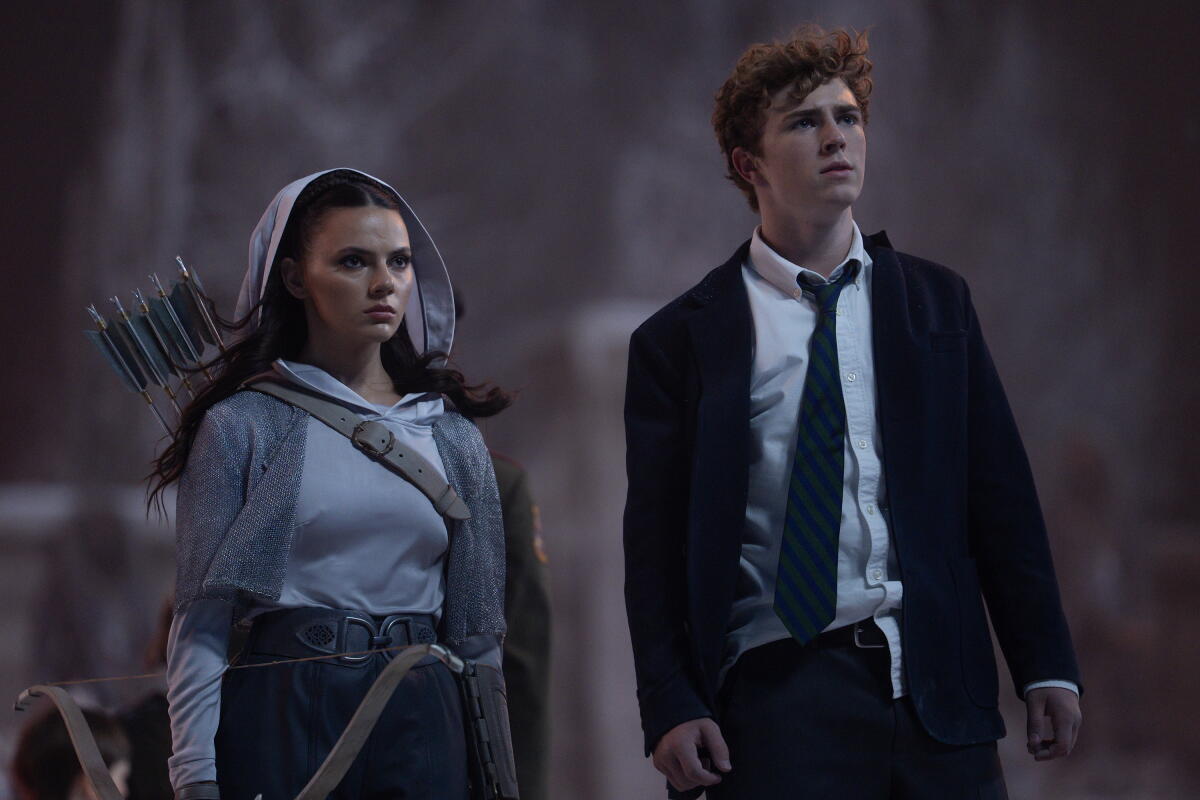
Dafne Keen, left, and Walker Scobell in a scene from Season 3 of “Percy Jackson and the Olympians.”
(Disney +)
“Percy Jackson and the Olympians” (Disney+)
This translation of Greek mythology into a witty, swashbuckling, vernacular American teenage adventure — Mt. Olympus is on Long Island, Apollo arrives in a low-slung sports car blasting “Eye of the Tiger” — is back for a third season, and I couldn’t be happier. It’s clever and fun, suspenseful and exciting, dramatic and moving; the production design is wonderfully inventive, the special effects seamless. Percy (Walker Scobell), the son of a mortal woman and sea-god Poseidon, which he learns at the traditional late date, gets his name in the title, but the heroics are a group effort, with the girls giving as good as the boys. An emphasis on quests makes each season a road movie, introducing new settings and new gods, demigods and monsters in novel arrangements — we get, for example, a battle with warriors sprung from dragons’ teeth (like in “Jason and the Argonauts”) set in the National Air and Space Museum. (The underlying arc is the Titanomachy, the battle between gods and titans, happening again.) Stick around for the beautiful closing credits, a side-scrolling Art Deco mural that animates the season’s action.— Robert Lloyd

A scene from the movie “The History of Concrete.”
(John Wilson / Sundance Institute)
“This History of Concrete” (VOD)
Granted, a documentary about concrete sounds like the sort of thing you’d watch only if you were having trouble falling asleep. But in the hands of John Wilson, even the world’s most ubiquitous building material turns out to be a lot more entertaining than it has any right to be. For three seasons on his HBO series “How to With John Wilson,” the filmmaker wandered around New York with a camera, dispensing deadpan advice on everyday subjects while following whatever oddball tangents caught his eye. His feature debut is essentially a supersized episode of the show, which should be welcome news to anyone who loved it. Having wrapped up the series, Wilson is casting about for a new project when he hits on the idea of exploring concrete. Before you know it, he’s attending a seminar on how to write a Hallmark movie, hanging out with a professional sidewalk-gum remover, investigating a 3,100-mile footrace around a single Queens block and rubbing elbows with the movers and shakers of the concrete industry. But amid all the weird detours, Wilson finds something surprisingly poignant in the tension between our desire to make things that last and the inevitability of change. As always, his deadpan narration and eye for visual absurdity make even the most mundane details of everyday life seem worth a closer look. It’s a rare filmmaker who can make you laugh out loud at a crack in the sidewalk one minute and contemplate the fleeting nature of existence the next. — Josh Rottenberg
Guest spot
A weekly chat with actors, writers, directors and more about what they’re working on — and what they’re watching

Zoe Kosovic, left, as Clementine, Henrik Bosovich as Wyatt, Leighton Meester as Hannah and Jared Padalecki as Jack in “Guarding Stars.”
(Chris Large / Netflix)
What does it take to be a leading man in a holiday movie? Jared Padalecki just found out. In Netflix’s “Guarding Stars,” now streaming, he plays a mega-action star Jack Stapleton, who has a busy schedule and a passionate fan base — a little too passionate, in fact. When threats from a stalker threaten his holiday plans to fly home to his family’s ranch in Montana to visit his ailing mom (Andie MacDowell), his studio refuses to let him make the trip without protection. He hires a bodyguard, Hannah Brooks (Leighton Meester), but not wanting to worry his mother, he requests that she pose as his girlfriend in front of his family to not raise any concern. A fake dating trope, two attractive people and a snowy backdrop? What could possibly happen next?
Padalecki knows something about being a leading man and making people swoon. He played Rory Gilmore’s first boyfriend, Dean, on “Gilmore Girls” and reluctant monster hunter Sam Winchester on “Supernatural.” More recently, he’s made the rounds on “The Boys” and “The Rookie.” Over a video call, Padalecki shared what it was like stepping into the role of holiday hunk and his favorite comfort watches this time of year. — Y.V.
Let’s start off by giving credit to your wife, actor Genevieve Padalecki. She recruited you for this project. Tell me about that.
It became a “book of the month” for her [online book club] four years ago. Then she met Katherine before I did, and basically was like, “Hey, your book is awesome, and it already reads like a movie.” Katherine was like, “I agree,” and Gen then said something to the effect of, “Well, can my husband and I try and make it into a movie? I think he’d be a great Jack Stapleton.” To which Katherine was like, “Yeah, I think that might work.” I read the book shortly thereafter and [thought] this would be a really fun character to play, and a fun story, and something fun to watch that could become not just a holiday movie, but something fun to watch with friends any time of the year, and family.
Holiday movies used to get a bad rap or carry a stigma, but that seems to have faded as the genre’s massive popularity has proved that there’s an audience. As an actor, did you need any convincing to step into this world? And what did you enjoy about dabbling in the genre?
I did not need any convincing. My favorite holiday rom-com is “Love Actually” — it’s something that I watch because I love what all the characters are going through. And once they have a good idea of their character, then the situations they find themselves in are sometimes melancholic, sometimes heartwarming, sometimes action-y, sometimes funny. But when the movie ends, you feel like you had a really great couple of hours, and you were able to escape whatever nonsense the world brings our way for that time. So for me, trying to figure out Jack Stapleton’s motivation and what he did that put him in the shoes he’s in today, career-wise — trying to get to the bottom of that — and to see that progression in the movie of him falling from “Hey, I got my suit on and I’m action-y” to seeing him around his family and wanting to reconnect with those that he loves that have been his world for his whole life [was appealing].
The film is obviously a fictionalized version of an actor with an intense fandom trying to get home for the holidays amid a busy work schedule, and trying to be present in the moments with his family. I imagine you’ve lived a version of that experience. How has your perspective on the importance of being home shifted as you’ve started a family?
It’s shifted quite a bit. Some of my friends and I have used this analogy: To try and make it in Hollywood — make it in any industry, really — you have to put some rocket thrusters on. You have to wake up earlier than you want to wake up. You have to skip birthdays and graduations. And you have to stay up late, not because you’re out drinking with friends at a bar, but because you’re preparing for the next day. You launch a rocket, the rocket thrusters get it out of the atmosphere, but the first thing it then does is it jettisons everything that got you there.
I’d gotten 15 years on “Supernatural.” We were filming in Vancouver. Met my wife. Got engaged. Got married. Had kids. Moved to Austin and was still going [from] Austin to Vancouver. That was the adult life that I knew. During “Walker,” we shot in Austin, so I was able to at least see my kids either in the morning or at night, and be there for the weekends. I wasn’t traveling 400 hours a year, but I still realized that sometimes even if my body was there at the dinner table, my head wasn’t. A big blessing, when “Walker” didn’t go for a fifth season, I was free in April of 2024 with nothing pressing. It forced me to be a husband and a father and a brother and a son and a friend and a neighbor. I think a lot of us think, “I’m going to do this, and I’m going to work as hard as possible so that one day I can live life,” never realizing that you’re currently living life. It was fun to show that transition for Jack Stapleton over the course of the movie.

Jared Padalecki, left, as Jack and Leighton Meester as Hannah in “Guarding Stars.”
(Netflix)
Audiences have very specific expectations for the leading men of a holiday movie. How was it leaning into that and embracing the holiday magic? Harder than you thought? Easier?
More difficult. It’s out of my wheelhouse. I mean, I’ve done so much work over 26 years, but I haven’t done this. And you see the pictures of all the handsome, charming, clean-shaven, square-jawed holiday male protagonists, and you’re like, “Do I need to buy like a jaw exerciser and work out a little bit harder?”
I think you’re doing OK.
Oh, thank you. But ultimately, the more I focused on who Jack was as opposed to what he looked like, the more I hope that audience would start to realize that what’s important is who somebody is, not what they look like or what they do for a living or how much money they make or how many people think they’re famous or whatever it is. And so that was really, again, cathartic. It was like I got paid for personal therapy, so that was nice.
I had no idea that you’d dabbled in this genre before, but in a slightly different way with the biographical drama about [painter] Thomas Kinkade, “Christmas Cottage.” It had Marcia Gay Harden, Peter O’Toole. What do you remember about that experience?
It was 25 years ago, and it was between, I think, Seasons 1 and 2 of “Supernatural” — or around there. I remember being in awe of the whole situation. The whole cast was phenomenal, but Peter O’Toole — I grew up watching, studying “Lawrence of Arabia” and “My Favorite Year” and “How to Steal a Million,” among others. There was a scene in “Christmas Cottage,” where my character [Kinkade] goes to Peter O’Toole’s character, who’s his mentor, and breaks down. I’d kind of gotten myself to a place where they called cut, and I was still crying. And Peter O’Toole asked the director if we could all take a 10-minute break, and director’s like, “Sure, everybody take 10.” And Peter O’Toole asked me, he’s like, “Jared, will you stay back?” I was like, ‘Of course.” Here I am talking to Lawrence of Arabia. And he said, “That was a wonderful scene, magnificent work. But those are Tom’s tears. Save them for Tom.” And it put things into perspective, the play of it all. Don’t get so worked up that something is the most important thing that you’ve ever done. That even when they call cut, you’re still there. You can let it go. And you can get back. That was one of many gems that he sent my way.
We’re nearing the holidays. What are the go–to comfort watches you typically seek out this time of year?
“Home Alone” [Disney+] for sure. “Christmas Vacation” [HBO Max, Disney+, Hulu] We do “The Polar Express” [HBO Max, Disney+, Hulu] with the kids. “Elf” [Prime Video] is always great. And I’m an unabashed sucker for “Love Actually” [Peacock, Netflix].
Is there any world where we might see you and Jensen Ackles, your “Supernatural” co-star, team up for a holiday movie?
Hell yes. Now you got me thinking about books I’ve read and scripts I’ve read. I’d love to. I can’t speak for his schedule. He’s the busiest man in Hollywood. I would absolutely.
ICYMI
Must-read stories you might have missed