Plans To Fly Talon Blue CCA Drone From British Carrier Confirmed By Northrop Grumman
The Royal Navy is aiming to see Northrop Grumman’s Talon Blue collaborative combat aircraft (CCA) drone fly from a British aircraft carrier next year. The planned demonstration is another notable step toward a carrier-based CCA capability in the United Kingdom. The plans also signal significant new opportunities on the horizon for Talon Blue, the first flight of which was only announced last month.
“We look forward to working with the Royal Navy over the next 12 months on this future demonstration,” Northrop Grumman told TWZ in a statement today. “Thursday’s signing is an important step in demonstrating relevant British naval capabilities, building on Northrop Grumman’s decades of leadership in autonomy and commitment to mission-relevant platforms and systems.”
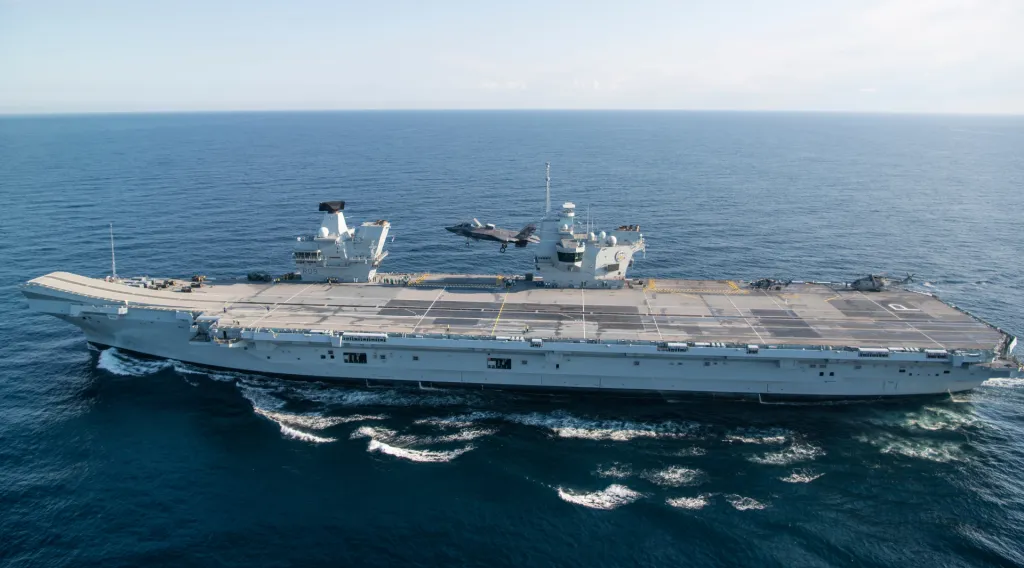
First Sea Lord General Sir Gwyn Jenkins had first announced plans to launch Talon Blue, which the U.S. military has also designated the YFQ-48A, from a carrier during an address yesterday at the International Sea Power Conference in Norway. Jenkins, the first Royal Marine to ever hold the post of First Sea Lord, the United Kingdom’s top naval officer, made his remarks aboard the HMS Prince of Wales. That ship is the second of two Queen Elizabeth class carriers in Royal Navy service today.

“In two days’ time, on this carrier, I will sign a statement of intent with our friends at Northrop Grumman to prepare their Talon demonstrator for trials with the Royal Navy under Project Vanquish,” Jenkins declared to those in attendance. “Through that agreement, we will work towards a demonstration in U.K. waters in 2027, including a launch from the carrier.”
The planned tests involving Talon “will give us the evidence we need to understand how uncrewed combat aircraft can operate safely and effectively alongside the existing air wing. Then we learn, adapt and keep moving forward,” he continued. “That is how we deliver capability at the pace necessary. Not by waiting years for a perfect solution, but by working with industry to get the latest technology into the hands of our people as quickly as possible. Of course, moving at pace carries some risk.”

Jenkins first announced Project Vanquish in September 2025. As outlined then, the project’s goal was to demonstrate the ability to launch and recover what authorities in the U.K. refer to as a Tier 2 Autonomous Collaborative Platform (ACP) from a carrier without the need for a catapult or arresting gear. The Royal Navy’s Queen Elizabeth class carriers are so-called short-takeoff and vertical landing (STOVL) types that lack catapults and arresting gear, but there has been talk in the past about adding those features in some form down the line.
In the British government’s parlance, Tier 2 ACPs are defined primarily by being ‘attritable.’ This, in turn, is generally taken to mean designs that are low-cost enough to be employed in higher-risk environments from which they may not return, but that are also capable enough to conduct relevant missions.
Since Talon Blue was first officially disclosed in December 2025, at a media event that TWZ attended, Northrop Grumman has talked about the design as being lower-cost. However, the company does not appear to have used attritable or similar terms to describe the drone. Hard cost data of any kind has yet to be disclosed. Talon Blue does appear to be in line, broadly speaking, with the complexity of the two CCAs now in production for the U.S. Air Force. Those drones, General Atomics FQ-42A Vengeance and Anduril’s FQ-44A Fury, are understood to have unit costs in the low tens of millions.
“Our customers made it clear they need autonomous systems that can be fielded faster and more affordably without sacrificing mission effectiveness,” Craig Woolston, Vice President and General Manager for Research and Advanced Design at Northrop Grumman, said in a statement accompanying the announcement of Talon Blue’s maiden flight last month. “We listened. Talon Blue’s first flight is one step toward a new generation of autonomous capabilities. Every flight and lesson strengthens our broader autonomy work and sharpens what comes next.”
What it might take to configure Talon Blue for carrier-based operations remains to be seen, even without the need for the drone to be capable of catapult launches and arrested recoveries. An entirely new variant could well be required, if it is not already in the works.
It should be noted that the Royal Navy has already demonstrated the ability to launch and recover several different types of propeller-driven drones from the decks of its Queen Elizabeth class carriers since 2023. This includes the Mojave from General Atomics in the United States. Just earlier this month, the service announced that the Tekever AR5 had joined this list. The British Army is already in the process of acquiring AR5s for land-based use to replace its long-troubled Watchkeeper drones. None of these drones are as advanced as the jet-powered Talon Blue.

Mojave Aircraft Carrier Takeoff and Landing

The Royal Navy has also launched other smaller drones, including long-range one-way-attack types, from its Queen Elizabeth class carriers via trailer-mounted catapults in the past.

All of this has been in service of a broader Royal Navy push to incorporate more uncrewed platforms with higher degrees of autonomy into its operations in the air and at sea. The service has dubbed this broader vision as its Hybrid Navy concept.
“I do not believe the Royal Navy can build the Hybrid Navy at the speed we need it by doing things the way we have always done,” First Sea Lord Jenkins said yesterday, speaking about these plans more broadly. “During my career, I have seen too many examples of what happens when institutions become too set in their ways. So I need industry alongside us from the start.”
The decision to involve Northrop Grumman Talon Blue also represents a significant development for that drone. The company has said the genesis behind this uncrewed aircraft was lessons learned from its failed bid in the first phase, or Increment 1, of the U.S. Air Force’s CCA program. Especially since it received its U.S. military designation, Talon Blue has looked well positioned for the Air Force’s follow-on Increment 2 CCA competition.

Northrop Grumman is also one of the companies under contract now to develop a conceptual carrier-based CCA design for the U.S. Navy. The company has yet to share details about what that proposed drone might look like, but a demonstration of Talon Blue operating from a British carrier could provide hints.
The market space for land- and carrier-based CCAs has also expanded globally. Talon Blue is just one of several notable new designs to break cover in this arena in recent years, including in the United Kingdom. This development trend also extends to potential adversaries, and China in particular.
The CCA market could be differently important for Northrop Grumman going forward given the company’s recent loss to Boeing in the U.S. Navy’s F/A-XX next-generation carrier-based fighter competition. Back in 2023, Northrop Grumman had also dropped out of the running for the U.S. Air Force competition that led to the F-47, which is also being built by Boeing. Northrop Grumman is the prime contractor for a number of other very high-profile U.S. military programs, including the B-21 Raider bomber and the LGM-35A Sentinel intercontinental ballistic missile (ICBM).
Plans to launch Talon Blue from a British carrier are still very much in their infancy, but the demonstration now on the horizon for next year looks set to be an important development for all parties involved.
Contact the author: joe@twz.com