WASHINGTON — Cuba’s top diplomat in Washington says Havana is prepared to enter diplomatic talks with the United States, reiterating the country’s willingness to engage even as tensions escalate with President Trump asserting that the island nation’s government could soon collapse.
“We are ready to engage with the U.S. on the issues that are important for the bilateral relation, and to talk about those in which we have differences,” Ambassador Lianys Torres Rivera, who leads Cuba’s mission in Washington, told The Times on Wednesday.
Any dialogue would need to respect Cuba’s sovereignty and its “right to self-determination,” the ambassador said.
“We are sure that it is possible to find a solution,” she said.
Her comments in a wide-ranging interview come at a particularly volatile moment for Cuba, which is under mounting economic pressure after the Trump administration imposed an oil blockade that has choked off the island’s energy supplies.
The measures have deepened a humanitarian crisis and prompted Cuban President Miguel Díaz-Canel to call for an “urgent” overhaul to the country’s economic model.
The situation in Cuba worsened after U.S. forces removed Venezuelan President Nicolás Maduro in January, allowing Washington to later cut off oil shipments from Venezuela to its longtime ally. The Trump administration later pressured other suppliers, including Mexico, to reduce deliveries.
“We are doing our best, and we are being very creative, but it has a serious impact,” Torres Rivera said of the blockade. “It is a collective punishment against the Cuban people.”
The White House this week framed Cuba’s worsening economic and humanitarian conditions as a potential opening to pressure Havana into negotiations.
“The country is obviously in a very weak place, economically speaking, the people are crying out for help, and the president believes and knows the Cuban regime wants a deal,” White House Press Secretary Karoline Leavitt said during a news briefing Tuesday.
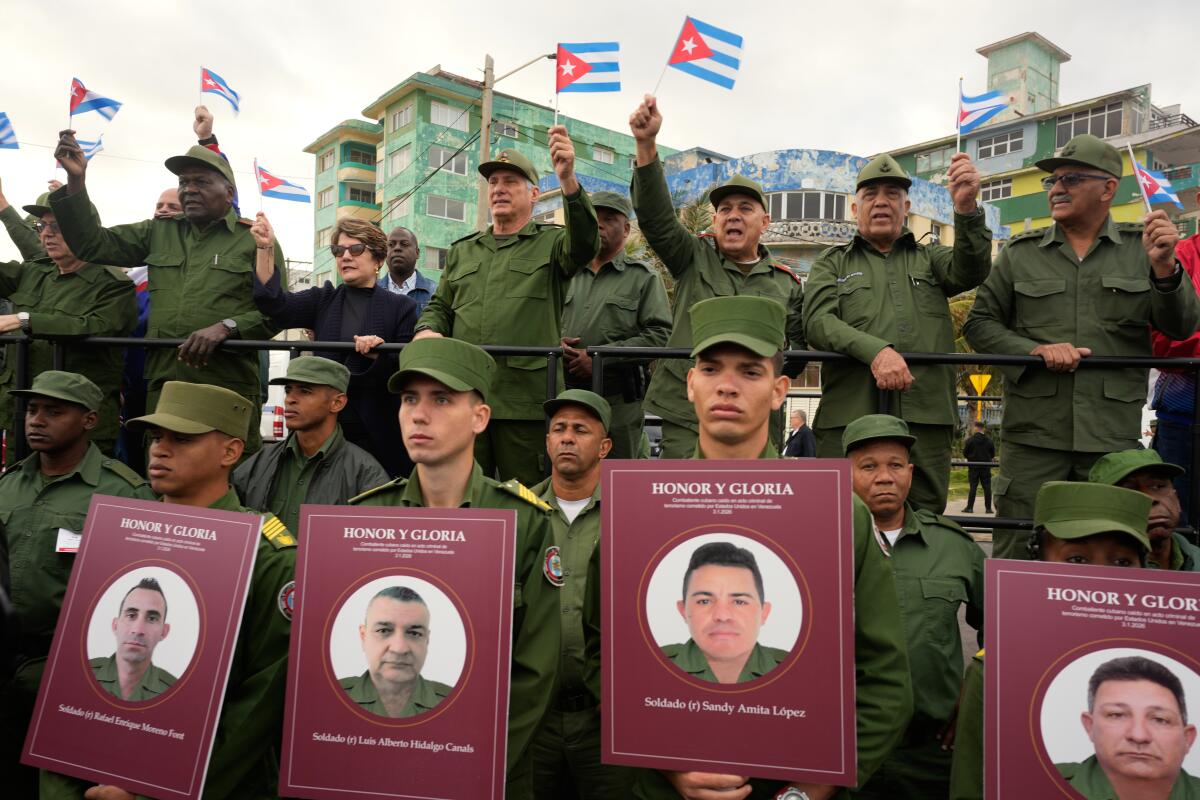
Rep. Mario Diaz-Balart (R-Florida) told the Miami Herald on Wednesday that the Trump administration had been having secret, high-level conversations with several people in former President Raul Castro’s inner circle, a similar approach that was taken in Venezuela before Maduro’s capture. (The operation to seize Maduro killed 32 Cuban officers stationed in the country.)
Cuban President Miguel Díaz -Canel, fourth from right, holds up a Cuban flag during a rally in Havana on Jan. 16, 2026, to protest the killing of Cuban officers during the U.S. operation that captured Venezuelan President Nicolás Maduro.
(Ramon Espinosa / Associated Press)
Another report by the USA Today this week said the Trump administration was close to announcing an economic deal with Cuba that would ease travel restrictions, among other things. A representative with the Cuban government declined to comment on the report.
The White House has not specified what a deal may look like. But Trump has said the United States is interested in a “friendly takeover” and has suggested that the move would allow Cubans to visit the island, a place that many Cuban exiles have worried about returning to while the current regime is in place.
“It is just a question of time before a lot of unbelievable people are going back to Cuba,” Trump said at an event last week.
Several news outlets have reported that the Justice Department is examining possible federal charges against officials within Cuba’s government, a move that could prompt a change in the island’s government.
Torres Rivera said she is aware of the reports but said the “judicial accusations” are an “instrument of political coercion without any legitimacy.”
“It is not something we are losing sleep over,” she said.
As for the potential negotiations, Torres Rivera did not provide specifics but talked about restoring diplomatic ties somewhat to how they existed during the Obama administration.
“We are neighbors,” she said. “We have common challenges, common threats, and we can speak about all that, and we can speak on the basis of respect for each other’s sovereignty and each other’s right of self-determination. We are ready for that.”
President Trump has approached diplomacy with Cuba with a harsher tone.
“As we achieve a historic transformation in Venezuela, we’re also looking forward to the great change that will soon be coming to Cuba,” Trump said Saturday, one week after U.S. and Israeli forces attacked Iran and killed Supreme Leader Ayatollah Ali Khamenei.
He added: “Cuba’s at the end of the line. They’re very much at the end of the line. They have no money. They have no oil. They have a bad philosophy. They have a bad regime that has been bad for a very long time.”
Trump said that he has put Secretary of State Marco Rubio in charge of leading the talks with Cuba and that he believes a “deal would be made very easily with Cuba.”
Torres Rivera did not offer an opinion on Rubio being tapped to lead the negotiations. Rubio is the son of Cuban immigrants who came to Florida three years before Castro’s brother, revolutionary Fidel Castro, rose to power in 1959. She reiterated that Cuba is “ready to engage” in talks regardless of who is leading them.
“We are not talking about persons, we are talking about the government and we are ready to engage with the U.S. to talk about the very important issues that we have in bilateral relations,” she said.
Audu Danbaba is in his fifties but trudges like someone in his eighties. He walks carefully, sometimes raising his hands as if they were scales calibrating his body’s equilibrium.
As he emerged from his house on Feb. 25, he moved with visible effort – his feet swollen – counting each step as if needles were being pressed into the soles of his feet. With a laboured exhale, he eased himself down onto a mat that faced his home. The house, made of mud bricks, is located in Nassarawa village, Gwarzo Local Government Area (LGA), in Kano State, northwestern Nigeria.
Audu cannot remember the exact date when the armed kidnappers pulled him from his house, but he does know that it happened roughly two months ago, maybe a little longer. “I spent about 40 days with them, and now I’m in my fourth week since I was released,” he told HumAngle.
Audu’s ordeal is a window into a calculated and expanding kidnapping economy that has quietly taken root in the Gwarzo LGA. Kidnapping in Kano is fuelled by informant networks, strengthened by a porous border with Katsina State, and maintained by a ransom cycle that is systematically draining the little resources left in the poorest communities of the northwestern region.
Late at night, he was lying down when he heard screaming. The attackers had already entered his home and were beating both of his wives and children. He rushed outside and asked what was happening. They told him directly that they had come for him. To protect his family, he surrendered.
Nasarawa village in Gwarzo LGA. Photo: Aliyu Dahiru/HumAngle.
“Here is where they tied my hands and started beating me with the butt of a gun on my legs,” Audu recalled, gesturing toward the spots he said still ache. “Then they pushed me forward, beating me and shoving me until we had walked a long distance through farmland and crossed a road.”
Audu could not recall how long they had trekked with him because he was barely conscious as they dragged him. His sense of measurement also appears faulty, as he confuses miles and kilometres several times while narrating his story.
And so they kept pushing him.
“It was on the road that I noticed security operatives on patrol, as though they had received a tip and were following us. I tried to lift my head, and they struck me with the rifle butt and pinned me down. I couldn’t speak. We stayed like that until the patrol passed, then they pulled me up and kept beating me as we walked,” he added.
What Audu described, the systematic beating of victims after abduction, has emerged as one of the most disturbing features of the kidnapping crisis in northern Nigeria. After reaching the forest, he said he was tied alongside another man who had also been abducted. The torture continued with such ferocity that the other man died a week after he was abducted.
“After his death, his corpse lay there with me for two days before they took him away,” he said.
Different clips showing how abducted victims are tortured by their abductors have recently been circulated online. One footage featured a member of the National Youth Service Corps (NYSC) being tortured repeatedly by his abductors while pleading for help. In another widely shared video, three women were shown being struck as the abductors pressured them to urge their families to pay a ransom.
Another harrowing case is the testimony of a man published by a local media outlet in Zamfara, Maibiredi TV. The man narrated that his abductors burned one of his hands using molten rubber during ransom negotiations to force his family to speed up payment. Only two of his fingers remain.
What is happening in Gwarzo?
At least five Local Government Areas (LGAs) in Kano share borders with neighbouring Katsina State, namely Rogo, Tsanyawa, Shanono, Gwarzo, and Ghari (formerly Kunchi). While Tsanyawa and Shanono have suffered the most attacks, Gwarzo is particularly vulnerable. The town’s western and northern borders are adjacent to Katsina’s Malumfashi and Musawa LGAs, which have been heavily impacted by terrorist activities for a long time.
The dense and ungoverned forests in these regions provide terrorists with continuous cover for their operations. From there, locals say, they flow into Gwarzo.
Gwarzo is particularly vulnerable. Map illustration: Mansir Muhammad/HumAngle.
Locals say that the first recorded case of kidnapping occurred on Dec. 14, 2025, when terrorists on motorcycles attacked the Kururawa community in the Lakwaya district of Gwarzo. They invaded the home of an elderly man known locally as Yakubu Na Tsohuwa and abducted him. His eldest son, Badamasi, was injured while attempting to stop the assailants from taking his father. Within the same week, a second kidnapping incident was reported.
Gwarzo’s security crisis did not start in December 2025. In January 2024, police operatives arrested Isah Lawal, a 33-year-old man from Giwa LGA in Kaduna, during a clearance operation in Karaye LGA along the Kaduna-Kano border. He confessed to fleeing a terrorist camp in Birnin Gwari due to internal gang violence and expressed his intention to establish a new camp in the Gwarzo-Karaye forest. This arrest, which was largely unreported at the time, served as a warning that the authorities did not adequately heed.
The Gwarzo-Karaye forest corridor, straddling Kano’s border LGAs and stretching toward Katsina’s ungoverned zones, had already been identified by displaced armed factions as a viable new territory.
The December 2025 attacks followed a pattern that exposed how openly these groups now operate. Around 20 armed men were spotted in Danjanku village in Malumfashi LGA, heading toward the Kano axis, according to sources. The attack on Zurum Mahauta in the Gidan Malam Sallau community came at midnight on the same day.
To address the growing threat, the Kano State Government deployed forest guards to monitor the woodland areas around Gwarzo. These guards serve a dual purpose: overseeing the reforestation efforts critical to the state’s climate change response, and functioning as an early-warning layer for security threats emerging from the forest.
Get our in-depth, creative coverage of conflict and development delivered to you every weekend.
Subscribe now to our newsletter!
Dahir Hashim, the Commissioner for Environment and Climate Change, told HumAngle that the guards were recruited to tackle both challenges simultaneously: “Managing the forests because of their critical role in halting desertification, and providing rapid alerts whenever security threats are detected.”
HumAngle spoke to Abdullahi Hamza, who leads the team managing one of the forests in Mainika, Gwarzo. He is cautiously optimistic about the project, saying: “This initiative by the government has delivered results; at least for now, we have gone many days without a security incident inside Gwarzo, though there may be areas we are not yet aware of.”
Abdullahi Hamza says the activities of forest guards have reduced the fear of insecurity in Mainika. Photo: Aliyu Dahiru/HumAngle.
There are two forests in Gwarzo. One is known as Dajin Katata, where the forest guard Musa Muhammad previously worked.
“There were constant criminal incidents in that forest; the fear eventually led the previous government to fell the trees to deny criminals cover,” he told HumAngle.
Musa was later reassigned closer to home in Mainika. He does not hide his discomfort with that decision. The felling of Dajin Katata, he said, was ecologically damaging — those trees were a bulwark against the advance of the desert. But he has made his peace with the logic behind it.
“Security comes first,” he said. “You must be alive to breathe the shade of a tree.”
Kidnapping the poor for ransom
Why was Audu a target for abduction in the first place? By every visible measure, even within his own village, Audu is not a wealthy man. His mud-brick house sits among the more neglected on the street, unrepaired and unremarkable.
He told HumAngle himself that shortly before his abduction, he had tried to sell his farmland out of financial desperation, but the offer he received felt so insulting that he walked away from the deal.
“The land was worth between three and a half and four million naira, but they offered me two and a half million naira. I felt disrespected, so I refused,” he said.
Then came a coincidence that, in hindsight, feels like anything but.
Around the same period, the Kano State government began disbursing outstanding allowances owed to former ward councillors across the state. Audu’s son, Anas, had served as a councillor between 2020 and 2023, which placed him among the beneficiaries. The payment, amounting to roughly ₦6 million, was not made quietly; the state government publicised it widely. Photographs were taken at the government house. Screenshots of bank alerts began circulating on social media, shared by recipients whose names and faces were now attached to a specific, traceable sum.
The publicity became something else entirely.
“Many people had their eyes on that money,” said Mallam Saidu, Audu’s neighbour. “There is a strong suspicion that it was this payment that drew the kidnappers to Danbaba’s house that night.”
Audu suspects the same. He says his captors told him, as they held him, that someone had directed them to him. They did not tell him who.
“They showed me about five people from a distance,” he said. “I could barely lift my head to look, and when I did, I didn’t recognise any of them.”
Later, during ransom negotiations, Audu says he kept hearing one side of a phone conversation — someone telling the kidnappers that they should push his family harder to bring more, insisting they had the money and should produce it.
Across northern Nigeria, kidnapping has evolved from opportunistic crime into a sophisticated industry, and at its operational core lies a network of human intelligence that security agencies have struggled, and often failed, to penetrate or counter.
Transborder lands between Katsina and Kano. Illustration: Mansir Muhammed/HumAngle
Kano has witnessed a surge in kidnapping and criminal operations aided by local informants and snitches within the state’s localities. This development seems to have inflated security threats in local communities. Musbahu Shanono, for instance, is originally from Faruruwa in Kano but works in Lagos, in Nigeria’s South West.
When HumAngle spoke with Musbahu in 2025, he described the creeping anxiety that now accompanies what should be an ordinary homecoming – the fear of informants making him a stranger in his own community.
“Now I only come at night,” he said. “No one should know I’m around. Not even my friends. Not until I’m sure it’s safe.”
According to security authorities across northern Nigeria, kidnappers conduct detailed advance planning before armed teams execute raids at vulnerable hours, overwhelming lightly protected targets and transporting captives deep into remote forest hideouts.
In 2021, the Zamfara State government announced the arrest of more than 2,000 suspected informants. The following year, the state went further to enact legislation prescribing life imprisonment for anyone found to have aided kidnapping operations or other criminal activity in the state.
Yet the problem has not abated. Security authorities across Nigeria acknowledge that informant networks remain one of the most intractable elements of the crisis, embedded in communities, operating in plain sight, and extraordinarily difficult to root out.
Even Nigeria’s Minister of Defence, then-Chief of Defence Staff, Christopher Musa, admitted publicly in 2024 that informants were being used not only to identify and track targets, but to actively misdirect security forces pursuing terrorists.
“They make the troops go elsewhere, and when they get there, they meet nothing,” Musa said.
The price of coming home
Now Audu is back. But his return has cost his family everything.
“They only released me after we paid ₦8 million and three motorcycles,” he recalled.
The family sold whatever they could find. The farm that he had refused to part with for two and a half million naira, the offer he had walked away from as an insult to his dignity, went for only ₦1.8 million in the end due to desperation.
Danbaba’s legs are recovering a month after he returned home. Photo: Aliyu Dahiru/HumAngle.
“Then we went around asking for help – some people gave us gifts, others gave us loans,” said Anas, his eldest son. Today, after his father’s release, the family is saddled with a debt of approximately ₦4.5 million and has no clear idea where to begin repaying it.
Audu carries the weight in his body as much as in his finances. “Even after I returned, everyone who saw me broke into tears at the state I was in,” he said. “Doctors have examined me and given me medication, but the pain in my body has not stopped.”
His deeper anguish is the problem he cannot solve: how does a man who had nothing rebuild from less than nothing? “We sought help from every direction and found very little,” Anas added. “We are still appealing to the government, even if it is just to help settle the debt, because everything we had was consumed by this ordeal.”
For the remaining residents of Nassarawa and the villages clustered along Gwarzo’s edges, the haunting question is not about debt. It is about prevention and how to protect themselves from the fate that swallowed Audu before the kidnappers come again.
ANNA and Mandi Vakili admit they’re desperate to reveal their boyfriends’ identities after years of using nicknames to keep them secret.
The Sisters in the City podcast hosts’ other halves have been shielded from the public eye, with Anna referring to her man as ‘Cowslick’ while Mandi’s fella is known as ‘Gingerbeard’.
Sign up for the Showbiz newsletter
Thank you!
Anna and Mandi Vakili might soon reveal their boyfriends’ identitiesCredit: Adored ByAnna has nicknamed her man ‘cowslick’Credit: Instagram
Neither had any say in the moniker they were given, and the girls admit they hate them.
But it might just be a matter of time before the pseudonyms are discarded.
Speaking exclusively to The Sun, Anna, 35, says: “I’m just so ready to put his face out there now.
“I just feel like this whole hiding his face has become such a long and annoying… like my poor editor has to keep blurring his face out in the YouTube vlogs and I want to take cute pictures with him and put it on my Instagram and I can’t do that, so I’m like maybe I’m past the stage of hiding his face.
Mandi, 34, adds: “I feel like the nickname though is kind of a comedic side of it and it’s stuck now. I love my boyfriend having a nickname. It just makes all of the serious stuff a little less serious when I’m calling him Gingerbeard.”
Chiming back in, Anna says: “But the only problem I have is that my boyfriend hates his nickname Cowslick, he’s really like recently he’s trying to like protest against his nickname.”
Her sister playfully jokes: “He has no choice though, he’s got no legal rights.”
It was four years ago that the girls came up with the names as they launched their podcast, which has grown massively and now has 108,000 subscribers on YouTube.
Initially, it was the boyfriends who were desperate to avoid any mention on the pod, and that was before listening figures began to soar.
They settled on the names to highlight parts of their appearance that differed from one another.
There have been ups and downs in Anna’s on/off relationship during that time, which she admits has had “toxic” moments, though things are currently going smoothly.
Last week, she bravely shared her most personal story to date, revealing she suffered a miscarriage just days after discovering she was pregnant. It was met by widespread support and praise from listeners who were moved by the story, as was Mandi beside her sibling in the studio.
Meanwhile, Mandi’s relationship has been stable throughout, with the odd bicker coming on holiday or off the back of pranks and other media appearances.
Reflecting on the early days of the podcast and deciding how much personal information to share, Anna says: “At the beginning there was arguments,” says Anna.
Mandi continues: “When it was like we were becoming really popular and everyone was starting to know that we’re talking, their friends and their community, then they were causing a scene about ‘we don’t want to be talked about’, and now are they have given up. They accept it now.”
Mandi has nicknamed her man ‘Gingerbeard’Credit: InstagramThe sisters have released their own brow and lip edit with Adored ByCredit: InstagramTheir Sisters in the City podcast has 108,000 YouTube subscribers
She continues: “I’ve been thinking about this reveal, but it needs to be major. You know what, I thought about a really good reveal would be like come to our next tour because we’re going to do a Gingerbeard and Cowslick reveal on stage and sell tickets at the same time.”
While their other halves’ faces might be under wraps for now, Mandi and Anna’s certainly aren’t.
The duo have teamed up with Adored.by to create their own brow and lip edit so fans can replicate their flawless aesthetic.
The new range follows a previous release with beauty influencer Lottie Tomlinson, which the girls were a big fan of.
Anna says: “We liked how they tailor the collection to the influencer so it’s not like we just put our name on the product. It’s inspired by us, our podcast, our personality, our makeup looks, so it’s just literally us in a makeup brand.”
Mandi says: “We knew it was going to be like really unique and it wasn’t going to be the same as other ranges they do because they want influencers to create an edit which reflects them and their brand so that’s what Adored by has done with us right now.
“All of the products, the shade, the names, all of them have been chosen and tailored by us, so it’s really exciting.”
She called the importance of good brows and lips “game-changing” an said it could take a 10 out of 10 looker down to a two if not styled correctly, and vice versa.
The girls were committed to putting out products that they personally use and this is reflected in their combo kits.
Mandi says: “We chose shades that we love, you know there are so many shades and everybody likes a different shade but we chose Anna’s lip kit, my lip kit, is our sort of go-to and we always get asked like what’s your lip combo?
She continues: “They say men always notice a woman’s lips so lips are very important.”
But perfection isn’t the goal for the girls, it’s rather about feeling comfortable in your appearance whatever the situation or style.
Anna says: “I feel because of our podcast we’re quite relaxed attitude, because like what’s perfect? I think like that’s so like old news now, people like to relate to people that are real.”
“We love glamming up, we love doing our makeup but we’re in tracksuits on podcast.”
Mandi says: “When you do a podcast you’re just sort of in like an environment, you’re in a kind of dynamic where we’re sitting on a sofa gossiping together, we’re not like catwalk supermodels.
“People want to see the real us, they don’t want to see perfect looking two girls, they just want to see like two real people, but I feel like there’s a balance between being content with how you look but also wanting to glam up and do your makeup, put your heels on and get going.
“At the moment we’re just adorned by Adored By, you know, so we’re really excited about the launch and showing everyone how we do our lips and brows with these products.”
Anna and Mandi have collaborated with Adored.by on the newest makeup edit now available to shop onwww.adoredby.com
The sisters’ edit is inspired by their big personalitiesCredit: Adored By