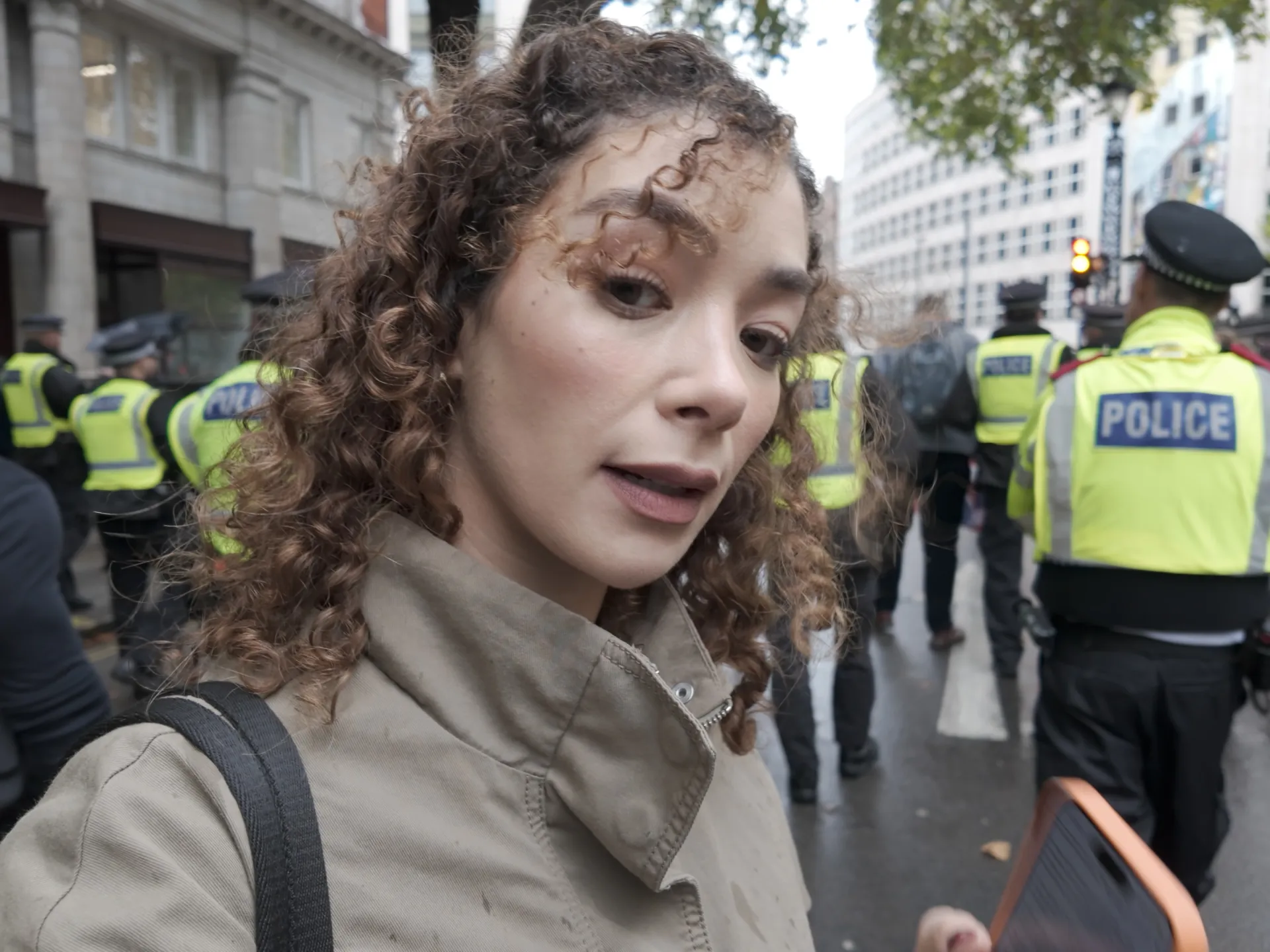
Pro-Palestine university groups march in London on October 7 anniversary | Gaza
Pro-Palestine students took to the streets of London on October 7, despite police calls to postpone the march. Al Jazeera’s @Lina_Serene reports.
Published On 7 Oct 2026
Pro-Palestine students took to the streets of London on October 7, despite police calls to postpone the march. Al Jazeera’s @Lina_Serene reports.
Published On 7 Oct 20267 Oct 2026
Share

The once simple message, “Get out the vote,” now has a corollary: “Protect the vote.”
That message was hammered home Saturday for dozens of voting rights groups, community organizations and unions attending a rally to recruit and train poll watchers for the November election.
Organizers for several groups brought together under the banner of Love Powers L.A. offered scenarios of the threats that could materialize on Nov. 3 — from ICE raids to intimidation by the Proud Boys — and detailed strategies to counter them.
Their goal was to raise a cadre of volunteers for a Neighborhood Vote Protection Program to observe 650 polling places throughout the 11 days of voting and to turn fear and confusion sought by election deniers into a celebration of the right to vote.
“We want to make it a season of excitement,” said Jeremy Payne of the social justice group Catalyst California.
1

2

1. David Gutierrez right, of Inner City Struggle, signs up Jocelyn Elizalde, 22, and Manuel Becerra, 19, from left, to help with outreach, during an event held by Love Powers LA, representing dozens of community groups and labor unions, provide education and training to Angelenos on how to protect their vote and respond to threats of election interference at East Los Angeles College on Saturday, September 26, 2026. (Christina House/Los Angeles Times) 2. Participants including Evelyn Gonzalez, right, attend a workshop for activist dance and street activation during an event by Love Powers LA, representing dozens of community groups and labor unions, providing education and training to Angelenos on how to protect their vote and respond to threats of election interference, at East Los Angeles College on Saturday, September 26, 2026. (Christina House/Los Angeles Times)
The event kicked off with multicultural music by Native American, Korean and West African drum ensembles.
Speakers from groups as diverse as Can’t Stop California, Inner City Struggle and Strategic Concepts in Organizing and Policy Education: SCOPE detailed the threat and their programs to respond to it for 300 prospective volunteers.
“L.A. is a target for retribution and spectacle,” said John Lee, also of Catalyst California. “When they try to steal an election, it is a sign they know they are losing.”

Godfrey Plata of L.A. Forward, left, and Jung Hee Choi of We Are California present skits on how to talk to neighbors about voting during the event Saturday.
(Christina House / Los Angeles Times)
The event, involving numerous nonprofit organizations, stayed away from endorsements or political messages aimed at the coming election. But speakers didn’t hold back on their views of President Trump.
“Trump is a chicken and a loser,” said Jung Hee Choi, of the umbrella group We Are California.
Choi described two personality types, skeptics and frozen, that the group is targeting.
She urged volunteers to hold ballot parties in their homes to move skeptics “from the couch to the poll” and routine voters from the “frozen mode to the fight mode.”
“We need people out at the polls,” she said. “You are the greatest tool to fight back and grow our movement.”
The groups held their event just a day after Trump’s latest move in his attempt to reshape voting in America.
The Supreme Court upheld Trump’s expanded use of government data to search for noncitizens who are registered to vote. The impact of the decision is likely to be limited, other than to highlight Trump’s distrust of elections and his unproven claims that a large number of illegal voters are casting ballots.

Love Powers L.A., representing dozens of community groups and labor unions, provides education and training to Angelenos including Azenith Morales, Marise Roxas, and Liezl Japona, from left, of the Filipino Workers Center, on how to protect their vote and respond to threats of election interference.
(Christina House/Los Angeles Times)
Breakout sessions covered how to plan a ballot party, activist dances and street activations.
Attendee Joe Pugh, who works for the community services organization ATAP, said she planned to host a block party to push the importance of voting in South-Central.
“They’re always talking about ‘my vote doesn’t count,’” she said.
During the poll monitoring session, Emma Olson Sharkey, a partner at the Political Law Group, outlined what poll watchers should look for and what they should do about it.
Their role, she said, is not to engage. They will observe and report any attempt to intimidate voters or poll workers.
The organization provides an online report form to report incidents.
“We hope it is boring,” Payne said. “In most cases, nothing will happen.”

The road to the UEFA Nations League 2026-27 begins on Thursday, with 54 teams in action in the league phase.
Portugal, the record two-time champions, will look to successfully retain the title they won in 2025.
list of 3 itemsend of list
But with reigning World Cup winners Spain, and former champions France and heavyweights England also in the mix, the title defence will be far from easy.
The UEFA Nations League was founded in 2018 to reduce the number of meaningless friendlies and give nations competitive matches against equally-ranked teams.
In this competition, countries from across Europe participate in a league structure, which features promotion and relegation.
A total of 54 teams will participate in the 2026-27 UEFA Nations League.
They are divided into the following leagues and groups, following the draw in Brussels, Belgium in February:
League A
Group A1: France, Italy, Belgium, Turkiye
Group A2: Germany, Netherlands, Serbia, Greece
Group A3: Spain, Croatia, England, Czechia
Group A4: Portugal, Denmark, Norway, Wales
League B
Group B1: Scotland, Switzerland, Slovenia, North Macedonia
Group B2: Hungary, Ukraine, Georgia, Northern Ireland
Group B3: Israel, Austria, Republic of Ireland, Kosovo
Group B4: Poland, Bosnia and Herzegovina, Romania, Sweden
League C
Group C1: Albania, Finland, Belarus, San Marino
Group C2: Montenegro, Armenia, Cyprus, Latvia
Group C3: Kazakhstan, Slovakia, Faroe Islands, Moldova
Group C4: Iceland, Bulgaria, Estonia, Luxembourg
League D
Group D1: Gibraltar, Malta, Andorra
Group D2: Lithuania, Azerbaijan, Liechtenstein
UEFA has earmarked the following dates for the Nations League 2026-27:
League phase
Matchday 1: September 24-26
Matchday 2: September 27-29
Matchday 3: October 1-3
Matchday 4: October 4-6
Matchday 5: November 12-14
Matchday 6: November 15-17
Quarterfinals, League A/B and League B/C promotion/relegation playoffs
March 25-30, 2027
League C/D playoffs
March 23-28, 2028
Final tournament
June 9-13, 2027
The teams compete across four different divisions, facing every other team in their group twice: once at home and once away. The league phase ends in November.
In the top-most league, League A, the top two teams from each group go through to the quarterfinals, which take place in March 2027.
The finals will again be contested between four teams. The host and the dates of the finals have not been confirmed yet.
As for each of the group winners in Leagues B, C and D, they will be promoted to the league above. The teams finishing bottom of their groups in Leagues A, B and C will be relegated one league below.
Here’s the full breakdown of the promotion and relegation scenarios:
League A
League B
League C
League D

According to European football’s governing body, UEFA, the 2026-27 UEFA Nations League is expected to be linked to qualification for UEFA EURO 2028 in the United Kingdom and Ireland.
Based on their UEFA Nations League results, some teams will be given a second chance to enter the playoffs for the final tournament.
Yes. Cristiano Ronaldo will feature in the upcoming Nations League after being called up for their upcoming four fixtures. Last weekend, he was included in new coach Jorge Jesus’s first 25-man squad.
However, in August, the 41-year-old fuelled speculation about his retirement plans after saying the coming year would probably be the last of his playing career.
The Portugal captain has won major trophies at the club level with Manchester United, Real Madrid, Juventus and current club Al-Nassr since making his senior debut for Sporting in 2002.
But he has not quite tasted similar success with his national team.
The five-time Ballon d’Or winner has yet to win a FIFA World Cup, football’s biggest prize, after Portugal were knocked out in the last 16 by eventual champions Spain.
Yes. Ronaldo led Portugal to UEFA Nations League victories in the inaugural edition in 2019 and the latest one in 2025.
In the 2019 edition, Portugal were crowned winners on home soil in Porto, defeating the Netherlands 1-0 in the final.
In the last edition, they were crowned champions for a second time, beating Spain 5-3 on penalties after the match was tied 2-2 in extra time, with Ronaldo among Portugal’s goalscorers in Munich.
The UEFA Nations League 2026-27 is filled with stars across all divisions.
In Group A, world champions Spain have talent all around with Lamine Yamal, Rodri and Ferran Torres among the standout names, while England skipper Harry Kane and Jude Bellingham also add glamour to the division.
Norway’s talismanic forward Erling Haaland and captain Martin Odegaard headline their team, Brian Bobbey has the spotlight on him in the Netherlands squad, and veteran Luka Modric continues his journey with Croatia.
In Group B, fans should watch out for Sweden’s Victor Gyokeres, the top scorer in the 2024-25 Nations League, Georgia’s winger and PSG star Khvicha Kvaratskhelia.
Several players have been sidelined with injuries, including England’s Cole Palmer, Declan Rice and Marcus Rashford.
Pedro Porro has been ruled out of the Spain squad.
Yes. The UEFA Nations League has been held every two years since 2019.
Here is the list of results of the finals:
Former adversaries say they will settle differences as fears grow of expanding war in Ethiopia.

Published On 21 Sep 202621 Sep 2026
Seven Ethiopian armed groups have formed an alliance aimed at overthrowing the government of Prime Minister Abiy Ahmed.
The groups announced the alliance on Sunday, saying that they would work together to set up an inclusive transitional government.
list of 2 itemsend of list
“We have established a joint alliance called the Ethiopian Peoples’ Forces Alliance for Survival, known in short as the Alliance for Survival,” the groups said in a joint statement.
The alliance includes the Amhara Fano National Movement, a coalition of Fano factions that has fought federal forces in the Amhara region since 2023; the Tigray People’s Liberation Front (TPLF), which dominated Ethiopian politics for nearly three decades before Abiy took office; and the Oromo Liberation Army (OLA), which has fought federal forces in Oromia since 2018.
Four smaller groups – the Ogaden National Liberation Front (ONLF), the Afar Revolutionary Democratic Unity Front (Ugugumo), the Benishangul Peoples’ Liberation Movement and the Gumuz Peoples’ Democratic Movement – make up the rest.

The groups’ leaders had been talking to form the alliance for about a year, a source close to Fano told Al Jazeera on Sunday.
The announcement comes weeks after clashes in the northern region of Tigray, one of the most serious breaches yet of a 2022 peace deal, deepened fears of a return to full-scale war.
Fighting has gripped parts of Oromia since 2018 and Amhara since 2023.
Abiy came to power in 2018 promising sweeping reforms. He freed journalists, activists and other political prisoners and revoked bans on many political parties after taking power.
But his opponents and human rights activists accuse his government of reversing those gains in recent years.
In the statement, the alliance accuses the government of imposing “dictatorial rule” that has pushed the country towards break-up.
It also says a transitional government guided by a charter would work to end the wars, protect rights and open a national dialogue.
Jaal Marroo, the OLA’s military leader, told a local broadcaster earlier this month that they had met several times before settling on the final announcement.
Zemene Kassie, the Fano leader, first publicly indicated that deals had been reached in an interview with the Swiss newspaper Le Temps, published on August 16.
The government has not publicly commented on Sunday’s announcement.
Fano fought alongside federal forces against Tigray’s fighters in the Tigray war of 2020 to 2022, which killed hundreds of thousands.
Amhara and Tigray also both claim Western Tigray, which Amhara nationalists have administered since the war ended.
Ethiopian academic Eyob Tilahun told Al Jazeera on Sunday that the competing groups had agreed to have a dialogue and form an alliance “in the best interests of the public”.
“Those allied forces believe that they all face a survival threat from the government,” Eyob said.
The 2022 peace agreement, signed in Pretoria, South Africa, ended the war between the federal government and Tigray’s forces but left disputes over disarmament and the TPLF’s legal status unresolved.
In mid-July, the TPLF declared the 2022 Pretoria peace deal “effectively dead”.
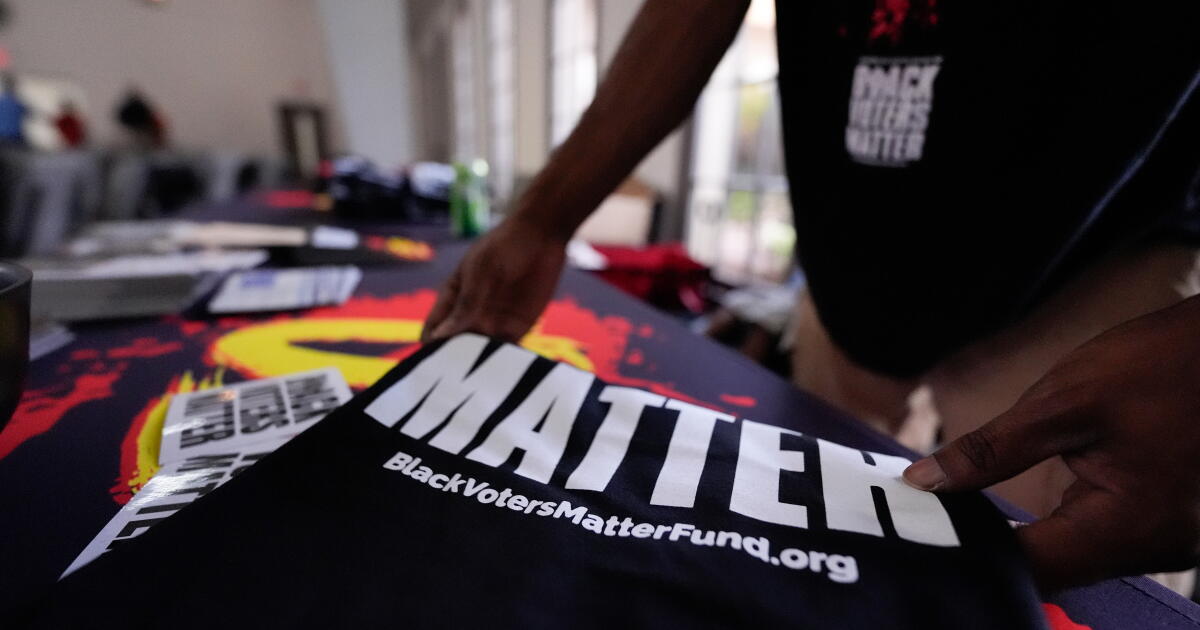
WASHINGTON — Several of the nation’s largest voter engagement and racial justice organizations are facing steep funding shortfalls and staffing cutbacks just as voting is getting underway in an election that will determine control of Congress for the final two years of President Trump’s term.
The shortfalls are setting off alarms among Democratic strategists, who are betting on high turnout and robust voter protection efforts to boost the party’s chances this fall. They are worried that many grassroots groups will not be able to mount effective registration and get-out-the-vote efforts, much less protect against the possibility of election interference from the administration given Trump’s efforts to restrict voting access and assert federal control over the election.
America Votes, a coordinating hub for more than 400 progressive groups, has fallen “well below” the level of funding it had during the 2022 midterms, the group’s executive director, Daria Dawson, said in a statement to the Associated Press. America Votes has acted as a nerve center for the voter mobilization efforts of groups such as the NAACP, Planned Parenthood, the League of Conservation Voters, the AFL-CIO and SEIU labor unions, as well as local groups focused on racial justice, climate and civil liberties.
“There is still time to reach voters and bring them into this election, but we are no longer talking about a future opportunity,” Dawson said. “The window to engage them is open now, and it is narrowing every day.”
Wealthy donors and philanthropic groups have reduced their support of many liberal causes since the 2024 presidential election. That pullback has been especially stark for voting groups geared toward engaging communities of color.
While multiple organizers said some funders had expressed an interest in adopting different strategies, racial justice organizers have felt that as a betrayal.
A retreat in donor support is “handcuffing our ability to persuade our communities to vote in a year where there is no Voting Rights Act,” said Esosa Osa, a veteran Democratic strategist and founder of Onyx Impact, a research group focused on combating misinformation in Black communities.
A Supreme Court ruling this year knocked out one of the last remaining pillars of that landmark 1965 law, essentially gutting it.
“We are watching surrender, not strategy,” Osa said.
A July memo that circulated among major Democratic fundraisers warned that “the organizations that registered and persuaded millions of voters to participate in the 2018 and 2022 midterms are drastically underfunded. They have raised nearly 40% less than they had at this point in those cycles.”
It further warned that funding voter mobilization groups was especially critical “given that the Democratic brand is underperforming on generic ballot tests relative to historical comparisons and the president’s approval ratings.”
The shortfalls have led organizations focused on engaging and mobilizing key voting groups to scale back operations and staffing over the last year. That has included programs aimed at registering and mobilizing lower-propensity voters, voters of color, and rural and younger voters.
The Democratic National Committee, which has faced its own funding challenges, has consolidated voter engagement efforts this year partly in response to the ecosystem’s past shortcomings. The DNC in a statement said it was making “historic investments” in its organizing but did not address the weaknesses among allied groups.
“We are expanding our voter protection infrastructure to defend Americans’ sacred right to vote, hold Trump and Republicans accountable in court, and register and mobilize voters across the country,” said Angelo Fernández Hernández, a DNC spokesperson.
The reasons for the troubled funding landscape are varied and at times unclear, according to nearly two dozen fundraisers and organizers who spoke with the AP. Some donors, still disappointed with the Democratic Party and some of its allies following the 2024 presidential election, have closed their pocketbooks to liberal causes entirely.
While a small group of liberal megadonors has continued to bankroll progressive causes, most focus their support on liberal legal organizations that have taken the Trump administration to court, rather than political or voter engagement groups.
Others, including major philanthropic institutions, have pulled back out of fear of retribution that giving to political or racial justice causes could draw the administration’s ire. Organizers who have engaged with potential donors said the administration’s targeting of political opponents and diversity initiatives seems to have put a chill on fundraising for their causes.
Tameka Ramsey-Brown, founding director of the Michigan Coalition on Black Civic Participation, said multiple donors since the 2024 election had asked whether her group could remove the word “Black” from its name or find financial conduits to mask the source of donations for fear of retribution from the administration.
“Just being Black in this country again has become a bad word, and it has made it that much more difficult just to raise money because funders don’t want the added pressure and stress or attacks on them by funding us,” she said.
Many of the nonprofit groups that traditionally have conducted the registration, voter education and organizing say they are trying to adapt to their new, leaner reality.
Vamos a Votar, an initiative of the largest civil rights and advocacy groups focused on Latino communities, has had to readjust its ambitions this year due to a lack of investment from funders.
“This is shaping up to be a cycle where investments haven’t gone to the Black and brown communities that will ultimately decide this election,” said Juan Proaño, chief executive of the League of United Latin American Citizens, a member of the initiative.
In a September pitch circulated among donors, the coalition said it aimed to invest $27.5 million in voter engagement and persuasion efforts this year, but still required $5.4 million from donors to fund voter turnout efforts across 10 states and 17 House districts. Even that investment reflected reduced ambitions from previous pitches to donors early this year.
“It has been extremely disappointing to see that progressive donors are not meeting the moment,” said Héctor Sánchez Barba, head of Mi Familia Vota, one of the affiliated organizations. “We are not waiting. We are always on the front lines for our democracy and our communities.”
To counter the funding cutbacks, some groups have begun relying more heavily on artificial intelligence to provide voter registration guides, share information in multiple languages and track potential election issues. Some groups have increased their partnerships with ride-sharing companies to provide free rides to polling places instead of bus shuttles.
With fewer in-person organizers, some groups are also focusing on social media and partnering with liberal content creators to boost their messages.
“In my more than 30 years of organizing, it has never been this bad to raise money to support Black causes of any kind,” said Melanie Campbell, president and chief executive of the National Coalition on Black Civic Participation, a nonpartisan civil rights group.
“We’re going to do the work, our state affiliates are doing all that is possible. … But the bottom line is that those who believe that democracy matters should make sure they fund the work.”
Brown writes for the Associated Press.
The rapper also challenged Robert Kraft to match the donation as fallout from his removal from Ed Sheeran’s tour grows.

Published On 16 Sep 202616 Sep 2026
Rapper Macklemore says he will donate the entire $1m he earned from singer Ed Sheeran’s Loop Tour to organisations supporting Palestinians, days after he was dropped from the tour over his support for Palestine.
Macklemore, whose real name is Ben Haggerty, announced the donation on Instagram on Wednesday, saying the money would go to six groups working directly to support Palestinians. He also called on pro-Israel billionaire Robert Kraft, owner of the New England Patriots, to match it after Kraft confirmed on Tuesday that he had barred Macklemore from performing at Gillette Stadium in the US state of Massachusetts.
list of 4 itemsend of list
“Whatever we disagree about, perhaps we can agree on this: Palestinian lives are worth protecting,” Macklemore wrote. “A Palestinian life is no less valuable than any other life on this earth.”
In a statement on Wednesday evening, Kraft said that before Macklemore issued the challenge, Sheeran had called and asked him to commit $2m in humanitarian aid to the region. Kraft said Sheeran now planned to approach other venue owners in an effort to raise more money.
“I believe deeply that all lives are worth protecting,” Kraft said.
Macklemore’s announcement comes as the fallout over his removal from Sheeran’s tour continues to grow. Macklemore said on Monday that he was dropped from the remaining United States dates after using his performances at MetLife Stadium in New Jersey to speak in support of Palestinians.
All of the supporting acts for Sheeran’s upcoming US Loop Tour have now pulled out in solidarity with the rapper. Some of the artists are Irish and pointed to their own country’s history of occupation in explaining their decision to withdraw.
Sheeran has said the decision to remove Macklemore was ultimately made not by him but by the tour promoter.
Kraft later said he had opposed allowing the rapper to perform, citing what he described as Macklemore’s history of “antisemitic rhetoric and imagery”.
Kraft, in a statement to Al Jazeera, said the decision to ban Macklemore from his venue wasn’t about “diminishing the suffering of innocent Palestinians” but argued that “advocacy should not come at the expense of the Jewish community or obscure the responsibility of Hamas”.
In his latest statement on Wednesday, Macklemore said he wanted to pull the conversation away from himself and the controversy surrounding the tour.
“That is what this has always been about. Not me. Not a tour. Not the headlines or the controversy,” he wrote. “It is about Palestinians’ right to freedom, dignity and safety in their own homeland.”
He also acknowledged that donating money carried far less risk than the work being done by people in Gaza and those organising in support of Palestinians.
“Writing a check is one of the least costly forms of solidarity available to me,” he wrote. “I am doing it because I can, and because these organizations are doing the work while much of the world debates it.”
He ended with a call for people to keep paying attention.
“When the news cycle moves on, which it will, don’t move with it. Free Palestine.”
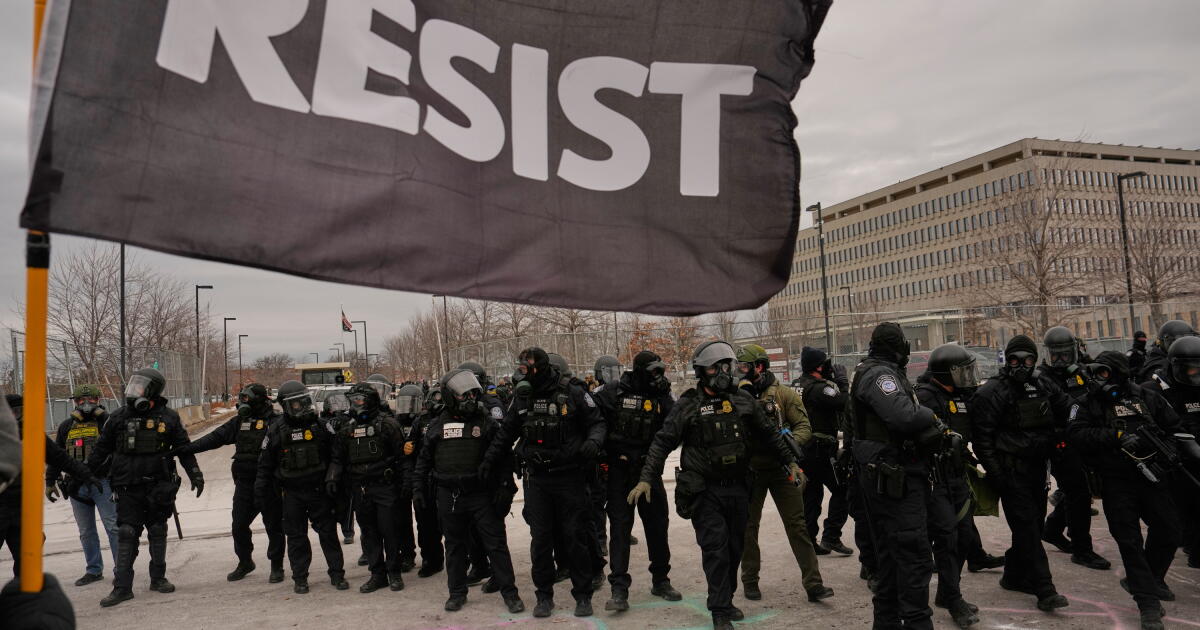
Democratic state parties announced Monday that they are launching an operation for the midterm elections they’re calling the “New Battlefield Project,” intended to recruit 10,000 volunteers to guard polling places in case armed federal officers show up.
Activists are planning mass protests if the Trump administration tries to interfere with voting or ballot counting. And legal scholars are distributing white papers advising judges what they should do if the government tries to seize ballots.
The unprecedented efforts are in response to President Trump’s equally unprecedented moves to interfere in this year’s midterm elections, which include attempts to impose proof-of-citizenship requirements to register to vote and directing the Postal Service to play a central role in deciding which voters should get a mail ballot.
The anxious contingency planning as voting gets underway has become a marker for how fraught democracy has become in the country that once stood as an example to the world.
“We have never prepared for an election sabotage event like we have now,” said Ezra Levin of the left-leaning group Indivisible.
Democrats say they have reason to plan for doomsday scenarios. During his first term, Trump refused to accept his 2020 loss to Democrat Joe Biden and attempted to overturn the vote, only to be defied by career officials and more establishment Republicans. Upon returning to power, Trump has stocked his administration with those who helped his 2020 efforts, has used the federal government to target his political enemies and pardoned more than 1,000 people prosecuted for the Jan. 6, 2021, attack on the U.S. Capitol that was intended to halt the certification of Biden’s win.
Incumbent presidents’ parties usually lose ground in the midterms, but Trump has pulled out the stops to try to keep that from happening this time. He’s demanded Republicans redraw maps to create more safe seats for themselves in the House of Representatives, held last week’s unusual midterm convention and tried to change election rules even as states begin to send out ballots.
The advice for judges asked to approve search warrants for ballots, for example, was inspired by the Trump administration’s seizure of 2020 ballots and other election records in Fulton County, Georgia, which includes Atlanta, based on old, disproven conspiracy theories.
Rick Hasen, a UCLA Law professor and director of the school’s Safeguarding Democracy Project, noted that Trump has expressed regret that he didn’t take more aggressive action to overturn the 2020 results, such as ordering voting machines to be seized.
“All these things take what was off the wall and put it on the wall,” Hasen said. He said that while it is important not to unduly scare voters about what might happen, it’s “hard to walk the line between alarmism and complacency.”
Last year, Democrats worried that Trump might intervene in off-year elections in California, Virginia and elsewhere, only to have voting go smoothly with no clashes with the federal government.
“The only ‘fears’ Americans have about our elections are being fueled by extreme liberal Democrats who refuse to support commonsense legislation that ensures Americans, and Americans only, decide our elections and other basic election security measures like Voter ID,” White House spokeswoman Lauren Blis said in a statement.
Still, the stakes are far higher in the midterms, which will determine whether Republicans continue to control both houses of Congress. So far Trump has been unable to change voting procedures before the midterms.
Courts halted Trump’s first attempt to reshape election rules via executive order last year. The president backed a bill in Congress to make even more sweeping changes but it’s stalled in the Senate because of opposition from Democrats and some Republicans.
Then Trump tried to limit mail voting by executive order, but the courts again blocked it, saying the changes couldn’t happen before the midterms. That case is before the Supreme Court. Election officials warn that it would be impossible to implement Trump’s requirements in time for this election.
Litigation about election rules has reached such a pitch that the National Bar Association last week announced an initiative to help voters of both parties understand last-minute election rule changes and to create a hotline for those who encounter trouble casting ballots.
Every election, the two major parties mobilize massive operations of attorneys, staffers and volunteers to monitor polling places and ballot counting. The Republican National Committee said it’s already recruited a record number of poll watchers.
“The RNC has spent this entire cycle preparing not just to defy history in November, but to protect it,” spokeswoman Ally Triolo said. “We’ve built the largest election integrity operation in Republican Party history because our mission is simple: secure every legal vote and ensure Americans can trust the outcome of our elections.”
Democrats also have expanded their operations, and the Association of State Democratic Parties is adding to that effort with its “battlefield” recruitment project. That also will include a network to share information about online threats and manipulation, said Jane Kleeb, the chair of the group and of the Nebraska Democratic Party.
“If they’re saying they’re going to put armed people outside polling places, we should put friendly people outside polling locations to film them,” Kleeb said in an interview. “There’s a whole new battlefield we have now.”
Kleeb was referring to widespread fears among Democrats that U.S. Immigration and Customs Enforcement officers will be deployed to the polls, something that multiple administration officials for months have denied will happen. There have been scattered instances of ICE officers at polling places over the past year, usually saying they’re in pursuit of or investigating a specific person. Homeland Security Secretary Markwayne Mullin said this month it’s possible that could happen again in November.
In an indication of the distrust of the administration’s reassurances, civil rights groups and the city of Denver last week filed a lawsuit asking a federal judge to formally bar ICE from polling places. They cited a law dating to the Civil War era prohibiting armed federal agents at election sites.
“This administration is basically using the rhetoric that undocumented citizens are voting and that they’re going to have DHS and ICE at the polls to try and intimidate and suppress the Latino vote,” said Juan Proaño, CEO of the League of United Latin American Citizens, one of the plaintiffs.
A staple of the election buildup is a series of tabletop exercises in which each side runs hypothetical scenarios to practice its response. As part of that, Democrats and civil rights groups are rehearsing for the possible deployment of ICE agents or the National Guard to polling sites, although the Pentagon has said it has no plans to deploy troops to the polls.
Levin, of Indivisible, said his group has run 17 different scenarios preparing for what could happen in November. But the first priority, he said, is to boost turnout.
The No Kings network, which has spearheaded large anti-Trump protests over the president’s second term and includes Indivisible, is launching a campaign encouraging early voting that will peak with rallies Oct. 17.
Others are organizing among both left-wing and more traditional groups to push back if the administration is aggressive in November. Some look to the anti-ICE protests in Minneapolis as a possible model.
Two activists were shot and killed by ICE agents during those January demonstrations, and the administration eventually backed off the aggressive crackdown the president had launched against the city.
“We recognize there might be a similar moment in November, where Trump attempts to do that again, where everyday working people and students need to band together and say, ‘Actually, no, this is our country, you don’t get to decide who gets elected or who gets to take office,’” said Kidus Girma of the left-wing Sunrise Movement.
Riccardi and Brown write for the Associated Press.