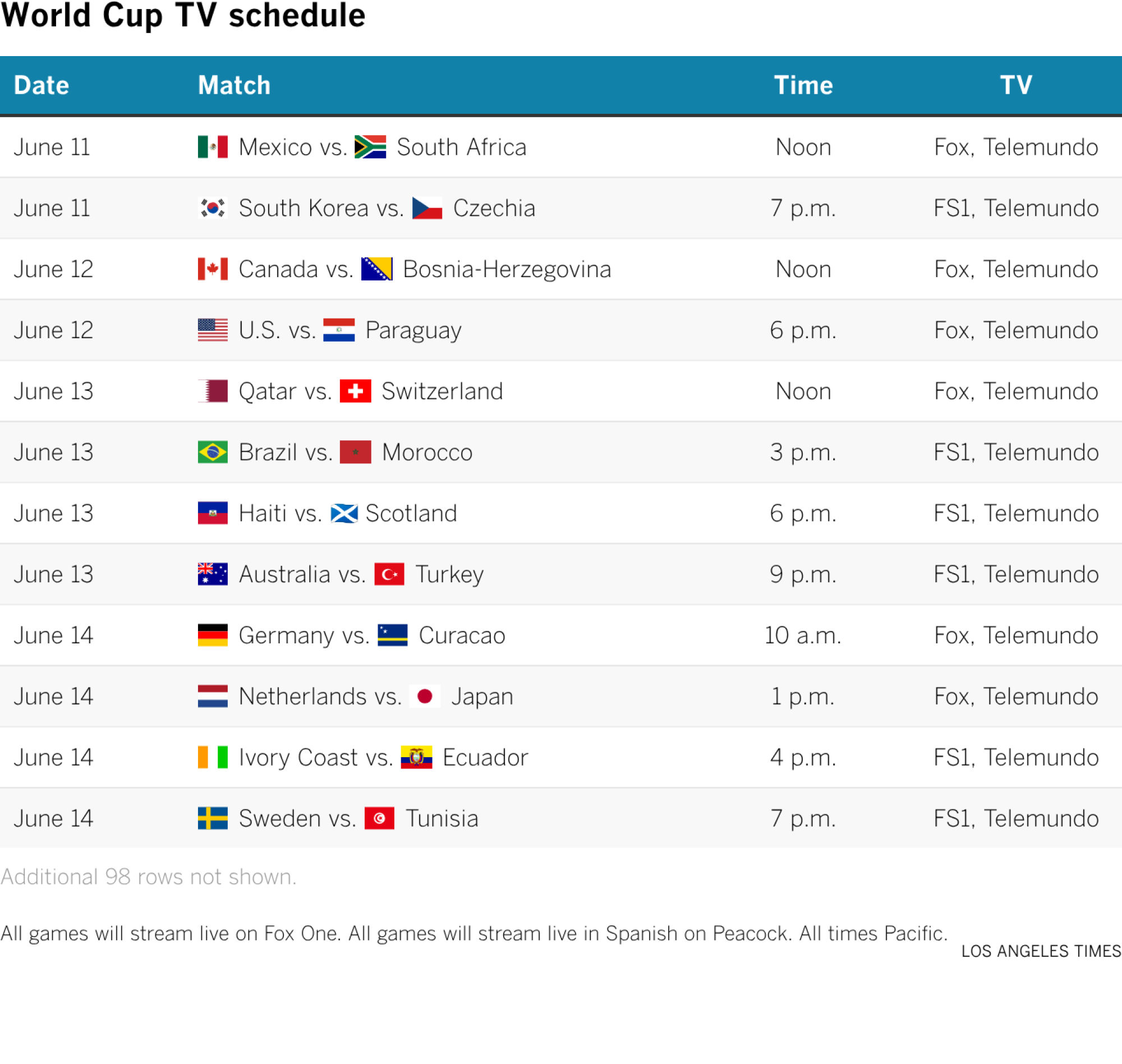
group stage

World Cup: Canada defeats South Africa, advances to round of 16

When FIFA expanded the World Cup field from 32 to 48 teams for this summer’s tournament, the gnashing of teeth and clutching of pearls was as predictable as it was loud. The field would be watered down, the traditionalists protested. The group stage would be a series of blowouts, the sharks would devour the minnows.

In fact, none of that happened.

What we got instead was plucky Cape Verde playing No. 3 Spain to a draw and becoming the smallest nation to reach the elimination rounds. We got Austria advancing on a goal six minutes into stoppage time — eliminating unbeaten Iran, which deserved better — and Canada, Egypt and the Democratic Republic of Congo all winning World Cup games for the first time.

We got Lionel Messi scoring six goals and Mexico and Spain giving up none. We got South Africa, Canada, Egypt and Cape Verde advancing to the knockout rounds for the first time while South Korea and Uruguay went home.

It was one of the most surprising, exciting and compelling group stages in recent World Cup history. And on Sunday it gave way to the first game of the knockout rounds, with Canada beating South Africa 1-0 on a goal by LAFC midfielder Stephen Eustáquio in the second minute of stoppage time.

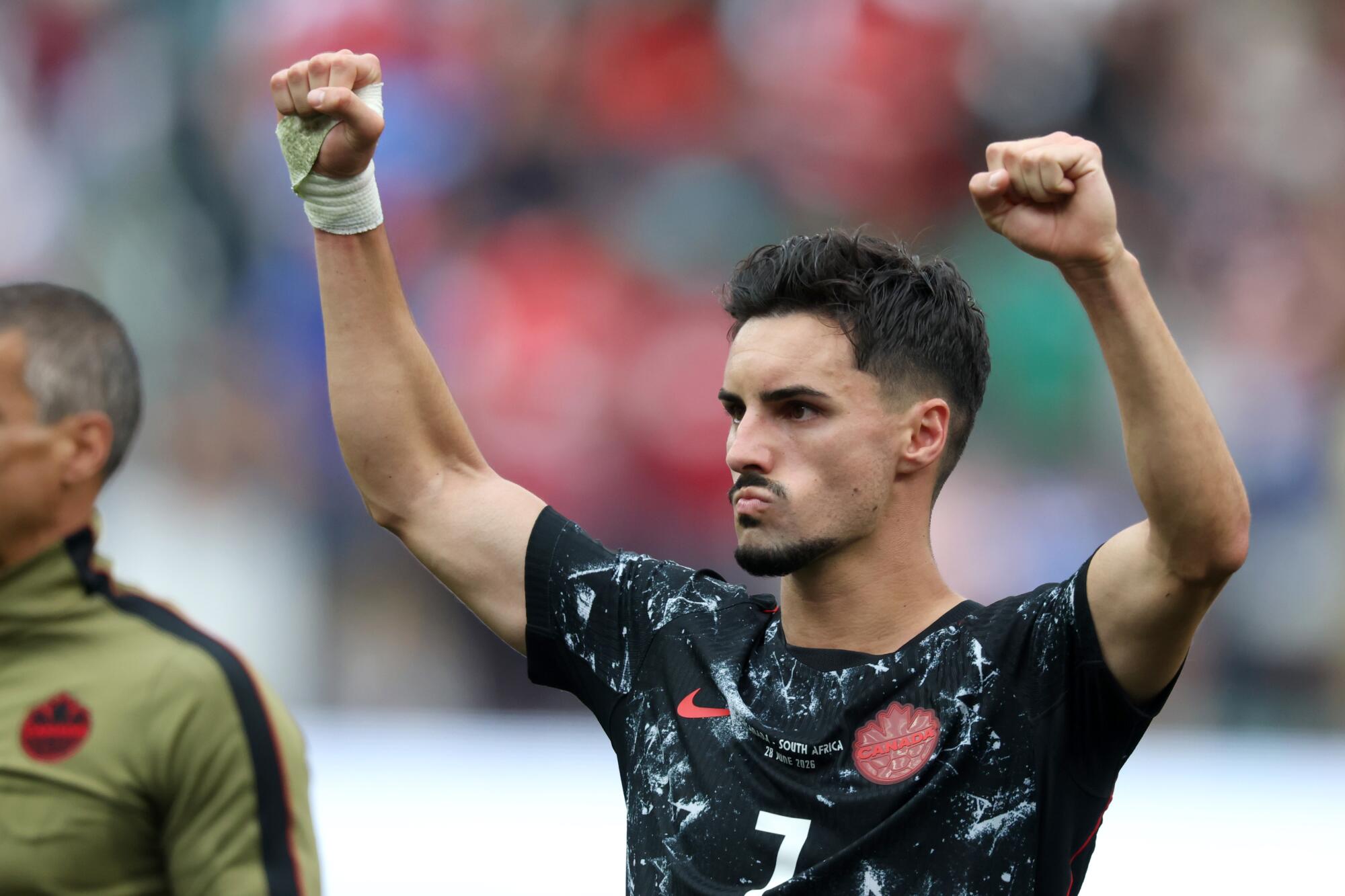
Canada's Stephen Eustáquio reacts after a 1-0 win over South Africa at the World Cup on Sunday at SoFi Stadium.

Canada’s Stephen Eustáquio reacts after a 1-0 win over South Africa at the World Cup on Sunday at SoFi Stadium.

(Robert Gauthier / Los Angeles Times)

Unlike much of the group stage, Sunday’s game was a sloppy, sleepy affair, with South Africa relying on some heroic play from its back line to keep the game even. But it ended with a bang with Eustáquio latching on to a loose ball at top of the box and blasting a right-footed volley just inside the left post.

Canada will play the winner of Monday’s Netherlands-Morocco match in the round of 16 next week. For South Africa, the World Cup is over.

For both countries, this World Cup was the most successful ever. Canada, which is sharing host duties with Mexico and the U.S., has won twice. South Africa had won games before, but it had never gotten beyond the group stage.

For South Africa, that success is part of a continental soccer resurgence. Four years ago in Qatar, Morocco became the first African nation to reach the World Cup semifinals. This summer, thanks to the expanded field, 10 African nations qualified for the tournament and nine advanced to the round of 32.

And the rise of African soccer hasn’t just boosted the fortunes of African teams. Top-ranked France, a World Cup favorite, has 21 players of African descent on its roster; at least a dozen other non-African teams, including Canada, have at least two players of African heritage.

Canada is one of the world’s most diverse countries with nearly a quarter of its population having been born somewhere else. Former coach John Herdman leaned into that diversity when he took over the men’s team in 2018; four years later, Canada made its second trip to the World Cup with a lineup that included four dual nationals.

Jesse Marsch, the U.S.-born coach who succeeded Herdman, doubled down on that. As a result, the 26 players on Canada’s roster, or their parents, come from more than 17 countries — from Iran, Croatia, Jamaica and Barbados to Haiti, Lebanon, Nigeria and the Philippines. Captain Alphonso Davies, Canada’s best player, was born to Liberian parents in a refugee camp in Ghana before being resettled in Edmonton, becoming a citizen in 2017.

Canada goalkeeper Maxime Crepeau makes a save against South Africa on Sunday.

Canada goalkeeper Maxime Crepeau makes a save against South Africa on Sunday.

(Ronaldo Bolanos / Los Angeles Times)

Davies, who hasn’t played since sustained an acute hamstring injury in early May, came on in the 76th minute Sunday and had an immediate influence, threading a perfect pass to the feet of Promise David, whose right-footed shot from the top of the box drifted inches wide of the left post.

Three minutes later, Davies drew two defenders to him on the left flank, opening space for Jonathan David to slip into the box and get off a tight-angled shot near the end line that stood up South African keeper Ronwen Williams. But the winner came from Eustáquio, the son of Portuguese parents who Herdman wooed away from the Portuguese U-21 team in 2019.

He has made 60 appearances with Canada’s senior national team, none bigger than Sunday’s.

Canada's Tani Oluwaseyi, center, gets caught between South Africa's Khuliso Mudau (20) and Sphephelo Sithole.

Canada’s Tani Oluwaseyi, center, gets caught between South Africa’s Khuliso Mudau (20) and Sphephelo Sithole during the first half Sunday.

(Kelvin Kuo / Los Angeles Times)

Source link

2026 World Cup knockout round TV schedule, game previews, results

Group play is over and it’s knockout time at the 2026 FIFA World Cup.

The round of 32 is set, with tournament co-host Canada kicking things off Sunday when it faces South Africa at SoFi Stadium.

Here’s everything you need to know about World Cup knockout stage matches being played Sunday, Monday and Tuesday across the U.S., Mexico and Canada (all times Pacific).

Sunday’s round of 32 match

Canada vs. South Africa

Canada's Alphonso Davies warms up before a World Cup match against Qatar on June 18.

Canada’s Alphonso Davies warms up before a World Cup match against Qatar on June 18.

(Abbie Parr / Associated Press)

Where: SoFi Stadium, Inglewood
Time: Noon
TV: Fox, Telemundo

The buzz: Both teams are making their first appearances in a World Cup knockout round, Canada (1-1-1) after losing its group-play final to Switzerland and South Africa (1-1-1) after upsetting South Korea. Canada, the first World Cup host to play a game outside its borders, could get a boost if Alphonso Davies, its best player, can play after missing the team’s first three games. South Africa scored just one goal of its own in the group stage; Canada got six in one game alone.

Monday’s round of 32 matches

Brazil vs. Japan

Brazil's Matheus Cunha (9) celebrates after scoring his side's opening goal.

Brazil’s Matheus Cunha celebrates after scoring against Haiti at the World Cup on June 19.

(Petr David Josek / Associated Press)

Where: NRG Stadium, Houston
Time: 10 a.m.
TV: FS1, Telemundo

The buzz: Brazil won Group C, posting consecutive 3-0 wins over Haiti and Scotland to close out the first round and run goalkeeper Alisson Becker’s shutout streak to 249 minutes. Vinícius Júnior, with four goals, and Matheus Cunha, with three, have accounted for all of Brazil’s scoring. Brazil hasn’t been eliminated in the first knockout stage of a World Cup since 1990. Japan has received goals from five players in an unbeaten run through Group F, where it finished second to the Netherlands. Japan has not won a World Cup knockout-round game in four tries.

Germany vs. Paraguay

Germany's Kai Havertz reacts during a match against Curaçao at the World Cup on June 14.

Germany’s Kai Havertz reacts during a match against Curaçao at the World Cup on June 14.

(Alexander Hassenstein / Getty Images)

Where: Gillette Stadium, Foxborough, Mass.
Time: 1:30 p.m.
TV: Fox, Telemundo

The buzz: Germany scored 10 goals in the group stage, but the four-time tournament champions lost to Ecuador and had to rely on a tiebreaker to win the group over the Ivory Coast. Deniz Undav, with three goals, and Kai Havertz, with two, are the only Germans who have scored more than once. Paraguay gutted out a scoreless draw with Australia in its final game to finish third in Group D and squeeze into the round of 32. It has just two goals in the tournament, but it is coming off back-to-back shutouts.

Netherlands vs. Morocco

Brian Brobbey celebrates after scoring for the Netherlands in a win over Sweden at the World Cup on June 20.

Brian Brobbey celebrates after scoring for the Netherlands in a win over Sweden at the World Cup on June 20.

(Eric Gay / Associated Press)

Where: BBVA Stadium, Guadalupe, Mexico
Time: 6 p.m.
TV: Fox, Telemundo

The buzz: Morocco, a semifinalist four years ago, did not lose in the group stage but finished second to Brazil on goal differential, setting up this challenging matchup with the Netherlands. Morocco is ranked sixth in the world by FIFA, one spot ahead of the Dutch, who matched Germany with a tournament-high 10 goals in the first round. The Netherlands haven’t lost a first-round knockout game since 2006. Brian Brobbey has three goals for the Dutch while Cody Gakpo and Crysencio Summerville have two apiece. Ismael Saibari has scored in each of Morocco’s three games.

Tuesday’s round of 32 matches

Ivory Coast vs. Norway

Norway's Erling Haaland celebrates after scoring against Senegal at the World Cup on June 22.

Norway’s Erling Haaland celebrates after scoring against Senegal at the World Cup on June 22.

(Steve Luciano / Associated Press)

Where: AT&T Stadium, Arlington, Texas
Time: 10 a.m.
TV: Fox, Telemundo

The buzz: Norway rested many of its regulars in its group-play finale, a 4-1 loss to France, to settle for second in Group I. Erling Haaland, playing in his first World Cup, had braces in Norway’s first two games. Ivory Coast finished second to Germany on a tiebreaker but advanced to the knockout stages for the first time. Villarreal’s Nicolas Pépé has two of the team’s four goals.

France vs. Sweden

France's Kylian Mbappé points during a win over Norway at the World Cup on June 26.

France’s Kylian Mbappé points during a win over Norway at the World Cup on June 26.

(Justin Setterfield / Getty Images)

Where: MetLife Stadium, East Rutherford, N.J.
Time: 2 p.m.
TV: Fox, Telemundo

The buzz: Unbeaten France, which has played in the last two World Cup finals, has designs on returning after dominating its group, winning two of its three games by three goals. Kylian Mbappé had braces in the first two games and is tied with Ousmane Dembélé for the team scoring lead for four goals. Sweden finished third in Group F, winning its first game by four goals and losing its second by the same margin. Sweden’s seven goals allowed matches Norway and Algeria for most by a round-of-32 qualifier.

Mexico vs. Ecuador

Mexico's Luis Romo gestures during a win over Czechia at the World Cup on June 24.

Mexico’s Luis Romo gestures during a win over Czechia at the World Cup on June 24.

(Lars Baron / Getty Images)

Where: Azteca Stadium, Mexico City
Time: 6 p.m.
TV: Fox, Telemundo

The buzz: Mexico hasn’t won a knockout-stage match since 1986, the last time the tournament was played in Mexico. El Tri didn’t allow a goal in winning its group easily. Colombian-born Julián Quiñones leads the team with two goals. Ecuador beat Germany 2-1 in its final group-play match to squeeze into the knockout stages for just the second time, advancing as a third-place team. It was shut out in its first two matches.

Source link

Mexico celebrates magical World Cup victory over Czechia

The Mexican national team overcame a lackluster first half to rout the Czechia thanks to a dream second half that allowed it to finish the group stage undefeated on a night that will be remembered as one of the greatest in Mexican World Cup history.

The celebration of Mexico’s 3-0 win Wednesday at Azteca Stadium turned into a tribute to legendary goalkeeper Guillermo Ochoa, who entered the game in the final minutes to receive a standing ovation unlike any other Mexican player has ever received in the history of the tournament.

With the loss, the Czechia was eliminated after failing to earn more than one point in the tournament. In the other group match, South Africa defeated South Korea 1-0 in Monterrey and advanced in second place. South Korea will have to wait to find out if it advances as one of the eight best third-place teams or it was eliminated.

Czechia put up a strong performance during the first 45 minutes, during which Mexico showed little offensive clarity, mainly due to a lack of control in midfield.

Everything changed in a matter of six minutes during the second half, when El Tri figured out Czechia and secured its best victory in the group stage.

Mateo Chávez, 22, opened the scoring in the 55th minute with the help of Mexico’s lethal counterattack. Luis Romo set up the goal by shaking off three Czechia players at midfield and pushing forward, passing to Chávez, who beat Czechia’s Michal Sadilek and buried a shot to the left side of goal.

Forward Julián Quiñones extended the lead in the 61st minute, exploiting Czechia’s defensive confusion in the penalty area.

Álvaro Fidalgo, who was a second-half substitute, capped the win with a stoppage time goal. The run on the final goal was set up by a booming Ochoa kick and triggered a raucous celebration by the goalkeeper and his teammates.

The match encapsulated both the present and the future of the Mexican national team.

Gilberto Mora, a 17-year-old midfielder from Tijuana and the team’s youngest player at the World Cup, was instrumental in the second half, setting up several of the plays that decided the outcome. With a 2-0 lead, one of the greatest moments for a goalkeeper in World Cup history unfolded. Ochoa replaced starting goalkeeper Raúl Rangel and was greeted with a standing ovation from a large portion of the 80,824 fans at Azteca Stadium.

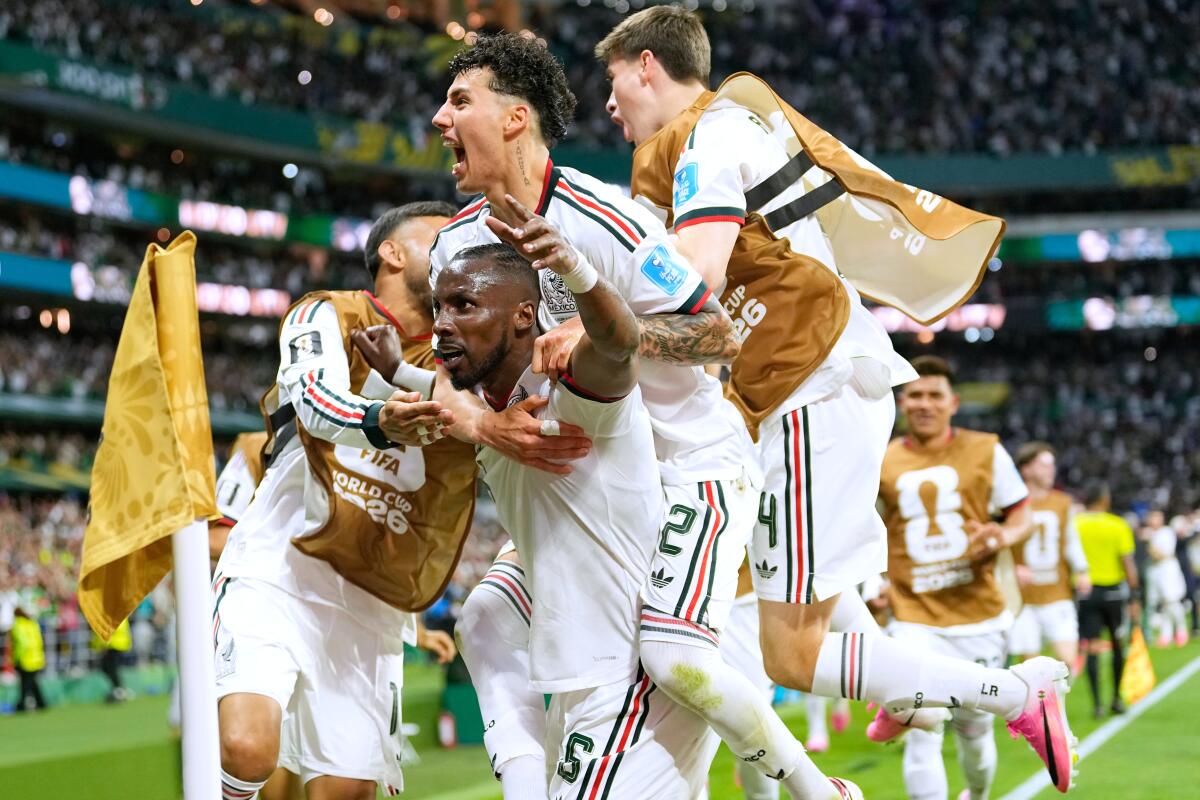
Mexico's Julian Quinones celebrates scoring his side's second goal against Czechia during a World Cup  match.

Mexico’s Julian Quinones celebrates scoring his side’s second goal against Czechia during a World Cup match in Mexico City on Wednesday.

(Silvia Izquierdo / Associated Press)

The fans chanted Ochoa’s name every time the goalkeeper touched the ball, honoring a player who has competed in six World Cups for Mexico.

Coach Javier Aguirre said that finishing first in the group was a “primary objective” for Mexico, which had already qualified for the next round. The team achieved a first for a Mexican national team by securing three consecutive wins without conceding a goal in the group stage of a World Cup. Mexico defeated South Africa 2-0 in the opening match and South Korea 1-0 in the second game.

The national team, which is co-hosting the tournament alongside Canada and the United States, will face its next opponent — one of the best third-place finishers — on Tuesday at Azteca Stadium.

The only sour note for Mexico came in the scoreless first half when the restless crowd unleashed a popular homophobic chant at least twice. FIFA has previously sanctioned the Mexican soccer federation in an effort to stop fans from saying the chant.

Source link

Mexico and South Africa both faced challenges ahead of World Cup

History tends to repeat itself at the World Cup. Such is the case with Mexico and South Africa, two teams that will face off in the World Cup opening match for the second time in history, just as they did in Johannesburg on June 11, 2010. The score that night was 1-1.

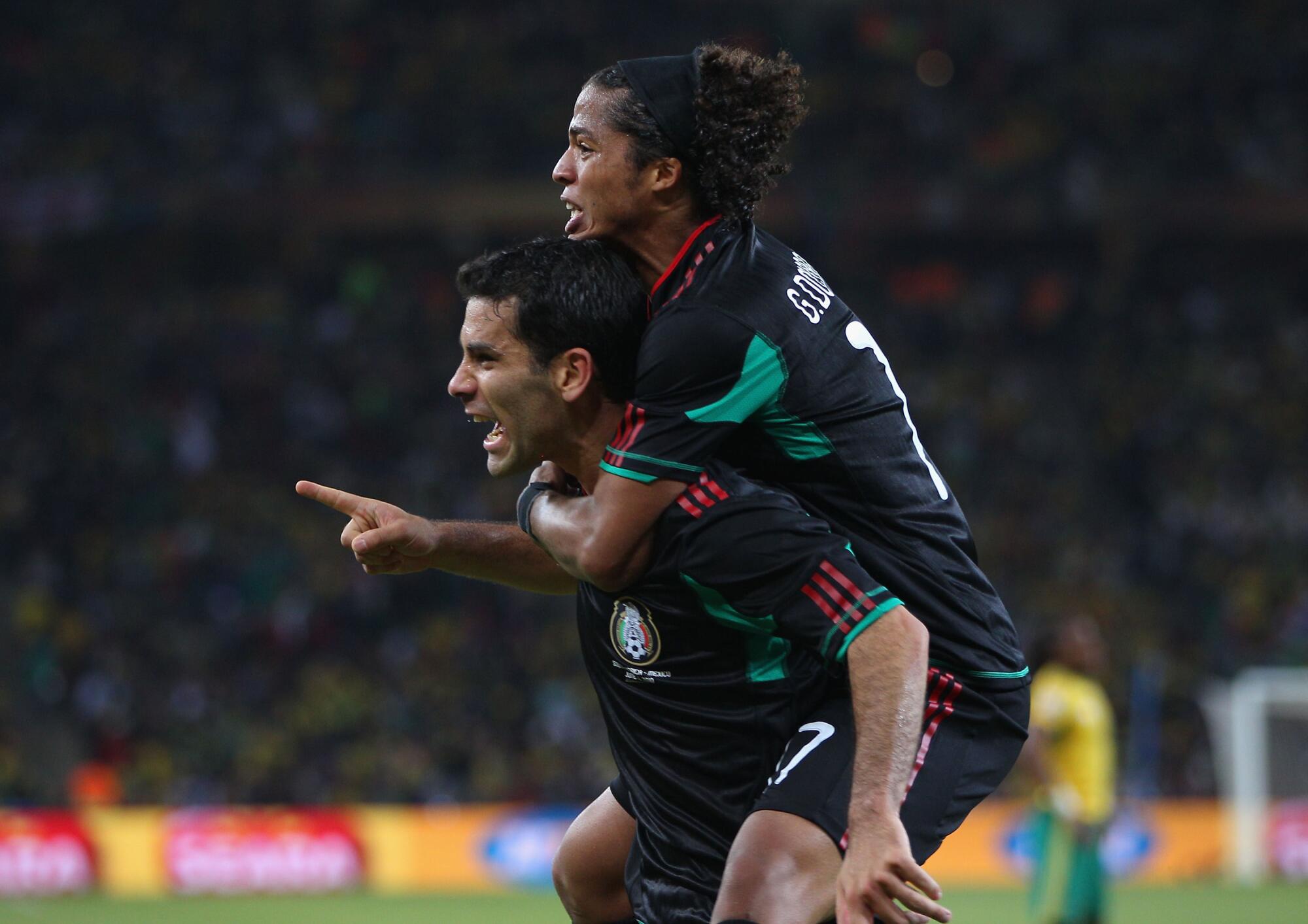
Many still remember Siphiwe Tshabalala and his powerful shot into the top corner that beat Mexican goalkeeper Óscar Pérez, and a celebration that remains etched in the collective memory of the soccer world. Unfortunately for the South African team that night, Rafa Márquez equalized for El Tri with 11 minutes remaining during what turned out to be a disappointing World Cup for the host nation.

Sixteen years later, the 2026 World Cup kicks off, curiously enough, with the same matchup, but with the roles reversed. Mexico is now the host at Azteca Stadium, known during this competition as Mexico City Stadium, at 7,216 feet above sea level. It will be the third World Cup the venue has hosted.

“It won’t be easy at all,” South Africa coach Hugo Broos said last December upon learning his team would debut against one of the hosts. “It’s a great thing to play in front of 80,000 people. We have nothing to lose.”

Mexico's Giovani Dos Santos jumps on the back of Rafael Marquez after Mexico scored against South Africa.

Mexico’s Giovani Dos Santos jumps on the back of Rafael Marquez after Mexico scored against South Africa during a World Cup group match on June 11, 2010, in Johannesburg, South Africa.

(Michael Steele / Getty Images)

On the Mexican side, the similarities to 2010 are striking — and not necessarily for the right reasons. Coach Javier Aguirre is back on El Tri’s bench — the same coach who led that campaign in South Africa — which, at first glance, might seem curious, though in practice it reflects the stagnation of a soccer team that has gone eight consecutive World Cups without advancing past the round of 16.

Former Barcelona player Márquez, who scored the equalizer, also remains connected to the national team, now as an assistant coach, with the mandate to take the reins of the team once the Aguirre era concludes after the World Cup. The squad has seen more than a dozen coaches come and go since 2010, including a qualification for Brazil 2014 that nearly ended in tragedy before a goal by the United States rescued the Mexican team and sealed its admission into the tournament.

“Javier [Aguirre] was a firefighter in 2002, he was a firefighter in 2010 and he stepped in as a firefighter again then — it’s the same old story,” said John Sutcliff, a journalist who has covered Mexico for more than 36 years. “[The federation officials] aren’t working in the best interest of the national team. There’s a lot of interest in bringing in foreigners [to the Mexican league] for business purposes and we don’t have players in Europe’s top leagues.”

Mexico’s recent record speaks for itself. It was eliminated in the World Cup round of 16 in 2010 by Argentina, by the Netherlands in 2014, by Brazil in 2018 and failed to even advance past the group stage in Qatar in 2022. Considered the “Giant of CONCACAF,” Mexico has remained dominant in its region since 2010, with five Gold Cups, although it has lost ground to the United States in the Nations League.

Outside the region, its participation in 2010 has been limited mainly to two editions of the Copa América held on U.S. soil, in which it has failed in both, reaching the quarterfinals in 2016 and being eliminated in the group stage in 2024.

“I think it’s been a roller coaster ride over these 16 years; for a moment it seemed like it was making progress, but then there were spectacular crashes,” said Gibrán Araige, a journalist who has followed El Tri through several World Cup cycles.

Mexico's Raúl Jiménez celebrates with teammates after scoring against Serbia during a friendly.

Mexico’s Raúl Jiménez celebrates with teammates after scoring against Serbia during a friendly at Nemesio Diez Stadium on June 4 in Toluca, Mexico.

(Agustin Cuevas / Getty Images)

For Araige, the level of the 2010 squad is similar to the current one, with players who are not yet established but have solid European experience.

Of the 26 players called up by Aguirre, 10 play in Europe, but few play for elite clubs or get significant playing time on their teams, mostly hampered by injuries, as is the case with Santi Giménez (AC Milan, Italy), César Huerta (Anderlecht, Belgium), Luis Chávez (Dinamo, Russia) and Edson Álvarez (Fenerbahçe, Turkey).

For its part, South Africa has not made significant progress since 2010.

After being eliminated in the group stage, finishing behind Uruguay and Mexico in a tournament held in its own country, it became the first host nation in a World Cup to fail to advance past that stage — a record that Qatar matched in 2022.

Bafana Bafana failed to qualify for the next three World Cups. In fact, this is the first time they have qualified since 2002, as they did not have to qualify in 2010, having hosted the tournament.

They were eliminated as group runners-up behind Ethiopia on the road to Brazil in 2014, they finished last in their group on the road to Russia in 2018 and finished second behind Ghana in the qualifiers for Qatar in 2022.

South African players run during a World Cup training session at Estadio Hidalgo on June 3 in Pachuca, Mexico.

South African players run during a World Cup training session at Estadio Hidalgo on June 3 in Pachuca, Mexico.

(Manuel Velasquez / Getty Images)

They have also lacked consistency in the Africa Cup of Nations, missing the 2012 and 2017 editions.

Broos, who took over as South Africa’s head coach in 2021, sought to instill discipline and relied on local talent, which was vital in securing a spot in this year’s World Cup. During the qualifying round, South Africa won its group by finishing ahead of Nigeria and advanced despite starting the campaign with a loss due to an ineligible player used in a match against Lesotho.

Broos faced criticism for strategic errors early on, but ultimately built a competitive team that achieved historic qualification, aided by nine direct World Cup spots in the expanded tournament field.

“It’s a truly excellent group of players. We got through a very tough qualifying phase, which I think helped polish the team,” said Mark Gleeson, a journalist specializing in African soccer.

For Gleeson, South Africa missed a major opportunity to strengthen its league by failing to retain investors and wealthy clients after the 2010 World Cup and continued to operate in the same way — a trend reflected in the league’s stagnation and the scarcity of talent playing abroad.

Lwethu Makhanya (Philadelphia Union, USA), Ime Okon (Hannover 96, Germany), Mbekezeli Mbokazi (Chicago Fire, USA), Sphephelo Sithole (CD Tondela, Portugal) and Lyle Foster (Burnley, England) are among the few South African players competing abroad for a national team reliant on domestic soccer.

South Africa huddle during a training session at Estadio Hidalgo on June 3 in Pachuca, Mexico.

South Africa huddle during a training session at Estadio Hidalgo on June 3 in Pachuca, Mexico.

(Manuel Velasquez / Getty Images)

However, with the World Cup’s new 48-team format, the task of advancing proved less daunting for teams in the qualifying phase and at the World Cup, there will also be more opportunities to advance beyond the group stage because the best third-place finishers move on. That math could benefit South Africa even if it loses its opening match.

Should Bafana Bafana lose to Mexico, they would have to beat the Czech Republic in their second match on June 18 in Atlanta and would likely play for qualification on June 24 against South Korea in Monterrey.

“The Czechs are among the weakest in Europe, and there’s a good chance of beating them. Furthermore, South Korea is well below its own historical standards, as was evident in March with very poor results in high-pressure matches,” Gleeson said.

To prepare for the altitude in Mexico City, Broos, a former Belgian player who competed in the 1986 World Cup in Mexico, brought his team in early and, starting May 30, held training camp in Pachuca, a city at higher in elevation than the capital. Several of his players are already accustomed to some altitude from playing for clubs in Johannesburg, at 5,751 feet.

“South Africa has a chance; we can compete,” Tshabalala said in an interview after the draw. “I think the pressure will be on Mexico because they’re the hosts. That gives us a real opportunity to pull off an upset.”

A scoreless draw against Nicaragua in Johannesburg days before the World Cup isn’t exactly encouraging, but it also fits with the team’s expectations and the mindset of “having everything to gain and little to lose.”

“We have to enjoy it, and when you enjoy something, you can achieve great things,” said Broos.

Source link