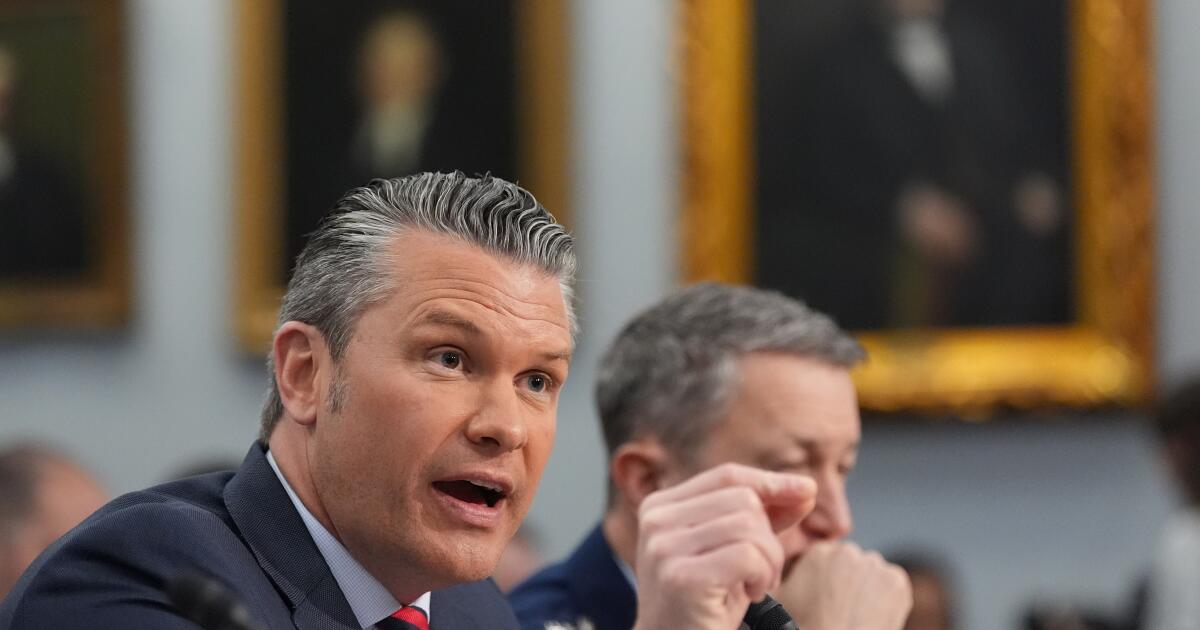
Hegseth faces bipartisan grilling about weapons drawdown during the Iran war
WASHINGTON — Defense Secretary Pete Hegseth faced tough questions Tuesday from Republican and Democratic lawmakers about the Trump administration’s end game for the Iran war, the cost of the conflict and its impact on diminishing U.S. weapons stockpiles.
For his part, the Pentagon chief softened his tone from hearings before Congress nearly two weeks ago, notably avoiding the same pointed criticism of lawmakers in his opening remarks as he outlined the Trump administration’s efforts to ramp up production of weapons and other military capabilities.
Even so, Hegseth insisted that the military has plenty of missile defense systems and other munitions for the Iran war or future conflicts as both Republicans and Democrats hammered him with those concerns.
“I take issue with the characterization that munitions are depleted in a public forum,” Hegseth said. “That’s not true.”
The cost of the Iran war has risen to about $29 billion, the vast bulk of which — $24 billion — is related to replacing and repairing munitions but also includes operational costs to keep forces deployed, Pentagon comptroller Jay Hurst said. That’s up from $25 billion that he told lawmakers nearly two weeks ago.
The powerful House and Senate Appropriations subcommittees that oversee defense spending are holding back-to-back hearings to review the Trump administration’s 2027 military budget proposal, which calls for a historic allocation of $1.5 trillion. The discussions in the House quickly veered into the handling of a war that appears locked in a stalemate as higher fuel prices pose political problems for Republicans in the midterm congressional elections.
Hegseth and Caine face bipartisan pushback on munitions stockpiles
Rep. Rosa DeLauro, the ranking Democrat on the House Appropriations Committee, told Hegseth that the “question must be answered at the end of this crisis: What have we accomplished and at what cost?”
“This administration has not presented Congress with any kind of clear or coherent strategy week to week, day to day, hour to hour,” DeLauro said. “The rationale shifts, the objectives change. The end game is ill-defined when it is defined at all.”
California Republican Rep. Ken Calvert, the House subcommittee’s chair, also asked about the impact of the Iran war on military funding as well as the U.S. military’s weapons stockpiles.
“Questions persist about whether we are building the depth and reliance required for a high-end conflict,” Calvert said.
Minnesota Rep. Betty McCollum, the defense subcommittee’s ranking Democrat, pressed Hegseth on whether the military has a plan to draw down troops in the Middle East if Congress passes so-far-unsuccessful efforts to end the Iran war.
“We have a plan to escalate if necessary,” Hegseth said. “We have a plan to retrograde if necessary. We have a plan to shift assets.”
He said he would not reveal any next steps publicly. Noting repeated questions from lawmakers over the military’s weapons stockpiles, drawn down from the Iran war, Hegseth said the concerns have been “unhelpfully overstated” and that “we have plenty of what we need.”
He said the defense industry has been told to “build more and build faster,” blaming the military industrial base’s inadequate capacity on previous administrations and U.S. aid to Ukraine in its war with Russia.
Trump administration faces pressure from impact of the Iran war
President Trump is facing increasing pressure from the economic shocks of Iran effectively closing the Strait of Hormuz, a vital shipping corridor where 20% of the world’s oil normally flows. The U.S. military in turn has blockaded Iranian ports and the two sides have traded fire, with American forces thwarting attacks on their warships and disabling Tehran-linked oil tankers.
Trump said Monday that the ceasefire is on “massive life support” and criticized Iran for its latest proposal, pointing to his demands that Iran significantly limit its nuclear program.
“I would call it the weakest right now after reading that piece of garbage they sent us,” Trump said.
The Republican president also said he wanted to suspend the federal gas tax to help Americans shoulder surging fuel prices. He has previously said higher costs are worth it to prevent Iran from getting a nuclear weapon.
Tuesday’s hearings are giving a mostly new group of lawmakers the chance to grill or applaud Hegseth and Gen. Dan Caine, chair of the Joint Chiefs of Staff, on the planning and execution of the war.
The Senate hearing later Tuesday will include Sen. Susan Collins of Maine, a Republican whose reelection this year is far from guaranteed. She voted with Democrats on an effort to halt the conflict late last month, saying she wants to see a defined strategy for bringing the war to a close.
Alaska Sen. Lisa Murkowski, another Republican on the Senate Appropriations defense subcommittee, has voted against the string of unsuccessful war powers resolutions but spoken of the need for congressional authorization so Americans will know the war’s limits and objectives.
He also will face plenty of friendly Republicans, including the Senate subcommittee’s chair, Sen. Mitch McConnell of Kentucky, and perhaps the Iran war’s biggest booster in Congress, Sen. Lindsey Graham of South Carolina.
Finley, Toropin and Barrow write for the Associated Press. Barrow reported from Atlanta.