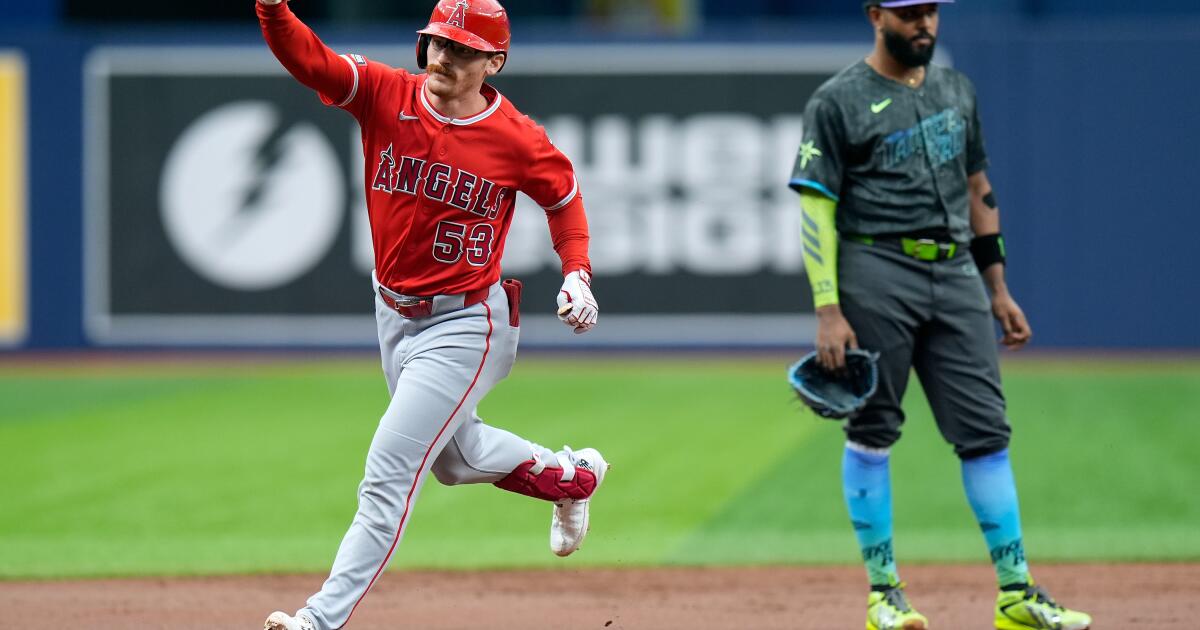
ST. PETERSBURG, Fla. — Wade Meckler hit his first grand slam in the majors for the first of Los Angeles’ four homers in the Angels’ 14-3 victory over the Tampa Bay Rays on Saturday.
Meckler connected off Drew Rasmussen (4-2) in the first inning. He also singled and stole a base.
Mike Trout hit his 14th homer of the season in the fifth and Jo Adell and Oswald Peraza had back-to-back shots in a seven-run ninth. Trout, the major league walks leader, also walked twice and scored three of the Angels’ season-high 14 runs.
Tampa Bay lost for just the second time in its last 18 home games.
Yandy Díaz’s 24th career leadoff homer, his second in two games, put the Rays on the board in the first. But Angels starter Reid Detmers (2-5) pitched out of a bases-loaded jam.
Junior Caminero doubled in the third inning, when his popup dodged the Tropicana Field catwalks before landing in the infield. But Detmers left him at second and Tampa Bay finished one for 12 with runners in scoring position, stranding 11 overall.
Four Angels relievers combined to one-hit the Rays over the final four innings.
In the top of the seventh inning, Angels shortstop Zach Neto scored on Ian Seymour’s wild pitch. Hip-checked by Seymour on the play at the plate, Neto remained on the dirt for several minutes before athletic trainers helped him to his feet. He walked off on his own power but did not return.
Neto’s replacement, Nick Madrigal, left in the top of the ninth inning after Andrew Wantz’s pitch ricocheted from Madrigal’s hand to his face. Adam Frazier pinch ran for Madrigal.
Up next: Angels RHP Jack Kochanowicz (2-3, 4.99 ERA) was set to start against LHP Shane McClanahan (5-2, 2.52) on Sunday in the series finale.
At 17, Moise Kouame becomes the youngest winner of a Grand Slam match with French Open win against Marin Cilic.
Published On 26 May 202626 May 2026
French teenager Moise Kouame announced himself on the Grand Slam stage in emphatic fashion, beating former US Open champion Marin Cilic 7-6(4) 6-2 6-1 at the French Open to become the youngest man to win a major main-draw match in 17 years.
Handed a wildcard by organisers, the 17-year-old French teen looked entirely unfazed on Court Simonne Mathieu in the first-round match on Tuesday as he made his Grand Slam debut against a player 20 years his senior and a former world number three.
Recommended Stories
list of 3 itemsend of list
Cilic, the 2014 US Open champion and a Roland Garros semifinalist in 2022, arrived in Paris ranked 46th in the world but was outplayed by the fearless teenager, whose speed in defence and deft drop shots repeatedly drew applause from the crowd.
Ranked 318th, Kouame edged a tense opening set in a tiebreak after saving two set points before taking control of the match.
“It wasn’t easy. I always try to stay in the present moment and not think too much about the score. Today I managed to do that really well,” Kouame said on court.
Kouame did not concede a break of serve throughout the contest as he sealed victory in straight sets.
At 17 years and two months old, Kouame became the youngest player to win a Grand Slam match since Australia’s Bernard Tomic reached the 2009 Australian Open second round at the age of 16.
France’s Moise Kouame celebrates his victory over Croatia’s Marin Cilic at the Roland-Garros [Julien de Rosa/AFP]
He is also the youngest player to advance past the first round at Roland Garros since Romania’s Dinu Pescariu achieved the feat in 1991 at 17 years and one month old.
“It’s a lot of emotion, it’s exceptional,” Kouame said. “Coming into this tournament, I didn’t really know what to expect. The team and I worked hard to be as ready as possible.”
The teenager, coached by former French player Richard Gasquet, claimed only the second main-tour win of his career after earning his first at the Miami Masters in March.
He will next face Paraguay’s Adolfo Daniel Vallejo, who advanced after 20th seed Cameron Norrie retired injured.
Kouame’s breakthrough run caps a rapid rise this season.
The Frenchman has won three ITF titles – the third tier of professional tennis – and received several wildcards on the main circuit, including at the Miami and Monte-Carlo Masters.
“All the experience I gained in Miami and Monte-Carlo probably helped me a little,” Kouame told reporters. “Technically, I felt pretty calm. I knew I was ready and I felt good mentally and physically.”
The Canadian Grand Prix was the race in which the Formula 1 title battle finally came alive this year.
It was also, however, the race in which it took a potentially decisive turn, putting a huge dent in George Russell’s hopes of beating his 19-year-old Mercedes team-mate Kimi Antonelli to the championship.
Russell’s retirement from the race came after 30 laps of frenetic battling between the pair which lit up the Circuit Gilles Villeneuve on a damp, gloomy day so cold it tempted world champions McLaren into a seemingly inexplicable decision to start the race on a dry track on wet-weather tyres.
Russell’s retirement handed the win to Antonelli, his fourth in a row, and the Italian now has a massive 43-point lead.
Doubtless there are many twists and turns to come in the remaining 17 races. Even so, that will take some recovering.
Afterwards, Russell was stoic but understandably downbeat.
“Right now it’s his to lose,” he said. “He is so many points ahead. It feels like the gods don’t want me to be in this fight, when I look at the safety-car timing in Japan, breaking down in China Q3, fighting for pole, breaking down from the lead here today.
“But, you know, the pressure’s off. Go out, enjoy every single race. Try to win every single race. And I’ve got nothing to lose.
“I don’t want to be stood here talking like that. It is, of course, frustrating, but I want to be in that fight. Hopefully, the luck will turn.”
George Russell bounced back after a difficult recent run to beat Mercedes team-mate Kimi Antonelli to sprint pole at the Canadian Grand Prix.
The Briton, who is 20 points adrift of the Italian after four races this season, headed Antonelli by 0.068 seconds after being fastest on both runs in final qualifying.
Lando Norris headed an all-McLaren second row, 0.315secs off pole and 0.019secs in front of team-mate Oscar Piastri.
Ferrari and Red Bull completed a two-by-two top eight with Lewis Hamilton ahead of Charles Leclerc and then Max Verstappen in front of Isack Hadjar.
Russell came to Montreal looking to turn around what he admitted had been a “turbulent” start to the season, in which Antonelli has won three of the four grands prix so far, and he has started the weekend off well.
“It feels great after a tough Miami but I never doubted myself,” said Russell. “I always knew what I could do. This is an amazing circuit, high grip, and feels like you’re driving a proper grand prix car.”
Mercedes have a major upgrade on their car for this race and Russell said it had made a significant difference.
“It’s definitely feeling great,” he said. “The team have done a great job to bring this forward. Pleased to have it on the car and pleased to be back in P1. It’s been a little while but still a big focus for tomorrow.”
Antonelli said he had started his lap with his tyres under temperature and described his session as “messy”.
McLaren also brought an upgrade to Montreal, their second in as many races, but while it kept them within range of Mercedes it was not enough to counterbalance the effect of Mercedes on this track, where the world champions have often struggled.
Norris said: “A good surprise. After this morning, we were a little bit worried about how far off we were. More just the lack of confidence in the car.
“But we changed some things on the car and seemed to make a good improvement. I could have got more out of it, but not enough to close the gap to the guys ahead.”
Hamilton was 0.361secs off pole and 0.084secs ahead of Leclerc on a circuit where he shares the record number of wins with Michael Schumacher.
The seven-time champion was pleased with his performance, saying his decision not to go into the Ferrari simulator before this race, because of a feeling it was leading to incorrect set-up choices, had paid off.
“Probably the best qualifying session we’ve had for some time,” said Hamilton. “Great work with the engineers.
“The car felt really fantastic from P1. We made just subtle changes going into qualifying. Q1 and Q2 was looking good and then I don’t know what the others are able to turn up a bit more, but I am just happy to be in the fight.
“I was having so much fun out there, and the fact I didn’t do the sim and it was the best I felt all year. I chose a set-up we’ve not used before and its transformed the car for me.”
And Verstappen, struggling with a car he said was “jumping” at the rear, was just 0.101secs clear of tea-mate Hadjar.
“My feeling in the car was not very good,” said Verstappen. “I was struggling a lot with the ride. All over the bumps I couldn’t put my foot down. Actually my feet were even flying off the pedals and it made it very difficult to be consistent.”
Look Mum No Computer is representing the UKCredit: AP
What is the Eurovision 2026 running order?
The running order for tonight’s Eurovision 2026 Grand Final was confirmed after the conclusion of the second semi-final on Thursday.
The running order for tonight is as follows:
Denmark: Søren Torpegaard Lund – Før Vi Går Hjem
Germany: Sarah Engels – Fire
Israel: Noam Bettan – Michelle
Belgium: ESSYLA – Dancing on the Ice
Albania: Alis – Nân
Greece: Akylas – Ferto
Ukraine: LELÉKA – Ridnym
Australia: Delta Goodrem – Eclipse
Serbia: LAVINA – Kraj Mene
Malta: AIDAN – Bella
Czechia: Daniel Zizka – CROSSROADS
Bulgaria: DARA – Bangaranga
Croatia: LELEK – Andromeda
United Kingdom: LOOK MUM NO COMPUTER – Eins, Zwei, Drei
France: Monroe – Regarde !
Moldova: Satoshi – Viva, Moldova!
Finland: Linda Lampenius x Pete Parkkonen – Liekinheitin
Poland: ALICJA – Pray
Lithuania: Lion Ceccah – Sólo Quiero Más
Sweden: FELICIA – My System
Cyprus: Antigoni – JALLA
Italy: Sal Da Vinci – Per Sempre Sì
Norway: JONAS LOVV – YA YA YA
Romania: Alexandra Căpitănescu – Choke Me
Austria: COSMÓ – Tanzschein
How can I watch Eurovision 2026?
Coverage will start in the UK on the BBC and BBC iPlayer at 8pm, with Graham Norton returning to his regular commentary role.
The show will last for almost three hours, coverage ending at 11.50pm, when the BBC will switch to the news.
Who is UK entrant Look Mum No Computer?
Look Mum No Computer is the alias of Sam Battle, originating from the name of his YouTube channel dedicated to creative audio electronics projects.
The artist also uses it as his stage name when performing as a musician.
The name is inspired by the phrase “look mum, no hands”, used by kids when they are learning to cycle.
It highlights the artist’s bold, anti-digital approach to making music where he builds his own synthesizers and hardware, such as his famous Furby organ.
During this tournament, she has been able to lean on Meg Jones a little more to lift her mood.
Like the new England skipper, Packer was born and raised in Wales. The pair will occasionally swap a word or two of Welsh, a reminder of home and family.
“We have just some funny phrases that no-one else really understands, but it really makes us laugh,” says Packer.
“She’s very good at making things quite light and I’m probably the opposite – I make it quite serious.”
There is plenty to be serious about when they face France in Bordeaux.
Given England’s home run at the 2025 Rugby World Cup, WXV’s sparse crowds and an expected record attendance at the 42,000-capacity Stade Atlantique, it is likely to be the most hostile environment the Red Roses have played in since that fateful defeat in Eden Park in 2022.
The streak of 37 straight wins England have put together since is in definite peril.
But, beyond her notes and focus points, there is something else, less easily defined, that bolsters Packer amid the stress.
“As a team we are all overly critical of ourselves, but there is a bond that’s really important to us,” she says.
“The biggest thing is how tight we are as a group – and that just really carries us through.”
Packer, her team and that togetherness will be tested.
But the scrum-half, book smart, street smart and quick smart at the breakdown, can pass most things.
Brace yourself, Coronado. The hospitality maven who brought San Diego its most over-the-top maximalist hotel — the Lafayette in North Park — is back with another glitzy project, this time in the wealthy island city known for its traditional bent.
Opening Thursday, Baby Grand includes a 35-foot faux rock wall, a 20-foot waterfall, a Mediterranean restaurant that feels like a Greek ruin being consumed by a jungle and a hidden oyster bar full of crystal and mirrors. All of this, including the Spanish statuary, Moroccan fixtures and Murano glass, is squeezed onto an Orange Avenue lot that once held a 1950s motel. If Liberace had run away with an art historian, they might have landed here.
The idea was “to create this little mirage within the mirage that is Coronado,” said Arsalun Tafazoli, founder of CH Projects, the group behind a multitude of design-intensive establishments across San Diego including the speakeasy Raised by Wolves, the hi-fi listening bar Part Time Lover and the Middle Eastern restaurant Leila.
The Baby Grand hotel and its restaurant Night Hawk stands along Orange Avenue about a block from the Hotel del Coronado.
The patio dining area of Coronado’s new Night Hawk includes seating for about 150.
Baby Grand’s high-density, high-gloss environment, which cost about $17 million and took about five years to complete, will come as no surprise to those who have followed Tafazoli’s earlier ventures.
Asked about the design philosophy behind the 2023 renovation of the Lafayette — the company’s first hotel — Tafazoli had a simple answer: “More is more.”
The Baby Grand project, put together in collaboration with design studio Post Company, is cut from the same cloth, describing itself as a “polychromatic pastiche” on its website. The goal, Tafazoli said, is to enrich Coronado’s culture and give people a respite in an anxiety-ridden time. But “it is different,” he said. “I don’t know if it is going to be embraced.”
Getting the necessary city permissions “was definitely a struggle,” Tafazoli said. “Had I known how difficult this was going to be, I don’t know …”
In the days before the hotel’s opening, Tafazoli, 44, led a tour of the site. The entrepreneur, whose heritage is Persian, wore his hair in braids and a button-down Supreme shirt featuring Barack Obama.
The Baby Grand hotel’s guest rooms feature separate tub and shower.
“I have a very one-dimensional existence. I’m single. I have no kids. This is what I do,” said Tafazoli, who grew up in San Diego and studied at UC San Diego. He lives now in downtown San Diego’s East Village, where his company is based and where his first CH venture, Neighborhood, opened in 2007.
Though his company started with eating and drinking establishments, Tafazoli said, his goals were always to create and run hotels, “the pinnacle of hospitality.” As a child of divorce, he said, he may have a heightened awareness of when the energy feels right in a room and when it doesn’t. Creating social environments, he said, gives him some control over that. Moreover, he added later, “beauty is important to me, because it conveys care.”
To make the most of Baby Grand’s compact location (2/3 of an acre), the CH team has exported parking. Instead of leaving their cars on site, guests will hand keys to valets who will deposit vehicles in a Bank of America parking structure a block away. That move freed up space for not only palm trees, torches, tables, booths and 21 pieces of statuary from Spain, but also a little faux beach with a 4-foot-deep wading pool that can hold a handful of people.
“I can’t tell you how many iterations of sand were brought in and taken out,” Tafazoli said. “Sand is its own universe. You want local sand. But local sand was not conducive to that feeling.” So the sand is from Turkey.
1
2
3
1.Guest shower in an en suite bathroom.2.Hotel design touches include guest bathroom door handles. 3.Fiberglass clamshells serve as headboard in guest rooms.
The property’s main restaurant, Night Hawk, is Mediterranean, with cooking by open fire, a Greek ruins vibe and seating for about 150. The second restaurant lurks behind the lobby — a hidden oyster-and-Champagne bar that holds about 35 people, reservation only. The space, called Fallen Empire, features red mohair booths, built-in Champagne buckets, mirrored walls and chandeliers, sconces and lamps from the Italian glass-blowing island of Murano. The floor is a custom mosaic of sea creatures.
There are 31 guest rooms, beginning at $350 per night. Each is dominated by a custom-made clamshell headboard (fiberglass). Beds are surrounded by animal-print seating, parquet oak flooring, marble tables, mirrored cabinets and custom wallpaper. The rooms measure roughly 300 square feet each, nearly half of that space taken up by their elaborate bathrooms, each with separate tub and shower, sinks from Morocco.
Now picture all of that placed in the heart of Coronado (population 20,192), which sits next to Naval Air Station North Island and is known for attracting well-heeled retirees. The median home value is $2.5 million.
Up the block from the Baby Grand is the grand dame of San Diego County tourism, the Hotel del Coronado, which went up in 1888, completed a $550-million renovation last year and starts its rates north of $600. Another option is the Bower Coronado, also a dramatically upgraded motel that reopened in 2025 with prices similar to Baby Grand’s but a much more buttoned-down style.
This view from above at the Night Hawk restaurant space shows a stone booth, elaborately patterned cushion and table top.
All of those properties stand close to Coronado’s wide, sandy beaches — which means they all face challenges as waters are often fouled by the northward flow of untreated sewage from greater Tijuana. The longstanding problem has worsened in recent years, and Coronado’s Central Beach was closed to bathers on 129 days in 2025 because of unsafe bacteria levels. The U.S. and Mexican government say they have sewage-treatment projects in progress, with improvements expected by the end of 2027.
“We are, unfortunately, not marine scientists just a group of deeply overcaffeinated hoteliers with strong opinions about lighting, linen textures, and good design. So please check local water conditions before swimming,” Tafazoli wrote in a statement.
Asked his target market for the new hotel, Tafazoli said he was looking close to home.
“I see this as a staycation for locals” from San Diego County, Tafazoli said. “The big risk is that we don’t get locals and it doesn’t resonate with tourists who like the status quo.”
That said, Baby Grand and Coronado might be a better match than some imagine. Christine Stokes, executive director of the Coronado Historical Assn. and Museum, sees at least a few parallels to Baby Grand in local history, beginning with the historical association’s own building. From the 1950s into the 1990s, Stokes noted in an email, Marco’s Restaurant operated in the space, with a “Roman Room” bar — “a dark and immersive hidden gem where bartenders performed sleight-of-hand magic tricks.”
Guest rooms, including No. 103, are labeled with inscribed brass clamshells.
Then there was the Hotel del Coronado’s Circus Room restaurant, open from the 1930s into the 1960s. That was “an immersive environment, using specialized murals and striped tents on the walls,” Stokes wrote. It’s also where, in 1950, the manager of an L.A. TV station spotted a promising young piano player and decided to give him a chance on screen. The pianist’s name was Liberace.
However people respond to the particulars of the new hotel, Tafazoli said, he knows that the larger setting of Coronado is a special place.
From his office in San Diego’s East Village, “it’s a six-minute drive,” he said. “I come off that bridge, and I feel like I’m in a different place.” It’s amazing, he said, “to be so close and feel so far away.”
Poland’s Swiatek said she would prefer continued discussions and negotiations with the majors instead of a boycott.
“I think the most important thing is to have proper communication and discussions with the governing bodies so we have some space to talk and maybe negotiate,” the Wimbledon champion said.
“Hopefully before Roland Garros there’s going to be opportunity to have these type of meetings and we’ll see how they go.
“But boycotting the tournament, it’s a bit extreme kind of situation.
“I guess we as players are here to play as individuals, and we’re competing against each other.
“So it’s really hard for me to say how it would work, if it’s even there on the picture. For now, I haven’t heard anything.”
But French Open champion Gauff thinks strike action would be a genuine possibility if the players come together as one.
“If we all collectively agree, then yes,” the American said.
“I wouldn’t want to be the only one, but we definitely can move more as a collective.
“From the things I’ve seen with other sports, usually to make massive progress and things like this, it takes a union. We have to become unionised in some way.”
World number two Elena Rybakina says she has not been involved in the campaign, but would go with the majority.
“If the majority say we are boycotting, then of course I’m up for it. It’s not an issue,” the Australian Open champion said.
World number five Jessica Pegula has been an articulate advocate of the players’ campaign, but virtually ruled out strike action during a BBC Sport interview in Indian Wells in March.
“We love playing the Slams – I don’t think anyone’s going to strike against the Slams,” the American said.
“I just think it’s us asking for what we think we deserve, but I do think that if the men and the women can come together – which we have on that front – and keep pushing, there’s nothing wrong with us just asking for what we think is right.”