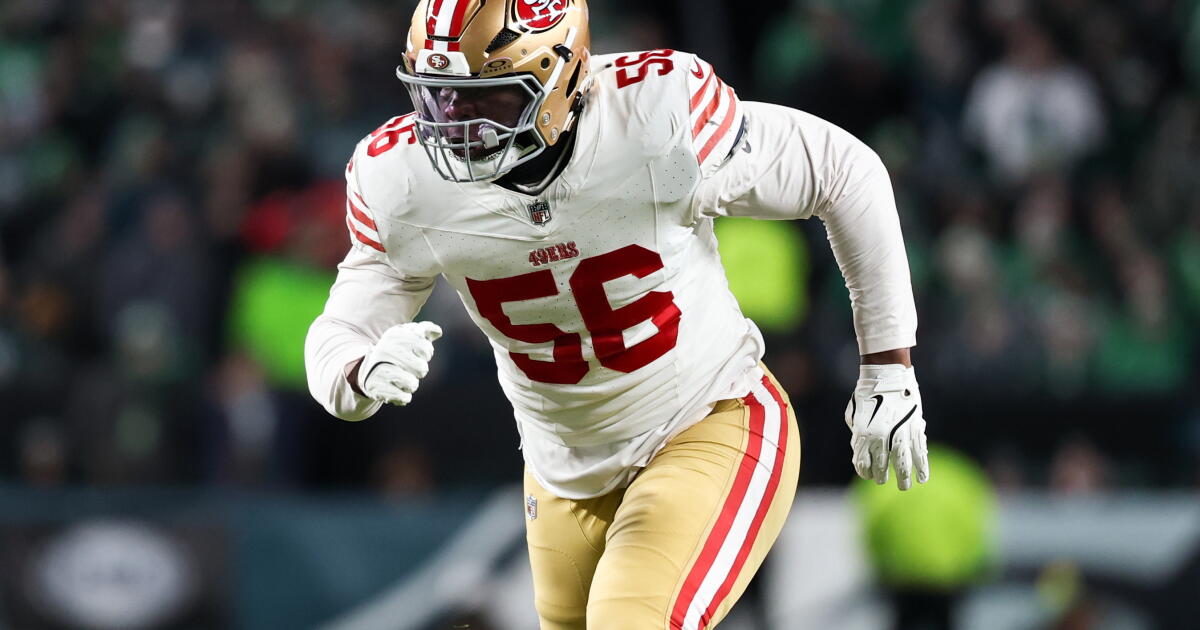
Two men charged in shooting of 49ers’ Keion White at Super Bowl party
Two men charged Wednesday in connection with the shooting of San Francisco 49ers defensive lineman Keion White at a Super Bowl party in the early hours of February 9 were among four arrested as a result of a sweeping investigation.
Alleged gunman Gregory Walker, 36, of Mountain House was arrested by the Los Angeles Police Department and charged with assault with a firearm. San Francisco District Attorney Brooke Jenkins said Walker is alleged to have personally discharged the weapon that wounded White. Walker is also charged with causing great bodily injury, possession of a firearm by a felon, possession of a concealed firearm by a felon, and possession of a loaded firearm by a felon.
Curtis Green, 35, of Irvine was charged with brandishing a firearm at the party held in the VIP area of the Dahlia Lounge in San Francisco’s Mission District. Green was booked in San Francisco on misdemeanor weapons charges. Charges for the other two suspects, Marquis Davis, 38, and Antoine Washington, 36, have not been announced because they are not in custody in San Francisco, police said.
Davis was arrested in Atlanta and police said they found 979 grams of cocaine, 820 grams of MDMA, 1,026 grams of methamphetamine and 3,842 grams of fentanyl at his home. Washington was arrested in Stockton and police said they found loaded gun and oxycodone pills.
The investigation was dubbed “Operation D-Line” by San Francisco police and involved more than 50 search warrants and the assistance of more than 250 law enforcement personnel nationwide, officials said Wednesday.
“This kind of violence is unacceptable in San Francisco, and we devoted significant resources to holding the perpetrators of this incident accountable,” San Francisco Police Chief Derrick Lew said in a statement.
White was struck in the ankle with a bullet at 4 a.m. According to reports, the shooting occurred after an argument between White, Atlanta rapper Lil Baby, and the rapper’s entourage, who attempted to enter White’s event, according to a police report.
“For those who know me, y’all know this won’t stope [sic] me from spreading peace and joy to the world,” White wrote on Instagram a day after the shooting. “Full steam ahead. I’m in great spirits and ready to make the most of this off-season.”
White, a second-round draft pick of the New England Patriots in 2023, has played in all five games this season for the unbeaten 49ers, registering three sacks and nine tackles. He had a rooting interest in Super Bowl LX because he was traded to the 49ers from the Patriots, who lost the game to the Seattle Seahawks at Levi’s Stadium in Santa Clara.
Lil Baby, a 2022 Grammy winner whose given name is Dominique Jones, performed the night of the game at The Grand nightclub San Francisco before heading to the Dahlia Lounge, where strippers entertained on the main floor. White’s private party was downstairs.
An unidentified witness from White’s group told police that when he went upstairs to ask for help breaking up the conflict, he heard two gunshots. He returned downstairs and found that White had been shot in the left leg. According to the police report, topless women were scooping up money from the floor when police entered the club.
“As I entered, I saw numerous scantily clad females picking up dollar bills that were strewn all over the floor,” the police report said. “Some of the females were topless and appeared to have been adult entertainers.”
White posted a photograph on his Instagram story showing him smiling from his hospital room. He wrote, “I’ve undergone successful surgery. Thank you to everyone who has reached out with their prayers and concerns on my behalf.”
The shooting was the second involving a 49ers player in San Francisco in the last two years. Rookie wide receiver Ricky Pearsall was shot in Union Square when a teenager allegedly attempted to rob him in 2004.