A ‘holy grail for movie nerds’ revived, plus the best movies in L.A.
Hello! I’m Mark Olsen. Welcome to another edition of your regular field guide to a world of Only Good Movies.
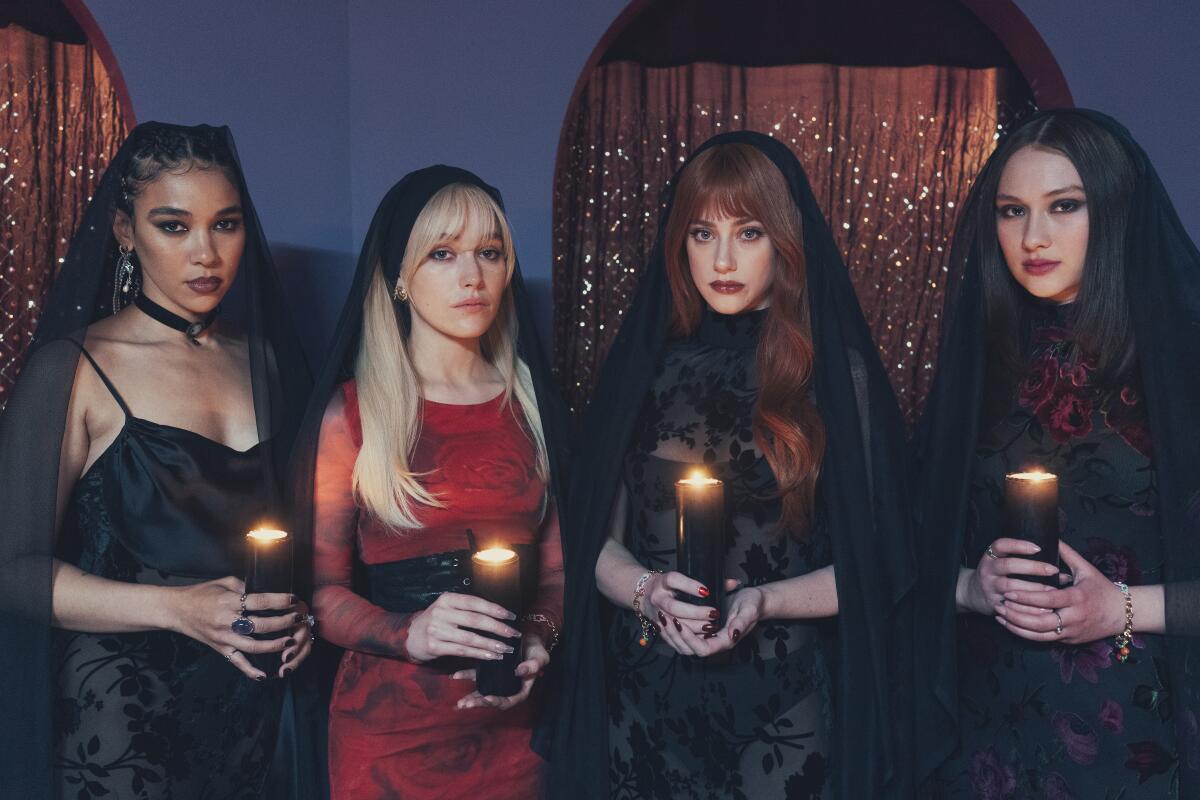
In another busy week for new releases, the horror-comedy “Forbidden Fruits” is among the standouts. Having just premiered at SXSW, it is the feature debut for director Meredith Alloway, who co-wrote the screenplay with Lily Houghton, adapting Houghton’s play. Diablo Cody is a producer on the film, and the movie shares a sensibility with her beloved “Jennifer’s Body.”
Set at a Texas shopping mall, the plot follows a group of female employees at a boutique who are secretly a coven of witches after hours. They bring a new employee into their fold. Lili Reinhart, Lola Tung, Victoria Pedretti and Alexandra Shipp star.

Alexandra Shipp, from left, Victoria Pedretti, Lili Reinhart and Lola Tung in the movie “Forbidden Fruits.”
(Sabrina Lantos / Independent Film Co. / Shudder)
Though Katie Walsh gave the film a mixed review, declaring it “essentially the fast fashion of girly pop horror,” the film casts a spell when it is working.
Pedretti in particular is a standout, and Malia Mendez spoke to her about the role. “It asks a lot of people to try to step into a world like this one,” Pedretti said of the film’s knowing, campy style. “And as nerve-racking as it may be to take that big swing, you gotta take the big swing.”
Also opening in L.A. this week is Sofia Coppola’s “Marc by Sofia.” The director’s first documentary, it’s more a snapshot than a definitive portrait of the life and career of her longtime friend, fashion designer Marc Jacobs, as he prepares for his spring 2024 collection. While not as in-depth or revealing as one would hope, the film has a warmth and charm all its own. And anyone feeling nostalgic for ’90s New York after watching the recent TV series “Love Story” will get a buzz from this too.
Larry Karaszewski on ‘Last Summer’

Richard Thomas, left, Barbara Hershey and Bruce Davison in the movie “Last Summer.”
(Warner Archive)
The American Cinematheque at the Aero Theatre on Sunday will host the world premiere of a new restoration of the theatrical version of 1969’s “Last Summer,” directed by Frank Perry from a screenplay by Eleanor Perry. Actors Barbara Hershey and Bruce Davison will be there for a Q&A moderated by screenwriter Larry Karaszewski.
“This is one of the holy grails for movie nerds,” says Karaszewski in a recent phone interview. The restoration happened in no small part thanks to his persistent and vocal fandom of the film. Best known for his work with writing partner Scott Alexander (including “Dolemite Is My Name” and “Ed Wood”) and currently a governor in the academy’s writer’s branch, Karaszewski is also a pillar of the repertory scene around Los Angeles, frequently moderating Q&As and an avid moviegoer.

Richard Thomas, left, Barbara Hershey and Bruce Davison in the movie “Last Summer.”
(Warner Archive)
“Last Summer” follows three teenagers (Hershey, Davison and Richard Thomas) whiling away the summer at the beach on New York’s Fire Island. As a certain psychosexual energy escalates among them, winding each other up, they turn their attention to a younger girl (Catherine Burns) and torment her in increasingly sadistic ways.
For her performance, Burns was nominated for an Oscar for supporting actress, while Hershey briefly changed her last name to Seagull after a bird was accidentally injured on set.
In his original July 1969 review, The Times’ Charles Champlin called “Last Summer” “a compelling and disturbing movie, with moments of quite extraordinary power and poignance.”
“This was a movie that people who saw it were just fascinated by,” says Karaszewski. “Even though it came out in ’69, it feels like an important ’70s-style movie, a really rough youth film that used the new freedom that cinema had at that time. But you couldn’t see it.”

Director Frank Perry and screenwriter Eleanor Perry during production of “Last Summer.”
(Warner Archive)
Over time, the rights to the movie changed hands, elements went missing and it became a rarity. Due to an intense rape scene, the movie was also briefly released to some theaters with an X-rating, though Karaszewski says the differences to the R-rated version are minimal — a matter of a few frames and a single word. Released on VHS, “Last Summer” has never been on DVD or Blu-ray. (The Warner Archive label will release a disc of the new restoration later this year.) An edited TV version of the film has circulated, and the last few times “Last Summer” has shown in Los Angeles, it has been from a print discovered at an archive in Australia.
Karaszewski has long had a fascination with the film, one that was only fueled by its inaccessibility.
“It became famous as just, ‘Oh, that’s the movie Larry champions, that’s the movie that Larry won’t stop talking about,’ ” he says. Karaszewski jokes that he won’t know what to do with himself now that his longtime obsession with seeing the film revived has been fulfilled.
“I’ve been championing it so long,” he says. “It could have been just like, ‘Oh, Larry’s a little crazy. He loves this movie.’ And that would’ve been fine too. I’m a person that feels like every movie should have its day in the spotlight.”
The complete Akira Kurosawa in 35mm

An image from Akira Kurosawa’s “Ran.”
(Rialto Pictures)
On Saturday, the Academy Museum launches “Darkness and Humanity: The Complete Akira Kurosawa,” a comprehensive retrospective of the Japanese filmmaker’s 30 existing features, all of which will screen in 35mm. The series opens with two of Kurosawa’s best-known films, “Seven Samurai” and “Rashomon.” Other highlights include “Throne of Blood,” “Ikiru,” “Hidden Fortress,” “Stray Dog,” “High and Low,” “Dreams” and “Ran.” This is a rare opportunity to take in the true breadth of Kurosawa’s work.
Writing about the filmmaker in 2009 to commemorate the centennial of his birth, Dennis Lim said, “The wonder of Akira Kurosawa’s 50-year career is that it was at once remarkably varied and satisfyingly coherent …. But the constant in his films was the principle of heroism, not as a vaporous ideal but a way of life, an awareness of individual agency and personal responsibility in a world that does not always reward or even allow heroic behavior.”

Toshiro Mifune in Akira Kurosawa’s “Yojimbo.”
(Janus Films)
Kurosawa’s influence on other filmmakers around the world has been widely acknowledged. Upon the news of Kurosawa’s death, Steven Spielberg proclaimed him “the visual Shakespeare of our time” and added, “I am deeply saddened by Kurosawa’s death. But what encourages me is that he … is the only director who right until the end of his life continued to make films that were recognized as, or will be recognized as, classics.”
In 1985, while in Los Angeles for a screening of his film “Ran,” Kurosawa described his own work by saying, “I just make up stories and film them. When I am lucky, the stories have a lifelike quality that makes them appealing to people and the film is successful.”
Points of interest
‘To Sleep With Anger’ in 35mm

Actor Danny Glover and director Charles Burnett during production of “To Sleep With Anger.”
(Samuel Goldwyn Company / Photofest)
To celebrate the release of Ashley Clark’s new book “The World of Black Film: A Journey Through Cinematic Blackness in 100 Films,” the UCLA Film and Television Archive will screen Charles Burnett’s 1990 drama “To Sleep With Anger” in 35mm at the Billy Wilder Theater on Sunday. Clark will be there for a book signing, and Burnett will join him for a Q&A.
Recently included as part of The Times’ ranked list of the 101 best Los Angeles movies, “Anger” stars Danny Glover in a galvanizing performance as Harry, an old friend from the South who arrives for an unexpected visit to a family in South Central L.A., upending their lives.
In his book, Clark describes the film as “a singular work with a distinct yet tantalizingly hard-to-pin-down performance from Danny Glover, who, as the inscrutable Harry, flickers between menace and charm, using all of his six-foot-four-inch stature to dominate the frame.”
In a 1990 Times story by David Wallace, Burnett spoke about how the film was meant to evoke a sense of Black cultural history, saying, “I didn’t appreciate the [storytelling] tradition until it disappeared. I had a sense of who I was because of that experience. … This film was an attempt to go back and deal with the past. To tell a story about a story.”
Added Glover: “I think there is a little of Harry in all of us. We’re constantly in conflict between the good side and the other. Harry’s involvement with the dark side is not that uncommon.”
Clark will also appear at the Academy Museum on Monday for the world premiere of Ngozi Onwurah’s restored 1995 film “Welcome II the Terrordome.”
‘Thank You for Smoking’

Aaron Eckhart in the movie “Thank You for Smoking.”
(Dale Robinette / Fox Searchlight Pictures)
On Saturday, Vidiots will host a 20th anniversary screening of Jason Reitman’s debut feature “Thank You for Smoking” in 35mm, with the filmmaker in attendance for a Q&A. Adapted by Reitman from a novel by Christopher Buckley, the film is media satire that follows the misadventures of a lobbyist (Aaron Eckhart) for Big Tobacco. The cast also includes Katie Holmes, Robert Duvall, William H. Macy and Sam Elliott.
In his original review, Kenneth Turan called the movie “that rare film that actually has a sense of humor,” before adding, “Reitman’s script and direction retain the novel’s rhythms and black comic sensibility while at the same time eliminating and/or rearranging large chunks of its plot. He’s also figured out a way to make the story more conventionally audience-friendly without losing the extraordinary bite that made the book so successful.”
I recall an afternoon spent on the Fox lot talking to Reitman and Buckley together for a piece I wrote in 2006. The political climate that the film examines, one of extreme partisanship, has only heightened in the years since.
“The compliment the book always got,” said Reitman at the time, “which I thought was wonderful, was Democrats always thought it was theirs and Republicans always thought it was theirs. Like all good satire, the book was a mirror. … It doesn’t feel like it’s coming from one way or the other. It’s ridiculing both, and hopefully the film does the same thing.”