grade

December Hurdle: Lossiemouth takes final Grade One win at Leopardstown

Lossiemouth took the final Grade One win of the year after holding off 2024 winner Brighterdaysahead in Monday’s December Hurdle at Leopardstown.

The pre-race favourite (4-6) produced the goods in what was an exciting finish as jockey Paul Townend delivered the victory for trainer Willie Mullins.

It was the first race of the season for Gordon Elliott’s Brighterdaysahead and the second favourite (5-2) made a late gallop with Jack Kennedy on board, but was unable to overhaul the favourite at the line.

“She was brilliant,” Townend said of the winner, speaking to RTE Sport.

“I hoped she’d get me out of trouble, like she did.

“I was anxious when Patrick [Mullins on Anzadam] flew over a couple of hurdles to go past us. It probably got us racing a bit sooner than if he hadn’t gone by me, but I wanted to mark him and cover all bases and make the rest of them dance to my tune as much as we could.”

Casheldale Lad set the early pace with Lossiemouth on the shoulder, while Brighterdaysahead stayed on the outside along the back straight.

Anzadam, with Patrick Mullins in the saddle, made a move to open a brief lead, yet it was Lossiemouth who roared back superbly and surged ahead on the home straight.

Brighterdaysahead rose to the challenge, narrowing the gap but had to settle for second with Casheldale Lad (16-1) pipping Anzadam for third.

Source link

Bob Baffert horses dominate on opening day at Santa Anita

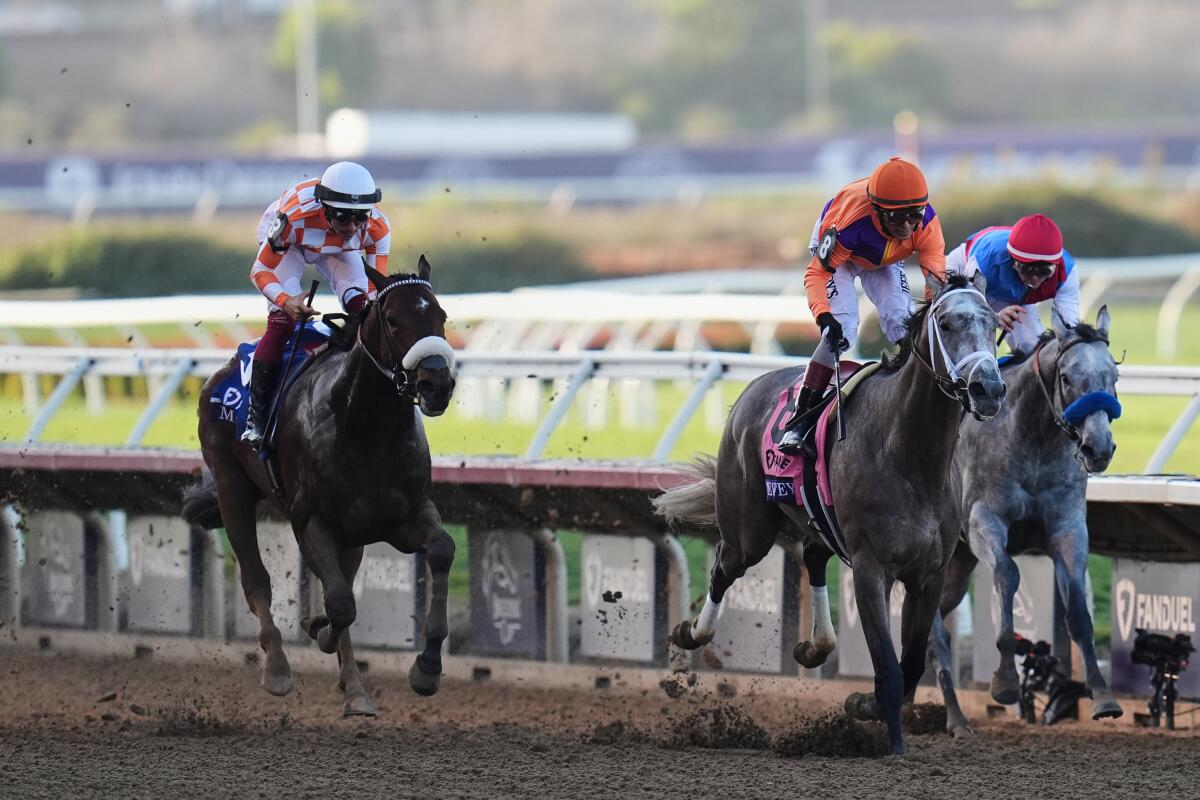
Opening day at Santa Anita might have been delayed by two days because of heavy rain, but it was worth the wait for no other reason than to watch the stretch run of the $200,000 Laffit Pincay Jr. Stakes.

And for trainer Bob Baffert, it was even better than that. Not only did Nysos and Nevada Beach run 1-2 for him Sunday in the thrilling Grade 2 Pincay, but he also captured the two Grade 1 races he entered, the La Brea with Usha and the Malibu with Goal Oriented.

It was the fourth time Baffert won three stakes on the same day at Santa Anita, including the same trio of races on opening day in 2022.

He was especially excited after the Pincay, and not just by what he saw on the track.

“You know what’s great?” Baffert said as he stood in the winner’s circle and motioned to the grandstand, which was crowded with an announced 41,962 fans, the largest opening day audience since 2016. “It’s great to see this place packed. Look, everybody came out. They’ll come out to see a good horse and everybody was on the apron for this one. And they saw a great horse race.

“It was actually fun watching.”

Particularly for Baffert, who knew as the field turned into the stretch he couldn’t lose. Nysos, the Breeders’ Cup Dirt Mile champion ridden by Flavien Prat, was on the inside of Nevada Beach, the Goodwood Stakes winner ridden by Juan Hernandez.

Nysos was the heavy 1-5 favorite, having lost only one of his seven lifetime races, but for at least a moment it looked as if he might not get past Nevada Beach, at 3 a year younger than his stablemate.

But, in a virtual rerun of the Dirt Mile, when Prat and Nysos edged past Hernandez and another Baffert 3-year-old, Citizen Bull, the older horse once again prevailed, again by a head.

“I was close,” Hernandez said. “My horse ran really good. I was in front on the stretch for a couple of jumps and then it was just back and forth between Nysos and my horse. … He was giving me everything he had.”

The Grade 2 Pincay (formerly the San Antonio) was one of six stakes races on opening day, which is traditionally held the day after Christmas. It wasn’t one of the three Grade 1 races, but the presence of Nysos made it feel like the day’s main event.

Nysos returned $2.40 after running 1 1/16 miles in 1:42.36, the fastest since the Pincay was moved to that distance in 2017.

Baffert said in the leadup to the race that Nysos likely would start next in the $20-million Saudi Cup on Feb. 14 in Riyadh, while Nevada Beach was more apt to go to the $3-million Pegasus World Cup next month at Gulfstream Park. After the Pincay, he didn’t rule out sending both to Saudi Arabia.

The only downside to Baffert’s stakes day was having to scratch Barnes and Cornucopian, the two morning-line favorites, from the Malibu. Barnes suffered a “minor setback” Saturday while Cornucopian had an incident in the paddock minutes before the race, which forced his withdrawal (he was uninjured).

No matter, though; Goal Oriented ($4.20) took over favoritism and earned his first stakes win, defeating stablemate Midland Money by a length in 1:20.97, the fastest Malibu since 2016.

“I’m just happy it turned out that we won it because it was so upsetting for a little bit,” Baffert said.

Usha ($13.20) was starting in a Grade 1 race for the first time, but she won the La Brea like a filly who has more victories in her future. She finished seven furlongs in a rapid 1:21.68 to beat 2-1 favorite Formula Rossa by 5¼ lengths.

The first of the six stakes races was the $200,000 Mathis Mile for 3-year-olds on the turf. Tempus Volat, trained by Leonard Powell, led the race but was passed in the final yard by Hiding in Honduras ($21.40), a 9-1 long shot ridden by Antonio Fresu for Jonathan Thomas. Namaron, the 1-2 favorite ridden by Prat, finished third.

There was no such drama in the second turf stakes, the $100,000 San Gabriel, in which Cabo Spirit ($14.80), trained by George Papaprodromou, took the lead shortly after the start under Mike Smith and rolled to a 1¼-length victory over Astronomer. Stay Hot, the 2-1 favorite, lost a photo for third to Mondego.

The final race of the day was the other Grade 1 event, the $300,000 American Oaks, won by another Thomas trainee, Ambaya, a 12-1 long shot. The daughter of Ghostzapper was ridden by Kazushi Kimura, who picked up the mount when Fresu injured his ankle earlier in the day.

Etc.

The two cards that were rained out over the weekend will be made up Monday and Wednesday, with free parking and admission. Both days will offer two stakes races; Monday’s highlight is the $200,000 Joe Hernandez, which includes Motorious and Sumter, who were 1-2 in the race last year, and Imagination, last month’s Breeders’ Cup Sprint runner-up who will be racing on turf for the first time.

Rain is forecast beginning Wednesday, with track officials saying they will monitor the situation before deciding on how it will affect the racing, if at all. The schedule calls for racing Thursday through Sunday before Santa Anita begins its normal schedule of Fridays through Sundays on Jan. 9.

Source link

Santa Anita opening day again delayed, but there are plenty of storylines to follow

p]:text-cms-story-body-color-text clearfix”>

People place bets at Santa Anita Park.

People place bets at Santa Anita Park, where purses have declined along with the number of horses racing and lack of money coming from off-site betting.

(Getty Images)

Figuring out the purse for 34 of the 35 graded stakes races at Santa Anita is, for horsemen anyway, maddeningly simple: Just look up the minimum purse required in North America.

For a Grade 1 race, that’s $300,000. It drops to $200,000 for Grade 2 races and $100,000 for Grade 3s.

Even the one local exception, the Santa Anita Derby, pays “only” $500,000 after offering $750,000 from 2021-24. The current amount is half the purse on offer for the top 3-year-old races at Gulfstream Park (Florida Derby) and Fair Grounds (Louisiana Derby), and just one-third what Oaklawn Park pays for the Arkansas Derby.

Last year the Santa Anita Derby attracted only five entries, which reduced the number of Kentucky Derby qualifying points available in the race. That almost kept Baeza, who finished second to Journalism in the Arcadia race, from qualifying for the Derby (he made it in the field only after another horse was scratched and wound up placing third).

It’s the same story for older horses, where Gulfstream offers the $3-million Pegasus World Cup next month plus turf races for $1 million and $500,000. Oaklawn Park has a half-dozen races worth at least $500,000 (two at $1.25 million), and Fair Grounds has three between $250,000 and $500,000. No Grade 3 race at any of those tracks offers less than $150,000.

All of that makes it harder for Santa Anita to attract top horses from those states, which increase purses with money from slot machines or casinos, something not available to California tracks. Santa Anita, however, has hiked its purses this meeting for maiden and allowance races.

Source link

Oklahoma college instructor fired after giving failing grade to a Bible-based essay on gender

The University of Oklahoma has fired an instructor who was accused by a student of religious discrimination over a failing grade on a psychology paper in which she cited the Bible and argued that promoting a “belief in multiple genders” was “demonic.”

The university said in a statement posted Monday on X that its investigation found the graduate teaching assistant had been “arbitrary” in giving 20-year-old junior Samantha Fulnecky zero points on the assignment. The university declined to comment beyond its statement, which said the instructor had been removed from teaching.

Through her attorney, the instructor, Mel Curth, denied Tuesday that she had “engaged in any arbitrary behavior regarding the student’s work.” The attorney, Brittany Stewart, said in a statement emailed to the Associated Press that Curth is “considering all of her legal remedies.”

Conservative groups, commentators and others quickly made Fulnecky’s failing grade an online cause, highlighting her argument that she’d been punished for expressing conservative Christian views. Her case became a flashpoint in the ongoing debate over academic freedom on college campuses as President Trump pushes to end diversity, equity and inclusion initiatives, and restrict how campuses discuss race, gender and sexuality.

Fulnecky appealed her grade on the assignment, which was worth 3% of the final grade in the class, and the university said the assignment would not count. It also placed Curth on leave, and Oklahoma’s conservative Republican governor, Kevin Stitt, declared the situation “deeply concerning.”

“The University of Oklahoma believes strongly in both its faculty’s rights to teach with academic freedom and integrity and its students’ right to receive an education that is free from a lecturer’s impermissible evaluative standards,” the university’s statement said. “We are committed to teaching students how to think, not what to think.”

A law approved this year by Oklahoma’s Republican-dominated Legislature and signed by Stitt prohibits state universities from using public funds to finance DEI programs or positions or mandating DEI training. However, the law says it does not apply to scholarly research or “the academic freedom of any individual faculty member.”

Home telephone listings for Fulnecky in the Springfield, Mo., area had been disconnected, and her mother — an attorney, podcaster and radio host — did not immediately respond Tuesday to a Facebook message seeking comment about the university’s action.

Fulnecky’s failing grade came in an assignment for a psychology class on lifespan development. Curth directed students to write a 650-word response to an academic study that examined whether conformity with gender norms was associated with popularity or bullying among middle school students.

Fulnecky wrote that she was frustrated by the premise of the assignment because she does not believe that there are more than two genders based on her understanding of the Bible, according to a copy of her essay provided to The Oklahoman.

“Society pushing the lie that there are multiple genders and everyone should be whatever they want to be is demonic and severely harms American youth,” she wrote, adding that it would lead society “farther from God’s original plan for humans.”

In feedback obtained by the newspaper, Curth said the paper did “not answer the questions for the assignment,” contradicted itself, relied on “personal ideology” over evidence and “is at times offensive.”

“Please note that I am not deducting points because you have certain beliefs,” Curth wrote.

Hanna writes for the Associated Press.

Source link

Trump’s economic claims collide with reality in a Pennsylvania city critical to the midterms

When Idalia Bisbal moved to this Pennsylvania city synonymous with America’s working class, she hoped for a cheaper, easier life than the one she was leaving behind in her hometown of New York City.

About three years later, she is deeply disappointed.

“It’s worse than ever,” said the 67-year-old retiree, who relies on Social Security, when asked about the economy. “The prices are high. Everything is going up. You can’t afford food because you can’t afford rent. Utilities are too high. Gas is too expensive. Everything is too expensive.”

Bisbal was sipping an afternoon coffee at the Hamilton Family Restaurant not long after Vice President JD Vance rallied Republicans in a nearby suburb. In the Trump administration’s second high-profile trip to Pennsylvania in a week, Vance acknowledged the affordability crisis, blamed it on the Biden administration and insisted better times were ahead. He later served food to men experiencing homelessness in Allentown.

The visit, on top of several recent speeches from President Trump, reflects an increasingly urgent White House effort to respond to the economic anxiety voiced by people across the country. Those worries are a vulnerability for Republicans in competitive congressional districts like the one that includes Allentown, which could decide control of the U.S. House in next year’s midterms.

But in confronting the challenge, there are risks of appearing out of touch.

Only 31% of U.S. adults now approve of how Trump is handling the economy, down from 40% in March, according to a poll from the Associated Press-NORC Center for Public Affairs Research. Yet Trump has called affordability concerns a “hoax” and gave the economy under his administration a grade of “A+++++.” Vance reiterated that assessment during his rally, prompting Bisbal to scoff.

“In his world,” Bisbal, a self-described “straight-up Democrat,” responded. “In the rich man’s world. In our world, trust me, it’s not an ‘A.’ To me, it’s an ‘F,’ ‘F,’ ‘F,’ ‘F,’ ‘F,’ ‘F.’”

Agreement that prices are too high

With a population of roughly 125,000 people, Allentown anchors the Lehigh Valley, which is Pennsylvania’s third-largest metro area. In a dozen interviews last week with local officials, business leaders and residents of both parties, there was agreement on one thing: Prices are too high. Some pointed to gas prices while others said they felt the shock more at the grocery store or in their cost of healthcare or housing.

Few shared Trump’s unbridled boosterism about the economy.

Tony Iannelli, the president and CEO of the Greater Lehigh Valley Chamber of Commerce, called Trump’s grade a “stretch,” saying that “we have a strong economy but I think it’s not yet gone to the next stage of what I would call robust.”

Tom Groves, who started a health and benefits consulting firm more than two decades ago, said the economy was at a “B+,” as he blamed the Affordable Care Act, widely known as Obamacare, for contributing to higher health costs, and he noted stock and labor market volatility.

Joe Vichot, the chairman of the Lehigh County Republican Committee, referred to Trump’s grade as a “colloquialism.”

Far removed from Washington’s political theater, there was little consensus on who was responsible for the high prices or what should be done about it. There was, however, an acute sense of exhaustion at the seemingly endless political combat.

Pat Gallagher was finishing lunch a few booths down from Bisbal as she recalled meeting her late husband when they both worked at Bethlehem Steel, the manufacturing giant that closed in 2003.

Now retired, Gallagher too relies on Social Security benefits, and she lives with her daughter, which helps keep costs down. She said she noticed the rising price of groceries and was becoming exasperated with the political climate.

“I get so frustrated with hearing about the politics,” she said.

A front-row seat to politics

That feeling is understandable in a place that often gets a front-row seat to the national debate, whether it wants the view or not. Singer Billy Joel’s 1982 song “Allentown” helped elevate the city into the national consciousness, articulating simultaneous feelings of disillusionment and hope as factories closed.

In the decades since, Pennsylvania has become a must-win state in presidential politics and the backdrop for innumerable visits from candidates and the media. Trump and his Democratic rival in 2024, Kamala Harris, made several campaign swings through Allentown, with the then-vice president visiting the city on the eve of the election.

“Every race here, all the time,” Allentown’s mayor, Democrat Matt Tuerk, recalled of the frenzied race last year.

The pace of those visits — and the attention they garnered — has not faded from many minds. Some businesses and residents declined to talk last week when approached with questions about the economy or politics, recalling blowback from speaking in the past.

But as attention shifts to next year’s midterms, Allentown cannot escape its place as a political battleground.

Trump’s win last year helped lift other Republicans, such U.S. Rep. Ryan Mackenzie, to victory. Mackenzie, who unseated a three-term Democrat, is now one of the most vulnerable Republicans in Congress. To win again, he must turn out the Republicans who voted in 2024 — many of whom were likely more energized by Trump’s candidacy — while appealing to independents.

Mackenzie’s balancing act was on display when he spoke to the party faithful Tuesday, bemoaning the “failures of Bidenomics” before Vance took the stage at the rally. A day later, the congressman was back in Washington, where he joined three other House Republicans to rebel against the party’s leadership and force a vote on extending Obamacare subsidies that expire at the end of the year.

Vichot, the local GOP chairman, called Mackenzie an “underdog” in his reelection bid and said the healthcare move was a signal to voters that he is “compassionate for the people who need those services.”

A swing to Trump in 2024

Lehigh County, home to Allentown and the most populous county in the congressional district, swung toward Trump last year. Harris’ nearly 2.7-percentage-point win in the county was the tightest margin for a Democratic presidential candidate since 2004. But Democrats are feeling confident after a strong performance in this fall’s elections, when they handily won a race for county executive.

Retaking the congressional seat is now a top priority for Democrats. Gov. Josh Shapiro, a Democrat who faces reelection next year and is a potential presidential contender in 2028, endorsed firefighter union head Bob Brooks last week in the May primary.

Democrats are just a few seats shy of regaining the House majority, and the first midterm after a presidential election historically favors the party that’s out of power. If the focus remains on the economy, Democrats are happy.

The Uline supplies distribution factory where Vance spoke, owned by a family that has made large donations to GOP causes, is a few miles from the Mack Trucks facility where staff was cut by about 200 employees this year. The company said that decision was driven in part by tariffs imposed by Trump. Shapiro eagerly pointed that out in responding to Vance’s visit.

But the image of Allentown as a purely manufacturing town is outdated. The downtown core is dotted by row homes, trendy hotels and a modern arena that is home to the Lehigh Valley Phantoms hockey team and hosts concerts by major artists. In recent years, Latinos have become a majority of the city’s population, driven by gains in the Puerto Rican, Mexican and Dominican communities.

“This is a place of rapid change,” said Tuerk, the city’s first Latino mayor. “It’s constantly changing ,and I think over the next three years until that next presidential election, we’re going to see a lot more change. It’s going to be an interesting ride.”

Sloan writes for the Associated Press.

Source link