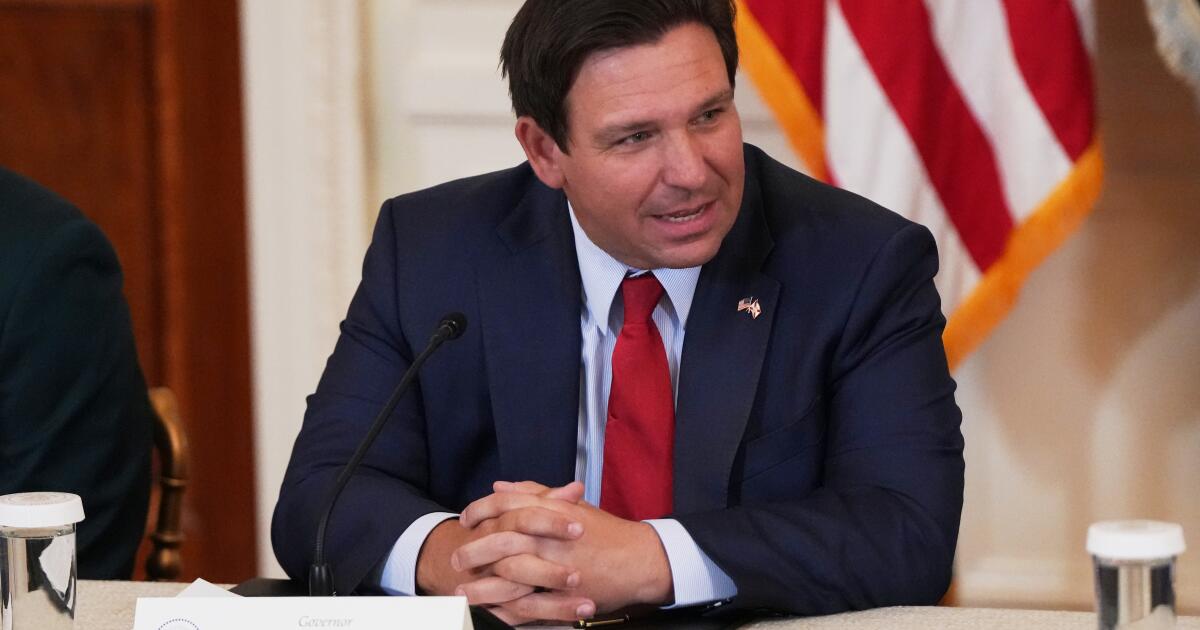
TAMPA, Fla. — Gov. Ron DeSantis signed a measure into law Monday that gives him along with other Florida leaders the ability to label groups as domestic or foreign terrorist organizations and expel state university students who support them.
The law, criticized by free speech advocates, allows a top official at the Florida Department of Law Enforcement to designate a group as a domestic or foreign terrorist organization, with the governor and three other members of the Florida Cabinet approving or rejecting the designation. Besides the governor, the Cabinet is made up of the attorney general, the chief financial officer and the agriculture commissioner, all of whom are elected separately.
Once designated a terrorist organization, a group can be dissolved and it can no longer receive any state funding through school districts or state agencies. Universities also would have to report the status of expelled students attending on visas to U.S. Immigration and Customs Enforcement.
“So this will help the state of Florida protect you. It’ll help us protect your tax dollars,” DeSantis said at a news conference in Tampa. “It’ll help us protect things that should not be happening in the United States of America, but certainly shouldn’t be happening in the free state of Florida.”
DeSantis in December designated the Council on American-Islamic Relations and the Muslim Brotherhoods as foreign terrorist organizations. A federal judge last month temporarily blocked the enforcement of DeSantis’ executive order.
PEN America, a free speech advocacy group, said the new law has vague language that could restrict education programs deemed to be “promoting” terrorism and that it could target student protesters who criticize Florida officials.
The new law “could chill education at every level,” said William Johnson, PEN America’s Florida director. “The implications are fraught.”
Billionaire hedge fund founder turned environmental warrior Tom Steyer, a leading Democratic candidate for California governor, is facing mounting questions about how he earned his wealth — notably investments in private prisons that are now being used to house undocumented immigrants facing deportation.
Some of the most vicious political attacks come from his Democratic rivals and Sacramento special interest groups as the June 2 primary election fast approaches, but Steyer has been dogged for years about his past, controversial business ventures and how they help fund his unbridled campaign spending.
Steyer, 68, faced that ire during a town hall event in San Diego last week.
“Tom, you’re not going to come to San Diego and ignore this detention center,” Holly Taylor, a 37-year-old Democrat screamed at Steyer, holding signs with QR codes to help detainees at an Otay Mesa private prison that Steyer’s hedge fund backed. “It’s a concentration camp. They’re drinking water out of a toilet.”
Taylor, a crime scene cleaner from Pacific Beach, is among scores of people who gather weekly at the facility to raise money for detained immigrants to provide them some comfort amid the Trump administration’s Immigration and Customs Enforcement raids.
In 1986, Steyer, co-founded Farallon Capital, which had shares valued at $89.1 million in the Corrections Corp. of America in 2005, according to the Securities and Exchange Commission. That company, now known as CoreCivic, operates private prisons around the nation that are housing people picked up by federal immigration agents, including the one in Otay Mesa.
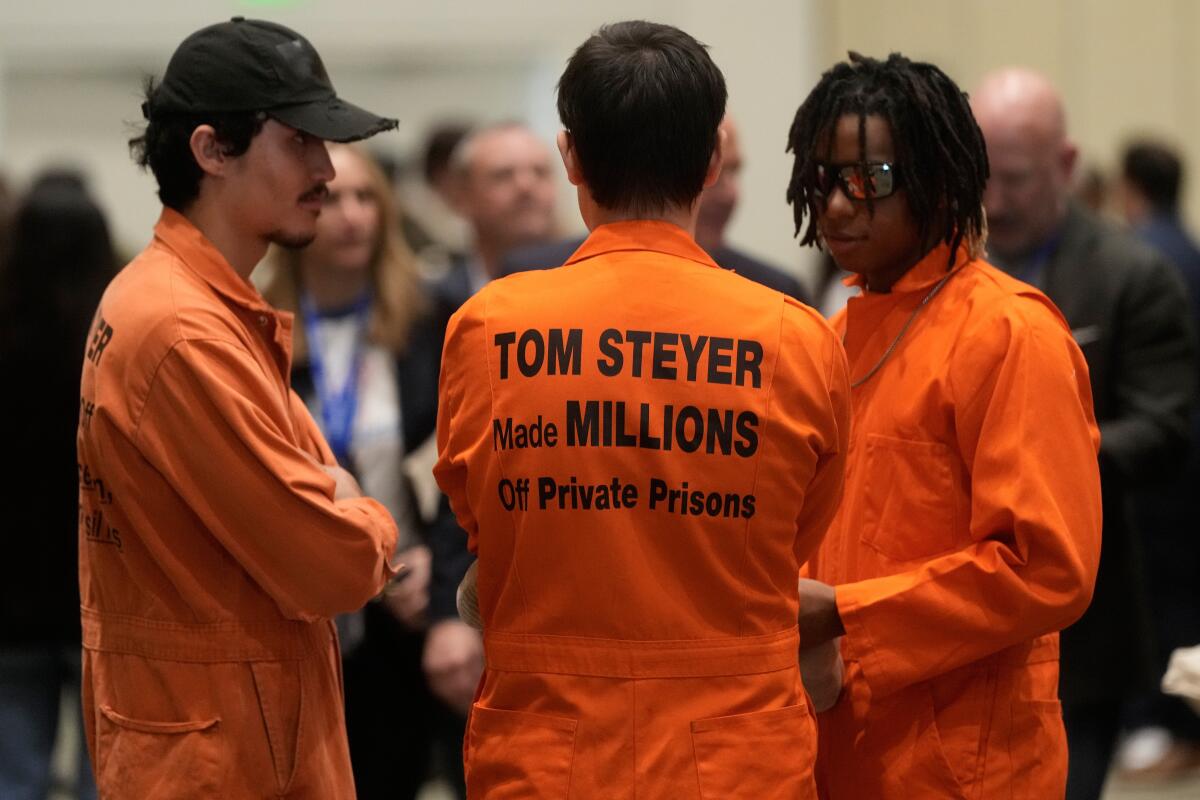
It is not the first time Steyer has faced criticism about the connection with private detention facilities. At the California Democratic Party convention in February, protesters dressed in orange prison jumpsuits sought to draw attention to the controversy.
“Before he was a progressive, he made millions off of companies that operate ICE detention centers, that operate private prisons that incarcerated young children,” state Supt. of Public Instruction Tony Thurmond said during a recent interview with a political influencer known as Mrs. Frazzled.
“His entire campaign is built on the backs of kids in cages,” Rep. Eric Swalwell, (D-Dublin) wrote Tuesday in a post on X.
People protest outside of a lunch held by California gubernatorial candidate Tom Steyer at the 2026 California Democratic Party State Convention in San Francisco on Feb. 21.
(Jeff Chiu / Associated Press)
Several years earlier, Yale University’s graduate teachers union called upon the school — Steyer’s alma mater — to divest from Farallon because of concerns about how the private prison company treated detainees, notably minorities.
Steyer has repeatedly expressed remorse about his former firm’s ties with the detention company. In 2012, he sold his stake in Farallon, which was named in reference to islands off the coast of San Francisco and was once one of the largest hedge funds in the world.
“I deeply regret that Farallon made that investment, and I personally ordered the investment in CCA to be sold because it did not accord with my values then or now,” Steyer told The Times in 2019 after he launched a short-lived presidential campaign.
Asked to comment about the latest iteration of the controversy, Steyer’s campaign pointed to comments he made in March at a town hall in San Francisco about how among the hundreds of thousands of companies his hedge fund invested in, the private prison company changed the course of his life.
“It was a mistake, and I sold it over 20 years ago, thinking, not that it won’t be profitable, it’s just a mistake. I don’t want to be in that business. But let me say this, it wasn’t just a mistake,” Steyer said. “It was also a big wake-up call that I was in the wrong place, that I was in a business that was taking me to places I absolutely didn’t want to go. And there’s a reason I walked away from that business and walked away from a ton of money, because I felt like that is not the life I want.”
He added that he and his wife, Kat Taylor, have spent the past two decades pushing for rehabilitative justice — treatment instead of mass incarceration except for violent felons.
“Am I a perfect person? No, have I made mistakes? Yes,” Steyer said. “But for those of you who like to read the Bible, there is a moment on the road to Damascus when someone makes a change, and I have made a big change, and I did it a long time ago, and I’ve been pushing very, very hard the other way.”
Farallon also invested in fossil fuel projects, including an Australian coal mine that denuded thousands of acres of koala habitat and generated an enormous amount of carbon emissions.
Steyer, who has a net worth of $2.4 billion according to Forbes, has painted himself as a reformed billionaire who walked away from Farallon because of angst about how he earned his fortune. He has spent hundreds of millions of dollars supporting Democratic causes, notably efforts to fight climate change.
“The truth is that is not where I think there is value, and that is not what I’m seeking in my life,” he said at a Sacramento town hall in March when retired state employee Gina Coates asked how, as a woman of color, she could believe his promises given his privilege as a wealthy white man.
“In terms of trusting me, let me say this, I left my business 14 years ago, and anybody who cared about money would not have done it,” Steyer said.
Steyer later said at the town hall that he left Farallon because he realized that he didn’t want to remain on that path.
“I want to have a meaningful life,” he said. “I want to stand with the people of this state and have actual prosperity. Twelve trillionaires and 40 million people who can’t make rent is not success.”
But Steyer and his wife continue to receive significant income from the hedge fund, including millions of dollars in investments, holdings and various complicated transactions in 2024, according to a statement of economic interest and tax returns he was required to file with the California Secretary of State’s office because of his gubernatorial run.
A Steyer campaign spokesman said Steyer created guardrails to ensure that he does not profit off companies he morally disagrees with.
“Tom has put in place an investment policy to ensure that he does not directly invest in fossil fuels, payday lending, or private prisons,” spokesman Anthony York said. “To the extent he inadvertently incurs exposure to those industries through third-party managers or liquid legacy investments, Tom will donate all profits to charity.”
After leaving Farallon, Steyer became one of the nation’s top Democratic donors. And he has used his wealth to fund his political ambitions. Steyer contributed nearly $342 million of his own money to his short-lived 2020 presidential campaign, according to the Federal Election Commission.
In the 2026 governor’s race, Steyer has donated nearly $112 million to his campaign as of Thursday, according to the California secretary of state’s office. He has been an ubiquitous presence on the airwaves, including local news programs and campaign ads that aired during the “Puppy Bowl” on the Animal Planet channel on Super Bowl Sunday. In the past month, Steyer has aired more than 5,000 ads, according to iSpot, which tracks television commercials.
California, home to 23.1 million registered voters, is home to some of the nation’s most expensive media markets. And candidates, particularly those who are not well known, need to spend heavily on television advertising if they hope to have a successful campaign.
But money is no guarantee of success. Billionaire Meg Whitman, the former eBay chief and formerly a longtime Republican donor, spent $144 million of her money on her 2010 gubernatorial bid. That set a record for a candidate’s contribution in a state race at the time, but Whitman lost to Jerry Brown by nearly 13 percentage points.
In 1998, Democratic multimillionaire Al Checchi who had been the co-chair of Northwest Airlines spent $40 million of his wealth on an unsuccessful run for governor, also a record at the time.
Steyer is one of the top three Democrats in the sprawling field to replace termed-out Gov. Gavin Newsom. And his liberal positions are drawing the ire of powerful forces in Sacramento. On Tuesday , the state’s Realtors donated $5 million to an independent expenditure committee opposing Steyer’s bid.
Taylor, who confronted Steyer at the San Diego town hall, said she had not planned to be so vocal. But as the event unfolded, she decided she had to speak, not only to Steyer but to the attendees. She and her compatriots gather every Sunday outside the Otay Mesa facility to raise money to help detainees buy food in the prison commissary and call their families.
“My main issue is that he has gotten financial gain off of these people suffering,” she said.
That’s for sure. It’s reminiscent of the panic that followed Joe Biden’s wretched debate performance in Atlanta, the biggest disaster to hit the city since a 2009 flood caused more than half a billion dollars in damage.
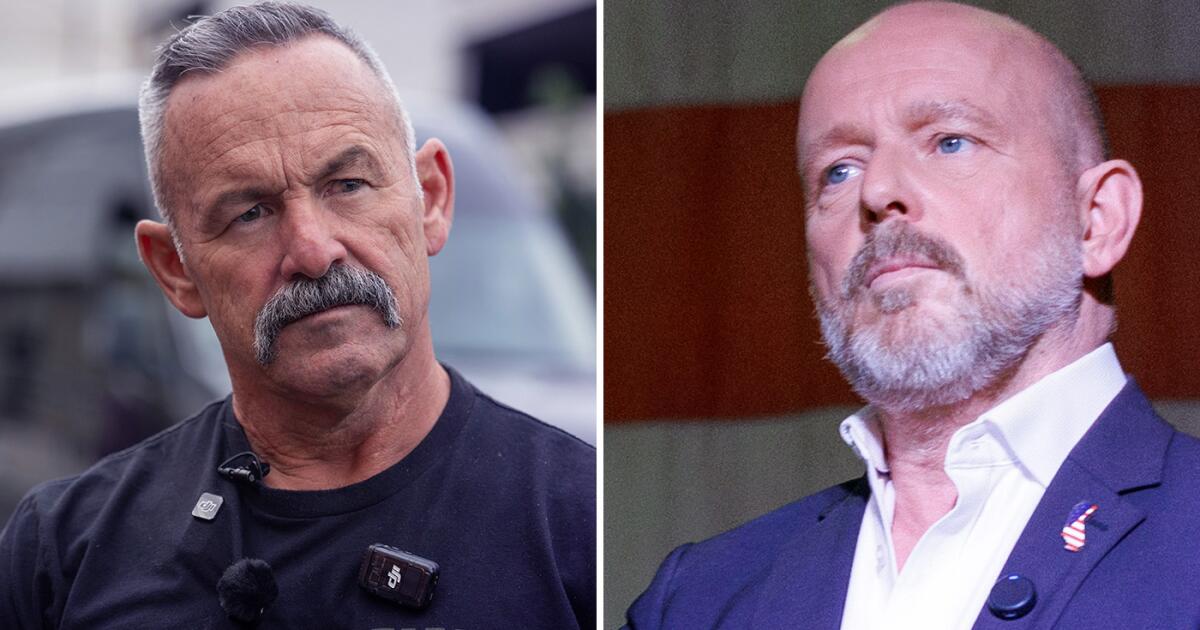
In California, the high anxiety is a result of the state’s “jungle” primary, in which all candidates appear on the same ballot, regardless of party, with the top two finishers advancing to a November runoff. With so many Democrats running, there’s the genuine prospect of them splintering partisan support, resulting in the leading GOP candidates — Chad Bianco and Steve Hilton — grabbing both slots and moving past June 2.
How likely is that to happen?
I can’t say. And Nostradamus is away on spring break.
But one of California’s leading political savants, Paul Mitchell, has developed a helpful online tool to suss out the possibilities. Visitors to his site have run tens of thousands of simulations, which right now put the odds of a Democratic freeze-out at about 17% to 20%.
Which suggests it’s unlikely. But it’s also not impossible.
Why don’t some Democrats step aside, for the good of the party?
That’s easy for you to say.
Anyone putting themselves out there by seeking public office has to have a certain amount of faith, in both their capabilities and the prospect of good fortune smiling upon them. (Luck being a greatly undervalued factor in political success.)
To be clear, no one is running away with the gubernatorial contest. For all the talk of Republicans “leading” in the polls, it’s more like a four- or five-way tie for first place, when you factor in the margin of error. And 20% support — which is roughly what the top candidate receives in surveys — is hardly a number to strike fear in the heart of rivals.
Several of the candidates mired near the bottom of polls — Antonio Villaraigosa, Xavier Becerra,Betty Yee — are probably looking at the end of the line if they lose this race. So you can understand, if not necessarily agree with, their reluctance to drop out and call it a day, in the hope that, just maybe, that proverbial bolt of lightning will strike.
So why doesn’t someone force some candidates to drop out?
Like who? There is no Tammany Hall. This isn’t Chicago under Boss Daley. Modern-day California has never had that kind of all-powerful political machine.
The closest approximations were in San Francisco, where brothers Phil and John Burton held great sway, and Los Angeles, where another pair of siblings, Howard and Michael Berman, exercised enormous clout with their compatriot, Henry Waxman. But their influence was mainly limited to Congress, the Legislature and local politics. They weren’t kingmakers when it came to electing California governors.
And the two major political parties, which never wielded the power they enjoy in other states, have become even less influential in this entrepreneurial age of politics, when candidates raise their money online and boost their profile by going on the political chat shows on TV.
The governor could certainly try to pare the Democratic field. But he’d risk humiliating himself and hurting his presidential prospects in the process.
How so?
It would be embarrassing if Republicans were to seize the governorship on Newsom’s watch. (At least among those political insiders who pay attention to that kind of stuff.) It would also be embarrassing if the governor tried to muscle candidates aside and failed.
It’s not at all clear Newsom would have much clout. He isn’t particularly close to any of the candidates running. No one needed his blessing to enter the race, or his backing to sustain their candidacy. And there isn’t very much the term-limited governor, playing out his final months in office, can offer as incentive to quit.
Newsom also has to consider how it would look if he tried to ease out the laggards — whose ranks happen to include all the prominent candidates of color: Becerra, Villaraigosa, Yee and state Supt. of Public Instruction Tony Thurmond.
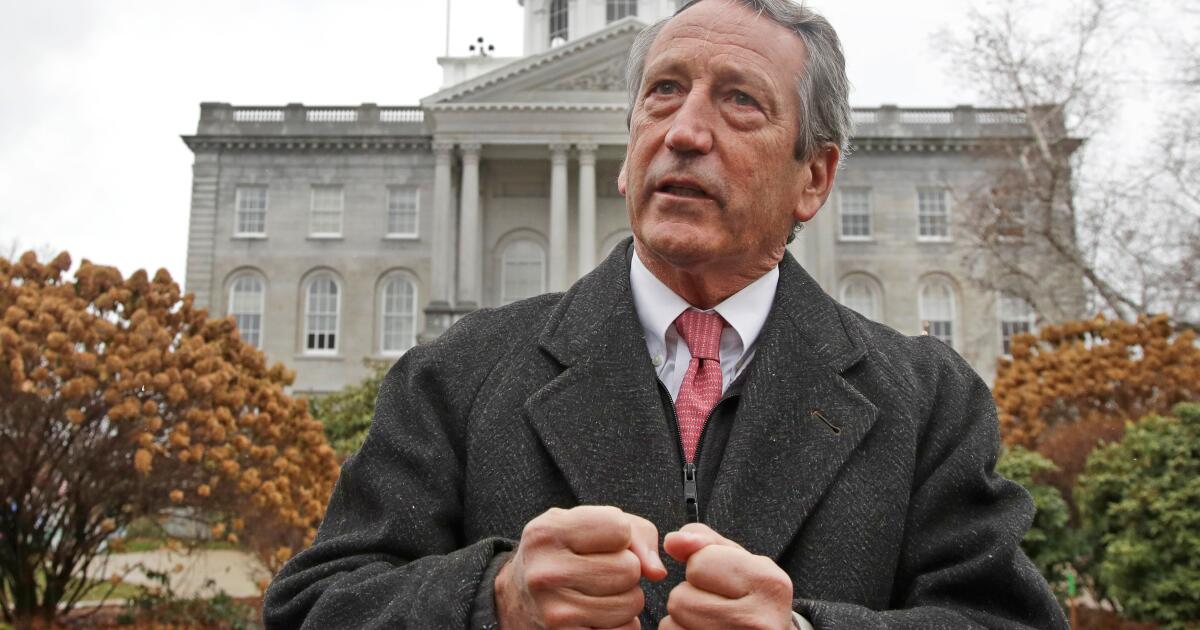
COLUMBIA, S.C. — Mark Sanford, the former South Carolina congressman and governor whose political ascendancy was stalled by a 2009 affair, wants to return to Congress — again.
Just hours ahead of the deadline to do so, Sanford filed candidacy paperwork with state officials to run in the June 9 GOP primary for South Carolina’s 1st District seat, which he has held twice before.
Sanford’s first political office was in the 1st District. An outsider with almost no name recognition, he navigated a primary for the open seat, finishing second before winning the runoff. He served for six years before his outside run at governor, again pushing his way through a crowded primary, then knocking off the last Democrat to hold the office.
But his eight years were overshadowed by the Appalachian Trail, which became shorthand for Sanford’s disappearance to go to Argentina to see his lover. Sanford’s wife, family and his staff didn’t know where he was.
Beating back both an ethics inquiry and calls to resign, Sanford held fast, leaving office on his own terms.
In 2013, Sanford won back his old seat, beating 15 other candidates in a primary and runoff. He won two more full terms before falling to a GOP challenger in 2018 who had President Trump’s backing.
The seat would go on to flip to Democratic hands that fall for the first time in decades, won back by GOP Rep. Nancy Mace in 2020. Mace is running for governor this year.
Sanford, 65, also briefly ran for president in 2020, challenging Trump for the nomination in what he characterized as a “long shot” effort around warnings about the national debt. Some, including Sanford’s former gubernatorial staffers, initially questioned whether the effort was a serious one, positing that it might be an effort to stay relevant after the 2018 defeat.
Sanford dropped out of the contest just ahead of the New Hampshire primary. Sanford’s home state would ultimately opt not to hold a 2020 GOP presidential primary, clearing the way for Trump’s nomination in South Carolina.
Sanford did not immediately return a message seeking comment on Monday. True to the themes that have dominated his political thinking, an email release on Sanford’s candidacy focused on the national debt, with the candidate saying he felt 1st District voters wanted a representative “who is an advocate for financial sanity that has been lost in Washington for all too long.“
Since leaving the U.S. House, Sanford has hung onto more than $1.3 million in a federal campaign account, funds that he can now use in a primary already crowded with multiple Republican and Democratic candidates.
Kinnard and Collins write for the Associated Press.
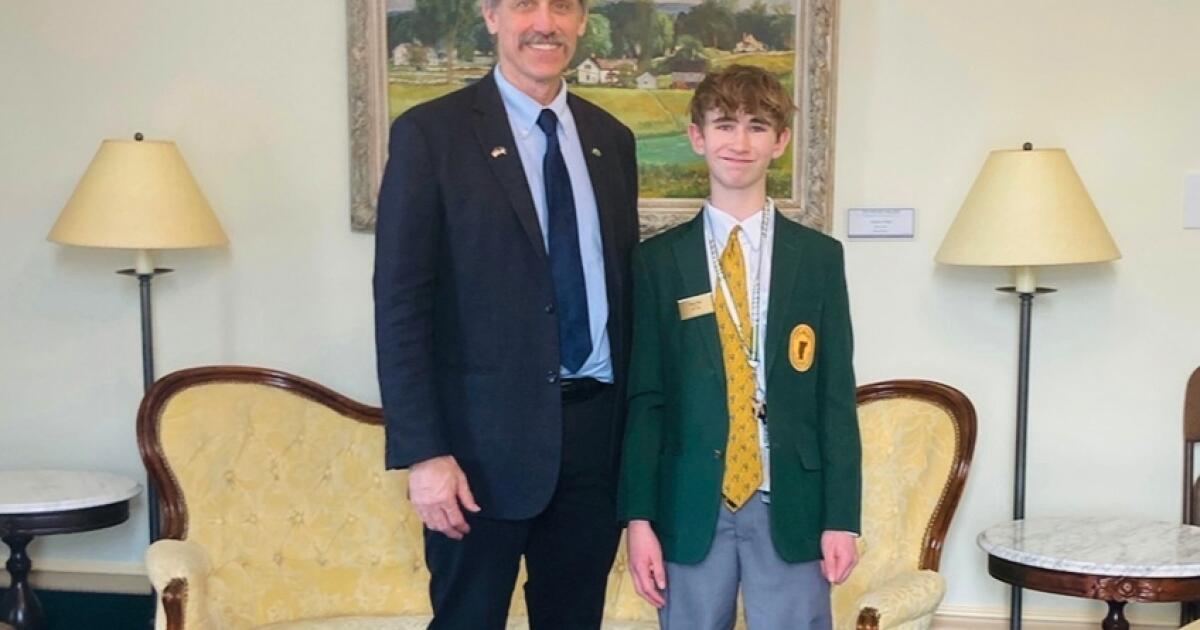
STOWE, Vt. — Looking back, gubernatorial candidate Dean Roy says his political ambitions started in the eighth grade. And by that he means last year.
After working as a legislative page at the Vermont Statehouse, the 14-year-old freshman at Stowe High School now has his sights set on the corner office. In November, he’ll be the first candidate for governor under age 18 to appear on the state’s general election ballot.
“I don’t expect necessarily to win,” he said. “What I do expect is to start the movement, and get more young people to come in behind me and say, ‘Yeah, we also want to make change.’”
Another eighth-grader, Ethan Sonneborn, sought the Democratic nomination for governor in 2018 but finished last in a four-way primary. Roy secured his spot in the general election by creating his own third party, the Freedom and Unity party. Both were able to run because the state constitution sets no minimum age for gubernatorial candidates, requiring only that candidates have resided in the state for four years.
“I know it sounds crazy, a 14-year-old running for governor, but honestly, look at the people in charge right now,” Roy said in a post on his campaign’s Instagram page. “They’ve been doing this forever and things still aren’t working.”
Nearly all other states set minimum age requirements for governor, often 30 years old. In Kansas, lawmakers added a requirement that gubernatorial candidates be at least 25 years old in 2018 after six teenagers ran for office.
Peter Teachout, a professor at Vermont Law and Graduate School, has a different take than Roy on Vermont’s constitution. He points to a section in the document referring to what qualifies someone to be “entitled to the privileges of a voter,” and that is that they must be 18 years of age. Even under Roy’s interpretation, Teachout doesn’t predict a win for the teenager.
“In theory, a 4-year-old could run for governor. Should we be worried about it? No,” he said. “Vermonters can be a little cantankerous and provocative just for the fun of it, but it is not something they are likely to support in this context.”
But Roy’s former history teacher, James Carpenter, said he thinks it’s great that Roy is giving it his all. Though most 14-year-olds aren’t concerned with property taxes or healthcare, Carpenter describes Roy as an “old soul” with endless curiosity.
“It just really shows what type of kid Dean is. He’s very earnest in what he’s doing. There’s no gimmick behind this,” he said. “I think he blends that youthful optimism with some pragmatism that few kids have.”
Roy, who said he doesn’t identify with either major party, said housing is the most important issue facing the state. He’s also thought about how he’d juggle school with a full-time job as governor, saying he’d consider online classes and would do his homework at night after work.
The current governor, Republican Phil Scott, applauds Roy’s interest in politics and public service but questions whether someone so young is ready for the responsibilities that come with running a state.
“He believes it’s important for our youth to get involved,” said Press Secretary Amanda Wheeler. “But the governor also believes that a teenager may not be best suited to serve in that role given the lack of experience and lived perspectives youth have at that point in their lives.”
Roy disagrees that age has anything to do with whether a candidate is fit to run for office.
“What I’m aiming for is that these career politicians look at me and they say, ‘Oh my God, he actually has a chance to disrupt things,’” he said. “If I can get people to think that I am a threat to them, then I know that’s been a success. Because what I want is to show them that the youth have a voice. We’re gonna make change. The future is now.”
Swinhart writes for the Associated Press. AP reporter Holly Ramer contributed to this report from Concord, N.H.
Once upon a time in California, I went to the Orange County fairgrounds to watch Arnold Schwarzenegger give the signal for a wrecking ball to drop onto a vehicle.
The audience went wild, and Schwarzenegger went on to become governor and deliver on his promise to roll back a car tax increase, thereby blowing a $4-billion hole in the state budget.
I think it’s fair to say that in the current gubernatorial campaign season, the excitement level is several decibels below what we experienced in 2003. But once again, it’s fair to say we’ve not seen anything quite like this year’s derby.
“There’s no historical precedent in modern California history for a governor’s race with such a large field or such an amorphous field of candidates,” said longtime political observer Dan Schnur. “Unless you’re paying very close attention, it feels like a big multi-headed political blob.”
The two Republicans could be the top two vote-getters because the Democrats have arranged themselves into a circular firing squad. While the Dems scramble for votes in the June 2 primary, the two Republicans lead in the polls because they’re splitting the GOP vote, and under the rules of the top-two primary, they could face off in the November election.
That means that California, which is one of the bluest states in the country and has nearly twice as many registered Democrats as Republicans, could end up with a Republican governor, which would be like having a Dodgers manager who wears a Yankees jersey in the dugout.
And by the way, if it happens, the Republican would be able to shuffle regulatory boards, attempt to squeeze budgets and create a bit of chaos, but still not get much accomplished because of Democratic super-majorities in the Senate and Assembly.
And he would be targeted for recall even before he takes office. (More on that in a minute.)
There is a way for the Democrats to avoid this humiliation, but they can’t seem to agree on anything at the moment. Party leaders have all but asked the candidates at the bottom of the polls to bow out, but understandably the response has been, “Why me? I’m no worse than the others.”
USC decided to host a debate night, a simple enough proposition, but then flubbed the deal by leaving four candidates off the invitation list — four candidates of color. A kerfuffle followed, and the debate was dumped, and an attempt to let everyone into the party fell apart.
So now what?
It’s possible the Dems will huddle around one or two candidates who then move up in the polls and remove the threat of the unthinkable — two Republicans head-to-head. That would be Riverside County Sheriff Chad Bianco going against former Fox TV host Steve Hilton.
It’s also possible the Dems will play dirty and either spend money to promote one of the two Republican candidates or torpedo one of them. All they want, at the moment, is for a Democrat to make it past the primary, because that would all but ensure victory in November, given voter registration advantages.
And then, if that doesn’t work, there’s the recall scenario.
“You could shut it down probably within five or six months,” said Mike Madrid, a longtime California GOP political consultant.
“It would surely happen,” said Rob Stutzman, a GOP strategist who helped Schwarzenegger knock Gov. Gray Davis out of office, and take his job, in the 2003 recall.
A wealthy Democratic donor could bankroll the recall campaign, Stutzman said. Or public employee unions might put up the money, given that a Republican winner is likely to create a state version of Elon Musk’s ham-handed attempt to fire nearly everyone on the federal payroll.
“The pitch,” Stutzman said of the recall strategy in an email, would be that “Trump still looms and CA must resist, and a GOP gov is a fluke of weird election law. Difficult to imagine it wouldn’t succeed.”
I thought of one more approach the Democrats could use to make sure at least one of them is on the ballot in November. Tom Steyer, a leader for many years on one of the most critical issues in California and the world, climate change, has already spent tens of millions of dollars on TV ads that run about every two minutes, promoting him as the best candidate for governor.
They’re so repetitious, you can’t help but tune them out.
But everyone would pay close attention if Steyer instead ran ads offering incentives for either Bianco or Hilton to leave the state. Steyer could offer $10 million cash for Bianco to move to Hawaii, and maybe throw in a beach house. He could buy a private jet for Hilton to take him back to his native Britain. Every day, there could be new ads upping the ante until one of them leaves the Golden State.
Wouldn’t that be a better use of Steyer’s money? It might even get him elected.
To be honest, having some honest pushback against Democratic authority in California wouldn’t be a terrible thing. It’s not as if Gov. Gavin Newsom and other Democrats are winning the battle against homelessness, housing shortages, affordability and other big challenges, and voters understandably want more — way more — for their tax dollars.
An experienced, no-nonsense, sensible, fiscally conservative GOP candidate would do the state good.
The problem is that the two Republicans in the running, Bianco and Hilton, are Trump toadies.
In an embarrassingly amateurish political stunt, Bianco blew the president a kiss and all but begged for an endorsement by seizing 650,000 ballots from last November’s election to determine whether they were fraudulently counted.
Hilton recently said in an interview with ABC’s Eyewitness News 7 that he believes “everybody supports” Trump’s immigration policies.
Hilton might have missed the news that U.S.-born residents are carrying their passports in case they’re targeted by skin color. That Californians by the thousands have joined the resistance. That despite claims, most deportees don’t have criminal records. And that even some of the state’s GOP lawmakers have begged Trump to stop raiding industries that rely on immigrant help (and are often owned by Republicans).
And by the way, is this a smart time for a GOP candidate in California to be doing his best Trump impression?
The president’s popularity is down, consumer prices are up, he’s shamelessly pardoned drug lords and Jan. 6 barbarians, he thinks the presidency is a game of Battleship after promising to keep us out of wars, gas prices are sky high, he just said he was glad that Vietnam War hero and former FBI Director Robert Mueller had died, and he’s playing golf all day as if everything’s hunky dory.
Like I said, there’s not a big-name character like Schwarzenegger in the race, but that doesn’t mean there aren’t good options. If you like Bianco or Hilton, so be it. Otherwise I suggest you read up on the other eight:
Steyer, Supt. of Public Instruction Tony Thurmond, former L.A. Mayor and legislative leader Antonio Villaraigosa, former Rep. Katie Porter, former state attorney general and U.S. Health and Human Services Secretary Xavier Becerra, former State Controller Betty Yee, San José Mayor Matt Mahan, and U.S. Rep. Eric Swalwell.
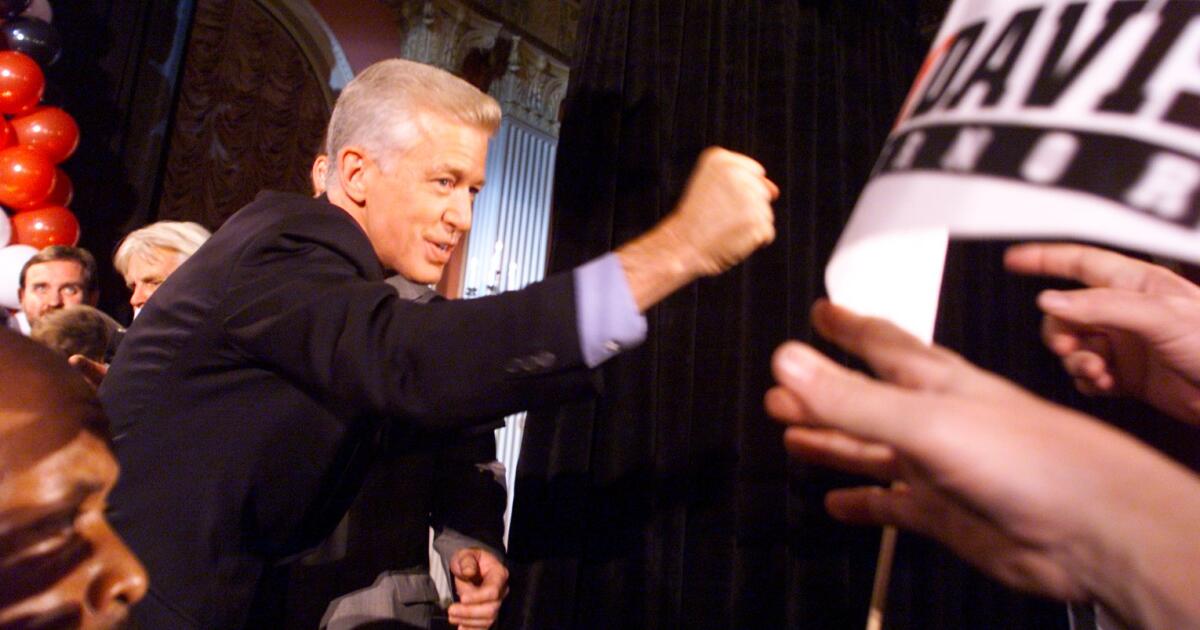
The outcome was one few anticipated, with Gray Davis romping to victory in the Democratic primary, then winning the governorship in a landslide.
Less than three months before the June primary, Davis had been running dead last, behind two well-heeled Democrats and the eventual GOP nominee. The number of people who told him to quit would have filled the L.A. Coliseum, Davis recalled this week. But he never considered dropping out; the pressure only made him more determined.
“Sometimes it’s meant to be. Sometimes you get every break,” Davis said. “Sometimes it’s not meant to be and you get no breaks.”
His bottom line: “Anything can happen.”
Of course, no two campaigns are the same.
This gubernatorial contest is being conducted under a system in which the top two vote-getters, regardless of party, will advance to a November runoff. In 1998, California held an “open primary,” under rules later voided by the Supreme Court. All candidates appeared on the same ballot, with the top finishers in each party guaranteed a spot in November.
Beyond that, the world has vastly changed: politically, socially, culturally. (Google is now one of the most valuable companies on the planet, pulling in a record $403 billion in revenue in fiscal 2025.)
Voter attitudes are different. One of Davis’ greatest assets was his position as lieutenant governor; that currency — incumbency and government know-how — no longer trade at the same high value.
The media landscape has fractured — back then newspapers set the political agenda, fewer than half of voters were online and streaming was something mostly done by water. Californians aren’t nearly as tuned in to the governor’s race as they were then.
“There’s a sideshow going on internationally and nationally and people are like, ‘Oh, right, there’s a governor’s race happening,’” said Paul Maslin, who was Davis’ pollster and is now working for Democratic gubernatorial hopeful Betty Yee. “Whereas in ‘98, that was clearly the big act in town.”
Having said all that, luck and an opportune break or two are still key ingredients to political success, as Davis suggested.
Feinstein, the state’s senior U.S. senator, had nearly been elected governor in 1990 and her lengthy deliberations froze out other potentially strong contenders. Had Feinstein run, she very probably would have blown away the field and made history by becoming the state’s first female governor.
Davis also greatly benefited when a federal court tossed out strict contribution limits, allowing him to go from collecting bite-size donations to much greater sums. Though he was vastly outspent by his two rich Democratic opponents, multimillionaire Al Checchi and then-Rep. Jane Harman, the decision allowed Davis to remain competitive and eventually pay for the statewide ad blitz that is indispensable in California.
Checchi, in particular, barraged voters with an unrelenting flood of ads. (Shades of the omnipresent Tom Steyer.) In one of them, a spot attacking Harman, Checchi included a photo of the lieutenant governor — and not a bad-looking one at that. The glimpse reminded voters that Davis, who was husbanding his resources for a late advertising push, was still in the race. He enjoyed a significant boost in polls.
Still, Checchi and Harman saw each other as the main opponent and their strategists acted — and tailored their advertising and campaign messaging — accordingly. The result was “a murder-suicide, as the term went at the time,” said Garry South, who managed Davis’ campaign. “They decided to focus so much fire on each other and ignore us that we simply slipped through the hole.”
Davis can well relate to those gubernatorial hopefuls in the position he once was — dissed, dismissed and bumping along near the bottom of horse-race polls. Speaking from his law office in Century City, he had this simple advice:
“Follow your heart,” he said. “Do what you think is right.”
“It’s fine for someone else to tell you you should get out, but that’s not their business,” Davis said. “You’re the candidate, and if you think for whatever reason you want to stay in the race, you should stay in the race.”
But Davis isn’t too worried about that happening. Moreover, he said, it’s easy for those watching from the sidelines to take potshots and offer unsolicited — and not particularly empathetic — advice.
“They’re not running for office,” he said. “Other people are putting themselves on the line. … [If] people have the wherewithal, the courage and the dedication it takes to put themselves in a position to run for office, if they really believe it’s the right thing to do, they should. They should follow their dream.”
Besides which, you never know what might happen come June.
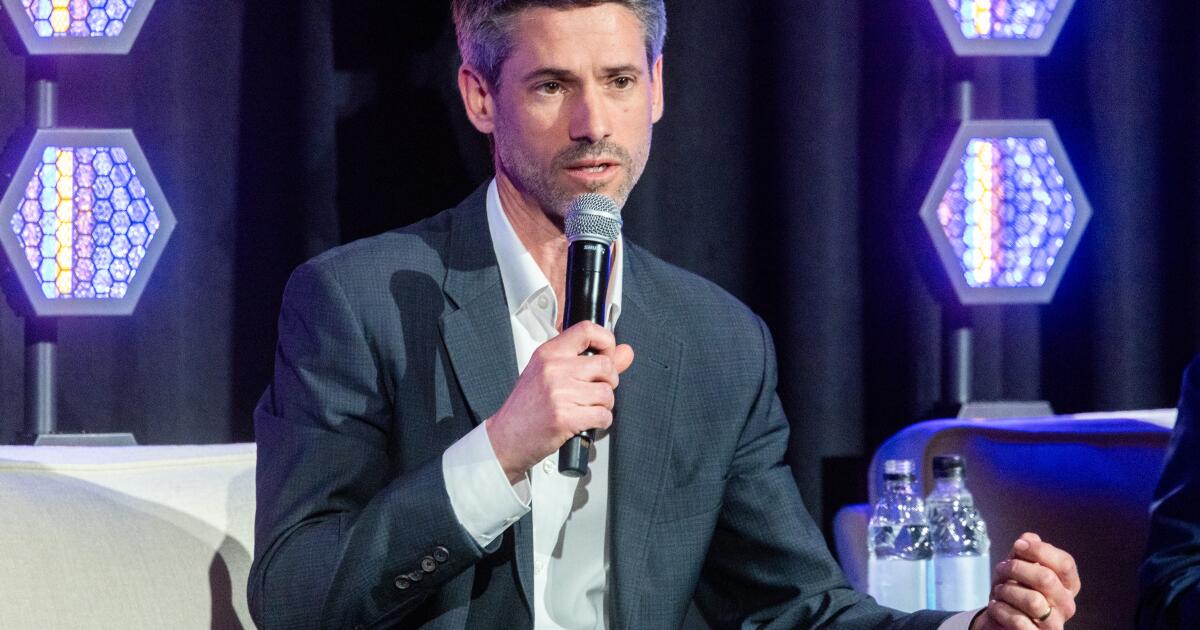
When he entered the race for California governor, San José Mayor Matt Mahan pitched himself as a pragmatic Democrat who would prioritize improving residents’ quality of life and government efficiency.
He unveiled a key part of that promise on Tuesday with an expansive plan to reform state government, including tying pay raises for elected officials and other top leaders to improvements on key issues, and pledging not to approve any tax increase until the state proves “that we can deliver better outcomes with the dollars we already have.”
Mahan also delivered a blistering rebuke of ballooning state spending — which, as he often points out on the campaign trail, has increased nearly 75% over the last six years. In 2020, amid the COVID-19 pandemic and accompanying economic uncertainty, California lawmakers approved a no-frills state budget that came in at $202 billion. Gov. Gavin Newsom’s latest spending proposal is nearly $349 billion.
“We have fallen into this lazy, reflexive mindset of always going back to voters and telling them that the only solution to every problem is a tax increase or a new bond or a new rule coming down from Sacramento,” Mahan said in an interview. “We need to step back and take a really hard look at our existing spending and increase the level of transparency and accountability in government.”
His eight-page plan includes ways to measure and track accountability, some of which are drawn from policies in other states. They include lobbying reforms, following up on audit recommendations and overhauling the state’s digital infrastructure and its procurement process — services Mahan described as “clunky and cumbersome.”
He also proposed a “California Performance Review,” inspired by a similar effort in Texas throughout the 1990s, that would review state agencies and solicit input from employees to eliminate waste and inefficiencies.
But near the top of the list is a proposal to tie pay raises for state officials including the governor, lawmakers and thousands of gubernatorial appointees to “measurable outcomes” in areas such as reducing homelessness and unemployment.
“People in the real world don’t get raises if they don’t do a good job,” Mahan said, “and I think it should be the same for the politicians and senior administrators who are allocating budgets, leading projects, making the big decisions on behalf of the people of California.”
Though the benchmarks would be created with input from the state Legislature, Mahan floated one example: reducing unsheltered homelessness by 5% to 10% within one year, something he said he’s accomplished three years in a row in San José.
It’s a solution one might expect from a former entrepreneur and mayor of a city in the heart of Silicon Valley. Mahan made a similar proposal at the local level last year, but it was rejected by the City Council.
“Tying pay to performance is nothing short of revolutionary in government. It’s a private-sector model that is overdue,” said former state Sen. Steve Glazer (D-Orinda), a Mahan supporter who sponsored several bills aiming to increase transparency in government.
Dozens of tech company executives are backing Mahan in the race for governor and have collectively donated millions to his campaign, as well as two independent expenditure committees supporting him.
That has raised concerns from some voters, and criticism from some of Mahan’s opponents, that he would be beholden to their interests and veto future regulations on tech or artificial intelligence companies.
Mahan has sought to dispel those concerns, arguing that he believes AI and social media platforms should be regulated. Of his plan to overhaul state information technology systems and infrastructure, he said that “whenever we spend public dollars, we have to run open, transparent and competitive procurement processes that ensure best value for the taxpayers.”
Though Mahan did not specify how he would link government outcomes to pay raises, state lawmakers have largely panned his campaign and are unlikely to get on board. The change probably would also require voter approval.
Currently, annual raises for elected officials are determined by a citizen commission that was added to the California Constitution in 1990. Changing how that panel works or imposing limits on when it can approve raises would require a constitutional amendment, which requires voter sign-off.
But Mahan contended it would be one of the fastest ways to fix a system that he says works for special interests at the expense of working people.
“I’m under no illusion that this will be easy, but I think it’s a necessary realignment of incentives,” he said. “We have to make ourselves as accountable to the people as we possibly can be.”
Four Democrats running for governor called on their fellow candidates to boycott an upcoming debate at USC, reiterating concerns that the criteria used to determine who was invited to participate resulted in every prominent candidate of color being excluded from the forum.
“We ask each and every candidate who is in this race to recognize that if we can’t have a fair process for a debate, then we should all not participate,” said Xavier Becerra, the former U.S. Health and Human Services secretary. “We call on them to withdraw from this biased forum.”
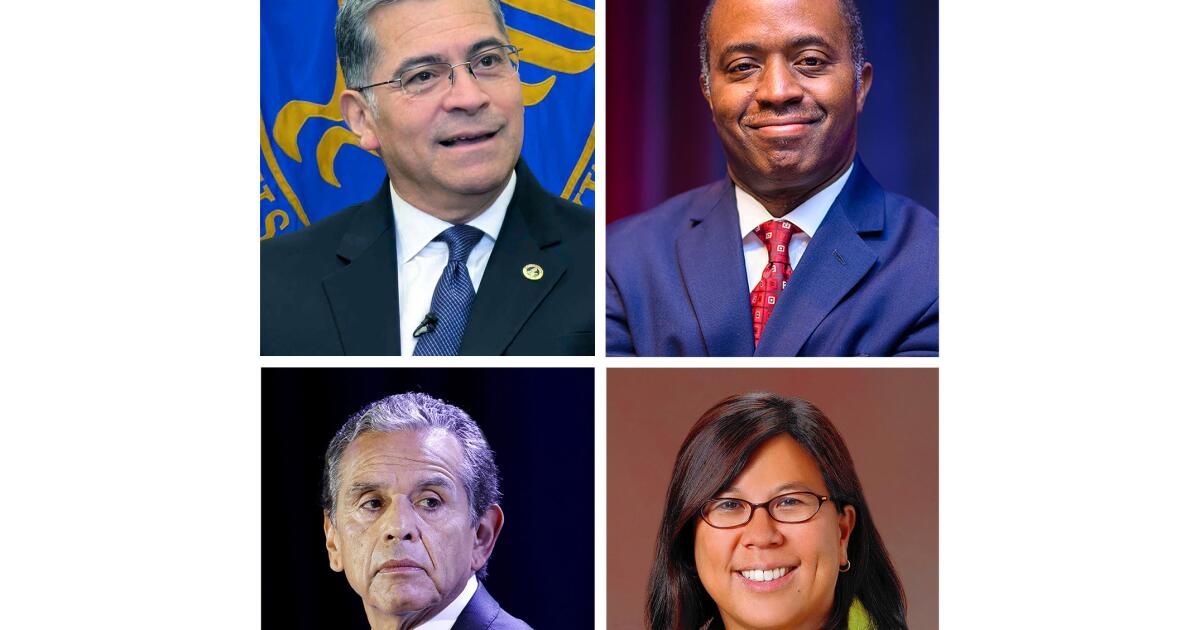
Becerra’s call was echoed by former Los Angeles Mayor Antonio Villaraigosa, state Supt. of Public Instruction Tony Thurmond and former state Controller Betty Yee during a Friday afternoon news conference.
The candidate’s request comes a week after some of them raised concerns about the criteria for Tuesday’s debate, arguing that it was engineered to allow the inclusion of San José Mayor Matt Mahan, who entered the race in late January and quickly raised millions of dollars from Silicon Valley executives.
“The rules initially were polling and money. Matt Mahan is [polling] lower than some of us, period,” Villaraigosa said, adding that the debate organizers “then added time in the race,” which resulted in Mahan’s invitation.
Mahan’s campaign did not respond to a request for comment on Friday, but when Becerra raised such concerns last week, Mahan said the former Biden administration official ought to be included in the debate.
The matter is further complicated by Mahan supporters who have notable ties to the university.
Mike Murphy, a co-director of the USC center hosting the debate, has been voluntarily advising an independent expenditure committee backing Mahan. The veteran GOP strategist said last week that he had nothing to do with organizing the debate and that he has asked for unpaid leave at the university through the June 2 primary if he takes a paid role in the campaign.
USC has also received tens of millions of dollars in donations from billionaire real estate developer Rick Caruso and his wife. Caruso, a USC alumnus who served as a trustee for years, is also a Mahan supporter.
A representative for Caruso did not respond to a request for comment.
The debate, hosted by the USC Dornsife Center for the Political Future, KABC-TV Los Angeles and Univision, is scheduled to take place on campus at 5 p.m. Tuesday — less than two months before ballots begin arriving in voters’ mailboxes. The forum will be streamed and broadcast on ABC and Univision affiliates across the state.
USC and the television stations put out a joint statement Friday morning, prior to the candidates’ news conference, justifying the criteria used to determine who was invited to participate and saying none of the debate partners had any influence on the methodology.
“We want to be clear that we categorically, unequivocally deny any allegations that the debate criteria was in any way biased in favor or against any candidate and want to clarify the facts,” they said in a statement, adding that Christian Grose, a USC political science professor, was asked to develop “data-driven” benchmarks to determine which candidates were invited.
“The methodology was based on well-established metrics consistent with formulas widely used to set debate participation nationwide — a combination of polling and fundraising — and developed without regard to any particular candidate.”
After the Democratic candidates called for their competitors to not participate, USC and KABC declined to comment further. Univision did not respond to a request for comment.
Grose defended the methodology he crafted as “objective” in an interview Friday, and said he met with Becerra as well as the staff of other candidates to explain it.
“The idea that it was biased or designed to create some sort of outcome to disfavor the candidates who spoke at the press conference is just not correct,” Grose said, adding that attacks on the methodology have a “chilling effect” on universities and media outlets who sponsor debates.
“I’m not worried about the optics,” he said. “The optics are we are having a debate at USC to inform voters and educate students.”
Jarred Cuellar, a political science assistant professor at Cal Poly Pomona, described Grose’s methodology as “thoughtful” and “empirically grounded,” and characterized the concerns raised by candidates not included in the debate as unfounded and not credible.
“The formula is methodologically sound and represents a clear improvement over how debate participation has often been determined,” he said. “Rather than relying on a single metric such as polling, it takes a multidimensional approach to evaluating candidate viability. That approach better reflects how political scientists measure complex phenomena like electoral competitiveness.”
But the controversy has caused consternation among USC professors past and present.
“It seems like an unforced error that is casting the entire event in a bad light,” said a current USC professor who closely follows politics but is not involved in the debate, and who asked for anonymity to speak candidly. “It’s super important that if the debate happens, it happens correctly.”
Darry Sragow, a veteran Democratic strategist who taught election and environmental law at USC for 19 years, said that while he believes the large field of Democratic candidates needs to be winnowed, that’s not the job of a university or media outlets.
“Every one of these eight [Democratic candidates] is capable of running the state of California,” he said. “ It would certainly be my advice to USC and to Univision and to ABC to allow all the candidates to take part, or to cancel the debate.”
The four Democratic candidates not invited to the debate argued that voters are just starting to pay attention to the thus-far sleepy race and that diverse candidates should be represented.
“We are a minority-majority state, and the idea that the four candidates of color are not going to be on the stage to bring those perspectives, to really speak to those communities, is really not doing right by the voters,” Yee said.
Becerra said some of the candidates had requested to speak with top university leadership, including President Beong-Soo Kim. In other conversations, he said university officials raised the possibility of “either canceling this debate or incorporating more of the candidates in it. Evidently they could not agree to do that. … I think they recognize that there were problems with the way this debate had been organized.”
Becerra said he reviewed the formula and has “never seen” debate criteria like it before during his decades of serving in elected office.
“Your fundraising numbers are divided by the number of days you’ve been out there campaigning in front of voters,” he said. “So you could have raised millions of dollars, but if you’ve been in longer than someone else who just raised millions of dollars very quickly, you get penalized.”
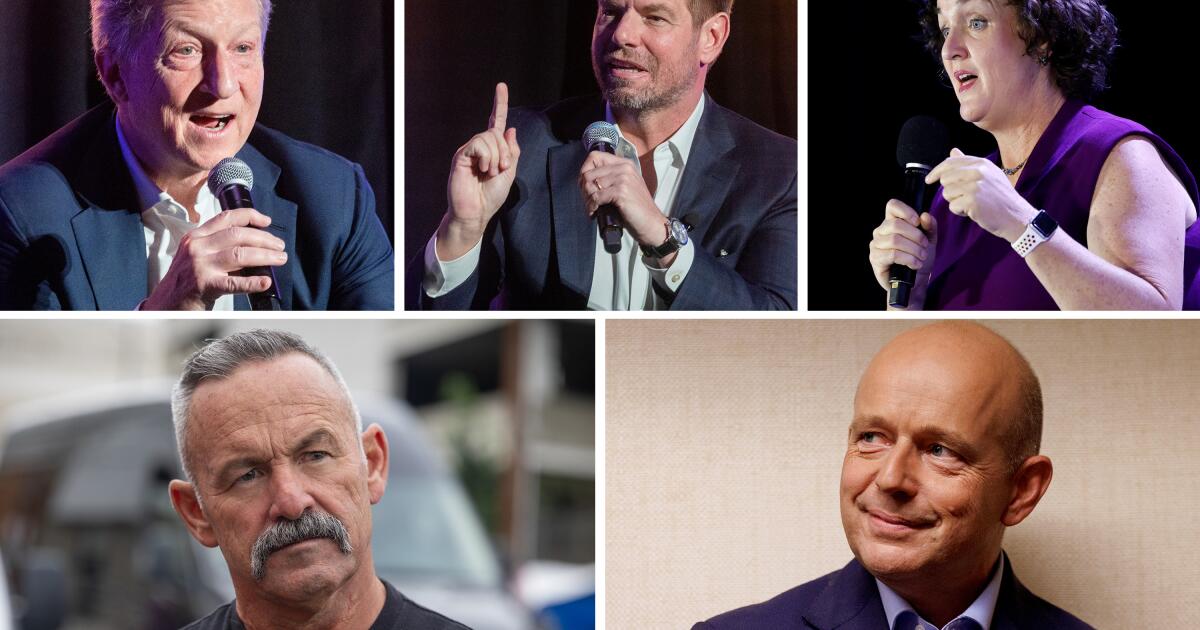
Campaigns for the invited candidates — Democrats Rep. Eric Swalwell of Dublin, former Orange County Rep. Katie Porter, climate activist Tom Steyer and Mahan; as well as Republicans Chad Bianco, the sheriff of Riverside County, and former Fox News host Steve Hilton — did not respond to requests for comment on the call to boycott the debate.
SACRAMENTO — Californians have never been forced to choose between Gavin Newsom and Kamala Harris, two homegrown political darlings, during any election.
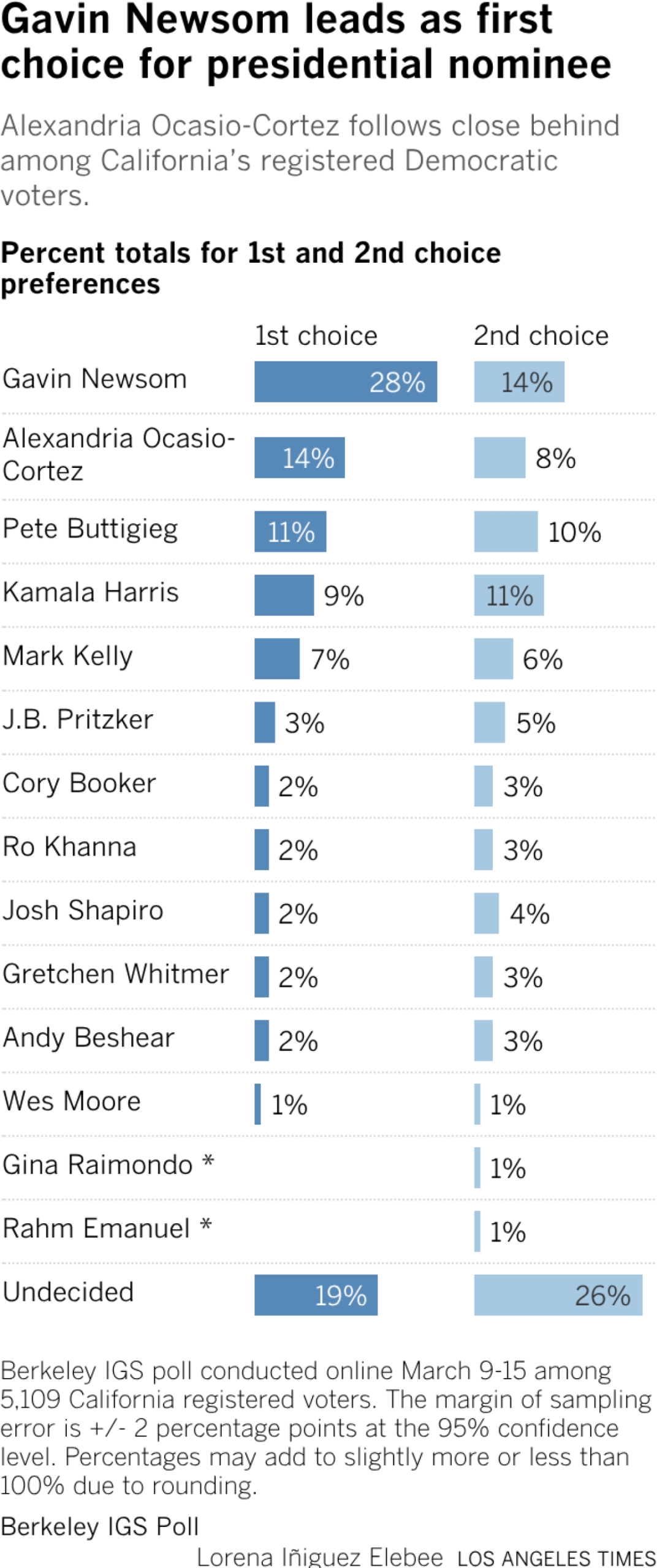
Twenty-eight percent of the California Democrats who were surveyed selected the governor as their top choice in the 2028 presidential election. U.S. Rep. Alexandria Ocasio-Cortez (D-New York) followed with 14% and former U.S. Transportation Secretary Pete Buttigieg received 11%. Harris came in fourth, with only 9% of voters in her own state naming her as their preferred Democratic nominee.
“It’s quite a positive result for Newsom,” said Mark DiCamillo, director of the Berkeley IGS Poll. “He’s separated himself from the rest of the pack, and especially when you compare him to the other major Californian in the considerations, he’s three times as much as Kamala. That’s quite impressive.”
The political careers of the governor and former vice president have orbited each other but never crossed since Newsom was sworn in as San Francisco’s mayor and Harris as the city’s district attorney on the same day in 2004. Now the two Bay Area natives are both flirting with the 2028 presidential contest as they travel the country promoting their life stories on respective book tours.
When Harris jumped into the 2020 and 2024 races for the White House, Newsom said he wouldn’t run against her. He’s discredited the idea that the two politicians have some kind of a sibling rivalry and noted that their trajectories ran adjacent and never collided.
Newsom was asked again last month whether he would vie against Harris in a presidential contest. The governor said he hasn’t “gotten in the way of her ambition ever,” and he doesn’t imagine that he would in the future. His answer changed when he was pressed to respond specifically to the potential for 2028.
“That’s fate. I don’t, I don’t know,” Newsom said to CNN’s Dana Bash, throwing up his hands. “You know, you can only control what you can control.”
Newsom and Harris had greater support from Black and Latino voters than white and Asian American Democrats in the new poll. She performed well among Democrats younger than 30 compared with other age groups, while Newsom fared better with older Democrats. More women selected Newsom as their first or second choice than they did Harris.
Neither California heavyweight performed particularly great among Democratic voters in the Bay Area, which DiCamillo called a curious finding for two politicians from the region. Support was higher for Harris and Newsom in almost every other region of the state.
DiCamillo believes the presence of Ocasio-Cortez on the list probably pulled some support from Harris. California voters in other recent polls were also sour on a third presidential run by Harris.
An Institute of Governmental Studies poll in August gauged interest in the potential candidacy of Newsom and Harris. About 45% of the state’s registered voters said they were enthusiastic about Newsom running, compared with 36% for Harris. Almost two-third of voters in that survey, and half of Democrats, said Harris should not run for president again.
Although Newsom clearly beat the field of candidates in the most recent poll, DiCamillo said receiving support from a little more than a quarter of those surveyed in his own backyard isn’t exactly wonderful. The governor’s approval rating is also down.
The poll found that 48% of California registered voters say they approve of the job Newsom is doing, with the same share disapproving of his performance. That marks a drop from 51% approval the last time DiCamillo asked in August. Disapproval also climbed, by 5 percentage points.
Voters held positive opinions about Newsom’s participation in international conferences, which was described in the poll as the governor “offering an alternative to the policies being promoted by President Trump on issues like climate change and the economy.” The poll found 59% of statewide registered voters approve and 37% disapprove.
“Though Californians may hold mixed views on his gubernatorial tenure, they overwhelmingly see him as the strongest counter to Trump and MAGA candidates,” Mora said. “Harris’s earlier presidential defeat, compounded by persistent voter biases against women and candidates of color, may also be shaping these early numbers.”
The Berkeley IGS/Times poll surveyed 5,019 California registered voters online in English and Spanish from March 9 to 14. The results are estimated to have a margin of error of 2.5 percentage points in either direction in the overall sample, and larger numbers for subgroups.
SACRAMENTO — During the Los Angeles writers’ strike in 2023, Democratic Rep. Eric Swalwell wanted to reach out to his donors in Hollywood and ask what he could do to help them. But he didn’t have an easy way to find the screenwriters who backed his many campaigns.
So Swalwell and his congressional chief of staff launched an AI technology company that sifts and analyzes campaign fundraising data.
The company has since been used by dozens of political campaigns, including by Sen. Adam Schiff (D-Calif.) and Rep. Jimmy Gomez (D-Los Angeles). Even Swalwell’s current campaign for California governor hired the artificial intelligence company, called Findraiser.
But some details of Swalwell’s private venture remain unclear, including the company’s investors.
Craig Holman, a governmental ethics expert with the nonprofit consumer advocacy organization Public Citizen, said it’s common and legal for candidates to use their own businesses to promote their campaigns or the campaigns of others, as long as all business interactions are charged at market value.
He said Swalwell can talk about his business privately but cannot do so in relation to his role in Congress, to avoid running afoul of ethics rules barring using one’s position for personal monetary gain.
Holman called it “odd and politically unwise” that Swalwell’s business will not publicly disclose all of its investors.
Swalwell, who has represented Northern California in Congress since 2013, is among the top Democrats in the governor’s race, according to a recent poll, but thus far none of the candidates has a breakaway lead.
Findraiser is close to profitability, his onetime chief of staff, current campaign manager and Findraiser CEO Yardena Wolf said in a podcast interview that aired in October.
The company received more than $67,400 from congressional campaigns in the 2025-26 cycle, according to filings with the federal government.
Members of Congress are not barred from owning outside companies or accepting a small outside salary, with exceptions. Swalwell makes no income from the company, according to filings he has made with the state of California, though he could benefit if the company was ever sold.
“Findraiser is a platform like hundreds of other tools in the market that helps Democratic campaigns communicate more efficiently,” a Swalwell spokesperson said. “Congressman Swalwell and the Findraiser team consulted the House Committee on Ethics on the conception and implementation of the tool every step of the way.”
Still, it highlights how mixing public service and private business can raise ethics questions.
Wolf told The Times that none of Findraiser’s investors have business before Congress, but she declined to reveal the names of the backers.
The fair market value of Findraiser is between $100,001 and $1 million, according to campaign finance documents filed with the state this month.
Swalwell stated on the documents that he is a part owner. Besides the Congress member and Wolf, the other member of the company listed with the state is Paul Mandell, who runs an event business.
The company’s website boasts that it provides a “straightforward AI-powered chatbot that supercharges your fundraising database searches. This first-of-its-kind tool sits on top of your political fundraising database, allowing you to ask simple, intuitive questions and receive the results you need instantly.”
The website also contains testimonials, including from former Democratic National Committee Chair Jaime Harrison, who says Findraiser provides the AI technology that makes it “easier than ever for campaigns to connect with the right donors and raise what they need to win.”
The amount of money campaigns are paying to use Findraiser is nominal, federal campaign finance records show. During the 2025-26 cycle, Swalwell’s campaign for Congress reported paying Findraiser $6,630. His campaign for governor paid the company $975.
Wolf, in an interview with The Times, declined to provide details about the company’s staff or how much it charges customers.
In her interview with the political podcast “The Great Battlefield,” she recounted that the writers’ strike was the impetus for Findraiser and said Swalwell came up with the name.
She conceded that it is “pretty unusual” for a member of Congress to start a company with his chief of staff. She also said there was “a lot of ethics back and forth — of lawyers and all of that, to make sure that we were aboveboard and that everything is kosher.”
Among other things, Findraiser has helped Swalwell’s campaigns pull in more money, she said. For example, the campaign could identify donors who gave small amounts to Swalwell but larger checks to other politicians, Wolf said.
“We’ve been able to set up meetings with people like that, and they’ve increased their contributions.”
Aside from Wolf, one other staff member who works for both Swalwell’s campaign and his government office is also being paid via a contract to do digital work for Findraiser, Wolf confirmed.
Michael Beckel, director of money in politics reform at Issue One, a bipartisan advocacy group, said that although there is no prohibition on a member of Congress hiring his own company, voters may perceive an issue.
“Voters may see self-dealing as evidence that a candidate is prioritizing personal enrichment over public service, which damages confidence in elections and governmental institutions,” he said.
“If donors give money knowing it will personally benefit the candidate, that undermines the integrity of the political system.”
Swalwell’s campaign declined to respond to Beckel’s statements.
Wolf in her podcast interview last year said the business was “going really well.”
“We have PACs that use it. We have first-time candidates, as well as 20-year incumbents who are using it. We have congressional races and Senate races,” Wolf said.
Around 2024, the company began offering beta testing, she said.
“Obviously, both Eric’s and my network are people who are in the political space and just in our day to day, as we were talking to people, we had people say, ‘Well, I want to use it,’” Wolf said. “And so we had a group of people who ended up beta testing.”
A spokesperson for Swalwell’s campaign said that “Findraiser spread through word of mouth among campaigns across the country. Any decision by a campaign or candidate to utilize the tool is based on their choice and their organization’s strategic prioritization.”
The Times contacted 16 congressional campaigns that reported using Findraiser in recent federal filings. None would tell The Times how they came to hire the company.
Both Schiff and Gomez have endorsed Swalwell in his campaign for governor.
Schiff’s paid about $2,000 for two months of Findraiser services last year. However, Wolf, in her podcast interview, said Findraiser works with Schiff “a lot.”
Ian Mariani, a spokesperson for Schiff’s campaign, said the company “is one of many campaign vendors used by our team, and it helped us engage with several people.”
Despite a long, entrenched Democratic reign over California politics, a new poll shows two Republicans leading by slim margins in the state’s 2026 race for governor as the June primary election fast approaches.
The confounding results appear to be mostly due to the state’s left-leaning electorate feeling uninspired by any single candidate in the crowded field of eight top Democrats. Because of California’s top-two primary rule, that lethargy could lead to Democrats being shut out of a November election that will determine the next leader of the largest state in the union, though that is still considered unlikely.
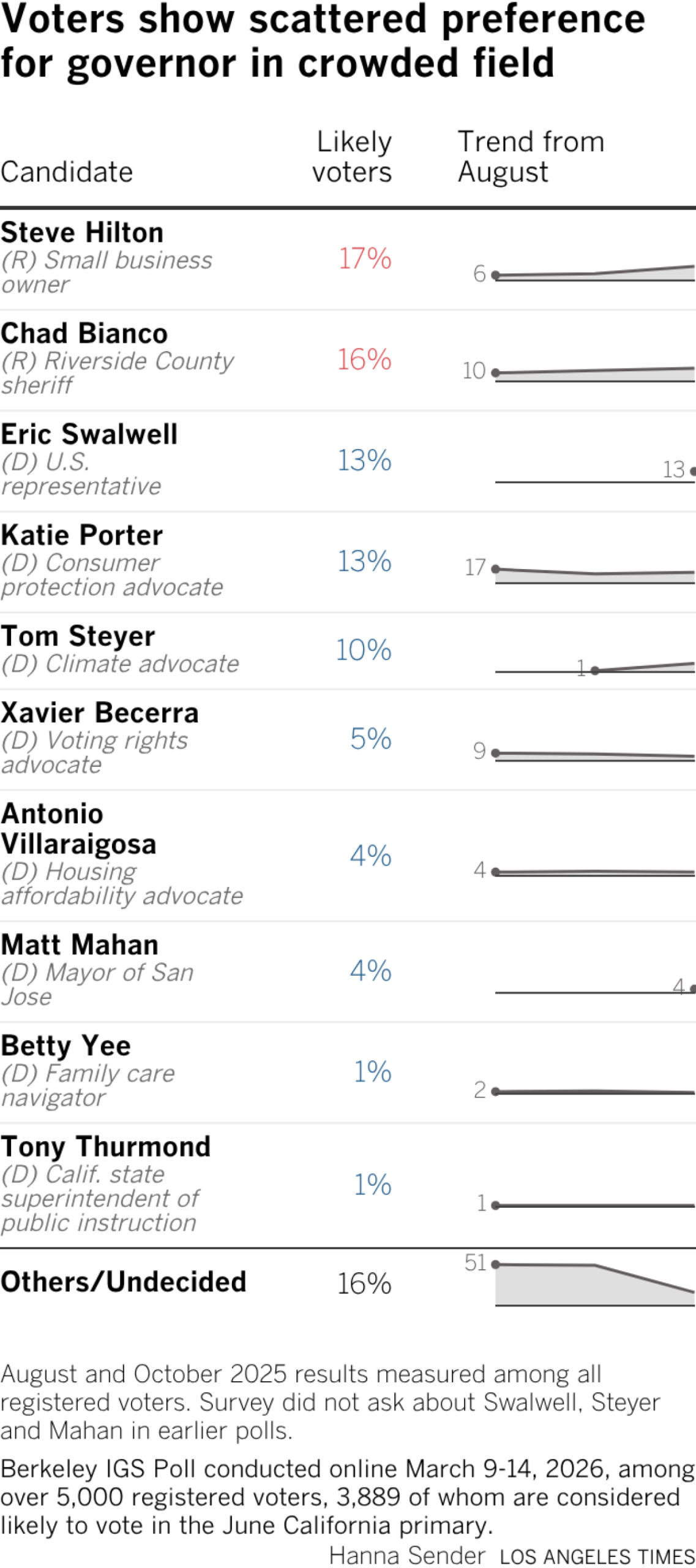
Conservative commentator Steve Hilton had the support of 17% of likely voters and Riverside County Sheriff Chad Bianco had the backing of 16%, according to a poll released Wednesday by UC Berkeley’s Institute of Governmental Studies and co-sponsored by The Times.
Following closely behind were Democrats Rep. Eric Swalwell of Northern California and former Orange County Rep. Katie Porter, both of whom had support from 13% of the likely voters surveyed. Aside from billionaire hedge fund founder and environmental activist Tom Steyer, who registered at 10% support after plowing tens of millions of dollars into his campaign, no other Democrat had won support from more than 5% of likely voters, the poll showed.
Mark DiCamillo, director of the poll, said he was stunned by how fractured voters are and how little knowledge they have about the candidates less than 60 days before ballots start arriving in Californians’ mailboxes.
“This is historic for me, and especially given that none of the candidates have really a positive image rating with voters, also startling. I mean, perhaps one of the reasons why voters are disengaged, they’re just not enthusiastic about any of the candidates,” he said. “They’re kind of sleepwalking to this election.”
Swalwell and Porter both hew toward the progressive wing of the party and rose to national prominence as frequent guests on cable news shows and as combative, at times theatrical, committee members during congressional oversight hearings. That notoriety prompted attacks from Republicans and the far right and increased their popularity among the Democratic base — both pivotal for voters seeking a strong candidate to challenge President Trump.
Porter slightly rebounded after a dip in polling in the fall after videos emerged of her berating an aide and a reporter. She also has the highest favorable rating of any candidate in the field at 34%.
According to the survey, Steyer’s support from likely voters increased to 10% from just 1% in Berkeley’s October poll. The momentum comes after Steyer spent about $50 million airing television ads since December, according to an analysis by data expert Paul Mitchell for Capitol Weekly.
Among the other top Democrats in the race: former U.S. Health and Human Services Secretary Xavier Becerra was backed by 5% of likely voters; former Los Angeles Mayor Antonio Villaraigosa and San José Mayor Matt Mahan by 4%, and former state Controller Betty Yee and state Supt. of Public Instruction Tony Thurmond by 1%.
The poll found that 16% of likely voters were either undecided or backed other, lesser-known candidates.
The splintered support for the Democrats hoping to become the state’s next governor has surfaced in other ways as well. On Monday, the powerful California Federation of Labor voted to endorse four gubernatorial candidates — half the Democratic field.
DiCamillo said he believes the poll’s inclusion of the candidates’ titles that voters will see on their ballots is crucial in a low-information contest.
“That really matters in a race where voters don’t have much information, or they say they don’t know much about the candidates,” he said, adding that it could particularly help Bianco, the Riverside County sheriff. “His job title is kind of impressive, and that voters think, well, that’s credible, so let me consider him.”
The fear of two Republicans winning the top two spots in the June 2 primary prompted California Democratic Party Chair Rusty Hicks to urge low-polling candidates to consider their viability and drop out if they didn’t see a path forward earlier this month.
Some candidates bristled, arguing that party leaders were in effect telling every candidate of color to leave the race. Aside from one candidate, all of the top Democrats in the race responded by quickly filing their campaign documents with the secretary of state’s office, meaning that their names will appear on the ballot.
The two candidates who receive the most votes in the primary are the only ones who advance to the November general election — regardless of their political party.
The odds that a Republican will become California’s next governor appear slim. No Republican has won a statewide election in California since 2006, the year Hollywood movie star Arnold Schwarzenegger was elected to a second term as governor. Democratic registered voters in the state outnumber Republicans by nearly 2 to 1.
Compared with prior gubernatorial races that had well-known Democratic front-runners, none of the candidates of either party are particularly well known by voters. Large numbers of voters have no opinion about any of the candidates — including roughly two-thirds of those asked about Mahan, Yee and Thurmond.
Voters were far more tuned in to the issues that they believe are most important for the state’s next governor to tackle.
Affordability was dominant among all voters, regardless of political ideology, the poll found. Four out of 10 voters said reducing the cost of living in California is among the top issues the next governor should prioritize, and smaller numbers also highlighted building affordable housing and lowering gas prices and utility rates.
Affordability “is the top issue for voters, both here in California and across the country. There’s no question,” DiCamillo said. “Perhaps it’s even of greater urgency here in California, just given our cost of living is higher than in most other places.”
Building new housing, paring back regulations to allow such construction quickly and to reduce the cost of buy a home, disincentivizing private firms from buying homes and reducing gas prices are among topics candidates frequently speak about on the campaign trail and in debates.
A notable split was evident among voters when asked about cutting waste, fraud and political corruption in state government, the poll found. Nearly 50% of Republicans said this was a top priority, compared with 10% of Democrats and a little over a quarter of voters who do not state a party preference.
DiCamillo said this sentiment aligns with President Trump’s messaging and what his administration has been pursuing in the federal government. Trump has repeatedly painted California as teeming with waste, fraud and abuse. On Monday, when he launched a task force to fight fraud that will be led by Vice President JD Vance, California was among the states he singled out as having insufficient oversight of federal funds.
GOP voters in California share similar sentiments, DiCamillo said.
In Washington, D.C., “they’re cutting back, trying to make government smaller, and … just cut the waste as well,” he said. California “Republicans, given the fact that Democrats have been controlling things for so long, they think … more of that is needed now here in California as well.”
The Berkeley IGS/Times poll surveyed 5,019 California registered voters online in English and Spanish from March 9 to 14. The results are estimated to have a margin of error of 2.5 percentage points in either direction in the overall sample, and larger numbers for subgroups.
WASHINGTON — President Trump has once again mocked Gov. Gavin Newsom’s dyslexia as “disqualifying” for leadership, marking at least the fourth time in a week that the president has targeted the California Democrat for being open about his diagnosis.
In remarks Monday in the Oval Office, Trump said Newsom was “dumb” and should never be allowed to be president because he has “admitted that he has learning disabilities, dyslexia.”
“That’s how crazy it’s gotten with a low-IQ person,” Trump said. “Honestly, I’m all for people with learning disabilities but not for my president. … And I know it’s highly controversial to say such a horrible thing.”
But in the course of his needling, Trump mistakenly elevated his political rival to the rank of commander in chief — repeatedly referring to Newsom as “the president of the United States.” Newsom took the opportunity to turn the tables on the president.
“I, GAVIN C. NEWSOM, AM OFFICIALLY PRESIDENT OF THE UNITED STATES (THANK YOU DONALD!)” he wrote on X Monday.
The clash is the latest in a storied contest of chest-beating between Trump and Newsom, who have made sport of bad-mouthing one another across campaign rallies, interviews and social media.
A model stealth bomber sits in front of President Trump during an executive order signing in the Oval Office Monday.
(Aaron Schwartz / Bloomberg via Getty Images)
The president has frequently cast Newsom as a symbol of the liberal governance he opposes, while the governor has leaned into the confrontations, often using them to elevate his national profile and position himself as a leading Democratic counterweight. His sparring with the president appears to be part of an aggressive strategy to amplify his own messaging as he weighs a potential run for president in 2028. This time, Newsom used the spotlight to support young people with dyslexia.
“To every kid with a learning disability: don’t let anyone — not even the President of the United States — bully you,” Newsom wrote on X. “Dyslexia isn’t a weakness. It’s your strength.”
The insults first materialized when a video went viral of Newsom speaking at a book tour appearance with Atlanta Mayor Andre Dickens during which he discussed his lifelong struggle with the learning disability. Since then, the president has repeatedly poked at the vulnerability.
Trump has brought up the governor’s dyslexia at least four times in the last week. He mentioned it at a political rally in Kentucky last week, where he equated dyslexia with a “mental lack of ability,” and again during a Fox News Radio interview on Friday, in which he reiterated that “presidents can’t have a learning disability.” In a post on Truth Social, Trump labeled Newsom’s admission a “politically suicidal act,” calling him “dumb” and “A Cognitive Mess!”
After the Kentucky rally, Newsom responded to Trump.
“I spoke about my dyslexia, I know that’s hard for a brain-dead moron who bombs children and protects pedophiles to understand,” he said.
Dyslexia affects as much as 20% of the population, according to the Yale Center for Dyslexia and Creativity. Despite affecting a such a wide portion of the population, the condition is widely misunderstood, according to dyslexia researcher Dr. Helen Taylor of the University of Cambridge.
“In some ways, Trump’s awful comments are just a cruder version of assumptions that already run through our culture,” she said. “If anything, [it’s] the opposite. There is evidence of an overrepresentation of people with dyslexia in business leadership roles.”
According to Taylor, there is a link between dyslexia and “enhanced abilities” in areas such as discovery, invention and creativity.
“The same cognitive trade-offs that can make routine tasks like reading more difficult support strengths in navigating complexity and guiding groups toward better future outcomes,” she said.
Newsom often describes his early experiences with dyslexia as a source of insecurity when he was growing up. In his memoir, the governor writes about his mother, Tessa Newsom, attempting to help him with homework. The lessons ended with him “running out of the room screaming that I didn’t know what was wrong with my brain.”
Back when Newsom was a boy in the 1970s, dyslexia was recognized but still not fully understood. He recalls a day when his mother grew so concerned that she took a deep breath and told him, “It’s OK to be average, Gavin.”
“I understood even back then that this, too, came from her deep reservoir of love for me,” Newsom writes in his book “Young Man in a Hurry.” “But I don’t recall crueler words ever said about me.”
The challenges from his learning disorder persist in his work at the state Capitol. Newsom finds reading off a teleprompter challenging. His aides describe days of painstaking preparation before major addresses to live audiences. Late edits to a speech, and the resulting changes to the words on the screen, threaten to throw off his delivery.
All memos in the governor’s office are written in 12 point Century Gothic font with specific spacing between lines, formatting that his aides say helps him with his disability.
The governor reads his daily briefings a few times in the morning, underlines sentences and writes down notes to retain the information on yellow cards he keeps in his suit pockets.
The ritual, he has said, helps him compensate for his dyslexia and feel confident communicating. But it also adds to the public perception of Newsom as a smooth-talking, and at times rehearsed, politician. His excessive preparation has become a trait he considers a “super power.”
His effort to thoroughly absorb reading material and desire to understand issues before he speaks about them means he’s often well-prepared. In his perception, the learning disorder has brought out his grit and resilience, and helped him hone other skills, such as quickly reading a crowd.
Without missing a beat, Newsom directed the journalist to the exact page in his 246-page budget that touched on the issue.
“While people with dyslexia are slow readers, they often, paradoxically, are very fast and creative thinkers with strong reasoning abilities,” according to the Yale Center for Dyslexia and Creativity.
The governor’s wife, Jennifer Siebel Newsom, discussed the president’s attacks Tuesday in a video on X in which she emphasized that “learning differences do not determine someone’s potential.” She listed a number of qualities she considered disqualifying for the presidency, including being a convicted felon, bankrupting businesses, having numerous associations with convicted sex offender Jeffrey Epstein, and sending “masked extremists to terrorize Black and brown communities and rip kids away from their families.”
“Everything that Donald Trump represents is frankly beyond disqualifying,” she said. “Day in and day out, Trump says things that make him unfit for office. He degrades our vulnerable communities, our institutions, even the Constitution itself.”
Two of the Newsoms’ four children have also been diagnosed with dyslexia.
Quinton reported from Washington, D.C., and Luna from Sacramento.
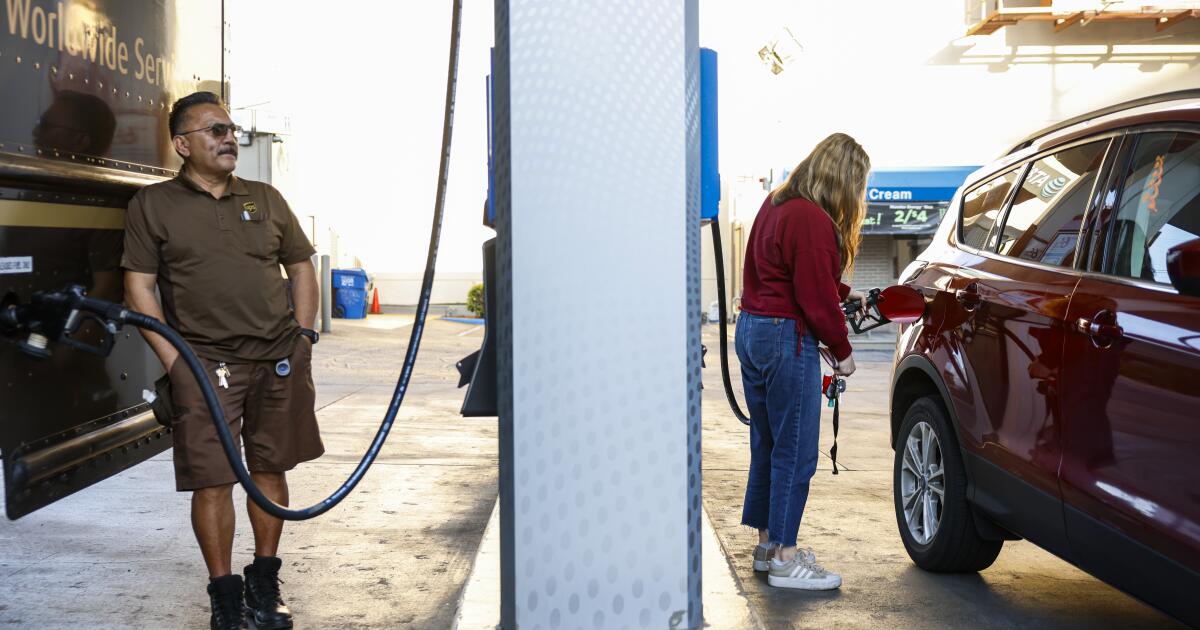
SACRAMENTO — As gas prices surge in California and nationally due to the war in Iran, two Democrats running for California governor are calling for the state to temporarily suspend its fuel tax or ease refinery regulations in an effort to lower costs.
Standing in front of a gas pump in a video posted to social media, San Jose Mayor Matt Mahan said the costs are “becoming an emergency for working families, and I think we ought to act like it.”
The moderate Democrat called on state lawmakers to suspend California’s gas tax, which at 61 cents per gallon is the highest in the nation.
Former Los Angeles Mayor Antonio Villaraigosa also called for an “immediate moratorium” on regulations that he blamed for “overburdening” California refineries and working families.
“These failed policies are not only hurting tens of millions of Californians, they are terrible for the environment because they have forced California to depend on imported foreign oil from the Middle East,” Villaraigosa said in a statement.
The cost of living in California, including the price at the pump, remains a pivotal issue for voters in the state, and has become central to the moderate-leaning campaigns of Mahan and Villaraigosa as they attempt to distinguish themselves in the tightly contested race for governor.
According to AAA, the average price for a gallon of regular gasoline in California on Monday was $5.52, the highest in the nation and more than 50 cents higher than any other state. The national average was $3.71, up from the previous month’s average of $2.92.
Gasoline prices in California are often among the highest in the country for a number of reasons, including environmental rules that require a unique blend of cleaner-burning fuel.
The state also relies mostly on crude oil imported from other countries including Brazil, Iraq and Guyana and processed at in-state refineries. In 2025, 61% of oil processed at California refineries was imported, compared with 23% that was produced in the state, according to data from the California Energy Commission.
Republicans have long supported suspending the gas tax and cutting regulations in order to lower prices at the pump.
Steve Hilton, a GOP candidate for governor and former Fox News host, outlined a plan to lower California gas prices to $3 per gallon by slashing regulations including the low-carbon fuel standard, the rule that requires cleaner-burning gas in order to reduce tailpipe emissions.
The other major Republican in the race, Riverside Sheriff Chad Bianco, supports suspending the gas tax, according to his website.
The current price spike echoes 2022, when Russia invaded Ukraine and disrupted global oil markets.
As prices eventually fell around the rest of the country that year, they remained high for months in California, leading Gov. Gavin Newsom to wage war against oil and gas companies. He accused them of price-gouging drivers and backed laws requiring companies to report their profit margins and keep a supply of fuel on hand to prevent shortages and price spikes.
The governor backed off his battle with the oil companies last year after two refineries announced plans to close. In September, he signed legislation to permit 2,000 new oil wells in Kern County, reflecting an acknowledgement that his war on oil companies threatened to send California’s gas market spiraling.
Republican state lawmakers in 2022 pushed for a temporary suspension of California’s excise tax on gasoline, arguing that it would provide immediate relief to California drivers. That effort was rebuffed by Newsom and Democratic lawmakers, but they later approved $9.5 billion in tax refunds to Californians, providing as much as $1,050 to families as financial relief from record-high gasoline prices and other rising costs.
In 2017, the Democratic-controlled Legislature passed Senate Bill 1, which then-Gov. Jerry Brown signed into law, levying the state’s first gas tax increase in 23 years to fix California’s roads and bridges in disrepair. Under the law, the tax increases each year on July 1 based on the growth in the California Consumer Price Index.
California voters remain conflicted on the state’s regulation of the oil industry, according to an August survey by the Public Policy Institute of California. It found that more than 60% of adults support goals to reduce greenhouse gas emissions and generate electricity from renewable energy sources.
But majorities also said the costs of gasoline and utility bills is a major problem for them personally, according to the poll.
Mahan and Villaraigosa are the only two Democrats who have publicly called to roll back regulations on the state’s oil and gas market, illustrating the political murkiness at the nexus of California’s climate and affordability challenges.
Still, Democratic lawmakers – who hold supermajorities in the state Senate and Assembly – continue to shut down proposals to pause the gas tax, arguing that the state would lose out on much-needed money for roads.
“If anyone has a proposal about how to backfill (transportation) revenues, I’m up for that conversation, but so far, it’s just a bulls— political talking point,” said Assemblymember Cottie Petrie-Norris (D-Irvine).
Petrie-Norris chairs the Assembly Utilities and Energy Committee and has helped lead legislative efforts to stabilize California’s fuels market without retreating from goals to achieve carbon neutrality.
”When I ask people, ‘Do you want affordable gas, clean air or safe roads?’ they say yes. So they want us to do all three of these things,” she said. “We’ve got to be honest with Californians about trade-offs so that we can have real conversations.”
Mahan pushed back on the importance of collecting gas tax revenue.
“The truth is we have the highest taxes in the country and a $350-billion budget, and we ought to be able to pave our roads and enable working families to put food on the table,” he said in an interview. “I just reject the notion that the sky is going to fall if we provide temporary relief to working families who are being pushed to the brink by a war that they didn’t ask for.”
The San José mayor said the state should suspend the fuel tax “for the duration of the war” in Iran “or as long as gas prices are over $5 a gallon” in the state. He also called for “massive regulatory overhaul that brings down costs across the board,” including rules on refineries.
If elected governor, Villaraigosa said he would “reform and overhaul” the California Air Resources Board, which enacts many of the state’s environmental laws — including the low carbon fuel standard and cap-and-invest program.
“We can no longer allow bureaucrats who live in a bubble — with no accountability for the harm they are causing our economy and our people — to have so much power over the lives of every Californian,” Villaraigosa said in a statement.
Former L.A. mayor and current candidate for governor Antonio Villaraigosa wants voters to know that he navigated billion-dollar budgets, cracked down on violent crime and championed the expansion of bus and rail lines.
The onetime state Assembly speaker argues he’s the only Democratic candidate with the experience to do the complicated job of running California.
But Villaraigosa left City Hall in 2013 — eons ago in the world of politics. President Obama was still in office, singer Robin Thicke’s “Blurred Lines” was atop the charts and Apple Watches weren’t yet a thing.
Because of his distance from elected office, combined with a decent but overshadowed fundraising effort, Villaraigosa lacks a high-profile platform to attract attention in today’s fractured media universe, an essential ingredient he needs to remind voters about his experience and accomplishments as mayor and a state lawmaker.
Antonio Villaraigosa gets his photo taken with students from Hazeltine Avenue Elementary School while visiting Placita Olvera in 2013.
(Irfan Khan / Los Angeles Times)
Recent polls show Villaraigosa, 73, wallowing at the bottom of the field, though none of the major Democratic candidates have an overwhelming edge.
Villaraigosa also ran for governor in 2018, coming in third in the primary election behind Democratic rival Gavin Newsom, who went on to win and is now serving his second term, and little-known Republican businessman John Cox.
Political strategist Mike Madrid, who worked for Villaraigosa on that campaign, said the former mayor’s absence from politics in recent years is a major liability in this race.
“He’s a dogged, determined candidate,” Madrid said. “But there are pretty stiff headwinds.”
Villaraigosa got a boost last week when the State Building and Construction Trades Council of California pledged $1 million to an outside committee supporting him.
His allies argue voters aren’t paying attention to the governor’s race because eyes are on President Trump, immigration raids and the Iran war.
But the new funding is a pittance compared to some of his rivals. Billionaire Tom Steyer is tapping tens of millions of his own money to pump out ads. Tech companies and billionaire Rick Caruso are supporting Matt Mahan, the mayor of San José, with millions.
Another contender, Rep. Eric Swalwell (D-Dublin), has the power of incumbency. Swalwell launched his campaign on “Jimmy Kimmel Live!” and is a regular on cable news shows, while former Orange County Rep. Katie Porter, who is also running, recently served in Congress and campaigned for the U.S. Senate two years ago.
With the June primary looming, Villaraigosa’s campaign risks sputtering out.
Angeleno Celine Mares holds a copy of Newsweek featuring newly elected Los Angeles Mayor Antonio Villaraigosa as he is sworn into office on the steps of City Hall July 1, 2005.
(David McNew / Getty Images)
Leaving a Compton church earlier this month, he reacted to Mahan’s support from technology companies, and the billionaire money in the race.
“When you have overwhelming sums of money influencing elections, there’s a great deal of concern for those of us who care about our democracy,” said Villaraigosa. “As much as they say it’s about free speech, it actually drowns out speech.”
(During his 2018 bid for governor, though, Villaraigosa was a major beneficiary of Californians using their wealth to wield political influence. Charter school backers, including Netflix co-founder Reed Hastings and philanthropist Eli Broad, spent around $23 million on efforts to boost his campaign. )
Earlier in the morning, he rallied runners at a 10K road race in L.A.’s Chinatown, lighting firecrackers, posing for photos and looking as energetic as when he was mayor and would dart into the street to personally fill potholes.
Villaraigosa flitted around the racers’ VIP tent, spotted a bowl of fortune cookies and made a beeline. “You have an active mind and a keen imagination,” he read aloud.
“Antonio V.!” a middle-aged man called out as the former mayor passed.
Minutes later, Villaraigosa swapped his black and white Veja sneakers and jeans for dress shoes and a suit for the church service in Compton, at which an overwhelmingly Black audience gave him a warm reception.
Building a coalition of Black and Latino voters helped him win the 2005 L.A. mayor’s race in a dramatic upset of then-Mayor Jim Hahn, and brought wide attention to the one-time high school dropout, who was raised by a single mother on Los Angeles’ eastside.
Newsweek magazine featured Villaraigosa on its cover with the headline, “Latino Power: L.A.’s New Mayor and How Hispanics will change American Politics.”
But national acclaim can be fleeting. Today, voters aren’t as interested in identity-based politics, said Fernando Guerra, a professor of political science at Loyola Marymount University who has known Villaraigosa for decades.
Guerra said Villaraigosa is struggling to differentiate himself in the race because his pitch to voters is not unlike the moderate path taken by Mahan. Another contender, former Health and Human Services Secretary Xavier Becerra, overlaps with Villaraigosa when it comes to biographical details: Both are from the L.A. area, Latino and relatively close in age.
“What’s made it so difficult is that [Villaraigosa said], ‘Here’s my path,’” said Guerra. “Well, guess what, there are one to two more candidates who are also on that path.”
Strategist Madrid questioned whether voters even want to hear about a candidate’s experience at a time when anti-Trump messages rally Californians. “They want a fighter,” he said.
Since leaving the mayor’s office, Villaraigosa has enjoyed success in the lucrative private sector. He purchased a $3.3 million home in the L.A. neighborhood of Beverly Hills Post Office in 2020. . A recent campaign filing shows he’s spent the last few years advising companies including the health company AltaMed, financial lender Change Company and crypto currency exchange Coinbase Global.
Then mayor Antonio Villaraigosa holds a news conference at the Department of Water and Power on Hope Street July 22, 2005, urging all of Los Angeles to conserve energy in an effort to ensure Southern California avoids blackouts.
(Ken Hively / Los Angeles Times)
He also worked for a few years for consulting firm Actum and briefly advised the Newsom administration on infrastructure projects.
“It’s not that I didn’t like the public sector,” said Villaraigosa, explaining his decision to run again. As he talked about his desire to serve, he cast a gauzy image of the aughts in Los Angeles, taking credit for the downtown resurgence, skyline full of construction cranes and fewer homeless people on the streets during that period.
“Most people look back on those years and say they were some of the best years we’ve had in the last 25 — at least,” said Villaraigosa.
Stuart Waldman, president of the business group Valley Industry and Commerce Assn., argues Villaraigosa’s experience in the private sector and distance from elected office is a good thing.
“Look at what the economy was like, look at what the city was like” under Villaraigosa, said Waldman. “That’s what he’s going to be judged on.”
Villaraigosa started his career working for labor and civil rights groups before entering politics. Elected to the state Assembly in 1994, he pushed legislation that banned assault weapons and created healthcare coverage for children. His outgoing personality established him as a coveted fundraiser for Democrats in Sacramento and paved the way for him to be chosen as Assembly speaker.
As L.A. mayor, he brought down gang crime through a program that used former gang members to broker truces. Voters backed his ballot measure to expand L.A.’s transit system through new sales tax money in the middle of the Great Recession. He drove down pension costs after a bruising battle with city unions. At the same time, he established himself as a national leader on climate issues and education.
His reputation took a hit after an affair with a television reporter led to the breakup of his marriage.
The media scene that covered Villaraigosa back then is vastly diminished, with young people now getting news from TikTok videos, message boards or Instagram posts.
Weighing in on recent TV news layoffs in Los Angeles, Villaraigosa called himself “lucky” that there were plenty of newspaper and television reporters covering him as mayor, recalling that he’d get a dozen cameras to his press conferences.
Asked to compare his 2018 campaign for governor with this one, he said, “I didn’t have to reintroduce myself last time in quite the way I’ve had to this time.”
Villaraigosa spent a significant time in Mexico in recent years to see his now ex-wife Patricia Govea, a clothing designer. “She was in Mexico 80% of the time, the last six years. So I` went to Mexico a lot.” The pair’s divorce was finalized last year.
During a debate in front of Jewish voters on L.A.’s westside last month, Villaraigosa appeared to seize on the fact that he was the sole Angeleno on the stage, introducing himself by saying, “It’s good to be home.”
He told the crowd about his work as president of the American Civil Liberties Union of Southern California and criticized UCLA — his alma matter — for its handling of incidents targeting Jewish students on its campus.
It remains to be seen if he’ll have a hometown advantage. In the 2018 race for governor, Newsom won more votes than Villaraigosa in Los Angeles County. While Villaraigosa did well in Latino communities in central L.A. and on the Eastside, Newsom captured more votes in wealthier, whiter areas.
But at the Compton church, a security guard approached Villaraigosa and told him she’d worked on his 2005 campaign, while others promised to vote for him.
“I know he has a track record,” said Valerie Bland, a 63-year-old former port worker from Long Beach, as she watched Villaraigosa work the pews. “I haven’t even looked at anyone else.”
Former Assembly speaker Fabian Núñez, a longtime friend of Villaraigosa and managing partner at Actum, hopes voters dig into Villaraigosa’s record.
“We have short-term memories in this country,” said Núñez.
SACRAMENTO — Gov. Gavin Newsom’s former chief of staff, Dana Williamson, left state service with two things: a federal corruption investigation and more than $50,000 in pay for vacation time she accrued but never took.
State payroll records reviewed by The Times show Williamson used approximately $30,000 in unused vacation time to remain on California’s payroll through Jan. 31 — seven weeks after Newsom’s office indicated she had departed — before collecting an additional $22,000 lump-sum payout for the hours she had left.
Large cash-outs for departing state workers with hundreds of hours of time off on the books have been a recurring issue in California. The state’s unfunded liability for vacation and other leave owed to employees has ballooned in recent years to $5.6 billion, fueled by generous time-off provisions and a long-standing failure to enforce policies that cap most employees’ vacation balances at 640 hours.
Many state workers accumulate large balances of unused vacation after decades of being on the government payroll. The typical public employee retires with more than two decades in public service, according the California Public Employees’ Retirement System. Their unused time off is paid when they leave state employment at their final rate of pay.
Williamson, however, amassed 462 hours of unused leave in less than two years on the job. She earned $19,612 a month as the governor’s chief of staff.
John Moorlach, director at the conservative think tank the Center for Public Accountability at the California Policy Center, said that a job like Williamson had probably involved incredibly long workdays but that the pace in which employees accumulate days off is a major financial burden.
“A normal blue-collar worker would say, ‘Really? Really?“” said Moorlach, a former Republican state senator from Orange County. “You don’t find this perk in the private sector.”
Williamson notified Newsom in November 2024 that she was under federal investigation and was put on paid administrative leave through Dec. 16, the governor’s office said.
Federal charges against Williamson, which were filed in November 2025, allege she siphoned $225,000 out of a dormant state campaign account belonging to gubernatorial hopeful Xavier Becerra and illegally claimed $1 million in luxury handbags and travel as business expenses on her tax returns. She pleaded not guilty to the charges.
A status conference in Williamson’s case was moved to April 16 after she recently underwent a successful liver transplant and due to the large volume of discovery — more than 280,000 pages so far — according to court records filed last month.
Williamson’s attorney, McGregor Scott, did not respond to a request for comment.
State payroll records show Williamson earned $40,000 in regular pay in 2025, which the state controller’s office said included her December 2024 and January 2025 paychecks. The governor’s office said Williamson’s December 2024 paycheck included 11 days of paid administrative leave, and the remainder of both paychecks was covered by her unused leave.
With her final cash-out of $22,000 in remaining time off, she made a total of $62,000 last year — all tied to administrative leave and unused vacation time rather than time worked.
“That’s shocking, honestly,” said Assemblyman Josh Hoover (R-Folsom), adding that stockpiled vacation time overall is something the state Legislature should look into.
The state paid $453 million in unused leave benefits to state workers in 2025. That was an average of more than $20,000 to the 21,000 employees who received a lump-sum check. The amount paid to departing or retiring state workers has steadily increased each year. In 2024, the state paid $413 million for unused time off.
“Obviously, employees are an important part of our state and they accrue vacation time,” Hoover said. “But, if this is something being used to pad people’s salaries … we need to look into that and possibly reform that.”
Last year, 80 state employees took home at least $250,000 in unused time off, and 1,081 employees were paid more than $100,000. Those numbers have been increasing each year. For example, the state paid 16 state workers more than $250,000 for unused time off in 2010, and 309 employees were paid more than $100,000.
In 2024, the state paid out a record $1.2 million to a prison supervising dentist for unused time off. Last year, the top amount paid for unused leave was about $650,000 to an assistant fire chief with the California Department of Forestry and Fire Protection.
The state owed nearly $5.6 billion to state workers for unused vacation and other leave benefits in 2024, according to the most recent financial accounting report issued by the state controller’s office. Although that unfunded liability held steady when compared with 2023, it has risen sharply from pre-pandemic amounts.
In 2019, the state owed $3.9 billion for employees’ unused time off before COVID-19 curtailed travel and work-from-home policies resulted in fewer workers taking time off. State employees have argued that under-staffing at state agencies can make it difficult to take vacations.
Nick Schroeder, a policy analyst at the nonpartisan California Legislative Analyst’s Office, said the state has plans to reduce unfunded liabilities for pensions and retiree healthcare, but that isn’t the case with unused time off.
“There isn’t a plan to address it,” Schroeder said.
When an employee retires with a large leave balance, the department where that person worked last is on the hook for the amount.
“It can be a big effect on that individual department’s budget,” Schroeder said.
During budget deficits — including in the current fiscal year — the state has cut employee pay or deferred annual raises in exchange for additional days off, a strategy that helps balance budgets but also adds to workers’ growing vacation balances.
In Newsom’s January budget proposal, which estimated a $3-billion deficit, the governor recommended providing $91 million in ongoing funding to the California Department of Corrections and Rehabilitation to help the prison system pay departing employees for their unused time off. The department said that from 2020 to 2025, it paid about $130 million annually on average to employees leaving state service, according to a Legislative Analyst’s Office report.
When employees cash out banked leave, the state pays them not only for the hours they have accumulated, but also for the additional vacation and holidays they would have earned had they taken that time off.
That means a person with 640 hours of vacation would also be paid for all of the vacation and holidays they would have earned had they taken those 80 days off. Each hour of leave is paid based on an employee’s final salary — not what they were earning when the time was accrued.
Most private-sector employers cap vacation accrual between 40 and 400 hours and stop employees from earning additional time once they reach those limits. Some companies have moved in the opposite direction, adopting “unlimited paid time off” policies. Under those systems, employees do not accumulate vacation days that can be banked or cashed out, but critics say the policies can lead to workers taking less time off because there is no guaranteed number of days and employees may feel pressure not to appear absent.
Jon Coupal, president of the Howard Jarvis Taxpayers Assn., said there appears to be little appetite in the state Capitol to address California’s burgeoning vacation liability.
“This problem is systemic within California government and no one seems willing to take it on,” Coupal said. “At the same time, they are clamoring that there is a budget crisis. I suspect they will continue to kick the can down the road.”
As anxiety mounts among California Democrats about the potential of a Republican being elected governor, the state party will spend hundreds of thousands of dollars on polling to assess the viability of the sprawling field of candidates hoping to replace termed-out Gov. Gavin Newsom, according to plans released Tuesday.
“Candidates have filed, and now they’ve got the opportunity to showcase their viability, their path to win. I want to simply ensure that everybody has information to fully understand the current state of the race,” said Rusty Hicks, the leader of the California Democratic Party.
As campaign season ramps up, the series of six polls will allow “candidates, supporters, the media, voters, anyone and everyone to have a clear understanding of what is or is not happening in this particular race,” he said.
The filing deadline to appear on the June 2 ballot was Friday. Three days earlier, Hicks released an open letter urging candidates who did not have a path to victory to withdraw from the race. Of the nine prominent Democrats who had announced runs for governor, only one heeded his call: former state Assembly Majority Leader Ian Calderon.
That means the eight other candidates’ names will appear on the ballot, regardless of whether they decide to later drop out. And that creates the possibility of a Republican winning the race because of how California elections are decided.
The state has a voter-approved top-two primary system, under which the two candidates who receive the most votes in the June primary advance to the November general election, regardless of party.
Two prominent Republicans will appear on the ballot: former conservative commentator Steve Hilton and Riverside County Sheriff Chad Bianco. Even though Democratic voters outnumber Republicans nearly 2 to 1, and the state’s electorate last elevated Republicans to statewide office in 2006, it is mathematically possible for Democrats to splinter the vote, allowing the two GOP candidates to advance.
Under such a scenario, not only would Republicans be guaranteed the leadership of the nation’s most-populous state, but Democratic voter turnout also would probably be depressed in November, potentially affecting down-ballot races such as those that could determine control of Congress.
Hicks’ call last week prompted concerns among candidates of color, including former U.S. Health and Human Services Secretary Xavier Becerra and state Supt. of Public Instruction Tony Thurmond, that the effort was aimed at every nonwhite candidate in the race.
The state party chairman responded that his letter was not aimed at any specific candidate.
“It’s not something I lose sleep over,” Hicks said when asked about the racial claims. But he added that the voter surveys will be conducted by Los Angeles-based Evitarus, the state’s only Black- and Latino-led full-service polling firm, and will oversample historically underrepresented communities: Latino, Black and Asian American voters.
Hicks said the polling will cost “multiple six figures” but did not specify the exact amount.
The first poll will be released on March 24, and then five additional surveys will come out every seven to 10 days until voters start receiving mail ballots in early May.
“We’re putting this forward to ensure everyone is armed with the information they need to clearly have an eyes-wide-open assessment of where the state of the race currently is between now and when ballots land in the mailboxes of voters,” Hicks said.
SACRAMENTO — California Gov. Gavin Newsom has positioned himself as a national public health leader by staking out science-backed policies in contrast with the Trump administration.
After Health and Human Services Secretary Robert F. Kennedy Jr. fired Centers for Disease Control and Prevention Director Susan Monarez for refusing what her lawyers called “the dangerous politicization of science,” Newsom hired her to help modernize California’s public health system. He also gave a job to Debra Houry, the agency’s former chief science and medical officer, who had resigned in protest hours after Monarez’s firing.
Newsom also teamed up with fellow Democratic governors Tina Kotek of Oregon, Bob Ferguson of Washington and Josh Green of Hawaii to form the West Coast Health Alliance, a regional public health agency, whose guidance the governors said would “uphold scientific integrity in public health as Trump destroys” the CDC’s credibility. Newsom argued establishing the independent alliance was vital as Kennedy leads the Trump administration’s rollback of national vaccine recommendations.
More recently, California became the first state to join a global outbreak response network coordinated by the World Health Organization, followed by Illinois and New York. Colorado and Wisconsin signaled they plan to join. They did so after President Trump officially withdrew the United States from the agency on the grounds that it had “strayed from its core mission and has acted contrary to the U.S. interests in protecting the U.S. public on multiple occasions.” Newsom said joining the WHO-led consortium would enable California to respond faster to communicable disease outbreaks and other public health threats.
Although other Democratic governors and public health leaders have openly criticized the federal government, few have been as outspoken as Newsom, who is considering a run for president in 2028 and is in his second and final term as governor. Members of the scientific community have praised his effort to build a public health bulwark against the Trump administration’s slashing of funding and scaling back of vaccine recommendations.
What Newsom is doing “is a great idea,” said Paul Offit, an outspoken critic of Kennedy and a vaccine expert who formerly served on the Food and Drug Administration’s vaccine advisory committee but was removed under Trump in 2025.
“Public health has been turned on its head,” Offit said. “We have an anti-vaccine activist and science denialist as the head of U.S. Health and Human Services. It’s dangerous.”
The White House did not respond to questions about Newsom’s stance and Health and Human Services declined requests to interview Kennedy. Instead, federal health officials criticized Democrats broadly, arguing that blue states are participating in fraud and mismanagement of federal funds in public health programs.
Health and Human Services spokesperson Emily Hilliard said the administration is going after “Democrat-run states that pushed unscientific lockdowns, toddler mask mandates, and draconian vaccine passports during the COVID era.” She said those moves have “completely eroded the American people’s trust in public health agencies.”
Public health guided by science
Since Trump returned to office, Newsom has criticized the president and his administration for engineering policies that he sees as an affront to public health and safety, labeling federal leaders as “extremists” trying to “weaponize the CDC and spread misinformation.” He has excoriated federal officials for erroneously linking vaccines to autism, warning that the administration is endangering the lives of infants and young children in scaling back childhood vaccine recommendations. And he argued that the White House is unleashing “chaos” on America’s public health system in backing out of the WHO.
The governor declined an interview request, but Newsom spokesperson Marissa Saldivar said it’s a priority of the governor “to protect public health and provide communities with guidance rooted in science and evidence, not politics and conspiracies.”
The Trump administration’s moves have triggered financial uncertainty that local officials said has reduced morale within public health departments and left states unprepared for disease outbreaks and prevention efforts. The White House last year proposed cutting Health and Human Services spending by $33 billion, including $3.6 billion from the CDC. Congress largely rejected those cuts last month, although funding for programs focusing on social drivers of health, such as access to food, housing and education, were axed.
The Trump administration announced that it would claw back more than $600 million in public health funds from California, Colorado, Illinois and Minnesota, arguing that the Democratic-led states were funding “woke” initiatives that didn’t reflect White House priorities. Within days, the states sued and a judge temporarily blocked the cut.
“They keep suddenly canceling grants and then it gets overturned in court,” said Kat DeBurgh, executive director of the Health Officers Assn. of California. “A lot of the damage is already done because counties already stopped doing the work.”
Federal funding has accounted for more than half of state and local health department budgets nationwide, with money going toward fighting HIV and other sexually transmitted infections, preventing chronic diseases, and boosting public health preparedness and communicable disease response, according to a 2025 analysis by KFF, a health information nonprofit that includes KFF Health News.
Federal funds account for $2.4 billion of California’s $5.3-billion public health budget, making it difficult for Newsom and state lawmakers to backfill potential cuts. That money helps fund state operations and is vital for local health departments.
Funding cuts hurt all
Los Angeles County public health director Barbara Ferrer said if the federal government is allowed to cut that $600 million, the county of nearly 10 million residents would lose an estimated $84 million over the next two years, in addition to other grants for prevention of HIV and other sexually transmitted infections. Ferrer said the county depends on nearly $1 billion in federal funding annually to track and prevent communicable diseases and combat chronic health conditions, including diabetes and high blood pressure. Already, the county has announced the closure of seven public health clinics that provided vaccinations and disease testing, largely because of funding losses tied to federal grant cuts.
“It’s an ill-informed strategy,” Ferrer said. “Public health doesn’t care whether your political affiliation is Republican or Democrat. It doesn’t care about your immigration status or sexual orientation. Public health has to be available for everyone.”
A single case of measles requires public health workers to track down 200 potential contacts, Ferrer said.
The U.S. eliminated measles in 2000 but is close to losing that status as a result of vaccine skepticism and misinformation spread by vaccine critics. The U.S. had 2,281 confirmed cases last year, the most since 1991, with 93% in people who were unvaccinated or whose vaccination status was unknown. This year, the highly contagious disease has been reported at schools,airports and Disneyland.
Public health officials hope the West Coast Health Alliance can help counteract Trump by building trust through evidence-based public health guidance.
“What we’re seeing from the federal government is partisan politics at its worst and retaliation for policy differences, and it puts at extraordinary risk the health and well-being of the American people,” said Georges Benjamin, executive director of the American Public Health Assn., a coalition of public health professionals.
Robust vaccine schedule
Erica Pan, California’s top public health officer and director of the state Department of Public Health, said the West Coast Health Alliance is defending science by recommending a more robust vaccine schedule than the federal government. California is part of a coalition suing the Trump administration over its decision to rescind recommendations for seven childhood vaccines, including for hepatitis A, hepatitis B, influenza and COVID-19.
Pan expressed deep concern about the state of public health, particularly the uptick in measles. “We’re sliding backwards,” Pan said of immunizations.
Sarah Kemble, Hawaii’s state epidemiologist, said Hawaii joined the alliance after hearing from pro-vaccine residents who wanted assurance that they would have access to vaccines.
“We were getting a lot of questions and anxiety from people who did understand science-based recommendations but were wondering, ‘Am I still going to be able to go get my shot?’” Kemble said.
Other states led mostly by Democrats have also formed alliances, with Pennsylvania, New York, New Jersey, Massachusetts and several other East Coast states banding together to create the Northeast Public Health Collaborative.
Hilliard, of Health and Human Services, said that even as Democratic governors establish vaccine advisory coalitions, the federal Advisory Committee on Immunization Practices “remains the scientific body guiding immunization recommendations in this country, and HHS will ensure policy is based on rigorous evidence and gold standard science, not the failed politics of the pandemic.”
Influencing red states
Newsom, for his part, has approved a recurring annual infusion of nearly $300 million to support the state Department of Public Health, as well as the 61 local public health agencies across California, and last year signed a bill authorizing the state to issue its own immunization guidance. It requires health insurers in California to provide patient coverage for vaccinations the state recommends even if the federal government doesn’t.
Jeffrey Singer, a doctor and senior fellow at the libertarian Cato Institute, said decentralization can be beneficial. That’s because local media campaigns that reflect different political ideologies and community priorities may have a better chance of influencing the public.
A KFF analysis found some red states are joining blue states in decoupling their vaccine recommendations from the federal government’s. Singer said some doctors in his home state of Arizona are looking to more liberal California for vaccine recommendations.
“Science is never settled, and there are a lot of areas of this country where there are differences of opinion,” Singer said. “This can help us challenge our assumptions and learn.”
KFF Health News is a national newsroom that produces in-depth journalism about health issues and is one of the core operating programs at KFF — the independent source for health policy research, polling and journalism.