PM Anthony Albanese asks Apple CEO Tim Cook to back Canberra’s online safety laws to ‘keep Australians safe’.
Published On 20 Sep 202620 Sep 2026
The Australian government is seeking support from global tech giants as it works to strengthen the country’s online safety laws and artificial intelligence (AI) regulations.
Prime Minister Anthony Albanese, who met Apple CEO Tim Cook at the tech company’s headquarters in Cupertino, California, on Saturday, said that “Australia can’t do it alone” when it came to protecting children from the dangers of the internet.
Recommended Stories
list of 3 itemsend of list
“We spoke about what we’re doing to protect children from online harm and the work ahead,” Albanese wrote on social media.
“We’re putting stronger rules in place to keep Australians safe online,” he said. “And now, big tech companies like Apple are stepping up too.”
Albanese, who is also in the United States for the United Nations General Assembly, used his trip to call for stronger AI regulation after dire safety warnings from industry leaders.
Australia will introduce new standards for AI by the end of the year, he said.
In a video posted to his X account, Albanese said his Labor government is “making sure technology works for Australians”, and not the other way around.
In a post on X, Cook also said he shared with Albanese new “strong and intuitive controls to help keep kids safe online”.
New Australian legislation unveiled this month would place a “duty of care” requirement on the firms behind popular platforms, such as Facebook, TikTok and Instagram, and allow users to turn off their algorithms.
The draft laws will be introduced to parliament later this year after consultation with social media companies, industry bodies and civil society groups.
The opposition Liberal-National Coalition opposes the bill “in its current form”, according to a statement published on September 10, saying that it “contains inadequate safeguards for free speech and journalism, and leaves too much power in the hands of the Communications Minister”.
Australia implemented legislation barring children under 16 from social media platforms last year as part of a world-first crackdown designed to protect children from online bullying and “predatory algorithms”.
However, data last month found that Australians under 16 continued using social media apps such as Instagram and TikTok despite the ban.
In Super Macklemore 64, players are chased by a giant Ed Sheeran, dodge tiny billionaire Robert Krafts and summon musicians to chant “Free Palestine”. Creator Jonathan Mann says it highlights the “absurdity” of Macklemore being dropped from Sheeran’s concerts and Israel’s genocide in Gaza.
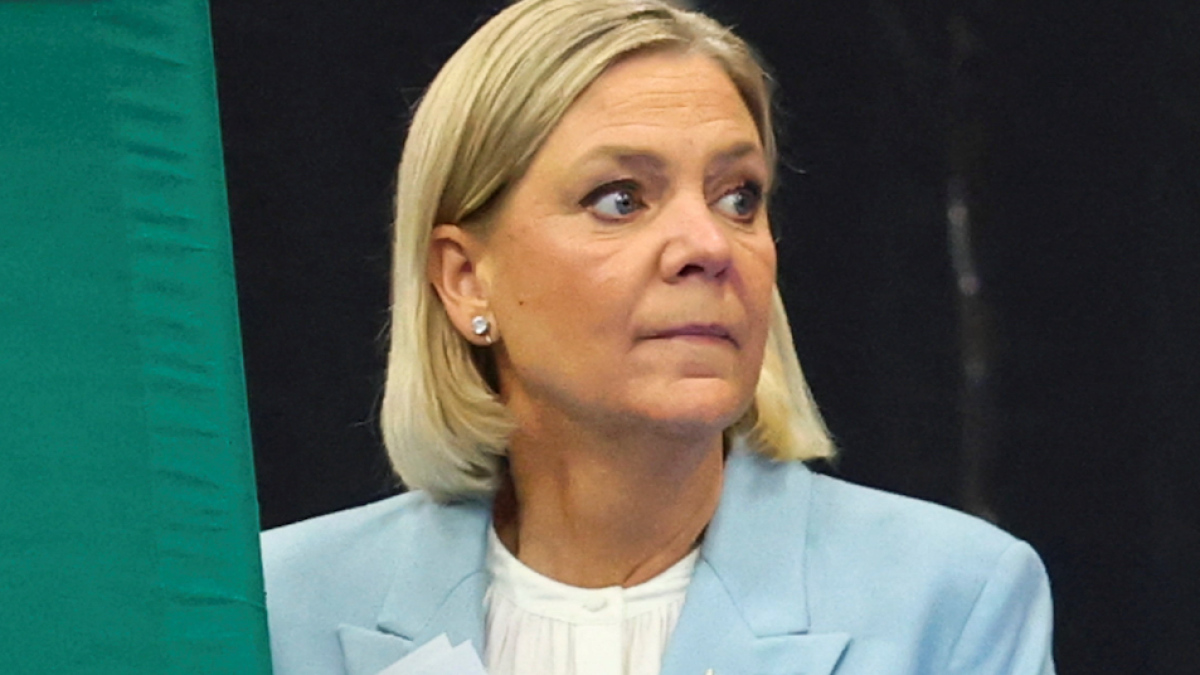
Magdalena Andersson will likely face several challenges as she tries to get Sweden’s other left-wing parties to unite.
Published On 18 Sep 202618 Sep 2026
Sweden’s opposition leader has officially begun talks to form a coalition government after the country’s left-wing bloc won a slim majority in last week’s election.
Magdalena Andersson, leader of the centre-left Social Democrats, was asked by Parliament Speaker Andreas Norlen on Friday to begin efforts to form a new government.
Recommended Stories
list of 3 itemsend of list
Norlen’s request follows the resignation of centre-right Prime Minister Ulf Kristersson, who stepped down on Thursday after the general election result was confirmed.
“I have now been tasked with exploring the possibility of forming a government. A task I undertake with great humility and will act constructively to put together a new government,” Andersson said in a statement posted on Instagram.
“My approach to the work that is now taking place is that all political forces now need to put party tactics aside and put Sweden and the Swedish people first.”
Andersson will likely face a series of challenges as she tries to persuade Sweden’s other left-wing parties to unite and form a new administration. The left-wing bloc won 176 of Parliament’s 349 seats in last week’s vote, securing a razor-thin majority of three seats.
Andersson is expected to seek the support of three other left-wing parties: the Greens, the Centre Party and the Left Party.
The socialist Left Party says Andersson will have to award some of its MPs cabinet posts to win their support. However, the liberal Centre Party insists it will not support such a government.
Andersson has until September 28 to form a government. If she fails, Kristersson, whose centre-right bloc won 173 seats, will try to form a coalition.
Coalition and minority governments are common in Sweden because the country has two major left- and right-wing blocs, both of which contain four parties.
The process of forming a government following the 2022 election took more than a month.
Russians head to the polls from Friday to Sunday to elect members of the State Duma, the lower house of Russia’s parliament, in the first parliamentary election to be held since the country launched its full-scale invasion of Ukraine in 2022.
The vote comes as Russians face a slowing economy as well as Ukrainian drone strikes on refineries and warehouses far from the front line.
United Russia, the governing party that backs President Vladimir Putin, is expected to keep its dominant position.
The authorities are presenting the election as a chance for voters to have their say. Critics argue that with no genuine opposition on the ballot, the result is largely settled in advance.
So why are the elections worth watching? Here is what you need to know:
How do Russia’s elections work?
Starting Friday and lasting through Sunday, Russians will elect members of the lower house, the State Duma.
They will also cast ballots in local elections.
Voters in 11 regions will elect their governors, and 39 regions will elect members of regional legislatures.
Voting is spread over three days to boost turnout among the 111 million eligible voters and includes areas Russia occupies in Ukraine. Electronic voting is allowed.
Half of the Duma’s 450 seats are filled by party lists and the other half are contested in single-ballot races.
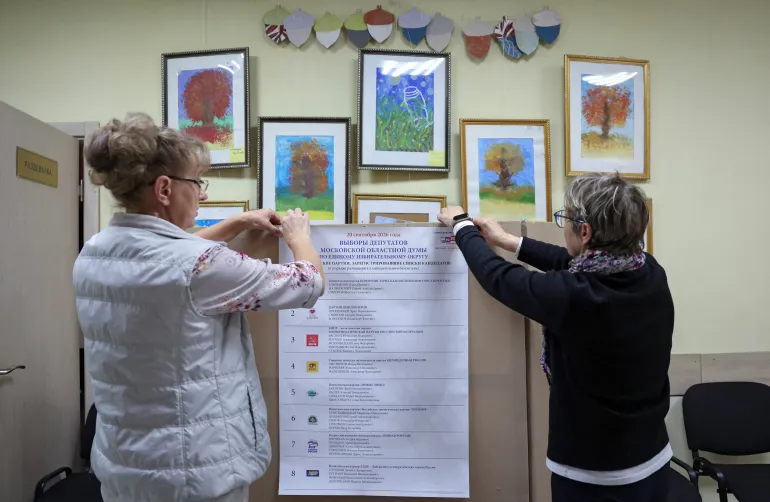
Election officials hang a list of political parties at a polling station before the parliamentary elections in Podolsk, Moscow region [Ramil Sitdikov/Reuters]
What is United Russia?
Russia’s governing party, formed in 2001 from a merger of pro-Kremlin parties, has backed Putin and dominated the parliament ever since.
United Russia won more than two-thirds of the Duma’s seats in the 2021 election. It is again poised to dominate the body.
The party’s list is led by political heavyweights: Foreign Minister Sergey Lavrov, Russia’s top diplomat for 22 years, and Sergei Sobyanin, Moscow’s powerful mayor.
In an apparent bid to add fresh faces to what is widely seen as a party of bureaucrats, its third-highest-ranking official is war correspondent Yevgeny Poddubny, who was badly wounded by a Ukrainian drone.
Members of United Russia have pledged to back the war effort and Putin’s maximalist goals in what the Kremlin calls the “special military operation” in Ukraine.
Deputy Chairman of the Russian Security Council and leader of the United Russia political party Dmitry Medvedev [Ekaterina Shtukina/Sputnik/Government press office/EPA]
Who else is running in Russia’s elections?
Alongside United Russia, other “systemic opposition” parties that vote in sync with the government on key issues are also expected to remain.
The liberal Yabloko Party, the only registered political party that opposes the war, was initially on the ballot, but the Supreme Court ordered it removed in August.
It cited, among other reasons, that the antiwar stance was akin to seeking the violation of Russia’s territorial integrity. Yabloko now runs only single-ballot races.
The Communist Party has been a leading force in the Federal Assembly since the 1990s, led for more than three decades by 82-year-old Gennady Zyuganov, a former Soviet official.
Throughout Putin’s rule of more than a quarter-century, the Communists have criticised some aspects of government policy but carefully avoided any criticism of him. They steadfastly support the war in Ukraine.
Alexander Bratersky, a political analyst and independent journalist, told Al Jazeera that the race for second place is worth watching.
If the Communist Party nab second, it would “suggest voters are angry about economic hardship and falling living standards”.
Russian Communist Party leader Gennady Zyuganov, centre, and Deputy Chairman Dmitry Novikov, second right, take part at the ‘Reds in the City’ all-Russian patriotic rally [Maxim Shipenkov/EPA]
The Liberal Democratic Party, an ultranationalist force that has been a significant presence in the legislature since the early 1990s, will also likely retain some influence in the Duma.
Like the Communists, it staunchly supports the war and boasts of having multiple veterans as members.
Other smaller parties round out the ballot.
The party known as A Just Russia has been on Russia’s political scene for 20 years. A social-democratic party, it competes with the Communists for older and middle-aged voters nostalgic for the Soviet past, and it supports the war in Ukraine.
The New People Party was founded shortly before the last parliamentary election in 2021, seeking to position itself as a liberal voice representing younger voters and technocrats. It won just more than 5 percent of the vote, allowing it to form a small faction.
Bratersky described the party as “a liberal-leaning party backed by some Kremlin people who are more technocratic and more pro-peace”.
He said it appeals to the “middle-class audience”, and after the Kremlin banned Yabloko, it has been viewed as its substitute.
“So, if they come third with a good number of votes, this is a sign that those who are antiwar used them as their legal avatar,” he said.
Other parties seeking seats include Communists of Russia, a small rival of the main Communist Party; the Party of Pensioners; the Green Party; the Party of Direct Democracy; and the Motherland Party.
A candidate for Russia’s liberal Yabloko party running in a single-mandate constituency in the upcoming parliamentary election, hands out flyers to passers-by on a street in Moscow, Russia [File: Yulia Morozova/Reuters]
Why do the elections matter to the Kremlin?
While these elections may seem routine, the fact that they are the first since Russia’s full-scale invasion of Ukraine is what makes them important, Bratersky told Al Jazeera.
He said that Putin has linked the elections to support for the war: Endorsing United Russia at its party congress in August, Putin said the party’s duty was “to do everything for victory” in the war in Ukraine.
“This shows that the Kremlin is a bit worried since the elections are the only legal way to show disrespect for the Kremlin,” Bratersky said. “Even Putin’s core fans hate United Russia as a corrupt force.”
How have past elections gone?
Since Putin first came to power in 2000, United Russia has won every Duma election, usually by a wide margin.
The results have repeatedly been disputed.
In 2011, allegations of vote-rigging set off the largest street protests of Putin’s rule.
After the 2021 vote, independent monitors and statisticians said the party’s real support was far lower than the official count.
The authorities have rejected claims of widespread fraud. Opposition parties and critics of the war have increasingly been kept off the ballot.
The ex-Oklahoma state trooper’s nomination had stalled in the Senate as ICE faced growing scrutiny over its operations.
By Reuters and The Associated Press
Published On 18 Sep 202618 Sep 2026
The White House has withdrawn the nomination of former Oklahoma state trooper Lance Schroyer to lead United States Immigration and Customs Enforcement (ICE), without giving a reason for the decision.
The withdrawal was announced on Thursday. Schroyer, a senior adviser to Homeland Security Secretary Markwayne Mullin, was nominated by President Donald Trump in June but had yet to receive a hearing before the Senate Homeland Security and Governmental Affairs Committee.
Recommended Stories
list of 1 itemend of list
Republican Senator Rand Paul of Kentucky, who chairs the committee, had refused to hold a hearing until the Department of Homeland Security (DHS) provided information he had requested about civilian deaths during ICE enforcement operations.
“I don’t have a concern with who the nominee was. I had asked them to give me an update on the internal investigation into civilian deaths,” Paul told The Associated Press news agency.
Paul said he had intended to hold a hearing on Schroyer’s nomination but learned that it had been withdrawn when the White House made the decision public.
ICE remains under scrutiny
Schroyer had little experience in immigration and had not previously worked at ICE or led a major law enforcement agency. Two US officials told the Reuters news agency when he was nominated that he had been a surprise choice for the position.
When announcing Schroyer’s nomination in June, Trump said on Truth Social that he had “firsthand experience getting Illegal Aliens OFF our streets” and called on the Senate to confirm him “IMMEDIATELY”.
The withdrawal comes as ICE remains under scrutiny over its enforcement operations as the Trump administration carries out its immigration crackdown.
Critics have raised questions about how the agency has recruited and trained officers as it rapidly expanded its workforce. Federal immigration officers have also shot and killed multiple people during enforcement operations, including two US citizens in Minneapolis earlier this year.
ICE arrests have continued to increase, reaching nearly 51,000 in August, the highest monthly total of Trump’s second administration.
ICE has not had a Senate-confirmed director since 2017. David Venturella is serving as acting director after Todd Lyons resigned earlier this year.
The White House has not indicated when it might announce another nominee to lead the agency.
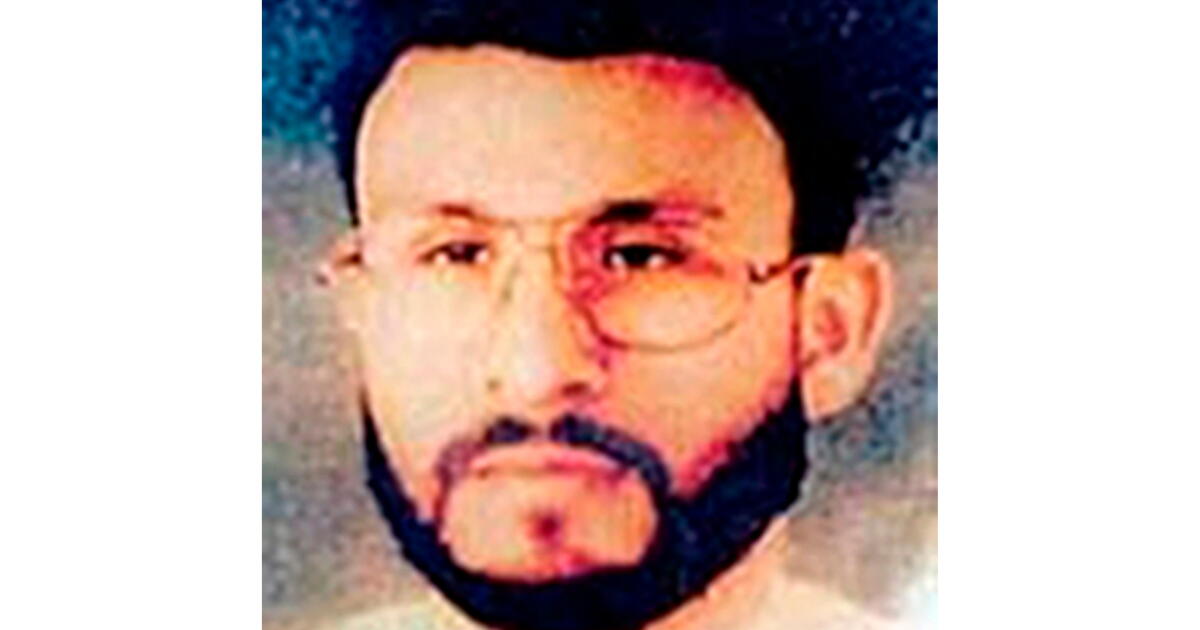
FT. MEADE, Md. — A man initially accused of being a high-profile Al Qaeda figure and who was tortured in CIA custody appeared Thursday at a hearing to review his detention at the U.S. military prison at Guantanamo Bay, Cuba, where he has been held for 20 years without charges.
A U.S. government official said Abu Zubaydah, who wore a neatly trimmed beard and glasses, had “probably” served as one of Osama bin Laden’s most trusted facilitators. The roughly 20-minute hearing offered rare visibility into the secretive military court proceedings of a suspect who had been tortured at CIA black sites during the U.S. war on terrorism and whose case still has not been resolved 25 years after the attacks of Sept. 11, 2001.
Zubaydah’s unidentified government-assigned representative and his private attorney, Annika Conrad, both acknowledged he had known Bin Laden, the 9/11 mastermind. But they said Zubaydah was never a member of the militant group that Bin Laden founded.
Conrad argued that Zubaydah poses no security threat to the United States and that it can no longer justify his detention. She said Zubaydah should be approved for transfer out of Guantanamo, which would kick off a multiyear process that includes finding a country to accept him.
Lawyer describes lasting injuries from torture and says Zubaydah could be monitored if released
Conrad said Zubaydah is prepared to accept a range of security measures, including continuous monitoring. Conrad said he has the financial and personal support of his family, has rejected any extremist views “and simply wants to live a life of peace.”
She also argued that a chief military prosecutor for U.S. military commissions, which oversees the 15 men still held at Guantanamo Bay, has said it is unlikely that Zubaydah will be charged. The Office of Military Commissions declined to comment.
Zubaydah’s attorney said the most the government can offer is a “probable association” to Bin Laden after more than two decades and noted that Zubaydah declined a direct request from Bin Laden to work for Al Qaeda.
Conrad also cited the torture that Zubaydah experienced, describing him as “a greatly injured man” who lost his left eye and his ability to write in English and “frequently struggles to recall words.”
Zubaydah’s detention is being reviewed by a U.S. government panel of senior defense, intelligence and homeland security officials. The Periodic Review Board was created under the Obama administration to evaluate prisoners and determine whether they could be released without posing a threat to national security.
The review panel did not immediately decide on the case
The review panel issued no immediate ruling Thursday. A live video feed of the unclassified portion of his hearing at Guantanamo was made available to reporters at Ft. Meade, an Army base in Maryland.
Detainees are not permitted to speak at their review hearings, and Zubaydah sat in silence next to his attorney and the government representative. Dressed in a gray suit jacket and patterned gray tie, he often pressed his left index finger to his left temple or fidgeted with something in his hands. A worn-looking book sat in front of him.
Zubaydah’s lawyers, Conrad and Ahmed Almudallal, said in a statement before the hearing that he may never face charges.
“For the first time in over two decades, the military’s chief prosecutor believes it is unlikely our client will ever be charged,” the attorneys said. “This is a major change in circumstances that warrants he be cleared for transfer.”
Almudallal and Conrad said Zubaydah has “no intent to engage in violence against the United States in the future.”
“Now, at 55 years old, he’s eager to reconnect with his family and live out the rest of his days as a free person,” they said. “Twenty-four years in prison plus being ‘patient zero’ in the U.S. government’s torture program has been punishment enough.”
He was first in the CIA’s ‘enhanced interrogation’ program after 9/11
Zubaydah was thought to be a high-ranking member of Al Qaeda when he was captured in Pakistan in 2002. A Palestinian born in Saudi Arabia, Zubaydah was tortured abroad before being transferred to Guantanamo in 2006.
The U.S. later dropped the claim that Zubaydah was one of the most senior figures in Al Qaeda, although it has continued to regard him as a security risk. Zubaydah’s lawyers have repeatedly said over the years that he was not an Al Qaeda member and point to waterboarding and other harsh treatment he experienced in the early 2000s.
Zubaydah was the first person in the CIA’s detention and interrogation program after 9/11 and subjected to what is now widely viewed as torture. He was held at CIA black sites in Poland and Lithuania, according to the European Court of Human Rights.
Zubaydah was waterboarded more than 80 times in a month at one point and confined over 11 days in a coffin-size box, among a raft of other mistreatment, a Senate report found.
In 2022, the Supreme Court dismissed a lawsuit by Zubaydah, who was seeking testimony from two former CIA contractors as part of an investigation into his treatment when he was held in Poland. The court rejected his case because the government said it would expose state secrets, despite much of the information having been widely reported.
In January, a lawyer for Zubaydah said the British government had agreed to pay a “substantial sum” to settle a lawsuit that said U.K. intelligence agencies were complicit in his torture. Attorney Helen Duffy said the confidential settlement was symbolically and practically significant for the “intolerable suffering” that Zubaydah endured.
A British parliamentary committee found in 2018 that U.K. security and intelligence services were aware Zubaydah was being tortured but continued to provide questions for the CIA to ask him without seeking assurances of his condition.
Tehran gives Swedish official 48 hours to leave as Iran says Stockholm is bowing down to outside pressure.
Published On 18 Sep 202618 Sep 2026
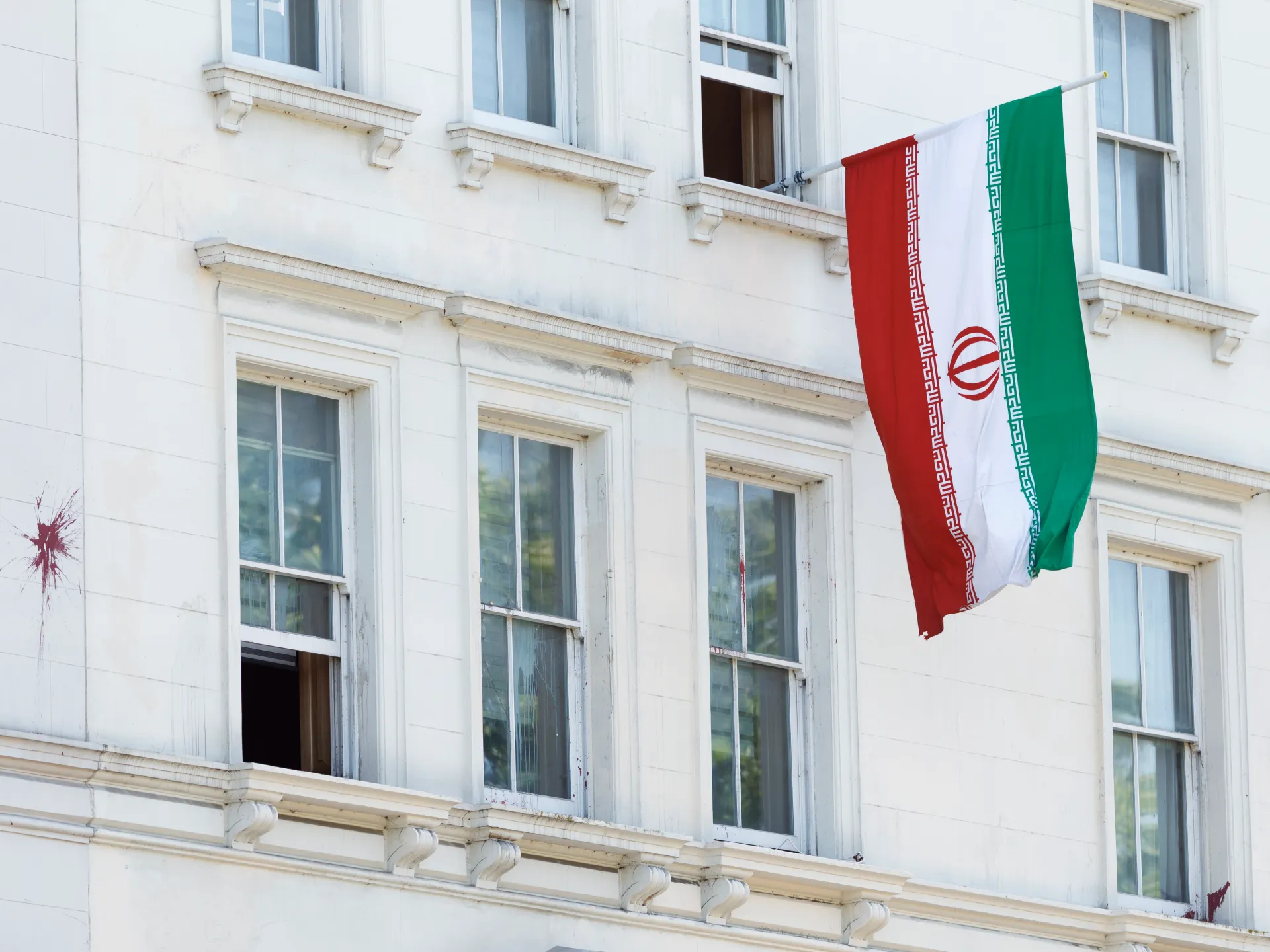
Iran has ordered a Swedish diplomat to leave the country one day after Sweden expelled an Iranian embassy official in Stockholm.
Sweden’s action was described by Iran’s Ministry of Foreign Affairs as “unjustified” on Thursday.
Recommended Stories
list of 3 itemsend of list
“Without doubt, this action by the Swedish government is the result of the influence of the Zionist regime and an effort to disrupt the normal activities of the Islamic Republic of Iran’s Embassy in Stockholm,” the Foreign Ministry said in a statement, Iran’s IRNA news agency reported.
Iran’s Foreign Ministry said its director general for Western Europe, Alireza Yousefi, summoned the Swedish ambassador in Tehran on Thursday. Yousefi protested Sweden’s policies, including its “hosting of anti-Iranian terrorist elements and groups”.
The ministry said Iran would take necessary measures to safeguard its national rights and interests, including through reciprocal action.
IRNA reports that in response to Sweden’s actions, the ambassador was informed in the meeting that a Swedish diplomat in Tehran had been given 48 hours to leave Iran.
Sweden expels Iranian official
Sweden’s Ministry for Foreign Affairs announced on Wednesday that the Iranian official was asked to leave the country due to activity incompatible with the Vienna Convention on Diplomatic Relations.
The Vienna Convention defines the rules of diplomatic missions.
The Iranian Foreign Ministry also referenced Sweden’s obligations under international law, including the 1961 Vienna Convention on Diplomatic Relations, warning that disruption of the Iranian embassy’s duties would entail Sweden’s international responsibility, reported IRNA.
Swedish Foreign Minister Maria Malmer Stenergard said the decision to expel the Iranian official was taken to protect Swedish citizens and interests.
Swedish Justice Minister Gunnar Strommer told state television that the decision involved Iran’s alleged activities against “Jewish and Israeli interests”.
“We know that Iran, over a long period of time, has conducted activities that threaten security in and against Sweden,” Strommer said, adding that Iran was “making use of criminal networks” to achieve its objectives.
Lawyers criticised mass arrests under emergency powers that allowed authorities to detain people without charge.
Published On 17 Sep 202617 Sep 2026
The Caribbean country of Trinidad and Tobago has ended a state of emergency that granted the government extraordinary powers to combat crime, including the ability to imprison people without charge.
The country’s prime minister told parliament on Wednesday that the government would not extend the state of emergency. One was issued in 2024 and another in 2025, with extensions lengthening both. Instead, the government would seek a “permanent legal framework”.
Recommended Stories
list of 3 itemsend of list
“The proposed legislation will establish a permanent legal framework for targeted operations against violent crime, gangs, illegal weapons and the criminal networks that finance them, while providing safeguards for law-abiding citizens, judicial oversight and parliamentary accountability,” Prime Minister Kamla Persad-Bissessar said in a social media post.
The government had faced criticism for a campaign of mass arrests that suspended key civil liberties in what it said was in the name of cracking down on crime and those the government deemed threats to security. A prominent businessman and his wife were among those arrested over alleged involvement in a plot to assassinate the prime minister, but were never charged and later released.
The measures were last extended in June, with the prime minister stating that more than 5,800 people have been arrested since a March extension. About 2,250 of those have yet to be charged, and it remains to be seen whether they will be released now that the state of emergency has ended.
Lawyer Criston Williams told The Associated Press news agency that he expects some of those detained without charge to bring lawsuits against the government and called for the Inter-American Commission on Human Rights to investigate possible abuses by the government.
“They are transported to us blindfolded, shackled, hands behind their backs, a gray knapsack over their heads,” he said, adding that meetings with lawyers took place in the presence of five armed men from law enforcement, “who refer to themselves as operator one, two, three, four, five. There’s a camera above, so guess what, there’s nothing like attorney-client privilege.”
Police reported a record 624 killings in the country of about 1.4 million people in 2024, a figure that police say dropped to 369 in 2025. Police state that 255 killings have been recorded this year, compared with 268 over the same period in 2025.
MEXICO CITY — Nicaraguan journalist Luis Galeano fled his country in 2018 after police raided the television station where he broadcasted his popular talk show, arresting two of his colleagues.
Galeano applied for political asylum when he arrived in Florida on a tourism visa, saying he faced grave risks back home for his fierce criticism of Nicaragua’s left-wing Sandinista government, which the U.S. labels a dictatorship. Soon after, Nicaragua declared Galeano a “traitor to the homeland” and confiscated his home and assets in the capital of Managua.
This week, U.S. immigration agents arrested Galeano in Orlando. Despite his ongoing asylum case, he now faces deportation to the country he fled and whose abuses he has spent years documenting.
Journalists, human rights advocates and political dissidents who were persecuted in Nicaragua and sought safety in the United States are increasingly being detained as the Trump administration widens its deportation dragnet and narrows access to asylum and other forms of protection.
Recent targets include activists who fled Nicaragua after a bloody crackdown on pro-democracy protests in 2018 and opposition leaders critical of the regime of Daniel Ortega and Rosario Murillo, a married couple who lead Nicaragua as co-presidents.
Some of the exiles arrested by U.S. agents in recent months had been welcomed with open arms by the U.S. government just three years ago under a novel deal negotiated by the State Department.
As part of the 2023 agreement, Nicaragua freed 222 political prisoners and the U.S. hired a charter plane to fly them to Washington, where each person was granted temporary humanitarian parole and the chance to apply for asylum.
One of those former prisoners, Marlon Gerardo Sáenz Cruz, a former Sandinista who said he was tortured in Nicaragua after denouncing government corruption, was arrested during a regular check-in with immigration authorities in Los Angeles on Aug. 17.
Another, Denis Javier Palacios Hernández, who languished for three years in a Nicaraguan jail after participating in pro-democracy marches, was detained by immigration agents Wednesday morning in Virginia.
Human rights advocates say the effort to deport dissidents with no criminal record and a history of persecution puts their lives in danger and is at odds with U.S. foreign policy, which condemns human rights abuses and corruption under Murillo and Ortega, a former Marxist revolutionary who at 80 is now the longest-serving leader in the Americas.
After Ortega said in July that Nicaragua would scrap all future elections, Secretary of State Marco Rubio, who had recently announced sweeping sanctions on dozens of Nicaraguan leaders, vowed consequences. This week, while celebrating the anniversary of Central America’s independence from Spain, Rubio praised Nicaraguans for pushing for democracy “despite the Murillo-Ortega dictatorship’s brutal efforts to annihilate it.”
“Whether at home or in exile, Nicaraguans’ aspirations for a future free from tyranny cannot be canceled or erased,” Rubio said.
He spoke one day after Border Patrol agents arrested Galeano, who, since moving to Florida, has driven for ride-hailing apps in the mornings to provide for his two children and has spent his afternoons recording episodes of “Café con Voz,” his daily YouTube show.
A spokesperson for the Department of Homeland Security said Galeano was detained because he overstayed his tourist visa, which gave him permission to remain in the U.S. only through 2019, and encouraged Galeano to self-deport. “Being in detention is a choice,” the spokesperson said. “The United States is offering illegal aliens $3,000 and a free flight to self-deport now.”
In the past, people who had filed asylum applications in the U.S. were generally allowed to stay and work while they waited for a ruling in their case, a process that often stretches years because of backlogs in immigration court.
That’s changed under President Trump, who has vowed to deport 1 million people annually, and who complains that the asylum system is abused and used as a back door for economic migrants falsely claiming persecution.
As immigration arrests in the U.S. have soared in recent months, surpassing 51,000 in August, asylum seekers and others who have shared their information with the U.S. in hopes of achieving legal status make up a growing share of detainees, according to the Deportation Data Project.
Removals of Nicaraguans have also surged, with deportation flights to Managua increasing more than fourfold under Trump compared to under President Biden, according to data tracked by Human Rights First.
Nicaraguans are also being shipped to Mexico, Costa Rica and as far away as the Central African Republic. They face unique risks in those countries, said Savi Arvey, director of policy for refugee and immigrant rights at Human Rights First.
In Costa Rica, Sandinista operatives are suspected in a series of shootings, abductions and killings of Nicaraguan exiles in recent years.
“This government is so single-minded in carrying out this vast mass deportation campaign that it blatantly ignores realities on the ground,” Arvey said.
Gerald Chávez, president of the Independent Journalists and Communicators of Nicaragua, said that at least one journalist who had sought protection in the U.S. had been sent to Costa Rica, avoiding deportation to Nicaragua thanks to a lengthy legal battle and help from Reporters Without Borders.
Restriction of press freedoms has been a cornerstone of Ortega and Murillo’s efforts to concentrate power in recent years.
Hundreds of journalists fled as government officials jailed colleagues, shuttered dozens of news outlets and passed laws barring reporters from publishing information not authorized by the government. At one point, Ortega even banned newspapers from importing paper and ink.
Galeano — who previously worked as a correspondent for the Associated Press in Nicaragua — believed he had a responsibility to call out what he saw as injustices perpetrated by the government.
“If there is one thing that has distinguished the Sandinista thugs … it is that up until now, they have enjoyed total impunity,” he said on a recent episode of his YouTube show.
Galeano’s arrest has drawn sharp criticism from human rights and press freedom groups and even Republican Rep. María Elvira Salazar, a Trump ally who is seeking reelection in Florida.
Salazar described Galeano as a journalist who had “paid a very high price for telling the world the truth.”
“The United States must always know how to distinguish between a criminal and a political exile,” she wrote on X. “Luis cannot end up in the hands of the very dictatorship that persecuted him.”
Linthicum reported from Mexico City. López, a special correspondent, reported from Orlando.
WASHINGTON — The top Democrat on the House Foreign Affairs Committee said Wednesday that he’s going to block a proposed sale of $2.8 billion in heavy weaponry to Israel over concerns that the powerful bombs may not be used in line with U.S. and international law.
Rep. Gregory Meeks of New York said he would withhold approval for the sale because of “grave, unresolved concerns” about how these munitions could be used in densely populated areas of Gaza and Lebanon by Israeli Prime Minister Benjamin Netanyahu’s government.
“The Trump administration has not provided sufficient assurances that these weapons will be used by the Netanyahu government in accordance with U.S. law and with appropriate protections for civilians,” Meeks said in a statement. “I therefore will not clear this sale at this time.”
Meeks’ objections, however, likely will not affect the sale, which was informally notified to lawmakers on Tuesday. Once it is formally notified to Congress, Secretary of State Marco Rubio can bypass the normal congressional review process by making an emergency determination that the transaction is an urgent national security interest.
Rubio has done so in the past, including bypassing a normal congressional review process to approve a nearly $3-billion sale to Israel last year. The administration then approved a new series of arms sales to Israel totaling $6.67 billion in January.
The State Department did not respond to requests for comment about either the new proposed sale or Meeks’ objection to it.
The $2.8-billion package includes 40,000 powerful 2,000-pound bombs, the Associated Press has reported. The transfer of 2,000-pound bombs had been paused by the Biden administration over concerns about the possibility of mass casualties.
The proposed sale is just the latest in a series of Trump administration steps to improve Israel’s military capacity and it comes as Israel is facing increased international isolation over its war in Gaza in response to the deadly Oct. 7, 2023 attacks by Hamas.
The conflict in Gaza has left tens of thousands of Palestinians dead and decimated the enclave. The U.S. brokered a fragile ceasefire, but violence has continued.
Native authorities issue condolences after two adults and a child swept away by floodwaters in southwestern US state.
Published On 17 Sep 202617 Sep 2026
Indigenous authorities in the United States have said that three people have been killed in flooding in the southwestern state of New Mexico, where heavy rains left roadways blocked by water.
Navajo Nation President Buu Nygren said on Wednesday that police had responded to reports of people being swept away by floodwater at 12:30am (06:30 GMT) near the community of Newcomb in northwestern New Mexico.
Recommended Stories
list of 3 itemsend of list
Nygren said that two adults and a child were killed in the incident and offered condolences to the community, while advising residents to exercise caution in areas impacted by rainfall.
“There are no words that can ease the pain of losing a loved one so suddenly, and our hearts are especially heavy knowing that three lives were lost,” Nygren said. “To the family, relatives, and loved ones who are grieving today, we offer our deepest condolences. We pray that you are surrounded by strength, comfort, and the love of your family and community in the difficult days ahead.”
The National Weather Service (NWS) in Albuquerque, New Mexico, issued a special briefing on Tuesday warning of the possibility of widespread thunderstorms in the coming days. The service repeated those warnings on Wednesday, noting that moisture levels are expected to be at record levels for mid-September.
“A Flash Flood Watch is in effect for the western third of New Mexico and the South Central Mountains today,” NWS Albuquerque said in a social media post on Wednesday. “However, flash flooding could occur anywhere in central and northern New Mexico today.”
Heavy rainfall is predicted across parts of Arizona, New Mexico, Colorado and Utah through Thursday. Flash flood warnings were issued for parts of northwestern New Mexico, along with flash flood watches for large areas of central and northern Arizona.
The deaths on Wednesday come several weeks after three hikers were swept away and dozens were rescued after heavy rainfall caused flooding at the Grand Canyon, a popular destination for tourists and outdoor recreation in Arizona.
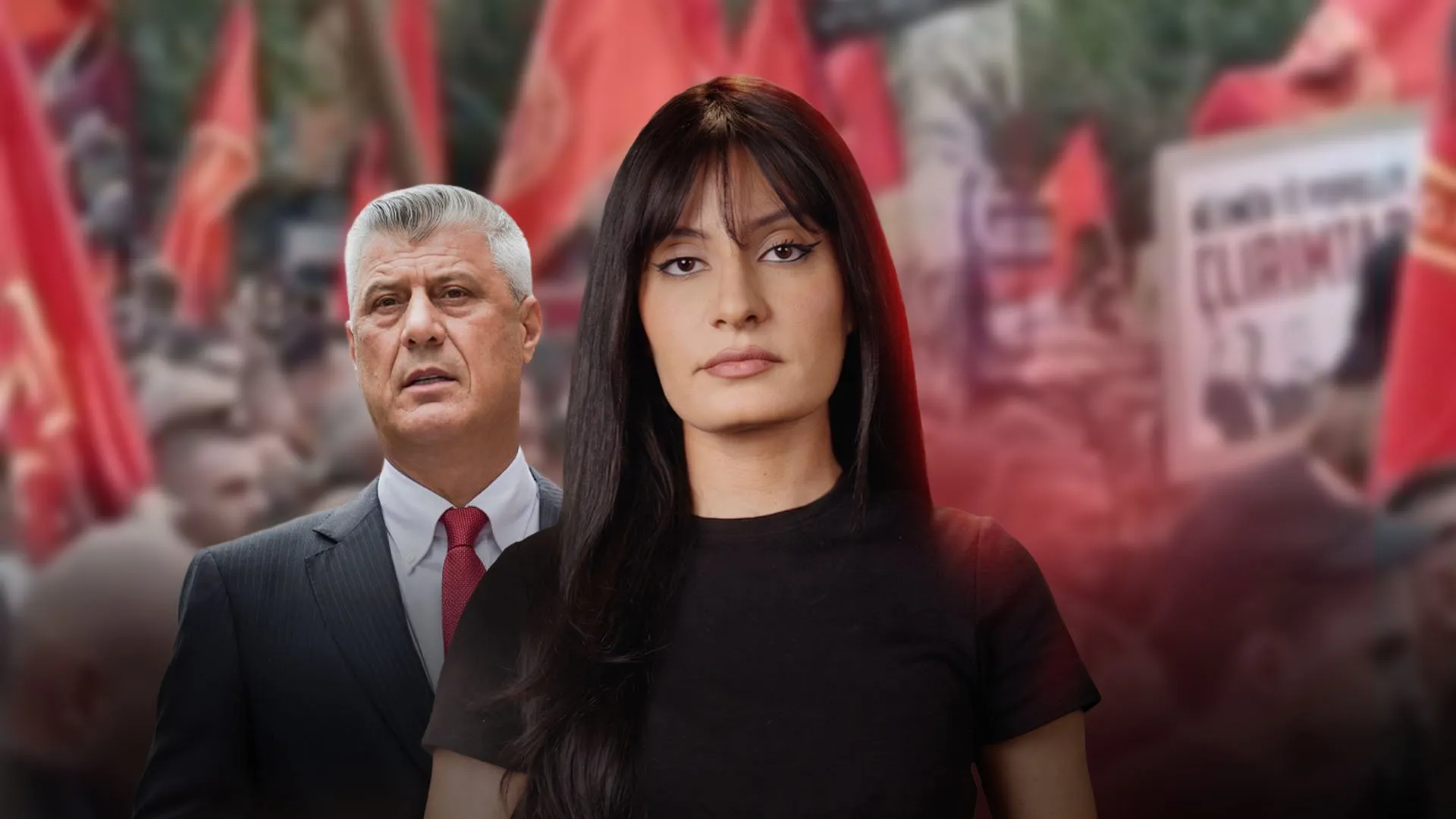
Hashim Thaci, former President of Kosovo and KLA leader, has been found guilty of war crimes by the Specialist Court in The Hague. Al Jazeera’s Marah Rayan explains how the ruling came about.
Prosecutors said that the group worked on behalf of Russian intelligence services to carry out attacks and murders around the world.
Published On 16 Sep 202616 Sep 2026
Five people have been charged over alleged Russian intelligence-linked plots involving surveillance, recruitment and planned killings, according to an indictment unsealed by the United States Department of Justice.
Prosecutors said on Tuesday that the group worked on behalf of Russian intelligence services to carry out attacks and murders internationally, including within the US, and that all five remain at large.
Recommended Stories
list of 3 itemsend of list
The defendants were identified as Russian national Yuri Khrameev, 63, his son Kirill Khrameev, 27, Cubans Oemis Romagoza Durruthy and Yaidel Delgado Suarez, both 35, and 22-year-old Venezuelan Angel Eduardo Castro.
All five were charged with conspiring to finance terrorism, while Khrameev, Suarez and Castro face additional charges of conspiring to commit murder for hire.
At a news conference, Attorney General Todd Blanche said the plots included attempts to kill a Russian dissident believed to be living in the Washington, DC area.
Justice Department officials said the network had recruited several people in the US to carry out surveillance on Russian dissidents, targeting individuals both domestically and in Lithuania.
In one instance, a recruit was reportedly promised $40,000 to make a US-based target “disappear”. A separate recruit was allegedly offered $25,000 the previous year to kill someone in Lithuania.
Russia’s embassy in the US has not commented on the case. Moscow has consistently rejected accusations that it has orchestrated assassination operations on foreign soil, including in the US.
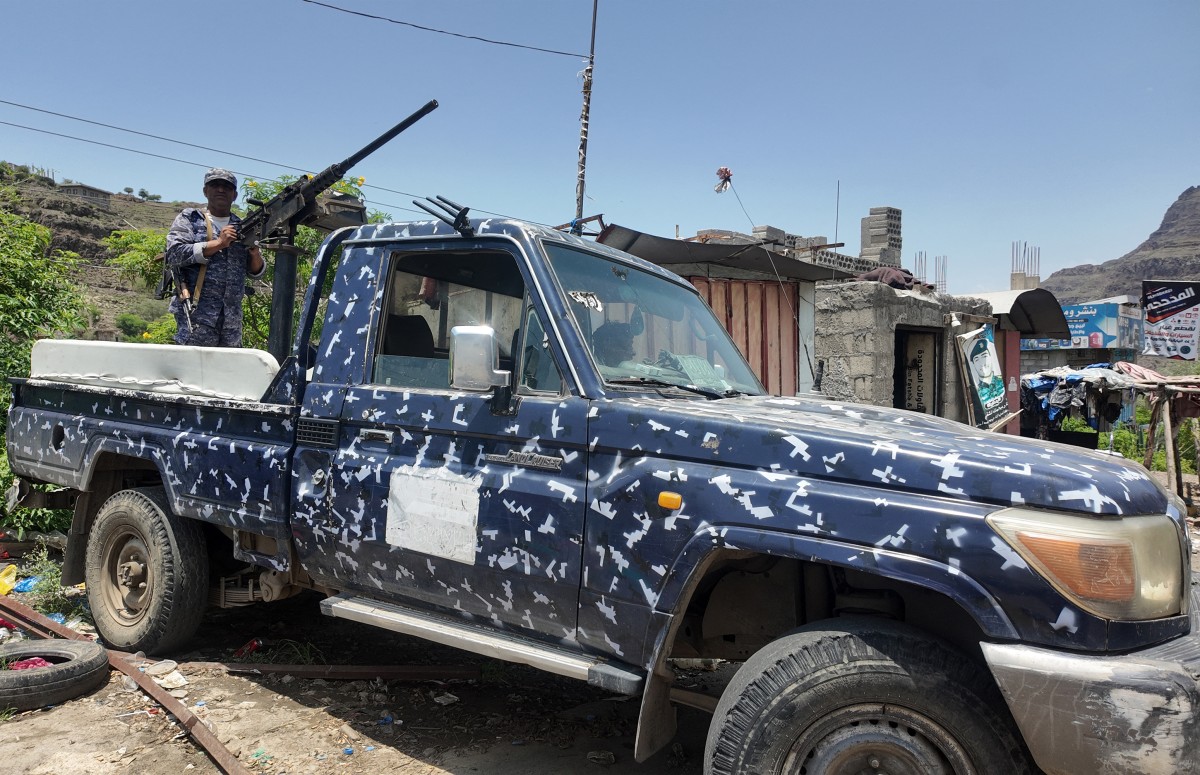
DUBAI: Fighting in Yemen intensified on Sunday as government forces claimed fresh gains against the Houthis in Taiz, state news agency Saba reported.
Yemeni government forces recaptured positions overlooking the Jardad area in western Taiz and advanced toward Gail Bani Omar, the agency reported citing a military source.
The source said government forces seized military equipment and inflicted heavy losses on the Houthis.
Government aircraft also carried out strikes on Houthi positions, gatherings and vehicles in several parts of Taiz, including Dhubab, Al-Wazaiya and Haifan, according to the source.
An airstrike on a Houthi gathering in the Afira area of Jabal Habshi district destroyed several military vehicles and detonated a stockpile of medium-weapons ammunition, killing at least 10 Houthi fighters, the source said.
The latest fighting comes amid a wider escalation across Yemen, with government forces also conducting operations in Marib, Jouf, Al-Bayda and Al-Dhalea, according to the Yemeni presidency.
President Rashad Al-Alimi has held talks with members of the Presidential Leadership Council, the prime minister, military commanders and provincial officials to assess developments on the various fronts.
He said individual changes along the front lines would not alter the government’s objective of restoring state control across Yemen.
Houthi attacks on Saudi Arabia
The escalation has also extended beyond Yemen’s borders, with the Houthis continuing attacks on Saudi Arabia.
Saudi Arabia’s Civil Defense issued emergency alerts early on Monday covering Khamis Mushait, Abha, Jazan and Najran in the southwest of the Kingdom before announcing that the danger had passed.
Civilian toll rises
The fighting has also triggered a major new displacement crisis inside Yemen.
Yemen’s Ministry of Human Rights said on Sunday that 150 civilians had been killed and more than 200 wounded since Sept. 3 in fighting and attacks in Taiz, Hodeidah and Marib.
The ministry said about 85,000 people had been displaced during the same period, while citing International Organization for Migration data showing that around 2,000 people had arrived in Djibouti as a result of the escalation.
The ministry accused the Houthis of launching ballistic missiles, drones and other weapons on populated areas, displacement camps and civilian convoys.
It also reported attacks on civilian and medical facilities, kidnappings, arbitrary detention, looting and alleged field executions.
The ministry called on the international community, the UN and human rights bodies to protect civilians and displaced people, investigate alleged violations and ensure humanitarian access.
Voting is under way in Sweden in a closely fought election that could see the far-right Sweden Democrats enter government for the first time, or centre-left leader Magdalena Andersson return to power.
Chavez’s eyes still gaze from walls across Caracas. So too do the eyes of other figures, like Maduro and independence leader Simon Bolivar. Some images are faded. Others are accompanied by slogans like “To doubt is treason”.
Forastero has worked on government projects, including under Rodriguez. But he is critical of some of the newer images. He remembers a time when he painted murals of Chavez playing with children or riding a bicycle, not slogans.
“When Chavez was alive, people painted Chavez because we loved him very much. It’s as simple as that,” he said.
In recent decades, he argues that Venezuela’s public art has fallen increasingly under government control, with murals commissioned to carry explicitly political messages.
“Muralism is a story told on a wall,” Forastero said. “What we really see on the walls now are propaganda posters. I’m a chavista, and I’m disgusted by it.”
Still, the removal of the artwork is another form of propaganda, in Forastero’s eyes. He believes the Rodriguez government is seeking to project a more “neutral” appearance to better appeal to the US.
He also accuses Rodriguez of abandoning ideals key to the chavismo movement: namely, anti-imperialism and revolution. He pointed to the US’s role in shaping Venezuelan policy.
“The United States is forcing our government to behave this way,” Forastero said.
Forastero believes the removal of Hugo Chavez murals is part of an effort by Venezuela’s government to appeal to the US [Catherine Ellis/Al Jazeera]
Rafael Araujo, a Venezuelan activist, has a different view of the changing landscape.
To him, there was something “jarring” about seeing chavista figures plastered across city walls, especially the leaders who have caused the country so much pain.
During their time in power, Chavez and Maduro both faced allegations of overseeing human rights abuses, including through the violent suppression of dissent. Venezuela’s last two presidential elections have been widely denounced as illegitimate.
Known in Caracas as Senor Papagayo, Araujo has used colourful, handmade kites to protest against government violence and economic policy.
He sees the Chavez murals as a form of oppression, an ever-visible reminder of a repressive government apparatus.
His kites are a way of sending a different message. His favourite carries aloft a single word: “Freedom”.
“Freedom is what all countries need. Democracy is the most balanced system a citizen can live under,” Araujo said.
MEXICO CITY — He’s been called the “MAGA man” of Latin America, a brash political provocateur whose social media assaults boosted right-wing campaigns from his native Argentina to Central America.
His career as political consultant and co-founder of an ultra-right online outlet made him a rich man and helped elect Trump-aligned politicians across the region. The Economist gave him the “MAGA Man” label, while political commentators gave him another nickname — the “Steve Bannon of Latin America” — a nod to the longtime Trump ally and advisor.
Now, however, Fernando Cerimedo, 45, sits in a maximum-security prison in Bolivia, accused of masterminding a murder-for-hire plot: The attempted femicide of his pregnant mistress, Nadia Beller, 33, a Bolivian lawyer and activist.
It’s a stunning collapse for a onetime ad man with a dodgy reputation who rose to become the go-to digital campaign guru for Latin America’s ascendant right wing. Cerimedo’s signature boasts, exaggerations and peddling of false election-fraud narratives reflected those of his political model, President Trump.
Cerimedo also is another example of how right-wing political operatives outside the United States — as recently in Colombia and Germany — have adopted Trumpian tactics and messaging.
The fall of the “King Midas of the Latin American right,” said Daniel Matamala, a prominent Chilean journalist, stunned “the ecosystem of fake news, bots, trolls and disinformation that has taken this region by storm in recent years.” Speaking on his podcast, Matamala added, “The name of Cerimedo looms like a ghost over the summit of the radical right.”
The Aug. 17 attack on Beller was a seemingly well-planned ambush that was captured by security cameras, the grainy images widely disseminated on social media.
One of two would-be assassins dressed as fast-food deliverymen pulled out a pistol and shot Beller point blank outside a hotel in the eastern Bolivian city of Santa Cruz. She fell to the ground and, according to her account, feigned death. The next day, at dawn, Cerimedo was arrested as he was about to board a plane to Buenos Aires.
Cerimedo set up the hit, prosecutors charge, in a nefarious attempt at damage control. Beller had threatened to expose his alleged criminal behavior and physically abusive behavior toward her while revealing Cerimedo, a married man with two children, as the father of her unborn child.
Cerimedo is also under investigation for alleged illegal enrichment and potential links to cocaine trafficking.
He has denied any wrongdoing.
Even before Cerimedo’s arrest, Latin American journalists had begun unmasking Cerimedo as a prodigious purveyor of fake news — about himself. New reports revealed that his frequent boasts about U.S. connections — that he attended Harvard, trained with U.S. Navy SEALs, worked in the Obama White House — were fanciful.
“He certainly exaggerated things,” said Damian Merlo, a Miami-based consultant who worked with Cerimedo on the 2023 campaign of Argentine President Javier Milei, a Trump favorite. “I never really got the impression that Cerimedo was ‘MAGA’s man in Latin America.’ The guy could hardly speak English! But that’s how he sold himself.”
Many times, the sales pitch worked. It was Cerimedo who helped broker then-candidate Milei’s celebrated 2023 interview with Tucker Carlson, at the time a Trump confidant, an appearance that thrust Milei into the international spotlight.
Like Milei, Cerimedo seemed to relish any proximity to Trump-land.
In February, at the inaugural “Hispanic Prosperity Gala” — a right-wing pep rally held at Trump’s Mar-a-Lago estate — Cerimedo was honored as “Hispanic Political Consultant of the Year.’” From the podium, he spoke of Latin America’s “culture war” and the need to ensure that “the left never again returns” to governments that have elected conservative leaders.
Switching to heavily accented English, Cerimedo gave a shout-out to Brad Parscale, Trump’s former campaign manager, whom Cerimedo thanked for “believing [in] me all the time and giving me your technology.”
Parscale declined to comment.
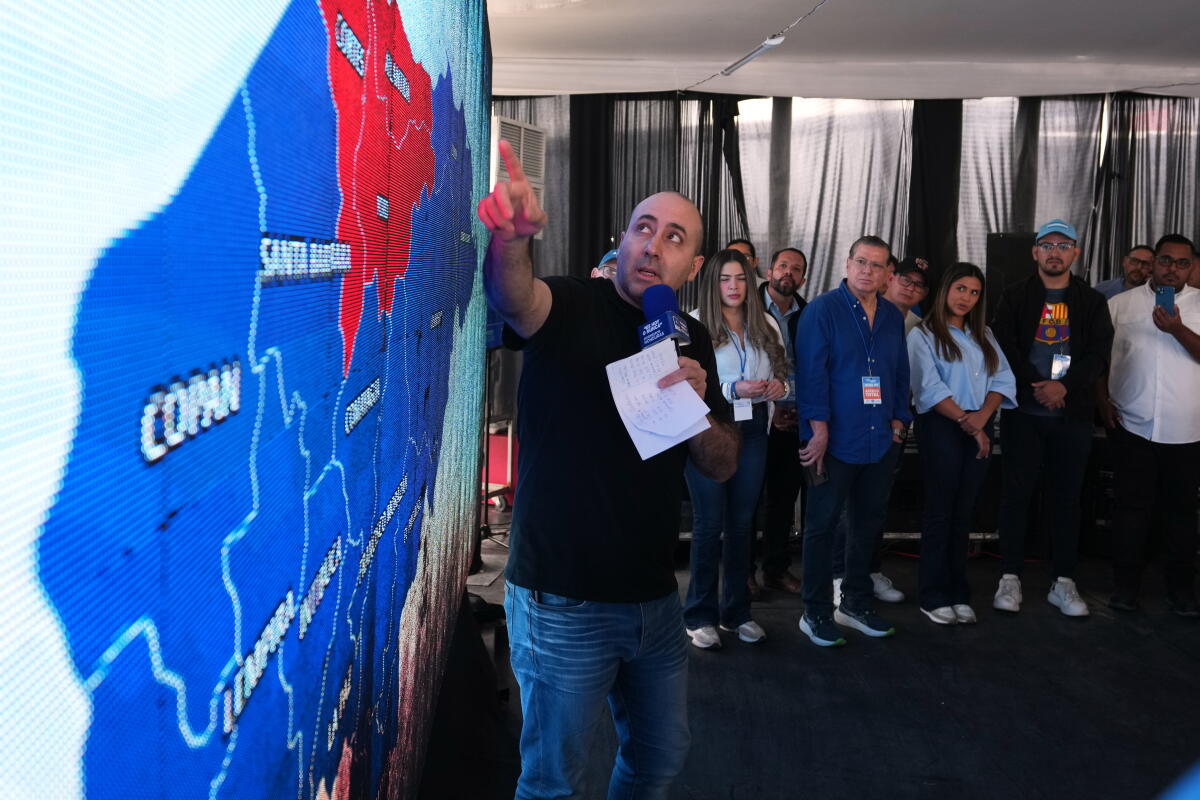
Fernando Cerimedo, an advisor to the National Party, points at a map of Honduras on Dec. 1, 2025, one day after voters went to the polls to elect Nasry Asfura president.
(Moises Castillo / Associated Press)
Both Cerimedo and Parscale were involved in last year’s campaign that resulted in the election of Honduran President Nasry Asfura, whom Trump backed publicly.
Last year, Cerimedo was a key player in the election of Bolivian President Rodrigo Paz, the center-right, U.S.-educated son of a former president who transitioned from Marxist firebrand to moderate. The ascension of Paz broke almost two decades of leftist rule by the Movement for Socialism party of ex-President Evo Morales.
Cerimedo had no official capacity in Paz’s government, but he enjoyed insider status. He accompanied Paz in March to Trump’s anti-narco “Shield of the Americas” summit, a confab of mostly conservative leaders at Trump’s Doral resort in south Florida.
Among the items found in searches of Cerimedo-linked properties, authorities say, was a business card listing him as Paz’s “chief adviser” — a nonexistent post.
“Mr. Cerimedo never had the authorization to represent … the presidency, the government or my family,” a deeply discomfited Paz said in Facebook message last month.
How exactly Cerimedo got into politics — and how he became a right-wing rabble-rouser — remains somewhat opaque. According to media accounts, he worked a series of uninspiring jobs — including stints as a taxi driver, a schoolteacher and an employee of insurance and computer firms — before veering into advertising. In 2019, he assisted the campaigns of several leftist Peronist candidates in provincial races in Argentina, and later founded his own consultancy, Numen.
Cerimedo first gained prominence in neighboring Brazil. That’s where he championed false election-fraud narratives following the narrow reelection defeat in 2022 of President Jair Bolsonaro — a MAGA stalwart — in his reelection bid against Luiz Inácio Lula da Silva, a leftist. Cerimedo’s “Brazil Was Stolen” livestream exacerbated the sense of outrage among Bolsonaro loyalists, who took to the streets in mass protests.
The Brazil exposure helped catapult Cerimedo into successful presidential campaigns in Argentina (Milei), Honduras (Asfura) and Bolivia (Paz). His arrest prompted Chilean lawmakers to create a commission to investigate Cerimedo’s possible role in that nation’s recent electoral shift to the right.
With Cerimedo’s name now toxic, Paz, Milei and other former allies have distanced themselves.
Also ditching Cerimedo was his close partner, Javier Negre, a right-wing Spanish media entrepreneur who, in 2024, purchased 50% ownership of Cerimedo’s La Derecha Diario (The Daily Right), an online, Spanish-language MAGA megaphone. The site strongly backed Colombian President Abelardo de la Espriella — who had Trump’s support — during his tight campaign this summer.
Following Cerimedo’s arrest, Negre announced that he had bought out his former partner in La Derecha Diario.
In Bolivia, the Cerimedo scandal has taken on the character of a Latin American telenovela.
A recovering Beller, shot three times in her upper body, granted interviews from her hospital bed, dishing on her lover’s alleged brutality and criminality.
According to Beller’s testimony to authorities, Cerimedo tricked her into the near-fatal rendezvous outside the hotel. He told her that a source was waiting to share details about the purported rape of a 13-year-old, she said. The supposed rapist? Bolivian ex-President Morales — a despised figure on the Latin American right.
The case has seen the once high-flying Cerimedo reduced to a slumping presence in a hoodie as authorities have shuffled the baldish, heavyset figure to hearings and lockups. Last week, he was transferred while awaiting trial to Bolivia’s maximum-security Chonchocoro prison, infamous for its high-altitude, ill-heated confines.
“I want to see my children!” a sobbing Cerimedo declared at one point in earshot of the media.
His legal team has pushed back. A defense lawyer, Margarita Arce, questioned whether Cerimedo had impregnated Beller and asserted to reporters that Beller staged a “self-inflicted attack” to smear Cerimedo and undermine the Bolivian government.
But prosecutors have sided with Beller, who told the Argentine daily Clarín: “Fernando Cerimedo wanted to kill me because I can tell everything that I know.”
Times staff writer Ana Ceballos in Washington and special correspondents Andrés D’Alessandro in Buenos Aires and Cecilia Sánchez Vidal in Mexico City contributed to this report.
Fort Portal, Uganda – When King Oyo Nyimba Kabamba Iguru Rukidi IV of Tooro was buried on September 12, the ceremony unfolded under the shadow of a bitter dispute over who should succeed him.
Prince Edward Rukidi Kijanangoma, a 56-year-old news anchor and editor at Uganda Broadcasting Corporation, had been selected by the royal clan to succeed Oyo. During the burial at the Karambi Royal Tombs in Fort Portal, he formally assumed power by casting nine coffee berries into the king’s grave, part of the traditional handover ritual.
But the succession remains contested.
Oyo’s mother, Queen Mother Best Kemigisa, and his sister, Princess Ruth Komuntale, have opposed Kijanangoma’s selection, saying the late king’s will named a son as his heir.
Oyo never married and was not publicly known to have children. After his death, Tooro’s Prime Minister Calvin Armstrong Rwomiire Akiiki announced that the king had left a son whose identity would be revealed at an appropriate time. The child has not been publicly identified.
Oyo’s family says a 2022 will named a son whom he described as his lawfully recognised biological son as heir to the throne. But Babiito clan elders, who are responsible for guarding the Tooro royal lineage, determining succession and safeguarding the kingdom’s traditions, say Oyo had not introduced the child through the customary process and instead backed Kijanangoma as his successor.
“The will is not a determinant of who is supposed to be a king; it is a document that expresses one’s wish,” said Reverend Father Charles Oyo, a Babiito clan elder. “The Musuuga [Babiito clan leader] is above the will.”
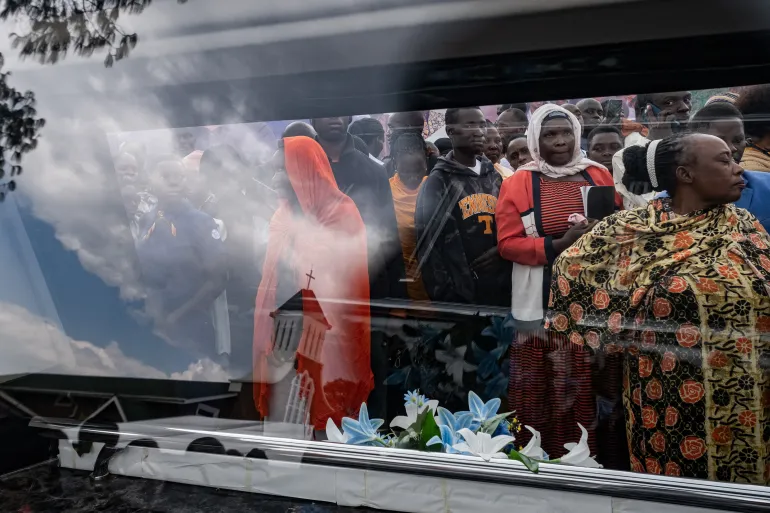
Members of the public react as the body of the late King Oyo Nyimba Kabamba Iguru Rukidi IV makes its way to Karambi Royal Tombs for burial in Fort Portal, Uganda, on September 12, 2026 [AFP]
Princess Komuntale has accused the elders of trying to take over the throne.
“King Oyo was a very peaceful man, a very humble man,” she said. “I just don’t want these evil vultures to come and steal what he worked so hard for. I continue to stand with my brother.”
The dispute has divided opinion over who should be regarded as Oyo’s legitimate successor. The Ugandan government also became involved in talks aimed at resolving the dispute before the burial.
The child king
Oyo’s own path to the throne began when he was just three years old.
He became king in 1995 after the death of his father, Patrick David Matthew Kaboyo Olimi III, and was recognised as the world’s youngest reigning monarch.
A coffin containing the body of the Late Oyo Nyimba Kabamba Iguru Rukidi IV is loaded onto a cortege after leaving the Karuziika Royal Palace before the burial at the Karambi Royal Tombs on September 12, 2026, in Fort Portal, Uganda [Hajarah Nalwadda/Getty Images]
As a child, Oyo was homeschooled, with the palace serving as his classroom. When he later joined primary school, childhood friends remember him as a kind and warm person.
During school holidays, he sometimes sneaked out of the family’s private residence in Buziga, Kampala, to play football in the neighbourhood.
Martin Odong, a radio journalist and childhood friend, remembers him as “friendly, social and compassionate”.
Oyo would stop football games to check on an injured player, regardless of which side they were playing for, Odong said.
His love of football continued into adulthood. He promoted local tournaments, including the Tooro Kingdom MTN Masaza Cup, which was suspended as his health deteriorated.
Oyo died on August 27, aged 34, in the United States while receiving cancer treatment. His body was returned to Uganda for nine days of mourning before his burial at the Karambi Royal Tombs, which coincided with Empango, the anniversary of his coronation.
At St John’s Cathedral, Queen Mother Best Kemigisa remembered her son as someone who had always protected her.
“He was my shield who always stood for me,” she said.
Mourners escort the cortege with the body of the late Omukama of Tooro, King Oyo Nyimba Kabamba Iguru Rukidi IV, for his burial at the Karambi Royal Tombs, in Fort Portal, Kabarole district, Uganda, September 12, 2026 [Abubaker Lubowa/Reuters]
She recalled praying for his life when she was in hospital.
“When I was in the hospital, I said, ‘God, please leave my son alone; take me first,’” she said. “He [God] decided to take him [King Oyo] first. I said, ‘Why? Because he was closer to You than me.’”
Princess Komuntale described her brother as a “funny person” who “always brightened my day”.
Although he was younger than her, she said, he often behaved like the older sibling and protected her and their mother after their father “left to be with the Lord”.
Father Charles Oyo remembered him as a “handsome king who loved his kingdom so much”.
He said Oyo died just as he was “beginning to demonstrate his abilities and capacity as a king”.
A king without political power
Uganda is a constitutional republic, and its traditional kings have no formal political authority. But the kingdoms retain cultural influence and command loyalty among many of their communities.
Queen Mother, Best Kemigisa (R), and her daughter (L), Princess Ruth Komuntale, attend a requiem mass for the late King Oyo Nyimba Kabamba Iguru Rukidi IV of Tooro, at the St John’s Cathedral before the king’s burial at the Karambi Royal Tombs, on September 12, 2026, in Fort Portal, Uganda [Hajarah Nalwadda/Getty Images]
Uganda abolished its traditional kingdoms in 1967. They were restored in 1993 under President Yoweri Museveni.
Oyo was guided by regents while he was a child and took on the full responsibilities of the monarchy as an adult.
His unusual position meant he met presidents, royalty and other world leaders from a young age. Among them was former South African President Nelson Mandela, who reportedly wanted to meet the young king during a visit to Uganda. Oyo, however, was more interested in playing with his toys behind the VIP tent.
As an adult, he used the platform of the throne to promote issues beyond the kingdom.
In 2020, he climbed the Rwenzori Mountains to draw attention to climate change and the retreat of the glaciers there.
He also supported a campaign to plant 10 million trees across Tooro over five years.
He promoted healthy living and took part in cancer awareness runs. Komuntale called him her “best workout partner”.
Before his death, Oyo had allocated land and begun fundraising for a paediatric hospital in Kyenjojo district. Clan elders have since appealed to the government to complete the project and establish a specialised cancer facility and an international stadium in his memory.
His final months
Oyo’s illness was kept largely private.
According to his sister, he began experiencing pain in his back and rib cage last year. The family initially thought it might be linked to strenuous exercise or ulcers.
He later travelled to Kenya, where he was diagnosed with angiosarcoma, an aggressive form of cancer, before travelling to Germany for treatment and eventually to the US.
Members of the public react as the body of the late King Oyo Nyimba Kabamba Iguru Rukidi IV makes its way to Karambi Royal Tombs for burial in Fort Portal, Uganda, on September 12, 2026 [AFP]
“He told us to keep it private, and we respected that,” Komuntale said.
She said that shortly before his death, Oyo spoke to key workers in Uganda about returning home. He wanted to celebrate Empango, the anniversary of his coronation, with his people.
He never made it home.
For Komuntale, the king remained her younger brother even after he became one of Africa’s most recognisable traditional rulers.
She remembered playing dodgeball with him and his love for his three dogs.
“Even though you were crowned a king, you were still a kid who loved to play,” she said.
“I will keep your legacy, what you loved, and we will talk about you every day.”
WASHINGTON — A federal judge has ruled that a plan by the Trump administration to slash staffing at the federal agency tasked with responding to disasters by 50% was unlawful.
The opinion issued late Friday marked a victory for labor groups who had sued the agency. The labor organizations had argued that plans by the Department of Homeland Security, which was then led by Secretary Kristi Noem, violated congressional protections that were designed to safeguard the independence of the Federal Emergency Management Agency.
The issue of the FEMA staffing was part of a much larger lawsuit filed by the American Federation of Government Employees and other labor groups, contesting efforts by the Trump administration to slash the federal workforce.
U.S. District Judge Susan Illston wrote in her opinion that top Homeland Security officials late last year directed FEMA’s leadership to submit a staffing plan that included a 50% staffing cut even though the agency’s own supervisors objected.
“Frankly, the FEMA staffing plan number appears as if pulled from thin air,” wrote Illston.
FEMA responded in a statement late Saturday saying that while it does not comment on personnel matters and ongoing litigation, “DHS and FEMA are ready for the 2026 hurricane season.”
“We’re ensuring workforce stability and a strong, deployable force for upcoming national events and potential disasters; making the agency leaner, faster and laser-focused on supporting state, local, tribal and territorial partners before, during and after disasters,” the statement said. “FEMA continues to maintain a roster of experienced leadership and support staff across headquarters and regional offices.”
The Department of Homeland Security did not immediately respond to requests for comment.
In the opinion, Illston wrote that it was clear that the government violated rules established after 2005’s Hurricane Katrina that put decisions on staffing levels squarely in the hands of FEMA, not the Department of Homeland Security, and that prevented Homeland Security from “substantially” reducing the “functions” of FEMA.
Illston didn’t order a specific remedy to carry out her opinion but directed the two sides to meet and decide on a course of relief.
Although FEMA has experienced terminations, the 50% staffing cuts ultimately were not carried out. In recent months, after top leadership changes at FEMA and the Department of Homeland Security, the agency has rehired some staffers who were let go.
FEMA was one of the agencies targeted for staff reductions in the federal government as part of a broad Trump administration plan to reduce the size of government. The embattled agency has been buffeted by mass staff departures, disruptions of grant programs and delays of disaster aid.
In May, a Trump-appointed FEMA Review Council submitted a final report recommending sweeping changes to how the agency supports states, tribes and territories in disaster.
The final version backed away from the recommendation to cut the FEMA workforce by 50%, which was included in a December 2025 draft reviewed by the Associated Press.
The council instead recommended the agency conduct a “strategic review” to determine “appropriate staffing levels.”
In an August report, the Government Accountability Office said it found that the departures of thousands of staff in 2025 resulted in a “loss of institutional knowledge and experienced personnel” and “exacerbated longstanding workforce challenges.”
More than 4,300 employees, or about 17% of FEMA’s workforce, separated from the agency in the 2025 budget year, with over 1,500 through voluntary reductions. The agency also made about 2,900 new hires.
The GAO recently recommended to Congress that it “consider requiring” FEMA to base “significant workforce decisions” on a more strategic planning process.
Without it, the GAO found, “FEMA cannot be assured that the agency is positioned to effectively meet its mission needs.”
Members of the high court have exchanged accusations after one justice was accused of involvement in a bank scandal.
By AFP and The Associated Press
Published On 11 Sep 202611 Sep 2026
Brazil’s Supreme Court has cancelled a second straight day of deliberations as suspicions of corruption, political bias and police interference loom over several of its members.
Cancellations are rare at the high court. But on Thursday, Chief Justice Luiz Edson Fachin nixed a second consecutive session, calling for the court to reconvene on Tuesday instead.
Recommended Stories
list of 3 itemsend of list
The decision was spurred by an ongoing crisis among the court’s members.
The divisions emerged on September 1, when one justice, Andre Mendonca, unsealed a series of federal police documents that appeared to show a disgraced banker, Daniel Vorcaro, seeking advice from another justice, Alexandre de Moraes.
De Moraes has rocketed to prominence in recent years for his roles in high-profile cases.
He presided over the trial of former President Jair Bolsonaro after prosecutors accused the far-right leader of plotting a coup following his 2022 election defeat. De Moraes also oversaw suspensions of platforms like X and Rumble for failing to abide by court orders, making him a target for Brazil’s right wing.
The document release authorised by Mendonca, a Bolsonaro appointee, contains roughly 30 text messages sent to a phone number associated with de Moraes, allegedly from Vorcaro.
In response, de Moraes has accused Mendonca of abusing his authority on the court for political gains. He requested a probe into whether Mendonca interviewed Vorcaro without the presence of police or prosecutors.
Tuesday’s session will involve the full Supreme Court bench, and 10 of the justices will discuss whether the 11th member, de Moraes, should be investigated over the text messages.
The tit-for-tat on Brazil’s high court is the latest fallout from the Banco Master corruption scandal.
Vorcaro, the head of the Banco Master financial institution, was arrested in November 2025 on accusations he defrauded investors of billions in lost funds, in one of the biggest banking scandals in the country’s history.
The collapse of Banco Master’s private banking arm left behind more than $7bn in debt.
Lawmakers from across the political spectrum have become embroiled in the unfolding scandal as new details emerge.
The turmoil risks affecting October’s general elections, including a pivotal presidential election.
Left-wing incumbent Lula Inacio Lula da Silva is set to compete for the presidency against Jair Bolsonaro’s eldest son, Senator Flavio Bolsonaro.
Both Lula and Senator Bolsonaro have called for investigations into the Supreme Court justices.
The Bolsonaro family itself has been dragged into the Banco Master scandal. In May, the publication Intercept Brasil released a report showing that Senator Bolsonaro petitioned Vorcaro for funds to finance a film about his ex-president father, who is now serving a 27-year prison sentence.
Senator Bolsonaro has denied wrongdoing, claiming he did nothing more than seek private sponsorship for the film, entitled Dark Horse.
But on Thursday, Brazilian police executed dozens of raids related to the Banco Master scandal, including some that targeted two figures involved in the film: Karina Gama, the head of a production company, and Congressman Mario Frias, who served as executive producer.
Senator Bolsonaro has called the probes “attempted political interference” ahead of the elections.
Venezuela’s former first lady, Cilia Flores de Maduro, has asked a judge to release her from federal detention in the United States, citing a worsening heart condition.
In an application for pre-trial release on Wednesday, her legal team asked for the court to allow Flores to await trial under home confinement in Manhattan.
Recommended Stories
list of 3 itemsend of list
It described her declining health since US military operation on January 3 that resulted in her abduction from Caracas and imprisonment in New York, as well as that of her husband, former Venezuelan President Nicolas Maduro.
“Prior to the United States’ military invasion of Venezuela, Ms. Flores de Maduro was physically healthy and took no ongoing medication, other than a monthly injection to help control her mitral valve prolapse,” the legal filing said.
“Now she is prescribed four medications, maintains nitroglycerin by her side in the event of a potential heart attack, and grapples with the continued medical advice suggesting coronary exploration and surgery.”
Flores was a prominent figure in her husband’s government, serving as first lady since his inauguration in 2013.
Prior to Maduro’s first inauguration, she was also a leading member of the United Socialist Party of Venezuela (PSUV), the country’s dominant political movement, leading the National Assembly for more than four years.
But Maduro had long clashed with the administration of US President Donald Trump, who accused Venezuela of sending drug-traffickers into the US. Both Maduro and Flores have also faced allegations of participating in human rights abuses, including the violent suppression of political dissent.
After launching a one-day military operation to abduct Maduro and Flores, the Trump administration charged them both with drug- and weapons-related charges. They are currently awaiting trial in New York City.
But Flores’s health has been in doubt since her forced removal from Venezuela, according to her legal team.
After consulting outside medical experts, Flores’s lawyers said they believe she may have suffered a minor heart attack on July 29 while in US custody.
They also questioned whether she was receiving the appropriate medical care for her mitral valve prolapse, a condition affecting one of the heart’s valves.
Since her imprisonment, her lawyers said Flores has not received the monthly injection she needs to manage the condition.
Instead, she has reportedly been prescribed baby aspirin, a statin, diltiazem and nitroglycerin to use when she experiences chest pain.
Doctors have recommended that she undergo a cardiac procedure, which could result in additional heart operations. If she undergoes such treatment, Flores “will need adequate time to recover from any procedures in a setting conducive to restoring her health”, her lawyers said.
Thursday’s filing acknowledges that Flores does not “dispute that she has received excellent care” from medical professionals. But it argues that “a detention centre lacks the conditions needed for such a recovery”.
Her lawyers proposed moving Flores from the Metropolitan Detention Center in Brooklyn to a residence within the Manhattan federal court district, where she and Maduro are due to go on trial next June.
Under home detention, Flores would be subject to round-the-clock armed monitoring, with visits restricted to people approved by the court and federal prosecutors. Her home would also be monitored by video and her phone calls recorded, according to the filing.
Judge Alvin K Hellerstein has yet to rule on the application.
Flores, 69, and Maduro, 63, have been held in US custody since the January raid on their home in Caracas. Both have pleaded not guilty to the charges of participating in a conspiracy to traffic cocaine into the US.









![TOPSHOT - Members of the public react as the body of the late King Oyo Nyimba Kabamba Iguru Rukidi IV makes its way to Karambi Royal Tombs for burial in Fort Portal, Uganda, on September 12, 2026 [AFP]](https://i0.wp.com/www.aljazeera.com/wp-content/uploads/2026/09/afp_6aa5b63bb446-1789244987.jpg?w=640&ssl=1)