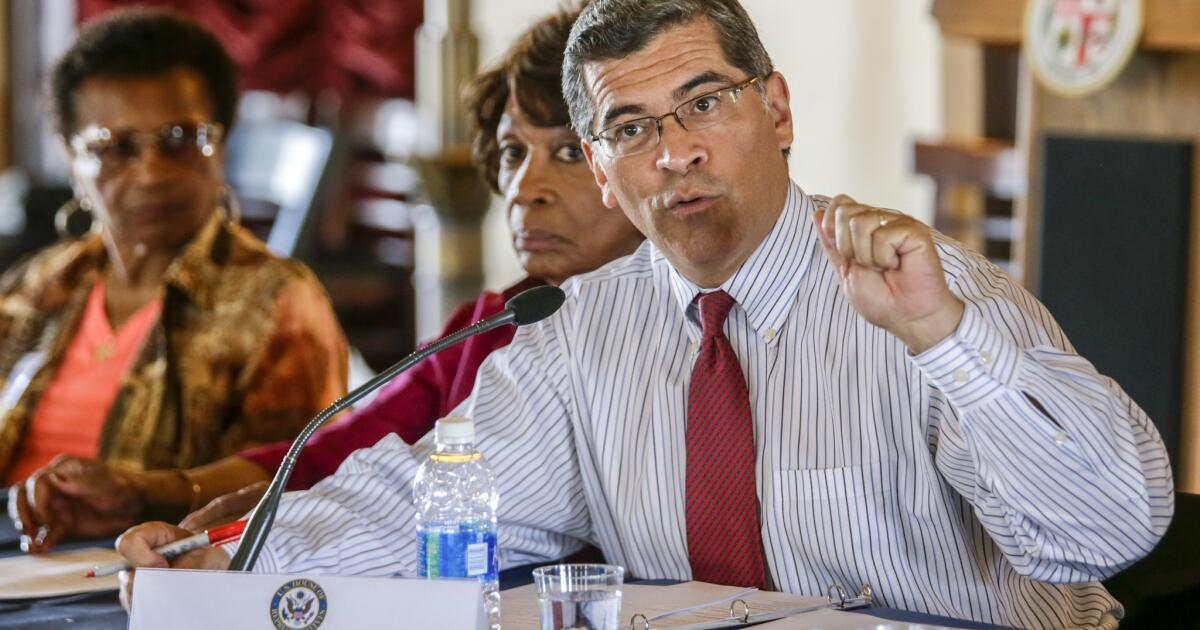
Los Angeles Rep. Xavier Becerra poised to become California’s first Latino attorney general
In a move that suggests a sharp battle to come with the administration of President-elect Donald Trump and upends conventional wisdom about who will emerge as the next generation of statewide elected officials, Gov. Jerry Brown picked House Democratic Caucus Chairman Xavier Becerra (D-Los Angeles) on Thursday to be California’s next attorney general.
If confirmed by both houses of the Legislature, he will succeed Kamala Harris, who was elected to the U.S. Senate in November.
Becerra, 58, has served 12 terms in Congress. Just days before the appointment, he had announced a bid to become the ranking Democrat on the powerful House Ways and Means Committee.
“It’s a phenomenal opportunity,” Becerra said. “It means I get to be home a lot more.”
Few statewide offices are as powerful, or prominent, as that of attorney general. The role has often been referred to as the state’s top lawyer and its top law enforcement officer, a nod to the breadth of responsibilities vested in the office and its leadership of the California Department of Justice.
Attorneys general not only must pursue cases of criminal and civil wrongdoing, they oversee criminal forensic work for most counties and make the final choice about defending state laws — even crafting the language that summarizes ballot measures for voters.
Becerra was beaming during an interview in his House office Thursday morning shortly after Brown offered him the job.
“I’m still processing,” Becerra said with a laugh. “I didn’t expect it.”
Becerra would be the state’s first Latino attorney general. The son of Mexican immigrants, he was the first member of his family to attend college, earning a law degree from Stanford Law School and a bachelor’s degree in economics from Stanford University. Elected to a two-year term in the state Assembly and then to the House in 1992, he rose through the ranks to become the highest-ranking Latino in Congress.
Becerra worked in the civil division of the state attorney general’s office, writing advisory opinions for former Gov. George Deukmejian, a Republican, and defending the state’s constitutional officers from 1987 to 1990 before entering the Assembly. He said he had always wanted to return to the office.
“It was a great place to be,” he said.
Brown’s pick was so sudden that Becerra has not yet had time to reactivate his state law license, though he would not be the first attorney general to have to do so. Inactive status allows attorneys to hold on to their licenses when they are not actively practicing law.
Becerra would also be the first attorney general appointed by a governor since Thomas Lynch, who was chosen by former Gov. Pat Brown in 1964. Few political appointments are likely to be as personal to the current governor as this one, given his own four-year stint as attorney general starting in 2006 and the fact that his father used the office as a steppingstone to governor more than five decades ago.
“Xavier has been an outstanding public servant — in the state Legislature, the U.S. Congress and as a deputy attorney general,” Brown said in a statement. “I’m confident he will be a champion for all Californians and help our state aggressively combat climate change.”
The choice sent political shock waves through California, in large part because Becerra was not on any of the widely circulated lists of potential picks. Brown had offered no details on whom he would pick or when.
Many suspected that he might choose a caretaker, perhaps even a career staffer who would simply carry out the office’s functions through the 2018 election. Virtually no Democrats who heard the news on Thursday believed that Becerra would be that kind of officeholder.
“He has the smarts, political experience and ambitions to run and win reelection,” said state Sen. Steve Glazer (D-Orinda), a former top political adviser to Brown.
If Becerra serves less than two years of Harris’ existing term, he could be eligible to run for up to two additional terms — eight years — as attorney general. Harris has said she plans to hold the position until she is sworn in to the Senate on Jan. 3, and at that point Brown could officially nominate Becerra.
Becerra said Thursday he’s thinking about the confirmation process at this point and not whether he’ll run for a full term as attorney general or another office in 2018. He must be confirmed by the state Senate and Assembly, both controlled by Democrats. Becerra said he hasn’t been told when a confirmation vote might happen.
Earlier, Becerra had flirted with a bid for U.S. Senate when Sen. Barbara Boxer (D-Calif.) announced plans to retire, but Harris’ quick entry into the race kept him and other California Democrats from running.
Holding such a prominent statewide post would raise Becerra’s profile as the Golden State’s foil to Trump, potentially setting him up to run for governor or U.S. Senate in the future. The attorney general, by virtue of the office’s broad power, will likely be a key player alongside Brown in pushing back against Trump’s proposed efforts on issues important to California, including immigration and climate change. In Texas, a state that has its own experience fighting the federal government, attorneys general have been a major force in the battle over states’ rights.
“He has great tenacity and he respects the rights of all Californians — much-needed qualities for an attorney general given the troubling times ahead,” Assembly Speaker Anthony Rendon (D-Paramount) said Thursday.
Several congressional colleagues echoed that sentiment.
“Many of the values that we stand by in California will be under attack in the next few years, and Chairman Becerra is the fighter I want in our corner,” Rep. Tony Cardenas (D-Los Angeles) said in a statement.
Becerra said that with Trump headed to the White House, he’s prepared to protect California’s progressive policies on immigration, the Affordable Care Act, energy and criminal justice. As California politicians embrace their roles in guarding the state against Trump’s policies, Becerra threw down his own gauntlet Thursday.
“If you want to take on a forward-leaning state that is prepared to defend its rights and interests, then come at us,” Becerra said.
A vocal advocate for Hillary Clinton’s presidential bid, Becerra was briefly floated as a potential pick for vice president or a Cabinet position. With Clinton’s loss Nov. 8 and no upward mobility available in House leadership, Becerra’s future political career was unclear.
He’d reached the time limit on serving as caucus chairman, the fourth highest-ranking House Democratic leadership position, and with House Minority Leader Nancy Pelosi (D-San Francisco) and the other two Democrats above him in leadership staying put, there was no path up the ladder headed into the next Congress.
Becerra serves on the powerful House Ways and Means Committee, and made a play as recently as Tuesday to be the committee’s ranking Democrat. He was quickly endorsed by the current ranking member, Rep. Sandy Levin (D-Mich.), who said in a statement Thursday that he respects that Becerra “feels a special responsibility during these difficult times to look after vital legal interests in his home state.”
Democrats across California reacted Thursday with effusive praise for Becerra. Lt. Gov. Gavin Newsom called him “a thoughtful and effective leader, with a keen legal mind and a passion for giving a voice to the voiceless.”
In particular, some pointed out the importance of elevating a Latino politician to statewide office, alongside both Latino leaders of the Legislature and Secretary of State Alex Padilla.
“It’s good for the state’s future,” said Bill Lockyer, who served as attorney general from 1999 to 2007.
The announcement also meant early guessing as to who would replace Becerra in representing downtown Los Angeles and communities to the west and north in Congress. Becerra won reelection in November in the solidly Democratic district. A special election to fill the seat would probably take place in late spring of 2017, though the law gives Brown wide discretion on the precise schedule.
John A. Pérez, the former Assembly speaker and current University of California regent, announced his bid less than an hour after Brown’s announcement, and more contenders may follow.
sarah.wire@latimes.com; john.myers@latimes.com
Follow @sarahdwire and @johnmyers on Twitter
Read more about the 55 members of California’s delegation at latimes.com/politics
ALSO
After beating back rival for House leadership post, Nancy Pelosi says Democrats are ready for Trump
Trump seems ready to fight the world on climate change. But he’s likely to meet resistance