good news

Chatsworth High’s Grant Wang hits the MIT jackpot

During a volleyball tournament trip to Las Vegas in March, Chatsworth coach Sina Aghassy confiscated all his players’ cellphones and put them in his backpack to make sure they focused on their sports assignment — with one exception.

Anyone waiting to learn if they were accepted to a college could briefly have access to their phone.

The players are standing in a hallway listening to their coach evaluate their performance when Grant Wang, the team’s star 6-foot-6 senior, decides to open his phone to check whether he got a message from MIT.

“I opened it up a couple minutes before it was supposed to come out and all I see is confetti,” he said. “I was in shock and all I did was make a noise.”

Aghassy, not knowing what the noise meant, said, “Can you quiet down a bit?”

“Five minutes into his talk, I started breaking down crying. I got overwhelmed by emotions,” Wang said.

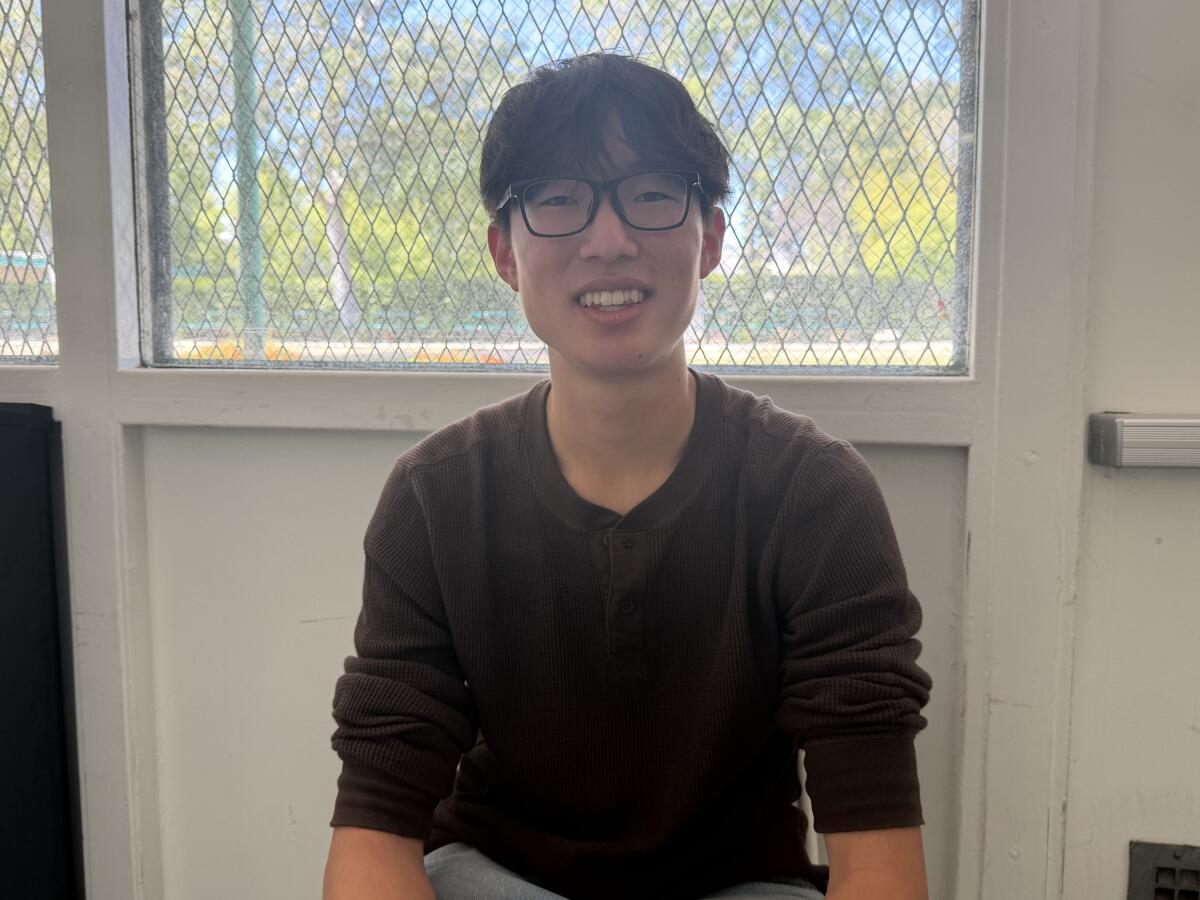
Volleyball standout Grant Wang of Chatsworth High poses for a photo.

Volleyball standout Grant Wange of Chatsworth High has never received a grade other than A in high school.

(Eric Sondheimer / Los Angeles Times)

Teammates didn’t know if it was good news or bad news as they saw his tears.

“My teammate whispers to me.”

Wang tells the good news, “I got into MIT.”

“Everyone breaks out cheering and going wild.

Wang had kept it a secret that MIT was his dream school. He was so disappointed in the fall when he was put on the deferred list that he didn’t think he’d get in.

He becomes the fourth volleyball player from Southern California to be accepted to MIT, joining three others from Redondo Union who he knows.

He’s never received a grade other than A in Chatsworth’s magnet program focused on STEM. He’s such a math whiz that he took geometry in eighth grade and finished all his math classes, from chemistry to calculus, last school year. This year he’s focused on AP Physics.

He already owns three rings — one playing for Chatsworth’s state championship basketball team with Alijah Arenas and two City Open Division volleyball titles. He’s going for a third ring this season as Chatsworth is expected to be the No. 1 or No. 2 seed for the volleyball playoffs. He gave up basketball for volleyball, a sport he didn’t start playing until his freshman year.

“I love the sport. I always put in extra work,” he said.

Redondo Union High volleyball players (from left) Tommy Spalding, Vaughan Flaherty and Carter Mirabal pose for a photo.

Redondo Union High volleyball players (from left) Tommy Spalding, Vaughan Flaherty and Carter Mirabal are headed to MIT this fall.

(Eric Sondheimer / Los Angeles Times)

Unlike the Redondo Union trio, he doesn’t surf and plays no instruments even though his Redondo Union friends are looking for a drummer to start a band. Wang knows math formulas, but drumming? “I cannot,” he said.

“In college, I’m going to learn how to drum so I can join the band,” he joked.

His size and improving skills make him a good volleyball prospect for the future. He seems all set except for dealing with cold weather.

“I don’t think I’ve ever been in weather under 60 degrees for two days,” he said. “My parents said, ‘Good luck,’ they would send me some hot Korean soup during tough days.”

Asked how he became such a good student, Wang said, “My mom and dad always put me in academic settings trying to get me to learn as much as possible.”

B’s on a report card are not allowed in his family.

He offered a rousing endorsement for his educators at Chatsworth.

“All the teachers put their heart and soul into us,” he said.

As for his volleyball coach, he appreciated Aghassy giving access to his phone for just a few minutes and apologizes for disrupting his speech.

What a memory it will be for years to come telling the story of being in Las Vegas and learning he got into MIT.

It was his jackpot worth more than money.

Source link

‘Amrum’ review: Director Fatih Akin delivers complex coming-of-age tale

The best coming-of-age stories derive their power from being endings as much as beginnings. There’s often a clarifying, poignant harshness in the losses they depict. That applies — with sobering grace — to the memory ballad “Amrum,” set on Germany’s titular North Sea island in 1945, when the winds of a world war’s conclusion blow into a 12-year-old boy’s life with unexpected consequences.

The movie bears a curious credit: “A Hark Bohm film by Fatih Akin.” Bohm, who died last year at 86, was a highly respected film writer, actor and academic, a veteran of Germany’s New Wave. Realizing he’d be unable to direct his fictionalized childhood remembrance, he entrusted it to his mentee Akin, the firebrand behind modern German classics such as “Head-On” and “In the Fade.” The project became, according to Akin, like “adopting a child.”

In story terms, that child, a stand-in for Bohm himself, is wide-eyed, sensitive Nanning (well-cast newcomer Jasper Billerbeck), who works in the potato fields of local farmer Tessa (Diane Kruger, in a small but key role). At home, he has a pregnant mother, Hille (Laura Tonke), aunt Ena (Lisa Hagmeister) and two younger siblings, but not the high-ranking Nazi officer patriarch who relocated them from bombed-out Hamburg to an ancestral house on this tiny, beachy outpost. Pejoratively dubbed a mainlander by even the friendliest neighbors and generally viewed with suspicion for his family’s Nazi ties, Nanning is assured by his ideology-soaked mom that their roots, their “bloodline,” make them real Amlumers.

The boy’s first real lesson in the shifting sands comes when, at dinner, he remarks that the war will soon be over, intending it as good news — Dad could come home. Yet his mother reacts as if he’d sided with the enemy by wishing defeat. Later, with the news of Hitler’s demise, she sinks into a depression, refusing food unless it’s white bread, butter and honey, all in scarce supply. So Nanning sets out to secure her the necessary ingredients, as if the fabric of his world depends on it.

What follows is a tightly told fable-like journey built around the war-battered realities of survival when everyone’s tired, hungry and irritated. There are brutal truths in store for Nanning about what his family represents. It’s an evolving boyhood, framed with unshowy elegance by cinematographer Karl Walter Lindenlaub against the island’s flat, grassy, weather-rich horizons. “Amrum” avoids the sentimentality baked into so many childhood-during-wartime stories. Akin, as if inspired by the unfussy youthfulness that marked Italian neorealism and the New Waves in both France and Iran (there are shout-outs to “Bicycle Thieves” and “The 400 Blows”), zeroes in on the steady accumulation of detail rather than the trappings of cuteness or melodrama.

That measured approach, exemplified in star Billerbeck’s arresting simplicity and the many fine supporting turns around him, allows us to clock Nanning’s growing awareness of what matters to others, what’s impossible to ignore and how to interpret an unjust world that’s still full of beauty and kindness if you know where to look. Which, of course, includes inside himself.

Near the end, “Amrum” serves up a wonderfully understated moment: Nanning is invited to celebrate the war’s end with a small group of dancing, drinking islanders. He hangs back, though, as if not quite ready to choose their joyous relief over obediently tending to his broken family. But you can see this dutiful son’s wish to be one of them. For all of us wondering when an ugly time will fade, the moment will resonate like a cautious, dawning hope.

‘Amrum’

In German, with subtitles

Not rated

Running time: 1 hour, 33 minutes

Playing: Opens Friday, April 24 at Laemmle Royal and Laemmle Town Center, Encino

Source link