US President Donald Trump has reacted to the resignation of the US National Counterterrorism Centre’s director, Joe Kent, saying that he couldn’t work with somebody who didn’t believe Iran was a threat. Trump also said his decision to bomb Iran avoided a ‘nuclear holocaust’.
A POPULAR ride at Thorpe Park has closed after nearly 40 years.
The Chertsey-based theme park’s Rumba Rapids was a river rapids ride where passengers would board a boat able to carry up to eight people at a time.
Sign up for the Travel newsletter
Thank you!
The Rumba Rapids ride is closing permanently at Thorpe Park theme parkCredit: Alamy
The ride originally opened back in 1987 as ‘Thunder River’ and was Thorpe Park’s first thrill ride, but has not been running since the end of the 2025 season.
Jack Silkstone, a theme park vlogger, posted a reel on Instagram announcing the news.
The post states: “After 39 years of soaking thrill seekers, Rumba Rapids at @thorpeparkofficial has now permanently closed.
“Join me as I take a trip down memory lane to look back at the history, rethemes and memories of one of Thorpe Park’s longest-running attractions.”
Thorpe Park has shared the video to its Instagram story, as well as commenting on the video: “Thank you for helping us pay tribute to such an iconic ride!”
In an official statement, a Thorpe Park spokesperson told Sun Travel: “After nearly four decades of making a splash, Rumba Rapids at Thorpe Park has permanently closed.
“First opening as Thunder River in 1987, the iconic water raft ride has been soaking generations of thrillseekers ever since.
“While we don’t have plans to share just yet on what’s next, we’re always reviewing our line-up of world-class rides and attractions to make sure Thorpe Park remains the UK’s most thrilling theme park.”
Riders would begin at the highest point of the ride on a turntable belt before turning sharply and heading down a curve to make the boat spin.
The boat would then head into a tunnel with a waterfall effect, before exiting the tunnel and entering the wave section of the ride.
The riders would then pass under a bridge and pass a photo opportunity.
The Rumba Rapids was the park’s second-oldest ride at the time of its closure.
Taking to social media, several fans have expressed their sadness at the news.
One person commented: “Sad times. I always enjoyed going on this to have a break and a chill from all the coasters.”
Another person said: “End of an era, the soundtrack alone was ICONIC.”
Over the years the park has been rebranded a few times, including in 2002 becoming Ribena Rumba Rapids with the colour theming changing from yellow to purple and the ride got its own soundtrack.
The ride was Thorpe Park’s first thrill rideCredit: AlamyThe ride originally opened in 1987 at ‘Thunder River’ with yellow boatsCredit: Alamy
In 2007, the partnership with Ribena ended and the ride became Rumba Rapids.
A decade later the ride was re-themed to fit in with the design of the Jungle area of Thorpe Park.
Thorpe Park also recently announced that they would be closing the waterpark after more than 35 years.
Instead, Amity Beach pool will be replaced with a new attraction called The Launchpad, which will be a recharge zone.
BRITAIN’s third busiest airport has shut one of the terminals for good.
The terminal, which first opened in 1962, has closed as part of the airport’s £1.3billion transformation.
Sign up for the Travel newsletter
Thank you!
Manchester airport is closing down its Terminal 1Credit: Alamy
Manchester airport is turning into a two-terminal operation under the new layout.
All airlines have moved into the expanded Terminal 2, which now handles more than 75% of passengers, while Ryanair flights will operate solely from Terminal 3.
Chris Woodroofe, managing director of Manchester Airport, said: “While this is the end of an era for Terminal 1, it’s really the start of a whole new chapter for Manchester Airport.
“We’re proud to connect the North to the world and our £1.3bn investment in Terminal 2 means that we’re now bigger and better than ever – serving our passengers in a setting that rivals any airport Terminal across Europe.
“It’s also allowing us to continue our growth and operate more flights to more destinations every single day. And we’ve achieved this at the same as making things more simple and straightforward for our passengers.
The closure also frees up space for new facilities at the airport, including hundreds of extra seats, a new bar called Sporting Chance and an Italian restaurant.
More than 2,000 signs across the airport have been replaced to reflect the changes, alongside a new parking system where all car parks are labelled P1 to P16 to make them easier to find.
The redevelopment forms part of the long-running Manchester Airport Transformation Programme, launched in 2015 to modernise the airport for future growth.
The first phase of the revamped Terminal 2 opened in 2021, with the full expansion completed in 2025, paving the way for Terminal 1 to be decommissioned.
The overhaul comes as Manchester Airport continues to grow, serving a record 32 million passengers in 2025.
This February has become the busiest on record with more than 2.05 million travellers.
Members of small business and self-employed groups, including the Korea Federation of Food Service Industry, the Korea Lodging Association and the Korea Federation of Micro Enterprises, call for passage of the Online Platform Act and the introduction of a total fee cap on delivery apps at the National Assembly in Seoul on Dec. 1, 2025. Photo by Yonhap News Agency
March 9 (Asia Today) —Guest commentary contributed to Asia Today by Park Ki-soon, Professor, Graduate School of Chinese Studies, Sungkyunkwan University.
Debate over platform regulation has been intensifying in South Korea. A prominent example is the proposed Online Platform Act (OPA). The bill includes provisions such as commission caps, a prior designation system, collective bargaining rights and class-action lawsuits – all framed as measures to protect merchants and ensure fair competition.
The intention itself is not necessarily misguided. Information asymmetry and unequal bargaining power do exist within the platform ecosystem. However, before deciding what to regulate, policymakers must carefully consider how regulation should be implemented. Good intentions do not always produce good outcomes.
The European Union (EU) enacted the Digital Markets Act (DMA) in 2022 and designated six companies – including Alphabet, Apple and Meta – as “gatekeepers,” subjecting them to strict ex-ante regulations. The law was introduced with the stated goal of promoting competition and protecting consumers.
Yet less than three years later, research is suggesting outcomes quite different from what policymakers expected.
A study examining 3,500 consumers in seven Central and Eastern European countries found that user behavior on Google and Facebook remained largely unchanged after the DMA took effect. Competition did not increase, while the complexity of online tasks rose by 39%.
Another study analyzing 4.1 million apps in the Google Play Store estimated that after the General Data Protection Regulation (GDPR) was implemented, one-third of all apps disappeared, the number of new apps was cut in half and consumer surplus declined by roughly one-third. Venture investment and startup formation also slowed significantly.
Commission caps have produced similarly disappointing results. After Apple lowered App Store fees in the EU, only 9% of apps reduced prices for consumers. Meanwhile, more than 86% of the fee savings flowed to developers outside the EU.
Rather than effectively restraining large corporations, platform regulations have often increased barriers to entry for smaller firms. In other words, regulations intended to curb market dominance may ironically end up protecting incumbent giants by making it harder for new competitors to enter.
South Korea faces an even more delicate situation than the EU.
In the search engine market, Naver and Google dominate, while KakaoTalk has become the country’s national messaging platform. Korean cultural content spreads globally through platforms such as YouTube and Netflix, and cosmetics exports reached $11.4 billion in 2025.
Except for China – which restricts foreign platforms – South Korea is often considered the world’s most platform-independent digital ecosystem. At the same time, this ecosystem is deeply interconnected with global platforms.
Under these circumstances, poorly designed regulations could also affect foreign investment by companies such as Netflix and Amazon Web Services (AWS) in Korea.
There are also diplomatic risks. The United States has expressed concern that the OPA’s prior designation system could disproportionately target American companies and potentially violate the non-discrimination principle under the Korea-U.S. Free Trade Agreement.
Washington has already criticized the EU’s DMA as a non-tariff barrier targeting U.S. Big Tech and has hinted at possible retaliatory measures. A similar dispute could arise if Korea adopts comparable regulatory frameworks.
Another concern is that excessive regulation could inadvertently benefit Chinese platforms.
Chinese e-commerce services such as AliExpress and Temu are already rapidly expanding their presence in the Korean shopping app market. If both domestic and global platforms are tightly constrained while Chinese platforms remain largely unaffected, the result would be the exact opposite of what regulators intend.
South Korea has previously fallen behind China in areas such as online banking due to a “regulate first, innovate later” approach. That experience should serve as a cautionary lesson.
Platform policy must be approached with prudence. Regulations designed without sufficient consideration of market dynamics risk doing more harm than good – weakening innovation, discouraging investment and ultimately undermining the very ecosystem they aim to protect.
SACRAMENTO — One unique perk California kids enjoyed for generations was tuition-free college. Now, a candidate for governor promises to bring that back. And bravo for her.
The candidate, former congresswoman Katie Porter of Orange County, even suggests a way to pay for her bold pledge. That’s unusual for a politician. It’s normal to promise the moon without specifying how to get there.
She‘d raise the corporate income tax a notch.
You’re reading the L.A. Times Politics newsletter
George Skelton and Michael Wilner cover the insights, legislation, players and politics you need to know. In your inbox Monday and Thursday mornings.
The powerful business lobby would scream, even though California companies would benefit from a more educated workforce.
And California’s public universities would probably cry about their revenue streams having to rely on unpredictable corporate profits rather than the pocketbooks of students’ parents.
But at least there’s a potential governor who’s advocating tuition-free higher education and proclaiming it to be a priority.
Why is this Democrat, a UC Irvine law professor, pushing the issue? Tuition cost doesn’t show up anywhere on voter lists of important concerns. But California’s high cost of living is a gigantic gripe. And “affordability” these days is one of the most overused words in any politician’s vocabulary.
“When we talk about affordability, there’s lots of talk about the problem, but people want to hear what [candidates] would do about it,” Porter told me over coffee last week. One thing she’d do is eliminate much of the tuition at public universities.
Another reason for making college tuition-free again, she said, is that “it was a promise made to the people” by the California Master Plan for Higher Education.
But that was 66 years and nine governors ago. A lot has changed.
Actually, tuition-free public higher education was a California birthright long before Gov. Pat Brown’s master plan.
Policymakers regarded tuition-free college as a sound economic investment. It was in the state’s self-interest to produce highly educated innovators and skilled professionals to grow the economy. The middle class expanded, with people landing good-paying jobs that resulted in higher tax revenue for state coffers.
That didn’t mean college was free — and it wouldn’t be under Porter’s plan. There’s still housing, meals, books and annoying fees.
But Sacramento switched priorities in the 1970s, spending tax money on other things: enhanced welfare, healthcare and specifically K-12 schooling.
Free tuition existed before the creation of Medi-Cal healthcare, which now eats up 20% of the state general fund. It also was prior to Proposition 13 in 1978 that dramatically cut property tax revenue for K-12 schools. The state felt obliged to make up the difference.
Naysayers contend California can’t possibly afford to educate students today without their paying tuition. Nonsense. The state could happily afford it long before we expanded into the world’s fourth largest economy. It’s about priorities.
And today, free tuition could be the PR tonic California needs to brighten its faded image across America. It could attract middle-class families to California and keep those already here from fleeing.
Porter promised a return to yesteryear in a speech that was a far cry from old-time political rhetoric. Addressing more than 2,000 delegates at a recent Democratic state convention in San Francisco, she held up a whiteboard with two words in large letters: “F— Trump.”
And she led the delegates in shouting “F— Trump.”
That was a bit of a turnoff for this old traditionalist, who thinks politics has gotten too coarse and foul-mouthed.
I asked Porter what prompted the profanity and whether she had any regrets.
No, she answered. Candidates were allotted only four minutes to speak and “I was economical with my time.
“I wanted to be very clear in the first 15 seconds that I would fight Trump. I wanted the other three minutes and 45 seconds to be about all other stuff.
“Some people just want to talk about Trump because they don’t want to talk about our own problems.”
Plowing into her speech, she quickly promised to “deliver single-payer healthcare, less-expensive housing, free childcare for all, zero tuition at our UCs and CSUs, and [elimination of] income tax for those earning less than $100,000.
“Those are real affordability solutions.”
Right. But no specifics. How does a state wading in red ink afford all that?
I pressed her when we met later. She didn’t have time for details at the convention, she said. But this is her plan on tuition:
Free tuition only for California residents who are undergrads. And only in their third and fourth years at the University of California and California State University. If they desired free tuition in their first two years, they could attend community college.
Many community colleges already waive course fees for full-time, first-time students. Kids are better educated in their first two years at community college anyway, the UC professor said.
Many liberals complain that free tuition would waste tax money on rich kids who don’t need it.
“I’m a believer in universal programs” that don’t base eligibility on income, Porter said. “Something I learned in Congress. You know what never gets cut? Universal programs such as Social Security and Medicare.”
Anyway, she added, “Kids from really wealthy families go to Harvard or USC or other options.”
Public school tuitions are bargains in California compared to other states and private universities.
At UC, annual tuition is roughly $14,900 and at CSU it’s around $6,500. Without tuition, UC would lose roughly $5.9 billion and CSU $3.7 billion, state budget officials say.
But under Porter’s plan, the universities would lose much less. They’d still collect tuition from freshmen and sophomores and hefty levies from non-Californians. Also student aid could be cut back if kids weren’t saddled with tuition.
Hiking the corporation tax from 8.84% to 9.5% “would generate way more than I need for tuition-free,” Porter said. “I would use any extra money for free childcare.”
Political promises often aren’t worth a nickel. But tenacious and feisty Porter’s free tuition pledge might be worth at least a few bucks. And, maybe some votes.
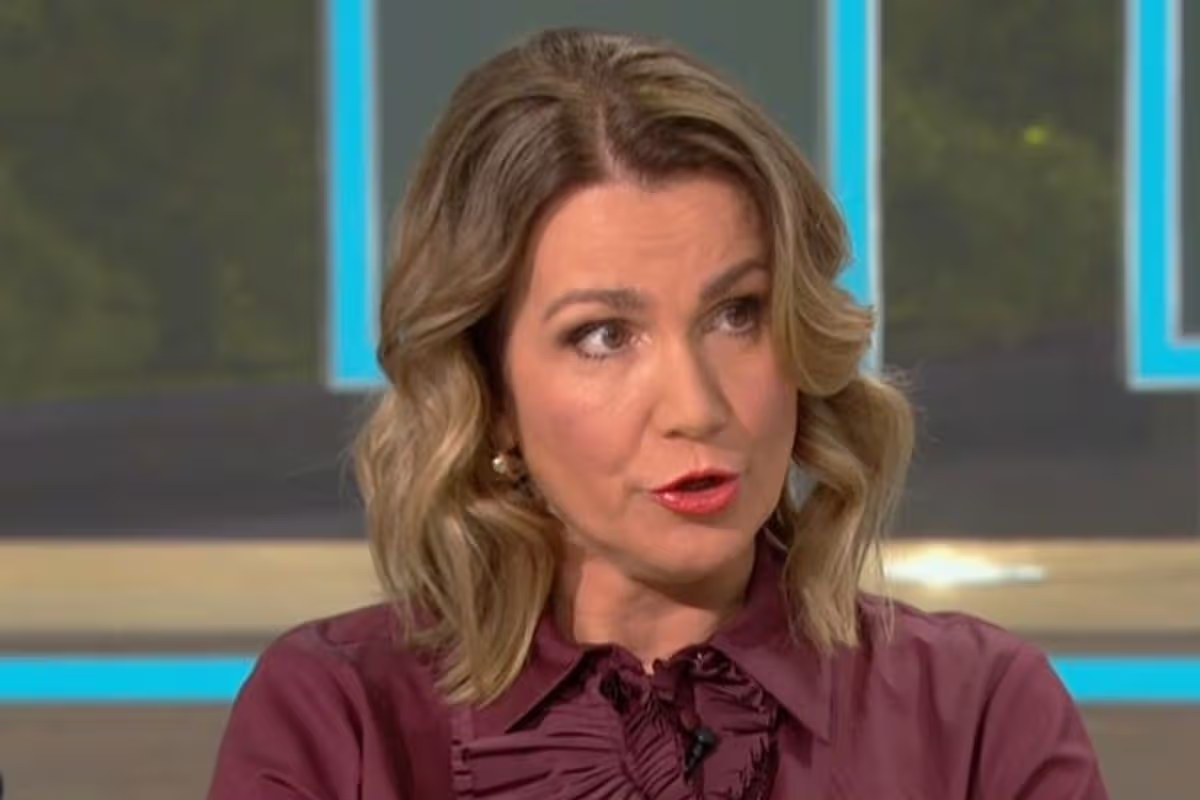
It comes after the programme was discussing a woman who had been sexually assaulted in her hotel room after a man lied to staff in order to get into her room.
Explaining what had happened, she shared: “It happened to me in America, obviously not this seriously. But I was staying at a hotel in Florida for work, and somebody came into my room in the middle of the night with their suitcase.
“Honestly, the shock you have when that happens. They’d said to the receptionist, ‘I’ve lost my key for this particular room’. They had given the wrong room number. I don’t think intentionally, I think mistakenly.
“Again, it makes me feel slightly ill talking about it. I went, ‘Excuse me!’ and they went, ‘Oh, I’m really sorry and left’.
The GMB star explained that reception gave her an apology and explained very casually that they’d given out the wrong room key.
Susanna added: “It’s extraordinary that this happens, in this case, it led to a crime being committed.”
Reffering back to the news headline being discussed on the show, Susanna called the incident “absolutely shocking”.
ITV viewers learnt that a man had met a woman at a party, found out where she was staying and lied to the reception staff at the Travelodge hotel, saying he was her boyfriend and had lost his hotel key.
Susanna added: “He then accesses her bedroom, it makes me feel sick. He accesses her bedroom and sexually assaults her.
“She only knew this person because they met at a party, he was not in any way involved with her, was not in a relationship with her and should absolutely not of been allowed to get into her hotel room.”
The man, who has been named as Kyran Smith, has been convicted of sexual assault and has been given a seven and a half year sentence. The victim was given a £30 refund, which she has since blasted as “very insulting”.
A Travelodge spokesman said: “The safety and security of our guests is our priority and we were deeply concerned to hear of this distressing incident and our sympathies are with the victim.
“At the time of the incident our hotel team followed the correct security procedures. We continue to ensure our hotel and customer services teams are trained to follow our approved policies.”
Good Morning Britain is available to watch on ITVX
If you or somebody you know has been affected by this story, contact Victim Support for free, confidential advice on 08 08 16 89 111 or visit their website, http://www.victimsupport.org.uk.
EastEnders have been using Nigel Bates in a dementia storyline, exploring the effects of the illness on those suffering from it and their loved ones, particularly those caring for them
20:00, 05 Mar 2026Updated 20:03, 05 Mar 2026
EastEnders air ‘heartbreaking’ Nigel scenes as character leaves Walford for good(Image: CREDIT LINE:BBC/Jack Barnes/Kieron McCarron)
BBC soap EastEnders has aired emotional scenes about Nigel Bates‘ dementia, as the fans become sure he will die soon. The character has been part of a “heartbreaking” dementia storyline that has highlighted the impact of the illness on those caring for a sick loved one.
In Thursday’s episode (March 5), Nigel (Paul Bradley) was thrown a going-away party at the Vic before moving to his new care home. While he was able to smile and laugh in the pub, as those around him reminisced, he was unable to remain completely in the present and struggled with his illness.
As he hopped in a taxi, Oscar Branning (Pierre Counihan-Moullier) noted that Nigel was unlikely to ever be back to Albert Square – and fans agree.
Ensure our latest headlines always appear at the top of your Google Search by making us a Preferred Source. Click here to activate or add us as your Preferred Source in your Google search settings.
When he arrived at the care home, Nigel became agitated and then unresponsive. His behaviour was deeply distressing for Phil (Steve McFadden), who had been caring for his friend. Breaking down in tears, Phil apologised to Nigel and gave his hand a squeeze, but Nigel did not move. As such, many fans think Nigel will die soon.
“I don’t know why, but I feel maybe next week, maybe Nigel’s final week,” one wrote. “I don’t know because seeing this episode made it feel like his time is near, and it’s so devastating and heartbreaking.”
Another added that Nigel’s unresponsive behaviour made it look like he was already dead. “Very much looked like he died at the end of the episode as he didn’t react to the door slamming or the card falling.”
Others shared that they thought this would become a euthanasia storyline. “I genuinely thought Phil was gonna suffocate Nigel OMG,” one wrote.
A second said: “For a minute there I thought Phil was gonna ease his pain by suffocating him by putting the jacket on him, but I’m glad it didn’t happen as it would have been even more heartbreaking.”
They later added that they loved a conversation between Yolande Trueman (Angela Wynter) and Nigel’s wife Julie Bates (Karen Henthorn) and felt this was leading towards Nigel’s death too: “I thought they were gonna go down the route of euthanasia.”
As part of Nigel’s dementia storyline, his daughter, Clare Bates (Gemma Bissix) has returned to the Square for a short stint. Clare is Nigel’s adoptive daughter. They became family in 1994 when he married her mother, and he continued to care for her after her mother died a year later.
Though Nigel and Clare both left the show shortly after, Clare made a comeback in 2008 without him, and she has made a return again. Her return was not such a happy one, as she had been estranged from her father, and he failed to recognise her for most of the episode. Eventually, Julie helped Nigel remember his daughter in a touching moment.
AIRLINE crews use secret code words around unsuspecting flyers – including the bizarre-sounding “crotch watch.”
Here’s what it means, and how it helps improve safety on planes.
Sign up for the Travel newsletter
Thank you!
Flight attendants have been known to communicate using code words while in the air (stock image)Credit: GettyOne of these terms is ‘crotch watch’ – meaning crew could have their eyes trained on your lap (stock image)Credit: Getty
Flight attendants can be overheard using their own language on the job.
And chances are you’ll be worried they’re insulting you – especially if you also hear them mention “gate lice,” meaning passengers who crowd around the boarding gate before their flight has even been called.
If they mention “crotch watch,” it is simply alluding to the crew checking that passengers have their seatbelts fastened properly before takeoff and landing.
The Federal Aviation Administration (FAA) recently warned that impatient flyers who unfasten seatbelts before their plane has come to a complete stop at the gate could get hit with $37,000 fines.
Its rule applies during the taxi, takeoff, and landing stages – until the aircraft has safely reached the gate and the illuminated seatbelt sign has been turned off.
The regulation dates back to the 1970s, and was imposed for safety reasons.
Another odd term you might hear is “blue juice.”
This refers to the cleaning liquid used to flush the contents of the plane’s bathrooms.
Other terms, such as ABP, translate to “able-bodied passengers.”
Flight attendants on ‘crotch watch’ are ensuring all passengers have seatbelts fastened when necessary (stock image)Credit: Getty
Secret cabin crew codes
Pax – means passengers.
Used in a sentence, it may be: “We have 20 pax on board.”
Gate lice – this term refers to over-eager passengers who gather around the gate before boarding has even been announced.
Briefing – it means crew may be meeting for the first time and discuss the flight ahead.
ABP – translates to able bodied passengers.”
These are individuals that the crew seek out just in case of an emergency.
Runners – Runners are those who sprint from one connecting flight to another because their first flight was late.
Spinner – this term relates to somebody who turns up late without an assigned seat.
Crew dub them ‘spinners’ as they usually look flustered as they search for a seat and space in the overhead lockers.
Sin bin – We may have all been stuck on a plane as we watch others take off.
This is known as the ‘sin bin’ which is the area the plan has to wait in to allow room for another aircraft to pass through.
The show’s viewers were delighted to see Paul step in, with many sharing their reactions on X (formerly Twitter). “#GMB Quality this morning with @PaulBrandITV. Praise be!”
Another added: “Nice to see Paul on GMB today,” while a third said: “Paul and Kate!”
This is a breaking showbiz story and is being constantly updated. Please refresh the page regularly to get the latest news, pictures and videos.
You can also get email updates on the day’s biggest stories straight to your inbox by signing up for our newsletters
He replied: “That’s what proper Shepherd’s Pie is-” Cutting him off, Susanna replied: “No, Shepherd’s Pie is with lamb mince. You made a cottage pie!”
Ed added: “If we did a poll of our viewers, in their lives, was Shepherd’s Pie made with beef or lamb’, 70% of people would say beef.”
Wanting to settle the debate, Good Morning Britain’s official X account asked their viewers in a poll.
They asked: “@edballs has revealed that he made a shepherd’s pie with beef mince last night, but @susannareid100, @Kevin_Maguire and Kwasi Kwarteng say Ed made a cottage pie. Help us settle the debate: Is it OK to make shepherd’s pie with beef mince?”
However, it was clear people weren’t thrilled with the question, as many flocked to comment on the topic.
For the latest showbiz, TV, movie and streaming news, go to the new **Everything Gossip** website.
One person said: “What utter garbage for a news or even a current affairs programme.” Another reeled: “Is this even a newsworthy debate: how or what Balls cooks for dinner?”
Someone else commented: “That’s your take on world news.” As another shared: “This is taking up airtime. Wtf.”
However, some fans were thrilled to take part in the debate, as one person commented: “Morning, I’m with Ed. I don’t eat Lamb, but I’ve had many tasty Shepherds pies, made with beef.”
Later on in the show, Susanna remarked: “We are losing sleep this morning on whether a pie topped with potato and mince is a Shepherd’s Pie, if it’s made with beef mince.
“My view is that it’s clearly a cottage pie, your view is that it’s clearly a Shepherd’s Pie, despite the fact that Shepherds don’t look after cows.”
While Ed insisted that he was correct, there are some people who are a ‘bit fussy’ over what is correct.
Speaking about the poll, Susanna added: “Obviously, we’re in the middle of conflict, and there are, as we understand, more important things to talk about. But, we’re on air for three and a half hours every morning, so real life does go on, doesn’t it?
“We put a Twitter poll up, help us settle the debate: is it OK to make Shepherd’s Pie with beef mince? No, 63.4%, of course it isn’t.”
Good Morning Britain is available to watch weekdays on ITV from 6am.
Ensure our latest headlines always appear at the top of your Google Search by making us a Preferred Source.** Click here to activate**** or add us as your Preferred Source in your Google search settings.**
A Netflix drama that’s been deemed “the best show ever produced” is said to be so good, viewers keep rewatching it again and again. It seems fans are totally hooked
12:14, 02 Mar 2026Updated 12:14, 02 Mar 2026
The drama has been deemed one of the “best ever produced”(Image: Courtesy of Netflix)
Occasionally we’re all on the hunt for a compelling series to immerse ourselves in, and Netflix currently boasts an impressive selection. However, if you’re after something genuinely gripping that’ll leave you craving the next episode, you might want to consider a television drama that’s been hailed as the “best ever” on Netflix.
The programme recently surfaced in discussions on Reddit, when a viewer was eager to gauge people’s opinions on the drama. It rapidly sparked considerable debate, with many unable to contain their enthusiasm for how exceptional they believe the show to be, whilst others confessed to binge-watching it multiple times.
The Reddit user enquired: “Is Mindhunter worth a watch? I’m gearing up for the Fincher series and realised that I’ve completely overlooked this show.”
The query prompted substantial discussion, with respondents rushing to share their views. The consensus appears overwhelmingly positive.
One responded, stating: “Very good. Probably the best show Netflix ever produced.” Another contributed: “The most disturbing crime of the show is that it only got two seasons.”
A third commented: “It’s really good. I rewatched it recently and still think it was very well done.” In separate discussions, viewers also voiced their disappointment that only two seasons were produced.
One viewer expressed: “I’m still mad about this. On my third rewatch.” Another chimed in with: “This is the only show that’s been cancelled that makes me angry. I miss other shows, but this one burns me.”
One more fan noted: “I’m not a crime or true crime show fan at all. Mindhunter is amazing. Watch it for sure. Holt McCallany is so good in it.”
Many labelled it as “fantastic”, with several pleading for its return someday. It appears fans are holding onto the dream of their hope becoming reality at some point, but for now, they can only continue to rewatch previous episodes.
What’s it about?
For those unfamiliar, Mindhunter is an American psychological crime thriller television series created by Joe Penhall, inspired by the 1995 true-crime book Mindhunter: Inside the FBI’s Elite Serial Crime Unit by John E. Douglas and Mark Olshaker. The series first graced screens back in 2017, and ran for just two seasons.
It boasts a cast including Jonathan Groff, Holt McCallany and Anna Torv, and delves into the establishment of the Behavioural Science Unit in the Federal Bureau of Investigation (FBI) during the late 1970s and early 1980s. This era also marked the advent of criminal profiling.
The series revolves around FBI agents Holden Ford and Bill Tench, along with psychologist Wendy Carr. They operate the FBI’s Behavioural Science Unit within the Training Division at the FBI Academy in Quantico, Virginia.
In addition to this, they collaborate to initiate a research initiative interviewing incarcerated serial killers. Their aim is to gain insight into the criminals’ psychological makeup.
Essentially, they hope the information they gather will assist in cracking active investigations. It’s regarded as essential viewing for crime drama enthusiasts, although reports suggest no additional episodes are planned.
Ensure our latest headlines always appear at the top of your Google Search by making us a Preferred Source. Click here to activate or add us as your Preferred Source in your Google search settings.
Nationwide members issued good news by BBC expert – what you should know – The Mirror
Need to know
Nationwide customers have been given some good news ahead of summer
06:00, 01 Mar 2026Updated 08:44, 01 Mar 2026
Nationwide is the world’s largest building society and has over 16 million members(Image: Peter Dazeley/Getty Images)
Need to know: Nationwide customers could save on travel insurance
Nationwide customers could save money on travel insurance by checking if they already have cover through their bank account.
Travel expert Rebecca Wilcox appeared on BBC Morning Live to highlight that many people overlook existing travel insurance benefits. She described not having travel insurance as “astonishing” but revealed some may already be covered.
Wilcox asked: “Are you already covered? You could have it with your bank account.”
Nationwide’s FlexPlus current account costs £18 per month and includes Worldwide Family Travel Insurance from Aviva. The account provides comprehensive coverage including emergency medical expenses up to £10 million and missed departure cover up to £1,000.
The FlexPlus account also covers trip cancellation up to £5,000 and alternative travel arrangements for disruptions.
Other banks including Monzo, Virgin Money and Halifax also offer travel insurance with their packaged accounts.
Customers are advised to check their existing bank account benefits before purchasing separate travel insurance to avoid paying twice.
DENVER — Renee Good loved sparkles and laughter and any excuse for a celebration. She loved pretty much everyone she met, and was late for pretty much everything.
“She had this way of making you feel special and loved that I didn’t even understand … until we lost her,” Donna Ganger said Friday of her daughter, who was shot and killed by an immigration officer during the federal crackdown in Minneapolis.
She was “slow to anger, quick to love, quick to care,” said her father, Tim Ganger. “That’s the essence of who she was.”
Good, a 37-year-old mother of three, was killed Jan. 7 as immigration agents surged through the Minneapolis area, sparking waves of protests. Her death and that of another U.S. citizen, Alex Pretti, weeks later in Minneapolis sparked outrage across the country and calls to rein in immigration enforcement.
In a wide-ranging interview in Colorado, where some of the family lives, Good’s parents and two of her brothers, Brent and Luke Ganger, talked to the AP about the joy Good found in life, their grief and their hopes that her death can bring about change in a deeply polarized nation.
“It’s going to be hard in the future,” Donna Ganger said. “It’s going to be kind of a constant pain.”
Settling in Minneapolis
Good, who graduated from college later in life, was volunteering in a local school district and working as a substitute teacher when she was killed, her parents said.
“She was working so hard to get her education, and then she was finally able to use it, and I could just tell how happy she was and how fulfilled,” Donna Ganger said.
Good, her 6-year-old son and her partner, Becca Good — the women were not legally married, according to a family lawyer, but referred to each other as wives — had only recently relocated to Minneapolis from Kansas City, Mo., settling on a quiet residential street in a tight-knit neighborhood known for its progressive activism.
In social media accounts, Renee Good described herself as a “poet and writer and wife and mom.” On Pinterest, a profile picture shows her smiling and holding a young child, alongside posts about tattoos, hairstyles and home decorating.
The family “settled very quickly into the community in Minneapolis,” said Donna Ganger, describing how the neighborhood had also welcomed the rest of the family when they came after the shooting. They see that as the result of the love that Good had showed her new neighbors.
“It was incredible to receive that back,” Luke Ganger said.
Donna Ganger held a stuffed toy owl as she spoke, a gift from her daughter, who knew how much she loved the birds. It had sparkles on its feet, a reminder of Good’s love for glitter.
At Good’s memorial service, a table of glitter had been set out for guests. Donna Ganger had put a piece on a lens of her glasses and it’s remained there.
“She just kind of sparkled all the way through,” said Donna Ganger. “I think of her and I look down and see my little sparkle.”
‘A very American blend’
The family is “a very American blend,” Luke Ganger said recently in testimony to Congress. “We vote differently, and we rarely completely agree on the finer details of what it means to be a citizen of this country.”
Yet “we have always treated each other with love and respect,” he said.
On Friday, the family didn’t want to discuss the specifics of their differences, but Donna Ganger said she’d long prayed for guidance: “Before all this happened, I said, ‘Make me a wise woman.’”
In the hours after Good’s death, Trump administration officials said she had been shot as she tried to drive her car into an immigration officer. Homeland Security Secretary Kristi Noem said Good had committed “an act of domestic terrorism.”
But as video evidence and other details of the confrontation emerged, and criticism of the crackdown began growing, administration comments softened.
President Trump said he’d been told that Tim Ganger had supported him.
“He was all for Trump, loved Trump. And, you know, it’s terrible,” he told reporters. “I hope he still feels that way.”
Tim Ganger declined to talk about his political affiliation or whether it had changed with his daughter’s killing.
“I think I’m just going to leave that go,” he said. “There’s so many other important things” to deal with now, he added.
But family members said they hoped their ability to get along would be an inspiration.
“Our purpose through this whole tragic, difficult, unbelievable time, is to have something good come out of this,” Tim Ganger said. “Otherwise the senselessness of this is overwhelming.”
Sadness echoed in Donna Ganger’s voice as she talked about navigating family differences.
“Sometimes I’m just silly, you know, and I joke with them and I’m goofy,” she said. “But I want to be able to talk about hard things — and that’s hard sometimes with your own family to talk about hard things that maybe you don’t agree on. And I don’t want there to be any hardships between us or hurt.
“But it’s important that we learn to be careful with our words, but share them in a deep way,” she said. “It’s really important.”
Family members spoke only in general ways about the change they’d like to see come from Good’s death.
“I think it’s evident that something is broken, right?” said Brent Ganger. “And when something is broken, you have to take a deep look to see what it is that can be changed and fixed in order for it to not happen again.”
The morning of the shooting
On the morning of the shooting, as immigration raids and protests were flaring across the city, Becca Good has said she and Renee stopped their car in the street to support neighbors during an immigration operation.
Video shows Renee Good in a maroon SUV blocking part of the road and repeatedly honking her horn.
Two immigration officers get out of a truck and one orders Good to open her door. She reverses briefly, then turns the steering wheel as the officer says again, “Get out of the car.” Almost simultaneously, Becca Good, standing in the street shouts, “Drive, baby, drive!”
When Good begins pulling forward, an ICE officer standing in front of the vehicle — later identified as Jonathan Ross — pulls his weapon and fires at least two shots into the car, through the driver’s-side corner of the windshield and the driver’s window, killing Good.
Weeks later, Tim Ganger said he hoped the family’s tragedy would lead to change, though “I’m not even sure what that will look like.”
“But for something good, for people to stop and take a breath and take a look and have a dialog,” he said. “That’s the broader mission of what we want, for people to come together and take care of each other.”
The Justice Department has said it sees no basis to open a federal civil rights investigation into Good’s death, but the family has hired a law firm that is conducting its own investigation and exploring potential legal action.
Family members said no one from the federal government has contacted them about Good’s killing, and they are unsure whether anyone will be held accountable.
“All we can do is speak out and hope that our sincere words are enough to enact some kind of change,” Brent Ganger said.
Slevin and Sullivan write for the Associated Press and reported from Denver and Minneapolis, respectively.
From Broderick Turner: The losses are mounting for the Lakers in the most excruciating of ways. They’ve lost their last two games in the final second, and it’s eating at them because they used to be so good in late, critical moments.
The Lakers fell to the Phoenix Suns 113-110 on Thursday after Austin Reaves missed a three-point shot as time expired. The injury-depleted Suns earned the win on a three-pointer by Royce O’Neale with ninth-tenths of a second left.
The Lakers have lost three consecutive games for the third time this season. They were blown out by the Boston Celtics on Sunday before losing by one at home to the Orlando Magic on Tuesday when Luka Doncic passed up a three and threw the ball to LeBron James, who missed a hurried, last-second three.
Against the Suns, the Lakers rallied from 12 points down in the fourth quarter after Doncic went to work. He hit back-to-back threes during the comeback and finished with 41 points, eight rebounds and eight assists.
The Lakers made it a clutch game, the kind in which they’ve been an NBA-best 16-5. Still, they lost.
“Our losses are louder than other teams’ because we’re the Lakers and because of the way we lose,” coach JJ Redick said. “Tonight was a one-possession clutch game, which, now we’ve lost a few of those. But we’ve been great for the most part in the clutch all year.”
The Lakers (34-24) tied the score twice in the final minute, first on a three by Reaves and then on a tip-in by James, who had 15 points, six rebounds and five assists, with 22.7 seconds left.
Dodgers pitcher Tyler Glasnow made his first start of spring training a good one, pitching two perfect innings and striking out four against the Chicago White Sox on Thursday at Camelback Ranch.
(Norm Hall / Getty Images)
From Jack Vita:Dodgers right-hander Tyler Glasnow is an admitted overthinker. But you wouldn’t know it based on his efficient first spring training start Thursday against the Chicago White Sox at Camelback Ranch.
Glasnow pitched two-plus innings, retiring the first six batters before coming out after giving up a single to start the third inning. Using a pitch mix that included a fastball that sat at 97 mph, Glasnow struck out the side in the first inning before recording another strikeout to close out the second. Having thrown just 28 pitches, Glasnow started the third inning and threw three more pitches before coming out of the Dodgers’ 7-6 win.
“Very in rhythm,” manager Dave Roberts said after the game. “Very efficient, used his entire pitch mix, it was really good. Good to see him get into the third inning. Positive day.”
The 32-year-old entering his third season with the Dodgers credits his coaches for keeping his mechanics on point.
“It allows me to just go out and pitch and be athletic,” Glasnow said after his outing. “I’m able to just go out and play baseball as opposed to trying to tinker and fix certain stuff.”
UCLA gymnast Sydney Barros performs her floor exercise routine at Pauley Pavilion on Jan. 17.
(Gina Ferazzi / Los Angeles Times)
From Anthony Solorzano: With the Big Ten title on the line during the Big Four Meet on Friday at Pauley Pavilion, the UCLA gymnastics team is focused on what it can control.
“Our goal is to go out there and just do what we’ve been doing all season long,” coach Janelle McDonald said. “Hitting great gymnastics and continuing to just build the confidence on the competition floor before we head into [the] postseason.”
Entering the season, the Bruins had a few elite veterans and an otherwise young team. The steady growth of underclassmen has helped UCLA earn its No. 5 national ranking and move a victory away from claiming its second consecutive Big Ten title.
“Last year, when we came into the Big Ten, we really wanted to make a statement and I think we did just that,” McDonald said. “Coming in this year with a younger team, hungry to just continue that, has just been really special.”
Artist Gustavo Zermeño Jr. paints a mural dedicated to Olympic gold medalist skater Alysa Liu on Wednesday at the corner of W. 156th and Crenshaw Boulevard in Gardena. “I like that it’s a little rough around the edges, but beautiful at the same time,” he said of the portrait.
(Ronaldo Bolanos / Los Angeles Times)
From Chuck Schilken: U.S. figure skater Alysa Liu made quite an impression at the Milan-Cortina Olympics with her unique style, her compelling backstory and, of course, her gold medals in the women’s singles competition — the first for an American woman since 2002 — and in the team event.
Her feats captured the attention of local artist Gustavo Zermeño Jr. He wanted to be sure to capture all of it in his new mural paying tribute to the 20-year-old athlete in Gardena.
“Obviously her winning gold was the main factor” in his choosing to paint Liu, Zermeño said.
But once the Mexican American artist learned more about the Chinese American skater, he found inspiration in other aspects of her life as well. That includes the Oakland native’s two-year retirement from the sport starting at age 16, her enrollment at UCLA and her decision to express herself in her own way.
United States’ Hilary Knight (21) celebrates after scoring during the women’s ice hockey gold medal game between the United States and Canada at the Milan-Cortina Winter Olympics on Feb. 19.
“I thought it was sort of a distasteful joke, and unfortunately, that is overshadowing a lot of the success of just women at the Olympics carrying for Team USA and having amazing gold medal feats,” Knight said Wednesday during an appearance on ESPN’s “SportsCenter.”
On Feb. 19, the U.S. defeated Canada 2-1 in overtime for a third gold medal in women’s hockey; the team won gold in 1998 and 2018. Three days later, the U.S. men’s hockey team also won gold by defeating Canada 2-1 in overtime.
Edmonton Oiles captain Connor McDavid, center, battles Kings forward Trevor Moore, left, and defenseman Mikey Anderson for the puck during the first period of the Kings’ 8-1 loss Thursday at Crypto.com Arena.
McDavid scored his 35th goal and Draisaitl got his 30th during his fourth four-point game of the season as the Oilers again routed the opponent they’ve knocked out of the first round of the Stanley Cup playoffs in each of the past four seasons.
The game marked the biggest margin of defeat against the Kings this season.
Clippers guard Kris Dunn drives to the basket in front of Minnesota’s Donte DiVincenzo during the Clippers’ 94-88 loss Thursday at Intuit Dome.
(Kyusung Gong / Associated Press)
From the Associated Press: Anthony Edwards scored 31 points, Donte DiVincenzo added 18 and the surging Minnesota Timberwolves beat the Clippers 94-88 on Thursday night.
Jaden McDaniels and Ayo Dosunmu each scored 12 points and Rudy Gobert had 13 rebounds to help the Timberwolves improve to 5-1 since Feb. 9 and 3-1 since the All-Star break.
Edwards, returning to the site of the All-Star Game, where he was the MVP, was 12 for 24 from the floor and sealed the victory with a step-back three-pointer over two defenders for a 92-88 lead with 42.9 seconds left.
After all, the “Fight of the Century” at the MGM Grand Garden Arena in Las Vegas — won by Mayweather — set records with 4.6 million pay-per-view buys and $72 million in ticket sales.
So it’s no surprise that long after both boxers slipped comfortably into (temporary) retirement, legal fights endured over even slim slices of that cash-stuffed pie.
For 10 years — and counting — lawyers and judges have attempted to determine what claimants are due and whether Pacquiao in particular suffered reputational damage along the way.
From John Cherwa: The hopes of Northern California racing and breeding interests were once again dashed when the California Horse Racing Board refused to license short racing dates to the Tehama District Fair and the Humboldt County Fair on Thursday.
Rather than a discussion about how to grow the sport, the 2-hour 45-minute meeting was mostly about how bad the state of racing is in the state and a determination that the future of Southern California racing is in jeopardy if it isn’t given every advantage available.
That advantage is the amount of money that goes to the host track from advance deposit wagering (ADW) and computer assisted wagering (CAW). If Tehama and Humboldt were racing, then money bet by any means in Northern California would stay there, the way it was since the start of ADW until shortly after the closing of Golden Gate Fields in Berkeley.
1918 — The first neutral site game in NHL history is held in Quebec City. Frank Nighbor scores twice in the first period to lead the Ottawa Senators to a 3-1 win over the Montreal Canadiens.
1955 — Boston beats Milwaukee 62-57 at Providence, R.I. in a game which set records for fewest points scored by one team, and by both teams, since the introduction of the 24-second clock.
1959 — The Boston Celtics beat the Minneapolis Lakers 173-139 as seven NBA records fall. The Celtics set records for most points (179), most points in a half (90), most points in a quarter (52) and most field goals (72). Boston’s Tom Heinsohn leads all scorers with 43 points and Bob Cousy adds 31 while setting an NBA record with 28 assists.
1966 — Richard Petty wins the rain-shortened Daytona 500 by more than a lap at a speed of 160.927 mph. Petty holds the lead for the last 212 miles of the scheduled 500-mile event, which is called five miles from the finish. Cale Yarborough finishes second.
1977 — Stan Mikita of the Chicago Black Hawks scores his 500th goal in a 4-3 loss to the Vancouver Canucks.
1982 — Florida apprentice Mary Russ becomes the first female jockey to win a Grade I stakes in North America when she captures the Widener Handicap aboard Lord Darnley at Hialeah (Fla.) Park.
1992 — Prairie View sets an NCAA Division I record for most defeats in a season with a 112-79 loss to Mississippi Valley State in the first round of the Southwestern Athletic Conference tournament. Prairie View’s 0-28 mark breaks the record of 27 losses shared by four teams.
1994 — Sweden wins its first hockey gold medal, defeating Canada 3-2 in the first shootout for a championship at the Winter Olympics in Lillehammer, Norway. Canada is 1:49 away from its first championship in 42 years when Magnus Svensson’s power-play goal ties it at 2. Paul Kariya’s shot is stopped by Sweden’s Tommy Salo after Peter Forsberg puts Sweden ahead on his team’s seventh shot.
1998 — Indiana’s 124-59 victory over Portland marks the first time in the NBA’s 51-year history that one team scores more than twice as many points as the other.
2005 — David Toms delivers the most dominant performance in the seven-year history of the Match Play Championship, winning eight out of nine holes to put away Chris DiMarco with the largest margin of victory in the 36-hole final. The score 6 and 5, could have been much worse as Toms was 9 up at one point.
2006 — Effa Manley is the first woman elected to the baseball Hall of Fame. The former Newark Eagles co-owner is among 17 people from the Negro Leagues and pre-Negro Leagues chosen by a special committee.
2010 — Steven Holcomb drives USA-1 to the Olympic gold medal in four-man bobsledding, ending a 62-year drought for the Americans in the event. Holcomb’s four-run time was 3:24.46, with Justin Olsen, Steve Mesler and Curt Tomasevicz pushing for him.
2015 — Travis Kvapil’s NASCAR Sprint Cup car is stolen early in the day from a hotel parking lot, forcing him to withdraw from a race at Atlanta Motor Speedway. The team didn’t have a backup car in Atlanta, so it’s forced to drop out when the stolen machine couldn’t be located in time for NASCAR’s mandatory inspection.
Compiled by the Associated Press
Until next time…
That concludes today’s newsletter. If you have any feedback, ideas for improvement or things you’d like to see, email me at houston.mitchell@latimes.com. To get this newsletter in your inbox, click here.
Some would argue that Downton failed to steal the crown of this classic.
Ketsuda Phoutinane Spare Time Content Editor
00:01, 26 Feb 2026
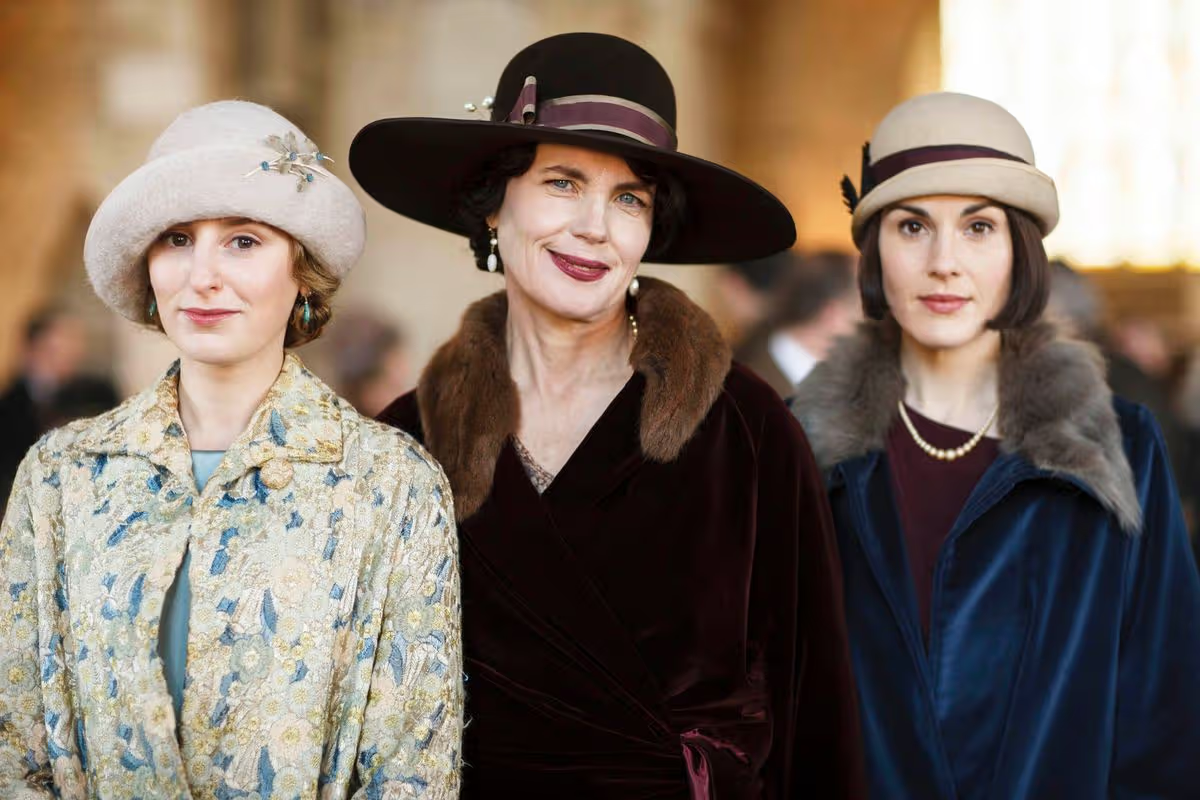
Downton Abbey is beloved for its opulent visuals and costumes(Image: ITV)
Some things are simply unbeatable. A classic period drama, one as critically acclaimed as it was popular, remains regarded as amongst the finest ever produced — Upstairs, Downstairs.
The family saga charted the lives of the aristocratic Bellamy family and their staff in the early 1900s. Spanning three decades, the programme’s narrative stretched both World Wars and the jazz age through to the Great Depression.
As the quintessential period drama of its era, comparisons between Upstairs, Downstairs and Downton Abbey are inevitable. The BAFTA-winning ITV series established the benchmark for costume dramas with storylines that mirror its successor.
Upstairs, Downstairs came before Downton Abbey by 50 years. Both programmes portray the lives of an aristocratic family and their servants against a backdrop of social and political upheaval in the early 20th century.
They diverge in some major ways though, with the most obvious being Downton Abbey’s production values. The 1970s show looks more understated, a quality that strikes viewers as either nostalgic of off-putting.
Downton’s location is fundamentally more grand. The Bellamy family inhabit a London townhouse, worlds apart from the Crawley family’s lavish country manor which became a character in its own right.
Whilst Downton was famed for its visual spectacle, a share of the audience felt the series occasionally strayed into the melodramatic. In contrast, Upstairs, Downstairs has been likened to theatre due to its more grounded visuals and plot lines.
Fans of both period dramas have invariably come together online to compare the shows and name their favourite.
One person sparked a debate on a Downton Abbey forum by asking: “If you have seen both shows, which show do you think is better?” to which one person simply responded: “Upstairs Downstairs without question.”
“The original Upstairs Downstairs is one of the finest TV programmes ever made,” argued another. “Downton Abbey is a jumped up soap opera.”
Of course it would be remiss not to mention the BBC’s reboot of Upstairs, Downstairs in the 2010s, but that’s a whole ‘nother debate.
ALL Saints star Melanie Blatt says taking part in the Strictly Come Dancing Christmas special stripped away her confidence.
The 1990s girl group singer, 50, said she did not feel comfortable in the flowing yellow dress she wore, which she said made her “look like custard”.
Sign up for the Showbiz newsletter
Thank you!
Melanie Blatt said the flowing yellow dress she wore on Strictly made her ‘look like custard’Credit: BBCMel with her dance partner Kai WiddringtonCredit: PA
Speaking to Good Housekeeping UK she said: “I felt extremely vulnerable.
“It’s taken me 50 years to feel as good as I have ever felt about myself and Strictly stripped it away from me. Nothing dodgy went on — I think they’re on their best behaviour — but I just didn’t feel comfortable in a dress.”
Mum Mel and her professional dance partner Kai Widdrington finished fifth out of six couples after performing an American smooth in the telly extravaganza.
It was won by TV host Scarlett Moffatt and Vito Coppola, who got a perfect 40 score for their cha-cha-cha.
Despite finishing second from bottom, Mel and Kai scored 36 out of 40 and she was hailed “fabulous” by judges Shirley Ballas and Anton Du Beke.
Mel had been tipped to take part in the full series this autumn but her comments suggest there is no way back.
Yet following her Christmas Day dance on the BBC One show, watched by 7.75million at home, Mel told host Tess Daly: “I really enjoyed it.
Mel in her All Saints heyday (L-R) Nicole Appleton, Shaznay Lewis, Natalie Appleton, and MelCredit: Getty
In a telling remark, she added: “It’s been amazing yet challenging, getting out of my comfort zone, having to wear a dress, having to look like custard . . . all of these things.”
A source insisted that Mel had taken her own dress which was “styled and adjusted” by the Strictly costume team to her specifications.
They added: “Strictly would never make anyone wear something they felt uncomfortable in.”
Mel, who had five No1 singles with All Saints, revealed last year that she was serving burgers at a North London boozer.
She is no longer in the pub but wants to start a new career in the food industry.
Mel, who performed in All Saints with Shaznay Lewis and sisters Nicole and Natalie Appleton said: “The main thing I want from life is peace and happiness.
“My dream is to do a cookery book or have my own cookery programme, something like ‘Cheeses of the World’. I will make it happen.”
Mel’s full interview can be read now in April’s Good Housekeeping.
All Saints singer Melanie Blatt revealed that Strictly ‘stripped away’ years of confidenceCredit: Jonty Davies / Good Housekeeping UKThe Good Housekeeping cover girl was left low after the reality TV stintCredit: Jonty Davies / Good Housekeeping UKThe Good Housekeeping cover star has spoken about fame, family and being in the bandCredit: Jonty Davies / Good Housekeeping UK
Britain’s Got Talent viewers were left divided by the drone performance featuring King Charles’ voice that closed the first episode of the ITV series
22:32, 21 Feb 2026Updated 22:36, 21 Feb 2026
The judges were blown away by the final act(Image: ITV)
Britain’s Got Talent viewers were left split over one particular act that brought the curtain down on the opening episode of the ITV programme.
This year, hundreds of hopefuls will be greeted by award-winning presenters Ant and Dec before showcasing their abilities to judges Simon Cowell, Amanda Holden, Alesha Dixon, and newcomer KSI.
Performers from every corner of the UK and across the globe will be taking to the stage, hoping not only to impress the judging panel but also the voting public, in a bid to scoop the life-changing prize of £250,000 and a coveted spot at the legendary Royal Variety Performance.
Fans were quick to voice their opinions after Somerset act Celestial closed the show with a spectacular mega-drone display. As the judges and audience filed outside, Celestial put on a breathtaking show combining drones and lights.
Towards the finale of the performance, King Charles‘ voice was heard in a poignant tribute, leaving some viewers feeling it “couldn’t have come at a worse time”, reports Belfast Live.
The voice said: “Wherever you may live in the United Kingdom, I shall endeavour to serve you with loyalty, respect and love.
“Our nation and the wider family of realms, of whose talents, traditions and achievements, I am so inexpressibly proud. Have prospered and flourished, which makes us great as a nation.”
Amanda Holden remarked, “I am going to start crying.”
Responding to the act, one viewer wrote: “An act with the King’s voiceover could not have come at a worse time!”
“This is kinda sick #BGT,” wrote one viewer, whilst another chimed in with, “Not good timing but wow this is cool.”
One sharp-eyed fan noted, “Celestial- very cool very different I love it but I can’t see the King going outside to watch it that’s the only thing #BGT.”
For the latest showbiz, TV, movie and streaming news, go to the new **Everything Gossip** website.
Another raised a valid point, asking: “How is a drone act going to work on the stage at The Royal Variety Show?”
Heaping praise on the heartfelt performance, one devoted viewer declared, “Celestial, best act of the Night #BGT.”
“Well, wasn’t that brilliant? Brought a wee tear to my eye #BGT,” gushed yet another fan.
Britain’s Got Talent is available to watch on ITVX.
Ensure our latest headlines always appear at the top of your Google Search by making us a Preferred Source.** Click here to activate**** or add us as your Preferred Source in your Google search settings.**
Crystal Palace manager Oliver Glasner has cast doubt on his immediate future at Selhurst Park after admitting he’s “not good enough” in the role, following the club’s 1-1 draw against Zrinjski in the UEFA Europa Conference League play-offs.
The territorial dispute flared up over the discovery of massive offshore oil deposits. (Archive)
Mérida, February 18, 2026 (venezuelanalysis.com) – The Venezuelan government commemorated the 60th anniversary of the Geneva Agreement and urged Guyana to engage in “good faith negotiations” to settle the longstanding dispute over the Essequibo Strip.
In a statement published on Tuesday, Caracas celebrated six decades of the agreement and reiterated that the treaty is “the only valid legal instrument for reaching a mutually acceptable solution to the dispute” over the 160,000 square-kilometer territory.
The 1966 accord, signed by Venezuela, the United Kingdom, and British Guiana, a British colony at the time, saw the different parties pledge to find an agreeable solution to the border issue.
The Venezuelan government’s communique noted that the treaty was submitted to the United Nations, arguing that it overruled the controversial 1899 arbitration ruling which awarded the territory to the United Kingdom.
The text also reaffirmed Venezuela’s sovereignty claim over the resource-rich territory and referenced the popular mandate from the December 3, 2023, referendum that saw over 90 percent of respondents back the country’s rights over the Essequibo Strip.
“The only possible solution to the territorial controversy is to engage in good faith negotiations, to achieve a satisfactory arrangement for the two parties that signed the Geneva Agreement,” the declaration concluded.
The Guyanese government responded on Wednesday with its own statement, arguing that the Geneva Agreement did not annul the 1899 Arbitral Award but rather established a framework for resolving the dispute that arose when Venezuela questioned the border’s validity in 1962.
Georgetown likewise noted that, in January 2018, the Secretary-General of the United Nations determined that the “good offices” mechanism had been unsuccessful in resolving the dispute.
“In accordance with Article IV (2) of the Geneva Agreement, the Secretary-General decided to submit the case to the International Court of Justice (ICJ) as the final means of resolution. Both Guyana and Venezuela were bound by that decision.”
Hours later, the Venezuelan government issued a second statement accusing Guyana of attempting to distort the spirit of the Geneva Agreement and reiterating Caracas’ position rejecting the ICJ’s jurisdiction over the border controversy.
“Venezuela will not recognize any decision emanating from the International Court of Justice on the territorial dispute surrounding Guayana Esequiba,” the document read.
Despite rejecting the Hague-based court’s authority on the matter, the Venezuelan government participated in a documentation-gathering process before the ICJ during 2023 and 2024. Acting President Delcy Rodríguez, then vice president, led the country’s legal efforts.
In August 2025, Caracas submitted further evidence backing its Essequibo sovereignty claim and challenging Georgetown’s historical and legal arguments. The case will advance to the oral hearings phase in May 2026.
In January, the Guyanese Minister of Foreign Affairs and International Cooperation, Hugh Todd, claimed that the ICJ’s ruling would be binding for both nations and that the case was now in the hands of “the highest and most respected judicial authority in the world.”
The longstanding territorial controversy flared up in 2015 after ExxonMobil discovered and began exploiting massive offshore oil reserves. Venezuelan authorities have raised their sovereignty claims and criticized Guyanese counterparts for giving drilling permits to multinational corporations in undelimited waters.
Caracas has also criticized the US’ interference in the issue, with successive administrations offering their full backing to Georgetown. Venezuelan authorities have accused Washington of stoking regional tensions amid plans to establish military bases in Guyana.