Goldman Sachs

Former Obama counsel Kathryn Ruemmler says Epstein used her to gain legitimacy

Kathryn Ruemmler, the former top lawyer at Goldman Sachs who was White House counsel to President Obama, said Wednesday in testimony to Congress that it “was a mistake to deal with” Jeffrey Epstein but insisted she never witnessed criminal activities.

“I can see now that he used me and other respectable people to legitimize his standing,” Ruemmler told members of the House Oversight Committee, according to a copy of her opening remarks.

Ruemmler is the latest prominent figure called before the House Oversight Committee as lawmakers investigate the network of powerful people connected with Epstein. The bipartisan inquiry has already included testimony from more than a dozen high-profile witnesses, including Microsoft co-founder Bill Gates and former President Bill Clinton, as lawmakers examine how Epstein’s wealth and influence may have helped shield him from scrutiny.

Ruemmler served as White House counsel under Obama from 2011 to 2014 and was briefly considered for attorney general. She served as Goldman Sachs’ general counsel for the past six years before announcing in February that she would step down amid backlash over her correspondence with Epstein.

Although she said she would step down on June 30, she remains employed by Goldman Sachs.

Entering Wednesday’s hearing, Rep. Robert Garcia of California, the top Democrat on the committee, told reporters that Ruemmler will provide unique insight as one of the few people who was “very close in the last phase of Jeffrey Epstein’s life.”

“I think some of the emails that are in the files are very concerning about how she communicated with Jeffrey Epstein,” he added.

The two were close years after Epstein’s 2008 conviction on sex crimes

While Ruemmler has tried to downplay their relationship in more recent statements, thousands of documents released by the Justice Department showed that Ruemmler and Epstein had an extensive relationship. The files included personal emails, social plans and gifts that extended beyond formal legal work. Documents showed she had called Epstein “Uncle Jeffrey” in emails and said she adored him.

Ruemmler said in her opening remarks that she first met Epstein in 2014 regarding potentially working with him and Gates “to set up a large donor advised fund.” Soon after, according to Ruemmler, she learned about Epstein’s 2008 conviction on sex crimes, when he became a registered sex offender.

She said Epstein expressed remorse about it, and that he did not know the women were underaged. She said she “relied on the resolution reached by federal and state prosecutors and validated by a judge as being a proportionate and final resolution of his criminal conduct.”

House Oversight Chair James Comer told reporters Wednesday that the “most concerning” part of Ruemmler’s communications with Epstein is how she “tried to rehabilitate his image after he was convicted of solicitation of a minor.”

Ruemmler’s interview is part of a broader investigation

Comer said Wednesday that Ruemmler is the 18th person to testify as part of their broader investigation.

Billionaire investor Leon Black was subpoenaed last month after lawmakers said he refused to answer some questions about his yearslong relationship with Epstein.

Comer said Wednesday that Black will appear for a formal deposition on Sept. 3 but that he expects to have Black’s nondisclosure agreements by “the end of the week.”

The committee has also expressed interest in questioning acting Attorney General Todd Blanche, whose nomination to permanently lead the Justice Department is pending before the Senate. Former Attorney General Pam Bondi identified Blanche as the department’s point person on the release of the Epstein documents, a process that has drawn bipartisan scrutiny.

“Hopefully Blanche will come in as soon as his confirmation is over,” Comer said.

Cappelletti writes for the Associated Press.

Source link

Goldman Sachs M&A Record: Leading the Global Megadeal Surge

Breaking a six-month record, the investment banking giant capitalizes on a surging wave of global megadeals.

Goldman Sachs said it had advised on more than $1 trillion of announced global mergers and acquisitions so far this year, the fastest any investment bank has reached that milestone in a six-month period, citing data from capital markets data provider Dealogic.

The bank attributed the milestone to a string of marquee mandates, including serving as co-financial adviser to Dominion Energy on its roughly $67 billion sale to rival utility NextEra Energy, announced last month, along with other major transactions.

Rise of the Megadeal

Goldman reported that its investment banking fees rose 48%, to $2.8 billion in the first quarter. It’s a reflection of the “K-shaped” M&A market, where megadeals are the dominant force, but deal volumes are declining, and mid-market activity is subdued. 

Data compiled by PwC revealed that the global M&A market is on track to reach $4 trillion in 2026, a 13% annual increase, with major sales estimated to account for 48% of deal value worldwide, a significant expansion from two years ago. 

“Goldman has been the global leader in M&A advisory fees for more than 90 consecutive quarters. The fact that it’s reaping benefits from a moment of megadeal activity simply proves the strength of its franchise,” said Mark Narron, senior director at Fitch Ratings. “However, advisory revenues are generally a small share of total revenues. In 2021, which was Goldman’s record year for advisory, advisory revenues contributed only 10% of total revenues.” 

Fitch says it’s difficult to forecast whether Goldman’s advisory revenues will continue to climb, given the cyclical nature of advisory fees and uneven regional M&A trends — with most deal activity still concentrated in the U.S.

Fitch expects M&A activity to be sensitive to market conditions, economic growth, geopolitical events, and interest rates. Global growth is estimated to decelerate to 2.8% this year, according to the latest OECD economic outlook report. Inflationary pressures are rising in advanced and emerging economies due to energy shocks from the Iran conflict. Prices in the G20 economies are expected to climb to 4% in 2026. In a “prolonged disruption” scenario, inflation could rise further, which may prompt hawkish interest rate responses from central banks.

Peter Taberner is a contributing writer based in the U.K.

Source link

BlackRock’s CEO Exit Signals Private Credit Shift

A steep NAV drop and a federal probe trigger a high-level departure at BlackRock.

The private credit market’s roughest stretch in years has claimed its first senior leader at a major asset manager.

BlackRock’s Phil Tseng is in the process of leaving his post as CEO of the firm’s publicly traded business development company, according to Bloomberg News.

The move comes amid a brutal year for BlackRock TCP Capital Corp. The firm marked down its net asset value twice in 2026 — by 19% in January and another 5% in May. Meanwhile, federal prosecutors in Manhattan have been reportedly probing the fund and questioning executives as part of the inquiry.

Tseng, an acqui-hire from BlackRock’s 2018 acquisition of Tennenbaum Capital Partners, remains employed for now with no set departure timeline.

Tseng’s exit echoes a pattern that emerged last fall when two auto-related borrowers collapsed and rattled private lenders. Cleveland-based First Brands filed for Chapter 11 in September after off-balance-sheet financing obscured leverage levels beyond what lenders had underwritten. Founder and CEO Patrick James resigned as the bankruptcy unfolded.

That same month, subprime auto lender Tricolor Holdings began liquidating. Federal prosecutors later indicted founder and CEO Daniel Chu and chief operating officer David Goodgame, alleging the pair systematically misled lenders to keep credit lines open. Goodgame pleaded guilty in June to six counts, including bank fraud and conspiracy, and is now cooperating with prosecutors — a deal that could put him on the stand against Chu, who has pleaded not guilty. Chu had also abruptly resigned from Origin Bancorp’s board days before Tricolor’s implosion.

Industry executives have largely characterized the two collapses as isolated fraud cases rather than evidence of systemic rot. Blue Owl co-president Craig Packer told CNBC in October that the failures “weren’t private credit stories” at all.

BlackRock CEO Larry Fink struck a similarly confident tone. On an April earnings call, he told analysts that institutional demand for private credit was “accelerating.” Still, headlines around the sector aren’t reflecting what the firm’s own client and portfolio data showed.

Redemptions from business development companies, key lenders in the private credit market, are surging. Investors requested $20.8 billion in redemptions in the first quarter alone. In some cases, those redemptions exceeded the 5% cap set by BlackRock and its rivals: Apollo Global Management, Ares Management, Blackstone, Blue Owl Capital, and KKR.

Not all private credit funds appear troubled. Goldman Sachs’ private credit fund, for example, honored all redemption requests in Q2 because it reported relatively modest private credit fund redemption requests (3.2%). The same goes for Nuveen Churchill and Oaktree with withdrawals of 3.1% to 4.5%, respectively.

But with so many of the sector’s players posting losses, Tseng’s departure suggests the reckoning is reaching up the org chart.

Source link

Global M&A Nears $4T as Megadeals Defy Geopolitics

Value up, volume down — megadeals carry record-chasing M&A market through a year of geopolitical turmoil.

Global mergers and acquisitions are on track to reach roughly $4 trillion in total value in 2026. That’s up 13% from 2025 — only the second-highest spike to the pandemic-era peak of 2021 — that figure obscures a market increasingly defined by a handful of blockbuster transactions.

Deal volume data from PwC and LSEG projects an estimated 42,000 transactions for the full year, down 13% from 2025. Megadeals exceeding $5 billion account for roughly 48% of global deal value — up from 39% in 2025 and just 26% in 2024. Remove them from the equation, and overall deal value falls 4% year over year.

Headwinds likely stymied deal activity in specific sectors. The U.S.-Israeli military campaign against Iran, launched in late February, caused what the International Energy Agency called the largest oil supply disruption in the history of the global oil market, sending energy prices sharply higher.

Despite the recent U.S.-Iran memorandum of understanding to reopen the Strait of Hormuz, the conflict cast a pall over deal activity for much of the first half of the year, particularly for transactions with any exposure to energy, logistics, or the Gulf region.

Geographic Picture Remains Uneven

The U.S. has expanded its dominance, commanding 63% of global deal value in the first half of 2026, up from 54% a year earlier, even as deal volumes fell, according to Dealogic.

Europe’s share of value also increased by 88% ($733.6 billion), buoyed by large individual transactions. The Middle East and Africa, together, saw a 45% increase in deal value ($61.3 billion).

Asia Pacific moved in the opposite direction: its share of global deal value dropped to 29% — reflecting fewer megadeals and smaller average transaction sizes relative to the U.S. and EMEA.

On the advisory side, Goldman Sachs is leading the rankings by a wide margin — $1.161 trillion in deal value across more than 200 transactions so far this year. Among the firm’s marquee assignments: advising Dominion Energy on its $66.8 billion sale to NextEra Energy, counseling Unilever on its planned $65 billion food business merger with McCormick & Company, and serving as lead-left underwriter on the SpaceX IPO.

JPMorgan ranks second with $743 billion, up from $557.1 billion a year earlier — a performance the bank has attributed in part to M&A fees that nearly doubled year over year in the first quarter of 2026. Morgan Stanley rounds out the top three at $622.5 billion.

Anthony Noto covers corporate finance and private credit. Contact him at anoto@gfmag.com

Source link

U.S. business leaders to travel with Trump for China trip

Elon Musk, and more than a dozen other U.S. business executives, will accompany President Donald Trump on his trip to Beijing this week as part of a wide-ranging summit with Chinese President Xi Jinping. File photo by Francis Chung/UPI | License Photo

May 11 (UPI) — President Donald Trump will be accompanied by 16 senior executives of U.S. companies for his trip to Beijing to meet with Chinese President Xi Jinping.

The White House on Monday shared a list of the executives, which include Tesla’s Elon Musk, Apple’s Tim Cook, BlackRock’s Larry Fink and Boeing’s Kelly Ortberg, among others.

Cisco CEO Chuck Robbins was unable to join the trip, however executives from Blackstone, Cargill, Citigroup, Coherent, GE Aerospace, Goldman Sachs, Illumina, Matstercard, Meta, Micron Technology, Qualcomm and Visa will also travel to China with Trump.

Trump is expected to discuss trade, artificial intelligence, Taiwan and the Iran War, with the creation of a board of investment and a board of trade with China high on his list of goals for his meetings with Xi.

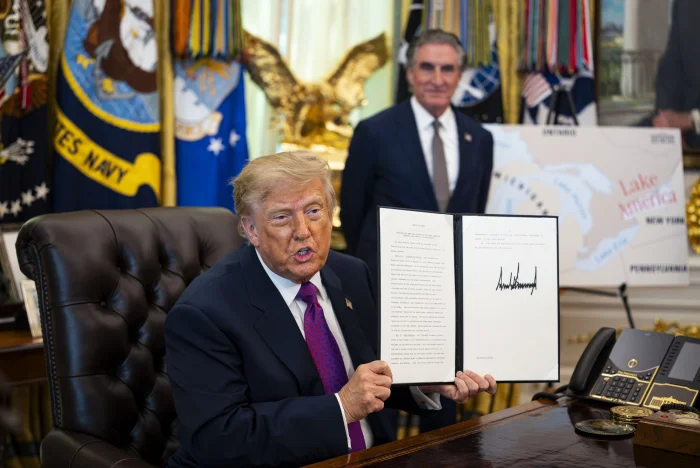
“We’re doing a lot of business [with China], but it’s smart business,” Trump told reporters during a press briefing in the Oval Office on Monday.

“We used to be taken advantage of for years with our previous presidents,” he said. “And now we’re doing great with China. We make a lot of Monday with China.”

The U.S. caravan will depart for Beijing on Tuesday, with meetings scheduled for the rest of the week between the two delegations.

Each of the executives traveling for the meetings has significant business interests in China, which is why they were asked to join Trump for the trip, White House officials have said.

President Donald Trump delivers remarks at an event he is hosting for a group that includes Gold Star Mothers and Angel Mothers in honor of Mother’s Day in the Rose Garden of the White House on Friday. Photo by Aaron Schwartz/UPI | License Photo

Source link