George W. Bush

Trump vs. Powell: Interest rates, investigation and a replacement

April 22 (UPI) — Federal Reserve Chairman Jerome Powell‘s term is nearing its end and President Donald Trump is pushing for his replacement but an investigation into Powell may hold up the appointment of a new chair.

The Justice Department opened an investigation into Powell over the renovation of the Marriner S. Eccles Federal Reserve Board Building in Washington, D.C., which Trump claims has exceeded $3 billion. The renovation was not the beginning of Trump’s feud with Powell but it has added to his effort to oust the chairman before the end of his term.

Powell’s term as chairman of the Federal Reserve will end in May but he will remain on the Board of Governors until January 2028.

Typically when a Fed chair’s term ends, they resign. However, Powell said he plans to stay put until a replacement is appointed.

At least one lawmaker, Sen. Thom Tillis, R-N.C., said he would not vote on a new chairman until the investigation into Powell is over.

The Justice Department alleges that Powell made false or misleading statements to Congress about the cost of the renovation project at the Federal Reserve headquarters during his testimony to the House Committee on Financial Services in June.

Powell’s testimony was part of his semiannual report to Congress on monetary policy.

Following the hearing, Rep. Anna Paulina Luna, R-Fla., submitted a request to then-Attorney General Pam Bondi for Powell to be investigated for perjury and making false statements. Luna said that Powell denied there would be “luxury features” included in the renovations, including a “VIP dining room, premium marble, water features and a roof terrace garden.”

Luna added that Powell “falsely claimed that the Eccles building ‘never had’ a serious renovation.” She notes that the building underwent renovations in 1999 and 2003.

“These are not minor misstatements,” Luna said. “Chairman Powell knowingly misled both Congress and executive branch officials about the true nature of a taxpayer-funded project. Lying under oath is a serious offense — especially from someone tasked with overseeing our monetary system and public trust.”

No charges have been formally filed against Powell. The challenge the Justice Department faces in convicting Powell of perjury or false statements is in proving that he willfully, knowingly made statements he knew to be false at the time.

Powell, who was Trump’s nominee for chairman in 2017, has said that the investigation into him and the Federal Reserve renovation is “pretext” to punish him for not following Trump’s direction to lower interest rates.

“No one, certainly not the chair of the Federal Reserve, is above the law, but this unprecedented action should be seen in the broader context of the administration’s threats and ongoing pressure,” Powell said in a video message in January. “This is about whether the Feed will be able to continue to set interest rates based on evidence and economic conditions — or whether instead monetary policy will be directed by political pressure or intimidation.”

Last month, federal prosecutor George A. Massucco-LaTaif told Chief U.S. District Judge James E. Boasberg that the Justice Department does not know of any evidence that a crime has been committed in the Federal Reserve renovation project.

“We do not know at this time,” Massucco-LaTaif said. “However, there are 1.2 billion reasons for us to look into it.”

The fissure between Powell and Trump began and has continued over the Federal Reserve’s decision to maintain elevated interest rates in response to inflation. Trump has repeatedly called on the Federal Reserve to lower interest rates, saying the United States should “have the lowest interest rate in the world.”

All along the Federal Reserve continues to hold an elevated interest rate, currently between 3.5% and 3.75%, in an effort to tame inflation. Its target rate of inflation is 2% on an annual basis.

Economic markers from the U.S. Bureau of Labor statistics show the rate of inflation remains at about 3%.

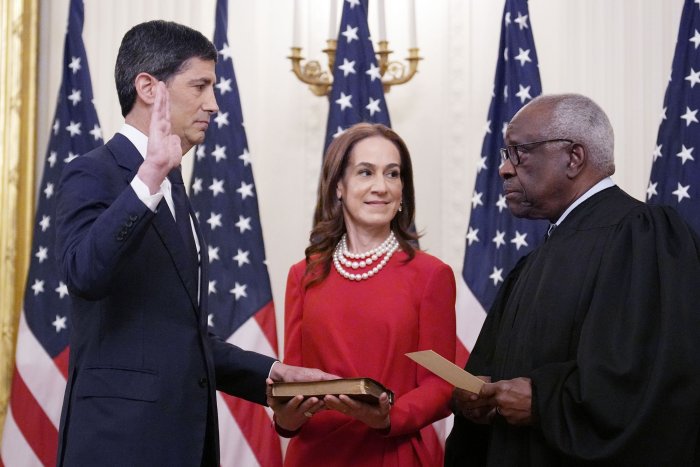
Trump has nominated Kevin Warsh to succeed Powell. Warsh served on the Fed’s board for five years after being appointed by President George W. Bush in 2006.

“I have known Kevin for a long period of time, and have no doubt that he will go down as one of the great Fed chairmen, maybe the best,” Trump posted on social media in January. “On top of everything else, he is ‘central casting,’ and he will never let you down.”

Warsh faced his first hearing on the path toward confirmation on Tuesday when he testified before the Senate Banking Committee. Questions by senators centered on the Federal Reserve’s independence, something Trump’s influence has called into question.

If appointed, Warsh would be the wealthiest person to lead the Federal Reserve.

Presidents have butted heads with the Federal Reserve throughout its history, as monetary policy can reflect on how the U.S. population views the president’s performance. A president has never tried to fire the chairman of the Federal Reserve.

The Federal Reserve is a non-partisan, independent agency made up of a board of governors posted in Washington, D.C., and 12 regional banks located across the United States.

Independence is key to the Federal Reserve’s function, keeping it from choosing policy based on the political goals of those occupying the White House and other branches of government.

Trump has not attempted to fire Powell yet but he did attempt to fire Fed board Gov. Lisa Cook. The attempt was unsuccessful as the U.S. Supreme Court intervened in October and ruled that she can remain at her post on an interim basis, at least for 2026.

The president does have some authority over choosing or designating a new Federal Reserve chair, Peter Shane, a constitutional law scholar in residence at NYU Law School, told UPI. However, a president must demonstrate a good reason for doing so.

There are two mechanisms in place that are meant to protect the independence of the Federal Reserve and its chair from political influence.

First, there is Supreme Court precedent. In 1935, the high court made a ruling in the landmark case Humphrey’s Executor vs. the United States. In this case, the court ruled that President Franklin D. Roosevelt could not fire the commissioner of the Federal Trade Commission, another independent agency, without cause.

The ruling affirmed that the authority to remove the head of any independent agency falls to Congress.

Second, there is the Federal Reserve Act. President Woodrow Wilson signed the Federal Reserve Act of 1913 to decentralize the control over monetary policy in the United States. This established the Federal Reserve and set its independence as a foundational feature of its existence.

The Federal Reserve Act makes the Federal Reserve independent in setting monetary policy without the influence of the president or Congress.

Congress has the ability to change the Federal Reserve Act. It did so in 1977 with the Federal Reserve Reform Act.

This amendment, signed into law by President Jimmy Carter, codified the objectives of the agency and established a requirement for the board of governors to report to Congress in hearings twice a year. It also added the requirement of Senate confirmation hearings for the chairman and vice chairman of the board of governors.

Last year, Rep. Thomas Massie, R-Ky., introduced the Federal Reserve Board Abolition Act, calling for the board of governors of the Federal Reserve and all Federal Reserve banks to be abolished.

“Americans have suffered under crippling inflation and the Federal Reserve is to blame,” Massie said in a statement.

Since being introduced in March 2025 the bill has not progressed beyond being referred to the House Committee on Financial Services.

FBI Director Kash Patel speaks during a press conference at Department of Justice Headquarters on Tuesday. The Trump Administration announced charges against the Southern Poverty Law Center, which the government alleges funneled over $3 million toward white supremacist and extremists groups. Photo by Bonnie Cash/UPI | License Photo

Source link

Ex-Trump adviser Olivia Troye launches congressional campaign as Democrat

Olivia Troye, a former Trump administration national security official, speaks at the 2024 Democratic National Convention at the United Center in Chicago. Troye has launched a campaign for Congress in Virginia. File Photo by Tannen Maury/UPI | License Photo

April 14 (UPI) — Saying, “Trump doesn’t scare me,” Olivia Troye, a former counterterrorism and homeland security adviser in the first administration of President Donald Trump, launched a campaign for Congress as a Virginia Democrat on Tuesday.

“I took [Trump] on when it mattered the most, and I’m ready to do it again,” she said in a campaign video posted on YouTube. “It’s time to send some real courage to Congress.”

The former Republican, who was also a member of the White House’s coronavirus task force, resigned before the presidential election in2020. She became a vocal critic of Trump’s attitude toward the coronavirus pandemic and appeared in an ad for Republican Voters Against Trump to share those criticisms.

In her launch video, Troye said “the evil I saw in that White House was staggering.”

“Too many families are struggling to get by while Washington looks the other way,” she said. “I won’t because I’ve lived it. Virginia deserves someone who’s been through the fire, who isn’t afraid to fight for our freedom, for our values, for our future.”

Troye, the daughter of a Mexican immigrant, worked in the Pentagon during the George W. Bush administration, as an intelligence officer in the Department of Homeland Security and as an adviser for then-Vice President Mike Pence.

Details of Troye’s run depend in part on a vote planned April 21 in Virginia, Politico reported. If voters approve a redistricting measure in that vote, she’ll run in the state’s 7th Congressional District, while Rep. Eugene Vindman, D-Va., will run in the 1st Congressional District.

Source link

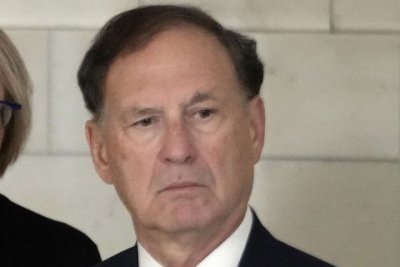
Supreme Court Justice Samuel Alito hospitalized last month

Supreme Court Justice Samuel Alito and his wife, Martha Bomgardner, attend inauguration ceremonies in Washington, D.C., on Jan. 20, 2025. Pool photo by Chip Somodevilla/UPI | License Photo

April 3 (UPI) — Supreme Court Justice Samuel Alito was taken to a Philadelphia hospital after a Federalist Society dinner in his honor last month, the court confirmed Friday.

Alito “felt ill during an event in Philadelphia” on March 20, a Supreme Court spokesperson said in a statement to the media.

“Out of an abundance of caution, he agreed with his security detail’s recommendation to see a physician before the three-hour drive home,” spokeswoman Patricia McCabe said. “After that examination and the administration of fluids for dehydration, he returned home that night, as previously planned. Justice Alito was thoroughly checked by his own physician, and he returned to work the following Monday for oral argument.”

Alito, 76, is the court’s second-oldest justice. He was nominated by President George W. Bush in 2005.

Sources told ABC News that those who saw him at the event said he looked tired and was not as engaging as usual. They said he stayed seated when people came by to greet him during the dinner.

The dinner capped off a daylong symposium by the society titled, “An Examination of the Jurisprudence of Samuel Alito,” which featured several of his former law clerks, law professors and attorneys who practice before the court. It was at the University of Pennsylvania law school.

Alito was not there during the day, as he was driving from Washington. The court was in session to hand down opinions, but Alito was on the road.

President Donald Trump delivers a prime-time address to the nation from the Cross Hall in the White House on Wednesday. President Trump used the address to update the public on the month-long war in Iran. Pool photo by Alex Brandon/UPI | License Photo

Source link

Federal judge orders halt to White House ballroom project

April 1 (UPI) — A federal judge has blocked construction of President Donald Trump‘s $400 million White House ballroom, ruling the New York real estate developer does not have congressional authorization to continue the project.

“The President of the United States is the steward of the White House for future generations of First Families. He is not, however, the owner!” U.S. District Judge Richard Leon for the District of Columbia wrote in the ruling.

Trump has said building a White House ballroom had been a dream of his since before he was president. Construction of the 90,000-square-foot building began with the demolition of the East Wing of the White House in October. Initially said to cost $200 million, the ballroom’s price tag has since doubled. Trump has said it will be financed by private donors.

In December, the National Trust for Historic Preservation sued the Trump administration to halt construction, arguing the project has not been authorized by Congress as required by U.S. law.

In response, the Trump administration has claimed Congress has already given him authority to construct the project, pointing to a statute that Leon, a President George W. Bush appointee, said only permits the president “to conduct ordinary maintenance and repair of the White House.”

Leon said the Trump administration’s understanding of the law assumes Congress has granted “nearly unlimited power to the President to construct anything, anywhere on federal land in the District of Columbia, regardless of the source of funds.”

“This clearly is not how Congress and former Presidents have managed the White House for centuries, and this Court will not be the first to hold that Congress has ceded its powers in such a significant fashion,” he said in the 35-page ruling.

For Trump to continue with the project, he can ask Congress to either appropriate the funds or approve of another funding scheme, he said.

“Unfortunately for Defendants, unless and until Congress blesses this project through statutory authorization, construction has to stop!”

In awarding the National Trust for Historic Preservation an injunction, Leon delayed its enforcement for 14 days in acknowledgment that the Trump administration intends to appeal his decision and that stopping an ongoing construction project may raise logistical issues.

“We are pleased with Judge Leon’s ruling today to order a halt to any further ballroom construction until the Administration complies with the law and obtains express authorization to go forward,” Carol Quillen, president and CEO of the nonprofit organization, said in a statement.

“This is a win for the American people on a project that forever impacts one of the most beloved and iconic places in our nation.”

Trump lambasted the decision on his Truth Social platform.

“He is WRONG! Congressional approval has never been given on anything in these circumstances, big or small, having to do with construction at the White House,” he said in a statement.

In an earlier statement issued after the ruling was made, Trump insulted the National Trust for Historic Preservation as “a Radical Left Group of Lunatics.”

According to the White House Historical Association, Congress has long been responsible for appropriating funds for the care, repair, refurnishing and maintenance of the White House, and Congress approved the Truman-era reconstruction project from 1948 to 1952.

Demolition equipment continues to break up the East Wing of the White House in Washington on October 22, 2025. Photo by Pat Benic/UPI | License Photo

Source link