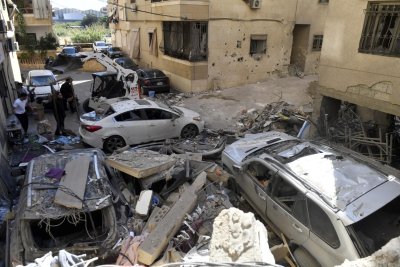
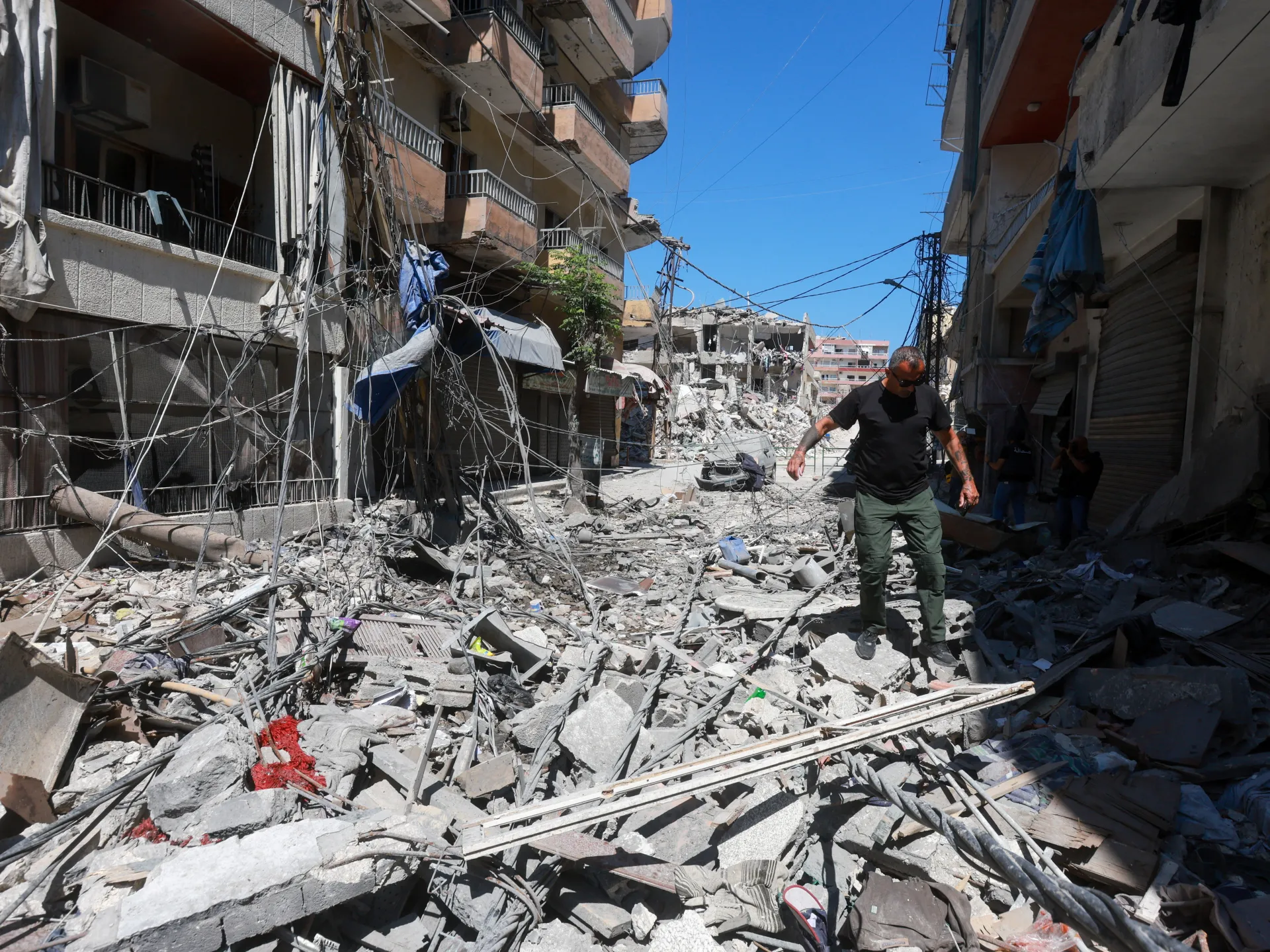
Israel has killed almost 600 people in Lebanon and displaced more than 750,000 in less than two weeks. This is the opening act of Israel’s Gaza doctrine applied to a new front. The formula is consistent: Displace – either by ordering people to leave or by destroying their means of survival. Demolish civilian infrastructure to prevent return and expand territory through so-called “buffer zones”. Fragment any coherent governance by carving territory into disconnected enclaves where military action continues at a lower intensity.
I spent three years working in Palestine before being expelled by Israeli authorities. I watched this doctrine develop in real time. Now, from Beirut, I am witnessing its replication.
In the West Bank, Israel has spent decades fragmenting territory and denying Palestinians any contiguous geography. Water wells sealed with cement, homes demolished over impossible-to-obtain permits, herders pushed from their land by illegal settlement outposts. In Gaza, the same logic was applied with far greater speed and fury.
In October 2023, Israel announced that every Palestinian north of Wadi Gaza had to leave immediately. Days earlier, Israel’s defence minister had declared a complete siege: No electricity, no food, no water. By labelling an entire population as the enemy, Israel created a class of expendable people. The military released maps with Gaza divided into numbered blocks. When your number was called, you were forced to leave. Evacuation orders became the alibi for the crimes that followed. People were ordered into al-Mawasi, a stretch of coastline Israel designated a “safe zone”, a concentration area for hundreds of thousands living in tents, where air attacks continued. So-called evacuation zones were depopulated and destroyed.
Classic counterinsurgency logic would have entailed “clear, hold, and rebuild”. Israel’s approach was radically different: Destroy, displace, dismantle. The goal was not to pacify territory but to empty it. In both Gaza and southern Lebanon, Israel has treated civilian populations as indistinguishable from the resistance they support. Their displacement is the objective. The collapse of their political representation is a condition Israel seeks to make permanent. This is settler-colonial logic in contemporary military form.
The same playbook has now arrived in Lebanon, but with a revealing difference from previous Israeli operations here. In the first Lebanon war in the 1980s, Israel sought to install a sympathetic government. Gaza has shown that Israel has abandoned that aspiration. The goal is no longer to determine who governs a territory but to ensure that no coherent governance exists at all. Nor is Israel alone in this; the UAE’s approach in Yemen and the Horn of Africa – and its support to Israel in Gaza – reflects the same preference for isolated enclaves. What has emerged is a regional doctrine of fragmentation shared between aligned powers.
Israel has issued evacuation orders for the entirety of southern Lebanon and southern Beirut. The familiar map that appeared on my screen in Beirut last week had the same design and the same deadly ambiguity as the ones we dealt with in Gaza; announced evacuation zones failed to match those shown on the map. In Gaza, those who crossed the invisible lines were killed.
Hundreds of thousands of people are now on the move. Schools have become shelters, health workers have been killed, and people are sleeping on the seafront where just two nights ago a tent was bombed. Israel has threatened to attack Lebanese state infrastructure if the government fails to act against Hezbollah – extending its aims from displacement and infrastructure destruction towards the forced destabilisation of the state itself. The Lebanese government has responded by forbidding Hezbollah from firing. This is precisely the internal fracturing that Israel’s strategy appears designed to provoke.
But Lebanon is not Gaza. Hamas was fighting with an improvised arsenal inside a besieged strip of land, and this already proved challenging for Israeli forces. Hezbollah commands more sophisticated weaponry, hardened infrastructure, and decades of preparation for this kind of war. It has shown it can absorb heavy blows and strike back, surprising both Israel and outside observers with the depth of its capabilities. Israeli ground operations in southern Lebanon and the Bekaa have already met significant resistance. It is here that the doctrine may encounter its limits – not through diplomatic pressure, which has failed to materialise, but through asymmetric military reality. Iran has made Lebanon’s fate explicitly part of any ceasefire calculus, signalling a unification of fronts that Israel had thought were weakened.
A doctrine built on the assumption of impunity has encountered little resistance in the conference halls of a so-called rules-based order. The Gaza doctrine is the expanded version of what Israel previously called the “Dahiyeh doctrine” – the use of overwhelming force against civilian infrastructure – now weaponised towards a larger end: The permanent redrawing of the region’s geography, demography, and political order.
This doctrine has developed in a vacuum of accountability. The International Court of Justice has been ignored. The Security Council has been paralysed. Governments have continued trading with Israel as it steadily normalised the unacceptable. Daniel Reisner, who headed the international legal division of Israel’s military advocate general’s office, was candid in saying that “If you do something for long enough, the world will accept it […] International law progresses through violations.”
The United States is not a bystander to this failure; it is an active participant in deepening it. At the Munich Security Conference earlier this year, Secretary of State Marco Rubio framed the transatlantic alliance in ethnonationalist terms and cast colonialism as a Western achievement. At an event in Tel Aviv, US Ambassador Mike Huckabee expressed confidence that Washington would “neuter” both the ICC and the ICJ – the very institutions through which accountability might otherwise be pursued.
What is unfolding in Lebanon is the political continuation of an ongoing settler-colonial project. The evacuation orders are precursors to mass destruction, designed to prevent return and permanently alter the landscape. Stability in the Middle East demands more than ceasefire agreements that manage fragmented populations while permitting lower-grade warfare to continue. It requires unconditional enforcement of international law, full accountability for those prosecuting this doctrine, and the right of return and reconstruction – from Beit Hanoon to Beirut.
The views expressed in this article are the author’s own and do not necessarily reflect Al Jazeera’s editorial stance.
Gaza City, the Gaza Strip – Shortly before the call to sunset prayer, Islam Dardouna stretches her hand towards a pot hanging over a makeshift stove fashioned from a battered metal can, with scraps of paper and pieces of wood feeding the fire beneath it.
Then she pauses. She turns her face away from the rising tongues of smoke. Her face stained with a thin layer of soot and her clothes steeped in the lingering smell of fumes, she takes a deep breath but does not immediately lift the lid.
Recommended Stories
list of 3 itemsend of list
In her right hand, Dardouna holds an asthma inhaler as though it were a ladle or tongs. With her other hand, she tries to prepare food for her three children.
“I can no longer tolerate the fire at all,” the 34-year-old says in a strained voice as she raises the inhaler to her mouth.
“We heat water on it, cook on it … everything. It completely destroyed my health,” she said, pointing to her chest.
Islam Dardouna suffers from respiratory problems that have worsened significantly due to constant exposure to wood smoke, and relies regularly on asthma inhalers [Abdelhakim Abu Riash/ Al Jazeera]
Dardouna has been displaced from Jabalia in northern Gaza since the start of Israel’s genocidal war against Palestinians in the territory in October 2023.
She now lives with her husband – 37-year-old Muath Dardouna – and their children in Sheikh Ajleen, west of Gaza City.
A year and a half ago, their home was destroyed. Since then, the family has moved from place to place until they eventually settled in this camp alongside other displaced families.
Everything changed after the war began. But for Dardouna, having to cook daily over an open fire in the face of cooking gas and fuel ranks among the worst.
“Our entire life now is a struggle, searching for wood and things we never imagined we would need one day,” she says. “There is no cooking gas and no gas cylinders. We lost all of that during displacement.”
What makes the situation even harder is that she suffers from asthma and chronic chest allergies, conditions she says began during Israel’s 2008 war on Gaza when she inhaled the smoke of a phosphorus bomb that dropped on her house. Her situation improved over the years, but has dramatically worsened during the current war.
“I developed airway obstruction, and recently there were masses found in my lungs,” said Dardouna, who in January was hospitalised for six days after suffering from oxygen shortage.
“The doctors prescribed an oxygen cylinder for me,” she says, quietly. “But unfortunately, I cannot afford it.”
A prolonged shortage
Like so many others across Gaza, Dardouna is struggling amid a prolonged shortage of cooking gas and fuel that has persisted since the start of the war.
Supplies have remained severely limited even after a “ceasefire” came into effect in October that included provisions allowing the entry of fuel and essential goods into the territory.
However, the quantities that have entered since then remain far below the population’s actual needs, according to official sources in Gaza and United Nations agencies.
The UN Office for the Coordination of Humanitarian Affairs says the availability of cooking gas in Gaza remains “critically constrained”, with the limited quantities entering the territory covering less than three percent of what is required.
As a result, many families have been forced to rely on alternative and often hazardous cooking methods.
UN data indicates that about 54.5 percent of households rely on firewood for cooking, roughly 43 percent burn waste or plastic, and only around 1.5 percent are able to cook with gas.
Humanitarian groups warn that such unsafe alternatives endanger people’s health and the environment due to prolonged exposure to smoke and toxic fumes produced by burning plastic and other waste.
Amid these conditions, cooking over open fires made from wood, scrap materials or plastic has become a daily reality across displacement camps and neighbourhoods throughout Gaza.
The crisis has intensified during the Muslim holy month Ramadan, when families must prepare both suhoor meals before their daily fast and iftar meals afterwards.
Firewood has become expensive, requiring a daily budget. Lighting the fire before dawn is also often difficult due to the lack of lighting and unfavourable weather conditions, so the family often skips the pre-dawn meal entirely.
“Today, for example, it’s raining and windy. I couldn’t light the fire,” said Darduna’s husband, Muath, who is also helping out with the daily cooking.
“Even when we break our fast, we wish we could drink a cup of tea or coffee afterwards, but we can’t, because lighting the fire again is another struggle.”
A former psychosocial support worker for children, Muath says it pains him to see his children fasting without suhoor.
“Every detail of our lives is literally suffering,” he says. “Fetching water is suffering. Cooking is suffering. Even going to the bathroom is suffering. We are truly exhausted,” he added.
“Our lives are covered in soot,” Muath says, pointing to the black smoke stains left by the fire.
Soot and smoke stains left by wood fires cover the hands of Islam Dardouna and many other women forced to cook over open fires since the war on Gaza began in October 2023 [Abdelhakim Abu Riash/ Al Jazeera]
He describes gas as “one of our dreams”, recalling how “it felt like Eid day” when the family got a gas cylinder a few months ago. “But we don’t even have the stove to use it, and many families are like us,” he said.
“We are living on the edge of nothing. Displacement and war stripped us of everything,” he adds. “We are willing to live with the simplest rights in tents. But there is no heating, no gas, no lighting. It feels like we are living in open graves on Earth.”
Serious implications
In a statement on Wednesday, the General Petroleum Authority in Gaza warned of the “catastrophic and dangerous consequences of the continued halt in cooking gas supplies” to the territory, stressing that the crisis “directly affects the lives of more than two million residents” amid already dire humanitarian conditions.
The authority said Gaza had already been facing a shortfall of about 70 percent of its actual gas needs compared with the quantities that entered after the “ceasefire” announcement.
It added that the “complete suspension of gas supplies places the Gaza Strip before a looming disaster that threatens food and health security”, particularly during Ramadan.
The authority also said that preventing gas from entering the enclave constitutes a “clear violation of the ceasefire understandings”, calling on mediators and international actors to intervene urgently to ensure the regular flow of cooking gas into Gaza.
Across Gaza, many families now rely on ready-made meals from aid distributions and charity kitchens because of economic collapse and the difficulty of cooking.
“Even when food arrives ready hours before iftar,” Muath says, “heating it becomes another problem.”
The frustration of daily survival pushes Muath to the brink.
“As a father now, I cannot even provide the most basic things,” he says. “Imagine my son simply wants a cup of tea … even a little wind can stop me from making it.”
‘The fire suffocates you’
In a nearby tent, Amani Aed al-Bashleqi, 26, sits watching food being cooked over an open fire for iftar while her husband stirs the pot.
She said cooking on fire makes food taste “flavourless” – not because the taste changes, but because “exhaustion and suffering have become part of every bite”.
“We start cooking early so we can finish by iftar, and after breaking the fast, my husband and I are completely exhausted and covered in soot.”
At times, Amani Aed al-Bashleqi says she cannot boil water for her baby’s milk because lighting the fire is difficult and not always possible [Abdelhakim Abu Riash/ Al Jazeera]
Like Dardouna, al-Bashleqi says the smoke causes severe headaches and health problems.
“The fire suffocates you. All the women in the camp suffer health problems from cooking on fire,” she says. “But we have no choice.”
She has a seven-month-old baby, and her biggest worry is boiling water for his milk.
“Sometimes I boil water and keep it in a borrowed thermos, but I don’t always have one,” she says. “And sometimes when he wakes up at night, I mix the milk with water without boiling it, even though I know that’s not healthy. But what can I do?”
Nearby, Iman Junaid, 34, displaced from Jabalia to western Gaza City, sits with her husband Jihad, 36, in front of the fire preparing food.
Junaid blows on the flames while she pushes an empty plastic oil bottle under the fire.
Behind them, bags full of plastic bottles are piled up. The family collected them to fuel the fire because cooking gas has been unavailable for months.
A mother of six, Junaid says she knows the health dangers of burning plastic, but has “no other choice”.
Iman Junaid and her husband Jihad rely on empty plastic bottles to fuel their cooking fire because they cannot afford the rising price of firewood [Abdelhakim Abu Riash/Al Jazeera]
“My little daughter is one year old, and her chest always hurts because she inhales the smoke,” she says. “Our life is collecting and burning plastic and nylon.”
“With the price of wood rising, we now wish we could even find wood. Gas has become almost impossible … we’ve forgotten it.”
She said there were many promises that gas would enter Gaza after the “ceasefire”, but “nothing happened”.
For Dardounah, the solution is not simply bringing cooking gas into Gaza. “What we need is for life to become possible again,” she says.
“Let gas enter. Let goods enter at reasonable prices. Let there be basic necessities for a normal life.”