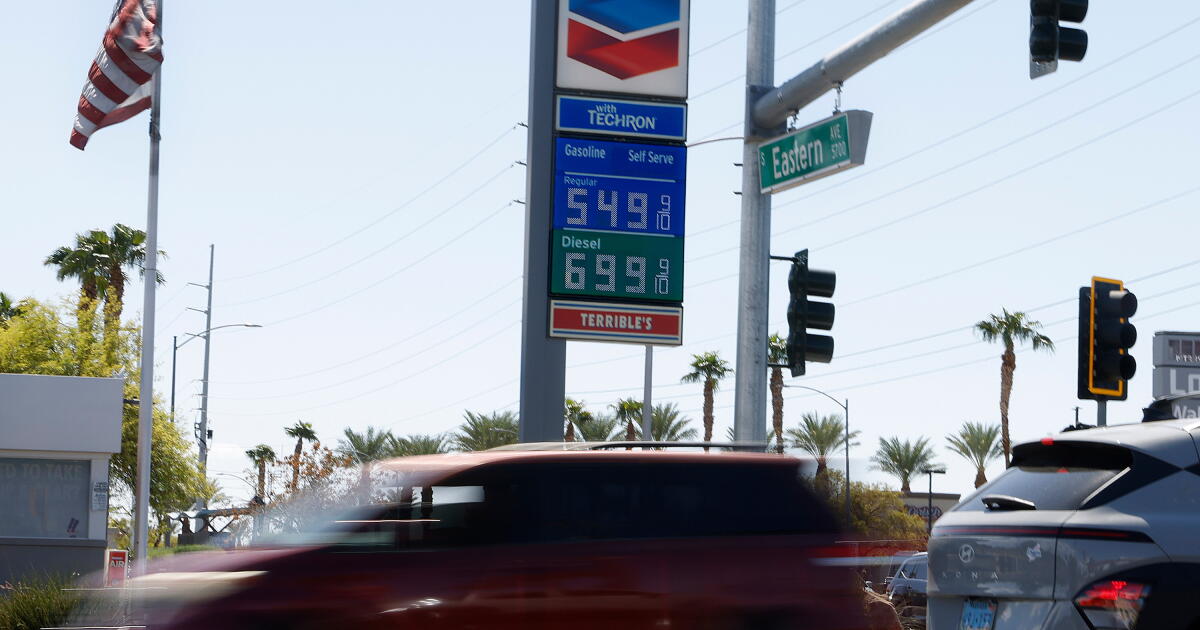
gas price

Senate confirms Trump pick Warsh as chairman of the Federal Reserve

The Senate confirmed President Trump’s nominee to lead the Federal Reserve, Kevin Warsh, bringing new leadership to the world’s most powerful central bank at a fraught moment for the global economy.

Warsh was confirmed Wednesday in a largely party-line vote. His nomination had been thrown into doubt in recent months after Republican Sen. Thom Tillis of North Carolina said he would block the nomination while the Justice Department investigated Fed Chair Jerome H. Powell. The Powell inquiry was dropped in April, clearing the way for the Senate to confirm Warsh.

Senate Majority Leader John Thune (R-S.D.) urged colleagues to support Warsh during a floor speech Wednesday morning, saying it’s crucial that a Fed chair “understand not only the macro” but also “appreciate the microeconomy: and that’s the hardworking Americans, their jobs and their livelihoods.”

“Kevin Warsh is just such a person,” Thune said.

Warsh, 56, a former top Fed official, will become chair at an unusually difficult time for the independent agency.

Inflation has topped the Fed’s 2% target for five years and is now rising faster because of surging gas prices. The Fed’s interest rate-setting committee is divided and saw the most dissenting votes in more than three decades last month. And Powell, after years of personal attacks from the Republican president and an unprecedented legal investigation by the Justice Department, plans to stay on the Fed’s board even after his term as chair ends, potentially creating a competing power center.

Trump has demanded change at the Federal Reserve

The Fed has faced numerous threats to its independence from Trump, who has repeatedly attacked Powell for not cutting interest rates. Trump also sought to fire Fed Gov. Lisa Cook and launched an investigation into brief Senate testimony by Powell on a building renovation.

Kevin Hassett, director of the White House’s National Economic Council, said in a Fox News interview on Sunday that he believes the markets are relieved that Warsh “is going to help lower interest rates over time.”

“Obviously, data driven,” said Hassett. “I’m not putting any pressure on Kevin Warsh.”

In December, Trump said on his social media platform that he wanted a Fed chair who would cut interest rates when the stock market rose — the opposite of what traditional economics would prescribe — and added, “Anyone that disagrees with me will never be the Fed chairman!”

Trump’s comments have fueled concerns over whether Warsh will set rates based on economic conditions or seek to cut rates to appease Trump, even if doing so could worsen inflation. At Warsh’s confirmation hearing last month, Sen. Elizabeth Warren, a Democrat from Massachusetts, derided him as a “sock puppet” for Trump. Warsh declined to say that Democrat Joe Biden had won the 2020 election against Trump, who has falsely claimed that voter fraud cost him reelection.

Still, Warsh denied at the hearing that Trump had pressured him to reduce the Fed’s key rate.

“The president never once asked me to commit to any particular interest rate decision, period,” Warsh said then. “Nor would I ever agree to do so if he had. … I will be an independent actor if confirmed as chair of the Federal Reserve.”

A critic of the Fed’s leadership in the past

Warsh has been highly critical of the Fed’s recent track record, particularly the inflation spike in 2021-22, the worst in four decades, and has called for “regime change.” Yet he has provided only broad outlines of what that change would involve.

He has called for limiting the Fed’s communications, which would be a sharp shift after decades of increasing transparency. He has argued that some of its communications tools, such as quarterly forecasts of where its key rate may head, have made it harder for officials to switch gears.

Senate Democrats also have condemned Warsh for not fully divulging the details of his extensive wealth, which disclosures show amounts to at least $100 million. His investments include stakes in Polymarket and SpaceX, but he hasn’t revealed how large those holdings are. He promised to sell all such assets within 90 days of being sworn in.

“He will be the wealthiest Fed chair in history, but he refuses to provide transparency to the American people about who he is entangled with,” Warren said.

Warsh faces difficult economic conditions

The Fed is still grappling with how to respond to the 50% jump in gas prices from the Iran war. The increase has boosted inflation, which reached 3.8% in April.

The Fed is tasked by Congress with keeping prices stable, which it seeks to do by raising its short-term rate to make borrowing and spending more expensive, cooling growth and inflation.

The Fed typically looks past temporary price increases that stem from supply disruptions, such as the war’s cutoff of oil through the Strait of Hormuz, because those prices typically level off — or even fall back down — once the supply is restored.

But the Fed also followed that approach after the COVID-19 pandemic snarled global supply chains for goods, lifting prices for things such as cars, furniture and electronics. Inflation turned out to last longer than expected, and Powell and other Fed officials have acknowledged they waited too long to raise rates. Inflation surged to 9.1% by June 2022.

The Fed’s rate-setting committee has kept rates unchanged for three straight meetings as it evaluates the effect of the gas price spike. At its most recent meeting last month, three members of the committee objected to language that suggested its next move would be a rate cut. They preferred more neutral language that would allow for a hike. Many Fed watchers saw those dissents as a warning shot to Warsh that he won’t be able to easily engineer rate reductions.

A fourth member of the 12-member committee, Stephen Miran, dissented in favor of a rate cut, as he has at every meeting since Trump appointed him to the Fed’s board last September. Miran is serving until a replacement is named, and Warsh will take his spot.

Powell, meanwhile, said at a news conference April 29 that he would remain as a Fed governor until the Justice Department closes its investigation into the Fed’s building project, the first time a chair may stay on the board for an extended period since 1948. His term as a governor lasts until January 2028.

U.S. Atty. Jeanine Pirro has dropped the government’s investigation, but she has said it could be reopened if the Fed’s inspector general office, which has looked into the renovation project since last July, finds evidence of criminal activity.

Rugaber and Cappelletti write for the Associated Press.

Source link

Gas prices, wildfire, insurance, climate – what each candidate said last night

Wildfire and insurance — issues amped by climate change — along with the price of gas, took center stage at the California governor’s debate on Tuesday night.

Here are some of the candidates’ defining statements, starting left of the stage:

Tony Thurmond

The Democratic State Superintendent of Public Instruction addressed the state’s wildfire insurance crisis, where private insurers have been dropping policies as climate changes fuels more frequent catastrophic fire. The state has allowed insurers to raise rates in return for writing more policies, but so far its backup FAIR Plan, meant to provide coverage when other companies will not, continues to grow.

Thurmond said he would withhold tax credits, subsidies and benefits from non-cooperative insurers, although moderators and other candidates raised questions about the legality of this strategy.

“The governor can certainly work with the Insurance Commissioner to say there should be no rate increase unless the insurance industry is actually writing policies. They have failed California in our greatest need. They’ve taken the money for premiums and then when people needed to have support to rebuild their homes, they said, ‘whoops, we’re not going to help you.’ Then they got a rate increase. I’m sorry, where I come from, when you do a bad job, you don’t get a raise.”

Chad Bianco

The Republican Riverside County Sheriff said insurers aren’t leaving California because of climate change, but because the state has failed to pass and enforce vegetation management and defensible space policies that would reduce wildfire risk.

“It wasn’t global warming, stop believing that. It was a failed environmental policy that doesn’t allow fire departments to prevent defensible space around our homes or clear out the brush for 30 years that are building in our mountains and in our hills that took out a city. [Insurers] specifically said we were going to lose a city, and our governor said ‘we don’t care.’ And so the insurance companies left.”

Inadequate brush clearance has contributed to other fires in the state, although it’s not a factor experts cite in the Los Angeles fires specifically.

Tom Steyer

The Democratic billionaire hedge fund founder who is positioning himself as the climate candidate in the race, touted his drive to make oil companies pay for damages from climate change, including rising insurance rates and homes lost to wildfires.

“In environmentalism, I have three real rules. Number one is polluter pays. It’s absolutely critical that if people are going to pollute and damage the environment and cause harm to their neighbors, they pay. Two, we have to include environmental justice in every single environmental rule. And third is we need to start to deploy all of the clean energy stuff that’s cheaper now and get us back to the front of the world in leading it.

“There is one person that the corporations are going after, including Big Oil, who is spending millions of dollars to stop me. The electric monopolies, PG&E, millions of dollars to stop me, because I’m the person on this stage who’s the change agent.”

Steve Hilton

The former Republican Fox News commentator said insurers should be allowed to raise rates consistent with actual wildfire risk. He also advocated for “modern forest management,” removing fuel from forests, as a way to protect against wildfires, reduce carbon emissions from fire, and revive the state’s timber industry.

“We can create jobs and opportunity in rural California and reduce carbon emissions in the process, because we won’t have the mega wildfires.”

Asked if he supports the transition to electrification, he promoted natural gas: “Yes, but let’s be sensible about electric. Right now, we have a fleet of gas fired power stations generating electricity that are running at 10 to 15% of their capacity, even though we have abundant natural gas in California that we could be using to generate affordable, reliable electricity that would lower the cost of electric bills for consumers and businesses.”

According to the U.S Energy Information Administration, California’s natural gas production provides less than one tenth of what the state consumes.

Xavier Becerra

The former Health and Human Services Secretary said he would call a state of emergency as governor to require wildfire insurers to freeze rates and come to the table.

“This affordability crisis is hitting every family, and we have to act as if this were a break glass moment … Rate payers have to understand what their risk is, so they understand why they are going to pay for what they’re going to pay for their home insurance. But an insurance company has to be open and transparent about how its pricing its policies so people can afford it.”

Moderator Julie Watts noted that California home insurance rates are below the national average and questioned the legality of a freeze.

Katie Porter

The former Democratic Orange County Congresswoman was asked whether California should keep its refineries. Two of them closed in the past year, reducing the state’s refining capacity by 20 percent and causing California to lean more heavily on imports.

She said the state should keep the remaining refineries open, but also rapidly scale up green energy to meet the state’s growing electricity demand: “Right now we need to keep all of our energy sources online. That’s just the reality that we’re in. … Right now those refineries, they’re up, they’re running, they’re creating good jobs. Let’s keep them there. But I want to be really clear … The people who work at those refineries, and the people who live in Kern County also face some of the worst pollution and lower life expectancies. Green energy gets us out of that.”

She also backed an idea to have state dollars cover insurance for insurers, known as reinsurance.

Matt Mahan

Democratic San Jose Mayor called to suspend the state’s 61 cent-per-gallon gas tax, used to fund road repairs, bridges, and public transport. The state is looking at a $216.4 billion revenue shortfall over the next decade due to increasing fuel economy and electric vehicles. The other Democratic candidates support keeping the tax; Mahan has instead proposed a flat fee on all vehicles.

He said: “I’m the only candidate on this stage who has pledged to suspend and then reform the gas tax. It is the most regressive tax in California. Working people, rural people, are spending three times as much maintaining our roads as wealthier EV owners.”

On the wildfire insurance crisis he said: “The government in Sacramento created so many restrictions, including taking over a year to approve any rate changes, prohibiting insurance companies from using climate data to project future costs, that they stopped writing new policies. The answer is bring them back, force them to compete, allow them to appropriately price risk, and then hold government accountable for maintaining our wildland, reducing all that vegetation and wildfire risk so that we don’t have these catastrophic fires.”

Antonio Villaraigosa

The former Democratic L.A. mayor expressed his concerns with the readiness of the state’s infrastructure to support a transition to electric vehicles.

“We need an all of the above strategy that understands we’ve got to transition from oil and gas to renewables. But here’s an example: the 2035 mandate [to ban gas-powered car sales]. We built 167,000 charging stations in the last 10 years. We need 2 million more to get to that mandate, and if we build them, we don’t have a grid. So we ought to build the grid instead of arguing about whether or not we need an all-of-the-above policy.”

Source link

Trump draws Marie Antoinette comparisons as he leans into the gilded trappings of the presidency

President Trump had something urgent to address while flying back to Washington from his Mar-a-Lago estate on a recent Sunday.

It wasn’t the Iran war, nor the partial government shutdown over Department of Homeland Security funding. He was focused on a monumental issue of a different kind, hoisting artist renderings of the $400-million White House ballroom he’s building, complete with hand-carved “top-of-the-line” Corinthian columns.

“I’m so busy that I don’t have time to do this. I’m fighting wars and other things,” Trump said before extensively detailing plans for “the greatest ballroom anywhere in the world.”

His divided attention has become a Democratic point of attack and a concern for some Republicans who worry he’s not spending enough time on issues that voters care most about ahead of November’s midterm races.

The contrast was on full display Thursday, when, as Trump flew to Las Vegas to discuss tax cuts for Americans earning tips, his administration was pushing ahead with another of his splashy projects: Plans to build a 250-foot Triumphal Arch near the Lincoln Memorial replete with a Lady Liberty-like statue and a pair of golden eagles.

The president’s ability to speak to the concerns of working people has always seemed incongruous with his biography as a billionaire real estate developer. Yet his populist policies and emphasis on the economy during his 2024 campaign helped catapult him back to the White House.

Republican strategist Rick Tyler noted that, when Trump first ran for president in 2016, his wealth was a selling point.

“While other people, like Mitt Romney, played down how rich he was, Trump was giving free helicopter rides at the Iowa State Fair,” Tyler said. “People loved it.”

Still, Trump’s preoccupation with some of the gilded trappings of the presidency, as more Americans worry about bills, has drawn accusations that he’s a modern-day Marie Antoinette.

“ ‘Fighting wars’ and surging gas prices, yet Trump has time to brag about his billionaire backed ballroom,” Sen. Andy Kim (D-N.J.) responded on X to Trump’s Air Force One presentation.

Democratic California Gov. Gavin Newsom, a potential 2028 presidential hopeful, has been more direct in comparing Trump to the last queen before the French Revolution, who has come to embody extravagant opulence — even posting an AI-generated image of Trump’s face on her body on social media.

“TRUMP ‘MARIE ANTOINETTE’ SAYS, ‘NO HEALTH CARE FOR YOU PEASANTS, BUT A BALLROOM FOR THE QUEEN!’” Newsom wrote in October 2025, at the start of last fall’s 43-day government shutdown.

White House says Trump’s success benefits all Americans

Asked about opponents invoking Marie Antoinette, White House spokesman Davis Ingle said Trump “is going to go down in history as the most successful and consequential president in our lifetime.”

“His successes on behalf of the American people will be imprinted upon the fabric of America and will be felt by every other White House that comes after him,” Ingle said in a statement.

The president faced similar critiques during his first term. But lately he’s been unabashed about accusations he’s disconnected from Americans’ worries about high costs, which could leave Republicans with an uphill battle to retain control of Congress.

Republicans have been loath to question Trump, though notably there has been little criticism of a federal judge’s ruling that work on the project must stop until it has congressional approval. The GOP-controlled House and Senate also haven’t prioritized legislation to move the ballroom project forward.

“I’m not much into architecture,” Republican Sen. John Kennedy of Louisiana said last fall.

About two-thirds of Americans said Trump is “out of touch” with the concerns of most people in the United States today, according to an ABC News/Washington Post/Ipsos poll from February, though the same percentage said the same about the Democratic Party.

Presidents are usually removed from voters, separated by layers of security and surrounded by adoring subordinates. In her book “Why Presidents Fail and How They Can Succeed Again,” Elaine Kamarck argues that presidents get too focused on their own political narratives rather than the public’s concerns. Yet, when it comes to Trump, “All of this stuff is frankly unique to him.”

She pointed to the ballroom as well as Trump’s other White House renovations, soon adding his signature to paper currency and renaming the Kennedy Center after himself.

“It’s a reflection, I think, of his own background as a businessman and somebody who made his fortune selling his name,” said Kamarck, who worked in Bill Clinton’s White House.

While Trump focuses on the ballroom and other Washington projects, some public work projects in other parts of the country have languished.

Joe Meyer, the former mayor of Covington, Ky., spent years pushing for critical improvements to the Brent Spence Bridge connecting his town with Cincinnati, a project listed as a top federal priority dating back to Trump’s first administration.

Federal funds for improvements were approved under President Biden but held up by a Trump-ordered review. Work is finally set to begin later this year, though delays will likely limit design options and slow the project, Meyer said.

“The ballroom is Washington inside-baseball,” Meyer said. “The bridge is just a wreck. It’s frustration that we’ve been dealing with forever.”

A $100 tip and a golden tractor

Trumpeting new tax deductions for tips, Trump staged ordering McDonald’s to the Oval Office — which he has adorned with gold flourishes — and tipped the grandmother making the delivery $100. When she described large medical bills from her husband’s cancer treatments, Trump said she should bring him to an upcoming UFC fight on the White House lawn.

When hundreds of farmers were invited to the White House for an agricultural policy speech, they stood on the South Lawn beside a tractor that had been painted gold. It drizzled, but Trump stayed dry, addressing them from a covered second-floor balcony.

“You don’t mind rain,” the president told the farmers below.

He then flew to Miami for a conference of Saudi investors who, the president noted, were too rich to be impressed by U.S. families scrounging to save up $5,000.

“I know they’re looking like, ‘What the hell is $5,000?’ ” Trump joked. “Their shoes cost them more than $5,000.”

When asked in February, meanwhile, for his message to young people wanting to buy a home, Trump replied: “Save a little longer. Wait a little longer.”

Members of the Cabinet have also fed the perception that Trump’s promised “Golden Age” may not be arriving for everyone. Health Secretary Robert Kennedy Jr. advised Americans to buy liver instead of beef.

“If you go and buy a steak, it’s still pretty expensive. But if you buy the cheaper cuts, it’s great meat. And it is very, very affordable. Or liver, or, you know, all these alternatives,” he told podcast host Joe Rogan.

Agriculture Secretary Brooke Rollins said people could still afford meals consisting of “a piece of chicken, a piece of broccoli, corn tortilla and one other thing.”

Texas-based Republican consultant Brendan Steinhauser said he thinks that Trump “can kind of get away with” building a ballroom because voters have come to expect that from him as a brash dealmaker and businessman.

But Steinhauser said he worries that dramatic increases in gas prices and a potentially weakening economy could resonate with voters. Ahead of the midterms, Steinhauser said, Democrats could score points “trying to make it more about Trump and his oligarch friends.”

Price and Weissert write for the Associated Press. AP writers Linley Sanders in Washington and Ali Swenson in New York contributed to this report.

Source link