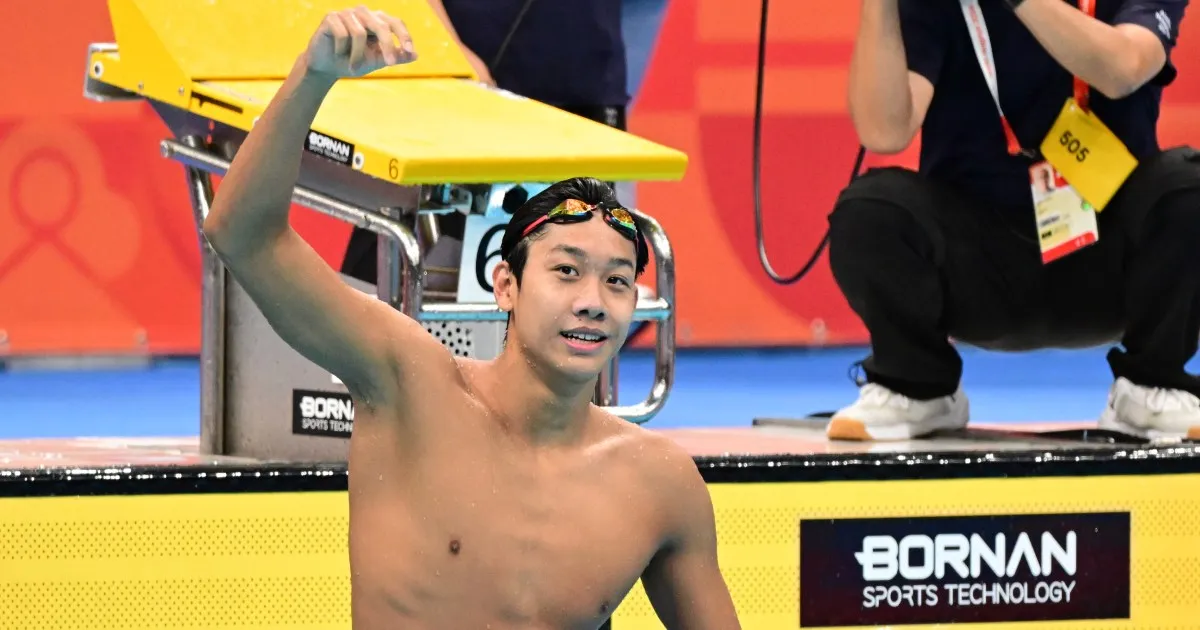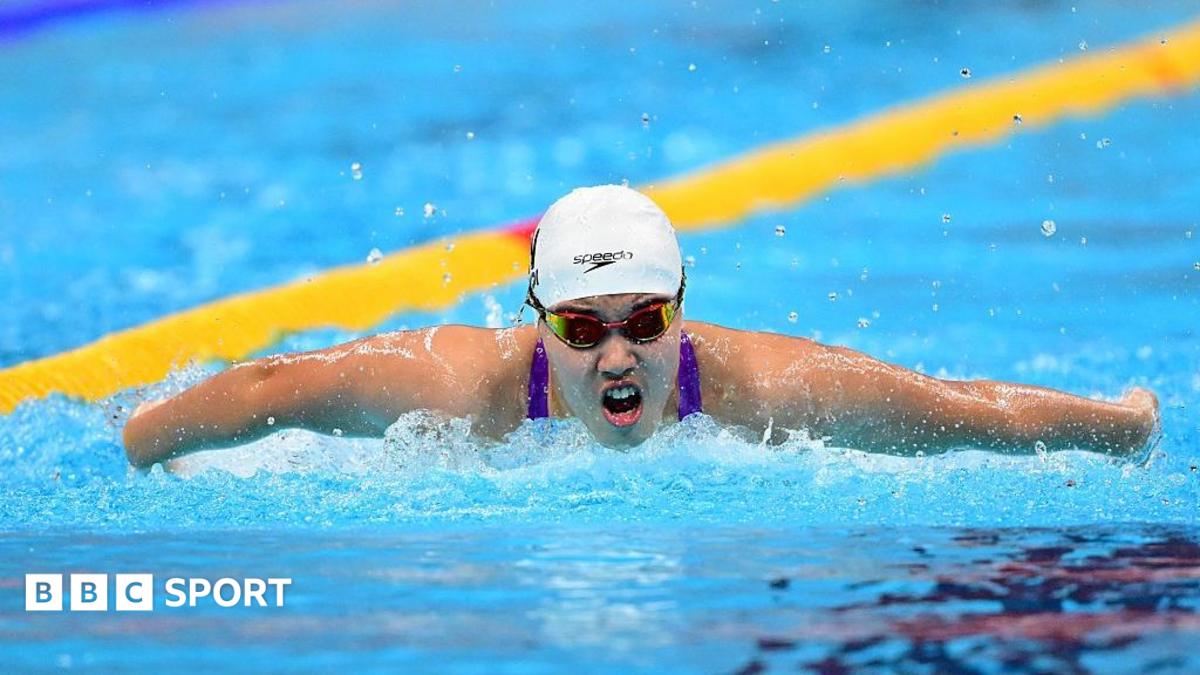
Chad le Clos says his apartment in South Africa was destroyed by a fatal fire – the night after the swimmer became the most decorated athlete in Commonwealth Games history.
Le Clos picked up his 21st medal to overtake Australia’s Emma McKeon as the athlete with the most medals in Commonwealths history, when South Africa took bronze in the men’s 4x100m medley relay in Glasgow last week.
It was the 34-year-old’s third medal of the 2026 Games, having won silver in the mixed 4×100 medley and bronze in the men’s 4×100 freestyle relays.
Only days later, Le Clos has revealed that a fire destroyed his home of more than a decade in Sea Point, Cape Town and killed one of his neighbours.
“It has taken me a while to process this heartbreaking tragedy,” the 2012 Olympic gold medallist wrote on Instagram, external.
“On the evening of 30 July, amid breaking the all-time Commonwealth record, a fire started in my apartment block, which quickly spread to my home. Sadly my home, where I’ve lived for more than a decade, burnt down and there is nothing left to salvage.”
In the post, Le Clos also paid tribute to his “neighbour of many years” who died in the fire, offering his “deepest and most sincere condolences” to the victim’s family and friends.
“No words can truly ease a loss like this, but I hope the family knows that the thoughts of an entire community are with them,” the Durban-born swimmer said.
Le Clos added: “To my fellow neighbours whose homes and lives have been severely affected by this fire, please know that you are not alone. This is a tight-knit community and it is in moments like these that we lean on one another.”
Le Clos, who famously beat Michael Phelps to win 200m butterfly gold at the London Olympics in 2012, said he has launched a fundraising campaign to help his neighbours affected by the blaze.
Phelps was a 14-time Olympic champion and had not lost in the event since 2001 when the United States icon was beaten by Le Clos.
The South African won his first Commonwealth medal in Delhi in 2010 at the age of 18 and now has seven gold, five silver and nine bronze medals across five editions of the Games.
Over his career, he has won four Olympic medals, 16 world titles, seven Commonwealth golds and 10 African titles.
After Victoria withdrew in 2023, Glasgow answered the SOS call – and organisers say the past 11 days in the Scottish city have “exceeded all expectations”.
Yes, there have been grumbles – including from those who have seen parking spaces outside their houses taken – and taxi drivers and shop owners the Games have passed by.
On the ground, though, this felt like a meaningful event.
Ticket sales of 434,000 were well down from 1.5 million for Birmingham 2022, but they were always going to be given the smaller venues for this scaled-back edition. It has been rare to enter a venue and not find a joyful, engaged crowd.
Organisers said their social media views passed those of Birmingham within the opening few days and highlighted record-breaking television figures in Australia and New Zealand, where the Games were free-to-air.
Still, without that same coverage in the UK, these Games have – at times – drifted by.
Glasgow 2026 was also hurt by the absence or late withdrawal of big-name competitors, particularly in athletics, which missed Keely Hodgkinson, Katarina Johnson-Thompson and Dina Asher-Smith.
The Games’ differing relevance between sports was again clear – for netball, this remains the pinnacle and is treated as such; for others, it is a stepping stone. Many narratives focused on the “next generation”.
Eighteen-year-old Jersey swimmer Filip Nowacki was perhaps the most exciting name to emerge, but gymnasts Ruby Evans (Wales) and Reuben Ward (Scotland) and England track cyclist Henry Hobbs, who won two golds and a bronze, were others.
Swimmer Faye Rogers impressively brought her success at the Paralympics back to Glasgow with gold in the pool – and then competed in the non-para event as well.
England tried to rally themselves following their semi-final defeat by New Zealand, but came up against a Diamonds team recovering from one of the biggest shocks in the tournament’s history.
Australia – who had previously been in every Commonwealth final and won the tournament four times – were stunned by Jamaica on Saturday afternoon, giving them less time to recover for the bronze-medal match than England.
The Roses worked hard to shut down the Diamonds’ forward-passing options from the start, but the team in green and gold found their rhythm with devastating consequences, overturning an early 9-7 deficit to lead 19-11 in a bruising first-quarter spell for the Roses.
Stembridge’s side, who lost 66-47 to the same opponents in the pool stage, then lacked impetus in the second period, showing signs of tired legs against one of the world’s most established shooting partnerships in Kiera Austin and Sophie Garbin.
A loose pass from England captain Fran Williams allowed Austin to calmly extend the gap to 28-16 and her side kept the margin steady, resulting in a half-time score of 35-24.
The presence of substitute shooter Eleanor Cardwell in the third quarter helped the Roses score five without reply to trail 45-34, but they were still 49-36 behind with 15 minutes left to play.
Bronze is not a colour of medal that Australia ever imagined they would be playing for, but what seemed just as important to them was reminding the world what they are capable of and why they have been such feared opponents.
In that sense, Stacey Marinkovich’s Diamonds shone as ultimate professionals, and England again came up short against a top side, losing by one less point than the pool stage match between the teams.
“It’s so tough after we lost yesterday and the disappointment of not making a final, to pull yourself up. I’m just so proud of the girls, the fight that we had through this 10 days to keep showing up and responding,” Williams told BBC Sport.
“Probably a few of our errors came through that fatigue and the mental drain that being in tournament netball is, and that is no excuse.
“For so many of us, 10 of us, that was our first Commonwealth Games experiencing that and maybe that showed in a final-day game where you’ve got to turn it on when medals are on that line.
“I’m not going away from that World Cup next year without a medal and standing on that podium, hopefully with a gold, so we’ll be doing as much as we can in the next 12 months to make sure that we are in a better position to fight in these final games.”
After reaching the final with some tiebreak heroics in the semi-final win over Malaysia, it seemed only fitting that the final would go the same way.
McKeown and Kelly were out of the traps fast in the first set as they took four shots in the third end on route to a 6-2 win.
The English pair fought back in a tight second set to build a 3-0 lead, and they held on to win 4-2 and send the final to a one-end shootout.
It was Kelly who came closest to the jack and Walker was unable to respond with his final bowl, which started the celebrations for a well-deserved gold medal.
“We wish it wasn’t always an extra end but we played really well,” added McKeown.
“We got a huge four shots early on and kicked on from there in the first set.
“In the second set we lost a three early on in probably the worst end of the game, and then clawed our way back into it.
“Gary had a chance to win the game with his last bowl and unfortunately just missed, but he played an absolute bomb on the tiebreak end to secure the win.”
Kelly said he had to grab the chance “with both hands” with the decisive bowl of the match.
“Obviously there’s nerves and there’s pressure, but you’ve just got to have belief and trust.
“I’ve been lucky enough n my career that I’ve done it before, so you’ve just got to reach into those moments and believe.
“You have to enjoy and embrace those moments as well, and thankfully I delivered.”
England’s Jazmin Sawyers was finally able to put previous disappointments at major championships behind her by winning the women’s long jump at the Commonwealth Games in Glasgow.
The 32-year-old bounced back from serious injury to celebrate a gold medal on a night when there was a silver for England’s mixed 4x400m relay team and a bronze for pole vaulter Owen Heard.
Sawyers finished just outside the medals in fourth place at the previous games in Birmingham four years ago, failed to qualify for the final of the 2023 World Championships and was then forced to miss the 2024 Olympics.
She had to undergo surgery after rupturing her Achilles tendon on her take-off leg and so, rather than competing in Paris ended up commentating for the BBC.
But the Stoke-on-Trent born athlete put all those setbacks behind her on a memorable evening at Scotstoun with her fourth jump of 6.93m proving to be enough to claim the gold medal ahead of Nigeria’s Ruth Usoro (6.87m) and Brooke BuschKuehl of Australia (6.80m).
“It hasn’t properly hit me how this is the thing I’ve been telling myself all the horrible bits are for,” she said.
“The feeling is overwhelming. I will do the horrible bits 100 times over, I’ll do it and do it and do it. This is amazing.”
Sawyers will now turn her attention to competing for Great Britain at the European Championships in Birmingham, which start on 10 August, but is keen to hang on to the memories Glasgow has given her.
“Twelve years ago almost to the day, I won a silver here in Glasgow (2014 Commonwealth Games) at my first major championships. It was a shock silver and I’ve held Glasgow close to my heart ever since,” she added.
“It was the start of my career and so sensational and I had the time of my life. I take that as one of the best moments of my entire career, but when you’ve done that there’s only one thing to do which is to upgrade.”
At the time, Kerr gave his answer as the bell tolled. In a flash, he made his move, bursting to the outside in pursuit of Myers and Cheruiyot, who made theirs momentarily first.
With 250m to go, Kerr left them behind. Wightman gamely tried to follow but how do you chase down a man this fast? His brave gamble failed and the bronze medallist from the last two Games trailed home in sixth.
By then, Kerr was already celebrating gold, with Myers coming through for silver and Cheruiyot bronze.
“I peeked up at the screen, saw I had a bit of a gap, and I felt great,” added the Edinburgh athlete, who has been racing at Scotstoun since he was a child.
“I was just trying to stay present and enjoy it. I learned how to race on that track – and I’ve had some pretty bad ones out there – so to really enjoy that last 100m was a really important moment.”
It was the moment Glasgow 2026 has been building to. The historic, reinstated, Blue Riband event of these Games got a fittingly elite winner. As a student of the sport’s history, Kerr will appreciate that.
And as a kid who was at the athletics event at Hampden in 2014, he knew how much joy every man, women and child inside this place would derive from every picture he had taken, every word he shared with them, and every scrawl of his name.
“I have to take my time out there because they’ve waited and put their hard-earned money to come out and watch me perform,” he said.
“You’ve got to stay in your lane and realise I’m lucky coming into this championship healthy, ready to go and I’m in the best shape of my life. And to do that in front of a home crowd is very special.”
When they landed the diving competition for the 2028 Summer Olympics last year, operators of the Rose Bowl Aquatics Center in Pasadena trumpeted it as a gold-medal achievement. But swimmers and others who use the facility are now learning that pre-Olympic construction probably will force them out of three immensely popular swimming pools for more than a year.
The Aquatics Center will close as early as next April, and not be returned to its regular users until after the Olympics conclude in the summer of 2028, people with knowledge of the plans confirmed to The Times.
Such a prolonged closure will send the more than 400,000 people who pour through the center’s turnstiles each year scrambling to find other places to swim, dive, play water polo and aqua-aerobicize. The center’s two 50-meter pools and an adjacent therapy pool will be closed, along with two expansive hot tubs, the people said.
Aquatics Center operators declined to discuss details of the shutdown, saying they plan to make an announcement Monday. They said it’s premature for them to discuss what improvements the Games will bring to the 36-year-old swim complex, as those negotiations have not been concluded.
The Rose Bowl Aquatic Center in Pasadena, shown on Friday, is set to close next year to make way for reconstruction as the center will host diving in the 2028 Olympics.
(Christina House / Los Angeles Times)
Jacie Prieto Lopez, vice president of communications for LA28, the Olympics organizing group, confirmed that improvements would be made to the facility but said specifics were still being sorted out.
“We cannot comment on specific facility improvements as those remain under active discussion between LA28 and the Rose Bowl Aquatic Center,” Prieto Lopez said “But based on initial evaluations of the existing facility, improvements could include the pool, diving tower and mechanical systems.”
Opened in 1990, in part with profits from the 1984 Los Angeles Olympics, the Aquatic Center was once viewed as a state-of-the-art facility. But it has grown somewhat shopworn and in need of a makeover. The operators of the center expect LA28 will pay for some of that work.
While LA28 officials wouldn’t discuss details, people familiar with their view said the Olympic organizers would balk at bankrolling every upgrade pined for by the city of Pasadena (which owns the facility) and the nonprofit that operates the center.
The massive deck around the swimming pools has grown rough in places. The locker rooms are cramped. Aged pumps and filters need an upgrade. Who should pay for these improvements has been the subject of prolonged discussion between LA28 and the Rose Bowl Aquatics Center operators, the people familiar said.
“At the end of the day, it’s going to be a win-win for LA28 and the Aquatics Center,” said one of the people, who wasn’t authorized to speak publicly. “The LA28 group is putting in a lot of investment. That should account for the fact the Rose Bowl will be losing revenue during the closure.”
Aquatics Center loyalists, however, wonder how they will cope with the loss of their pools.
“The pool helps me keep my weight down. It keeps my blood sugar down. It’s just everything to me,” said Elizabeth Ramirez, a social worker from Alhambra, after emerging from a morning aqua-aerobics class. “So when it closes down, it’s gonna definitely have an impact on my health. … Hopefully they will be able to tell us [about] another place where we will be able to go.”
Lynn Roberts, with one leg stunted by childhood polio, finds her time in the pool “life changing, because in the water I can do the things that everyone else does.” She knows that Rose Bowl is looking for alternative locations, but so far there are no details. The thought of the pool being closed for more than a year is “a big thing,” she said, adding “People are very, very concerned.”
The Rose Bowl Aquatic Center on April 6 in Pasadena. The facility will host diving in the 2028 Olympic Games.
(Eric Thayer / Los Angeles Times)
Like a dozen other regulars, Bonnie Stern talked about the social hub the Aquatics Center creates. It’s been her gateway to new friendships, a walking group, brunches and even a regular happy hour.
“We’re all really concerned. There’s such a wonderful community here,” said Stern, who works in the entertainment industry. “We haven’t heard yet where we can go. And where are we going to be able to find what we have now?”
The complex also rents space to a cafe and a separate shop, the Swim Guy. Michael Eisenberg, who co-owns the swim equipment business with his brother, Craig, worries about losing clientele.
“We spent a lot of money setting this up and building our relationships with customers and teams,” Michael Eisenberg said. “The RBAC asked us if we could stay open and service the community during construction, but I don’t see how we can do that, since all our teams and the public will be scattered to different pools in the area. My brother and I are kind of freaking out about it about how best to serve the teams and the public and the financial cost of closing.”
Aquatics Center executive director Melanie Sauer said the nonprofit and its many user groups — for youth swimming, Masters swimming, water polo and more — are working fervently to find alternative pools. Rose Bowl Masters Swimming (to which the writer of this article belongs) already has launched new workouts at Occidental College in Eagle Rock and is talking to other pool operators.
The financial losses during the closure could be significant. The Aquatic Center reported $8.6 million in receipts from admissions, merchandise and services in 2024, the most recent year reported on its federal tax filings. Another $1.6 million came in via gifts, grants, contributions and membership fees.
Sauer said that an “RBAC on the Road” program will seek to draw payments from user groups when they relocate to other pools. She said it’s premature to provide any details of those arrangements.
Organizers of the Games announced the shift to the Rose Bowl center — in the Arroyo Seco just south of the more than 100-year-old football stadium — in September of last year. Previously, the Games planned to have divers compete at the LA84 Foundation/John C. Argue Swim Stadium, immediately southwest of the Los Angeles Memorial Coliseum, which will host track and field events.
A drone view of the pool, lower right, at Exposition Park on Nov. 10, 2025, in Los Angeles.
(Eric Thayer / Los Angeles Times)
But the Exposition Park pool, used for the 1932 Los Angeles Olympics, was not deep or wide enough for diving. And it would have proven more costly to retrofit than the Rose Bowl pool.
“This facility requires minimal work, provides additional amenities for athletes, and accounts for up to $17.6 million in revenue increases and cost savings,” LA28 said when it announced the shift to the Rose Bowl pool.
People familiar with the plans for the Pasadena complex say that Olympic diving fans will be seated in bleachers that will be erected atop the “competition” pool, which sits closest to the parking lot. Additional seats may wrap around the north end of the dive pool.
That pool’s 10-meter platform, originally constructed with a donation from the late televangelist Gene Scott, will be torn down and replaced. One plan being considered by LA28 organizers would eschew the existing locker rooms in favor of temporary modular structures, the sources said.
LA28 officials believe that any short-term losses to the center will be more than made up for by the long-term gains from the international attention the pools will receive and the promise that other major swimming and diving events will be held there, according to people who have spoken to the Olympic organization. LA28 officials point to an analysis by the Southern California Assn. of Governments that projected the Games will generate more than $17 billion in gross domestic product for the region.
1
2
3
1.A child jumps off a diving board.2.Margaret Shieh, 79, of San Marino, participates in a water fitness class.3.Swimmers do laps at the Rose Bowl Aquatic Center.(Christina House / Los Angeles Times)
Both the 2028 Games and those future events will help fill Pasadena hotels, restaurants and shops, bolstering the local economy and adding tax dollars to the city treasury, according to supporters of the plan. The pool is being considered as the site of the 2028 Olympic diving trials, one source said.
“This historic opportunity will shine a global spotlight on our community,” the Aquatic Center proclaimed last year. “We look forward to keeping you updated as more details become available.”
Saturday’s netball results mean Jamaica and New Zealand will battle it out for the gold on Sunday during some of the final medal awards of the tournament.
England will also try to deny Australia a consolation bronze, before teams transform the Hydro from a netball court back to a gig venue for the closing ceremony on Sunday night.
The venue will be turned around in just six hours.
It has been a scaled-down version of the Games, with 215 medals awarded across 10 sports, however it has hosted a record 47 para-sports events.
Glasgow stepped in to host the tournament – for the second time in eight years – when Australian state Victoria pulled out due to soaring costs.
Flags from 74 nations and territories were carried into the arena during the event, which also featured the Loch Ness monster and performances from Nathan Evans, Tom Walker and KT Tunstall.
Morris had heard her victories played out for GB with a different anthem but she looked to be overcome when celebrating this one with the Welsh national song.
No time to immediately reflect on what she had just achieved though.
There was a quick chance for a picture with the Welsh flag and then off it was to the next task.
The scratch race started just 10 minutes later where Morris lined up with Welsh team-mates Megan Barker and Carys Lloyd.
It looked like they had concocted an almost perfect plan, with Barker going off a few laps out and Morris driving through to finish second behind Australian winner Georgia Baker.
A gold and a silver all in one day. Or so we thought.
Morris had already done some interviews celebrating this fact before she was given the message in the media mixed zone about her demotion.
Morris had been relegated for entering the sprinter’s lane when her New Zealand opponent was already there, and Scottish cyclist Erin Boothman was promoted to bronze.
Morris returned to do a couple more interviews, ironically, while the scratch closing ceremony was going on.
Morris reflected on her golden moment.
“It was just a dream,” said Morris. “We get that opportunity once every four years, so for it to come together tonight was amazing.
“I have my family and friends in the crowd and the support team from Welsh Cycling were also there.
“I’m going to carry that with me forever, it’s amazing.”
Morris seemed unaware of her dominance in the race.
“It was only when I crossed the line I knew I’d won the race,” said Morris.
“I focused on my ride and tried to execute it well and really leave it all out on the track.”
It had been a day of mixed emotions and, when asked to sum up her feelings about the scratch race, Morris was whisked off so we will have to wait for that verdict.
So, disappointment to finish the day but that should not take away from her pursuit domination and golden moment.
Morris is a world champion for a reason and she proved why.
Wales cycling have two special world-class talents in Finucane and Morris.
Meanwhile, a boxer from Tuvalu claimed her country’s first ever Commonwealth Games medal without winning a fight.
Because there were only five entrants, Tarona Taafaki received a bye to the last four, meaning she was automatically guaranteed at least a bronze medal.
The 20-year-old lost her first and only fight in the women’s 75kg division – which was a semi-final – to India’s Lovlina Borgohain on Friday, losing every round on all three of the judges’ cards.
Taafaki’s coach and father, Badi Taafaki, says the population of the tiny Pacific island nation – at 10 square miles the fourth smallest in the world – will celebrate the medal and use it to highlight a climate change emergency.
“For the people of Tuvalu, this medal means everything,” he said. “We’re one of the smallest nations in the world, so a medal like this is hugely significant.
“If we can win medals, more people around the world will recognise Tuvalu and begin to understand the challenges we face because of climate change.
“It is very real for us. The coastal erosion is unbelievable, and the countdown is now measured in years, not decades.”
A huge 44 gold medals to be won across two sessions of athletics, boxing, track cycling and judo.
All 14 of the men’s and women’s boxing finals take place at the SEC Centre – with seven English fighters seeking gold medals.
The men’s mile is the highlight of the athletics schedule, with Scotland’s world record holder Josh Kerr favourite to take the gold
Plus, 2018 champions England face New Zealand in the netball semi-finals.
Schedule (all times BST and subject to change):
08:30-14:00 – bowls and Para-bowls
09:00-11:00 – netball – England v New Zealand semi-final
10:00-13:30 – track cycling and Para-track cycling
10:00-14:00 – athletics and Para-athletics – eight gold medals
11:00-14:00 – judo – last 16, quarter-finals and semi-finals
11:00-14:30 – boxing – seven gold medals
13:00-15:00 – netball – Australia v Jamaica semi-final
15:00-19:15 – track cycling and Para-track cycling – six gold medals including men’s sprint final
15:00-20:45 – bowls and Para-bowls – semi-finals
16:00-18:45 – judo – five gold and bronze medal contests
16:30-22:00 – boxing – seven gold medals
18:30-22:00 – athletics and Para-athletics – 11 gold medals including 4x100m relay finals from 20:15, men’s 800m final at 20:45, men’s mile at 20:55, mixed 4x400m relay final at 21:20 and the women’s mile at 21:45
The 32-year-old, a training partner of 800m Olympic champion Keely Hodgkinson, will also race at next month’s European Championships and the inaugural Ultimate Championships in September.
“There are four opportunities to win gold this year,” Hunter Bell told BBC Sport.
“I am two golds down and two more to go.”
Hunter Bell is blossoming later in her career.
Having taken five years out from the sport before returning during the Covid-19 pandemic, she took 1500m bronze at the Paris Olympics before pipping Hodgkinson to silver at last year’s World Championships in the 800m.
This, though, is her first outdoor title – in the event Hodgkinson is Olympic champion.
“Every medal is a landmark moment but my first outdoor gold is huge,” she said.
Hunter Bell and Kenya’s world champion Lilian Odira were the favourites for this title after Hodgkinson opted not to compete. The final was barely a contest with Hunter Bell setting the pace and then kicking on with 200m to go to win by more than a second.
Hodgkinson has instead taken time off before the European Championships in Birmingham, which start on 10 August.
Hunter Bell is only running in the 1500m in that event, denying the chance to see an intriguing race between the pair, but took her opportunity in her friend and training partner’s absence.
Though she said the win validates her decision to come to Glasgow, she defended the decision of others to withdraw.
Scotland’s Melanie Woods has won the Commonwealth Games women’s 1500m T54 for the second time in under 40 hours after streaking to victory in the restaged final – however England’s Ellis Kottas could not replicate her silver medal.
Woods set a new Games record to triumph in Glasgow on Wednesday evening, but it emerged on Thursday morning that Para-athletics authorities had decided the race should be held again following appeals surrounding a first-lap crash.
However, the Scot kept her composure in her home city to replicate her initial success, break the record again, and reclaim the gold that was already hers – in mind if not around her neck.
Kottas, though, finished fourth, having said she was “low-key traumatised” when the race result was overturned.
Woods led from the start in her home city, although Noemi Alphonse of Mauritius and Australia’s Eliza Ault-Connell kept her honest over the first couple of laps.
The latter had fallen away by the final 200m, though, and the Scot held off the Mauritian as she was roared by down the home straight by the crowd.
“It was in my mind ‘what have I got left?’ and you do question what you’ve got in your arms,” Woods said.
“But I just needed to be confident I could stay out in front and it was nice coming down the home straight and not seeing her wheel moving in front of me.”
Woods – who has used a wheelchair since being hit by a car while riding her bike in 2018 – will also compete in the 400m later on Friday morning.
The heats of that will start a little more than 90 minutes after the replayed final.
Given Keith herself was a tad surprised she scooped up a medal here, her grandad’s take on the event ought to be a good one.
The 10,000m is her preference, but the longer distance final did not go to plan on Monday and she finished seventh.
The Inverness athlete said she was faced with the ‘can Megan win a medal?’ talk earlier this week, but with that weight of expectation lifted – combined with experience of the home crowd and “the help of two other Scots in the race” – she was freed from the shackles to soar to a classy and courageous run.
“If you look at Monday on paper, that was pretty disappointing,” the 24-year-old added.
“I don’t think you’d put me in the running for a 5km medal since the 10km is normally closer to being my strength, so that definitely helped, the removal of that pressure.
“I think I knew if I felt horrendous and dropped out or fell off the pace again it wouldn’t really matter so I may as well shoot my shot.”
And shoot she did. Biding her time in the middle of the congested pact, Keith made her move with four laps to go, weaving past early pacesetters from Kenya and Uganda.
She was afforded a bit of breathing space with two hurls around the track to go. But as expected, the exceptional Australian duo of Rose Davies – who made it a double gold at these Games with her 10km – and Jessica Hull, the 1500m Olympic silver medallist, entered another gear in the final lap.
While the cameras focused on the tremendous tussle between the pair in the matching yellow vests, the majority of the crowd had their eyes a wee bit further back, bawling at Keith on the final stretch.
She was home safe and sound. And swiftly searching for a saltire.
Once that was draped over her shoulders, and she’d caught up with fellow Scots Eloise Walker and Laura Muir, who finished 15th and 16th respectively, she was darting back around the track – the wrong way, this time – in search of her grandad.
He was eventually found for a quick hug, but a bigger debrief – and the declaration, surely, that this topped any other Scotstoun occasion – is still to be had.
Given that impressive 2025 she had, the pressure was on O’Connor to at least win a medal in Glasgow and it only ramped up after Katerina Johnson-Thompson, who had won gold ahead of her in 2022, pulled out.
The Englishwoman’s withdrawal paved the way for a good shot at that coveted gold, but she still had to go out and deliver.
O’Connor ended on 6,569 points, 291 ahead of her nearest challenger, England’s Jade O’Dowda, but it wasn’t all straightforward.
Resilience is a key trait for any sportsperson, but particularly a heptathlete.
Fortunes can fluctuate across the seven events so it is needed in ample supply to come out on top at the end of two days of competition.
It was particularly pertinent for O’Connor in a rain-soaked second session of the event on Tuesday evening.
After a good start in the morning, that brought a third-place finish in the 100m hurdles and a season’s best 1.82m in the high jump, O’Connor struggled in the shot put and dipped well below her high standards by throwing just 12.85m as the torrential rain hammered down.
She said trying to grip the shot put in that rain was akin to trying to lift a bar of soap and that she was “gutted” as she “made it a lot easier for the rest of them to beat me”.
Her resilience was shown in abundance in the 200m that followed as she defied the elements to easily win her heat in a time of 24.14.
The Newry-born athlete added she had to “work really hard” on Wednesday and that she did, finishing with a flourish.
First came a big leap of 6.37m in the long jump, then another season’s best, this time in the javelin, of 52.85m that far exceeded those around her.
It will be particularly satisfying as that was an event she had worked hard at improving heading into 2026.
All that was left was to hold her nerve in the 800m and she did that and more, cruising to victory in a time of 2:10.46 just as the sun broke through for the celebrations at Scotstoun.
“I came here expecting a lot from myself and I really wanted to score like 6,600 or 6,700 and open up my season because that’s the shape I felt I was in,” she added.
“After day one I had to raincheck myself a bit, it’s not always about getting huge big scores but competing and getting the best out of yourself with the elements and challenges.
“I tried to navigate it as best as I could. The shot put didn’t go to plan, it needs work in those conditions, but I’m happy overall with how I did.
“There’s a lot of positives to take from it. I’ve got a gold medal round my neck so I can’t say much more.”
A Scottish gold made up for the fact Scott missed out on his bid to defend his 200m freestyle title and add a 16th Commonwealth medal, having failed to qualify for the final at the end of a rigorous schedule.
And Evans’ success was not the only one cheered to the roof of Tollcross instead.
Aberdeen’s Toni Shaw stopped an Australian clean sweep of medals in the women’s S9 100m freestlye final to replicate the bronze of Birmingham four years ago.
“I had lots and lots of nerves even before the walkout, all day since my heat,” Shaw told BBC Scotland.
“But we’ve got a good support team and they helped me keep my cool and wish me luck. All you can do is swim as fast as you can and that’s the mentality I went into the race with.”
Meanwhile, Keanna MacInnes added 200m butterfly silver, having also come second in the 100m. The 24-year-old played her part in the relay silver too to take her own tally to three.
As she stood next to her relay team-mates Katie Shanahan, Evans, and Evelyn Davis the Stirling swimmer reflected on a Games during which Scottish swimmers have delivered 12 medals, four of them gold.
“If you said to me at the start of the week I’d win two medals I’d be over the moon – sneaking that extra mixed medley one last night was special for all of us,” MacInnes said.
“We heard it a 100 times, about the crowd being amazing but it absolutely delivered. I’m a proud and patriotic Scot so there’s been a lot of tears this week.
“Not only is it 12 medals but there are a lot of golds and silvers, not necessarily sneaking into bronze. That shows the depth.
“There were so many finals with multiple Scots in them. So not just medals but lots of personal and season’s bests which shows how good the team has been this week.”
Olympic champion cyclist Emma Finucane insists she has “nothing to prove” at the Commonwealth Games despite her ambitions of winning an elusive gold in Scotland.
Finucane, 23, collected two bronze medals in Birmingham four years ago but has since won 16 medals at the Olympics, World and European Championships.
The Welsh star says she is targeting “the top step” on the podium in Glasgow.
“I haven’t actually stood on the top step at the Commonwealth Games,” Finucane told BBC Sport Wales.
“That’s something I’d love to achieve this time round.
“I feel like I’m a different person four years on and I can’t wait to show what I can do on the track.”
The Carmarthenshire native credits the Birmingham 2022 Games as the “springboard” to where she is today.
“I would not be where I am today without the Commonwealth Games,” she said.
“The first time I was pretty young, pretty naive to the sport of sprint cycling.
“It was a very overwhelming experience, whereas this time round I feel like I’m more of an established rider.”
She added: “I was 19 [in Birmingham] and the year after I won my first world title, which was crazy for me.
“I think it gave me the confidence I needed as an athlete to develop in my career, and get to where I am so quickly.
“We became Olympic champions two years ago, and I actually don’t even know how that happened.”
Before the super-heavyweight bout Abdul told the BBC he wanted to become the new ‘King of Scotland’ – in reference to Amin declaring himself that name in 1976.
After taking power in a coup in 1971, Amin ran a brutal regime during which an estimated half a million people were killed. He was also known as the Butcher of Uganda.
Abdul, who never met his grandfather, was chasing Uganda’s first Commonwealth boxing medal since Auckland in 1990 – something which would have been guaranteed had he beaten Thomas.
Instead, he was given warnings in the previous two rounds and was trailing on all of the judges’ scorecards.
“All I can say about this is the decision is not right, I am not happy,” he said.
“He elbowed me. He caught me with the elbow.
“It [the head movement] was not intentional. I was trying to come back.
“How can I headbutt someone? I would not.
“He was the person they wanted to win. He was the winner before.
“I knew if I did not get knockout I could not win the fight.”
BBC Sport has contacted Commonwealth Games organisers and World Boxing for a response to Abdul’s comments.
Thomas, who is now guaranteed at least a bronze medal, said it was “not the way” he wanted to win.
“I can’t change what happened today but I can control how I box on Friday,” he said.
Amin, himself a boxer, harboured a fascination with Scotland after serving in the King’s African Rifles in his 20s.
At the height of the regime, he was fond of wearing a kilt and playing the bagpipes – and even declared himself “King of Scotland” in 1976.
Some years later, those predilections even spawned an Oscar-winning film, The Last King of Scotland, starring Forest Whitaker and James McAvoy.
In a previous interview, Abdul said he was “inspired” by Amin, although it was not entirely clear whether he was talking about his boxing feats or not.
Speaking to the BBC, he refused to answer when asked if he was proud to be the dictator’s grandson, but he did address the question of how he feels when he is linked to someone with such a sinister reputation.
After a relatively quiet day, the first medal was claimed by the men’s 3×3 basketball team just before 17:00 BST.
A couple of hours later, three more followed in the space of five minutes.
The women’s wheelchair 3×3 basketball team took silver; Evans added her second gold – and third medal – of the Games in the 200m breaststroke; then Woods claimed gold in the women’s T54 1500m.
Shaw then joined in with bronze in the women’s S9 100m freestyle before MacInnes was edged into second place in the women’s 200m butterfly to take her second individual silver of the meet.
Around the same time, MacKenzie was leaping to long jump bronze, before the haul was completed in the pool when Evans and MacInnes teamed up with Katie Shanahan and Evie Davis to take silver in the women’s 4x100m medley.
Three more further medals are guaranteed in boxing – with fighters in semi-final action on Friday – while further prospects remain in athletics, bowls, cycling, judo and weightlifting.
Kate O’Connor has won Northern Ireland’s first gold medal at the Commonwealth Games in the heptathlon at Scotstoun Stadium.
O’Connor, a World indoor and outdoor silver medal, finished top of the standings with 6569points and is the first new heptathlon champion at the Games in eight years.
England’s Jade O’Dowda claimed silver while Australia’s Tori West won the battle for bronze.
It is O’Connor’s first senior outdoor gold and her first gold at her third Games after she finished eighth in 2018 and claimed silver in 2022.
The 25-year-old becomes NI’s 12th medal winner in Glasgow, claiming the country’s first gold at the Games in athletics since 1986.
O’Connor was favourite heading into the event after the late withdrawal of England’s Katrina Johnson-Thompson, who beat her to gold in 2022 and she certainly lived up to the billing.
The Newry-born athlete led after the first two events on Tuesday. She ran the 100m hurdles in 13.54 seconds and produced a season’s best 1.82m in the high jump.
In a rain-soaked evening session, she dipped in the shot put, throwing just 12.85 in difficult conditions.
While she said she was “gutted” with that performance, she rallied and she bounced back well to run the 200m in a season’s best time of 24.14, which was just 0.07 off her personal best as she strolled to victory in her heat.
She earned 3731 points across the four events to top the standings heading into Wednesday’s second day of the competition and, with a 49-point advantage over O’Dowda, looked to be in pole position for gold.
O’Connor further increased that lead on Wednesday morning as she recorded a leap of 1.82m in the long jump and a season’s best 52.85m in the javelin to move 258 points ahead.
In the 800m, she finished first as she ran 2:10.45 to take home NI’s first multi-class gold medal since Dame Mary Peters won the pentathlon in 1974.
NI team-mate Anna McCauley finished eighth in the standings despite being second-fastest in the 800m behind O’Connor.
O’Connor will receive her gold medal on Thursday evening at 18:30 BST.