g7

From the IAEA to the G7: The Contested Meaning of Global AI Governance

In May 2026, just hours before President Donald Trump met President Xi Jinping, OpenAI’s Vice President of Global Affairs Chris Lehane floated the idea of a US-led global governance body for artificial intelligence that would include China as a member. The model, according to media reports, was compared to the International Atomic Energy Agency (IAEA), a familiar reference for managing strategic technologies with global consequences.

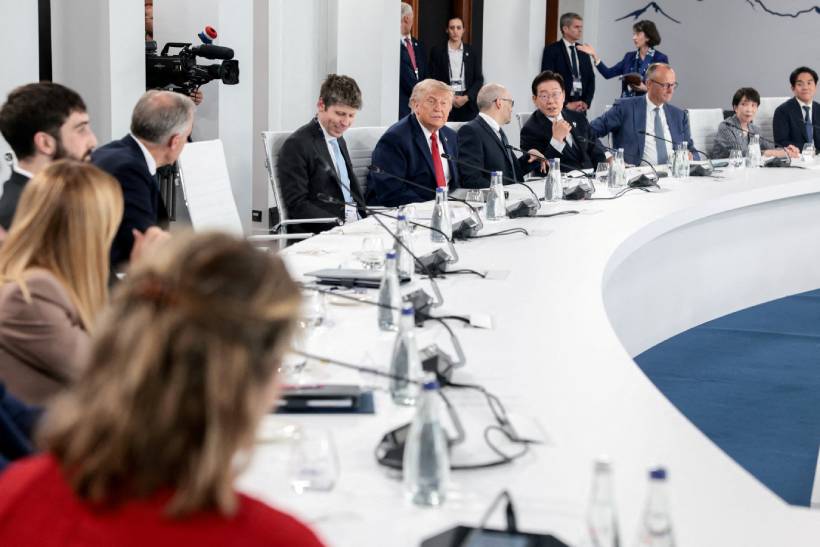
One month later, at the G7 summit in Évian-les-Bains, a different tone emerged. Several influential AI executives joined leaders from advanced economies to discuss AI governance, online safety, and global security. According to Axios, Anthropic’s Dario Amodei and Google DeepMind’s Demis Hassabis leaned towards a more selective framework among democratic countries, while OpenAI’s Sam Altman used broader language, calling for an international forum to develop shared testing standards and risk assessments.

These two moments reveal something important: the meaning of “global AI governance” remains unsettled. In one setting, global means including China for legitimacy. In another, it can mean a trusted coalition designed to manage access, capability, and strategic risk. AI governance is becoming part of the architecture of global power.

Three Voices, Different Emphases

Stay ahead of the geopolitical week.

MD Briefing delivers expert analysis across five global fronts — the Indo-Pacific, energy, geoeconomics, European security, and the Middle East — every Monday morning. Free.

Their presence at the G7 showed how quickly AI firms have moved from building systems to helping shape the politics around them. The leaders of OpenAI, Anthropic, Google DeepMind, Mistral, Cohere, and other firms were not simply observers of geopolitics. They were part of the conversation about how technological power should be governed.

Their positions were not identical. Amodei reportedly urged democratic countries to coordinate more closely so that AI governance would not fragment. Hassabis stressed the strategic importance of frontier capability. Altman, by contrast, used more institutionally neutral language, suggesting that advanced AI should not be shaped only by the companies building the most capable systems.

Even among frontier AI developers, there is no settled imagination of global governance. Should it include all major AI powers, including strategic rivals? Should it be built around trusted coalitions? Should it prioritize safety, democratic values, geopolitical advantage, or public legitimacy?

The question became more complicated because the G7 discussions came shortly after the US government imposed export controls that forced Anthropic to suspend foreign access to its Fable 5 and Mythos 5 models. Reuters reported that the order required Anthropic to block access to the models for foreign nationals, leading the company to disable them more broadly to ensure compliance. The episode showed how frontier AI governance can move from abstract principles to abrupt restrictions. Even among democratic allies, technological solidarity has limits. When AI becomes strategic infrastructure, every country begins to think about its own room for maneuver.

The Asymmetry of “Global”

The deeper issue lies in who has the power to define the word “global” in the first place. In May, global governance could mean a US-led institution that includes China. In June, it could mean coordination among democracies to manage frontier capability and strategic access. The definition changed because the political room changed.

This reveals a double asymmetry. The first is technical: only a small number of firms can define what counts as a frontier model, how its capabilities should be tested, and who should be allowed to access it. The second is narrative: the same ecosystem also helps frame the language through which the world discusses governance.

For countries outside the frontier AI circle, they may be invited to conversations but not always to the stage where categories, thresholds, and governance priorities are first shaped. They may be asked to adopt best practices whose assumptions were formed elsewhere. They may be told that risks are global, even when preparedness remains highly unequal.

G7 outreach to partner countries such as India, Brazil, Kenya, South Korea, and Egypt is important. It recognizes that AI governance cannot remain a conversation among advanced economies alone. Yet there remains a difference between being present in a forum and helping design the architecture of the forum itself. The question is who defines the table, the agenda, the risk categories, and the meaning of global governance itself.

When the AI Frontier Moves Towards the Market

There is another reason why a broader governance imagination is necessary. Frontier AI innovation is no longer centered primarily in universities or public research institutions. It is increasingly shaped by private firms with the capital, compute, talent, data access, and infrastructure required to train and deploy the most capable models.

Stanford’s AI Index 2025 noted that nearly 90 per cent of notable AI models in 2024 came from industry, up from 60 per cent in 2023. A report prepared for the European Economic and Social Committee on generative AI and foundation models also described significant US dominance across the value chain. These findings point to a structural shift: the frontier is becoming more concentrated, more expensive, and more closely tied to corporate and geopolitical capacity.

Much of AI’s progress has come from companies willing to take risks, scale products, and build technical capability at extraordinary speed. But the center of gravity has shifted. When frontier AI is largely financed, defined, and deployed by market actors, the default imagination of AI development can tilt towards commercial viability, platform advantage, user growth, and strategic positioning.

Public interest does not disappear in such a system. It risks becoming secondary unless other actors are strong enough to bring it back into the room.

Open Future, a European digital policy organization, has warned that concentrations of power in AI can make public activities dependent on “a narrow group of monopolists.” The phrase matters because infrastructure-level dependency can weaken society’s ability to negotiate the terms of the technologies it relies on.

A Wider Public-Interest Layer

In a multiplex digital world, power does not flow only through states or markets. It also moves through universities, civil society organizations, professional associations, media, labor groups, open-source communities, public-interest technologists, and moral institutions. Together, these actors form the society layer often missing from discussions dominated by states and markets.

States define security priorities. Companies define technical possibility. Society must help test legitimacy. Who bears the risk? Who benefits from deployment? Who is excluded from design? What harms are being normalized because they are commercially convenient or geopolitically useful?

This is why Pope Leo XIV’s recent intervention on AI is politically relevant beyond its religious context. In his encyclical Magnifica Humanitas, he argues that protecting the human person in the age of AI requires renewed reflection on the common good, solidarity, social justice, and human dignity. Such interventions will not replace regulation or technical standards. They help recover a truth easily lost in frontier AI politics: governance is also about preserving the human meaning of technological progress.

The same question of authorship is beginning to appear in empirical research. Ongoing fieldwork-based research at the University of Oxford has started to examine whether countries in the Global South are developing approaches to AI governance that are neither simple copies of Western regulatory templates nor rejections of international cooperation but pragmatic syntheses shaped by local institutional capacity, regulatory sequencing, and historical experience with technology transfer. Indonesia has appeared as one of the country cases in this line of inquiry.

Governance models worth studying are not only those negotiated in Évian, Brussels, Washington, or New York. They are also being improvised, often informally, by mid-sized digital economies navigating dependency and ambition at the same time.

The United Nations’ Global Digital Compact (GDC), adopted in September 2024, offers a useful multilateral reference point. It frames digital cooperation and AI governance around inclusion, human rights, open standards, interoperability, digital public goods, and multi-stakeholder cooperation. The Compact does not resolve the power asymmetries of frontier AI by itself, but it gives societies, alongside states and firms, a language for claiming a legitimate role in digital governance.

The practical task is to strengthen public-interest evaluation: the ability to test social impact, language bias, local risks, institutional misuse, and deployment consequences in different societies. The aim is to preserve enough room for public reasoning so that the future of AI is not defined only by those with the largest models, the biggest markets, or the strongest strategic leverage.

Imagining a More Inclusive AI Governance

The lesson from the IAEA analogy and the G7 discussions is not that one model is right and the other is wrong. Both reflect real concerns. A broadly inclusive governance arrangement may be necessary for legitimacy, especially when AI risks cross borders. A trusted coalition may also be necessary when capability access raises genuine security concerns. The problem begins when either model claims to be global while leaving too many societies downstream of decisions made elsewhere.

For emerging economies, the strategic challenge is not simply to wait for a better invitation to the next summit. Participation matters, but it is not enough. Countries and societies need stronger capacity to evaluate AI systems, understand their dependencies, articulate local risks, and negotiate governance terms with greater confidence.

This is a call for a more plural architecture of governance, where states, markets, and society all have meaningful roles. The uncomfortable question is not whether AI requires international coordination. It clearly does. The harder question is whether that coordination can remain open enough for societies, not only states and companies, to shape the terms of technological power.

In the age of frontier AI, the future will not be determined only by who builds the largest models. It will also be shaped by who gets to define risk, test systems, question assumptions, and decide what counts as progress.

Every era that has tried to govern a transformative technology eventually learns the same lesson: legitimacy borrowed from power is not the same as legitimacy earned through participation. The IAEA’s own history shows that global trust is rarely built at the moment institutions are created; it is earned over time, through broader representation, credible restraint, and shared accountability. The real question for AI governance is whether it can shorten that distance by design, rather than waiting for legitimacy to arrive only after contestation.

Source link

Kremlin Says European Leaders Influenced Trump on Ukraine at G7 Summit

The war between Russia and Ukraine has entered its fifth year, with military operations continuing alongside intermittent diplomatic efforts to reach a settlement. The United States and European allies remain Ukraine’s principal supporters, providing military, financial, and political backing.

At the recent G7 summit, Ukrainian President Volodymyr Zelenskiy met U.S. President Donald Trump and other Western leaders to discuss the war and prospects for peace negotiations. Following those discussions, Trump expressed optimism that a peace deal could eventually be reached.

What Happened?

Senior Kremlin aide Yuri Ushakov said European leaders likely influenced Trump’s views on the Ukraine war during the G7 summit.

Ushakov suggested Trump had been given misleading information about developments on the battlefield and rejected claims that Ukraine’s recent drone operations had significantly improved Kyiv’s military position.

The Kremlin official also said Moscow still expects visits from Trump’s envoys, including Steve Witkoff and Jared Kushner, although no timetable has been announced.

Key Statements

Kremlin Position

  • European leaders are exerting an “unhelpful influence” on Trump regarding Ukraine.
  • Russia believes Trump may have received inaccurate assessments of the battlefield situation.
  • Moscow maintains that Ukraine’s military position has not improved as claimed by Kyiv and its allies.

Trump’s Position

  • Trump said after meeting Zelenskiy that Russia should make peace with Ukraine.
  • He described discussions at the G7 as constructive.
  • Trump has continued to signal interest in facilitating a negotiated settlement.

Why It Matters

The comments offer insight into how Moscow views Trump’s evolving position on the war and the role of European leaders in shaping Western policy.

Russia appears keen to preserve direct communication channels with Trump while simultaneously pushing back against narratives advanced by Ukraine and its European supporters. The remarks also suggest the Kremlin remains attentive to potential diplomatic openings involving the United States despite ongoing military operations.

The episode highlights the growing importance of diplomacy and messaging as all sides attempt to influence future peace discussions.

Stakeholders

  • Donald Trump
  • Volodymyr Zelenskiy
  • Vladimir Putin
  • Yuri Ushakov
  • European G7 leaders
  • U.S. diplomatic envoys Steve Witkoff and Jared Kushner
  • Russian and Ukrainian armed forces

What’s Next?

  • Potential visits by Trump’s envoys to Moscow for further discussions.
  • Continued efforts by Ukraine and European allies to secure stronger U.S. backing.
  • Russian attempts to influence Washington’s understanding of battlefield developments.
  • Further diplomatic contacts aimed at exploring conditions for a possible peace framework.
  • Monitoring whether Trump’s public optimism translates into concrete negotiations.

Analysis

The Kremlin’s comments reveal an important strategic calculation: Moscow wants to criticize European influence on Trump without alienating Trump himself.

By describing Trump as a strong leader who ultimately forms his own views, the Kremlin is attempting to preserve a working relationship with the U.S. president while casting doubt on information coming from Kyiv and European capitals. This messaging suggests Russia still sees value in engaging directly with Trump and may believe he could play a decisive role in future negotiations.

The remarks also reflect a broader battle over perceptions of the war. Ukraine and its allies have highlighted successful long range drone strikes and attacks on Russian infrastructure as evidence that Kyiv retains leverage. Russia, meanwhile, seeks to project confidence and reject suggestions that its strategic position has weakened.

Looking ahead, the key question is whether the apparent diplomatic momentum emerging from recent meetings can produce substantive negotiations. Both Moscow and Kyiv continue to believe they have leverage, making compromises difficult. As a result, public statements from leaders and advisers are increasingly becoming part of a larger effort to shape the diplomatic environment before any formal peace talks begin.

With information from Reuters.

Source link

G7 Launches Critical Minerals Alliance to Reduce Dependence on China

Leaders of the Group of Seven agreed to deepen cooperation on critical minerals and establish a new coordination platform aimed at reducing reliance on China for materials essential to defense, technology, electric vehicles, and renewable energy industries.

The move comes as Western economies seek to strengthen supply chain security following disruptions caused by Chinese export restrictions on rare earth related products and permanent magnets, which exposed the vulnerability of global industries dependent on a single dominant supplier.

New Targets for Supply Chain Diversification

The G7 outlined ambitious goals to reduce dependence on any single supplier outside the group and its partners. Leaders said they aim to lower reliance on one source for rare earths and permanent magnets to below 60 percent by 2030, with a longer term objective of reducing that figure to 50 percent as soon as possible.

Initial cooperation will focus on lithium and nickel, two minerals that play a crucial role in battery manufacturing and clean energy technologies. The framework is expected to expand gradually, adding several new minerals each year with particular attention on rare earth elements.

New Monitoring Platform and Investment Push

A central part of the initiative is the creation of a new platform that will coordinate policy responses, improve information sharing, and monitor potential supply disruptions.

The platform will work closely with the International Energy Agency, which will provide market analysis and early warnings about supply risks, shortages, and distortions.

G7 leaders also stressed the need for greater investment across the entire supply chain, from mining and processing to manufacturing and recycling. Development finance institutions, export credit agencies, and private investors are expected to play a larger role in funding strategic projects.

According to the summit statement, nearly 200 critical mineral projects have already been announced since the start of 2026, representing tens of billions of dollars in planned investment.

Economic Security Becomes a Strategic Priority

The initiative reflects a broader shift in Western economic policy, where critical minerals are increasingly viewed as a national security issue rather than simply a trade matter.

Rare earths, lithium, nickel, cobalt, and other strategic minerals are essential for advanced military systems, semiconductors, electric vehicles, batteries, renewable energy infrastructure, and artificial intelligence technologies.

Spend

Western governments have become increasingly concerned that geopolitical tensions could disrupt access to these resources, creating economic and security vulnerabilities.

Analysis

The G7 initiative represents one of the most coordinated attempts yet by advanced economies to reduce strategic dependence on China. While the statement avoids directly confronting Beijing, the objectives clearly target vulnerabilities that became apparent after China’s export restrictions disrupted global industries.

The challenge, however, extends beyond mining. China has spent decades building dominance across processing, refining, manufacturing, and logistics networks. Replicating those capabilities will require sustained investment, government support, and international coordination over many years.

The inclusion of measures such as joint procurement, subsidies, quotas, and price support mechanisms suggests governments are increasingly willing to intervene in markets to secure strategic resources. This marks a significant departure from the free market approach that previously dominated global trade policy.

Success will depend on whether G7 members can maintain political unity and attract sufficient private investment. If implemented effectively, the alliance could gradually reshape global critical mineral supply chains and reduce China’s leverage over key industries. If not, Western economies may continue to face supply risks despite ambitious targets and large investment commitments.

What Comes Next

The G7 is expected to begin implementing pilot programs focused on lithium and nickel while expanding cooperation with allies such as Japan and the European Union. The United States is also expected to pursue new trade and supply agreements related to critical minerals in the coming months.

Attention will now shift to whether governments can translate commitments into operational projects, increase domestic processing capacity, and build alternative supply chains quickly enough to reduce dependence on China before future disruptions occur.

With information from Reuters.

Source link

Trump signals swift return of sanctions on Russian oil as G7 refocuses on Ukraine

The United States could soon reimpose sanctions on Russian oil shipments after President Trump and fellow leaders at the Group of Seven summit of major industrialized democracies moved Tuesday to put the war in Ukraine back on top of their agenda, more than four years after Russia launched its full-scale invasion.

The Iran war has recently overshadowed Ukraine, but Trump said he wants to shift the focus following the announcement of an agreement to end the 3½-month-old conflict in the Gulf.

Trump said Iran will soon be “back in the rearview mirror.”

Trump said the sanctions on Russia that were eased during the Iran war to help lower oil prices can go back in place as more oil moves through the Strait of Hormuz.

“Soon we’ll be able to do that because the oil is now flowing,” Trump told reporters in Evian, the French spa town close to the Swiss border that is hosting the summit. “We’re in a position to do that soon.”

The U.S. in March temporarily eased some sanctions on some Russian oil shipments as crude prices sharply increased. The waiver has been extended.

Zelensky joins G7 leaders for talks

Ukrainian President Volodymyr Zelensky joined the G7 leaders for talks on the war in his country. They wrapped quickly, after just 75 minutes.

Zelensky said Ukraine is serious about peace while Russia toys with world leaders. “The entire ‘Seven’ supports Ukraine unanimously today,” he said.

Zelensky added that G7 leaders supported Ukraine’s need for more Patriot missiles and discussed how to increase production by licensing production. Patriot missiles are able to counter Russian ballistic missile attacks on Ukraine’s power grid and cities.

As the U.S. under Trump has cut back aid to Ukraine, France and its European allies are now the biggest providers of military and financial support to Kyiv.

Trump downplayed the impact of the Russia-Ukraine war on the U.S. but lamented the death toll.

“The whole thing is ridiculous,” Trump said. “So, yeah, I’m going to do whatever I can.”

Meanwhile, the U.K. announced new sanctions targeting the “shadow fleet ” Russia uses to ship oil and gas, and the finance networks used by Moscow to evade Western sanctions. The ships targeted include several recently purchased by Russia to transport liquefied natural gas from its sanctioned Arctic LNG 2 project.

Russia fires again at Ukraine’s biggest cities

Hours before the summit began Monday, Russia fired hundreds of drones and dozens of missiles at Ukraine’s biggest cities in a barrage that killed 11 people and set fire to a religious landmark.

The attacks came after Zelensky and Putin spoke separately by phone with Trump on Sunday, the U.S. leader’s 80th birthday.

While campaigning in 2024 for a return to the White House, Trump claimed he could end the Russia-Ukraine war within 24 hours of taking office. However, negotiations have faltered and Trump has acknowledged it has proved much harder than he thought.

Ukraine on Monday officially started European Union membership negotiations, launching a process that will require its government to commit to years of political reforms even as it fights the Russian invasion.

Ukraine sees EU membership as a security guarantee for a stable future once the war ends. Its best guarantee would be membership in the NATO military alliance, but the Trump administration insists that cannot happen, and others are wary of Ukraine joining while the war continues.

Trump says he may send Iran deal to Congress

The U.S.-Iran ceasefire deal got plenty of attention at Tuesday’s sessions, with Trump voicing his openness to sending the deal to Congress for review. The text has not been made public.

“I like the idea, send it to Congress please,” Trump said at the start of a meeting with United Arab Emirates President Sheikh Mohamed bin Zayed Al Nahyan on the summit’s sidelines. He added, “I mean who wouldn’t approve it?”

Republicans on Capitol Hill say they want Trump to provide more information about the agreement, with some expressing skepticism that the deal can deter Iran from pursuing a nuclear weapon.

Trump also met with the Emir of Qatar, Sheikh Tamim bin Hamad al-Thani. The Gulf nations are not part of the G7, but French President Emmanuel Macron extended invitations to their leaders at a fraught moment for their region.

Trump also expressed frustration over Israel’s continued hostilities with the Iranian-backed militia Hezbollah in Lebanon, telling reporters he’s “not happy with the way Israel has handled themselves with Lebanon and with Hezbollah.”

Trump said Israeli operations to target Hezbollah “should have been able to deal with them faster,” adding: “It just goes on forever. And when that happens, it throws a negative light on the big deal. And that’s the deal with Iran.”

Macron said France and other Western partners are “ready to take action very quickly” to help reopen the Strait of Hormuz peacefully to ease the economic impact of rising oil prices. France and the U.K. have championed a mission to restore maritime security there as soon as conditions allow.

The G7 comprises France, the United States, Canada, Germany, Italy, Japan and the United Kingdom. Other guest nations, including Brazil, India, Kenya and South Korea, were invited to participate in some discussions.

Superville, Corbet and Madhani write for the Associated Press. Madhani reported from Geneva. AP writers Jill Lawless and Samuel Petrequin in London, Collin Binkley in Washington and Illia Novikov in Kyiv contributed to this report.

Source link

Ahead of G7, Carney softens tone toward Trump

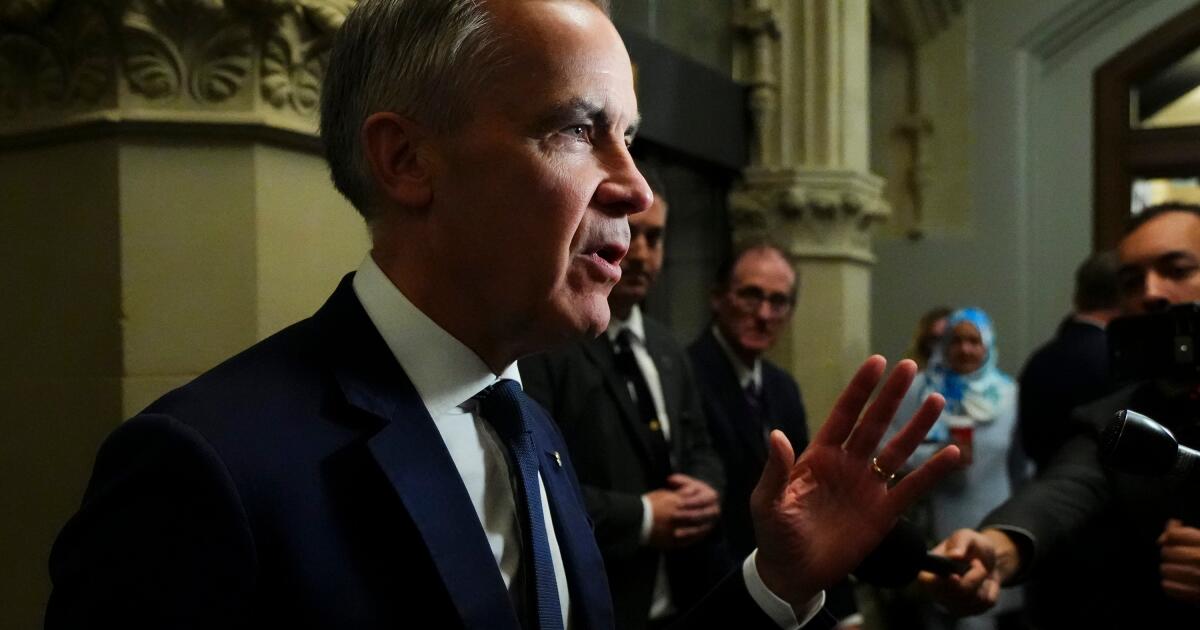
Canadian Prime Minister Mark Carney became a symbol of middle power resistance after a celebrated speech earlier this year, but he is expected to be more muted in his criticism of President Trump at an upcoming summit in Europe.

Carney’s speech at the World Economic Forum in Davos, Switzerland, helped make him an international political star in January, when he declared the global rules-based order over and condemned coercion by great powers on smaller countries. The prime minister received widespread praise and attention for his remarks and upstaged Trump at the gathering.

But the G7 summit of industrialized democracies that begins Monday in France comes ahead of the scheduled July 1 review of the United States-Mexico-Canada Agreement, or USMCA, the latest iteration of the North American free-trade pact that has intertwined the economies of the United States, Mexico and Canada since the early 1990s. It is a crucial moment in trade talks, and Trump said this week that he may not renew the deal.

More than 70% of Canada’s exports go to the U.S., so preserving the accord is critical for Canada.

Canadian historian Robert Bothwell said Trump is more of a problem for Carney “than anybody else because we are more exposed to the United States than anybody else.”

Trump leaves for the G7 summit right after he hosts UFC fights at the White House on Sunday for his 80th birthday.

The summit will unfold as tensions are ramping up between Trump and Canada. One of the world’s most durable and amicable alliances — born of geography, heritage and centuries of common interests — is broken, as seen in several recent examples of tension between leaders.

Ontario Premier Doug Ford, the leader of Canada’s most populous province, had a reception with the U.S. Chamber of Commerce in Washington canceled Monday at the last minute. Vic Fedeli, one of Ford’s ministers, said if Trump forced the chamber to cancel, “Ford should be wearing that as a badge of honor.”

Trump said again this week that the U.S. doesn’t need anything that Canada has. Carney has set a goal for Canada to double its non-U.S. exports in the next decade, saying Trump’s trade war is causing a chill in investment.

In other developments, the opening of a major Canadian bridge across the Detroit River that Trump previously threatened to block was delayed Thursday due to unresolved issues.

Trump’s actions, including launching a trade war and suggesting Canada become the 51st U.S. state, have infuriated Canadians and created the political environment for Carney to win the job of prime minister after promising to confront Trump.

Trump administration officials keep noting that only two countries, China and Canada, retaliated against America in the trade war. U.S. Trade Representative Jamieson Greer says Canada’s retaliatory measures are a major issue in talks.

Daniel Béland, a political science professor at McGill University in Montreal, said Carney seems to have moderated his tone toward the Trump administration to avoid worsening relations.

“There is a clear tension between what Prime Minister Carney said in his Davos speech about middle powers standing up to hegemons and his attempt to nudge the U.S. administration ‘in the right direction’ with regard to the USMCA review and trade policy more generally,” Béland said.

Carney has downplayed Trump’s most recent comments about Canada becoming the 51st state.

Canada and Mexico want the USMCA to be renewed for another 16 years. Trump has mused about withdrawing from it. More likely it will be subject to annual reviews for the next 10 years.

Carney arrived in Paris on Friday morning and will meet with French President Emmanuel Macron in the evening, a few days before the summit in Évian-les-Bains, France.

The prime minister will also travel to Ireland this weekend to meet with the Irish prime minister in a bid to diversify trade away from the U.S.

This is Carney’s ninth trip to Europe in the 15 months since he became prime minister in March 2025.

The U.S. “will clearly remain Canada’s largest trading partner for the predictable future,” Béland said, calling it an inescapable reality that Carney “must keep front of mind even as he seeks to make Canada somewhat less dependent on trade with the U.S.”

Gillies writes for the Associated Press.

Source link

Macron once had a knack for managing Trump. The G7 may test it

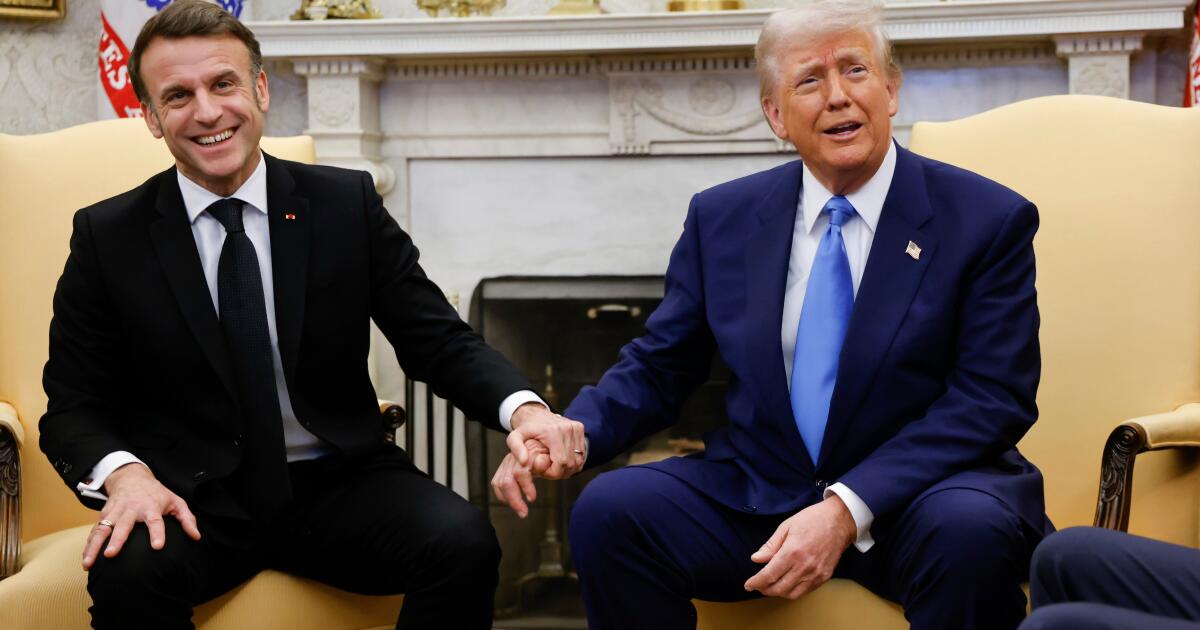
The relationship between President Trump and French President Emmanuel Macron started simply enough, with a handshake, nearly a decade ago.

But even then, there were signs of strain in their relationship — tensions that could be on full display during next week’s G7 summit in France.

Back in 2017, Trump was a brash businessman just elected to America’s most powerful office, and Macron was an upstart politician who had won his race in a landslide. At a NATO summit in Brussels, they clinched hands far longer than most people do when they meet for the first time. Neither seemed to want to be the first to break a grip so tight that it exposed white knuckles.

Nevertheless, a friendship was born. And early on, Macron seemed to be the one European leader with a knack for managing his mercurial, three-decades-older counterpart.

Macron invited the Republican president to join him for Bastille Day celebrations in July 2017, including an Eiffel Tower dinner date with their wives. Trump reciprocated by making Macron the guest of honor the following year at his first White House state dinner, the highest diplomatic honor the United States can extend to an ally.

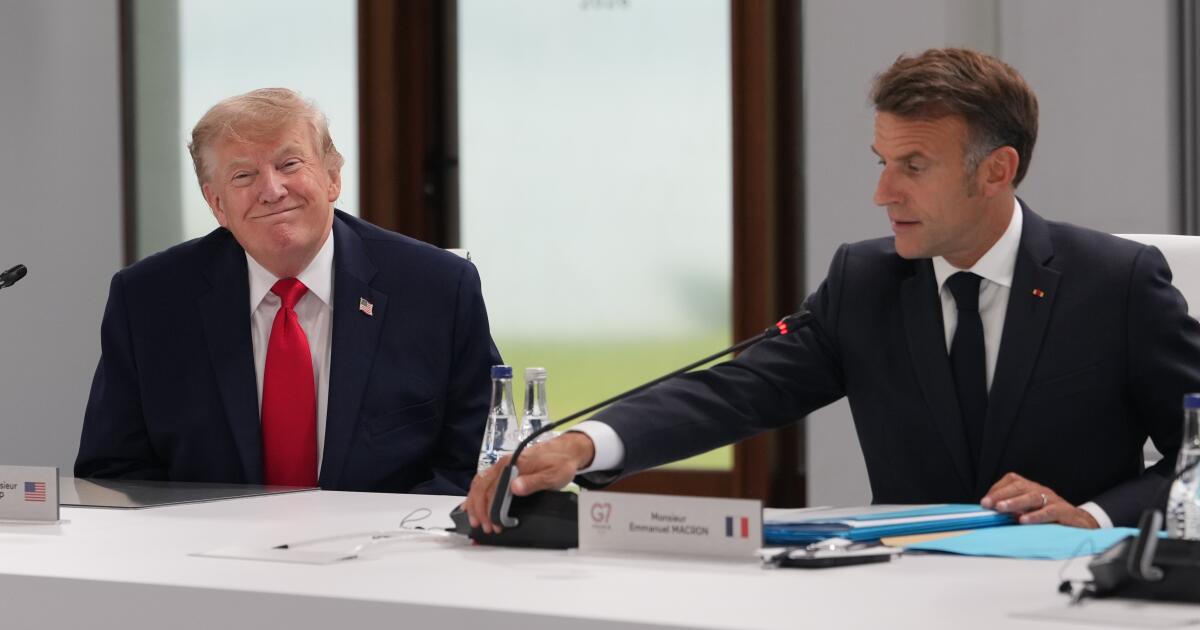
But by the end of Trump’s first term, the bromance had faded. And in his second term, the leaders now openly trade barbs, disagreeing over tariffs, Ukraine and the Iran war. That dynamic will be scrutinized next week when Trump and the leaders of Britain, Canada, Germany, Italy and Japan join Macron in the French lakeside resort of Evian-les-Bains for the G7 summit.

Trump’s long-simmering frustrations with US allies could be on display

There could be awkward moments between Trump and Macron, as well as among Trump and the other G7 leaders he’s criticized for not joining him in Iran.

“But I also think European leaders are quite professionals when it comes to politics, and in some ways diplomacy at this point, and will maybe see it as an opportunity as well,” Max Bergmann, director of the Europe, Russia, and Eurasia Program at the Center for Strategic and International Studies, said in an interview.

Kurt Volker, a former U.S. ambassador to NATO, said the Trump-Macron relationship has been further complicated by the Iran war and Trump’s complaints “that Europeans weren’t helping, when they hadn’t been consulted, and their interests are very much affected by this.”

“I think that was a negative for Macron,” Volker said.

Trump joined Israel in a war against Iran over its nuclear program back in February without consulting other U.S. allies. He then complained publicly when European countries spurned his requests for their help.

Waning support for Ukraine in its war against Russia from the Trump administration “has really irritated the French,” Volker said. “They feel this is important and we’re not paying attention to it.” Macron invited Ukrainian President Volodymyr Zelenskyy to join the leaders’ discussions on Tuesday.

Macron is the G7 member who has dealt with Trump the longest

In Trump’s first term, Macron appeared confident that he could persuade and influence the U.S. leader, but the relationship increasingly has come to be defined by their disagreements.

Macron now says he is “careful” about Trump’s statements, suggesting he no longer takes them at face value. Their relationship remains cordial as each calls the other “my friend.” But the relationship has also experienced some ups and downs.

As president-elect, Trump attended the reopening of Notre Dame Cathedral in Paris in late 2024 at Macron’s invitation. After Trump began his second term in 2025, Macron was an early Oval Office visitor. The president wrote on social media that he was “delighted” to welcome Macron back to the White House and said the relationship with France has been “very special.”

But at one point during the meeting, the French president publicly corrected Trump after he wrongly suggested that Europe would recover the money it had provided to support Ukraine. With a smile, Macron touched Trump’s forearm and replied, “We provided real money.”

Macron also condemned as “brutal and unfounded” new tariffs that Trump slapped on steel, aluminum and a broader range of European imports in early 2025.

But there have also been some lighter moments mixed with the tensions.

A documentary aired last year on French television showed Macron telling Trump during a phone call that Zelenskyy had agreed to a U.S.-backed ceasefire proposal. Trump replied, “You’re the greatest.”

Macron has often said he can reach Trump directly whenever he needs to — and proved his point during last year’s U.N. General Assembly session in New York. After police officers blocked the French leader from crossing a street because traffic had been halted for Trump’s motorcade, Macron whipped out his cellphone and dialed the U.S. president.

“How are you?” Macron said. “Guess what? I’m waiting in the street because everything is frozen for you!”

‘This is not a show,’ Macron has said about Trump’s NATO ambiguity

Macron has argued that Trump’s “America first” policies bolstered his case for a stronger European defense capability that would lessen reliance on the United States.

In April of this year, as Trump sent mixed signals about Washington’s commitment to NATO after the start of the war in Iran, Macron delivered some of his sharpest criticism of the U.S. president.

“There is too much talk, and it’s going in all directions,” Macron said. “We all need stability, calm and a return to peace. This is not a show.”

“You have to be serious, and when you want to be serious, you don’t say the opposite every day of what you said the day before,” he said.

Trump, while mimicking a French accent, recently has taken to reenacting a conversation he says he had with Macron over drug prices and tariffs. Trump also poked Macron by telling a private luncheon in April that his wife, Brigitte Macron, treats her husband badly. The comments were in a video the White House had posted on its YouTube channel before blocking access.

Macron didn’t see any humor in Trump’s comments. “The remarks I heard were neither elegant nor appropriate,” he said. “They do not deserve a response.”

Still, Macron has tried to accommodate Trump’s schedule to ensure his presence at the summit in Evian-les-Bains, knowing that he has a record of leaving such gatherings early.

Macron originally had set Sunday, which is Trump’s 80th birthday, as the opening day of the summit, but he pushed the start back a day because Trump is celebrating the occasion with a UFC show staged on the White House grounds.

Superville and Corbet write for the Associated Press. Corbet reported from Paris.

Source link

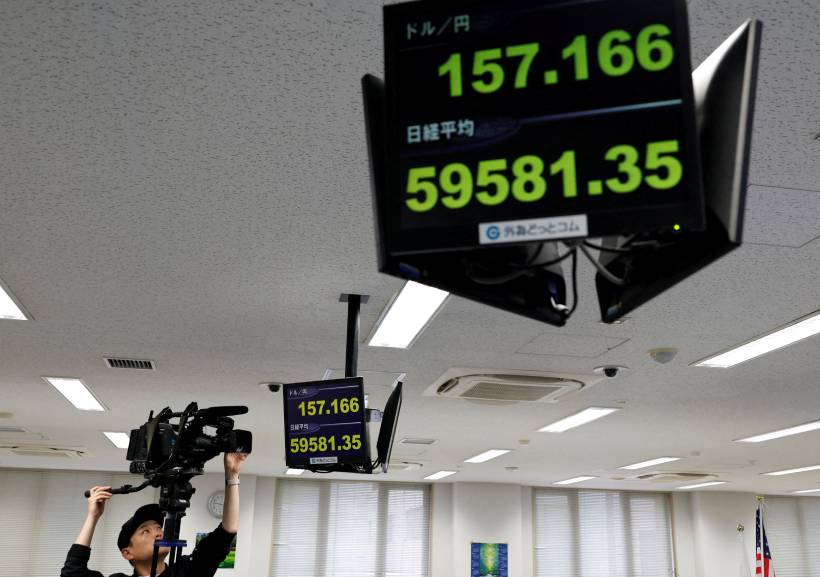
G7 Finance Chiefs Confront Bond Market Turmoil and Global Economic Imbalances

Finance ministers from the Group of Seven met in Paris to address rising global financial instability triggered by a bond market selloff and concerns over inflation linked to the ongoing conflict involving Iran.

The meeting comes at a time when global bond markets from Tokyo to New York are under pressure, as investors anticipate that higher energy prices could force central banks to maintain or increase interest rates.

Officials are also preparing for a broader discussion on structural global imbalances and coordination ahead of an upcoming G7 leaders summit.

Bond Market Pressure and Inflation Concerns

Bond yields have risen sharply across major economies as investors reassess inflation risks. Markets are increasingly focused on whether rising energy costs will translate into sustained price pressures that limit the ability of central banks to ease policy.

French officials have described the current situation as a correction rather than a crisis, though they acknowledge growing sensitivity around sovereign debt levels and fiscal sustainability.

The volatility has raised concerns particularly in highly debt sensitive economies such as Japan, where bond market movements are closely watched for spillover effects.

Diverging Views Within the G7

Despite the shared concerns, divisions remain among G7 members over how to respond to global economic instability.

European officials have emphasized the need for coordinated, temporary, and targeted responses to market shocks, while acknowledging that consensus with the United States may be difficult.

Some members argue that global economic imbalances are becoming structurally entrenched, with consumption and investment patterns increasingly misaligned across major economies.

Global Imbalances and Structural Concerns

A central focus of the discussions is the growing imbalance in global economic activity. European officials argue that long term trends show excessive consumption in some economies, under consumption in others, and insufficient investment in parts of Europe.

These structural disparities are seen as contributing to persistent trade tensions, capital flow imbalances, and financial market instability.

Officials warn that without coordinated policy responses, these imbalances could eventually lead to more severe market corrections.

Critical Minerals and Supply Chain Strategy

Another key agenda item is the global competition over critical minerals and rare earth supply chains, which are essential for electric vehicles, renewable energy systems, and defense technologies.

G7 members are exploring ways to reduce dependence on dominant suppliers, particularly China, through coordinated investment, joint procurement strategies, and diversification of supply chains.

Proposals under discussion include pooled purchasing mechanisms, market monitoring systems, and industrial policy coordination to strengthen supply security.

Analysis

The G7 meeting highlights a convergence of financial instability and geopolitical fragmentation. Rising bond yields and inflation fears are no longer isolated market issues but are now directly linked to geopolitical disruptions in energy supply and global trade routes.

At the same time, disagreements within the G7 reflect deeper structural tensions in the global economy, particularly around debt levels, consumption patterns, and industrial policy priorities.

Efforts to coordinate on critical minerals signal a shift toward more strategic economic alignment among advanced economies, where supply chain security is becoming as important as price stability.

Overall, the meeting underscores a global transition toward a more fragmented and politically driven financial system, where economic coordination is increasingly shaped by geopolitical risk rather than purely market based forces.

With information from Reuters.

Source link