fútbol

Mexico wins back fans, still faces familiar World Cup wall

After what may have been the most important game in the Mexican national team’s World Cup history, coach Javier Aguirre hugged each of his 26 players.

The embraces weren’t to celebrate a victory. They were hugs of gratitude, encouragement and, above all, resignation.

Minutes earlier, the players paraded around Azteca Stadium — traditionally an impenetrable fortress — to applaud El Tri fans with tears in their eyes. Mexico had just lost 3-2 to England, extinguishing the hope that it could parlay its World Cup co-host role into the deepest tournament run in the country’s history.

The goal was to advance to the quarterfinals for the first time since 1986 and, above all, to show the world that Mexican soccer finally had taken the leap that had been demanded for so long — defeating a past world champion, England, that hadn’t looked particularly dominant. But reality, once again, hit hard as the loss became Mexico’s eighth defeat in the round of 16 since 1994.

This time, Mexico had the support of its fans, playing on home soil. And it wasn’t enough.

“I’m satisfied with the work we’ve done, but when you lose — and I’ve lost a lot in my career — you never quite get over it,” Aguirre said. “It’s very painful because dreaming gives us hope; losing this way hurts a lot.”

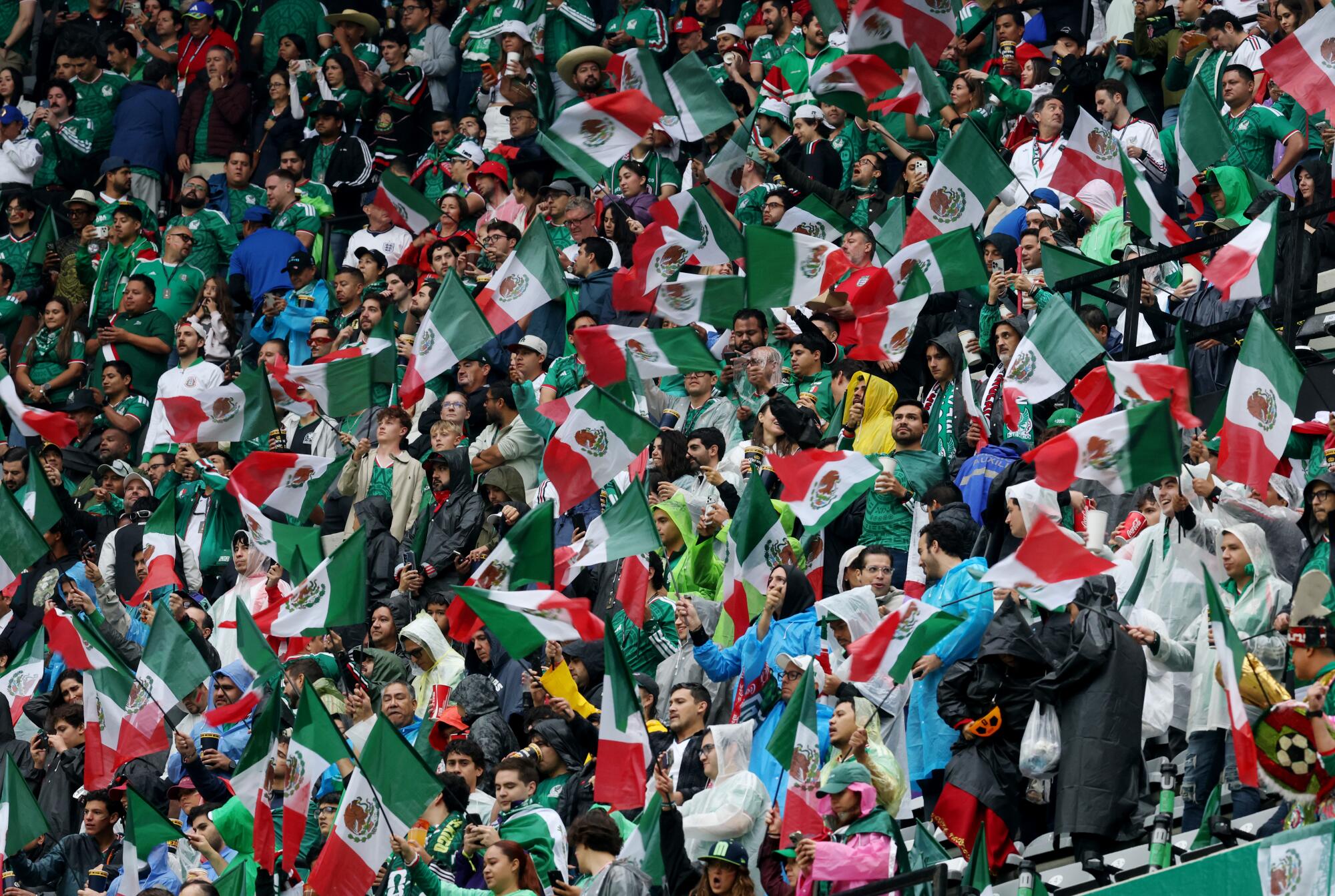
Mexico fans wave flags and show their support before their team faced England in a World Cup match at Azteca Stadium.

Mexico fans show their support before their team faced England in a Round of 16 World Cup match at Azteca Stadium on July 5.

(Richard Pelham / Getty Images)

After weeks of celebrations following wins over South Africa, South Korea, Czechia and Ecuador, Mexico failed the test against England, ranked fourth in the world. El Tri dominated possession but could not convert it into goals, while the English were clinical, led by Jude Bellingham, Harry Kane, Anthony Gordon, Bukayo Saka and goalkeeper Jordan Pickford.

For Aguirre, the loss reopened a familiar wound. In the 2002, Mexico lost 2-0 to a U.S. squad led by Landon Donovan in what many consider the most painful defeat in the country’s World Cup history. This defeat to England very well could rival it.

“I would have liked to win five games, to leave home with five victories. That hurts — it hurts a lot,” Aguirre said. “A loss is a loss. Our opponent didn’t make the same mistakes we did.”

Judging Aguirre solely on the end of this World Cup run would be simplistic given what he inherited. Two years ago, he was asked to lead the struggling team for the third time. When he arrived, Mexico was ranked 17th in the world and had not won the Nations League. He leaves with Mexico ranked in the top 10 and as Nations League champion and two-time defending Gold Cup champion.

This World Cup wasn’t the disaster that Qatar was four years ago, when Mexico was eliminated in the group stage. This summer, Mexico secured its first knockout-round victory since 1986, advanced to a fifth World Cup match for the second time and swept three games during the group stage without conceding a goal — something no other Mexican team achieved.

In 22 months at the helm — having taken over in 2024 following Jaime Lozano’s failure at the Copa América, where Mexico failed to advance past the group stage — Aguirre achieved something that went beyond the scoreboard by uniting players previously accused of having too much ego and preferring not to sacrifice to help the team.

At this World Cup, that squad gave its all — body and soul — and rebuilt a relationship with the fans that had seemed broken since the 2024 Copa América. Thousands of fans filled the Ángel de la Independencia, the Zócalo and other squares across the country, as well as watch parties in cities like Los Angeles.

“We managed to restore the pride of being part of the national team — for the national anthem and for its people. It’s a privilege to be here, and they know it,” Aguirre said of his players. “I think we’ve returned to a Mexican identity.”

Green jerseys were seen all over Mexico as people set aside their differences to cheer on El Tri.

“Mexico was the best host of the three. It had the best atmosphere — it’s a country that truly loves soccer,” Mexico City native Santiago Mondragón said before the England match.

Mexico had standout and inspired performances from Erik Lira, Gilberto Mora and Roberto Alvarado, but its lineup struggled to keep pace with English players trained at elite European clubs.

Mora, just 17 years old and with tremendous potential, made a mistake on the play leading to England’s second goal. Alvarado, who provided strong passes to Raúl Jiménez and was solid in defense throughout the tournament, lost track of Bellingham on the first goal. Raúl Rangel, who was outstanding against South Korea and who three years ago was playing for Tapatío in the Mexican expansion league, stepped too far forward on the penalty kick that sealed the match, minutes after an English player was sent off in the second half. Edson Álvarez, who did not have a good season with Turkey’s Fenerbahce because of an injury, received little playing time and made a serious mistake marking Kane, which led to Gordon’s breakaway on the play that resulted in the penalty kick.

Mexico's Raúl Jiménez gets tangled with England's Ezri Konsa while going for the ball during a World Cup match.

Mexico’s Raúl Jiménez gets tangled with England’s Ezri Konsa while going for the ball during a World Cup Round of 16 match at Azteca Stadium on July 5.

(Francois Nel / Getty Images)

Following the loss, many in Mexico still are wondering why, despite having a one-man advantage for 36 minutes —plus 11 minutes of stoppage time — the team was unable to tie England. Aguirre replaced Mora and goal-scorer Julián Quiñones, bringing on an attacking lineup that focused on sending in crosses, which the English defense easily cleared.

While it’s possible a few changes could have shifted the match in Mexico’s favor, there were limits to how much the technical staff could get out of the roster.

El Tri lacks sufficient depth to assemble a truly competitive 26-man roster, as players such as Álvarez and Santiago Giménez didn’t arrive at their best form, and players such as Brian Gutiérrez weren’t ready for the pressure of a tournament of this magnitude, in need of more time to develop.

Mexico lacked game-changing players capable of breaking down tight defenses — the role Hirving Lozano played in 2018 or Giovani Dos Santos in 2014. The lack of creativity that showed against Saudi Arabia in 2022 flared up late against England.

Thanks to Jiménez and Quiñones, the team did show firepower, scoring 10 goals in five matches, but it lacked depth to break down a well-organized English defense.

The talent pool has been hindered by the Mexico club system.

Mexico's Julián Quiñones is tossed in the air by teammates as they celebrate a Round of 32 World Cup win over Ecuador.

Mexico’s Julián Quiñones is tossed in the air by teammates as they celebrate a Round of 32 World Cup win over Ecuador at Azteca Stadium on June 30.

(Kevin C. Cox / Getty Images)

Liga MX owners maintain a narrow view of domestic soccer, prioritizing foreign signings over the development of local players and promotion and relegation remain abolished — removing competitive pressure that is the backbone of English leagues.

Top Mexican players continue to be overvalued by their home clubs, which makes it difficult for European clubs to sign them when there are cheaper options with more impressive résumés.

“This was the opportunity; that’s why it’s frustrating, that’s why it’s sad,” Mexican journalist Javier Alarcón said of El Tri’s World Cup exit. “With the Mexican federation and its owners, there isn’t much hope.”

Rafael Márquez, a former FC Barcelona star and one of the greatest players in Mexican national team history, is succeeding Aguirre after serving as one of his assistant coaches. Márquez has formed a close bond with players, who tossed the 47-year-old former defender in the air after one of their World Cup wins, and is familiar with all the reasons Mexico continues to hit the same World Cup wall.

“Rafa is a great guy, a great coach,” said Aguirre, who noted that the team’s average age has dropped and that more and more players are playing in Europe. “Hopefully he can do better than we were able to.”
Source link

In must-win match against Ecuador, Mexico looks to advance

Mexico advances to the second round of the World Cup backed by its strong record in the group stage and a formidable fortress — Azteca Stadium — where it will host Ecuador on Tuesday at 6 p.m. PDT in a knockout match airing on Fox and Telemundo.

El Tri became the first Mexican team to win all three of its group stage matches at a World Cup — a perfect finish accompanied by fan support rarely seen before, with more than 80,000 packing Azteca Stadium for two of its games and more than 800,000 surrounding El Ángel de la Independencia statue to celebrate wins.

Coach Javier Aguirre’s third stint leading the national team, which began in 2024 amid skepticism, has sparked World Cup fever in the streets of Mexico City, which have filled with fans wearing green jerseys, along with their dogs, cats and even ducks decked out in the national team colors.

“We’re motivated, but nothing is decided yet,” Mexico forward Armando González said. “Earning points is useless because now comes the important part — do-or-die matches. We’re focused on that.”

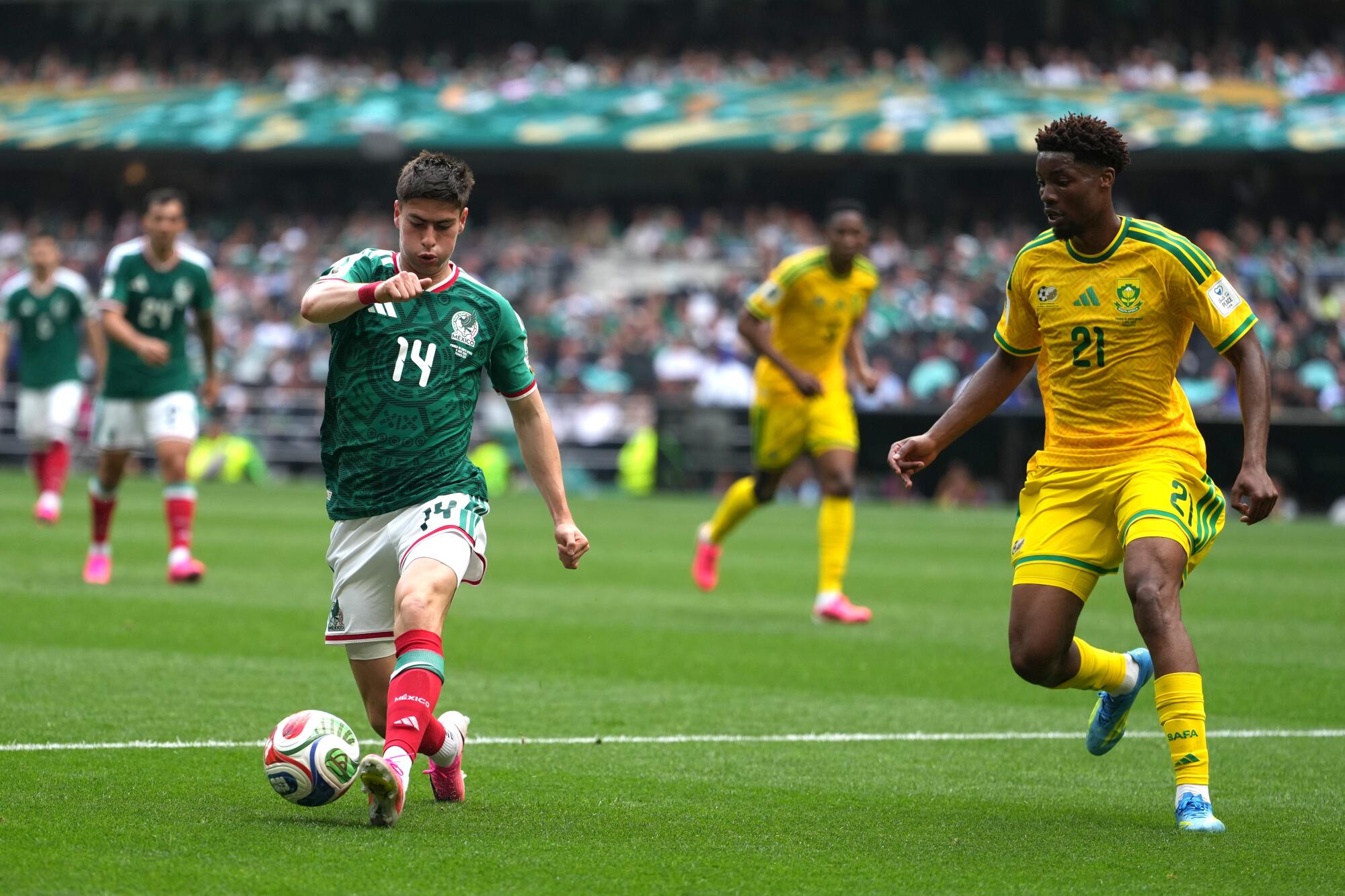
Mexico's Armando González controls the ball in front of South Africa's Ime Okon during on a World Cup match on June 11.

Mexico’s Armando González controls the ball in front of South Africa’s Ime Okon during on a World Cup match on June 11 at Azteca Stadium.

(Eduardo Verdugo / Ap Photo/eduardo Verdugo)

The winner of the match will face the winner of the contest between England and Congo on July 5 at Azteca Stadium.

Mexico has also been solid on defense, keeping three clean sheets while scoring six goals.

“We respect all our opponents,” said Mexico defender Jesús Gallardo, who sat out the last group stage match against Czechia. “We know this is the World Cup and every team is playing to win. We’ve won our three matches, and we’re proud of that. But we haven’t won anything yet. Ecuador has played well. We know they’re a very dynamic, very strong team.”

Erik Lira, Raúl Jiménez and Brian Gutiérrez will join Gallardo returning to the lineup after sitting out Mexico’s last match. Gutiérrez had a yellow card and was held out against Czechia to avoid a second yellow card and suspension. Gilberto Mora, 17, started in place of Gutiérrez and had a tremendous performance.

“We have to focus on what we do on the field; we want the fans to cheer us on,” Gallardo said. “We want to bring them a lot of joy.”

Following the convincing 3-0 victory over Czechia while resting some starters, the atmosphere on the Mexican team has been very relaxed, with several videos showing the players joking around with each other. Some of them have been training together for nearly two months because Aguirre arranged a monthlong training camp ahead of the World Cup.

“That’s why these past few months have gone by so quickly. Even though they’re always joking around, we know that we have a brother right beside us who would give his life for us,” González said.

On the other side, Ecuador arrives after advancing as one of the best third-place finishers, having closing Group E competition with four points — a stark contrast to its performance in the South American qualifiers, where Ecuador finished second only to world champion Argentina.

At the World Cup, Ecuador began the tournament with a tough last-minute loss to Ivory Coast and then failed to score against debutant Curacao. But when Ecuador had its back against the wall and needed to beat Germany in the final group-stage match, it pulled off a stunning upset, defeating the German team 2-1 to secure its spot in the next round.

That inconsistency makes Ecuador a wild card.

Mexico's Luis Romo celebrates with Jesus Gallardo, Erik Lira and Johan Vasquez after scoring against South Korea.

Mexico’s Luis Romo celebrates with Jesus Gallardo, Erik Lira and Johan Vasquez after scoring against South Korea during a World Cup match at Guadalajara Stadium on June 18.

(Silvia Izquierdo / Ap Photo/silvia Izquierdo)

“That’s what life is all about — having faith, having confidence. The team is very united,” said Sebastián Beccacece, Ecuador’s Argentine coach. “We’ve always remained calm and cautious in the face of adversity.

“The team is united, obviously full of enthusiasm and energy — like all national teams — but also tired, especially due to the schedule. Still, that’s no excuse. We’re driven by enthusiasm and the desire to make history; we’ll build our efforts on these foundations.”

Ecuador has also had to move quickly to plan for the match against Mexico. Following Thursday’s victory, Ecuador didn’t know it would be facing Mexico until Saturday morning. The team tried to travel to Mexico City on Sunday, but it ran into logistical problems and had to do so on Monday.

“Traveling to the Azteca Stadium is going to be a bit of a challenge,” Agustín Delgado, the all-time leading scorer for the Ecuadorian national team, said in an interview with Claro Sports. “That ultimately takes its toll in a match of this magnitude.

“This generation has what it takes for this World Cup and another one after that. They’re very young players. They haven’t reached their full potential yet; they have a lot to give.”

Unlike the game against Czechia, altitude won’t be as big a factor, since the Ecuadorian national team plays its home games in Quito, which sits at an elevation of 9,350 feet — making it the second-highest capital city in the world and more than 2,000 feet higher than Mexico City. It also has players who compete for clubs accustomed to playing at Mexican altitudes, such as Pedro Vite of Pumas and Enner Valencia of Pachuca.

Ecuador boasts proven talent such as Moisés Caicedo of Chelsea in England; William Pacho of Paris Saint-Germain in France; Piero Hincapié of Arsenal; and Joel Ordóñez of Club Brugge in Belgium.

“It’s a close match; there are star players on both teams,” said Álex Aguinaga, a former Ecuadorian player and Liga MX legend who is now a commentator for Fox Sports. “Ecuador’s defense is much more solid; it has players who handle the defensive zone very well.

Mexico fans cheer during a World Cup game against Czechia at Azteca Stadium on June 24.

Mexico fans cheer during a World Cup game against Czechia at Azteca Stadium on June 24.

(Alex Slitz / Getty Images)

“It’s so close, but I think it’s going to come down to a single goal.”

Ecuador will also try to capitalize on the pressure stemming from the fact that Mexico has won only one match in its entire history in knockout rounds — in 1986 when it played at home against Bulgaria and won 2-0. Between 1994 and 2018, Mexico was eliminated in the second round of the World Cup on each of the last seven occasions it reached that stage.

Mexico has never lost a match at Azteca Stadium in a World Cup, and its last defeat in an official match was against Honduras in a qualifying match in 2013.

“I think right now all the opponents are going to be tough; none of them will be easy,” said Obed Vargas, an Atlético Madrid player who has come off the bench for Mexico. “We’re taking it one game at a time, but for me, we have to make it to the final.”

Source link

Boyle Heights exhibit criticizes FIFA, reminds fans of fútbol community

As soccer fans await the FIFA World Cup kickoff Thursday — and as criticism of the organization’s ticketing practices and social impact on local communities circulates across North America, where the games will be held — longtime aficionados want to remind the sports community of the real beauty beneath the game.

Last Friday at Espacio 1839 in Boyle Heights, visitors were greeted by the thumping bass of cumbia sonideras, earthy scent of leather trinkets and clothing racks featuring silky screen-printed soccer jerseys. The Latino-centric gift shop reached maximum capacity with a new pop-up art exhibit titled “El Fútbol Es del Pueblo,” featuring over 30 artworks that provide commentary on the global sport.

“It’s reclaiming the sport again, reminding folks that the essence of the game belongs to the people,” said Nico Aviña, owner of Espacio 1839. “With everything that’s going on with the World Cup, everybody’s giving FIFA credit, but I think that we need to reclaim that power. This is a people’s sport and it belongs to us.”

Los Angeles, CA., June 5, 2026. - Nico Avina.

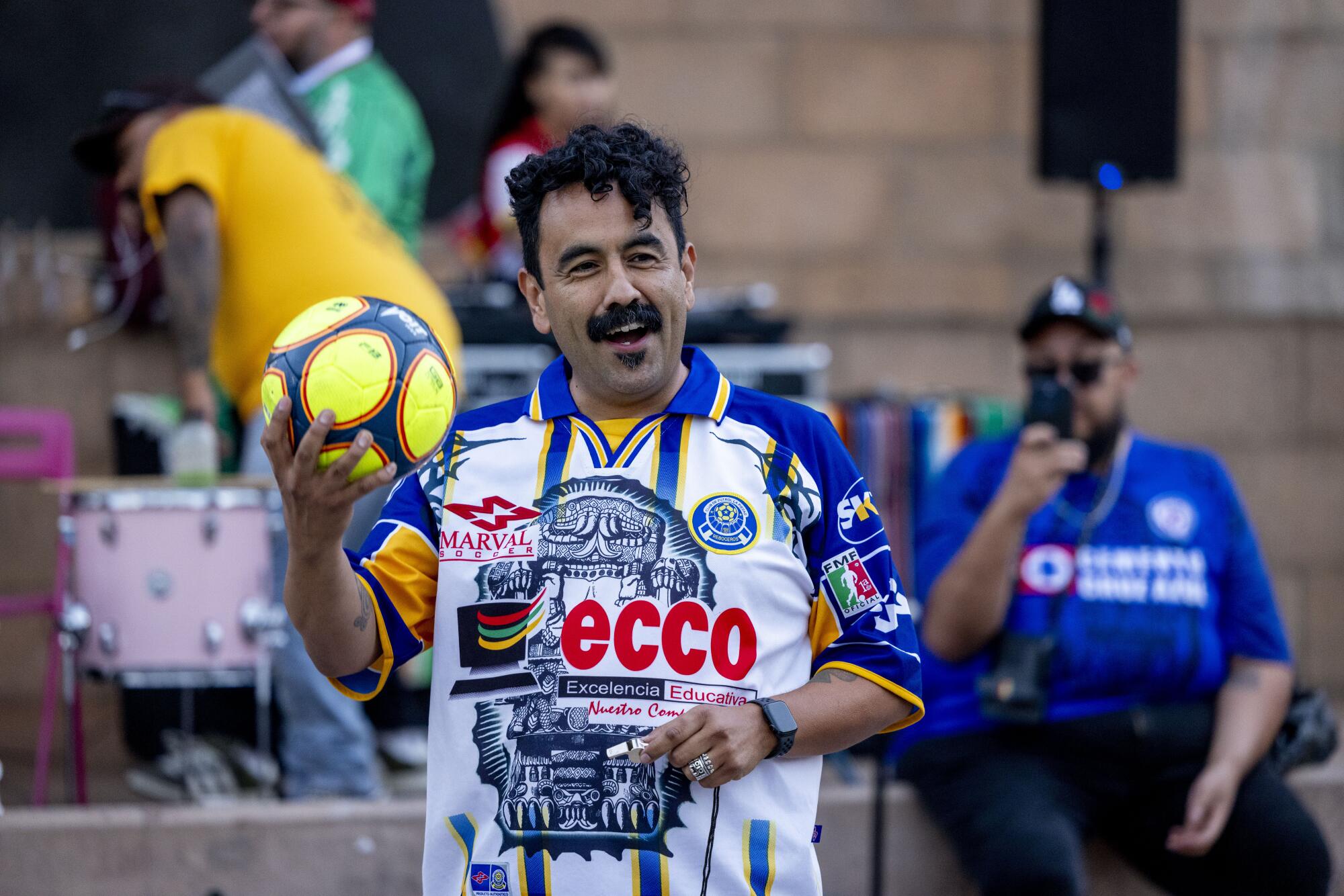
Nico Avina gets ready to start a soccer match at Mariachi Plaza at “El Futbol es del Pueblo,” a community soccer event hosted by Espacio 1839.

(Jill Connelly/For De Los)

Every four years, soccer fans around the globe go berserk over the World Cup, but in host cities like Los Angeles, the worldwide spectacle feels bittersweet and financially out of reach. Fans have paid thousands of dollars for non-premium seating at SoFi Stadium; this does not include parking, which is estimated to be about $250 near the venue.

“ I’m not interested in going into those games or paying these ridiculous amounts,” said Aviña. “It’s more about greed. It’s more about wealth extraction than anything else.”

That sentiment resonated with 42-year-old Antonio Rivera, a Bay Area local who recalled the excitement he felt as a child in Jalisco watching the 1986 World Cup, which Mexico hosted. He remembers his little toy bank shaped like Pique, the anthropomorphic jalapeño pepper that was Mexico’s tournament mascot.

“You hear stories of people going to the World Cup with their whole family.  Now you can’t even get a ticket,” he said. “ It’s an important opportunity for people to talk about some of the discomforts that they may have with  an organization like FIFA.”

Rivera was at Espacio 1839 on Friday accompanying his son, Marc Rivera, one of the youngest exhibitors, alongside his classmate Miguel Yanez. The tweens came down from Napa, Calif., to showcase their acrylic comic-strip painting featuring Mexican soccer player Alexis Vega, who channels his Mesoamerican ancestors when scoring the victory goal.

Los Angeles, CA., June 5, 2026. - Marc Rivera explains the meaning behind his painting.

Marc Rivera explains the meaning behind his painting on display at “El Futbol es del Pueblo.”

(Jill Connelly/For De Los)

“It’s important to expose our next generation and give them an opportunity to express themselves a little bit,” Antonio Rivera said.

Tijuana artist Vianney Harelly’s piece was hard to miss on the wall. It featured a bloody cross with the Spanish words for “soccer comes with blood and tears.” It also included headlines from articles regarding the Naupan artisans who were allegedly underpaid by Adidas and social-impact brand Someone Somewhere, during its work on the latest embroidered Mexican soccer kit.

“I wanted it to be a piece showing kind of the dark side of the World Cup, because there’s so many things that are buried underneath the whole spectacle,” Harelly said.

The 30-year-old said they are not interested in tuning into the World Cup activities because of the close relationship between FIFA President Gianni Infantino and President Trump. Human rights organizations have called on the FIFA leader to request that the Trump administration declare a moratorium on ICE raids during the soccer tournament; SoFi stadium workers threatened to strike if agents aren’t kept out of the venue.

Los Angeles, CA., June 5, 2026. - Artwork on display at "El Futbol es del Pueblo."

Artwork on display at “El Futbol es del Pueblo.”

(Jill Connelly/For De Los)

“I know people want to be seen and celebrated and they wanna feel love,” Harelly said. “But I don’t want them to settle and think that the only option for them to feel love and be seen is through corporations that hate us.”

Gerardo Gómez looked mesmerized as he glanced at the wall. Some of his favorite pieces included a scarf that read “Siempre Antifascista” and a banner that featured a masked Indigenous soccer player with the words “Futbol Libertad.”

“I think a lot of us here love the sport, but we are against FIFA,” Gómez said. “What you’re seeing here is a representation of the people’s struggle that comes with the sport.”

The 46-year-old said the soccer organization, as well as the Olympic Games, have a history of displacing marginalized communities; for example, ahead of the 2014 World Cup and 2016 Olympic Games in Brazil, at least 19,000 families were displaced to make way for sporting infrastructure.

That’s why he’d rather put his focus on the Homeless World Cup, an annual international street football tournament that advocates an end to homelessness globally. Players are individuals who have experienced some form of homelessness or social exclusion in their life.

“People that came together [for the Homeless World Cup] recognized that soccer brings people together,” said Gómez. “And it’s the most beautiful thing I have experienced.”

Los Angeles, CA., June 5, 2026. - A soccer match at Mariachi Plaza at "El Futbol es del Pueblo."

A soccer match at Mariachi Plaza on June 5, 2026.

(Jill Connelly/For De Los)

As the sun went down, the crowd shifted over a block to Mariachi Plaza where a 3-vs.-3 cascarita, or scrimmage, began on the pavement. Onlookers gathered around the makeshift field, which had no clear outer bounds, as the pulsating drumming and anti-ICE chants led by Lxs Tigres del NorthEnd (an independent LAFC supporter group) filled the air.

“It’s very bittersweet,” said 30-year-old Claudia Llontop. “With families being deported.”

Llontop, who grew up watching the World Cup, arrived at the pick-up match with her two children — and even documented her journey getting there on TikTok to her more than 50,000 followers. She had been trying to find ways to kick a ball around when she heard about “El Fútbol Es del Pueblo,” which allowed her to put on a red mesh jersey and run like the wind.

“This is for single moms, this is for kids, this is for high schoolers,” said Llontop. “ I think this alone is a lot more powerful than FIFA, because this is us.”


Source link