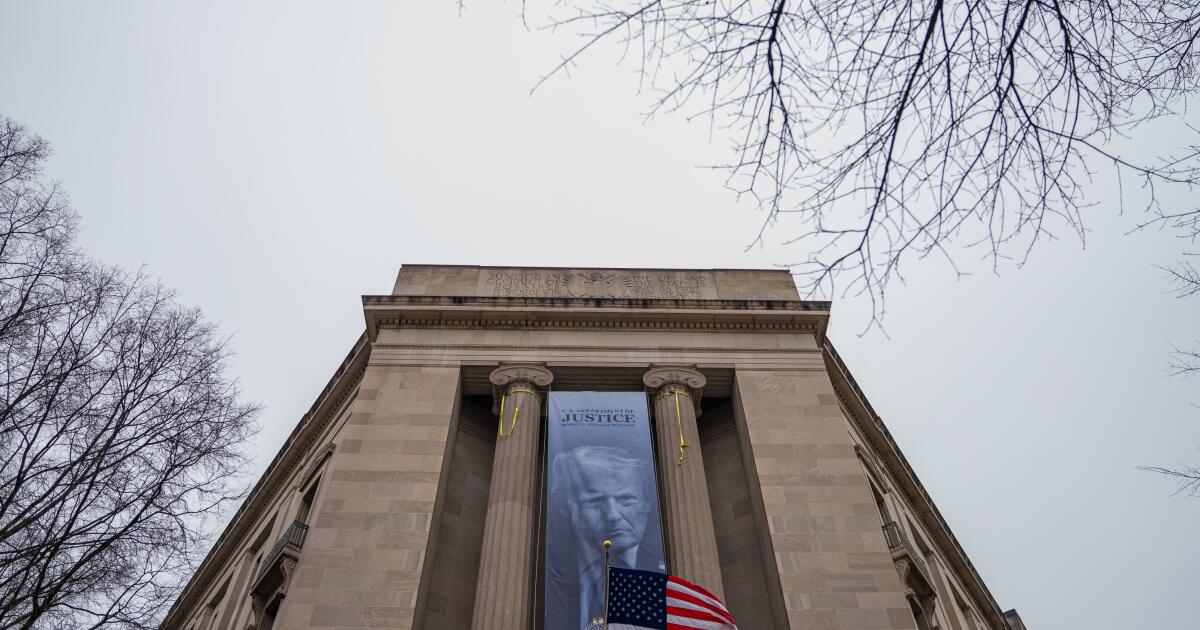
fulton county

How California is preparing to fend off federal interference in 2026 election

In recent weeks, Marin County Registrar Natalie Adona has been largely focused on the many mundane tasks of local elections administrators in the months before a midterm: finalizing voting locations, ordering supplies, facilitating candidate filings.

But in the wake of unprecedented efforts by the Trump administration to intervene in state-run elections, Adona said she has also been preparing her staff for far less ordinary scenarios — such as federal officials showing up and demanding ballots, as they recently did in Georgia, or immigration agents staging around polling stations on election day, as some in President Trump’s orbit have suggested.

“Part of my job is making sure that the plans are developed and then tested and then socialized with the staff so if those situations were to ever come up, we would not be figuring it out right then and there. We would know what to do,” Adona said. “Doing those sort of exercises and that level of planning in a way is kind of grounding, and makes things feel less chaotic.”

A woman with long black hair, black T-shirt and a shawl poses against a wall framed by shadows.

Natalie Adona faced harassment from election deniers and COVID anti-maskers when she served as the registrar of voters in Nevada County. She now serves Marin County and is preparing her staff for potential scenarios this upcoming election, including what to do if immigration agents are present.

(Jess Lynn Goss / For The Times)

Across California, local elections administrators say they have been running similar exercises to prepare for once unthinkable threats — not from local rabble-rousers, remote cyberattackers or foreign adversaries, but their own federal government.

State officials, too, are writing new contingency plans for unprecedented intrusions by Trump and other administration officials, who in recent days have repeated baseless 2020 election conspiracies, raided and taken ballots from a local election center in Fulton County, Ga., pushed both litigation and legislation that would radically alter local voting rules, and called for Republicans to seize control of elections nationwide.

California’s local and state officials — many of whom are Democrats — are walking a fine line, telling their constituents that elections remain fair and safe, but also that Trump’s talk of federal intervention must be taken seriously.

Their concerns are vastly different than the concerns voiced by Trump and other Republicans, who for years have alleged without evidence that U.S. elections are compromised by widespread fraud involving noncitizen voters, including in California.

But they have nonetheless added to a long-simmering sense of fear and doubt among voters — who this year have the potential to radically alter the nation’s political trajectory by flipping control of Congress to Democrats.

An election worker moves ballots to be sorted.

An election worker moves ballots to be sorted at the Orange County Registrar of Voters in Santa Ana on Nov. 5, 2024.

(Allen J. Schaben / Los Angeles Times)

Trump has said he will accept Republican losses only if the elections are “honest.” A White House spokesperson said Trump is pushing for stricter rules for voting and voter registration because he “cares deeply about the safety and security of our elections.”

Rick Hasen, an election law expert and director of the Safeguarding Democracy Project at UCLA Law, said some of what Trump says about elections “is nonsensical and some is bluster,” but recent actions — especially the election center raid in Georgia — have brought home the reality of his threats.

“Some worry that this is a test run for trying to seize ballot boxes in 2026 and prevent a fair count of the votes, and given Trump’s track record, I don’t think that is something we can dismiss out of hand,” Hasen said. “States need to be making contingency plans to make sure that those kinds of things don’t happen.”

The White House dismissed such concerns, pointing to isolated incidents of noncitizens being charged with illegally voting, and to examples of duplicate registrations, voters remaining on rolls after death and people stealing ballots to vote multiple times.

“These so-called experts are ignoring the plentiful examples of noncitizens charged with voter fraud and of ineligible voters on voter rolls,” said Abigail Jackson, the White House spokesperson.

Experts said fraudulent votes are rare, most registration and roll issues do not translate into fraudulent votes being cast, and there is no evidence such issues swing elections.

A swirl of activity

Early in his term, Trump issued an executive order calling for voters nationwide to be required to show proof of U.S. citizenship, and for states to be required to disregard mail ballots received after election day. California and other states sued, and courts have so far blocked the order.

This past week, Trump said outright that Republicans should “take over” elections nationwide.

The Justice Department has sued California Secretary of State Shirley Weber and her counterparts in other states for refusing to hand over state voter rolls — the lawsuit against Weber was tossed — and raided and seized ballots from the election office of Fulton County, long a target of right-wing conspiracy theories over Trump’s 2020 election loss.

President Trump walks behind former chairperson of the Republican National Committee Michael Whatley.

President Trump walks behind former chairperson of the Republican National Committee Michael Whatley as he prepares to speak during a political rally in Rocky Mount, N.C., on Dec. 19.

(Andrew Caballero-Reynolds / AFP via Getty Images)

Longtime Trump advisor and ally Stephen K. Bannon suggested U.S. Immigration and Customs Enforcement agents will be dispatched to polling locations in November, reprising old fears about voter intimidation. White House Press Secretary Karoline Leavitt said she couldn’t rule that out, despite it being illegal.

Democrats have raised concerns about the U.S. Postal Service mishandling mail ballots in the upcoming elections, following rule changes for how such mail is processed. Republicans have continued pushing the SAVE America Act, which would create new proof of citizenship requirements for voters. The U.S. Supreme Court is considering multiple voting rights cases, including one out of Louisiana that challenges Voting Rights Act protections for Black representation.

Charles H. Stewart, director of the MIT Election Data + Science Lab, said the series of events has created an “environment where chaos is being threatened,” and where “people who are concerned about the state of democracy are alarmed and very concerned,” and rightfully so.

But he said there are also “a number of guardrails” in place — what he called “the kind of mundane mechanics that are involved in running elections” — that will help prevent harm.

California prepares

California leaders have been vociferous in their defense of state elections, and said they’re prepared to fight any attempted takeover.

“The President regularly spews outright lies when it comes to elections in this country, particularly ones he and his party lose,” Gov. Gavin Newsom said in a statement. “We will continue to correct those lies, rebuild much-needed trust in our democratic institutions and civic duties, and defend the U.S. Constitution’s grant to the states authority over elections.”

California Atty. Gen. Rob Bonta and Secretary of State Shirley Weber.

California Atty. Gen. Rob Bonta and Secretary of State Shirley Weber take questions after announcing a lawsuit to protect voter rights in 2024.

(Damian Dovarganes / Associated Press)

California Atty. Gen. Rob Bonta said in an interview that his office “would go into court and we would get a restraining order within hours” if the Trump administration tries to intervene in California elections, “because the U.S. Constitution says that states predominantly determine the time, place and manner of elections, not the president.”

Weber told The Times that the state has “a cadre of attorneys” standing by to defend its election system, but also “absolutely amazing” county elections officials who “take their job very seriously” and serve as the first line of defense against any disruptions, from the Trump administration or otherwise.

Dean Logan, Los Angeles County’s chief elections official, said his office has been doing “contingency planning and tabletop exercises” for traditional disruptions, such as wildfires and earthquakes, and novel ones, such as federal immigration agents massing near voting locations and last-minute policy changes by the U.S. Postal Service or the courts.

“Those are the things that keep us up at night,” he said.

Los Angeles County Registrar-Recorder Dean Logan said the county no longer has ballots from the 2020 election.

Los Angeles County Registrar-Recorder Dean Logan said the county no longer has ballots from the 2020 election.

(Irfan Khan / Los Angeles Times)

Logan said he is not currently concerned about the FBI raiding L.A. County elections offices because, while Fulton County still had its 2020 ballots on hand due to ongoing litigation, that is not the case for L.A. County, which is “beyond the retention period” for holding, and no longer has, its 2020 ballots.

However, Logan said he does consider what happened in Georgia a warning that the Trump administration “will utilize the federal government to go in and be disruptive in an elections operation.”

“What we don’t know is, would they do that during the conduct of an election, before an election is certified?” Logan said.

Kristin Connelly, chief elections officer for Contra Costa County, said she’s been working hard to make sure voters have confidence in the election process, including by giving speeches to concerned voters, expanding the county’s certified election observer program, and, in the lead-up to the 2024 election, running a grant-funded awareness campaign around election security.

Connelly — who joined local elections officials nationwide in challenging Trump’s executive order on elections in court — said she also has been running tabletop exercises and coordinating with local law enforcement, all with the goal of ensuring her constituents can vote.

“How the federal government is behaving is different from how it used to behave, but at the end of the day, what we have to do is run a mistake-free, perfect election, and to open our offices and operation to everybody — especially the people who ask hard questions,” she said.

Lessons from the past

Several officials in California said that as they prepare, they have been buoyed by lessons from the past.

Before being hired by the deep-blue county of Marin in May, Adona was the elected voting chief in rural Nevada County in the Sierra foothills.

In 2022, Adona affirmed that Trump’s 2020 election loss to Democrat Joe Biden was legitimate and enforced a pandemic mask mandate in her office. That enraged a coalition of anti-mask, anti-vaccine, pro-Trump protesters, who pushed their way into the locked election office.

Protesters confronted Adona and her staffers, with one worker getting pushed down. They stationed themselves in the hallway, leaving Adona’s staff too terrified to leave their office to use the hallway bathroom, as local, state and federal authorities declined to step in.

“At this point, and for months afterwards, I felt isolated and depressed. I had panic attacks every few days. I felt that no one had our back. I focused all my attention on my staff’s safety, because they were clearly nervous about the unknown,” Adona said during subsequent testimony before the Senate Judiciary Committee.

In part because she knows what can go wrong, Adona said her focus now is on preparing her new staff for whatever may come, while following the news out of Georgia and trying to maintain a cool head.

“I would rather have a plan and not use it than need a plan and not have one,” she said.

Clint Curtis, the clerk and registrar of voters in Shasta County — which ditched its voting machines in 2023 amid unfounded fraud allegations by Trump — said his biggest task ahead of the midterms is to increase both ballot security and transparency.

Since being appointed to lead the county office last spring, the conservative Republican from Florida has added more cameras and more space for election observers — which, during the recent special election on Proposition 50, California’s redistricting measure, included observers from Bonta’s and Weber’s offices.

He has also reduced the number of ballot drop boxes in the vast county from more than a dozen to four. Curtis told The Times he did not trust the security of ballots in the hands of “these little old ladies running all over the county” to pick them up, and noted there are dozens of other county locations where they can be dropped off. He said he invited Justice Department officials to observe voting on Proposition 50, though they didn’t show, and welcomes them again for the midterms.

“If they can make voting safer for everybody, I’m perfectly fine with that,” he said. “It always makes me nervous when people don’t want to cooperate. Whatcha hiding? It should be: ‘Come on in.’”

Election workers inspect ballots after extracting them from envelopes.

Election workers inspect ballots after extracting them from envelopes on election night at the Los Angeles County Ballot Processing Center on Nov. 5, 2024, in the City of Industry.

(Gina Ferazzi / Los Angeles Times)

Weber, 77 and the daughter of an Arkansas sharecropper whose family fled Southern racism and threats of violence to reach California, said that while many people in the U.S. are confronting intense fear and doubt about the election for the first time, and understandably so, that is simply not the case for her or many other Black people.

“African Americans have always been under attack for voting, and not allowed to vote, and had new rules created for them about literacy and poll taxes and all those other kinds of things, and many folks lost their lives just trying to register to vote,” Weber said.

Weber said she still recalls her mother, who had never voted in Arkansas, setting up a polling location in their home in South L.A. each election when Weber was young, and today draws courage from those memories.

“I tell folks there’s no alternative to it. You have to fight for this right to vote. And you have to be aware of the fact that all these strategies that people are trying to use [to suppress voting] are not new strategies. They’re old strategies,” Weber said. “And we just have to be smarter and fight harder.”

Source link

Georgia’s Fulton County seeks the return of 2020 election ballots and documents seized by the FBI

Georgia’s Fulton County has gone to federal court seeking the return of all ballots and other documents from the 2020 election that were seized by the FBI last week from a warehouse near Atlanta.

Its motion also asks for the unsealing of a law enforcement agent’s sworn statement that was presented to the judge who approved the search warrant, the county chairman, Robb Pitts, said Wednesday. The filing on behalf of Pitts and the county election board is not being made public because the case is under seal, he said.

The Jan. 28 search at Fulton County’s main election facility in Union City sought records related to the 2020 election. Many Democrats have criticized what they see as the use of the FBI and the Justice Department to pursue President Trump’s political foes.

The Republican president and his allies have fixated on the heavily Democratic county, the state’s most populous, since the Republican narrowly lost the election in Georgia to Democrat Joe Biden that year. Trump has long insisted without evidence that widespread voter fraud in the county cost him victory in the state.

“The president himself and his allies, they refuse to accept the fact that they lost,” Pitts said. “And even if he had won Georgia, he would still have lost the presidency.”

Pitts defended the county’s election practices and said Fulton has conducted 17 elections since 2020 without any issues.

“This case is not only about Fulton County. This is about elections across Georgia and across the nation,” Pitts said, citing comments by Trump earlier this week on a podcast where he called for Republicans to “take over” and “nationalize” elections. White House spokesperson Karoline Leavitt has said the president was referring to legislative efforts.

A warrant cover sheet provided to the county includes a list of items that the agents were seeking related to the 2020 general election: all ballots, tabulator tapes from the scanners that tally the votes, electronic ballot images created when the ballots were counted and then recounted, and all voter rolls.

The FBI drove away with hundreds of boxes of ballots and other documents. County officials say they were not told why the federal government wanted the documents.

“What they’re doing with the ballots that they have now, we don’t know, but if they’re counted fairly and honestly, the results will be the same,” Pitts said.

Andrew Bailey, the FBI’s co-deputy director, and Tulsi Gabbard, the director of national intelligence, were seen on-site, at the time. Democrat in Congress have questioned the propriety of Gabbard’s presence because the search was a law enforcement, not intelligence, action.

In a letter to top Democrats on the House and Senate Intelligence committees Monday, she said Trump asked her to be there “under my broad statutory authority to coordinate, integrate, and analyze intelligence related to election security.”

Brumback writes for the Associated Press.

Source link

FBI raid in Georgia highlights Trump’s 2020 election obsession and hints at possible future actions

Donald Trump lost his bid for reelection in 2020. But for more than five years, he’s been trying to convince Americans the opposite is true by falsely saying the election was marred by widespread fraud.

Now that he’s president again, Trump is pushing the federal government to back up those bogus claims.

On Wednesday, the FBI served a search warrant at the election headquarters of Fulton County, Georgia, which includes most of Atlanta, seeking ballots from the 2020 election. That follows Trump’s comments earlier this month when he suggested during a speech at the World Economic Forum in Davos, Switzerland, that charges related to the election were imminent.

“The man has obsessions, as do a fair number of people, but he’s the only one who has the full power of the United States behind him,” said Rick Hasen, a UCLA law professor.

Hasen and many others noted that Trump’s use of the FBI to pursue his obsession with the 2020 election is part of a pattern of the president transforming the federal government into his personal tool of vengeance.

Sen. Jon Ossoff, a Georgia Democrat, compared the search to the Minnesota immigration crackdown that has killed two U.S. citizen protesters, launched by Trump as his latest blow against the state’s governor, who ran against him as Vice President Kamala Harris’ running mate in 2024.

“From Minnesota to Georgia, on display to the whole world, is a President spiraling out of control, wielding federal law enforcement as an unaccountable instrument of personal power and revenge,” Ossoff said in a statement.

It also comes as election officials across the country are starting to rev up for the 2026 midterms, where Trump is struggling to help his party maintain its control of Congress. Noting that, in 2020, Trump contemplated using the military to seize voting machines after his loss, some worry he’s laying the groundwork for a similar maneuver in the fall.

“Georgia’s a blueprint,” said Kristin Nabers of the left-leaning group All Voting Is Local. “If they can get away with taking election materials here, what’s to stop them from taking election materials or machines from some other state after they lose?”

Georgia has been at the heart of Trump’s 2020 obsession. He infamously called Republican Secretary of State Brad Raffensperger on Jan. 2, 2021, asking that Raffensperger “find” 11,780 more votes for Trump so he could be declared the winner of the state. Raffensperger refused, noting that repeated reviews confirmed Democrat Joe Biden had narrowly won Georgia.

Those were part of a series of reviews in battleground states, often led by Republicans, that affirmed Biden’s win, including in Michigan, Wisconsin and Nevada. Trump also lost dozens of court cases challenging the election results and his own attorney general at the time said there was no evidence of widespread fraud.

His allies who repeated his lies have been successfully sued for defamation. That includes former New York Mayor Rudolph Giuliani, who settled with two Georgia election workers after a court ruled he owed them $148 million for defaming them after the 2020 election.

Voting machine companies also have brought defamation cases against some conservative-leaning news sites that aired unsubstantiated claims about their equipment being linked to fraud in 2020. Fox News settled one such case by agreeing to pay $787 million after the judge ruled it was “CRYSTAL clear” that none of the allegations were true.

Trump’s campaign to move Georgia into his column also sparked an ill-fated attempt to prosecute him and some of his allies by Fulton County District Atty. Fani Willis, a Democrat. The case collapsed after Willis was removed over conflict-of-interest concerns, and Trump has since sought damages from the office.

On his first day in office, Trump rewarded some of those who helped him try to overturn the 2020 election results by pardoning, commuting or vowing to dismiss the cases of about 1,500 people charged in the Jan. 6, 2021, attack on the U.S. Capitol. He later signed an executive order trying to set new rules for state election systems and voting procedures, although that has been repeatedly blocked by judges who have ruled that the Constitution gives states, and in some instances Congress, control of elections rather than the president.

As part of his campaign of retribution, Trump also has spoken about wanting to criminally charge lawmakers who sat on the House committee investigating the Jan. 6 attack, suggesting protective pardons of them from Biden are legally invalid. He’s targeted a former cybersecurity appointee who assured the public in 2020 that the election was secure.

During a year of presidential duties, from dealing with wars in Gaza and Ukraine to shepherding sweeping tax and spending legislation through Congress, Trump has reliably found time to turn the subject to 2020. He has falsely called the election rigged, said Democrats cheated and even installed a White House plaque claiming Biden took office after “the most corrupt election ever.”

David Becker, a former Department of Justice voting rights attorney and executive director of The Center for Election Innovation & Research, said he was skeptical the FBI search in Georgia would lead to any successful prosecutions. Trump has demanded charges against several enemies such as former FBI Director James Comey and New York’s Democratic Atty. Gen., Letitia James, that have stalled in court.

“So much this administration has done is to make claims in social media rather than go to court,” Becker said. “I suspect this is more about poisoning the well for 2026.”

Riccardi writes for the Associated Press.
Source link