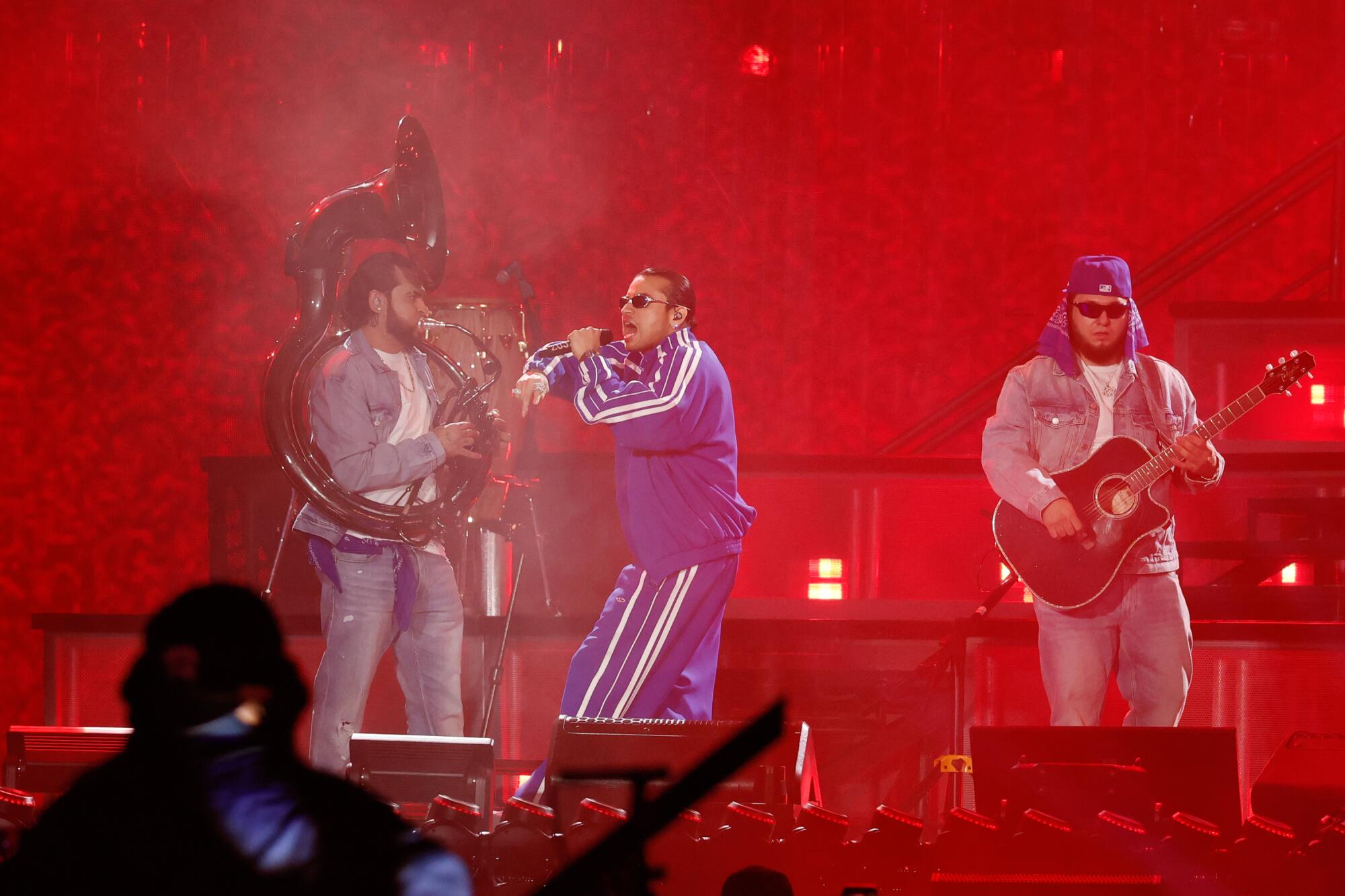
Fuerza Regida’s This Is Our Dream tour stops at Dodger Stadium
On Saturday at Dodger Stadium, as the sun dipped below the horizon, Fuerza Regida took center stage for a career-defining show, delivering cinematic time-travel segments and hints of off-stage controversy.
The Mexican American band joined an illustrious list of legendary acts — Elton John, the Beatles, Michael Jackson and Beyoncé to name a few — to perform at the iconic venue built on Chavez Ravine, the shallow canyon that served as home to thousands of Mexican American families forcibly displaced in the 1950s for the sake of progress.
In June, the San Bernardino quintet kicked off its This Is Our Dream stadium tour across nine U.S. cities to close out its manifestation project “111xpantia.” The 2025 LP peaked at No. 2 on the Billboard 200 in May 2025, becoming the highest-charting Spanish language album by a duo of band ever. It also comes a year after the band sold out the Madison Square Garden and the Hollywood Bowl in consecutive nights.
But the stadium tour — which will end Aug. 7 in New York’s Citi Field — does more than showcase the band’s recent mainstream success. It honors the years of grit it took to get there.
“It’s proof that dreams are worth chasing, fighting for, even when it feels hard or impossible,” said Khrystian Ramos, the band’s rhythm guitarist.
As part of the set design, a massive prop car stereo was affixed atop the stage. Inspired by the 1985 film “Back to the Future,” it doubled as a time traveling machine. But instead of a DeLorean, the band opted for a Chevrolet 454 SS pickup truck, a car that symbolizes the American dream for lead singer Jesús Ortiz Paz, better known as JOP, and is largely associated with the group’s corrido forefather, the late Chalino Sanchez.
The first stop in Fuerza Regida‘s journey to the past was 2018, as the band performed its breakthrough hit, “Radicamos En South Central,” a song about gradually building a drug empire that went viral on YouTube. Shortly after its release, the band signed with independent label Rancho Humilde and followed up with “Sigo Chambeando,” a bouncy corrido that embodies the band’s “never stop hustling” ethos.
It’s a mindset that has served them well.
The more than a decade-long road to selling out Dodger Stadium certainly wasn’t easy for the corrido tumbado band, which formed in 2015 and first built a fan base by performing cover songs at local parties across the Inland Empire. .

Jose “Pelon” Garcia, left, Jesus Ortiz Paz and Khrystian Ramos of Fuerza Regida perform during their This Is Our Dream Stadium tour at Dodger Stadium on July 18 in Los Angeles.
(Carlin Stiehl/For De Los)
“We got kicked out of a gig one time. The guy literally told us that he didn’t like our music,” said Ramos. “That drive home was a key moment in our career. It showed us that it’s not all stars and rainbows.”
Ramos started the band alongside the band’s 12-string guitarist, Samuel Jáimez. The two met at martial arts school as kids and kept in touch in the years that followed, jamming out together after their 9 to 5 .
The band’s name was originally Raimez — a portmanteau of Ramos and Jáimez— but was later changed to accomodate the arrival of lead singer JOP.
“I remember exactly [where we came up with the name]. We’re driving down the 10 passing Mount Vernon Avenue,” said Ramos. “Fuerza Regida, a governing force. Wherever you step, the presence is felt.”
That certainly was the case on that warm July evening as the more than 56,000 fans in attendance chanted the band’s name in unison.
“Not in a thousand years, I didn’t see it until it crept up. It was like alcohol,” said Jáimez about the band’s global success.
Sousaphone player José García, also known as Pelon, never imagined that leaving behind a steady job to pursue his musical dreams would pan out like this.
“I worked in construction Monday through Friday and we had gigs with Fuerza Thursday, Friday, Saturday and Sunday. I practically had two jobs,” said García. “I had life insurance. I had benefits, 401(k), all that. So I left a really good job so I could join Fuerza Regida.”
In 2022, the band added its fifth member, Moisés López, who plays the tololoche — a small upright bass. López, who contributed to the 2020 track “Vamos Bien” as a bass player, said that JOP had asked him to learn the instrument if he wanted to stay with the group. “He bought me it. I picked it up real quick and from there it’s history.”

Jesus Ortiz Paz, left, and Moises Lopez of Fuerza Regida perform during their This Is Our Dream stadium tour at Dodger Stadium on July 18 in Los Angeles.
(Carlin Stiehl/For De Los)
At the concert, the time machine took attendees back to 2022, Fuerza Regida’s bélico era marked by the corridos “Billete Grande” and “Igualito A Mi Apá” as well as its gentler viral hit “Bebe Dame,” the first Fuerza Regida song to reach the Billboard 100, peaking at No. 25.
“We went from clubs to theaters to arenas. I’ve never thought we would get this far,” said López. “We’ve always said hard work beats talent.”
But it isn’t just drive that has shaped Fuerza Regida’s career — time and time again, the band has proved to be adaptable and experimental, always evolving its sound and drawing from a wide range of influences.
2023 saw the release of “Pa Las Baby’s y Belikeada,” a party record that fuses trap, pop and EDM, and features the player anthems “TQM” and “Sabor Fresa”; to complement the womanizer themes of the record, there was a baddie camera on stage, which panned to women in the audience.
As the band sang its 2023 ballad “Una Cerveza” — a song about getting drunk to forget a lost love— a girl across my way called her ex and lifted her phone up in the air so that he could hear its heartbreaking lyrics. Then she hung up.
The Dodger Stadium show felt like a massive celebration, not just for the band but for música mexicana as a whole. Special guest performances throughout the night included Los Gemelos de Sinaloa, Calle 24, Chino Pacas, Clave Especial and Chuyin — acts that have helped fuel the meteoric rise of the genre.
“I’m proud and grateful that la raza is finally doing it. We’re here to stay,” Jaimez said.
Though the show focused on Fuerza Regida’s past, there were also hints of what’s to come. The band’s relationship with its record label Rancho Humilde has become acrimonious and litigious. In recent months, JOP has repeatedly accused founder Jimmy Humilde of withholding royalties and sabotaging the band. In turn, the record mogul has claimed that the band is not fulfilling its contractual obligations. A bitter divorce feels imminent.
“The internet tells a lot of lies. False news. That supposedly someone won a lawsuit. But that lawsuit is still underway and we know who will win,” JOP told the audience before singing “Triston,” a track released at the start of 2026 that was immediately pulled from the streamers. “They took this song off the platform but they can’t stop us from singing the song here.”
