frieze

The fashion and art at Frieze L.A., captured in photos

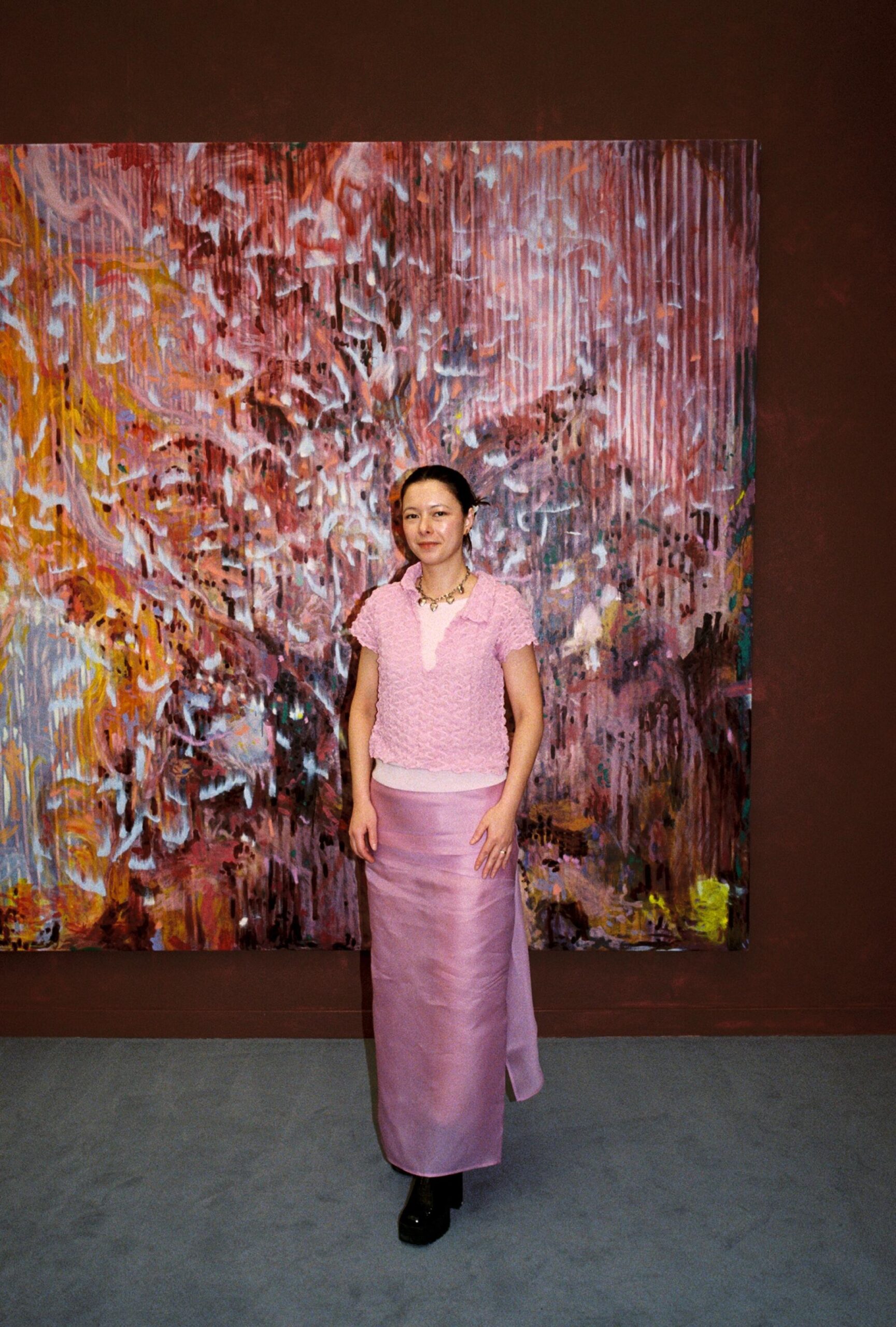
Erica Mahinay, showing with Make Room Gallery at Frieze L.A.

Erica Mahinay, showing with Make Room Gallery at Frieze L.A.

Some art shows are not just about the art. At Frieze L.A., it’s also about seeing — and being seen.

On Thursday morning, over 100 artists, gallerists and collectors representing 24 countries wafted into the maze that is Frieze at the Santa Monica Airport and transformed the space into a winding runway. The dress code was eclectic and appropriately L.A.: hyper-curated and nonchalant. Archival Mugler was paired with reconstructed relaxed denim. Silk pajama pants slouched over Wales Bonner loafers. And much like the works on display, attendees dared to be visually undefinable.

This year, the four-day frenzy is expected to draw about 30,000 attendees to exhibitions both in and outside the tent, including public installations from Frieze Projects’ “Body & Soul,” and the Focus section curated by Essence Harden, which spotlights young and lesser-known artists.

Storm Ascher, left, and Greg Ito

Storm Ascher, left, founder of Superstition Gallery and Greg Ito pictured with his solo booth, “A Cautionary Tale,” in the Focus Section curated by Essence Harden.

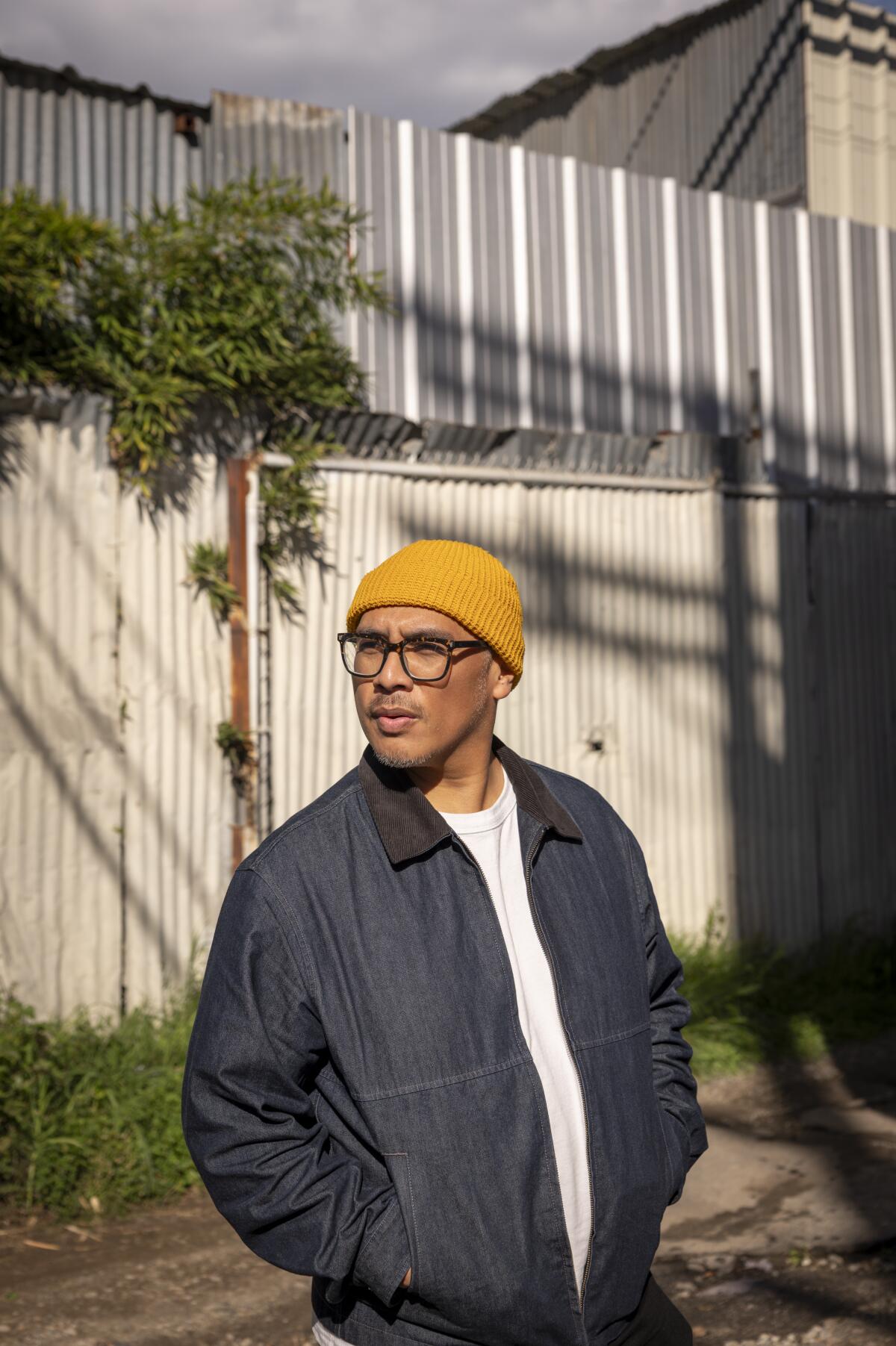
Patrick Martinez

Amanda Ross-Ho

Undeniably, the art this year is a product of now. Outside, Patrick Martinez welcomes guests with neon quotes supporting immigrant rights. Across the tent, in a display of performance art, Amanda Ross-Ho continuously pushes a giant, inflatable Earth around a soccer field, symbolic of “the labor it takes to just keep things going all the time.” Walking around the fair, a shared sentiment of post-fire rejuvenation, cultural collaboration and a pride for the Los Angeles community was deeply felt.

Sharif Farrag

Sharif Farrag ceramic

Angeleno and artist Sharif Farrag said he’s “excited to show in the city [he] grew up in.” His ceramic collection “Hybrid Moments” with Jeffrey Deitch is a cultural analogy for his childhood. “I hope my work can reflect the times we’re in through a lens of color,” he said, “and the flora and fauna of L.A.”

Nicole Reber

Nicole Reber, an L.A.-based real estate agent, was giving “’90s sparkle princess,” coupling a pair of Chanel loafers with a vintage Escada jacket that’s “highly underrated.” She came to Frieze to scope out the next addition to her home. “There’s something valuable about living and collecting art,” she said. “It’s a chance to live with somebody else’s energy.”

Dr. Joy Simmons, right

Dr. Joy Simmons wore a calf-length button-down by South African designer Thebe Magugu. Collecting art, like clothes, is her way of exploring the diaspora. “I just want to find something that’s different,” she said. “[African American artists] bring a different kind of color palette and excitement to the art world.”

Sharon Coplan Hurowitz

Sharon Coplan Hurowitz came to Frieze with her “support animal, ‘Hector.’” The pebble grain Thom Browne shoulder bag, though, was no size comparison to the 10-foot John Baldessari sculpture she stood in front of. Coplan, who recently authored a catalog of Baldessari’s notable art, is excited to see support for his archival works.

Sebastian Gladstone

Nevine Mahmoud sculpture at Sebastian Gladstone Gallery

Nevine Mahmoud sculpture at Sebastian Gladstone Gallery

Sebastian Gladstone, owner of namesake New York and L.A. galleries, said he loves the L.A. art community because it brings together “people that would never mix otherwise.” If he could describe “good” art in a sentence, it would be: “an alchemy where there’s a mystery of its creation, and how it makes you feel.”

Kibum Kim, partner at the Commonwealth and Council gallery

Kibum Kim, partner at the Commonwealth and Council gallery

rafa esparza at Commonwealth and Council booth

rafa esparza at Commonwealth and Council booth

Kibum Kim, a partner at the Commonwealth and Council gallery, said sifting through Frieze is like making “Sophie’s choice.” He wore a jacket from Jakarta-based brand Tanah le Saé, adorned with mixed-matched buttons. In a similar spirit of upcycling, his exhibition shows Rose Salane’s newest project from Pompeii featuring rocks and other ephemera taken from the historic site.

William Escalera, left, and Francisco George

William Escalera, left, and Francisco George

Francisco George, a longtime art collector and docent at LACMA, is a Frieze regular. To him, good art “grabs your attention and keeps it. It communicates.” He visits the fair with his husband, William Escalera, who this year is looking for art that incorporates textiles. “It’s different,” he said.

Gallerist Susanne Vielmetter

Gallerist Susanne Vielmetter

Gallerist Susanne Vielmetter layered an Issey Miyake Pleats Please dress with a skirt from J.Crew underneath. At Frieze, she never knows whether it’s going to be cold or hot in the tent. “It’s an onion look,” she said. Although she is particularly excited to display paintings by Alec Egan, depicting the trauma of the Palisades fire, she is glad that the fair is bustling and joyous. “People are just done with doom and gloom,” she said. “They’re positive, they’re energetic, they want to go back to collecting.”

Kohshin Finley

Shio Kusaka, left, and Jonah Wood

Shio Kusaka, left, and Jonah Wood

Roksana Pirouzmand

Hans Ulrich Obrist

Thelma Golden

An artwork by Jade Guanaro Kuriki-Olivo, aka Puppies Puppies

An artwork by Jade Guanaro Kuriki-Olivo, aka Puppies Puppies

Conny Maier wears a Healthy Boy Band tee and MISBHV biker shorts.

Conny Maier wears a Healthy Boy Band tee and MISBHV biker shorts.

Lauren Halsey

Jwan Yosef and Steven Galloway

Jwan Yosef and Steven Galloway

Zanele Muholi

François Arnaud

William Wei

Davida Nemeroff of Night Gallery

Davida Nemeroff of Night Gallery

Isabelle Albuquerque

Soshiro Matsubara, showing with Bel Ami

Soshiro Matsubara, showing with Bel Ami

Soshiro Matsubara, Bel Ami

Soshiro Matsubara, Bel Ami

Kelly Wall with her installation

Kelly Wall with her installation

Polly Borland

Shana Hoehn

Cosmas & Damian Brown

Amanda Ross-Ho

Source link

Frieze Projects’ ‘Body & Soul’ stages site-specific work across L.A.

“If I love you, I have to make you conscious of the things you don’t see.”

James Baldwin’s quote about the artist’s role in society is emblazoned on billboards across Los Angeles this winter. Created by artist Patrick Martinez, the purpose of the signage is two-fold: to promote Frieze Los Angeles and, in the case of neon signs at the art fair’s entrance, to stand as a discrete work of art on its own.

Martinez, an East Los Angeles-based artist, has long translated protest language into storefront-style neon, a strategy he now extends into a broader campaign tied to Frieze, which runs Feb. 26 through March 1 at the Santa Monica Airport and features more than 100 galleries.

This year, however, some of the fair’s most compelling work may be happening outside the tent. Frieze Projects’ “Body & Soul” features eight installations staged across Santa Monica’s Airport Park and beyond. The initiative is intended, organizers say, to broaden the fair’s reach beyond its art world audience — positioning Frieze as a civic platform rather than a purely commercial event.

In addition to Martinez’s creations, “Body & Soul” brings together site-specific works including Amanda Ross-Ho’s durational performance rolling a 16-foot inflatable Earth around the perimeter of a nearby soccer field; Cosmas & Damian Brown’s interactive fountain installation incorporating ceramic heads, incense and water; and Shana Hoehn’s first large-scale public sculpture, fabricated from a fallen tree sourced through Santa Monica’s Urban Forest program. Off campus, Kelly Wall extends the program to a former Westwood Village newsstand, where glass “magazines” will be displayed — 136 in all, priced at $300, with 15 given away.

Martinez’s billboards bearing 2024’s “If I Love You (James Baldwin)” serve as the most highly visible part of the fair’s public outreach. His neon installations respond to ICE raids and immigrant rights, placing protest at the literal threshold of one of Los Angeles’ most visible art events.

A man stands by a metal fence.

L.A. artist Patrick Martinez’s work is featured on billboards around the city, as well as at the entrance to Frieze Los Angeles.

(David Butow / For The Times)

The public art program acts as “a way that we can bring in people who may not be just the ticket goers or the VIP,” said Christine Messineo, Frieze’s director of Americas.

It also serves to amplify the city’s cultural temperature.

“Our job is to represent what’s happening in our community,” Messineo said, adding that immigration and social impact are not anomalies at the fair but part of its foundation.

Some of Martinez’s neon entrance signs — including “Abolish ICE” (2018), “No Body Is Illegal” (2021) and “Then They Came for Me 2” (2025) — predate the current political moment. Instead, they emerge from years of observation and protest.

The artist credits Messineo with approaching him last summer to utilize what he calls his “urgent warning signs” as the face of the fair. Demonstrators also carried signs bearing Martinez’s imagery last June during protests against ongoing federal immigration crackdowns in downtown Los Angeles.

Those events, Martinez says, are not experienced evenly across the city — particularly by the well-heeled audience that attends Frieze and spends $85 to $106 for weekend general admission tickets.

A neon sign in a window.

Patrick Martinez, “If I Love You (James Baldwin),” 2024.

(artwork Patrick Martinez / photo Paul Salveson)

Martinez wants his signs to unsettle viewers who are insulated from the city’s unrest.

“The Westside people aren’t even going to see any of that, right? So it’s bringing that kind of mindfulness to that space.”

“It felt prescient then,” Messineo said of engaging Martinez last year, “and I think even more so now.”

Frieze has integrated public art into its Los Angeles fair since its 2019 debut. But the works in “Body & Soul,” produced with the nonprofit Art Production Fund, lean into the particular conditions of public space.

The exhibition brings together Los Angeles artists exploring ideas of memory, community and collective experience — often in quieter ways than Martinez’s overt messaging.

Additional participants include Dan John Anderson, Polly Borland and Kohshin Finley.

Casey Fremont, Art Production Fund’s executive director, said most of the works are newly commissioned.

The program is designed to prioritize innovation over sales. “It isn’t transactional. It’s really just about experimenting and giving the public the opportunity to experience art like they’ve never experienced before.”

Artists scale up — and slow down

“Body & Soul” marks several participants’ first ventures into public work, including Hollywood artist Finley, whose “The Piano Player” will be installed near the corner of Airport Avenue and Donald Douglas Loop. Finley’s piece arranges ceramic vessels inside shadow-box shelving that the artist describes as containers for memory — some “you love to take out and peek into,” others that “should just stay shut forever.”

A man stands in front of a piece of art.

Kohshin Finley’s “The Piano Player” arranges ceramic vessels inside shadow-box shelving that the artist describes as containers for memory.

(Micaiah Carter)

The title references the film “Casablanca,” and its piano player, Sam, whose music stirs up memories of the central love story.

Finley said the public setting creates an unusually direct encounter as he, like many of his fellow artists, will be standing with his work.

“A lot of people have never seen a living artist,” he said.

Ross-Ho takes visibility even further with her inflatable soccer ball Earth, which weighs 78 pounds. The familiar “blue marble” image will no doubt draw spectators at the Airport Park Soccer Field outside the Frieze tent.

A woman in front of a piece of art.

Amanda Ross-Ho is creating a durational performance on a soccer field by Frieze Los Angeles.

(Jennelle Fong for ILY2)

Ross-Ho’s performance, “Untitled Orbit (MANUAL MODE),” functions as an endurance test that is a response to what she calls “the temporal container of the art fair” — and to the pressures of contemporary life.

“Gesture and duration are the ways that I could achieve scale rather than something that was materially constrained like a giant sculpture,” she said.

Designing for gathering

Brown’s installation, “Fountain: Sources of Light,” invites guests to congregate. Positioned between the Airport Park playground and dog park, it combines running water, ceramic vessels, incense and sound.

“I really wanted to make a fountain because I thought that [it’s] something that … people tend to gravitate to,” he said.

The work will incorporate metal plates and bowls created by participants in the youth workshop Art Sundae, taking place Feb. 28 at Airport Park.

Near Brown’s fountain, Echo Park artist Hoehn will present “Deadfall,” a massive fallen fig tree embedded with carved cheerleader legs and skirts — imagery drawn from her Texas upbringing.

A woman in her art workshop.

Shana Hoehn with one of her carved wooden sculptures.

(Josh Cohen)

“I’ve been working with cheerleading iconography for the past few years,” she said, linking the imagery to what she calls an omnipresent football culture layered with “American patriotism and militaristic qualities.”

Hoehn acknowledged that the fair’s four-day window and limited nearby parking may keep the audience closer to fair-goers than the broader public the program aims to reach.

Beyond the airport fence

A few miles away in Westwood Village, Mar Vista artist Wall will extend the program beyond the airport campus with “Everything Must Go,” installed at a defunct newsstand and on view from 5:48 p.m. (sunset) to 8 p.m. during the fair.

Where magazines and newspapers once were, glass stand-ins bearing skyline imagery will occupy illuminated lightbox shelves. As the glass “magazines” are removed, glowing silhouettes mark their absence.

A picture of art in glass.

Kelly Wall, ‘Everything Must Go’.

(Kelly Wall)

Wall’s related project will appear on the Frieze campus with found newspaper boxes transformed into lightbox displays for her glass publication.

“In things coming to an end, there is no real end … there’s transformation,” she said. “How you might see [the piece] may differ depending on different times — or where you’re personally at in your life.”

Source link