freshman

USC’s freshmen make a big impact in season-opening victory

A quartet of true freshmen pass-catchers trotted onto the Coliseum field around noon Saturday, taking their places to either flank of USC’s far-older quarterback. None of the four — neither Trent Mosley, nor Kayden Dixon-Wyatt nor Tron Baker or Mark Bowman — had ever played in a college football game. But the significance of their presence, on the first play of an especially critical campaign for USC and its coach, Lincoln Riley, was no small thing.

This USC season, if only by sheer numbers, is sure to be defined by how fast its freshmen can grow up, which, after Saturday’s season-opening, 42-26 win over San José State, might not sound so bad after all.

First impressions, of course, can only say so much. With redshirts no longer a concern, Riley had promised to acclimate as many young players as possible. He stuck to a mostly conservative play script, leaning on the run and relying primarily on short passes through the air. Still, USC tallied more than 500 total yards in a mostly ho-hum debut, with star quarterback Jayden Maiava completing 25 of 29 passes for 286 yards and three total touchdowns.

However, there were also plenty of glimpses that suggest the kids will be all right.

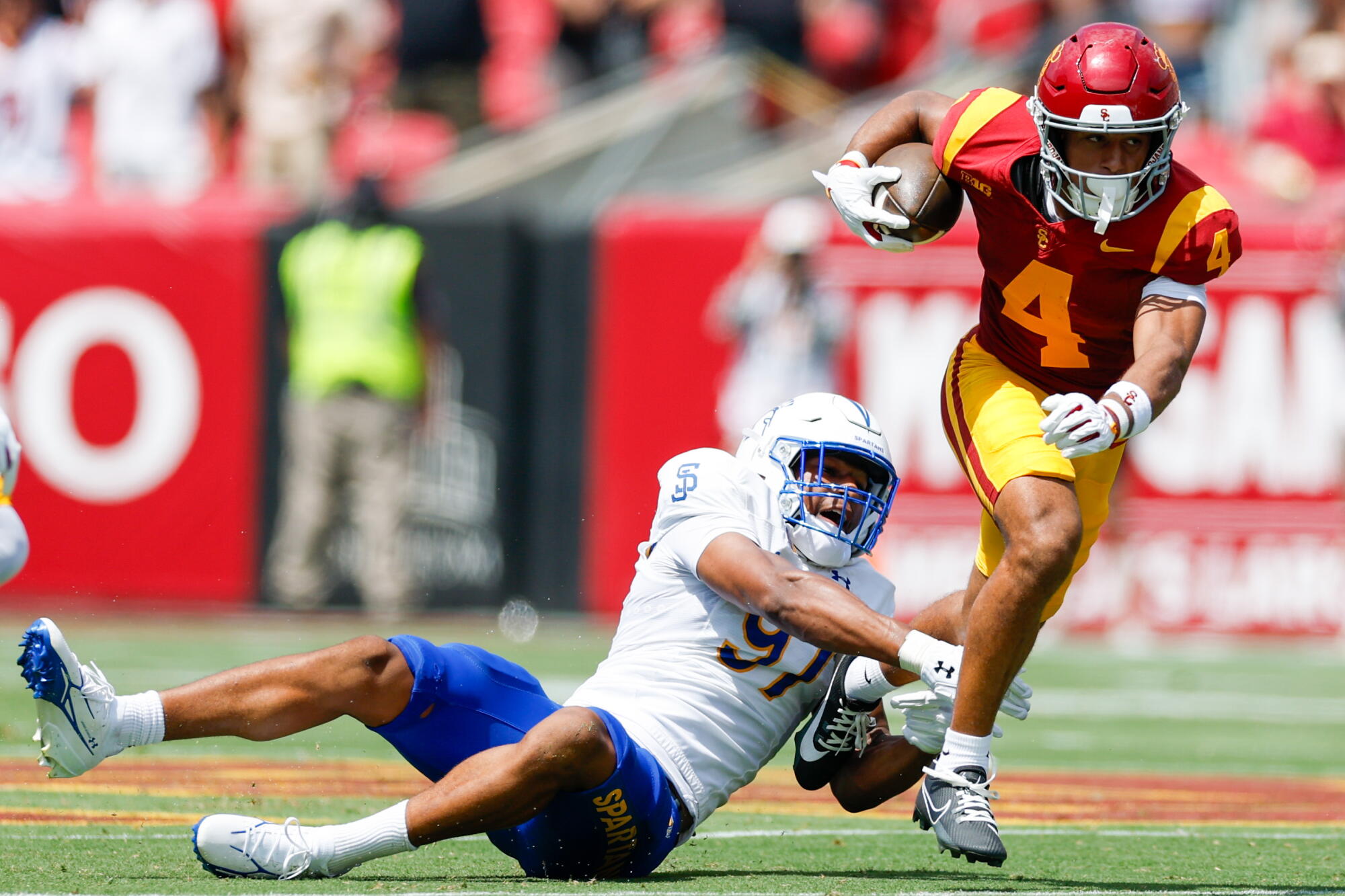
The most memorable came from Mosley, who took off with his first-ever collegiate punt and ping-ponged his way down the field, refusing to go down until he gained 41 yards.

It was just the start for the former Santa Margarita High standout. In the second quarter, Mosley caught a pass over the middle and broke three tackles for 33 yards. In the third, he burst open in the red zone and reeled in a 14-yard touchdown. He finished with seven catches for 118 yards and a touchdown, becoming the first Power Four freshman receiver to meet those marks in a debut since Purdue’s Rondale Moore in 2018.

There were standout moments for other members of the Trojans’ 2026 class, too. Defensive end Luke Wafle looked unblockable at times off the edge. Dixon-Wyatt dusted his defender off the line to catch a red-zone slant for a score. And quarterback-of-the-future Jonas Williams led a seamless fourth-quarter scoring drive.

USC wide receiver Trent Mosley breaks a tackle by San José State linebacker John Norwood.

USC wide receiver Trent Mosley breaks a tackle by San José State linebacker John Norwood during the first quarter Saturday.

(Ronaldo Bolanos / Los Angeles Times)

But arguably the most encouraging results for USC came on the defensive end, where, for one half at least, Gary Patterson’s unit stood strong in his debut as Trojans defensive coordinator.

USC didn’t allow the Spartans to score until midway through the third quarter, when they opted for a field goal, down four touchdowns, just to wipe the zero off the scoreboard. San José State added another score after that, albeit long after USC’s starters had been replaced.

The defense held San José State to just 102 yards in the first half. It also gave up just 93 yards on the ground.

USC was at its best early, even with its fleet of freshmen needing time to find their footing. The Trojans immediately ripped off a 13-play touchdown drive to start the game. Fans were still filing in, braving 90-degree heat with novelty beer swords in hand, as Maiava moved USC methodically down the field, punching in a one-yard keeper for an early score.

A fourth-down stop at the goal line gave San José State a brief respite from USC piling on points. But Wafle, the five-star pass rusher, nearly added to the scoreboard anyway, when he slipped past the Spartans’ right tackle on third down, blew up the Spartan running back, and came up a split second short of a safety.

USC quarterback Jayden Maiava, right, hands off the ball to running back Riley Wormley.

USC quarterback Jayden Maiava, right, hands off the ball to running back Riley Wormley during the second quarter Saturday.

(Ronaldo Bolanos / Los Angeles Times)

USC still turned the sterling field position into points. While Waymond Jordan and King Miller did most of the damage on the ground, combining for 111 yards, redshirt freshman Riley Wormley was the first USC running back to score. He was one of five to see work Saturday.

Miller led the way, with 63 yards. And he added his touchdown later, just before the half, as the Trojans took a 28-0 lead into the locker room.

San José State played USC a lot closer after that, actually outscoring the Trojans 26-14 in the second half.

It was the sort of lacking finish that probably left both Riley and Patterson wanting a bit more. But as far as first impressions go, it did the job for one Saturday at least.
Source link

How Boobie Feaster, age 17, became a USC playmaker to watch

Long before he arrived at USC, a couple days shy of his 17th birthday, Ethan “Boobie” Feaster had always been in a hurry to grow up.

He was the baby of the Feaster family, seven years younger than his next youngest sibling. But nothing about his behavior, even as a kid, suggested as much. He was always quiet, calm, determined, seemingly from birth, according to his father, Lee. When Lee Feaster encouraged Boobie at age 8 to write down his goals, and “make ‘em plain,” Boobie took the advice literally. He went straight to his bathroom mirror and copied them down. They’re still written on the bathroom mirror, to this day.

When he was 9, Boobie asked his father to buy him a football poster. Lee came in later to find it attached to the ceiling, above his bed. He asked Boobie why.

“I need it to be the first thing I see when I wake up,” Lee recalled him saying, “and the last thing I see when I go to bed.”

This, needless to say, was not exactly normal behavior for a 9-year-old. But nothing about Boobie Feaster has ever been normal. Least of all the relentless drive that would one day have everyone at USC raving and others around the nation whispering about one of the most anticipated freshman in college football.

Neither is it normal exactly for USC’s offensive-minded coach, Lincoln Riley, to enter into a season so unproven at the receiver position.. With the status of No. 1 receiver Tanook Hines still unclear less than a week out from the season opener, USC will almost certainly have to rely on a group of talented freshman receivers to hit the ground running.

That includes Boobie, who at just 17 years and three months, will be the youngest among them by a wide margin. In fact, he may be the youngest ever to suit up at USC. Feaster is the school’s youngest player dating back to when USC started recording player birth dates.

But talk to those who know Boobie best, and they’ll tell you that age, in his case, is merely a number.

“He’s always been an old soul,” said Kerry Sweeney, the receivers coach at DeSoto High in Texas.

Sweeney met Boobie when he was in the seventh grade. He’d heard about the kid’s stellar football IQ, so he tried to stump him. He asked Feaster, then barely 12, to explain the difference between cover-2 and cover-3 defenses.

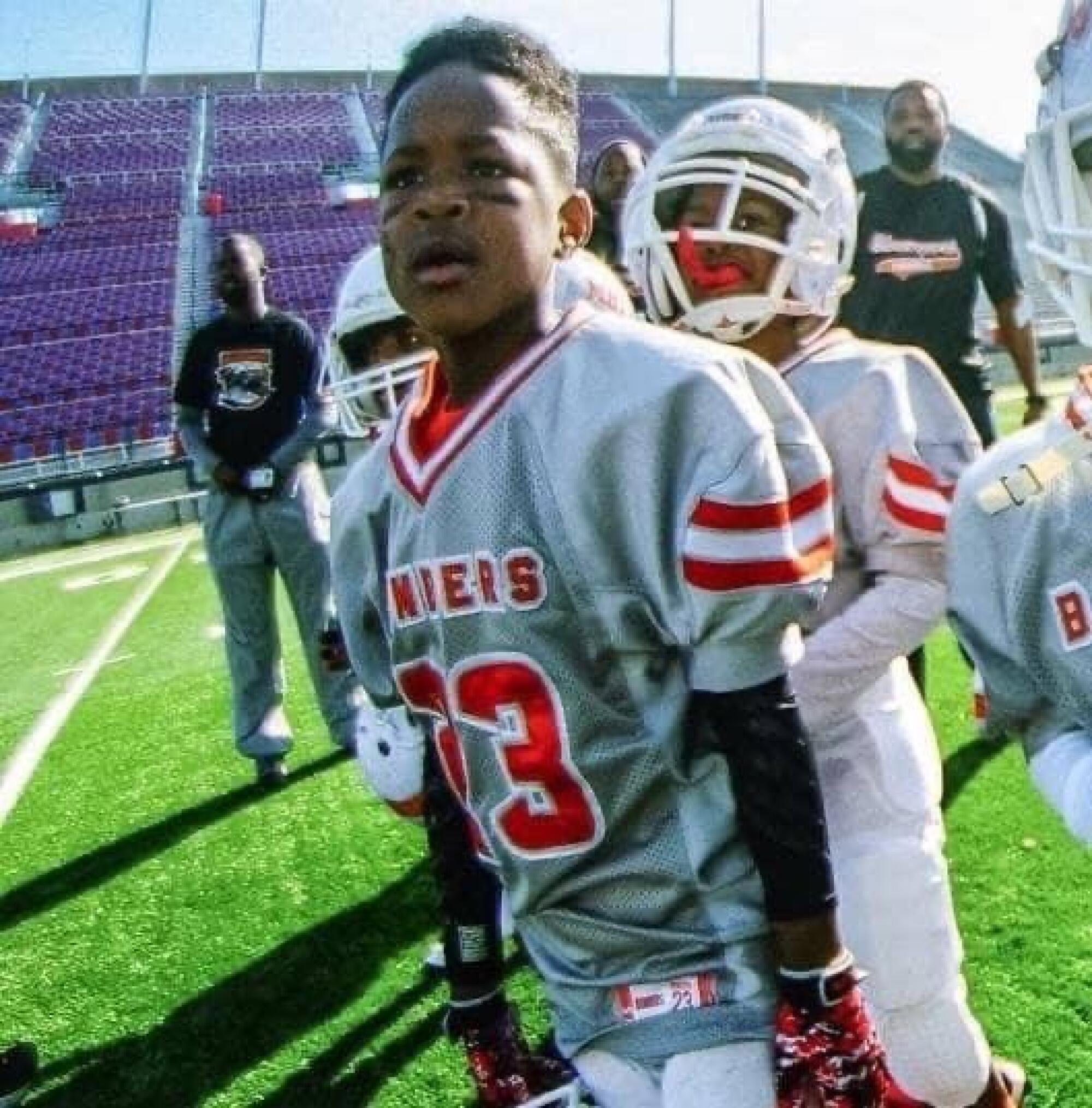
Boobie Feaster looks across the field during a youth football game.

Boobie Feaster looks across the field during a youth football game. The USC receiver frequently played against older kids.

(Courtesy of Lee Feaster)

“He knew exactly what it was,” Sweeney said.

What Sweeney didn’t know was that when Lee Feaster, a football coach himself, was studying game film, Boobie was right there with him. He knew a lot more than coverage schemes.

Boobie had also been playing up one — or two even — age levels. In the seventh grade, he started working with a personal receivers coach, David Robinson of D-Rob Sports & Fitness Training. A year later, Robinson had Boobie, as an eighth grader, training with former NFL receivers, such as Dez Bryant, or college receivers on their way to the NFL.

“There was no polish or anything,” Robinson said. “But he was just a natural. Natural speed, natural length, naturally tall.”

But it was his mind that continued to mystify coaches most. Even at a young age, he made sure to concern himself with the minor nuances of the playbook and the receiver position. By the time he debuted as a freshman at DeSoto, coaches already trusted him to run choice routes, which gives the receiver multiple different options based on the defensive alignment.

By the state playoffs that season, Sweeney said that Boobie was already the best receiver on a team that would produce three Division 1 wideouts.

“He was dominating,” Sweeney said, “as a freaking freshman. “

It seemed clear to everyone around him, at that point, that Boobie could handle skipping a season of high school football. So after his sophomore season, Boobie reclassified from the Class of 2027, in which he was recognized as a top-five prospect in the nation, to 2026.

His relationship with USC receivers coach Dennis Simmons was solidified by that point. They’d been introduced when Boobie was in the seventh or eighth grade — and just beginning to blow up on social media. Simmons said he was impressed by Boobie’s maturity.

“He recruited Boobie really hard,” Robinson said. “That relationship is what really kind of jump-started USC as a front-runner.”

USC never relinquished that spot. But Feaster had to wait until he enrolled at USC this summer while the other talented pass-catchers in his class got a head start.

That’s not to say he wasn’t trying to get ahead in other ways.

Boobie Feaster reaches out to catch a pass during his youth training before arriving at USC.

Boobie Feaster reaches out to catch a pass during his youth training before arriving at USC.

(Courtesy of Lee Feaster)

Lee Feaster said that before his son’s arrival at USC, Boobie was obsessing for months over USC’s playbook. He worked flashcards with Robinson and sometimes made his father line up in the street in front of their house just to commit certain plays and alignments to memory.

“Oh, he knew the playbook,” Lee Feaster said. “He knew it before he got there.”

He’s opening eyes at USC practice. During a preseason scrimmage at the Coliseum last week, Boobie burst through a sliver in USC’s defense and took a tunnel screen to the house, reminding in one play exactly why USC’s coaches thought he was ready to contribute at 17.

“He was game-ready,” wideout Terrell Anderson said, “as soon as he came in.”

How quickly he’ll actually influence a game at USC remains to be seen. The Trojans are expected to play several freshmen against San José State on Saturday, and anyone who knows Boobie will tell you it’s only a matter of time before he contributes. After all, after starting in the slot, Feaster took it upon himself to start learning the outside receiver spot.

When Boobie moved to L.A. in May, his father tagged along, just to make sure he got acclimated. His mother came shortly after that.

And they’re reminded sometimes that Feaster is still just a teenager. That he’s still got a lot of growing to do. His goals are still written on his bathroom mirror, to remind him of that every day.

But if the past is any indication, it shouldn’t be long.

“I believe, like three games in, everyone is going to be saying, ‘Who’s this freshman?” Sweeney said. “Who’s this Boobie Feaster?’”

Source link

New NCAA eligibility rules boost USC, its top recruiting class

During his eight seasons as a head college football coach, Lincoln Riley often faced a frustrating conundrum when it came to playing freshmen: Were a handful of plays at the end of a blowout really worth burning a whole year of eligibility?

“I can remember at times going to a player in the game,” Riley said Tuesday. “‘We can probably play you like five to 10 plays at the end of the game. But if you do that, we can’t play you anymore, or we’re going to have to take your redshirt.’ We’re having to talk about that in-game. … You had to be ready to adjust on the fly.”

But after years of meticulously monitoring that playing time, those adjustments will no longer be necessary, after the NCAA adopted new eligibility rules in June. The new model gives athletes a blanket five years to compete, effectively eliminating the need for redshirts or special waivers. It also could alter how rosters are constructed.

Riley has been calling for the rule change since shortly after he became USC’s head coach. And it is now being implemented at the best possible time for his Trojans.

With so many highly touted freshmen from USC’s No. 1 recruiting class sure to see the field this season, there’s no need now for Riley or his staff to look four years into their future while deciding when and how to give them game-day snaps.

“Now you can just make the best decision in the moment,” Riley said. “I think that’s great for the player. … Just play the guys who deserve to play.”

For USC, it means that a fleet of first-year players are sure to see the field, not just during the nonconference slate but beyond, as Riley and his staff feel out which members of the Trojans’ 2026 class could contribute when the schedule suddenly stiffens in late September.

“Any opportunity that we get a chance to play these guys, however it comes out,” Riley said, “you love the fact to be able to do it.”

Some schools could land veteran roster reinforcements as a result of the rule change after a judge granted an injunction allowing anyone in the class of 2022 who would’ve used the fifth year of eligibility to return to claim it. The decision is being appealed by the NCAA. Former USC wideout Jay Fair has indicated on social media that he intends to pursue that route, but as of Tuesday, Fair hadn’t rejoined the program.

The Trojans stand to benefit more than most from the new eligibility rules this season. But Riley does have one issue with the new rule. It currently stipulates that a player’s eligibility clock begins with either their full-time enrollment or the academic year following their 19th birthday, whichever occurs first.

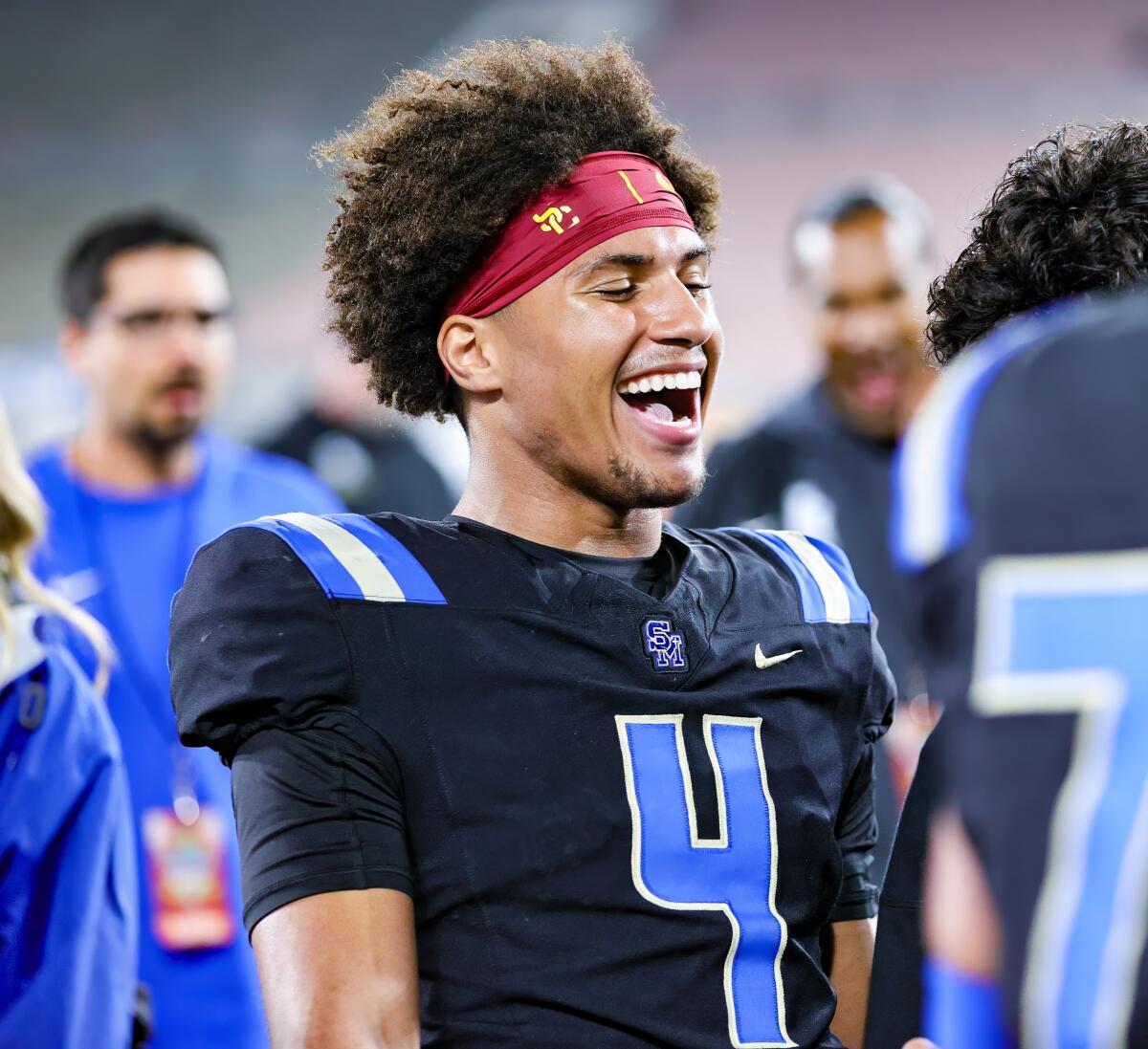
Trent Mosley smiles while leading Santa Margarita to a Division 1 title.

Trent Mosley smiles while leading Santa Margarita to a Division 1 title. Mosley is among the freshmen at USC who will benefit from new eligibility rules.

(Craig Weston)

So as it stands, any freshman with a birthday prior to Sept. 1, 2006, is left with one fewer year to play than their freshmen counterparts.

At USC, that affects two members of the 2026 recruiting class — wide receiver Trent Mosley and safety Madden Riordan.

For Mosley, a former Rancho Santa Margarita star, a fifth year may not ultimately matter. He’s already 20 years old and on track to potentially start in the slot as a freshman.

But USC’s coaches were quick this week to note that the Trojans’ freshmen, no matter how talented, still had some acclimating to do.

“Age is really just a number,” inside receivers coach Chad Savage said of Mosley. “When you’re a freshman and you come into college, there’s a big learning curve, right? Whether it’s playbook, whether it’s everyday life, whether it’s the weight room, whatever it may be, um, I think from a maturity standpoint, he is very mature, but it’s just one step in front of the other, every single day with Trent.”

Tanook Hines, USC’s top returning receiver, was a bit less restrained in his evaluation.

“Trent Mosley definitely stands out,” Hines said. “He seem like a vet, like he’s already been here.”

Riordan, meanwhile, is older than some of the vets on USC’s defense, including junior starting linebacker Desman Stephens, who already has 26 games under his belt at USC. It follows then that Riordan’s football IQ has made an impression with coaches early on.

He’s one of the several freshmen who might have been on the brink of a redshirt, given his weight. But Riordan added almost 15 pounds during the summer to hit 180 and could push for a place in USC’s defensive back rotation.

Riley said he believes Mosley and Riordan — and any other freshmen, for that matter — should get the chance to play all five seasons. No matter how old they are when their college careers start.

“We have a few guys that we are in the process of seeking some clarification and potentially getting some relief on that,” Riley said of the age restrictions. “Our belief is if they’re five for five coming out of high school, they should be five for five. We should keep it simple.

“Hopefully we get to that point.”

Source link

New receivers give Lincoln Riley hope as USC opens fall camp

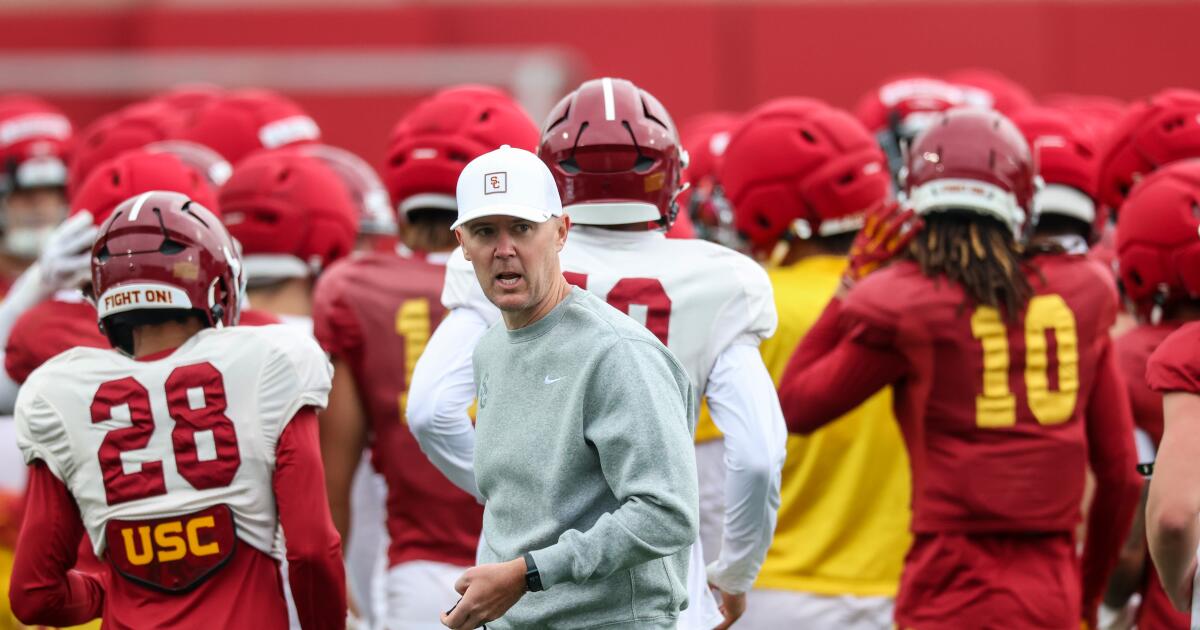
At the start of his fifth fall camp at USC, Lincoln Riley found himself enamored with all that felt new around him. Namely the state-of-the-art, $200-million facility towering over one end of the Trojans’ practice field, with all the luxuries any football coach could ask for.

“This building is magical,” Riley said. “It’s hard to explain how different, how fantastic it is.”

On the field, in front of that gleaming facility, the Trojans also were breaking in something entirely new on Saturday: their receiving corps.

USC opened training camp this week without the services of its top returning wideout, Tanook Hines, after the sophomore underwent an offseason surgical procedure that has yet to revealed. Riley said the injury affecting Hines, who missed the spring, isn’t “overly serious” and that he’s expected back for the start of the season. But his absence leaves the Trojans with a totally new and unproven group to catch passes; many of them are getting their first experience of college football, and of quarterback Jayden Maiava.

“A lot of new bodies. Fortunately he had spring and all summer with all these guys to start developing that chemistry and that confidence,” Riley said of Maiava. “But that’s going to be something we have to work at every single day.”

Among those new players is a host of top receiver recruits expected to contribute right away. Partly, out of necessity.

Freshmen wideouts Trent Mosley and Kayden Dixon-Wyatt already made a strong impression and should immediately step into roles on offense. Tron Baker is another who presumably could carve out a place. And joining them this week at practice, after just enrolling this summer, is a freshman wideout who some believe will be the best of the bunch, top-60 recruit Boobie Feaster.

It may take Feaster time to get up to speed. Hines stepped into a similar position last season, having just arrived on campus for the summer. He proceeded to start eight games anyway.

But Hines was 19 years old by the start of his freshman season. Feaster just turned 17 in late May — and presumably would be one of the youngest players ever to suit up for USC.

Receiver isn’t the only position at which the Trojans are trending young. USC should get key contributions out of freshmen at tight end (five-star Mark Bowman), on the defensive line (five-star Luke Wafle), in the secondary and, at some point, on the offensive line.

That sort of impact should be expected after bringing in a 35-player class that ranked No. 1 in the nation. It also helps, Riley said, that so much of that class has been enrolled for seven months.

“Having as many midyears made a massive difference; I mean, there’s no question about it,” Riley said. “You can feel some of the confidence level.

“And so the less that we can have new as we go on, the more these guys settle in off the field, the better they play.”

That’s the primary goal over the next four weeks of fall camp. One that Riley already has spent plenty of time focused on, while breaking in the Bloom Football Performance Center

“These first few days in here have honestly been a little bit of a dream,” Riley said. “It’s honestly been hard to get players to go home. I haven’t left this place in five days. I haven’t left the compound.”

Source link

UCLA women embracing tougher standards in title-repeat bid

The UCLA women’s basketball team won its first NCAA championship in April. Now, it’s vying to stay there.

Based on Thursday’s practice, after which UCLA spoke with the media for the first time since its dominant title run, it’s clear that the Bruins intend to remain on top, even with a target on their back and a revamped roster.

Success leaves clues

One would think a defending champion pursuing a repeat would, well, just try to run it back.

But not Cori Close’s bunch.

Entering her 16th season as UCLA coach, Close is emphatic about the importance of process over outcome — or journey over destination — and leaning into the beauty of the grind.

“We get to walk out and live out what we learn from the championship run,” Close said. “But we’re also not trying to repeat a championship outcome. We’re trying to repeat a championship process. And success leaves clues. There are things that we want to make sure we carry over from what we learn.

“But this is a new art project. This is a new identity. This is a new chance. The standards don’t change, but the way we go about it is going to be unique to this team, and that’s really fun to explore.”

The 98%

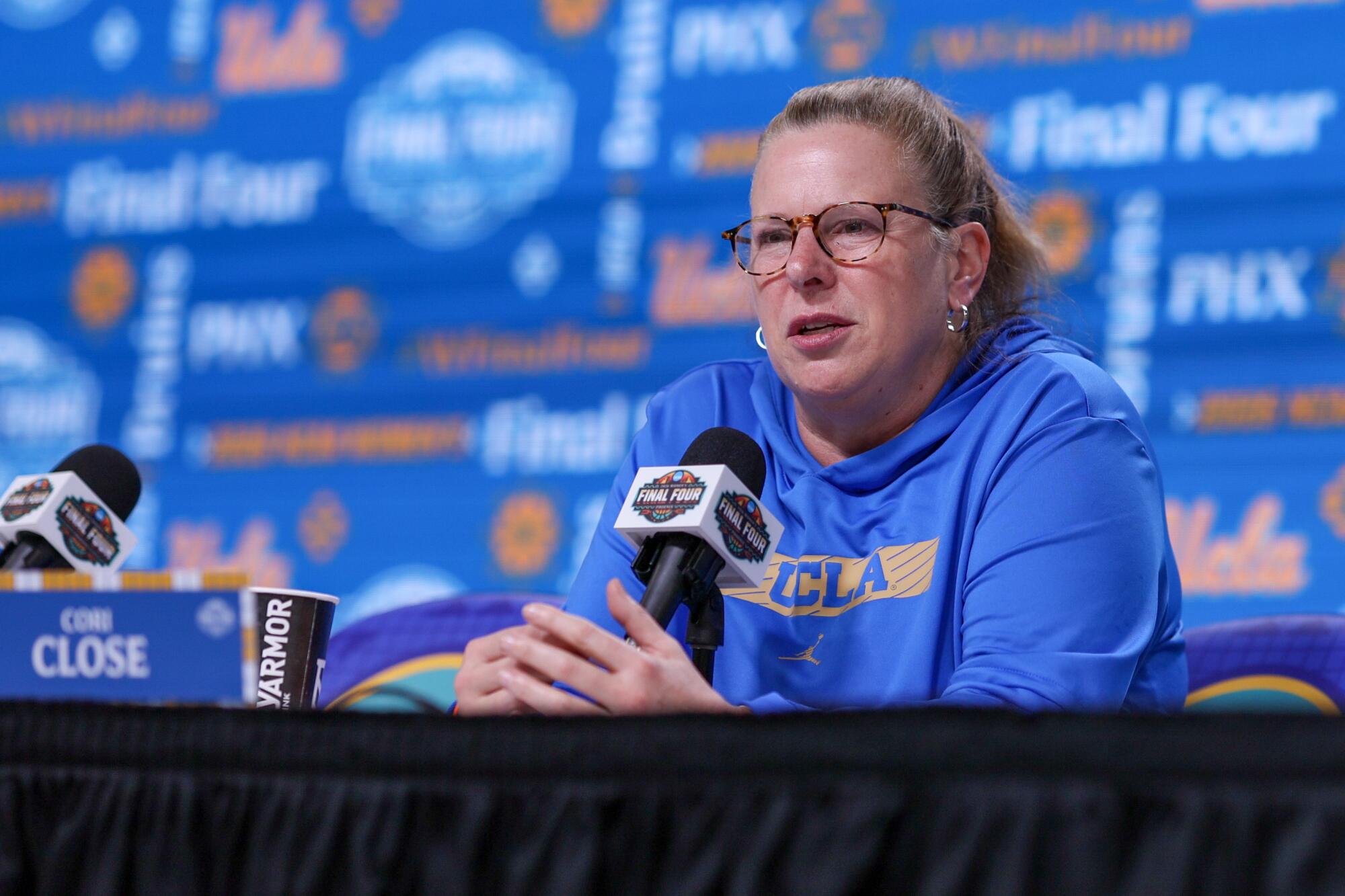
UCLA coach Cori Close speaks during a news conference on April 4.

UCLA coach Cori Close speaks during a news conference on April 4.

(Ronaldo Bolanos / Los Angeles Times)

Part of the “championship process” Bruins fans can expect to hear about is the “98%.”

Close repeated it. Players repeated it. It’s a mentality Close wants the Bruins to keep in mind throughout the season.

“What I mean by that is 98% of the game is played without the ball,” Close explained. “Can you become a better screener? Can you learn someone else’s tendencies? Can you talk more on defense? Can you become a better rebounder? How many ways can we learn from each other and be better ‘98%’ players? And if we do that, we’ll be on our way.”

Possessing the ball — the two percent — does matter. But players who can thrive without the ball will establish a team that, in Close’s eyes, is one that can be difficult to beat.

Sienna Betts’ role

UCLA forward Sienna Betts, left, speaks to her older sister, UCLA center Lauren Betts before a game in December.

UCLA forward Sienna Betts, left, speaks to her older sister, UCLA center Lauren Betts before a game in December.

(Caroline Brehman / Associated Press)

Sienna Betts, the younger sister of UCLA icon and Washington Mystics rookie Lauren Betts, is set to have a key role this season, especially as a returning sophomore on a team with many new players.

“It’s going to be different,” Sienna said, referencing the Bruins losing six players to the WNBA. “But I mean, I’m excited. And it’s not the first time I’ve been in a position like this; I mean, not at this level, obviously. So, I’m just excited to be in this new role. And I have coaches who are here to help me.

“I’m just planning on doing whatever coach Cori needs from me, whatever the team needs, and, you know, game to game.”

The 6-foot-4 forward is primed to be the Bruins’ anchor in the paint. She demonstrated her leadership during Thursday’s practice as well as some bully ball inside.

Betts, who is left-handed, mentioned her focus on right-handed shooting this offseason, in addition to preparing for increased touches. She averaged six points and four rebounds over 28 games as a freshman. Close said she is improving quickly.

“The younger players have grown into new roles,” Close said. “I think you could see glimpses of that [with] how Sienna’s already started to do that, even maybe ahead of where I thought she’d be at this point.”

Aarnisalo’s return

UCLA guard Elina Aarnisalo controls the ball against Mississippi in the Sweet 16 of the 2025 NCAA tournament.

UCLA guard Elina Aarnisalo controls the ball against Mississippi in the Sweet 16 of the 2025 NCAA tournament.

(Young Kwak / Associated Press)

Elina Aarnisalo, who played for UCLA as a freshman in 2024-25, is back in Westwood after spending her sophomore season with North Carolina.

The 5-foot-10 guard averaged 5.1 points, 3.4 assists and 2.2 rebounds as a freshman, but saw her scoring double (10.2) in Chapel Hill. Aarnisalo, a native of Finland, said she is more confident, not only as a player but also as a communicator.

“Obviously, there’s going to be a lot of spots on the team open now after a big draft class,” Aarnisalo said. “And a lot of seniors leaving, that obviously interested me too. Talking with Cori [about] what my role could be on this team and what we could accomplish this year … just knowing the standards at UCLA, how we practice, how they focus on individual work; I’ve seen it, and I’ve seen my old teammates [and] how they’ve succeeded in this environment, which is why I wanted to come back.”

Aarnisalo averaged 21 minutes per game as a freshman and 27 as a sophomore. She stands a good chance of seeing her playing time increase this season.

New faces, same goal

Former Texas Christian guard Donovyn Hunter is among the new players on the UCLA roster.

Former Texas Christian guard Donovyn Hunter is among the new players on the UCLA roster.

(Tony Gutierrez / Associated Press)

The Bruins will look starkly different next season after essentially exchanging six WNBA-ready players for five enticing transfers.

Those newcomers are Texas Christian guard Donovyn Hunter, Iowa State forward Addy Brown, Arkansas guard Bonnie Deas, Notre Dame guard KK Bransford and Aarnisalo.

“These girls are obviously really talented, come from really different programs,” Betts said. “It takes a second to adjust to coach Cori’s rhythm, and her offense, and just how she runs practice and games. But I think they’re doing a great job integrating in, and they’re all just great human beings off the court and on the court. So, I’m really excited for this group.”

Close admitted she has been very busy following the Bruins’ title win. She had to retool the roster while simultaneously celebrating the previous one.

“Of course, I’m not complaining, but it has been a great challenge and an incredible, intense thing,” Close said. “I mean, literally, the minute after the UCLA women embracing tougher standards in title-repeat bid game, we are on the phone with recruits from the locker room, and the next day, the transfer portal opens. So, I mean, this has been nonstop.”

UCLA’s first test is north of the border

The Bruins will face Canada’s women’s national team in an exhibition on July 22 in Victoria, British Columbia.

While UCLA is far from a polished product, facing Canada’s best is, if anything, a great opportunity to gain even more exposure and improve team chemistry.

“We’re trying to get better. We’re trying to get more physical,” Aarnisalo said. “So we’re going to be in better shape when the actual game starts and the season starts. So it’s an everyday process.”

Bruins forward Timea Gardiner is expected to play in Canada after missing last season as a medical redshirt with a knee injury.

Gardiner, who transferred to UCLA in 2024 after spending two years at Oregon State, averaged 7.6 points, 3.4 rebounds and 18 minutes per game with the Bruins.

Source link

USC freshman linebacker Talanoa Ili joins lawsuit seeking to upend new NIL system

The first serious legal challenge to the House settlement will come courtesy of a USC freshman linebacker.

Talanoa Ili, a top-100 recruit in the Trojans’ vaunted 2026 class, joins Stanford quarterback Charlie Mirer as one of two lead plaintiffs in a class-action lawsuit that takes aim at the system implemented since the settlement ushered in a new era of direct payment from universities to athletes. The suit, which was filed Tuesday, accuses the NCAA, the Power Four conferences and the enforcement arm they created — the College Sports Commission — of participating in a “conspiracy” by creating a system of policies that have “direct anti-competitive effects, including the suppression of [name, image and likeness] compensation below competitive levels.”

Those policies, their attorneys argue, violate state laws in California that prohibit restrictions on NIL rights, as well as federal antitrust statutes. They’re seeking monetary damages, as well as an injunction that would upend the enforcement structure created to determine whether individual NIL deals over $2,500 meet criteria, including whether they have “a valid business purpose” or fall within a reasonable range of market value.

The clearinghouse, NIL Go, was created with the hope of eliminating an influx of booster-funded NIL deals that were basically direct payments from donors to the program. But since its inception, the system has been more restrictive and worked less efficiently than some schools and athletes might have hoped. As of last month, according to Yahoo Sports, more than $125 million worth of NIL compensation that had been promised to athletes had been rejected by the clearinghouse or was still under review.

In Ili’s case, the complaint states that he received a “substantial multi-year offer” from USC’s House of Victory collective in 2024 that led him to commit to the Trojans, only to have the offer disappear after approval of the House settlement.

“Absent the NIL Restrictions on Direct Pay NIL Compensation, Ili would have received more for his NIL rights than he now receives,” the complaint states. “The Agreement has thus injured Ili.”

Mirer, meanwhile, claims that he has received no NIL compensation from Stanford’s collective or revenue-sharing money from the university since 2024 as a result of the settlement.

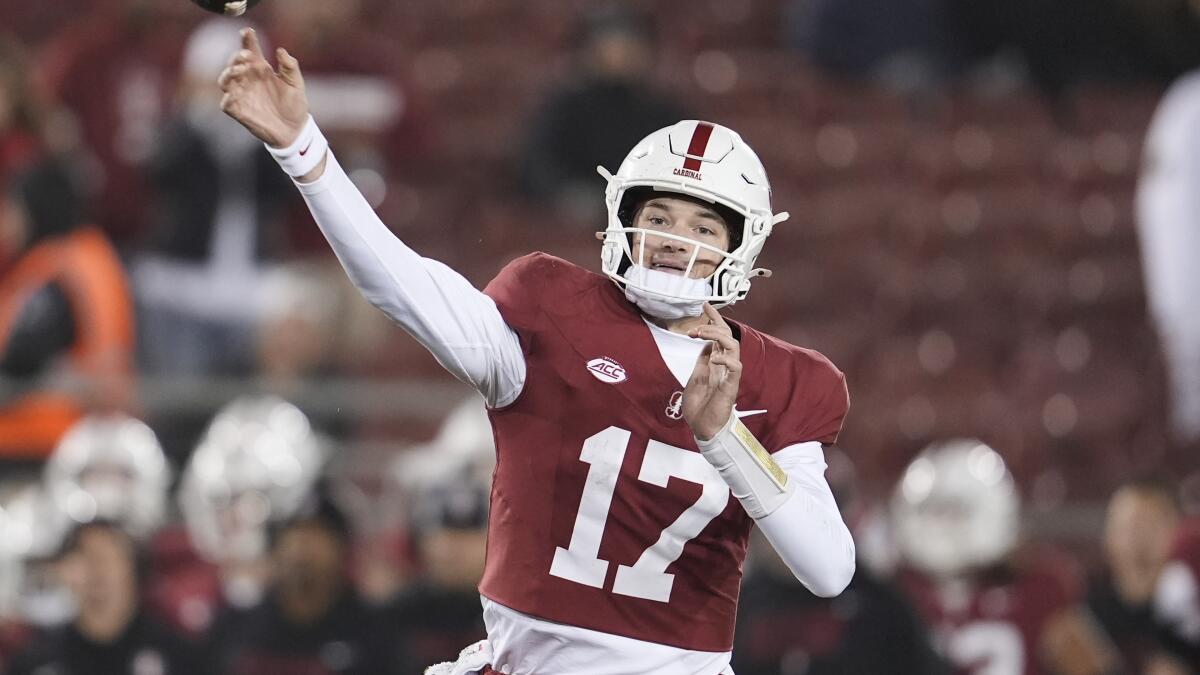
Stanford quarterback Charlie Mirer during a game last season.

Stanford quarterback Charlie Mirer during a game last season.

(Godofredo A. Vásquez / Associated Press)

“The [CSC agreement] has suppressed, deterred, and effectively terminated the economic relationships that had produced his prior NIL compensation,” the lawsuit says.

Even the plaintiffs in the House settlement, which created the CSC, are in the process of challenging the current system. On Wednesday, plaintiff attorney Jeffrey Kessler will argue in a hearing that school-affiliated businesses such as multimedia rights holders or corporate sponsors, should not be subject to the CSC’s rigorous criteria for NIL deals. That decision could also open the floodgates, with schools using those entities to circumvent the cap.

Two U.S. senators are hoping to pass legislation they believe would bring more stability to college athletics and thwart legal challenges. Ted Cruz (R-Texas) and Maria Cantwell (D-Texas) spoke with presidents and chancellors from the Big Ten Conference on Tuesday about a bipartisan bill, the Protect College Sports Act, which would codify some of the CSC’s policies into federal law.

Source link