freshman

New NCAA eligibility rules boost USC, its top recruiting class

During his eight seasons as a head college football coach, Lincoln Riley often faced a frustrating conundrum when it came to playing freshmen: Were a handful of plays at the end of a blowout really worth burning a whole year of eligibility?

“I can remember at times going to a player in the game,” Riley said Tuesday. “‘We can probably play you like five to 10 plays at the end of the game. But if you do that, we can’t play you anymore, or we’re going to have to take your redshirt.’ We’re having to talk about that in-game. … You had to be ready to adjust on the fly.”

But after years of meticulously monitoring that playing time, those adjustments will no longer be necessary, after the NCAA adopted new eligibility rules in June. The new model gives athletes a blanket five years to compete, effectively eliminating the need for redshirts or special waivers. It also could alter how rosters are constructed.

Riley has been calling for the rule change since shortly after he became USC’s head coach. And it is now being implemented at the best possible time for his Trojans.

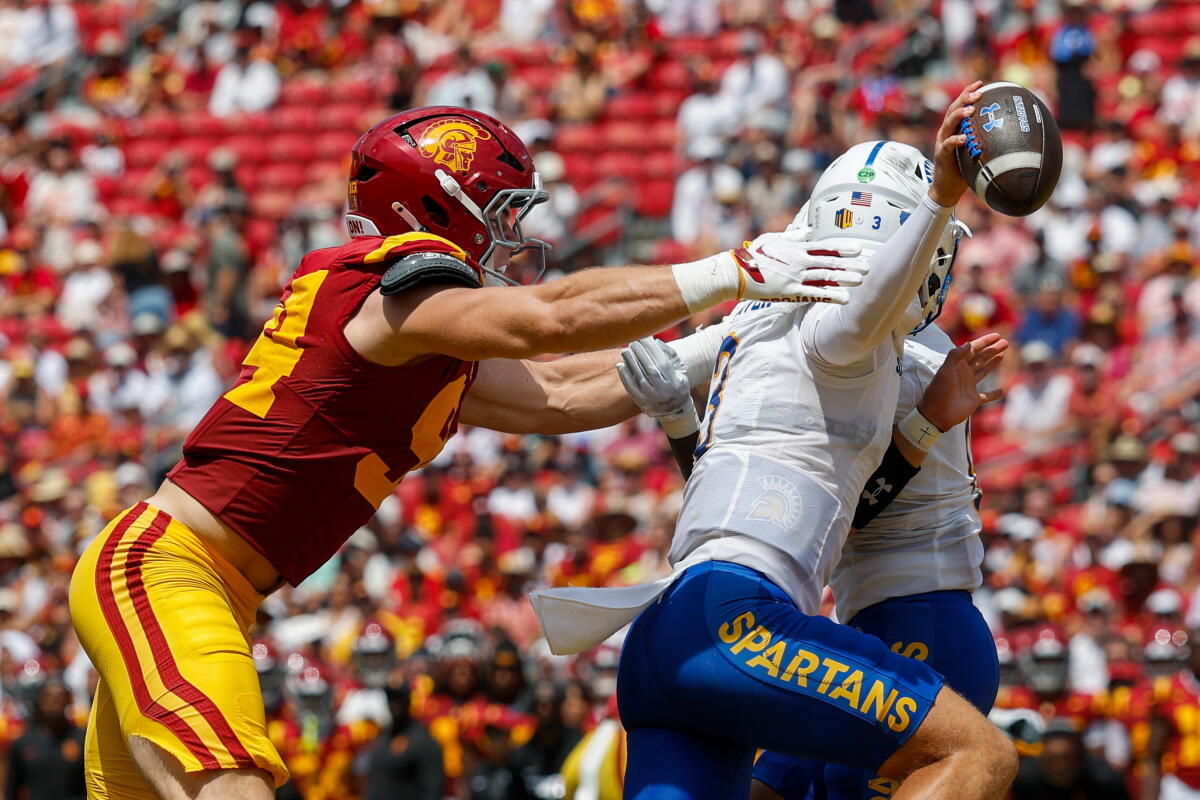
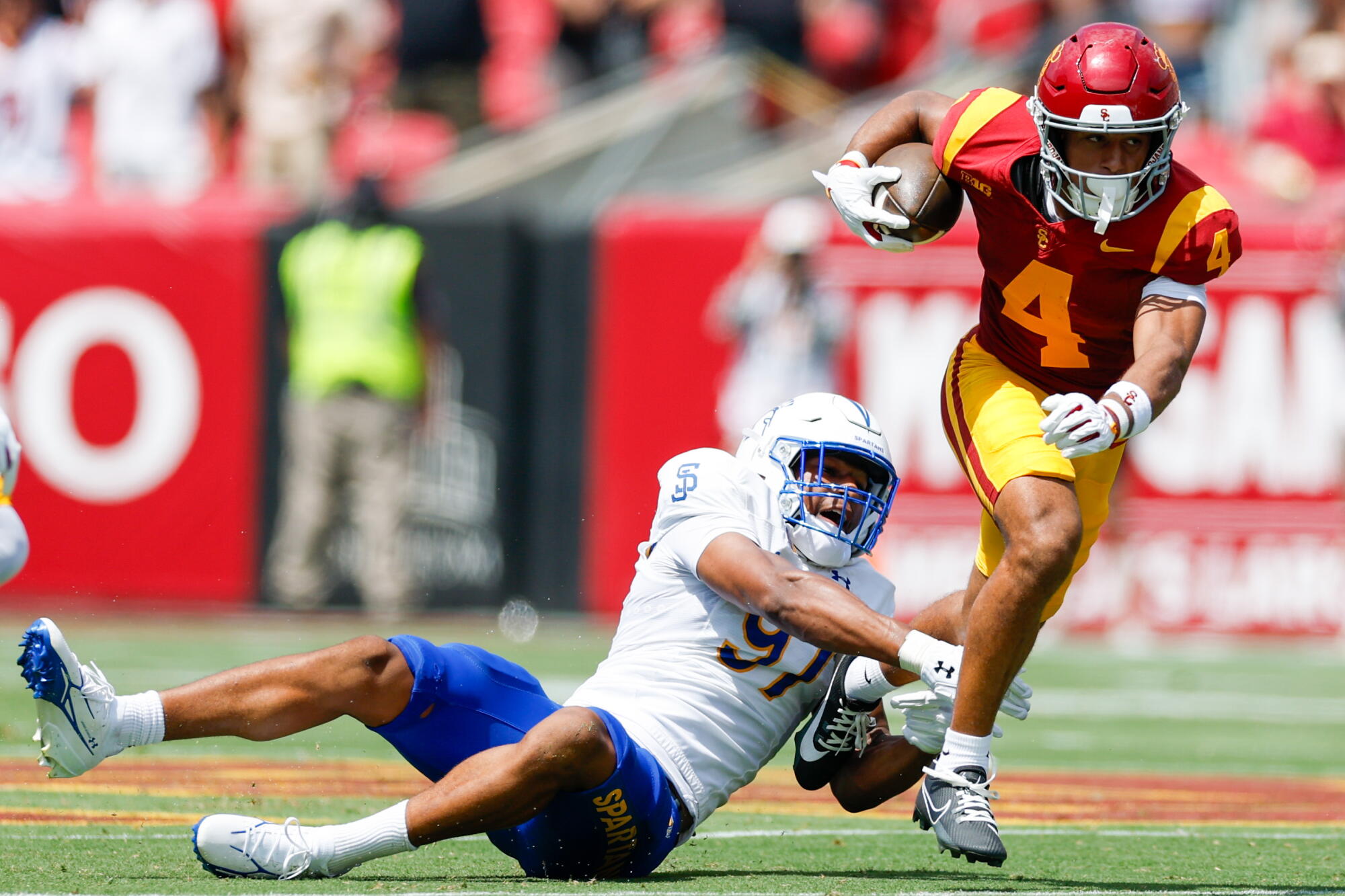
With so many highly touted freshmen from USC’s No. 1 recruiting class sure to see the field this season, there’s no need now for Riley or his staff to look four years into their future while deciding when and how to give them game-day snaps.

“Now you can just make the best decision in the moment,” Riley said. “I think that’s great for the player. … Just play the guys who deserve to play.”

For USC, it means that a fleet of first-year players are sure to see the field, not just during the nonconference slate but beyond, as Riley and his staff feel out which members of the Trojans’ 2026 class could contribute when the schedule suddenly stiffens in late September.

“Any opportunity that we get a chance to play these guys, however it comes out,” Riley said, “you love the fact to be able to do it.”

Some schools could land veteran roster reinforcements as a result of the rule change after a judge granted an injunction allowing anyone in the class of 2022 who would’ve used the fifth year of eligibility to return to claim it. The decision is being appealed by the NCAA. Former USC wideout Jay Fair has indicated on social media that he intends to pursue that route, but as of Tuesday, Fair hadn’t rejoined the program.

The Trojans stand to benefit more than most from the new eligibility rules this season. But Riley does have one issue with the new rule. It currently stipulates that a player’s eligibility clock begins with either their full-time enrollment or the academic year following their 19th birthday, whichever occurs first.

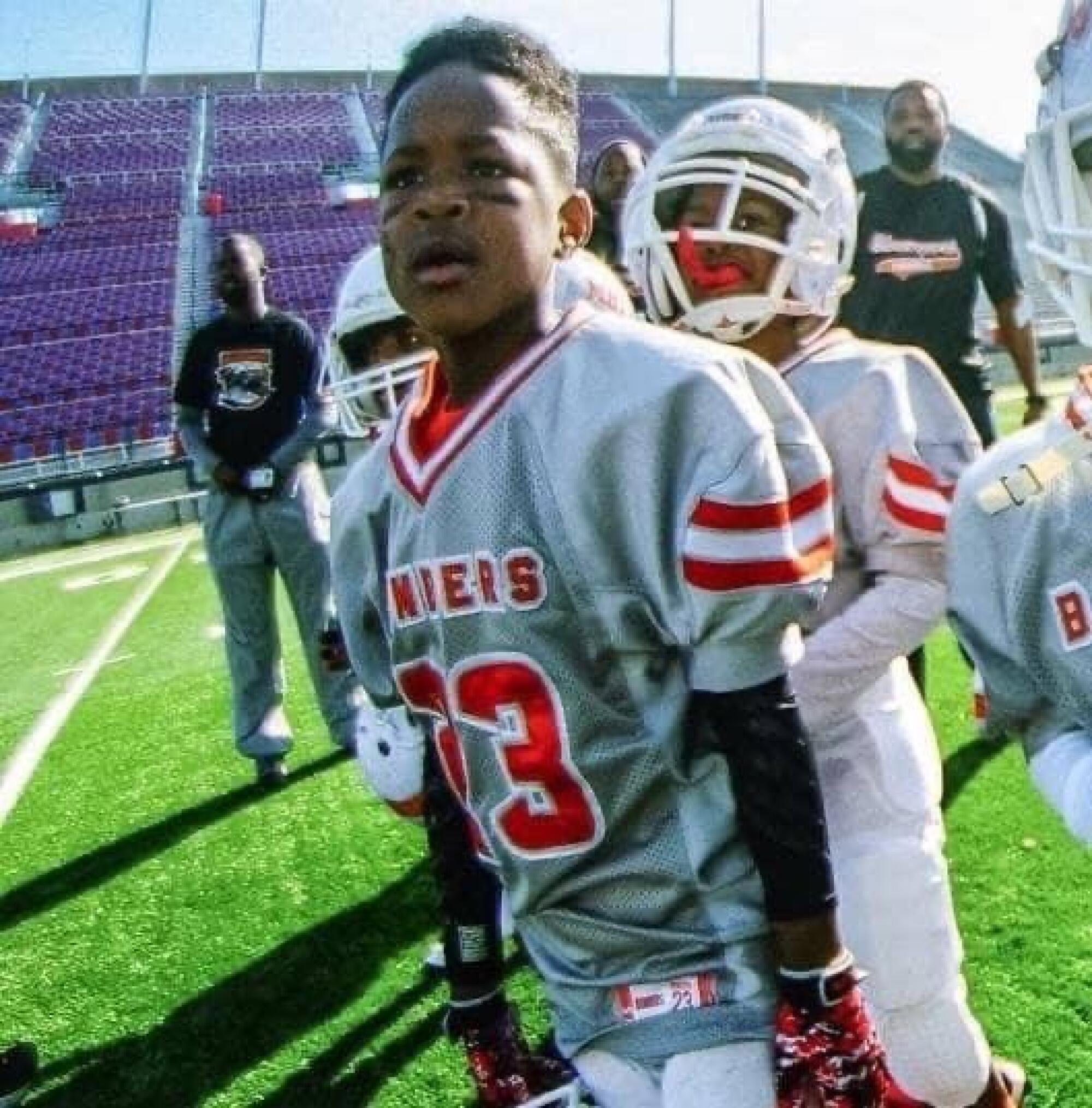
Trent Mosley smiles while leading Santa Margarita to a Division 1 title.

Trent Mosley smiles while leading Santa Margarita to a Division 1 title. Mosley is among the freshmen at USC who will benefit from new eligibility rules.

(Craig Weston)

So as it stands, any freshman with a birthday prior to Sept. 1, 2006, is left with one fewer year to play than their freshmen counterparts.

At USC, that affects two members of the 2026 recruiting class — wide receiver Trent Mosley and safety Madden Riordan.

For Mosley, a former Rancho Santa Margarita star, a fifth year may not ultimately matter. He’s already 20 years old and on track to potentially start in the slot as a freshman.

But USC’s coaches were quick this week to note that the Trojans’ freshmen, no matter how talented, still had some acclimating to do.

“Age is really just a number,” inside receivers coach Chad Savage said of Mosley. “When you’re a freshman and you come into college, there’s a big learning curve, right? Whether it’s playbook, whether it’s everyday life, whether it’s the weight room, whatever it may be, um, I think from a maturity standpoint, he is very mature, but it’s just one step in front of the other, every single day with Trent.”

Tanook Hines, USC’s top returning receiver, was a bit less restrained in his evaluation.

“Trent Mosley definitely stands out,” Hines said. “He seem like a vet, like he’s already been here.”

Riordan, meanwhile, is older than some of the vets on USC’s defense, including junior starting linebacker Desman Stephens, who already has 26 games under his belt at USC. It follows then that Riordan’s football IQ has made an impression with coaches early on.

He’s one of the several freshmen who might have been on the brink of a redshirt, given his weight. But Riordan added almost 15 pounds during the summer to hit 180 and could push for a place in USC’s defensive back rotation.

Riley said he believes Mosley and Riordan — and any other freshmen, for that matter — should get the chance to play all five seasons. No matter how old they are when their college careers start.

“We have a few guys that we are in the process of seeking some clarification and potentially getting some relief on that,” Riley said of the age restrictions. “Our belief is if they’re five for five coming out of high school, they should be five for five. We should keep it simple.

“Hopefully we get to that point.”

Source link

New receivers give Lincoln Riley hope as USC opens fall camp

At the start of his fifth fall camp at USC, Lincoln Riley found himself enamored with all that felt new around him. Namely the state-of-the-art, $200-million facility towering over one end of the Trojans’ practice field, with all the luxuries any football coach could ask for.

“This building is magical,” Riley said. “It’s hard to explain how different, how fantastic it is.”

On the field, in front of that gleaming facility, the Trojans also were breaking in something entirely new on Saturday: their receiving corps.

USC opened training camp this week without the services of its top returning wideout, Tanook Hines, after the sophomore underwent an offseason surgical procedure that has yet to revealed. Riley said the injury affecting Hines, who missed the spring, isn’t “overly serious” and that he’s expected back for the start of the season. But his absence leaves the Trojans with a totally new and unproven group to catch passes; many of them are getting their first experience of college football, and of quarterback Jayden Maiava.

“A lot of new bodies. Fortunately he had spring and all summer with all these guys to start developing that chemistry and that confidence,” Riley said of Maiava. “But that’s going to be something we have to work at every single day.”

Among those new players is a host of top receiver recruits expected to contribute right away. Partly, out of necessity.

Freshmen wideouts Trent Mosley and Kayden Dixon-Wyatt already made a strong impression and should immediately step into roles on offense. Tron Baker is another who presumably could carve out a place. And joining them this week at practice, after just enrolling this summer, is a freshman wideout who some believe will be the best of the bunch, top-60 recruit Boobie Feaster.

It may take Feaster time to get up to speed. Hines stepped into a similar position last season, having just arrived on campus for the summer. He proceeded to start eight games anyway.

But Hines was 19 years old by the start of his freshman season. Feaster just turned 17 in late May — and presumably would be one of the youngest players ever to suit up for USC.

Receiver isn’t the only position at which the Trojans are trending young. USC should get key contributions out of freshmen at tight end (five-star Mark Bowman), on the defensive line (five-star Luke Wafle), in the secondary and, at some point, on the offensive line.

That sort of impact should be expected after bringing in a 35-player class that ranked No. 1 in the nation. It also helps, Riley said, that so much of that class has been enrolled for seven months.

“Having as many midyears made a massive difference; I mean, there’s no question about it,” Riley said. “You can feel some of the confidence level.

“And so the less that we can have new as we go on, the more these guys settle in off the field, the better they play.”

That’s the primary goal over the next four weeks of fall camp. One that Riley already has spent plenty of time focused on, while breaking in the Bloom Football Performance Center

“These first few days in here have honestly been a little bit of a dream,” Riley said. “It’s honestly been hard to get players to go home. I haven’t left this place in five days. I haven’t left the compound.”

Source link

UCLA women embracing tougher standards in title-repeat bid

The UCLA women’s basketball team won its first NCAA championship in April. Now, it’s vying to stay there.

Based on Thursday’s practice, after which UCLA spoke with the media for the first time since its dominant title run, it’s clear that the Bruins intend to remain on top, even with a target on their back and a revamped roster.

Success leaves clues

One would think a defending champion pursuing a repeat would, well, just try to run it back.

But not Cori Close’s bunch.

Entering her 16th season as UCLA coach, Close is emphatic about the importance of process over outcome — or journey over destination — and leaning into the beauty of the grind.

“We get to walk out and live out what we learn from the championship run,” Close said. “But we’re also not trying to repeat a championship outcome. We’re trying to repeat a championship process. And success leaves clues. There are things that we want to make sure we carry over from what we learn.

“But this is a new art project. This is a new identity. This is a new chance. The standards don’t change, but the way we go about it is going to be unique to this team, and that’s really fun to explore.”

The 98%

UCLA coach Cori Close speaks during a news conference on April 4.

UCLA coach Cori Close speaks during a news conference on April 4.

(Ronaldo Bolanos / Los Angeles Times)

Part of the “championship process” Bruins fans can expect to hear about is the “98%.”

Close repeated it. Players repeated it. It’s a mentality Close wants the Bruins to keep in mind throughout the season.

“What I mean by that is 98% of the game is played without the ball,” Close explained. “Can you become a better screener? Can you learn someone else’s tendencies? Can you talk more on defense? Can you become a better rebounder? How many ways can we learn from each other and be better ‘98%’ players? And if we do that, we’ll be on our way.”

Possessing the ball — the two percent — does matter. But players who can thrive without the ball will establish a team that, in Close’s eyes, is one that can be difficult to beat.

Sienna Betts’ role

UCLA forward Sienna Betts, left, speaks to her older sister, UCLA center Lauren Betts before a game in December.

UCLA forward Sienna Betts, left, speaks to her older sister, UCLA center Lauren Betts before a game in December.

(Caroline Brehman / Associated Press)

Sienna Betts, the younger sister of UCLA icon and Washington Mystics rookie Lauren Betts, is set to have a key role this season, especially as a returning sophomore on a team with many new players.

“It’s going to be different,” Sienna said, referencing the Bruins losing six players to the WNBA. “But I mean, I’m excited. And it’s not the first time I’ve been in a position like this; I mean, not at this level, obviously. So, I’m just excited to be in this new role. And I have coaches who are here to help me.

“I’m just planning on doing whatever coach Cori needs from me, whatever the team needs, and, you know, game to game.”

The 6-foot-4 forward is primed to be the Bruins’ anchor in the paint. She demonstrated her leadership during Thursday’s practice as well as some bully ball inside.

Betts, who is left-handed, mentioned her focus on right-handed shooting this offseason, in addition to preparing for increased touches. She averaged six points and four rebounds over 28 games as a freshman. Close said she is improving quickly.

“The younger players have grown into new roles,” Close said. “I think you could see glimpses of that [with] how Sienna’s already started to do that, even maybe ahead of where I thought she’d be at this point.”

Aarnisalo’s return

UCLA guard Elina Aarnisalo controls the ball against Mississippi in the Sweet 16 of the 2025 NCAA tournament.

UCLA guard Elina Aarnisalo controls the ball against Mississippi in the Sweet 16 of the 2025 NCAA tournament.

(Young Kwak / Associated Press)

Elina Aarnisalo, who played for UCLA as a freshman in 2024-25, is back in Westwood after spending her sophomore season with North Carolina.

The 5-foot-10 guard averaged 5.1 points, 3.4 assists and 2.2 rebounds as a freshman, but saw her scoring double (10.2) in Chapel Hill. Aarnisalo, a native of Finland, said she is more confident, not only as a player but also as a communicator.

“Obviously, there’s going to be a lot of spots on the team open now after a big draft class,” Aarnisalo said. “And a lot of seniors leaving, that obviously interested me too. Talking with Cori [about] what my role could be on this team and what we could accomplish this year … just knowing the standards at UCLA, how we practice, how they focus on individual work; I’ve seen it, and I’ve seen my old teammates [and] how they’ve succeeded in this environment, which is why I wanted to come back.”

Aarnisalo averaged 21 minutes per game as a freshman and 27 as a sophomore. She stands a good chance of seeing her playing time increase this season.

New faces, same goal

Former Texas Christian guard Donovyn Hunter is among the new players on the UCLA roster.

Former Texas Christian guard Donovyn Hunter is among the new players on the UCLA roster.

(Tony Gutierrez / Associated Press)

The Bruins will look starkly different next season after essentially exchanging six WNBA-ready players for five enticing transfers.

Those newcomers are Texas Christian guard Donovyn Hunter, Iowa State forward Addy Brown, Arkansas guard Bonnie Deas, Notre Dame guard KK Bransford and Aarnisalo.

“These girls are obviously really talented, come from really different programs,” Betts said. “It takes a second to adjust to coach Cori’s rhythm, and her offense, and just how she runs practice and games. But I think they’re doing a great job integrating in, and they’re all just great human beings off the court and on the court. So, I’m really excited for this group.”

Close admitted she has been very busy following the Bruins’ title win. She had to retool the roster while simultaneously celebrating the previous one.

“Of course, I’m not complaining, but it has been a great challenge and an incredible, intense thing,” Close said. “I mean, literally, the minute after the UCLA women embracing tougher standards in title-repeat bid game, we are on the phone with recruits from the locker room, and the next day, the transfer portal opens. So, I mean, this has been nonstop.”

UCLA’s first test is north of the border

The Bruins will face Canada’s women’s national team in an exhibition on July 22 in Victoria, British Columbia.

While UCLA is far from a polished product, facing Canada’s best is, if anything, a great opportunity to gain even more exposure and improve team chemistry.

“We’re trying to get better. We’re trying to get more physical,” Aarnisalo said. “So we’re going to be in better shape when the actual game starts and the season starts. So it’s an everyday process.”

Bruins forward Timea Gardiner is expected to play in Canada after missing last season as a medical redshirt with a knee injury.

Gardiner, who transferred to UCLA in 2024 after spending two years at Oregon State, averaged 7.6 points, 3.4 rebounds and 18 minutes per game with the Bruins.

Source link

USC freshman linebacker Talanoa Ili joins lawsuit seeking to upend new NIL system

The first serious legal challenge to the House settlement will come courtesy of a USC freshman linebacker.

Talanoa Ili, a top-100 recruit in the Trojans’ vaunted 2026 class, joins Stanford quarterback Charlie Mirer as one of two lead plaintiffs in a class-action lawsuit that takes aim at the system implemented since the settlement ushered in a new era of direct payment from universities to athletes. The suit, which was filed Tuesday, accuses the NCAA, the Power Four conferences and the enforcement arm they created — the College Sports Commission — of participating in a “conspiracy” by creating a system of policies that have “direct anti-competitive effects, including the suppression of [name, image and likeness] compensation below competitive levels.”

Those policies, their attorneys argue, violate state laws in California that prohibit restrictions on NIL rights, as well as federal antitrust statutes. They’re seeking monetary damages, as well as an injunction that would upend the enforcement structure created to determine whether individual NIL deals over $2,500 meet criteria, including whether they have “a valid business purpose” or fall within a reasonable range of market value.

The clearinghouse, NIL Go, was created with the hope of eliminating an influx of booster-funded NIL deals that were basically direct payments from donors to the program. But since its inception, the system has been more restrictive and worked less efficiently than some schools and athletes might have hoped. As of last month, according to Yahoo Sports, more than $125 million worth of NIL compensation that had been promised to athletes had been rejected by the clearinghouse or was still under review.

In Ili’s case, the complaint states that he received a “substantial multi-year offer” from USC’s House of Victory collective in 2024 that led him to commit to the Trojans, only to have the offer disappear after approval of the House settlement.

“Absent the NIL Restrictions on Direct Pay NIL Compensation, Ili would have received more for his NIL rights than he now receives,” the complaint states. “The Agreement has thus injured Ili.”

Mirer, meanwhile, claims that he has received no NIL compensation from Stanford’s collective or revenue-sharing money from the university since 2024 as a result of the settlement.

Stanford quarterback Charlie Mirer during a game last season.

Stanford quarterback Charlie Mirer during a game last season.

(Godofredo A. Vásquez / Associated Press)

“The [CSC agreement] has suppressed, deterred, and effectively terminated the economic relationships that had produced his prior NIL compensation,” the lawsuit says.

Even the plaintiffs in the House settlement, which created the CSC, are in the process of challenging the current system. On Wednesday, plaintiff attorney Jeffrey Kessler will argue in a hearing that school-affiliated businesses such as multimedia rights holders or corporate sponsors, should not be subject to the CSC’s rigorous criteria for NIL deals. That decision could also open the floodgates, with schools using those entities to circumvent the cap.

Two U.S. senators are hoping to pass legislation they believe would bring more stability to college athletics and thwart legal challenges. Ted Cruz (R-Texas) and Maria Cantwell (D-Texas) spoke with presidents and chancellors from the Big Ten Conference on Tuesday about a bipartisan bill, the Protect College Sports Act, which would codify some of the CSC’s policies into federal law.

Source link

Prep talk: Loyola freshman pitcher Sheriff Hall can be a slayer in Division 2 final

Week by week, freshman left-handed pitcher Sheriff Hall of Loyola High has gotten better and better. It sets up for an intriguing Southern Section Division 2 baseball final on Saturday when Hall goes against Ganesha at 5:30 p.m. at the Rancho Cucamonga Quakes’ diamond.

He’s expected to face unbeaten left-handed pitcher Logan Schmidt after the Pomona Unified School District indicated that issues about top Ganesha players participating in an out-of-state camp have been resolved.

Whatever happens, Hall is ready. Coach Keith Ramsey has been preparing him for this moment. Hall is 7-3 with a 2.53 ERA while pitching mostly in the tough Mission League.

If Hall ever needs someone to put together a highlight tape, he knows whom to ask. His father, Jason, is a screenwriter and director who also played a recurring character in “Buffy the Vampire Slayer.”

Let’s see if Hall can be his own slayer on Saturday.

This is a daily look at the positive happenings in high school sports. To submit any news, please email eric.sondheimer@latimes.com.

Source link

Prep talk: Fremont, once best in City Section baseball, plays for Division III title

First-year baseball coach Dino Flores of Fremont High teaches health, and for the entire semester, he had a freshman from Venezuela, Roiber Colmenares, sitting in class.

One day, Colmenares asked Flores a strange question.

“Hey Mr. Flores,” he said in Spanish. “Do you know how I can join the baseball team?”

“Yes I do,” Flores said.

Colemenares told him playing baseball was all he did in Venezuela.

Then Flores had Colemenares show him how to field a ground ball with an imaginary ball in class.

“That’s when I knew we had something special,” Flores said. “Just his movement you could tell he’s a baseball player.”

With Colmenares leading the way, Fremont has advanced to face Hamilton in Friday’s 2:30 p.m. Division III final at Stengel Field. The Division II final will have South East playing Roosevelt at 5:30 p.m. at East Los Angeles College.

“He’s our best hitter and best pitcher,” Flores said of the 5-foot-8, 140-pound freshman.

Fremont used to be a baseball power, having won five upper-division City titles, the last in 1963. There also was a 3A title in 1992.

“The history is well documented,” Flores said.

This is a daily look at the positive happenings in high school sports. To submit any news, please email eric.sondheimer@latimes.com.

Source link

UCLA men’s basketball lands four transfers through portal

Forwards Filip Jovic of Auburn and Sergej Macura of Mississippi State as well as guards Jaylen Petty of Texas Tech and Azavier Robinson of Butler have joined UCLA through the transfer portal, coach Mick Cronin said Wednesday.

Macura will be a junior this fall and has two seasons of eligibility remaining. Jovic, Petty and Robinson will be sophomores and have three seasons left.

Jovic averaged 6.3 points and 4.0 rebounds in all 37 games for Auburn last season, helping the Tigers win the NIT title.

Macura averaged 5.0 points and 4.8 rebounds in 28 games for Mississippi State last season.

Petty averaged 9.9 points, 3.9 rebounds and 2.2 assists in 33 games as a freshman at Texas Tech. He shot 41% from the field and 37% from 3-point range.

Robinson averaged 6.1 points, 1.9 rebounds and 2.5 assists in 22 games as a freshman at Butler. His season ended in early February after a left wrist injury. Robinson shot 47% from the field and 43% from 3-point range.

The foursome join incoming freshmen Javonte Floyd and Joe Philon.

Source link