French Open

Jannik Sinner beats Alexander Zverev to win Wimbledon again

Jannik Sinner is starting to make a habit of responding to adversity in Paris with titles at Wimbledon.

The top-ranked Sinner beat Alexander Zverev 6-7 (7), 7-6 (2), 6-3, 6-4 Sunday for his second consecutive title at the All England Club after his German opponent appeared bothered by a knee injury following a slip to the grass on a key point in the third set.

Sinner’s fifth Grand Slam title came in his first tournament since a second-round meltdown at the French Open, when he wilted in a Paris heat wave.

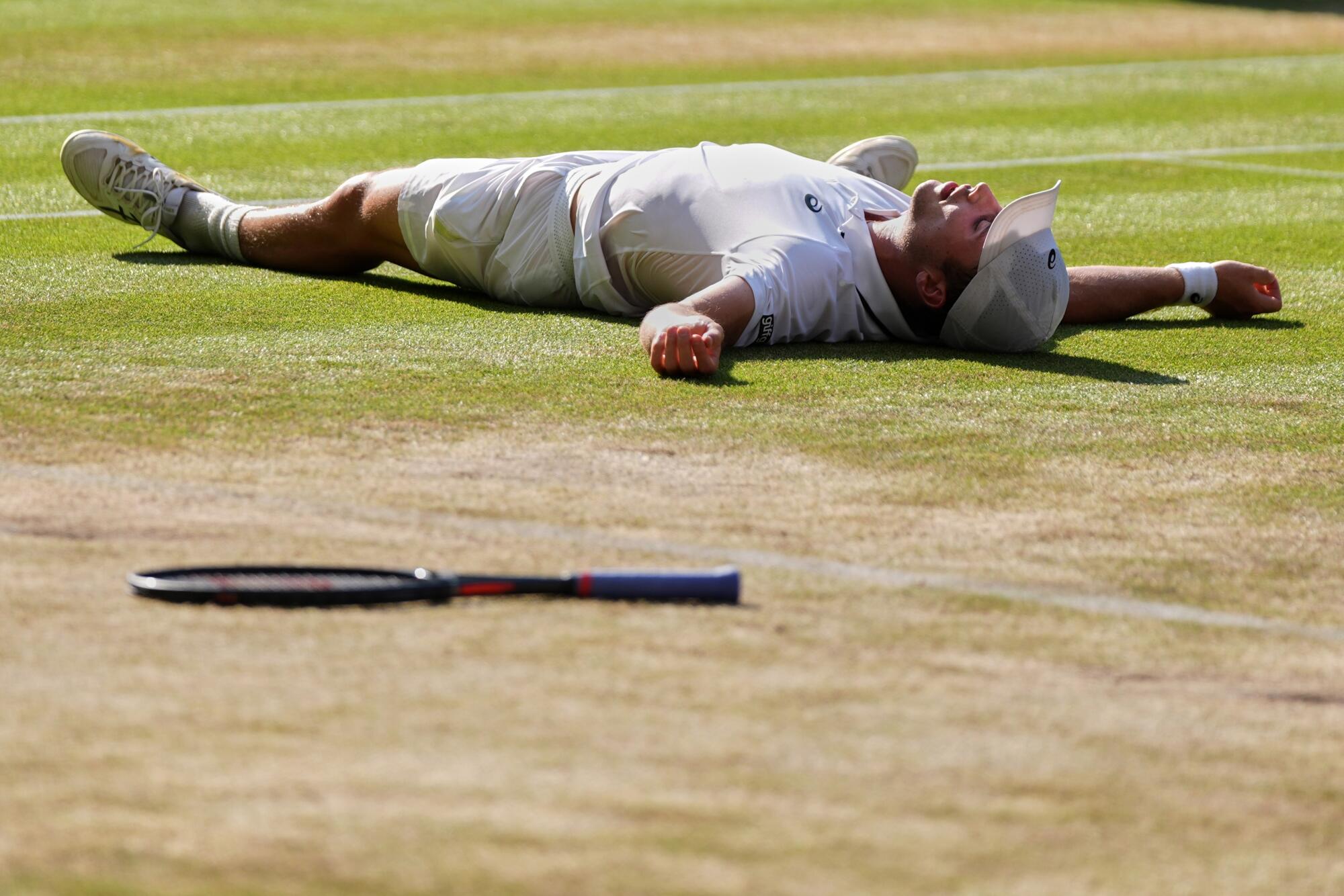
When Sinner ripped a forehand winner up the line on his first match point, the Italian dropped to the grass on his back in celebration.

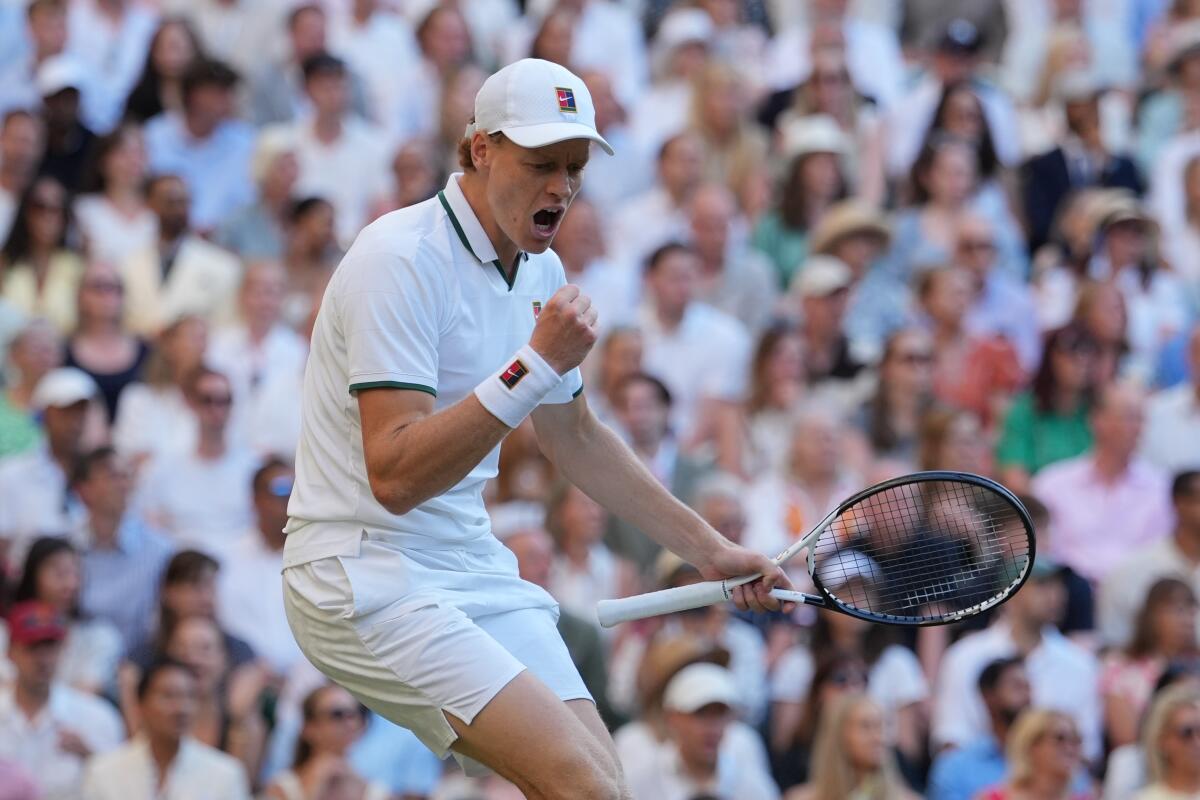
Jannik Sinner celebrates after winning a point against Alexander Zverev during the men's singles Wimbledon final.

Jannik Sinner celebrates after winning a point against Alexander Zverev during the men’s singles Wimbledon final in London on Sunday.

(Kin Cheung / Associated Press)

A year ago, Sinner beat Carlos Alcaraz in the final at the All England Club after wasting three match points against his rival in the Roland Garros final.

It was Sinner’s 10th straight victory over Zverev, who was coming off his first Grand Slam title at the French Open.

Linda Noskova beat Karolina Muchova in an all-Czech women’s final on Saturday for her first Grand Slam title.

Prince William joined his wife Kate and two of their children for the final in a star-studded Royal Box that also included actors Dustin Hoffman, Nicole Kidman and Ben Stiller.

Zverev slips

The top two seeds appeared perfectly matched until Zverev earned his first break point of the match at 3-3 in the third set — 2 hours and 42 minutes in. Sinner produced a drop shot and Zverev slipped and appeared to hyperextend his right knee as he attempted to change directions behind the baseline.

Zverev grasped his knee in apparent discomfort and Sinner went around the net and helped his opponent up off the grass. Zverev quickly resumed playing but he appeared slightly hampered and slung his racket across the baseline in frustration when he missed a forehand and handed Sinner the first break of the match and a 5-3 lead in the third. Sinner then served it out.

Zverev had also lost 14 straight sets to Sinner and when he claimed the opening set of the final with a forehand winner up the line to conclude a tight tiebreaker, he let out a loud roar toward his box as he bent over in celebration.

Zverev continually cranked out serves at up to 139 mph, while Sinner produced a series of well-placed aces at a slightly lower speed.

But Sinner began to read Zverev’s serve better in the second-set tiebreaker and Zverev started to miss forehands.

Jannik Sinner kisses his trophy after defeating Alexander Zverev to win the men's singles Wimbledon title in London.

Jannik Sinner kisses his trophy after defeating Alexander Zverev to win the men’s singles Wimbledon title in London on Sunday.

(Kirsty Wigglesworth / Ap Photo/kirsty Wigglesworth)

Paris meltdown

Amid stifling heat and humidity in Paris in late May, Sinner had his 30-match winning streak ended after coming within one game of a straight-set victory over Juan Manuel Cerundolo, who was ranked No. 56.

Conditions were cooler in southwest London for the final, with clear skies and a temperature of 82 degrees but it was also breezy — which led to a series of shanked shots from both players.

Sinner went in for medical exams in Milan after the Paris defeat and didn’t play an official match again until he arrived at Wimbledon, where he twice had to come back from a set down in a five-set marathon against Miomir Kecmanovic in the first round.

Sinner then didn’t drop a set the rest of the way until the final, having dominated against Novak Djokovic in the semifinals.

Despite the defeat in the final, Zverev will leapfrog Alcaraz into the No. 2 spot in the rankings on Monday.

Alcaraz missed both the French Open and Wimbledon this year because of a right wrist injury.

Women’s doubles

Kristina Mladenovic won a seventh career Grand Slam women’s doubles title by teaming up with Guo Hanyu to defeat Gabriela Dabrowski and Luisa Stefani 6-3, 7-5 in the final Sunday.

Mladenovic has won the French Open doubles tournament four times and the Australian Open twice with different partners but lost her only previous Wimbledon final in 2014.

“It’s really a dream,” said the French player, who missed much of last year with an injury. “I definitely cannot believe what just happened now.”

Mattias Karén contributed to this report. Dampf and Karén write for the Associated Press.
Source link

Arthur Fery’s Wimbledon miracle run puts him on brink of history

A local boy sleeps in his own bed, plays in front of a king and queen and makes a Cinderella run to the Wimbledon semifinals. Sounds like a Hollywood script that might never see the silver screen.

But it’s no fairy tale — it’s Arthur Fery’s out-of-nowhere performance over the last 10 days.

Fery, a virtually unknown British wild card with a triple-digit ranking, has become the emotional heartbeat of Wimbledon while legitimately diverting some national attention from England’s World Cup quest.

The royal treatment at his matches across the All England Club has come in more ways than one.

Fery, who grew up five minutes from Wimbledon and is staying at home during the tournament, first played before grass-court king Roger Federer, Wimbledon’s eight-time singles champion, during Monday’s fourth-round victory. Two days later, he beat No. 9 seed and French Open runner-up Flavio Cobolli of Italy in the quarterfinals 6-4, 7-6 (4), 6-0 in front of Queen Camilla.

Ranked 114th, Fery had never reached the semifinals of an ATP Tour event, let alone a major, before his brief chat with the queen following the match.

“She just said, ‘Congratulations, keep going,’” 23-year-old Fery told reporters later. “I told her it was my birthday on Sunday, so it would be great to play the Wimbledon final on my birthday.”

That’s still a match away. To get there, Fery will have to get past one of the hottest players on tour: No. 2 seed Alexander Zverev, who is fresh off his first Grand Slam title at the French Open. Looming on the other side of the draw is a highly anticipated showdown between defending champion Jannik Sinner against 24-time major winner Novak Djokovic.

If Fery can continue his magical run to the end, he would become the first British wild card to win a Wimbledon title.

Arthur Fery reacts after defeating Flavio Cobolli in the Wimbledon quarterfinals on Wednesday.

Arthur Fery reacts after defeating Flavio Cobolli in the Wimbledon quarterfinals on Wednesday.

(Maja Smiejkowska / Associated Press)

Born in France, Fery’s family moved to Wimbledon when he was an infant. His mother played professional tennis. He was a top British junior but chose to sharpen his game for three years in the U.S. collegiate system at Stanford, as many of his compatriots have done.

“I came out with a lot of hunger coming out of that, and I was ready to attack the pro circuit,” Fery said.

After struggling with bone bruising in his arm that limited him to playing mostly on the lower-tier Challenger circuit in recent years, Fery is finally healthy and playing consistently.

His path to the last four in London has been a masterclass in clutch come-from-behind performances. The Brit has stared down near-certain elimination in multiple matches, repeatedly breaking his opponents’ momentum with Houdini-like on-court acts.

At 5-foot-9, Fery possesses a skill set perfectly suited for low-bounding grass.

His compact strokes, low center of gravity, and elite movement allow him to hug the baseline, take time away from opponents, and confidently execute delicate volleys at the net, according to ESPN analyst Chris Eubanks.

“He defends well,” said Eubanks, a 2023 Wimbledon quarterfinalist. “He can scrap. He can claw. He can dig his way back into points. And when he ventures forward, he’s very, very comfortable at the net. This is a picture-perfect example of someone whose game is built for the surface.”

Still, it’s hard to fathom the multitude of milestones for Fery, who briefly reached the No. 1 ranking in college and earned 2023 Pac-12 Singles Player of the Year honors before leaving early to pursue a pro career.

He arrived at Wimbledon with just one main-draw victory at a major, a losing record as a professional, and only one previous ATP quarterfinal, at Queen’s Club last month. He’s now 11-8, won his first two five-set matches, and is the first British wild card to reach the Wimbledon men’s semifinals in the Open Era. The only other men’s wild-card semifinalist was Goran Ivanisevic, who won the title as a wild card in 2001.

Fery, who started the season ranked No. 185 and will climb to at least No. 36 after the tournament, said there were a “lot of first times” as he reflected on his unprecedented run. “First five-setter, longest match that I’ve ever played, first time breaking into the top 100, first second week in a slam, all at home, five minutes from where I grew up. It’s a great story for me,” he said.

The gap with his fellow semifinalists is understandably massive.

Entering Wimbledon, Djokovic, Sinner and Zverev’s combined records include 29 Grand Slam titles, 2,088 match wins and 155 tour-level titles. Fery was 6-8 in tour-level matches with zero titles.

But he has singlehandedly lifted the tournament for locals. With top hopes Jack Draper and Emma Raducanu withdrawing before the tournament and the rest of Britain’s singles prospects falling one by one — 18 men and women were eliminated by the third round — Fery became the nation’s last knight standing.

If his first name inevitably evokes Arthurian legend, Fery’s march through the draw gave Britain reason to believe again. No sword, no Round Table, just world-class shot-making, a lion’s heart and a Centre Court crowd thrilled to rally behind him.

“This is really quite something to see on home soil,” said Russell Fuller, the BBC’s tennis correspondent, who compared it with Raducanu’s stunning U.S. Open win in 2021 as a qualifier.

Fery earned every bit of it.

In the first round against Damir Dzumhur, Fery dropped the opening set and trailed by a break in the second before surging back. Against Zizou Bergs in the third round, he faced a 4-1 deficit with a double break in the fourth set, and again fell behind 4-1 in the fifth, before somehow surviving.

Then, stepping onto Centre Court for the first time against former top-10 stalwart Grigor Dimitrov of Bulgaria in the fourth round, Fery clawed out of a 2-sets-to-1 hole and a break down in the fourth set to clinch the victory in a fifth-set tiebreak.

“He carries himself with humility, but he’s a fierce competitor, and he’s got a ton of belief in himself,” said Stanford men’s coach and former top-60 player Paul Goldstein, who flew to England Tuesday to see his former charge compete against Cobolli.

While Fery attempts to outmaneuver Zverev on Friday, the other semifinal features a 2025 Wimbledon semifinal rematch between seven-time Wimbledon winner Djokovic and top-ranked Sinner, who defeated the Serb in straight sets on his way to the title. It’s also their second Grand Slam semifinal meeting in 2026. At January’s Australian Open on hard courts, Djokovic bested 24-year-old Sinner in five sets before falling to now-injured Carlos Alcaraz in the Melbourne final.

Arthur Fery hits a return during his Wimbledon quarterfinal win over Flavio Cobolli on Wednesday.

Arthur Fery hits a return during his Wimbledon quarterfinal win over Flavio Cobolli on Wednesday.

(Clive Brunskill / Getty Images)

Djokovic, 39, enters the match after surviving a grueling five-set, 5-hour-plus quarterfinal slugfest against No. 3 Félix Auger-Aliassime that concluded just minutes before Wimbledon’s 11 p.m. curfew. But the seventh-seeded Serb has a way of defying Father Time and he has had two days to recover on a surface where points are shorter and generally less taxing on the body.

Italy’s Sinner, who defeated Alcaraz in last year’s Wimbledon final, has been efficient if not at the level that saw him capture five consecutive titles before crashing out in the second round at the French Open. After a first-round scare here, the four-time Grand Slam champion has dominated opponents behind his improving serve, winning 80% of his first-serve points. He hasn’t dropped a set since the opening round. Sinner leads the head-to-head with Djokovic 6-5.

According to Eubanks, Djokovic must disrupt Sinner’s movement to break his rhythm, and take his chances.

“He’s got to play similar to how he played in Australia, where it was just all-out aggression,” Eubanks said.

For Sinner, he added: “His serve can be a neutralizing force for what Novak is going to try to do.”

On the other side of the ledger, Fery’s poise under pressure and deft use of the home crowd will be paramount to continue his surprise run against Germany’s Zverev, whom he called a “step up again” from his last five matches. Zverev, 29, is seeking his fifth major final and first at Wimbledon.

“I’m ready for it,” Fery said. “I have nothing to lose. I’m just going to go out there and … put my game on the court, do what I’ve done, believe in myself. We’ll see where that takes me.”

Home has never been closer to Centre Court. Nor has Arthur Fery ever been closer to tennis history.

Source link

Teenager Mirra Andreeva wins French Open for first major victory

Russian teenager Mirra Andreeva was already a tennis phenom at age 15.

At 19, she’s a Grand Slam champion.

The eighth-ranked Andreeva ended the run of 114th-ranked Polish qualifier Maja Chwalinska by 6-3, 6-2 in the French Open final on Saturday.

Andreeva became the youngest player to win the women’s singles title since Monica Seles, who was 18 when she landed her third straight French Open in 1992.

“You’re so young and talented. It’s so annoying,” Chwalinska told Andreeva during the awards ceremony.

When Andreeva executed a backhand cross-court winner on her first match point, she threw her racket into the air and dropped on her knees to the clay to celebrate.

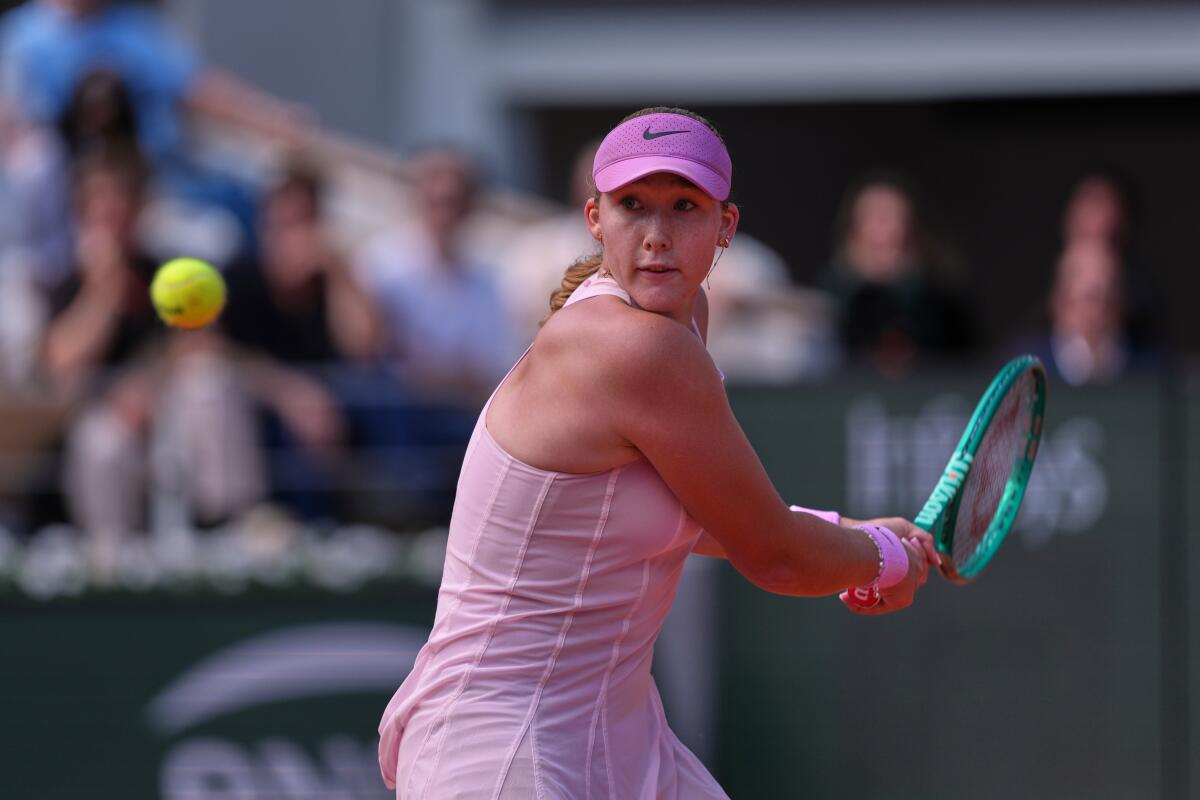
Mirra Andreeva returns a two-handed backhand shot

Mirra Andreeva returns a shot against Maja Chwalinska during the French Open women’s final on Saturday.

(Thibault Camus / Associated Press)

During the trophy presentation, Andreeva took the unusual step of thanking herself “for believing in myself, always giving my 100%, even when it’s tough, trying every day to be better as a person and as a player, believing that I can do this, fighting so many demons inside of me.

“Only I know how tough it was for me,” Andreeva added. “How nervous I was throughout these two weeks.”

Chwalinska was attempting to become the first qualifier to capture the Roland Garros title.

Andreeva was born in Siberia and moved to Sochi and eventually France to develop her tennis career.

She drew loud applause from the crowd on Court Philippe-Chatrier when she spoke a few words of French during the trophy presentation.

“Thanks for your support today and over these past two marvelous weeks here in Paris,” Andreeva said. “It was very important for me.”

Alexander Zverev plays Flavio Cobolli in the men’s final on Sunday to conclude the wildest Grand Slam in recent memory.

Andreeva has been considered a Grand Slam contender since she burst onto the scene as a 15-year-old at the 2023 Madrid Open, where she became the third-youngest player to win a main draw match at a WTA 1000 tournament and made the quarterfinals.

Lately, Andreeva has had to contend with playing under neutral status and without her country’s flag due to the war with Ukraine.

When she beat Marta Kostyuk in the semifinals, Kostyuk refused to shake her hand, as has been the custom for Ukrainian players facing Russians ever since the war started in 2022.

Andreeva has gone a step further than her coach, Conchita Martinez, who lost the 2000 French Open final to Mary Pierce.

Pierce presented the winner’s trophy to Andreeva.

The final was played under mostly sunny skies but wind was a factor in the first Grand Slam final for both players.

Chwalinska double-faulted on the opening point of the match but she was the first player to hold serve in the fifth game for a 3-2 lead.

But then Andreeva won nine straight games to take control as she found a way to hit through the wind and answer Chwalinska’s array of spins and drop shots.

Andreeva produced 25 winners to Chwalinska’s 10 and also had fewer unforced errors: 26 to 29.

There was a strong Polish presence in the crowd.

When Chwalinska was introduced, fans held aloft red-and-white Polish flags and chanted her name: “Ma-ja, Ma-ja.”

Andreeva had little support from the crowd, although there was a shout of “Davai Mirra!” (“Go Mirra”) in Russian late in the match.

In men’s doubles, top-seeded Marcel Granollers and Horacio Zeballos retained their title with a 6-4, 6-2 win against Harri Heliovaara and Henry Patten.

Dampf writes for the Associated Press. Samuel Petrequin contributed to this report.

Source link

Naomi Osaka’s French Open fashion statements depend on wins to matter

“Dress shabbily and they remember the dress; dress impeccably and they remember the woman.” ― Coco Chanel

Apropos of Paris. Apropos of the French Open.

That’s all the context necessary to appreciate Naomi Osaka removing a ceremonial black skirt and sleeveless beaded bodice ahead of her opening match at the Roland-Garros Complex this week, revealing a sequined gold playing dress.

Osaka was playing all right. With sensibilities. With tradition. With her opponents, who she summarily dispatched with victories in the first and second rounds.

Naomi Osaka in a flowy pleated black skirt atop a shiny tennis dress, holding up a tennis racket

Naomi Osaka arrives on Court Suzanne-Lenglen to play her singles match against Laura Siegemund.

(THOMAS SAMSON/AFP via Getty Images)

And it was clear the four-time Grand Slam champion was playing with all of us when she said of her dress, “It’s very couture. You know the Eiffel Tower at night when it’s sparkly? I kind of think I look like that a little bit.”

Countless LinkedIn pages spout something about residing at the intersection of sport and fashion. Osaka locates that intersection at tennis tournaments worldwide, looks both ways and boldly steps into the street.

Last year at the U.S. Open she adorned her ponytail with red roses and attached a Labubu to her tennis bag that she named Billie Jean Bling.

At the Australian Open in January, she entered the court in a tie-dye turquoise and green palette with flowing tendrils. Her face was concealed by a veil, a wide-brim hat and a white parasol that she said was inspired by an image of a jellyfish that excited her 2-year-old daughter.

Naomi Osaka in a white wide-brimmed hat with a veil, white wide leg flowy pants and holds a white parasol with stairs behind

Naomi Osaka walking onto the court in a jellyfish-inspired ensemble ahead of her first-round match at the 2026 Australian Open in Melbourne.

(Quinn Rooney/Getty Images)

It’s all great fun. Yet continued fashion statements depend on her performance on the court. Osaka wins, she earns another grand entrance. She loses, nobody cares what she wears on the ride home.

At the U.S. Open, Osaka shined, reaching the women’s singles semifinals. Seeded as an also-ran at No. 23, she upset Coco Gauff and Karolina Muchova before falling in a tight three-set match to Amanda Anisimova.

Seeded No. 16 in Australia, she won two matches before withdrawing because of an abdominal injury suffered during her three-set victory against Sorana Cîrstea.

Fast forward to the French Open. Osaka advanced to the third round for the first time in seven years Thursday with a 7-6 (7/1), 6-4 win against Croatia’s Donna Vekic and will take on teenager Iva Jovic on Saturday.

What she will wear walking in is anybody’s guess. An effortless chic aesthetic courses through Paris. Advancing to the French Open round of 16 for the first time would require the opposite, Osaka toiling through another step in her return to form after giving birth to her daughter.

And creating another opportunity to have fun with fashion.

Source link

Europe copes with record-breaking spring heat wave

May 26 (UPI) — Western European countries are caught up in an extreme and early heat wave in late May, with temperatures breaking records and officials warning of health risks.

In Great Britain, London broke heat records Monday and again Tuesday, with Monday marking the hottest May day on record when it hit 94.6 degrees Fahrenheit (34.8 degrees Celsius), two whole degrees higher than the previous record, CNN reported.

Tuesday temperatures reached 95 degrees (35 degrees Celsius). The average high temperature for this time of year is about 68 degrees (20 degrees Celsius).

The country experienced a “tropical night” Monday, which is one in which the temperature doesn’t fall below 68 degrees (20 degrees Celsius).

Not many people in Great Britain have air conditioning – about 5% percent, CNN reported. The UK Climate Change Committee said in a report last week that the country was “built for a climate that no longer exists.”

France is experiencing a similar heat wave, with temperatures regularly exceeding 86 degrees (30 degrees Celsius). Monday was also the country’s hottest May day on record. Officials said about seven people have died since Saturday due to issues caused by the heat, The New York Times reported. At the French Open, organizers installed water misters to help sweltering fans.

In Spain, the trend continues. While the country is more used to hotter temperatures, they may reach 104 degrees (40 degrees Celsius) later this week, the country’s weather service said.

Source link