free skate

American Alysa Liu rides wave of joy to Olympic gold medal

She flipped her hair. She shrugged. She dusted her hands off.

Alysa Liu makes winning an Olympic gold medal look easy.

The 20-year-old became the first U.S. woman to win the Olympic singles title since 2002, electrifying the crowd at Milano Ice Skating Arena with her “MacArthur Park” program Thursday and overtaking Japanese rivals Kaori Sakamoto and Ami Nakai, who won second and third, respectively.

Liu scored a monster 150.20 points in her free skate, the highest mark for a women’s free skate all season in international competition to win by a total of 1.89 points. Her choreographer Massimo Scali’s jaw dropped when he heard the score read in Italian. A beat later when the screen caught up to the public address announcement in the stadium, Liu nodded confidently and cracked a subtle smirk.

American gold medalist Alysa Liu hugs Japanese bronze medalist Ami Nakai after their final scores were revealed.

American gold medalist Alysa Liu hugs Japanese bronze medalist Ami Nakai after their final scores were revealed at the Winter Olympics on Thursday in Milan.

(Jamie Squire / Getty Images)

She doesn’t care about the scores.

Liu, who grew up in Oakland, has floated through her second Olympics as if she had not a single care in the world. A two-year retirement during which she climbed Mt. Everest, got her driver’s license and started college at UCLA made skating feel inconsequential. Now so unbothered, Liu spent part of her six-minute warmup cheering on teammate Amber Glenn in the leader’s chair. Minutes before taking the ice, Liu snapped a selfie with her coaches. She gives her coaches a high-five right before taking her starting position.

“She’s not like us,” her coach Phillip Diguglielmo said. “The rest of us here would be like, ‘Oh my God, I’m nervous. Oh, I can’t do this. I have a million voices in my head.’ She has one voice in her head, and it says, ‘I got this.’”

The only emotions Liu felt during her program were “calm, happy and confident.” When she sees the faces in the crowd smile, Liu said she can’t help but smile, too. And there was a lot of smiling. Her Donna Summer disco program had fans clapping within the first minute. Diguglielmo and Scali held their hands overhead to join the roar. Liu’s pre-program message to the crowd on the video board was “Y’all better turn up!”

Liu, who won the 2025 world championship with the same crowd-pleasing program, returned to the sport in 2024 with the sole objective of sharing her art. She wanted to make as many programs as possible. Winning never seemed to matter. With the gold medal hanging around her neck, Liu stopped short of saying she even wanted it. She surely didn’t need it, she said.

“What I needed was the stage,” Liu said. “And I got that.”

Once Liu processed the final scores, she rose to her feet and turned toward Nakai, clapping for the 17-year-old. Nakai, skating in her first Olympics, was shocked. She held up three fingers to Liu, asking if she had finished on the podium. Overjoyed, they hugged. Liu picked Nakai, who had entered the free skate in first place, up off the ground.

Sakamoto was less than a point ahead of Liu entering Thursday’s free skate, but small mistakes from the three-time world champion, in addition to Liu’s strong technique and infectious energy made Liu the first U.S. woman to win the Olympic gold medal since Sarah Hughes in 2002. The United States’ 20-year drought without a medal — since Sasha Cohen took silver in 2006 — was the country’s longest.

Liu held her palms up in disbelief after finishing the program of her life that put her in the lead with two competitors remaining. She leaned into the camera and pointed to the piercing on the inside of her upper lip. She did it herself.

With blond horizontal stripes dyed in her dark brown hair, bold black eyeliner and the smiley lip piercing, Liu has cut an alternative path to the top of a sport that long valued a specific kind of femininity. But the slick back bun, classical music and balletic dress was not Liu’s brand.

Her brand is joy.

And now as just the second figure skater in history to win two Olympic gold medals at the same Olympic Games — joining U.S. star Nathan Chen — Liu has the stage, and the attention, to display her joy for the next generation of athletes.

“People will be able to see how she approaches the sport now versus before and see how much more successful it is now in a healthy way,” Glenn said. “And I’m hoping people can really learn from that.”

Glenn got redemption after the short program, putting up a season’s best 147.52 during her free skate that vaulted her from 13th to fifth with a 214.91 total score. The only blemish was when Glenn put one hand down on her final jump — the same triple loop that cost her in her short program. But as she held one leg behind her during a spiral in her last sequence, Glenn smiled as she looked into the crowd. After the program, she whipped her fist through the air triumphantly.

The performance put a positive punctuation mark on Glenn’s winding Olympic journey. She has faced intense scrutiny at the Games. The same pressure that consumed Glenn and teammate Ilia Malinin could not even touch Liu’s glowing aura.

When asked Thursday if she felt any “Olympic pressure,” Liu smiled.

“You would have to explain what Olympic pressure is,” she said.

Then she bounced away, the gold medal around her neck blending perfectly with her gold dress.

Source link

Alysa Liu shines, while Amber Glenn makes big mistake in figure skating

She’s the only U.S. skater still in medal contention. Alysa Liu is the last person to care.

The unbothered 20-year-old is the only American who finished in the top six of the women’s short program Tuesday and is holding the weight of an Olympic medal drought that’s as old as she is. But after placing third in the short program, she said she hadn’t even looked at the standings. She is angling more for an invitation to the post-competition gala than a medal.

“A medal?” Liu asked with a sarcastic scoff and giggle. “I don’t need a medal. I just need to be here, and I just need to be present. And I need people to see what I do next.”

Next will be the women’s free skate Thursday, where Liu will try to be the first U.S. woman to stand on an Olympic podium for singles figure skating since Sasha Cohen in 2006.

The United States entered the Milan-Cortina Games with three strong contenders to end the drought, but will need comeback performances from the other two “Blade Angels.”

Alysa Liu strikes a pose with her left arm overhead and right arm outstretched to the right.

Alysa Liu is the top hope for the U.S. in women’s singles figure skating after finishing third in the short program.

(Robert Gauthier / Los Angeles Times)

Isabeau Levito skated cleanly in her Olympic debut but finished the short program in eighth with 70.84 points, almost eight points back from leader Ami Nakai’s 78.71.

Amber Glenn appeared poised to join Liu in medal contention after she started her “Like a Prayer” program with a steady triple axel. Looking inspired from a good luck message from Madonna this week, Glenn executed a strong triple-triple combination with her second jumping pass. The crowd at Milano Ice Skating arena roared.

Then Glenn popped her last planned triple jump. She earned zero points on the element. Her face fell immediately.

Glenn went through the motions of her step sequence but she looked lifeless, and after her program, she clutched the necklaces on her burgundy lace dress and knelt at center ice. She broke down in tears when she hugged her coach.

“I had it,” Glenn said through sobs.

With 67.39 points in 13th place, the three-time national champion is well outside the medal race led by Nakai and three-time world champion Kaori Sakamoto, who is in second with 77.23 points. Levito, skating in her mother’s hometown and paying homage to iconic Italian actress Sophia Loren with her short program, is less than six points out of podium position behind Liu’s 76.59 points.

Snoop Dogg and Martha Stewart, wearing bedazzled headphones in a booth at the top of the arena, were shown on the video screen after Glenn’s skate clapping for her performance. U.S. teammate Ilia Malinin cheered behind them.

Malinin could empathize as Glenn held back tears on the ice. The United States won the team figure skating competition with a dramatic one-point victory but hasn’t secured any of the individual gold medals that appeared likely. Malinin, whose free skate collapse was one of the most stunning moments of the Milan-Cortina Games, cited the intense Olympic pressure.

Isabeau Levito competes during the women's short program Tuesday.

Isabeau Levito competes during the women’s short program Tuesday.

(Robert Gauthier / Los Angeles Times)

After a shaky performance in the team competition, Glenn tried to escape the spotlight by training with U.S. teammates at a facility in Bergamo, 50 minutes outside of Milan. She tried to commit to rest and recovery and shy away from social media. She said after training Monday that she felt physically strong and had refocused enough to make the competition feel like any other world championship.

Knowing how hard it was for Glenn to get one jump away from putting herself into medal contention made the sight of her mistake all the more painful for Liu.

“She works so freaking hard,” Liu said after seeing Glenn’s skate on TV screens in the interview area. “Genuinely, such a hard worker, and she’s overcome a lot, and I just want her to be happy.”

Liu received some of the loudest applause of the night. Before beginning her program, she skated by the boards and high-fived both of her coaches, who hugged and hopped for joy when Liu executed her tricky triple lutz-triple loop combination jump. After hitting her ending pose, Liu covered her face to hide the tears that often well up in her eyes after her program set to “Promise.”

The reigning world champion returned to her second Olympics seemingly oblivious to any sort of pressure after a two-year retirement changed her perspective on skating. In Beijing, she was a 16-year-old who skated as she was told. She executed the jumps, performed to the music and wore the costumes that she was given.

But she laid the road to Milan all by herself and on her own terms.

One strong free skate away from her first individual Olympic medal — and second overall after helping the United States to team gold last week — Liu can’t be bothered to fret about how she’ll prepare for her last Olympic competition. Instead, she said she wants fans to see her new gala program.

A new dress just arrived and the choreography is almost done. All she needs is an invitation.

Source link

Ilia Malinin’s collapse: Olympics are a different kind of pressure

When she skated, Tara Lipinski was always nervous. But it was different before the free skate of the 1998 Olympics. The teenager cried that morning. She called her parents after the six-minute warmup and said she couldn’t do it. Her legs were physically shaking in her beginning pose. She didn’t know what to do.

“When you go to the Olympics, there’s no training for that,” said Lipinski, now an analyst for NBC. “You don’t know what it’s going to feel like ‘til you’re actually feeling it.”

The awe-inspiring dream that often starts as a child can quickly turn into a nightmare for athletes who get blinded by the bright Olympic spotlight. While Lipinski realized her dream, becoming Olympic champion in Nagano, she knows the suffocating feeling of competing under the Olympic rings.

She knows the stress that devoured Ilia Malinin on Friday in Milan.

Malinin’s meltdown from favorite to eighth place underscored the unpredictability of the Olympic stage. The 21-year-old dubbed “the Quad God” was supposed to unleash the first quadruple axel in Olympic history. The four-and-a-half twisting jump he successfully executed when he was 17 has been the talk of the Olympic cycle.

Battling nerves and the conditioning needed for a long Olympic competition, he didn’t use it during the team competition or his individual short program. The free skate would be the last opportunity. It felt like the perfect coronation for the soon-to-be Olympic champion.

Then he bailed midair.

“I think that, for me, I would be like, ‘Oh, man, I just missed what everyone was waiting for,’” Lipinski said. “You go through that minute of being rattled and you have to come back to [the program]. … The next jump [he] wasn’t able to completely reset and shake it off. And then once that next mistake happened — and for Ilia, who doesn’t make mistakes — I think that was probably very difficult for him.”

The standing-room-only crowd gasped when Malinin gave up on the quad axel. Fans grew more uneasy when he fell two jumps later. They tried to urge him on as the mistakes piled up. Instead of joyful encouragement, the clapping felt like desperation in the arena.

Ilia Malinin falls during his free skate at the Milan-Cortina Games on Friday.

Ilia Malinin falls during his free skate at the Milan-Cortina Games on Friday.

(Robert Gauthier / Los Angeles Times)

Eight years ago, when Nathan Chen bent under the Olympic pressure in Pyeongchang, the crowd’s gasps each time he stumbled through his short program only made one of the hardest moments of his career even more difficult.

“That just hurts you to your gut,” Chen said in a video for Yahoo Sports. “You get up and mentally you have to refresh … but also the energy just changes in the arena. You can tell there’s tension now.”

Chen, then 18 years old in his Olympic debut, bounced back in a fearless free skate that moved him into fifth overall. He became almost unbeatable for the next Olympic cycle. At the Beijing Games, he set the world record for the short program, exorcised the demons from 2018 and became the United States’ first Olympic gold medalist in men’s singles in 12 years.

Malinin was a contender to be at those Games four years ago. He finished second in the 2022 U.S. championships, but was left off the Olympic team in a controversial decision. Then just 17, he was only in his first full season of senior competition.

But Malinin was already poised to be the future of the sport. Simply going to the Games as an understudy to Chen’s leading role would have been valuable experience.

Instead, U.S. Figure Skating selected third-place finisher Vincent Zhou and fourth-place Jason Brown.

Sitting with his coaches while waiting for his score Friday, a frustrated Malinin said if he had been sent to Beijing, he “wouldn’t have skated like that.”

“It’s not easy,” he said as cameras zoomed into his face.

He shrugged. He reset.

“It’s done,” he said.

“I think if I went to ’22 then I would have had more experience and know how to handle this Olympic environment,” a composed Malinin said in the mixed zone interview area. “But also, I don’t know what the next stages of my life would look like if I went there. So now all I can do is just regroup from this and really just take in the information that happened and just figure out how to manage in the future.”

Malinin has said he wants to skate for three Olympic cycles. The first attempt ended in shattering disappointment. That could only make the comeback sweeter.

“He will dominate the sport for years to come,” Lipinski said. “This was a huge, obviously, heartbreak for him, but we will see him rise again.”


Source link

Ilia Malinin talks crippling anxiety that cost him an Olympic medal

He popped the quad axel. He stumbled across the ice. He tried to hide the pained expression.

Ilia Malinin fell apart in the men’s free skate, tumbling from near lock to win the gold medal to eighth place after a disastrous performance Friday. After his music ended, Malinin covered his anguished face. He put his hands on his knees, shook his head in disbelief and scrunched his face, hoping to hold back the tears.

It was the first time since November 2023 that he hadn’t won a competition.

“I just thought that all I needed to do was go out there and trust the process that I’ve always been doing with every competition,” Malinin said with tear-stained cheeks. “But, of course, it’s not like any other competition. It’s the Olympics.”

American Ilia Malinin reacts after stumbling through the men's singles free skate at the Winter Olympics on Friday.

American Ilia Malinin reacts after stumbling through the men’s singles free skate at the Winter Olympics on Friday in Milan.

(Robert Gauthier/Los Angeles Times)

Malinin skated four times at the Milan-Cortina Games, helping the United States to a team gold medal with a clutch free skate that clinched the one-point win. But the 21-year-old had just one clean skate in his first Games experience. He explained his slow start during the team event as “Olympic nerves.”

There was no explaining away Friday’s flop.

“I think people only realize the pressure and the nerves that actually happen from the inside,” said Malinin, whose technical advantage was supposed to be insurmountable for his opponents. “It was really just something that overwhelmed me. I just felt like I had no control.”

After Malinin’s score was announced, Kazakhstan’s Mikhail Shaidorov covered his mouth in shock. He was the new Olympic champion. Shaidorov claimed his country’s first Olympic gold in figure skating. His coach held his arm up like a boxing champion as a legion of Kazakh fans seated in the corner above the kiss-and-cry booth where skaters wait for their score waved their country’s teal and yellow flags. Malinin hugged him. He pointed to Shaidorov’s chest.

“You deserve it,” Malinin said.

Japan’s Yuma Kagiyama shook off several falls in his program to fight for his second consecutive Olympic silver. His countryman Shun Sato was in tears after learning he took the bronze.

Ilia Malinin's father, Roman Skorniakov, holds his head in his hands during his son's stumbles at the Olympics

Ilia Malinin’s father, Roman Skorniakov, reacts during his son’s performance at the men’s singles free skate at the Winter Olympics on Friday in Milan.

(Robert Gauthier/Los Angeles Times)

The United States’ Andrew Torgashev finished 12th with his season’s best 259.06-point total. Maxim Naumov stumbled through several jumps in his free skate to finish 20th overall with a 223.36 point total. The 24-year-old who lost both parents in a plane crash last year earned a standing ovation from actor Jeff Goldblum, who was in the stands behind the judges.

As the groups progressed toward the medal contenders, the crowd filled Milano Ice Skating Arena to the brim. Fans in suites in the rafters leaned over glass panes to get a better look. Volunteers and arena workers stood at the top of the concourse with no open seats left to claim.

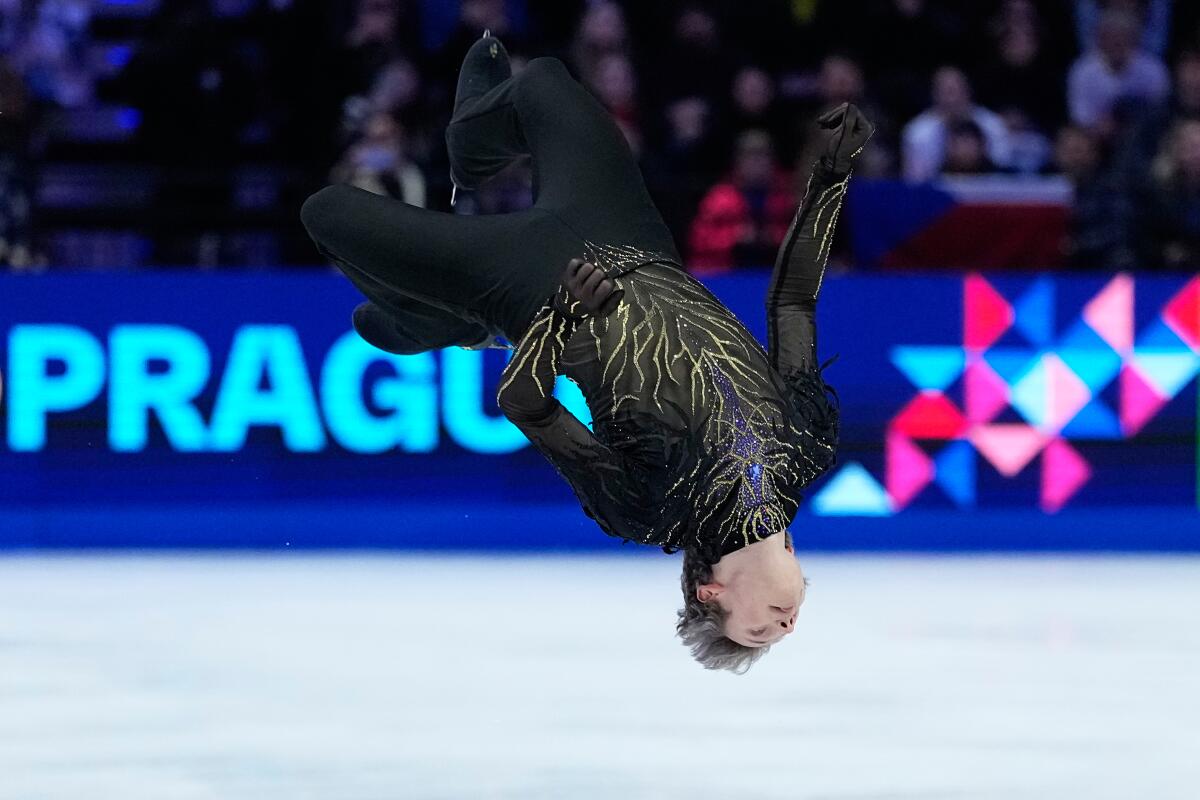
While rising to the top of the sport with his stunning jumps and crowd-pleasing backflip, Malinin said his mission was to boost the popularity of figure skating to get this kind of attention outside of just the Olympic stage.

But standing at the center of the ice as fans waved U.S. flags from every corner, Malinin, the “Quad God” who looked invincible just three months ago when he became the first person to land seven quadruple jumps in one program, felt scared.

“Especially going into that starting pose, I just felt like all the just traumatic moments of my life really just started flooding my head,” Malinin said. “It was just like so many negative thoughts that just flooded into there, and I just did not handle it.”

He started off the program with a strong quad flip. Then he bailed mid-air on his signature quad axel that he had yet to attempt in the Olympics. The crowd gasped. Panic started when Malinin downgraded a planned quadruple loop to a double two jumps later.

American Ilia Malinin falls while competing in the men's singles free skate at the Winter Olympics in Milan on Friday.

American Ilia Malinin falls while competing in the men’s singles free skate at the Winter Olympics in Milan on Friday.

(Robert Gauthier/Los Angeles Times)

Behind the boards, his father and coach, Roman Skorniakov covered his face. Coach Rafael Arutyunyan, who has worked with Malinin part-time since 2021, paced back and forth. He hit the padded boards for encouragement before Malinin lined up for a three-jump combination.

Malinin fell again.

The program couldn’t end soon enough just to allow the 21-year-old a chance to hide after years of being in the spotlight as the presumed next Olympic champion.

“Being the Olympic gold hopeful is really just a lot to deal with,” Malinin said, “especially for my age.”

Malinin’s free skate music includes self-narrated voiceovers telling the story of his personal journey growing in the sport. As it begins, he uncovers his face. His words echo over the speakers.“The only true wisdom,” Malinin says in the program, “is in knowing you know nothing.”

After this result, that couldn’t be more true.

Source link

Maxim Naumov shines in Olympics spotlight on strength of parents

Maxim Naumov typically trembles as he waits in his opening position before the music begins. But on Tuesday, the 24-year-old U.S. figure skater stood firm at center ice with the Olympic rings beneath his feet and his right fist raised. A white gold ring with a single diamond on his ring finger glittered in the light.

It was his father’s ring.

A year after his parents, Vadim Naumov and Evgenia Shishkova, were among 67 people killed in a Washingon, D.C. plane crash, Naumov carried their strength during his Olympic debut and delivered an emotional season’s best 85.65 in the men’s short program that qualified him for the free skate.

U.S. teammate Andrew Torgashev also scored a season’s best in his Olympic debut, qualifying for Thursday’s free skate with an 89.94. His coaching team, which includes Irvine-based Rafael Arutyunyan, fist-bumped after Torgashev hit the final combination jump of his program. Skating to “Maybe I Maybe You” by the Scorpions, Torgashev flashed the rock-and-roll symbol to the crowd as he saluted.

Instead of the raw emotion Naumov released after the U.S. championship that clinched his Olympic spot last month, he smiled purely and breathed deeply while the crowd at Milano Ice Skating Arena showered him with applause. He looked toward the rafters and spoke to his parents.

“Look what we just did,” Naumov said. “We did it.”

Maxim Naumov holds a photo of his parents after competing during the men's free skate at the U.S. championships.

Maxim Naumov holds a photo of his parents after competing during the men’s free skate at the U.S. championships.

(Stephanie Scarbrough / Associated Press)

The elder Naumov and Shishkova were three-time world pairs skating medalists and two-time Olympians. The 1994 world champions coached at the Skating Club of Boston and remained at the 2025 U.S. championships in Wichita, Kan., after the competition to coach a development camp.

Maxim Naumov, who had finished fourth at the U.S. championships for the third time in a row, returned home immediately after the competition. In one of their last discussions as a family, Naumov’s father laid out the plan to ensure they could reach the Olympics in one year. The talk lasted about 45 minutes. After the first 30 minutes, Naumov said he was rolling his eyes the way children often do, but he understood the message: They were going to work together and revamp everything they do.

After the crash on Jan. 29, 2025, Naumov struggled to leave the house. He couldn’t bear to tie his skates. Going to the rink felt unimaginable.

At every moment, Naumov wanted to lay in bed and rot. He instead chose to find the thing that felt like the most difficult task and attack it. At first it was simply waking up. Then it was getting out of bed. Then it was going to work and coaching his parents’ former students. Now they’re his students.

“The only way out is through,” Naumov said. “Everyone has the ability to do that: to remain strong in your mind, have willpower and do things out of love instead of fear. I think if you’re able to do that, whatever it is that you’re going through, however big or small, you can have small wins every single day, and you can do things that you never thought that you could.”

Naumov earned his Olympic spot by finishing third at last month’s U.S. championships. The emotions of the national competition that would decide the family’s dream were so heavy that after he finished his free program, he found a secluded corner in the tunnel and sobbed.

Finally on the Olympic stage, Naumov felt nothing but stillness. Naumov said he felt his parents’ presence and the support of the entire figure skating community “like a hand on my back pushing me forward.”

Looking at old videos can still be painful for Naumov. But he mustered the strength to look through the family’s large photo album ahead of the U.S. championships and pick out several photos he brought to the competition. His parents had always been in the kiss-and-cry with him. With his spot on the Olympic team at stake, he wanted them there again.

Waiting for his score in Milan, Naumov flashed a photo he picked. He is flanked by his parents standing on the ice for the first time at about 3 years old.

Two decades later, he was stepping off Olympic ice.

“To be able to just have 2 minutes and 50 seconds to show what you’ve been working on for 19 years, and to be able to make it happen when it matters and when it counts, there’s no feeling like it at all ever,” Naumov said, still breathless from the emotional performance more than 30 minutes after he nailed the final note. “I just hope that I made everyone proud.”

U.S. flags waved on every side of the rink as he saluted the crowd. He knows his mother would have not been there watching in person because she was too nervous to attend. Refreshing the online score tracker to keep up with Naumov’s program, she would always find a way to send a message of support to her son.

Before his program, Naumov sent a message of his own.

“Mom and dad,” the videoboard in the arena read, “this is for you.”

Source link