free-agent market

Dodgers need to stop using Edwin Díaz in high-leverage moments

Put away the trumpets. Pack them up, put them in the attic, let them collect some dust.

Nobody wants to hear them.

Nobody wants to be subjected to one more triggering, off-key note of an Edwin Díaz dirge. Not anytime soon, not in any high-leverage moments for the foreseeable future.

Not after the Dodgers’ closer blew another save Thursday, his third in four appearances.

Not after another Díaz disaster class. This time, after he trotted in to Timmy Trumpet’s “Narco” as usual, he gave up four consecutive hits and coughed up a two-run lead before getting yanked in a 5-4 loss to the Milwaukee Brewers at Dodger Stadium. It spoiled Max Muncy’s pinch-hit home run in the sixth inning that staked Díaz to a 4-2 lead.

Díaz was the high-profile free agent the Dodgers signed to lock down the ninth inning for the next three seasons, inking him to a $69-million deal to do it, a record for relievers.

He has an ERA of 11.57 for the season. And in the 5⅔ innings since returning from a procedure to remove “loose bodies” in his right elbow, he has given up 12 hits and three walks. On Thursday, he left everybody in the stands rooting for the Dodgers up in arms, booing.

Those folks might still be booing when they hear what Dodgers manager Dave Roberts said saltily postgame: “Give me another option … I can’t just say change him to low-leverage. I have to have options.”

So plan a search party, do it by committee.

Or give the ball back to Tanner Scott. He isn’t perfect, but has 16 saves and was serviceable filling in for Díaz before he was activated off the injured list on July 29.

Just don’t give the ball to Díaz.

Not while the 32-year-old right-hander is flailing. Not while he’s flustered and frustrated — which you can’t spell without rust, though even Roberts admitted, “I don’t know how long you can use the rust thing, which I’ve certainly used.”

Go with anyone but Díaz, who has been the biggest disappointment of this Dodgers’ trek toward what they hope is a three-peat.

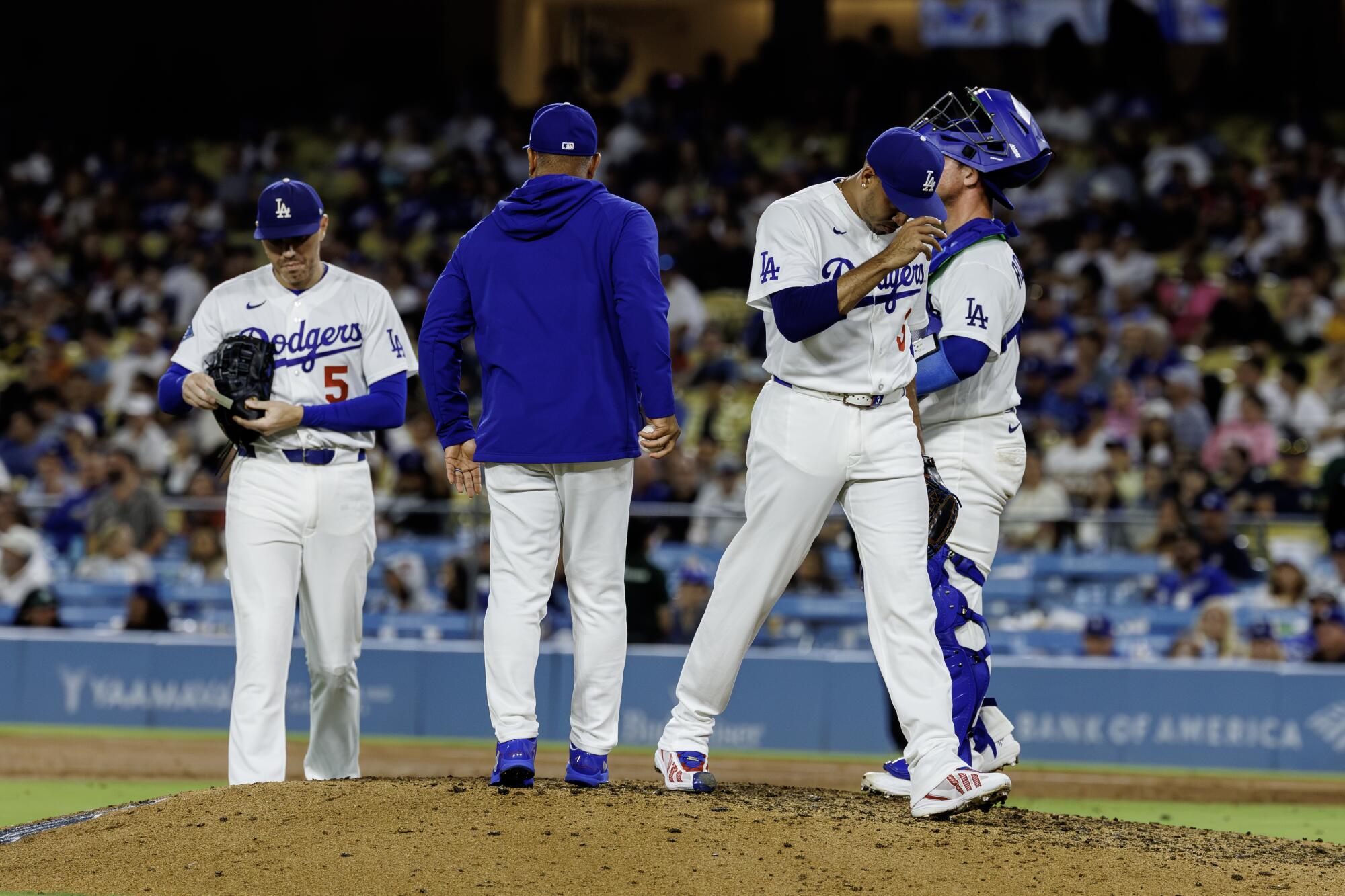
Dodgers manager Dave Roberts, center, pulls closer Edwin Díaz from the game.

Dodgers manager Dave Roberts, center, pulls closer Edwin Díaz from the game in the ninth inning Thursday against Milwaukee.

(Gina Ferazzi / Los Angeles Times)

He’s not the only disappointment: Mookie Betts is hitting worse than ever before in his career while another newcomer, $240-million man Kyle Tucker, is hitting just .239 with 11 home runs. Fittingly, he flew out for the final out and went 0 for 4 on Thursday.

But Díaz was heralded as the best reliever on the free-agent market when the Dodgers signed him.

Instead, he’s making a run at Worst Reliever in the Game.

His slider hasn’t been sliding. He’s been consistently inconsistent. His location has been spotty — or right down the middle, and as he showed and told Thursday: “I was throwing my fastball right in the middle. When you miss in the middle, you pay.”

And, like Roberts, Díaz doesn’t know the answer, just that “I just gotta sit down with the pitching coaches to see what I’m missing and what they say to see if we can fix it and keep working hard.”

In a short-sleeved T-shirt and shorts, he stood with his hands on his hips and faced the music — and the facts, saying he’s ready to relinquish his closer role if Roberts wants to try another option.

“I just gotta see what they wanna do,” Díaz said. “I wanna do the best thing for the team. At the end of the day, if they give me the ball in the ninth I will try to do my job. If they give me the ball in another inning, I will try to do my job.”

Roberts would prefer he do the job for which he’s being paid so richly: “Everyone’s got a role, they all have jobs to do, and they all have to do their job. That’s it.”

But Díaz hasn’t been up to the job. He had a 10.50 ERA in seven shaky appearances before he went on the IL on April 20.

It can seem like the Dodgers print money with all their high-priced players, but they might as well be lighting it on fire with the relievers they’ve brought in.

For them, the concept of the high-priced reliever should be an oxymoron. Because being fooled once is a shame; being fooled twice — that’s moronic.

In 2025, they signed Scott — then considered perhaps the best relief pitcher on the free-agent market — to a four-year, $72-million contract.

And he blew his opportunities like a trumpet too, ending last season with a 4.74 ERA (second-worst of his career) and 1.263 WHIP with 60 strikeouts through 57 innings. He didn’t pitch for the Dodgers in the playoffs.

Now they’ve got the Díaz debacle to deal with before the postseason, when it looks like the Dodgers, if they don’t have their big-name closer to rely on, will again be forced to find other options.
Source link

Angels interim GM John Mozeliak gives fans a reason to hope for wins

In 2012, when Mark Walter and his partners bought the Dodgers, team president Stan Kasten declared mediocrity would no longer be acceptable.

Would the Dodgers improve their minor league system? Yes. Would the Dodgers improve their major league roster? Also yes. Would spending in one area preclude spending in another? Absolutely not.

“These fans expect and deserve a team that can win,” Kasten said then.

So do Angels fans. For the first time this decade, with the arrival of John Mozeliak as interim general manager, they have legitimate hope.

Mozeliak, whose St. Louis Cardinals teams reached the playoffs more often than not in his 18 years running baseball operations there, is here to end baseball’s longest postseason drought, or at least steer the Angels in that direction.

At first, I was shocked to hear him say he does not believe the Angels need to rebuild. Under owner Arte Moreno, the Angels have resisted rebuilding, preferring to add lower-tier free agents and rush college players to the major leagues in an effort to field a competitive roster. That has failed: For the first time in franchise history, the Angels could finish in last place for a third consecutive season.

But, when Mozeliak and I sat down in the Angels’ dugout the other day, he explained that the path forward in Anaheim should not be tanking. It should be acting like the major-market team the Angels are — and were, during Moreno’s first decade of ownership.

“The one thing you have to realize about the Los Angeles Angels is: they do have resources,” Mozeliak said. “From Mr. Moreno to the market size, this is a place that could be a very, very special place.”

In Moreno’s first decade, under Bill Stoneman and Mike Scioscia, the Angels were a player development machine. In 2003, in his first winter as owner, Moreno signed the best position player on the free-agent market in Hall of Famer Vladimir Guerrero and the best pitcher on the market in four-time All-Star Bartolo Colon.

The questions Mozeliak asks and answers now are the same ones Kasten did with the Dodgers. Can the team deploy resources to upgrade scouting and player development? Yes. Can the team do the same with the major league roster? Also yes.

“There are many franchises in the game of baseball that cannot do that,” Mozeliak said. “They have trade-offs. They have to make a decision: If I’m going to give you $20 million for your infrastructure, that’s $20 million less for your payroll.

“This place is different.”

The Dodgers parallel only goes so far. Walter and Kasten inherited a core of Clayton Kershaw, Kenley Jansen, Matt Kemp and Andre Ethier. Mozeliak will work with Mike Trout and a long-touted “young core” that has shown by now it is not the foundation of a championship-caliber team.

No one expects Moreno to spend like the Dodgers do (and even Walter’s fellow owners want a salary cap in an attempt to stop the Dodgers). Yet, in St. Louis, Mozeliak built winners without the Cardinals owners ever paying a luxury tax.

The first step in revitalizing the Angels comes Saturday, in the draft.

“We’re going to take the best available player,” Mozeliak said.

Mozeliak said he is not interested in two recent Angels trends: paying less to a first-round pick in order to spread the savings around longer shots in the lower rounds, or targeting a polished college player in part because he could get to Anaheim in a hurry.

“I’m not wedded to a high school player or a college player,” Mozeliak said. “I want the best player.”

The second item on the agenda: the Aug. 3 trade deadline, which would afford Mozeliak the opportunity to collect prospects for such players as pitcher Reid Detmers and Jose Soriano and outfielder Jo Adell.

In 2020, Moreno nixed a trade that would have brought Andy Pages – then a Dodgers prospect, now an All-Star – to the Angels.

In 2023 and 2024, Moreno rebuffed trade offers for Shohei Ohtani that could have returned the likes of Junior Caminero or Jackson Merrill. No player of that caliber would be coming in return for what the Angels have to offer now.

Mozeliak said the Angels should not consider a trade proposal in isolation, without considering how to flex their major-market muscles to fill whatever hole a trade might create.

“If we understand what we’re doing today can help make us stronger tomorrow, and then look at potentially what we could do on the free-agent market,” he said, “that should be something we are doing in parallel thinking.”

Mozeliak said he does not believe any player should be untouchable. As if on cue, Trout walked by.

Trade Trout? That’s not happening, right?

“That’s not happening,” Mozeliak said.

In his hours of conversations with Moreno, Mozeliak said, the topic of whether the owner might sell the team “never came up.”

Does Moreno appear interested in staying for the long haul?

“Absolutely,” Mozeliak said.

Mozeliak said he had presented Angels President Molly Jolly with a 100-day plan for what the team calls a consulting role: run baseball operations on an interim basis; do a deep dive into how the Angels do things now and how they can do them better; recommend a new general manager. Maybe he stays in that role, or in a supporting role, or he simply leaves when his contract expires in December.

“I’m certainly confident in what we need to do, and I’m certainly confident this is a market that could be amazing,” he said. “It’s exciting times for me. I’m energized.

“I’m smart enough to know that one person cannot change everything. But one person can begin change, and that’s what I’m going to start to do.”

Distinguished executives, including the likes of Dave Dombrowski and Andrew Friedman, have wanted no part of the Angels. Then again, Mozeliak is only committed for six months. If Moreno does not do what Mozeliak believes should be done, and if Mozeliak is not allowed to begin that change, he can just walk away.

“I think I have that authority,” Mozeliak said, “and I think he understands that he can embrace change, because that is what is going to be required.”

Based on Moreno telling you that?

“Yes,” Mozeliak said.

The last time the Angels hired an experienced general manager from outside the organization: 35 years ago, when they also looked to St. Louis for Whitey Herzog. That didn’t work. Herzog won a power struggle in the front office, then quit anyway, amid disputes with ownership.

This might work, or might not. But think back to 2020, when then-Angels president John Carpino said this: “Obviously, we’re not doing it the right way. We’re not winning games. So something is not right in our organization.”

Carpino retired in April, without ever explaining what was not right in the organization or, based on the standings, repairing it.

Jolly replaced him and, within two months, secured Moreno’s approval to hire the architect of a World Series championship team to figure out what was not right in the organization, and to fix it.

In one bold step, the Angels admitted they had a problem and set out a path to remedy it. With three months to go in this wretched season, the MVP of the 2026 Angels is abundantly clear: Molly Jolly.

Source link