Dudamel on his life as he prepares to leave L.A. Phil for New York
On the second weekend of May, Gustavo Dudamel gave the New York Philharmonic a salsa shock. He gleefully brought the startled players together with the Spanish Harlem Orchestra, an uptown salsa and jazz band, for concerts at Lincoln Center and Washington Heights. The city‘s classical music fans treated it as a cultural breakthrough; Dudamel is expected to transform the orchestra as a cultural institution when he returns in the fall as its music and artistic director.
A day later he was back in Los Angeles to begin rehearsals at a Walt Disney Concert Hall that had been fantastically transformed by Frank Gehry for the Los Angeles Philharmonic’s staging of “Die Walküre.” Transformation — be it cultural, orchestral, personal — has marked Dudamel’s 17 years as music (and more recently artistic) director of the L.A. Phil, which is now coming to an end with his three weeks of concerts in Disney to close the season June 7, followed by a celebratory weekend at the Hollywood Bowl in late August.
But meeting with Dudamel in his dressing room after a “Walküre” rehearsal (the opera begins Tuesday night at Disney and runs for six nights, an act a night, the full opera performed twice) , he says as he has said before, he does not think of this as a culmination, merely the beginning of a new adventure. He’s apartment shopping in New York. But he is keeping his house in Los Angeles.
He’s also departing with two very long new titles as “Die Walküre” premieres: the Diane and M. David Paul Artistic Cultural Laureate of the L.A. Phil and Jane and Michael Eisner Founding Director and Conductor Laureate of Youth Orchestra Los Angeles (YOLA).

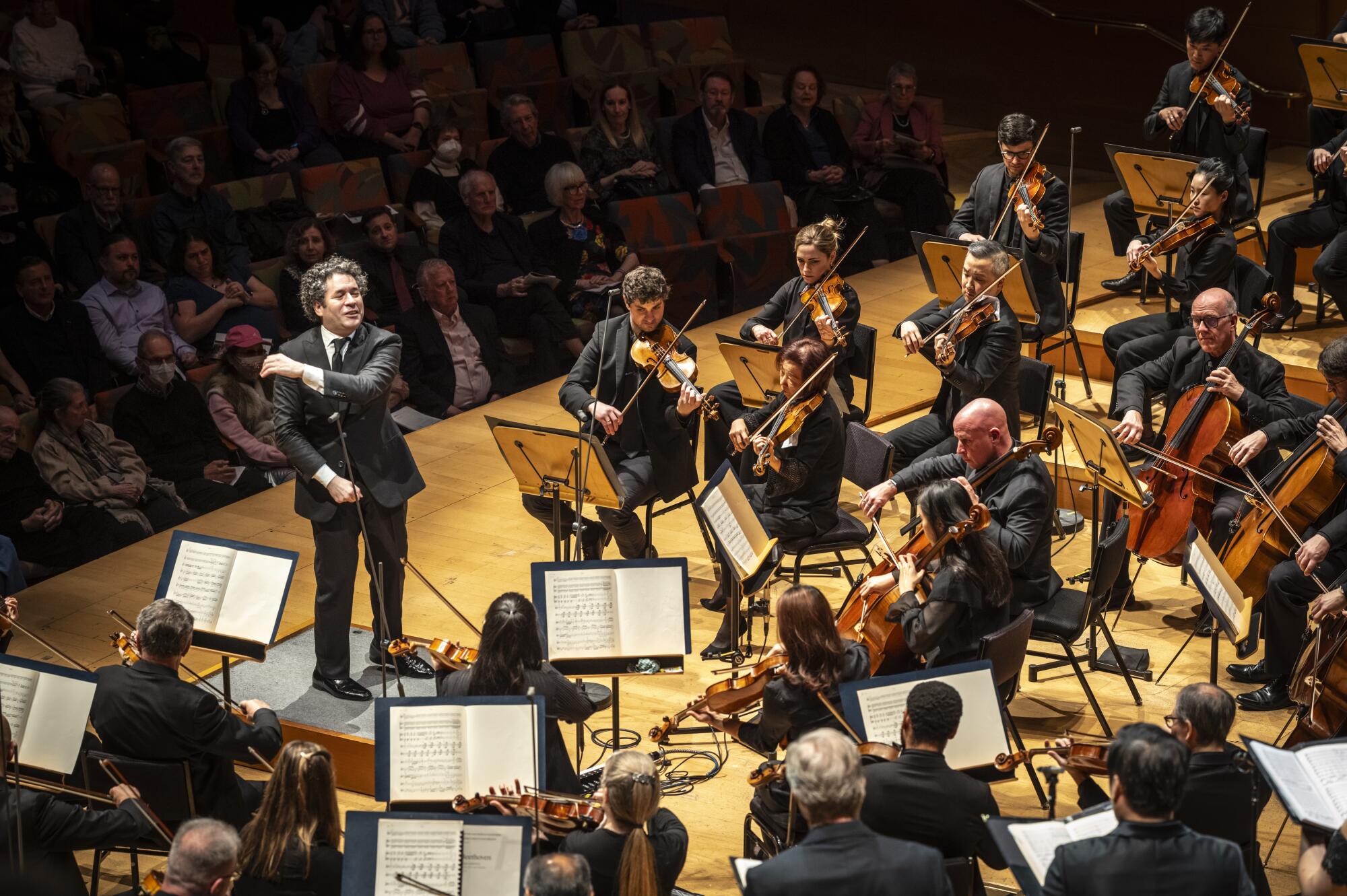
Gustavo Dudamel conducts the Los Angeles Philharmonic in a performance of Beethoven’s Missa Solemnis at the Walt Disney Concert Hall on Feb. 22.
(David Butow / For The Times)
“We are talking about projects,” he says. “Look, I’m coming back for two weeks in December,” when he will lead Beethoven programs. He returns in the spring. The Bowl will always be a second home.
“I’m living here and I’m not living here,” he explains. “The connection will always be here.”
The energy in New York is, he continues, “super exciting.” And what excites him the most is how comfortable he feels with the very real differences between L.A. and New York.
“As a Latino from Venezuela,” he says, “I have an immediate connection with the New York that is home of salsa. When I was in the womb I was hearing salsa.” His father, Oscar Dudamel, is a trombonist and salsa musician.
But he adds that mariachi, ubiquitous in Mexico and L.A., is also an integral part of Venezuelan culture. “What I have to say is that I am blessed. I’m blessed that both cities are now part of my life.”
Bringing ‘crazy’ ideas to Los Angeles
L.A., of course, has been the major part of his adult life. At 24, an unknown, he made his dazzling U.S. debut in 2005 leading the L.A. Phil at the Hollywood Bowl. Four years later, he became the orchestra’s music director and caught the world’s attention.
There is no doubt that Dudamel’s extraordinary talents would have meant a major career wherever he landed. But, here, he inherited the world’s most culturally open major orchestra, where fresh thinking and new music thrive. Disney Hall allowed him the extraordinary freedom to dream. Being back at Disney, Dudamel admits, is very emotional, especially conducting “Walküre” with Gehry’s sets of billowy, sumptuous clouds and fanciful white papery horses.
“Frank is here with us,” Dudamel exclaims about the architect, who died in December and with whom he had become close. Conducting Wagner’s opera, in many ways, sums up Dudamel’s ambitions, the way he has connected with more sides of L.A.’s cultural landscape than possibly any other artist.
In L.A., Dudamel grew as an artist and a person, he says, through his relationship with an orchestra that is uniquely flexible and a welcoming community. This allowed Dudamel to be what he likes to call “crazy.”
“I remember the first time I came here. I didn’t have a chance to do or see anything,” he says of his Bowl debut. “So, I remember driving from the airport to Sunset Boulevard, where my hotel was, and I didn’t understand anything. But immediately it was the connection with the orchestra.”

Frank Gehry designed the sets for a Jan. 18, 2024, performance of Wagner’s opera, “Das Rheingold,” with Gustavo Dudamel leading the Los Angeles Philharmonic at Walt Disney Concert Hall.
(Allen J. Schaben / Los Angeles Times)
Flash forward 20 years from 2005 to 2025. In what seemed like a truly crazy idea, he brought the L.A. Phil to the Coachella Valley Music and Arts Festival, where he led a varied set of classical favorites and appearances with pop stars, for 150,000 people shouting “L.A. Phil! L.A Phil.” Among the highlights was “Ride of the Valkyries,” the English title of “Walküre.”
The symbolism of doing “Walküre” is, for Dudamel, unmistakable. Wagner’s four-part “Ring” cycle, of which “Die Walküre” is the second opera, strongly influenced the “Star Wars” films Dudamel grew up with. The saga’s composer John Williams is another L.A. legend who became for Dudamel like family. Williams has, in fact, written a fanfare, “Bravo Gustavo!” that Dudamel will premiere on June 4 in a concert in which he celebrates the musicians of the L.A. Phil.
The “Walküre” production, moreover, further expresses his desire to remain connected with L.A. When asked whether he still plans to complete the “Ring” cycle with the L.A. Phil, which he began two seasons ago with “Das Rheingold,” he says, “completely.”
It’s a radical notion, to say nothing of an extraordinarily expensive and time-consuming challenge for any orchestra given to a former music director, but Dudamel has never been one to take no for an answer. “At my last conversation with Frank,” he recalls, “I said I was coming to talk about ‘Siegfried’ [the next opera in the cycle], and he said, ‘You are crazy.’”
“That was Frank. He freaked out about the operas every time I talked to him about them. And then he came up with fabulous ideas.
“You know I never dreamed about coming to the L.A. Phil. I was happy in Venezuela and guest conducting elsewhere. But when I met Frank and John [Williams], I knew I had come to the right place.”
One reason Dudamel was happy in Venezuela was his position as music director of the Simón Bolívar Youth Orchestra, part of El Sistema, the country’s famed music education program. He brought a version of that to Los Angeles with YOLA, which offers free musical education to students. Bringing young people together to learn — and not just to play music but to listen to each other — has grown increasingly essential to him.

Gustavo Dudamel has fun with John Williams at the Hollywood Bowl as he conducts the L.A. Phil during “Maestro of the Movies: John Williams with the LA Phil” on July 9, 2023.
(Emil Ravelo / For The Times)
On Thursday evening, USC awarded Dudamel an honorary doctorate during its graduation ceremonies at the Coliseum, where Dudamel also gave the commencement speech.
“I will never tire of repeating this: music, art and beauty are universal rights,” he told the graduates, urging them to go out into the world listening to others, seeing others, paying attention to everything. These are the practices he has long championed as the essential need for youth orchestras.
This was, in fact, almost precisely what he said when he first arrived in L.A. “I was very young, but I grew up with these ideas,” he told me.
“You have to say to the students, ‘Stop! Let’s pause. Just listen.’”
“It’s a way to really connect with what surrounds you, but also connect with yourself. That’s the beauty of all the layers of listening we do as musicians. I now think that is our main tool. In the end it’s not listening only to sounds. It’s listening as connecting with others.”
Practicing what he preaches
As Dudamel plans for his next chapter, he indicates that the advice he gives students is what he is also saying to himself.

YOLA students perform on stage during a “Gracias Gustavo Community Block Party” at the Judith and Thomas L. Beckmen YOLA Center in Inglewood on Oct. 11, 2025.
(Etienne Laurent / For The Times)
What L.A. gave him, he concludes, is a greater depth of his own listening. There was the guidance of Deborah Borda, who, as the orchestra’s president and CEO, hired and mentored him. There were the opera productions with Peter Sellars, who made him look deeply inside himself. There were the communities to discover and with which to collaborate.
New York, he insists, will be a further continuation of this process. “There are a lot of things to do. As I did here, that will be not only conducting but spending a big amount of time doing other things. I will have to listen to the community. Every place is different.”
And every place needs to be, for Dudamel, connected. He began his last season in Disney in the fall with the world premiere of Ellen Reid’s “Earth Between Oceans,” a bicoastal co-commission between the L.A. Phil and the New York Philharmonic, sonically evoking the environmental difference between L.A. and New York. He recently repeated it with his new orchestra in David Geffen Hall in New York.
In L.A., Reid’s score felt like a vast, moving, spiritual soundscape of our fires’ fury as well as our coastal fancy. At Geffen, it became a gripping showpiece, like attempting to zoom in a Ferrari through Manhattan streets, were they ever empty — the thrill of taking it all in.
Dudamel says his favorite place in New York so far is the orchestra’s archives. Becoming absorbed in the history of America’s oldest orchestra gives him new ideas. He wants simultaneously the old, the new and the many.
He also insists on ever more connections. ”We are making, many, many projects together,” he says of the L.A. Phil and the New York Philharmonic. That includes bringing the two orchestras together in a further experiment in listening.
“That‘s very important to me, one of my dreams. And it’s not difficult,” he says. “We have plans and it’s beautiful. We have to do that.”