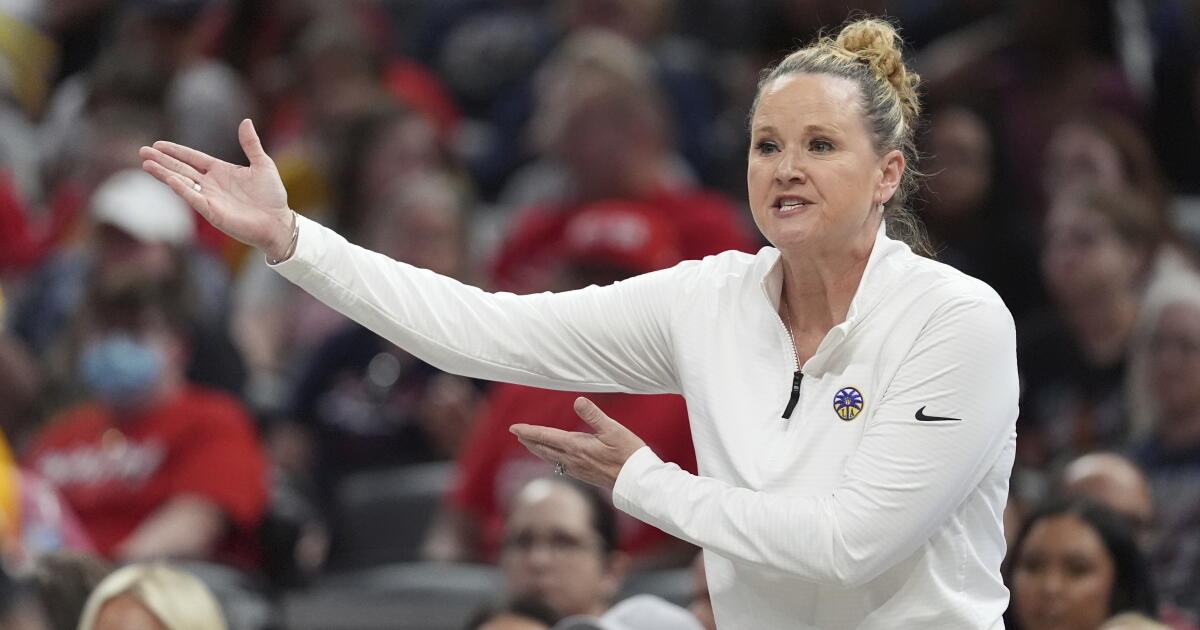
The Sparks fired head coach Lynne Roberts, ending her tenure Friday after two seasons as the franchise continues its search for a return to championship contention.
The move comes after the Sparks finished 16-28 in 2026, missing the playoffs for the sixth consecutive season. Roberts compiled a 36-49 record with Los Angeles after being hired ahead of the 2025 season after nearly a decade leading the women’s basketball program at Utah.
The team has not announced an interim head coach but will conduct a search this offseason.
“We are grateful to Lynne for the commitment and determination she brought to the role, which was evident all the way through our last game last night,” said Sparks special advisor Farhan Zaidi. “Lynne has cared deeply about our organization and for our players and their development. We sincerely thank her for everything she has invested in the Sparks and wish her and her family the best moving forward.”
Roberts arrived in Los Angeles with a reputation as one of college basketball’s top offensive minds after leading Utah to three consecutive NCAA tournament appearances and back-to-back Sweet 16 berths. The Sparks hoped she could oversee a rebuild around a young core led by Cameron Brink and Rickea Jackson while making one of the league’s flagship franchises a contender again.
Instead, the turnaround never materialized.
Los Angeles struggled to find consistency on both ends of the court during Roberts’ tenure, dealing with injuries, roster turnover and uneven play while remaining outside the WNBA playoff picture. Despite flashes from its young talent, the Sparks were unable to build sustained momentum, even after acquiring All-Star guard Kelsey Plum, whom they eventually traded before the deadline in July.
The Sparks fired general manager Raegan Pebley midseason after her offseason trade of Jackson to Chicago for Ariel Atkins, a two-time All-Star who is now on a three-year deal.
Before Thursday’s loss to Golden State, Roberts said she believed she should stay the team’s head coach.
“I think what this org needs is some stability, and a vision and a direction, like a plan,” she said. “Not that we haven’t had one, but I think now that we’ve got people in place, just give us a goalpost, and we’ll march down the field in that way.”
Roberts became the latest coaching change for a franchise that has been searching for stability since its last championship in 2016 under coach Brian Agler. Since then, the Sparks have cycled through four head coaches while missing the postseason every year since 2021.
The decision raises questions about the direction of the franchise entering the offseason with several long-term deals for veterans such as Atkins and Dearica Hamby, but also one of the best young players in the league in Brink.
Mike Trout was practically beaming. He dropped the phrase “fresh start” four times in an interview that barely lasted five minutes.
The burden of the Angels’ failures has been disproportionately his to bear. He has insisted that his path to Cooperstown would run through Anaheim and only Anaheim. He has played 16 seasons for an owner that blessed him with half a billion dollars, treated his family like royalty and stranded him in position to conclude a star-spangled career without ever winning a postseason game.
“What a track record,” Trout said. “Wherever he buys, he wins.”
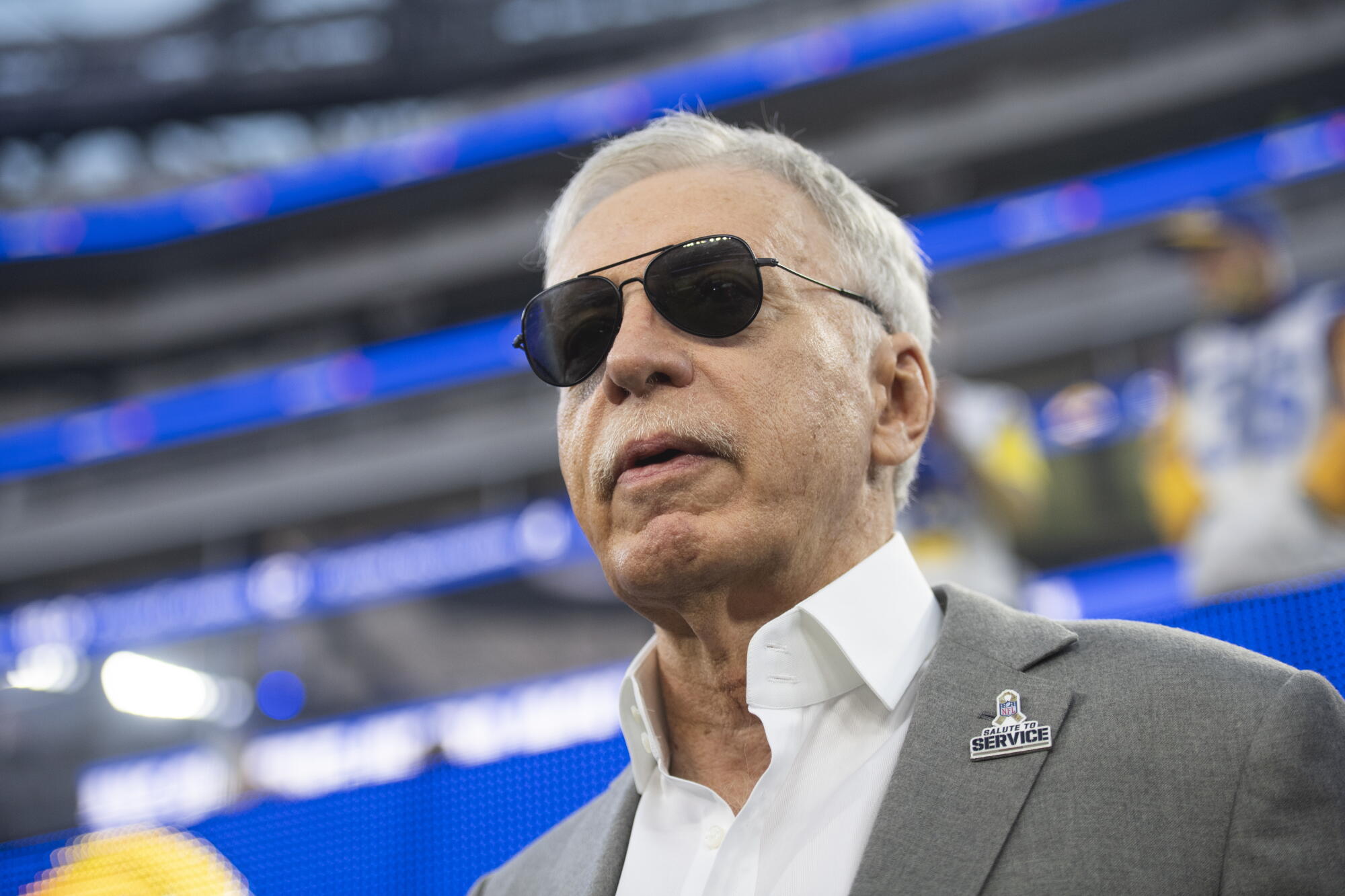
Rams owner Stan Kroenke has agreed to purchase a majority stake of the Angels on Tuesday. The deal is pending regulatory review and MLB approval.
(Kyusung Gong / Associated Press)
The Rams. The Colorado Avalanche. The Denver Nuggets. Arsenal.
So what if the Angels have baseball’s longest playoff drought? They now have baseball’s richest owner, with a net worth valued by Forbes at $24 billion.
Kroenke bought a controlling share of the Angels at a valuation of $4 billion, a record for a major league team, with current owner Arte Moreno retaining a small stake, a source with knowledge of the deal not authorized to discuss it publicly told The Times. The sale includes the team-owned television and radio outlets, ABTV and AM 830. The deal is subject to customary closing conditions and MLB approval.
In 2009, ESPN put Moreno on the cover of its magazine, proclaiming the Angels delivered the best value of the then-122 teams in the NFL, NBA, NHL and Major League Baseball. In this decade, the experience had been so devalued by 12 consecutive losing seasons that resale tickets for Tuesday’s game against the mighty New York Yankees were available for $5, amid a season of fans regularly chanting “Sell the Team!”
“He’s aware of the chants,” Angels president Molly Jolly said. “He knows about them. At the end of the day, this is about having the right next owner more than it is about anything else.”
Jolly wouldn’t say whether Kroenke or Moreno initiated the negotiations. She did say the sale was not conducted through a formal bidding process, but proceeded through face-to-face discussions between Kroenke and Moreno.
“He has a traditional sense about him,” Jolly said. “To be able to sit down with another gentleman and have a conversation and talk about baseball and the franchise, that resonates for how he thinks and looks at things, rather than it being a complex conversation.
“I think that’s what was the ‘Why now?’ It was the right person having the right conversation with him.”
As far as she knew, Jolly said, the conversations had not started when she assumed the team presidency in April, but the possibility of a sale had “always stayed out there” after Moreno invited bids in 2022 and then decided not to sell.
In July, after joining the Angels as interim general manager, John Mozeliak said he had spoken with Moreno for hours and the topic of whether the owner might sell the team “never came up.” On Tuesday, Mozeliak acknowledged that, when he started his position, Moreno “had mentioned that this was a possibility.”
Fans at Angel Stadium hold up signs during a game against the Yankees Tuesday marking Stan Kroenke’s agreement to purchase the Angels from Arte Moreno.
(Mark J. Terrill / Ap Photo/mark J. Terrill)
The sale is not expected to be finalized until early next year. Kroenke has not done the usual due diligence that would precede a sale — meeting with team management and touring the stadium — and has not introduced himself to officials from the city of Anaheim. The city owns the stadium and surrounding parking lots, a 150-acre site that city officials would love to see Kroenke develop.
In the meantime, it’s business as usual for the Angels. Mozeliak, who ran the St. Louis Cardinals when the Rams played in St. Louis, said he never has met Kroenke. He did recall speaking with Kevin Demoff, who oversees all of Kroenke’s teams.
Mozeliak has no idea whether Kroenke might invite him to stay, but for now the plan of rebuilding the team and reorganizing the front office remains on course, in the interest of serving fans weary and frustrated after 12 consecutive losing seasons.
“We’ve been preaching change all along,” Mozeliak said. “Now they’re going to see even more.”
And, he noted, the Padres and Angels had sold at successive record prices for MLB teams, despite the prospect of a lockout and owners’ hopes for a new collective bargaining agreement with a salary cap intended in part to raise franchise values.
“A lot of people thought teams wouldn’t sell until there was a new CBA,” Mozeliak said. “Clearly, that prediction was wrong.”
In the clubhouse, no one was talking about that. Neto was talking about the call Trout made to “some of the Rams guys” for a scouting report on Kroenke.
“I reached out to one Rams player,” Trout said, smiling. “He exaggerates a little bit.”
Still, given the national attention given last winter to the air conditioning not working properly in an Angel Stadium weight room, Neto said the evaluation from the Rams’ locker room was glowing.
“The most important thing they said is, he just wants what’s important for us,” Neto said. “That’s to make the clubhouse better, in the sense of whatever we need, we get, whether that’s amenity-wise, speakers, whatever it is, he’ll make sure we get those.”
Trout was so enthusiastic that, when a reporter asked if he was excited about what the new vision might be, he answered before the reporter could finish asking the question.
“No doubt,” Trout said. “Obviously, when you’re frustrated the last — I don’t know how many years it’s been, but to hear the news like this, I’m super excited to have this change.”
For his part, Neto sounded ready to pitch Tarik Skubal on pitching for the Angels — or, at least, pitching Kroenke on the possibility of recruiting him in free agency.
“Who doesn’t want to be in Southern California?” Neto said. “The weather is beautiful here. We have the best fans, in my opinion. We have a beautiful stadium.
“Who wouldn’t want to be here and play in this organization, in this market? It would be a no-brainer.”
Trout said the ownership change “was needed” and said there was “a good vibe around the clubhouse,” but both he and Neto expressed appreciation for Moreno.
“Arte was very supportive of us, whatever the outside noise was,” Neto said.
“I’ve seen a lot of hate, a lot of love, a lot more hate. But, as a player who has played under him, it was a lot of love. He treated us well, and that’s all you can ask for as a player.”
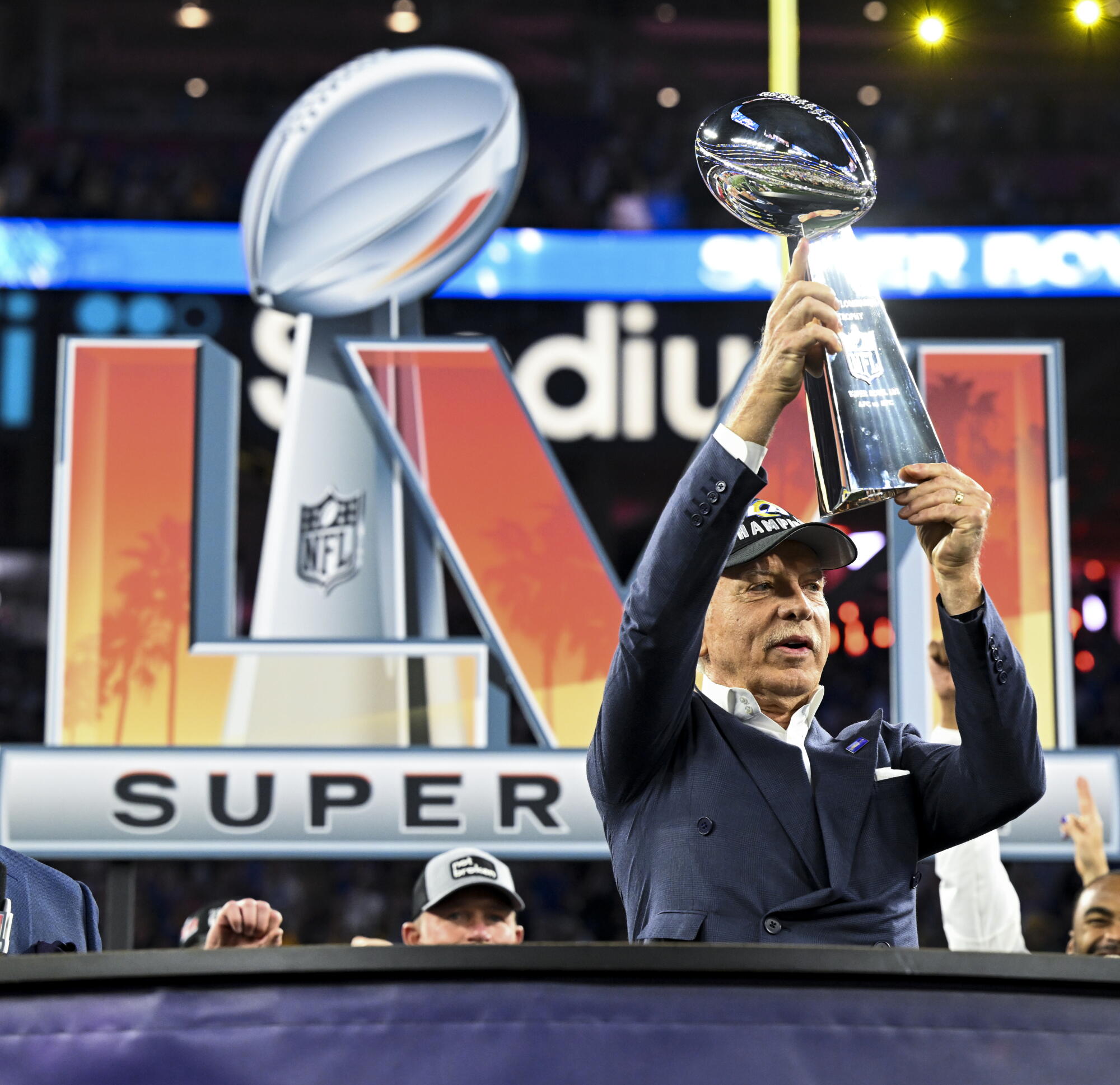
Rams owner Stan Kroenke holds up the Lombardi Trophy after his team beat the Bengals to win the Super Bowl at SoFi Stadium in 2022.
(Wally Skalij/Los Angeles Times)
This is huge. This is landscape altering. This is like Southern California just added an expansion team led by one of the best owners in sports.
For the Angels, currently the second-worst team in baseball and on track to finish a league-worst 12th consecutive season out of the playoffs, this is downright life changing.
Kroenke builds. Kroenke spends. Kroenke wins.
The sale is not expected to close until early 2027, so change will come slowly, but buckle up, because a bumps-be-damned renovation is coming.
First, the Angels are getting a new stadium. Kroenke hasn’t confirmed it, but it’s surely happening. He’s a real estate guy at heart who loves turning empty lots into palaces and that’s what he’ll do in Anaheim.
You think SoFi is nice? Here’s guessing the new Angels stadium will be nicer, and surrounded by the sort of commercial baseball village sprouting up all over the major leagues. The stadium and its environs will offer everything the Dodgers can’t, and may just steal a few fans in the process.
Second, the Angels are getting new swashbuckling leadership. Don’t know who, but expect the new general manager to be the kind of leader who will boldly sacrifice the future to win now, because that’s what Kroenke does, he wins now. Think baseball’s version of Les Snead.
Third, the Angels are getting one of the game’s bright young managers. Don’t know who, but he will be a guy who’s big on analytics and even bigger on the human touch, and he’ll probably be very young and very anonymous and eventually very successful. Think baseball’s version of Sean McVay.
The overall theme of Kroenke’s leadership will be championship or bust. He hates finishing second, and has left no stone unturned in giving the Rams every opportunity to succeed.
When he brought the Rams back to Los Angeles in 2016, he gave the team all of 13 games before firing then-coach Jeff Fisher after going 4-9. Soon thereafter he made 30-year-old McVay the youngest coach in NFL history and they’ve since become arguably the most admired franchise in the NFL.
Kroenke wins both on the field and in the community. His entire operation, which also owns the Denver Nuggets of the NBA, the Colorado Avalanche of the NHL, the Colorado Rapids of MLS and Arsenal of the Premier League, is led by Kevin Demoff, a lifelong Angeleno who understands and works the local market as well as any sports executive ever. The community has become saturated with Rams, and the same will be happening with the Angels as they increase their reach into Los Angeles County, something Moreno tried but could never pull off.
The name will remain the Los Angeles Angels, not because Kroenke doesn’t like Anaheim, but because he knows his investment must expand out of Orange County to eventually reap rewards.
“The Angels are a storied franchise anchored in a great market,” Kroenke said in a statement. “We look forward to an exciting future with the Angels organization.”
Storied. Anchored. Exciting. Those are words you rarely heard about the Angels under Moreno, whose 23-year stewardship began with a cheer and ended with a whimper.
Angels owner Arte Moreno has agreed to sell the team to Rams owner Stan Kroenke.
(Sean M. Haffey / Getty Images)
Remember how, in his first news conference after buying the team from Disney, he lowered beer prices? He was fun, he was innovative and he was the first Latino majority owner in major American team sports. It was all so cool, and the team responded with five American League West titles and two appearances in the American League Championship Series.
Chris Hansen has not seen “Primetime,” the A24 film in which Robert Pattinson plays him, and he probably won’t anytime soon. He walked out of an Aug. 20 screening arranged for him at the studio’s Manhattan offices after refusing to sign a nondisclosure agreement, which he believed would prevent him from raising any legal objection to the way he is portrayed.
But Hansen’s company has purchased preshow advertising in theaters showing “Primetime,” which opens Sept. 25. The spots promote TruBlu, the subscription streaming platform where the former “Dateline NBC” correspondent presents his current sting operations under the title “Takedown.”
“It’s a movie that uses my name, image and likeness,” Hansen told The Times in a recent interview. “Why not direct people to what the real Chris Hansen is doing? Here’s where you can see it.”
Moviegoers, in other words, will be asked to have a seat twice.
The film revisits one of the most provocative and scrutinized franchises in the history of TV news. “To Catch a Predator,” which ran as a periodic “Dateline” investigation from 2004 to 2007, exposed men who used online chat rooms to solicit sex with minors. It accelerated the popularity of the true crime genre while raising lasting questions over journalistic ethics.
Directed by Lance Oppenheim in his narrative feature debut, “Primetime” is based on Luke Dittrich’s 2007 Esquire article “Tonight on Dateline, This Man Will Die,” about the suicide of a Texas prosecutor targeted by one of the stings. It premieres Sept. 5 at the Venice Film Festival.
Hansen, 66, is ready to ride the wave of notoriety the film is bound to generate. He is still pursuing online predators and a new generation of fans have found him on TruBlu, his YouTube page and on social media. “I’ve got to be the only 66-year-old man in America with 1.1 million TikTok followers,” he said.
Hansen first heard from A24 regarding “Primetime” when an executive reached out to him in late May to ask whether he would participate in promoting the film, according to emails obtained by The Times. Over the two months that followed, the journalist and his business partners repeatedly asked to see the film or a script before making any commitment. They also raised the possibility of compensation or a production credit, although Hansen said no formal request was made.
Hansen and his partners repeatedly raised concerns that he had never been contacted about the use of his name and likeness, even as a courtesy, before production was completed. The studio said it wasn’t necessary.
“Chris’s work was an important inspiration for ‘Primetime,’ which is a dramatized film inspired by true events,” according to an Aug. 8 email from A24. “While the film didn’t require individual consultation or permission during production, we’d love to have Chris’s support of the film to the extent he feels comfortable. If not, we certainly understand.”
An A24 representative declined to comment for this story. A person involved with the film who was not authorized to discuss the matter publicly said the nondisclosure agreement Hansen was asked to sign is standard for a movie screened ahead of release, so that viewers do not reveal plotlines or spoilers.
The trailer, released earlier in August, has generated buzz in media business circles for the appearance of Jeff Zucker, former NBCUniversal chief executive, who appears as himself in a small role as a ratings-hungry network executive. Pattinson’s Hansen is later seen in the trailer screaming, “I’ll be bigger than ‘Lost’!” in reference to the ABC hit.
Robert Pattinson in a scene from A24’s “Primetime.”
(Sinna Nasseri / A24)
Hansen said he is not looking for a payout from the filmmakers. But he would like a clearer statement that the film is fiction rather than “inspired by true events,” as it says in the trailer, and perhaps a financial contribution to organizations for victims of child predators.
“I want some recognition that they used my name, image, and likeness in a largely fictional story,” he said. “They used my name, my colleagues’ names and some family members. Based upon what I know about this, it’s an insult to the thousands of people who work diligently, often at great risk, every day to protect children from predators.”
The conflict is hardly the first involving a living celebrity objecting to a fictional depiction. But legal challenges are often futile.
“You don’t own your life story,” said Domenic Romano, managing partner at Romano Law. “If you’re a celebrity, the filmmaker doesn’t need your permission to dramatize it. Even if you’re alive and you don’t like how you’re being portrayed, the 1st Amendment gives broad protection.”
Actor Olivia de Havilland went to court in 2017 over the FX series “Feud: Bette & Joan,” claiming the portrayal of her as a vicious gossip damaged her reputation. The court ultimately ruled in FX’s favor.
Actor Daryl Hannah took a different route, publishing an opinion piece in the New York Times in March objecting to her depiction in FX’s “Love Story: John F. Kennedy Jr. & Carolyn Bessette.” Hannah, who dated Kennedy before he married Bessette, wrote: “In the weeks since the series aired, I have received many hostile and even threatening messages from viewers who seem to believe the portrayal is factual.”
“When entertainment borrows a real person’s name, it can permanently impact her reputation,” Hannah wrote.
The rise and fall of “To Catch a Predator” provides enough drama for a big-screen treatment.
During his run at NBC News, Hansen was an Emmy Award-winning correspondent delivering hidden-camera investigative stories on such topics as identity theft and sex trafficking. But his “Predator” franchise, which used online decoys in chat rooms to draw men seeking sex with minors into police stings turned him into a global sensation, albeit a polarizing one.
NBC News conducted the investigations with the help of a civilian watchdog group called Perverted-Justice and local police in the towns and cities where the stings were set up. The suspects arrested and convicted included a rabbi, a teacher and a doctor.
Decoys posing as young teens lured the men to sting locations, mostly set up at private homes in quiet communities. Hansen would then enter and confront the men with his signature line: “Have a seat.” After a chat with the correspondent (“You see how this looks, right?”), the men were arrested by local police, while a camera crew captured it all.
The tableau of Hansen going face-to-face with suspects seated in suburban kitchens became so familiar it was spoofed in a comedy sketch that opened the 2006 Emmy Awards.
“Predator” remained a giant hit until a November 2006 sting in Murphy, Texas, went awry. Bill Conradt, a Rockwell County assistant district attorney, had been exchanging online messages and photos with a decoy posing as a 13-year-old boy. Unlike other targets, he never came to the sting house. Police obtained warrants and a SWAT team came to his home with a “Dateline” crew in tow. He shot himself to death after law enforcement entered.
Conradt’s family sued NBC, which settled out of court. The incident sharpened the debate over Hansen’s tactics, and as the “Predator” franchise became more popular, he was criticized in journalism circles for collaborating with police and an outside group of private citizens in his investigative work.
There have been many accolades as well. Law enforcement organizations credited the program for shedding light on a new form of criminal activity in the then-emerging internet age. Over the years, Hansen has helped promote advocacy groups and legislation protecting the rights of sexual abuse victims.
“Dateline” continued producing “Predator” investigations for another year after Conradt‘s death, airing its final installment in December 2007 before NBC retired the franchise in early 2008. Hansen has long maintained that the show simply ran its course. The library of his episodes continued to air on cable news channel MSNBC, now called MS NOW.
Hansen left NBC News in 2013 after the network declined to renew his contract. He continued to orchestrate the sting operations on a short-lived syndicated series, “Crime Watch Daily.” He also became one of the first well-known TV journalists to use a Kickstarter campaign to raise money to produce his own work to present on web platforms, which eventually led to the TruBlu site he has now. He also has a podcast series distributed by Red Seat Ventures called “Have a Seat,” a true crime podcast where he interviews figures in law enforcement.