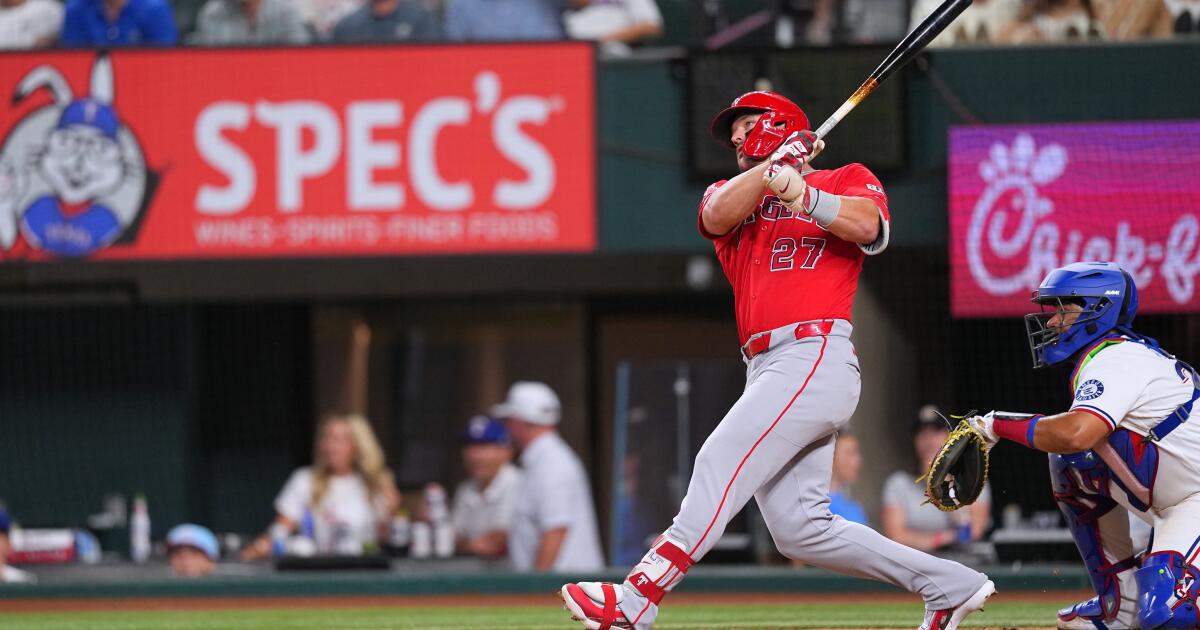
ARLINGTON, Tex. — Mike Trout hit a two-run homer in his return from the injured list, Jo Adell had two home runs and drove in a career-high five runs and the Angels beat the Texas Rangers 13-1 on Wednesday night.
Trout, who missed 17 games due to a strained right hamstring, hit a 438-foot shot that gave the Angels an 11-0 lead in the eighth. Trout has 48 homers against the Rangers, the most by any player since the franchise moved to Texas in 1972 and the second-most ever against the club. Reggie Jackson hit 54 home runs against the Washington Senators/Texas Rangers.
Adell hit a two-run shot in the fourth inning and a three-run homer in the fifth that made it 7-0.
Vaughn Grissom went 4 for 5 with a double and four RBIs, and Zach Neto was 3 for 4 with two doubles and three runs. Denzer Guzman and Jose Siri each had two hits.
Angels starter Walbert Ureña threw 90 pitches and walked five in four scoreless innings before he was replaced by Samy Natera Jr. (1-0) to begin the fifth. Natera, a rookie left-hander, had five strikeouts in two perfect innings for his first career win.
Neto doubled to lead off the game, and scored when Grissom singled off MacKenzie Gore (5-8).
Pinch-hitter Kyle Higashioka hit a leadoff homer in the ninth for the Rangers.
Higashioka pitched the ninth — his second career appearance on the mound — and gave up two runs. The 36-year-old catcher also gave up two runs in a 12-2 loss to Minnesota on June 16.
Gore gave up seven runs and nine hits with seven strikeouts in five innings.
Dodgers two-way phenom Shohei Ohtani waddled through the clubhouse after the Dodgers’ 4-3 comeback victory against the Padres on Friday night, the bulging ice wraps around his left knee and right arm creating a penguin-like effect to his gait.
That in and of itself wasn’t noteworthy — ice after starts is a regular part of any pitcher’s recovery and arm care. But for Ohtani, the awkward wraps were reminders of one ailment he’s getting over, knee inflammation, and one that popped up Friday night — a right biceps problem.
“More precautionary reason,” Ohtani said through interpreter Will Ireton about being replaced by a pinch-hitter in the seventh inning. “I was a little concerned with my biceps with the last at-bat that I took.”
Ohtani limited the Padres (43-44) to three runs over 110 pitches when he stepped up to the plate in the sixth.
Teoscar Hernández hits a grand slam for the Dodgers against the San Diego Padres on Friday.
He worked a full count and then flew out to right field. Ohtani paused on his follow-through, his lips pursed, before jogging up the line.
“It’s the same location that I felt a couple months ago,” Ohtani said. “It went away relatively quickly, so I expect that to happen again.”
That Ohtani dealt with a biceps problem earlier this season was not disclosed before Friday. Even manager Dave Roberts said after the game that he had just learned about the previous ailment.
Ohtani will take off Saturday to recover, Roberts said. And Ohtani skipping his last pitching start before the All-Star break is “on the table.”
Ohtani was voted the starting designated hitter for the National League, marking his sixth straight All-Star selection. But even before Friday, it seemed unlikely he would pitch in the All-Star Game given his rotation schedule.
“He’s a quick healer, and finds a way to get back,” Roberts said. “But I do think that for us to read and react and hear what his body is telling him is really important, given the toll it takes on his body to be a two-way player.”
The injury concern replaced now-assuaged questions about Ohtani’s pairing with catcher Dalton Rushing with Will Smith (neck) on the injured list. Smith has at least resumed throwing and took swings Thursday, Roberts said, but he isn’t expected to return before the All-Star break.
The last time Rushing caught Ohtani, the pitcher took over pitch-calling after a disastrous second inning against the Twins last week.
“I just overthought last time,” Rushing said in a conversation with The Times on Thursday night. “I was trying to be perfect, and with a guy like that, you don’t have to be perfect. You just need to call the right pitches at the right time and allow his stuff to just beat them naturally. And that’s the plan [Friday]. Whether I call the pitch, he calls the pitch. I want to make sure we’re both convicted in what we’re throwing, and we can execute it to the best of our ability.”
On Friday, Ohtani handed back over pitch-calling duties, communicating with head shakes and nods instead of the PitchCom buttons on his arm.
Ohtani walked the first two batters he faced. But then he struck out three of the next four, escaping the jam down just 1-0, courtesy of an RBI single from Gavin Sheets.
That started a streak of 10 batters who Ohtani retired in order, fanning six of them.
“The best way that I can describe it is, if it ain’t broke, don’t fix it,” Rushing said when asked what he’d learned from following along last week. “That’s the way he pitches. … Trust what you do, trust how good his stuff is, and just go from there.”
Dodgers pitcher Shohei Ohtani, left, gets a fist bump from catcher Dalton Rushing during the first inning of a 4-3 win over the San Diego Padres at Dodger Stadium on Friday night.
(Gina Ferazzi / Los Angeles Times)
Ohtani’s back-to-back strikeouts to end the second inning were a good example. Against left-handed hitting Sung-Mun Song, he threw mostly four-seam fastballs and splitters, finishing off the six-pitch at-bat with a sweeper, according to Statcast.
Against right-handed hitting Rodolfo Durán, Ohtani threw mostly sinkers and sweepers, with one four-seamer mixed in out of seven pitches.
Ohtani eventually relented a second run with two outs in the fourth inning. He fell behind 0-2 in the count to Jackson Merrill, who flipped a strike call with an ABS challenge. Then Merrill hammered a fastball over the plate for a solo homer.
Ohtani successfully navigated traffic to throw a scoreless fifth, but Xander Bogaerts tagged him for an RBI double in the sixth.
“I think I did the bare minimum,” Ohtani said. “To get through six, to give the team the chance to win, keep the game in check. But there were some good and some bad.”
Ohtani gave up seven hits for a quality start that wasn’t his cleanest. The Dodgers (58-31), who had struggled to get anything going against Padres starter Michael King, were trailing 3-0 when Ohtani exited. But Teoscar Hernández took care of the deficit.
Teoscar Hernández hits a grand slam in the seventh inning of the Dodgers’ 4-3 win over the San Diego Padres at Dodger Stadium on Friday night.
(Gina Ferazzi / Los Angeles Times)
Facing reliever Adrian Morejon with the bases loaded and no outs in the seventh, Hernández ambushed a first-pitch slider.
“Knowing him, every pitch is hard,” Hernández said. “I was looking for the hardest one, the fastball, middle-in. But just reacted to that one in the middle of the plate.”
Hernández drifted up the first-base line as he watched the ball fly. When it landed, he launched his bat back toward the dugout, and it made it halfway there.
“I’m just trying to find the same swing that I had before I got hurt,” Hernández said. “And at the same time, just do something for the team. It happened to be a big swing.”
Roki Sasaki’s abysmal appearance faded away in the Dodgers’ 12-7 win over the San Diego Padres after Los Angeles rose from a catatonic first inning. The Dodgers roared back from a 6-0 deficit as Andy Pages skirted a tying double down the left-field line, and Mookie Betts and Max Muncy each drove in runs to give them the lead in a four-run fourth inning. All of which sent the sellout crowd into jubilant celebrations, some jumping, others breaking out World Cup chants.
“I don’t know,” manager Dave Roberts said of the team’s ability to turn the game around. “Thankfully, it played out the way I didn’t expect, or the way it started.”
By the time the game ended, Sasaki’s three-inning start seemed like a murky nightmare the Dodgers awoke from in a sweat. Except the Dodgers weren’t dreaming, and the team hadn’t done much to assuage the concerns with Sasaki.
The problem with Sasaki isn’t his stuff. On his best nights, when the velocity and command combine, Sasaki blows past batters with a triple-digit fastball and cutting off-speed pitches. The problem has been how to tick the radar without making the strike zone look like a Jackson Pollock painting — and recently, it has.
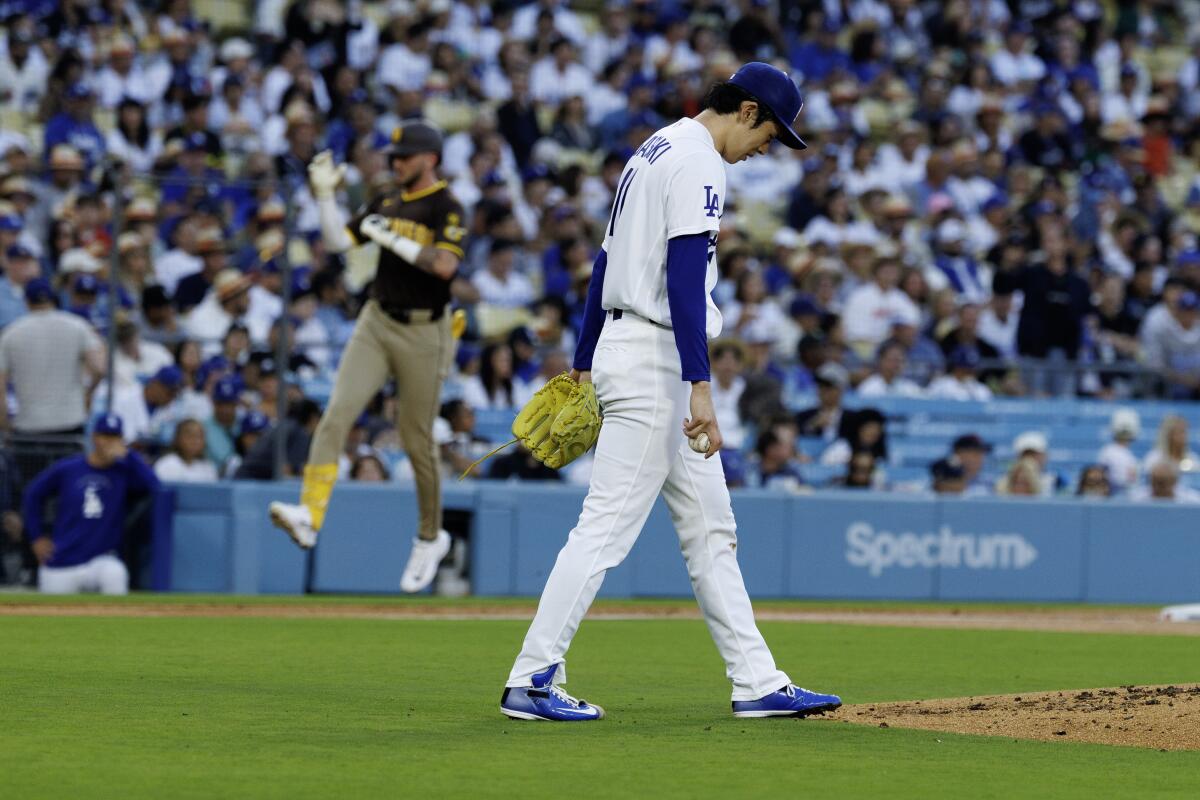
Sasaki’s June swoon, impervious to the calendar change, continued into Thursday’s series opener against the Padres, in which the right-hander gave up three home runs and seven hits before Roberts called it quits going into the fourth inning.
“They were on everything,” Roberts said. “You could see it.”
One possible concern? Tipping pitches. While Roberts and catcher Dalton Rushing said the team would need to do some more research into Sasaki’s start, both left the door open to this answer.
“That would be a big explanation as to how they felt like they were on every pitch,” Rushing said.
As San Diego chugged through its lineup, Sasaki struggled to keep up. With his first pitch, he gave up a double to Fernando Tatis Jr., who scored on Manny Machado’s home run that left center fielder Pages staring at the ball’s path as it plopped down on the other side of the blue outfield fence.
The inning was only a preview of the Padres’ power. Each of the nine San Diego batters got his chance against Sasaki in the second, and the team quickly dug the Dodgers into a six-run hole. He surrendered two home runs in the second inning. First, Jackson Merrill blasted a ball to left-center field, and, two outs later, Jake Cronenworth drove in two runs with a shot to right-center.
Sasaki said through interpreter Kensuke Okubo that he felt like he needed work on his command to improve, but he felt like his fastball was good.
Roki Sasaki has his head down after giving up a solo homer to Jackson Merrill in the second inning.
(Gina Ferazzi / Los Angeles Times)
“I don’t think my stuff was bad today,” Sasaki said. “Overall, it wasn’t great but a lot of things evolved.”
Part of Sasaki’s issue lies with his approach. Roberts said he wants the second-year pitcher to be aggressive, to play the cat-and-mouse game required to beat batters in the box. But when given the opportunity, Sasaki has shrunken in recent outings, struggling with his command and his ability to pitch deep into games.
“We had a great May, so let’s just get back to competing and making pitches,” Roberts said.
When reliever Will Klein walked out to the mound in the fourth to the aggressive, rambunctious clamor of the Dropkick Murphys’ “I’m Shipping Up to Boston” and collected two scoreless, one-hit innings, the relief was immediate: The Dodgers took the lead.
The lineup already was revving, as Dalton Rushing homered in the second inning while Sasaki was still in the game, and both Kyle Tucker and Max Muncy drove in runs in the third, cutting the deficit to two. The Dodgers broke through against the Padres’ bullpen to score six runs in the fourth and fifth innings.
“The bullpen was fantastic tonight, and then the offense came up big,” Roberts said.
A late catch by Pages helped close out the game after he gloved a ball despite ramming into the padding of the center field wall. A combined effort by Paul Gervase and Tanner Scott shut down San Diego’s ninth-inning momentum after it pushed across a run.
“Turned back around, was able to find the ball and make a really good catch right there,” Tucker said. “That was a huge out.”
The Dodgers (57-31) beat their division rivals for the fifth time in seven games to open a 13-game lead over both San Diego and Arizona. The Padres, meanwhile, have given up 65 runs over the last six days, the most in such a span in franchise history.
But San Diego’s flaws don’t negate the Dodgers’ as they burned through six relievers in their win. So, while the Dodgers crawled out of the hole with a season-high 17 hits, the steep cost heightens the pressure on the rest of the rotation the rest of the series.