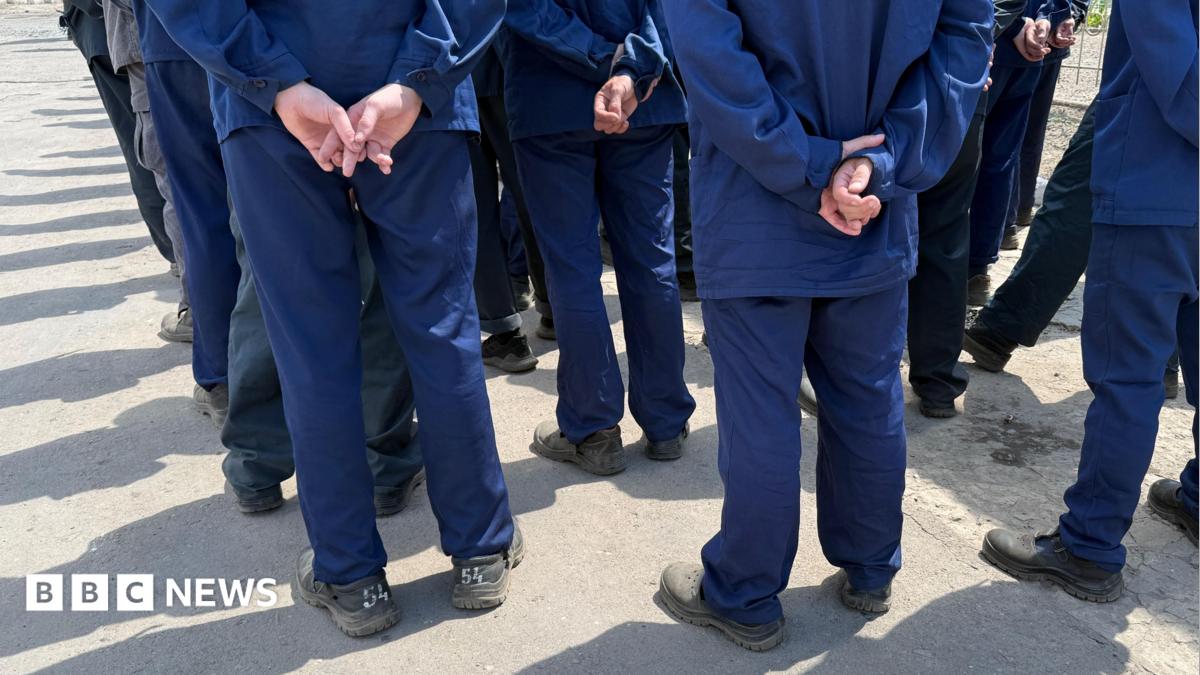
All the Ukrainian-born PoWs we interviewed came from areas occupied since 2014 and almost all joined the Russian army voluntarily.
But one man from Donetsk region told us he had been forced to fight.
His eyes darted around as he talked, unsure who he could trust.
One official tally, citing “intelligence”, suggests more than 50,000 Ukrainians have been conscripted against their will in occupied areas. Others put the figure far higher.
This man told us that when the Russians invaded, his family had stayed, not through any political or national allegiance but because Donetsk was their home.
Now, his only ambition was to get back to his wife and children, then avoid being returned to the front. “I’m just going to hide,” he confided.
Beneath the hospital windows and newly whitewashed walls there are rows of strawberries and cucumbers planted by the prisoners.
Further on, the stench of varnish from an outhouse is overpowering.
An official lifts a gold-coloured plastic handle from a bag near the door. “Guess what this is for?” he challenges us, grinning.
Inside, I do a double-take: the men working inside are hammering together wooden coffins. I am told the last contract the prison got was for garden sheds. This one feels macabre.
Across the courtyard in another workshop a handful of PoWs are making artificial Christmas trees, gaudy baubles strung from their machines. Like the coffin-makers, they tell me they use their wages to buy extra food and cigarettes.
Sergei was born in the Ukrainian city of Luhansk but says he is Russian like his parents, who moved to the Donbas when both countries were part of the Soviet Union.
He joined the Russian army a decade ago “to defend my homeland”, but claims he will retire when he gets back, not return to the front. “I’ve done my bit.”
Most will have no choice.
Stacking plastic branches next to Sergei is a drug dealer who signed up, like many, “exclusively” to avoid a long jail term.
“For me, 15 years in prison was too much,” Konstantin explains. “I know it probably doesn’t excuse me, but it’s a fact. I’m 44 now, I would be 60. So no.”
But Vshniki, or convict-soldiers, have to survive to the end of the war to be released and in the assault troops the odds are not good.
Three convicted murderers told us they had thought they could walk free after fighting for a year, only to have their contacts renewed automatically.
Across northeastern Nigeria, former Boko Haram insurgents now move with Nigerian troops into forests they once controlled. They identify footpaths that insurgents use after attacks, point out where improvised explosive devices are most likely buried beneath soft sand roads, and decode habits, voices, and movement patterns invisible to the average soldier. They explain how camps are structured during the rainy season and identify commanders at a distance. Some of these ex-insurgents die in combat fighting the same insurgency they once served.
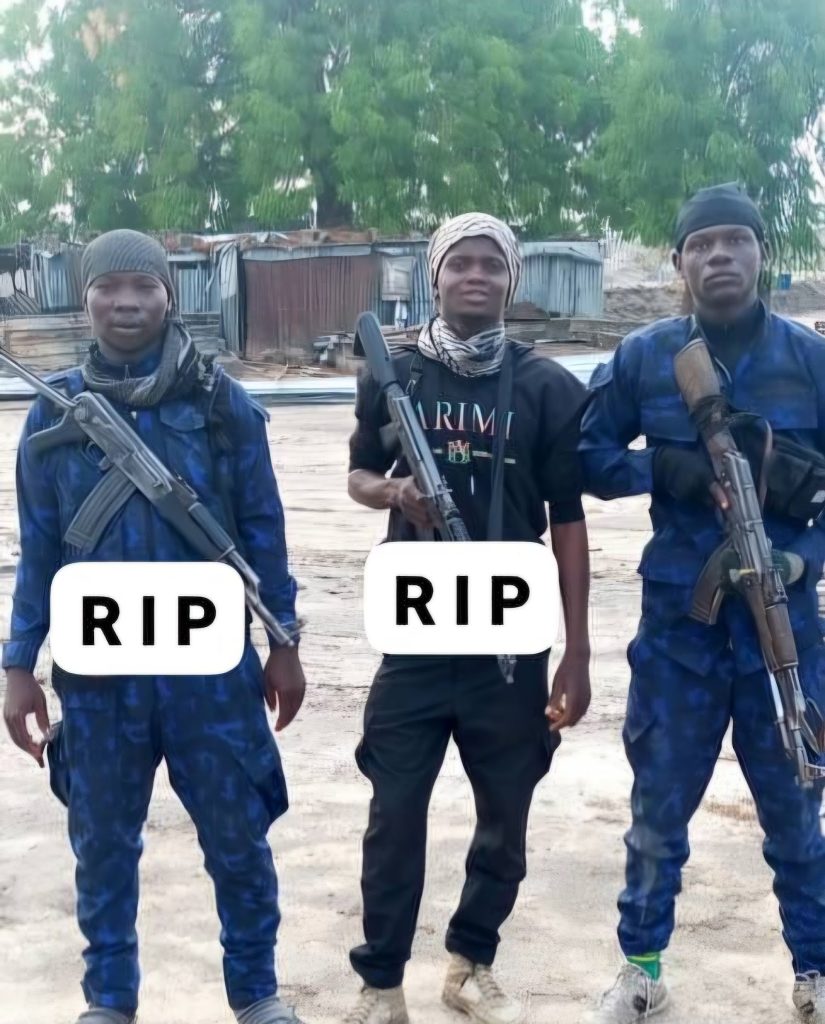
One of the first such defectors was Abubakar Umar from Bama in Borno State. Soldiers called him Small and say he was presumably in his mid-20s when he died in 2023. Before then, he had fought on the frontlines of multiple operations across Sambisa, Timbuktu, and the Lake Chad basin.
Before surrendering, Small spent years in the insurgency as a Naqeeb, a low-ranking fighter, enabling him to know the terrain intimately. By the time he defected to the Nigerian Army, he already knew which routes disappeared under floodwater during the rains, where insurgents buried weapons before abandoning camps, and how insurgents escaped after raids. He understood the logic behind ambushes because he had once planned and carried out attacks against the same army he would later fight beside.
Others followed a similar path. Among them was Zakariyya from Pulka in Gwoza, another ex-insurgent who later supported military operations across Borno and Yobe. He died in late 2025.
At first, many soldiers distrusted them, especially as some of them had lost close friends and colleagues to Boko Haram attacks. For them, accepting a former insurgent carrying a rifle beside them was never easy. Operation after operation changed the relationship, however. According to military sources familiar with the missions, Small and Zakariyya repeatedly identified patterns that helped troops avoid deadly traps and ambushes. With time, commanders began listening whenever they spoke.
Then came a particular operation deep inside Sambisa in 2023. Small moved ahead of the troops in a way one soldier later described to HumAngle as “fearless, almost reckless,” as though death no longer frightened him, having already crossed too many moral boundaries to fear its arrival. He never returned.
Ex-surgents who defected and were actively engaged in combat against Boko Haram. Late Abubakar Umar “Small” is seen in the middle in this file photo.
The soldiers who survived that operation spoke about him afterwards with the kind of tone usually reserved for men buried in decorated military uniforms.
There are many stories like this now scattered across the northeastern region–former insurgents fighting alongside the state.
From the islands and marshes of Lake Chad to the forests of Zamfara, Sokoto, Kaduna, Niger, Kebbi, and the roads stretching toward Kwara, Nigeria is confronting a conflict system that has changed shape. In response, security forces are increasingly turning toward defectors.
The unseen war
For years, the Nigerian state has made progress against the Boko Haram war. When villages like Bama and Gwoza fell to the terror group, the military reclaimed them very quickly. They have also killed commanders over time, while still exploring non-kinetic approaches that made it possible for insurgents to surrender. Through this approach, defections occurred at an unprecedented rate.
Boko Haram fractured internally as ISWAP consolidated its presence in parts of the Lake Chad Basin. Many did not want to remain in the Lake Chad theatre, but they also did not trust a formal surrender to Nigerian authorities, so some of them moved to other parts of Nigeria.
HumAngle has tracked the movement of former Boko Haram elements to the North West region and parts of central Nigeria as far back as 2020. Some joined criminal armed groups, others became trainers, bomb makers, couriers, informants, guards, or logistics brokers. Others disappeared into cities following the death of Abubakar Shekau and clashes between factions within the group.
In Kano and several urban areas, defectors and affiliates blended into urban life. Some became labourers, mechanics, phone repairers, commercial drivers, or petty traders. Some drifted into robbery and informal criminal economies, while others married and completely concealed their past.
This creates a difficult security dilemma for many reasons. How does a state track men who have left the insurgency but not entered any formal process? How does it distinguish between a deserter seeking anonymity and one rebuilding operational networks elsewhere? How does it protect communities without criminalising everyone who once lived under insurgent rule?
Nigeria has not answered those questions through a coherent national framework. Instead, it improvises.
The intelligence war nobody sees
When HumAngle spoke with soldiers and intelligence officers who served in the North East, their language was different. They do not romanticise former Boko Haram insurgents nor do they describe them as heroes, but they call them assets.
Before defectors became operationally useful, troops often entered unfamiliar terrain with insufficient intelligence from local hunters, the civilian joint task force, and satellite imagery. Equipment like drones and maps was useful but had limitations, as it could not predict movement patterns or likely landmines. Former insurgents helped dismantle part of that advantage. According to several defectors interviewed for this report, many military successes now depend partly on information provided by them.
“Whenever soldiers go for operations,” one explained, “some of us move ahead because we know the roads, the bushes, and where bombs are planted. We tell them which road not to use.”
Another former insurgent described how they identified hidden weapon caches and camp positions.
“Some of us know where weapons were kept. So when operations happen, we guide soldiers directly to those places.”
Get our in-depth, creative coverage of conflict and development delivered to you every weekend.
Subscribe now to our newsletter!
They also described helping troops understand insurgent movement patterns after attacks.
“When fighters escape,” one said, “we know the routes they use because we ourselves used those routes before.” The source added, “We advised soldiers to evacuate the women and children left behind by fighters to Maiduguri, which encouraged a lot of the fighters to defect from the group easily at a later date.”
The moral fracture
For victims, however, these battlefield contributions rarely erase memory. A widow whose husband was executed does not easily accept that the man who once terrorised her community now works alongside soldiers. A farmer whose village was burned does not find emotional comfort in hearing that a former insurgent helped identify buried bombs. A displaced family living with hunger in an abandoned resettled community does not easily understand why former insurgents appear to receive rehabilitation support while survivors struggle alone.
That anger has become one of the deepest unresolved tensions inside Nigeria’s reintegration strategy. Many affected communities perceive former insurgents as receiving privileges unavailable to victims. Some surrendered members received food support, accommodation, vocational training, phones, stipends, or reintegration assistance. Meanwhile, many survivors still live with displacement, trauma, hunger, unemployment, grief, and insecurity.
Infographics: Akila Jibrin/HumAngle.
One former insurgent described how resentment intensified after communities observed rehabilitated insurgents riding motorcycles, carrying weapons alongside soldiers, wearing jeans and clean clothes, and moving relatively freely.
“What happened was mostly hatred and resentment,” he said. “People saw the boys looking comfortable and became angry.”
Kabiru Adamu, the Managing Director of Beacon Consulting, comments on this imbalance. “When we look at this from a transitional justice perspective,” he said, “the current imbalance is a significant vulnerability.”
According to him, communities may interpret reintegration programmes as rewarding violence while neglecting victims.
“If the state appears to reward insurgency while neglecting victims, it breeds a deep sense of injustice. Unaddressed grievances are the primary fuel for cyclical violence.”
Former insurgents speak
The former insurgents interviewed by HumAngle described themselves not as forgiven men, but as useful men. “There are those who go to war,” one former fighter said, “And there are informants.” He explained that some maintain communication with active insurgents and relay intelligence to security agencies.
“If attacks are being planned, information is passed quickly to intelligence officers so security can be strengthened.”
Others described identifying civilians secretly supplying insurgents with food, fuel, or information. “There are people in town transporting petrol, food, and information,” one explained. “Those who surrendered know many of them because they worked together before.”
According to the former insurgents, these intelligence networks disrupted insurgent logistics and prevented attacks. Some defectors also described participating directly in combat operations.
“They gave some of us motorcycles and guns,” one said. “Sometimes, operations happen without soldiers even accompanying us.”
Another described units led by surrendered insurgents moving independently through forests to intercept attacks or recover weapons.
“Some commanders are given twenty or thirty motorcycles and sent to carry out patrols,” he said. “They stop attacks and return with captured weapons… Nearly 40 per cent of ground troops’ successes achieved in the past three years in this war come from the contribution of surrendered fighters.”
HumAngle cannot independently verify this claim. Still, several military and intelligence sources who spoke to HumAngle on the condition of anonymity admit that defectors remain useful in operations. What is less clear is whether relying on them will be safe or sustainable in the long run.
Security expert Kabiru Adamu described former insurgents as “force multipliers” rather than the decisive force behind military gains. According to him, conventional military operations, air power, and the Civilian Joint Task Force remain central to weakening insurgent networks.
“Ex-fighters provide precision,” he explained. However, he warned that the strategic dangers remain severe. “The risks include infiltration, double agents, human rights concerns, institutional degradation, and loss of civilian trust.”
The risk of dependence also concerns some analysts and security officials. If military units become too reliant on defectors for intelligence, what happens when defectors lie, or when personal grudges shape accusations, or when former insurgents return to active criminal networks or, as in some cases, return to Boko Haram carrying sensitive operational knowledge? What happens when military institutions fail to build independent intelligence systems because surrendered insurgents appear easier to use?
The northwestern region is quite different from the North East. Boko Haram and ISWAP emerged through ideological insurgency structures combining theology, coercion, governance, taxation, and violence. In contrast, the armed groups in the northwestern region emerged differently, engaging in criminal activities such as cattle rustling, communal conflict, illegal mining, vigilante reprisals, extortion, kidnapping, and governance collapse.
Yet over time, the distinction blurred. Armed groups across Zamfara, Sokoto, Katsina, Kaduna, Niger, and Kebbi increasingly adopted tactics associated with insurgent warfare: IEDs, ambushes, and rural territories being subject to armed taxation systems.
Abubakar Abdullahi, a journalist who has reported extensively from Zamfara, said Boko Haram-linked elements have become increasingly visible inside parts of the northwestern region.
“In areas such as Dutsin Maiqardaji mountain,” he said, “Boko Haram members have a heavy presence. Both Lakurawa and Boko Haram terrorists preach to residents they keep under siege in ungoverned spaces. Ongoing armed operations in the North East pave the way for fighters to find Zamfara as a haven,” he explained.
Therefore, the state’s decision to use surrendered insurgents in counterinsurgency operations across parts of the northwest follows a grim internal logic.
Trauma beneath the surface
The psychological burden of the insurgency now stretches across an entire generation. In Maiduguri, Monguno, Bama, Dikwa, Gwoza, Damboa, Pulka, Banki, and dozens of smaller communities scattered across Borno and the wider Lake Chad region, trauma shows up in ordinary routines. Some people report waking suddenly at night whenever motorcycles pass too quickly outside their compounds. Parents instinctively gather children indoors whenever rumours of attacks on nearby roads spread. Men who once farmed freely now calculate distance from military formations before deciding whether land is safe enough to cultivate.
For many survivors, peace itself feels temporary.
Kauna Malgwi, a clinical psychologist directly affected by the insurgency during its early years, described northeastern Nigeria as a society living in a prolonged psychological survival mode.
“Prolonged violence keeps societies in chronic hypervigilance,” she explained. “People shift from acute stress into collective survival mode. Nervous systems remain activated for years. Unresolved trauma normalises fear, weakens communities, and erodes cohesion. Ongoing violence keeps trauma active and prevents healing.”
The effects appear everywhere: overcrowded displacement settlements, classrooms where children struggle to concentrate because conflict has interrupted the normal architecture of childhood, families where fathers withdraw emotionally after years of violence, and young men who have grown up around guns, funerals, military convoys, and uncertainty.
“Children in chronic conflict develop emotional, learning, and behavioural problems that, if unaddressed, persist into adulthood and become the generational norm,” Malgwi warned
She listed the consequences as cycles of violence, emotional detachment, chronic anxiety, educational disruption, social mistrust, difficulty forming secure relationships, and increased vulnerability to recruitment by armed groups.
“If trauma among children is ignored,” she warned, “national stability itself is at risk. Peacebuilding that ignores collective healing produces fragile and temporary peace. When victims feel forgotten as ex-fighters are supported, trauma deepens and trust in institutions erodes. Forgiveness must not be forced. Communities require safety and acknowledgement before reconciliation.”
According to her, communities need public acknowledgement of suffering before reintegration can become emotionally sustainable.
“Victim-centred support systems are essential. Communities need visible justice, visible care, and transparent communication before trust can begin to recover.”
She also warned about the development of emotional desensitisation among conflict-affected populations.
“Without support, grief becomes anger or despair,” she explained. “Violence itself can become normalised.”
Many young people in northeastern Nigeria have never experienced sustained normalcy. They grew up hearing stories about massacres the way previous generations heard folktales. They learned directions through checkpoints and geography through displacement.
Kauna Malgwi believes recovery in such environments cannot depend solely on psychiatrists or formal hospitals because the scale of trauma is too large.
“Community healing includes training community health workers in psychosocial support, group therapy, trauma-informed schools, faith-based healing spaces, and safe storytelling forums,” she explained, stressing the importance of collectively restoring dignity. “The goal is not only treatment. The goal is restoring function, trust, and resilience across society.”
For many survivors, however, the war never became a discussion about tactical adaptation. It remained personal. A missing daughter. A burned house. A father was executed beside a road. A child was buried after an explosion and nights of screaming.
A life divided permanently into before and after.
The state’s impossible calculation
For Kabiru Adamu, the question is not whether the state should use former insurgents operationally. The deeper issue is whether Nigeria can do so without weakening its own legitimacy. He described the current approach as a fragile balancing act between military necessity, transitional justice, and social stability.
“The Nigerian military faces a highly asymmetric threat,” he said. “Using former fighters offers distinct immediate operational advantages because these individuals possess granular, real-time intelligence. They know Sambisa Forest, the Mandara Mountains, the Lake Chad islands, and the internal communication structures of factions like JAS and ISWAP.”
Still, he repeatedly returned to the dangers. “The strategic risks are severe and multifaceted.” The operational usefulness of former insurgents can serve as an excuse to abandon accountability. “There must be transparent triage,” he argued. “Low-level associates and coerced participants cannot be treated the same way as high-level perpetrators. Most residents of Borno, Adamawa, and Yobe reject blanket amnesty for commanders associated with mass atrocities.”
For Adamu, reintegration without visible justice creates long-term instability.
“If communities feel abandoned by the state in favour of their attackers, it erodes the social contract. It opens the possibility of vigilantism or future militant mobilisation driven by resentment. Demobilisation is not simply a military process,” he said. “Reintegration is generational and should remain civilian-led.”
He pointed to global examples from Iraq, Afghanistan, and Colombia as warnings.
“When stipends dry up without sustainable livelihoods, ex-combatants often return to criminal economies.”
According to him, Nigeria risks repeating similar mistakes unless rehabilitation becomes economically viable. “Cash support alone is not enough. Long-term reintegration requires market-driven livelihoods and ongoing monitoring.”
He also warned against grouping defectors into separate armed formations.
“Never create isolated paramilitary monopolies from ex-combatants,” he said. “If they are used operationally, strict oversight and accountability systems are essential.”
Perhaps most importantly, he insisted that reintegration cannot survive politically unless victims see equal investment in their own recovery.
A group of former Boko Haram insurgents who were rehabilitated by Nigeria’s Operation Safe Corridor programme in northeastern Nigeria.
“For every dollar spent on DDR,” he argued, “an equal or greater amount should be visibly invested in victims and receiving communities.”
Without that balance, he believes the state risks winning short-term tactical gains while deepening long-term social fractures.
The soldiers and the boys
One of the strangest transformations inside this war is the relationship between soldiers and former insurgents. Many soldiers lost friends to insurgent attacks, some carry visible scars, and others carry memories they rarely discuss. Meanwhile, former insurgents themselves live in a state of permanent ambiguity. They are neither fully accepted civilians nor recognised soldiers. They exist inside a grey zone.
According to the former insurgents HumAngle spoke to, several surrendered members deployed to Zamfara and other northwestern states were killed during operations against armed groups.
“In this war,” one said, “many of those helping the government have lost their lives. Some died fighting people they once called brothers.”
A Nigerian soldier told HumAngle he never imagined he would one day fight alongside former Boko Haram members.
“I thought the only relationship I would ever have with these bastards was to kill them or be killed,” he said, speaking on condition of anonymity because he’s not permitted to speak to journalists on this matter
Now deployed with some of the defectors against their former comrades, the soldier said the experience has reshaped parts of his perception over time. Some of the former insurgents have proven useful in combat operations, particularly because of their familiarity with insurgent tactics and terrain.
“They have been very helpful since we started working with them. They are constantly watched and supervised, but the contributions of some of them have been priceless,” said the staff sergeant.
What a serious framework would require
Nigeria does not need to pretend former insurgents are useless. Evidence from the field suggests they have helped disrupt attacks, expose explosives, identify camps, trace logistics, and support military operations. At the same time, experts say the state cannot continue to manage reintegration through improvisation and silence. A credible framework would require clear categories that separate coerced associates from high-level perpetrators. It would require transparent accountability systems. Victims would receive compensation, trauma support, livelihood recovery, education, and public acknowledgement.
The northwest would be treated as its own conflict system requiring tailored responses rather than simple transplantation of northeastern models.
Repentant volunteers
The former insurgents interviewed for this report did not seem to want public sympathy. Most acknowledged that many Nigerians would always see them as part of the violence they once took part in. Yet, beneath their answers was a recurring theme. They insisted they no longer recognised the movement they had joined years earlier.
Abu Muhsin, now 38, said he entered Boko Haram as a teenager after preachers repeatedly visited his village.
“I joined them when I was around 16 years old,” he said. “They used to come and preach in our village, near Damasak. I got convinced, and I joined them.”
Over time, he rose within the movement and eventually became a Naqeeb, a field commander operating around the Lake Chad region. But years inside the insurgency changed his view of the organisation.
“We saw that the group was not following the rules of Islam,” he said. “They kill people and loot their properties. We started communicating with those who surrendered before us. They directed us and later escaped from the bush with some of our families.”
After surrendering, Abu Muhsin said he volunteered to support military operations because former insurgents understood terrain and insurgent movement patterns better than most troops.
“No one forced us to volunteer,” he said. “We just felt we should assist the military since we know the bush better than they do.”
For that assistance, he said, volunteers receive irregular payments. “They give us some allowance. They pay us ₦100,000, sometimes ₦50,000 or ₦30,000.”
Another former insurgent, Ibn Mus’ab, traced his recruitment to family influence. “My cousins were already members and used to visit us,” said the 35-year-old former fighter from Wulgo in Gamboru Ngala. “They used to preach their doctrines to us. Later, they convinced me, and I followed them to the bush.” That was in 2014.
Inside the insurgency, Ibn Mus’ab became Amirul’Uddah, responsible for weapons management. Like several defectors interviewed for this report, he framed his disillusionment in religious terms.
“I left them because some of their activities are becoming un-Islamic,” he said. “They kill people unnecessarily. They kill someone for taking drugs, which is not so in Sharia.”
His departure from Boko Haram was shaped partly by internal persecution. He said he was accused of an offence and that members of the group declared him wanted. “I escaped to Giedam, not even knowing that the military was accepting people who surrendered,” he recalled. “I was later told I could submit myself, and I surrendered to them.”
He escaped alone, and his family joined him later. Asked why he now assists the military against former comrades, he answered without hesitation.
“I decided to assist because those people are no longer following the Sharia accordingly. There are many of us who are ready to assist, and a lot are doing well.”
Like others, he described financial incentives as modest and inconsistent.
“The usual pay is ₦100,000, sometimes ₦50,000,” he said. “If they can pay more than this, many more would be willing to volunteer.”
Abu Faruq’s story begins differently. Unlike some defectors who joined as adults through ideological persuasion, he said he was absorbed into the movement as a child during Boko Haram’s expansion across Gwoza.
“They took me when I was a kid,” the 35-year-old said. “It was in Gwoza when they were preaching. I grew up in their place and got married.”
He said he became part of the Rijaal, the fighting cadre within the insurgency structure.
Years later, he concluded that the movement no longer reflected the religious principles it claimed to defend. “I left them because they were not practising what the Qur’an and Hadith say about Sharia,” he explained. “They kill innocent people, they loot and destroy people’s properties.”
According to him, communication with earlier defectors again played a critical role in encouraging surrender. “Some of our friends have earlier surrendered, and they told us how they were received warmly,” he said. “They directed us on the phone on how we could come out and meet the military.”
After leaving the bush, Abu Faruq eventually joined operations supporting Nigerian troops, including deployments far beyond the northeast. “Yes, I did,” he said when asked whether he travelled with soldiers to the northwest. “They selected some of us to assist them in Zamfara and Sokoto.”
According to him, defectors participated in operations across multiple villages affected by armed groups. “They first took us to Sokoto, and from there we went to many villages in both Sokoto and Zamfara for operations.”
He said he remained there for about two months. For that deployment, he received what he described as ranger allowances. ‘They pay us ₦100,000 per month as rangers.”
These stories show men trying to find a new place for themselves in a war that has already taken over much of their lives. But none of their reasons answers the deeper moral question about Nigeria’s use of former insurgents.