Foreign Office

UK food ban for airport travellers update as minister issues statement

Currently anyone found with five types of food – even bought in duty free – will have the seized, destroys and face £5,000 fines

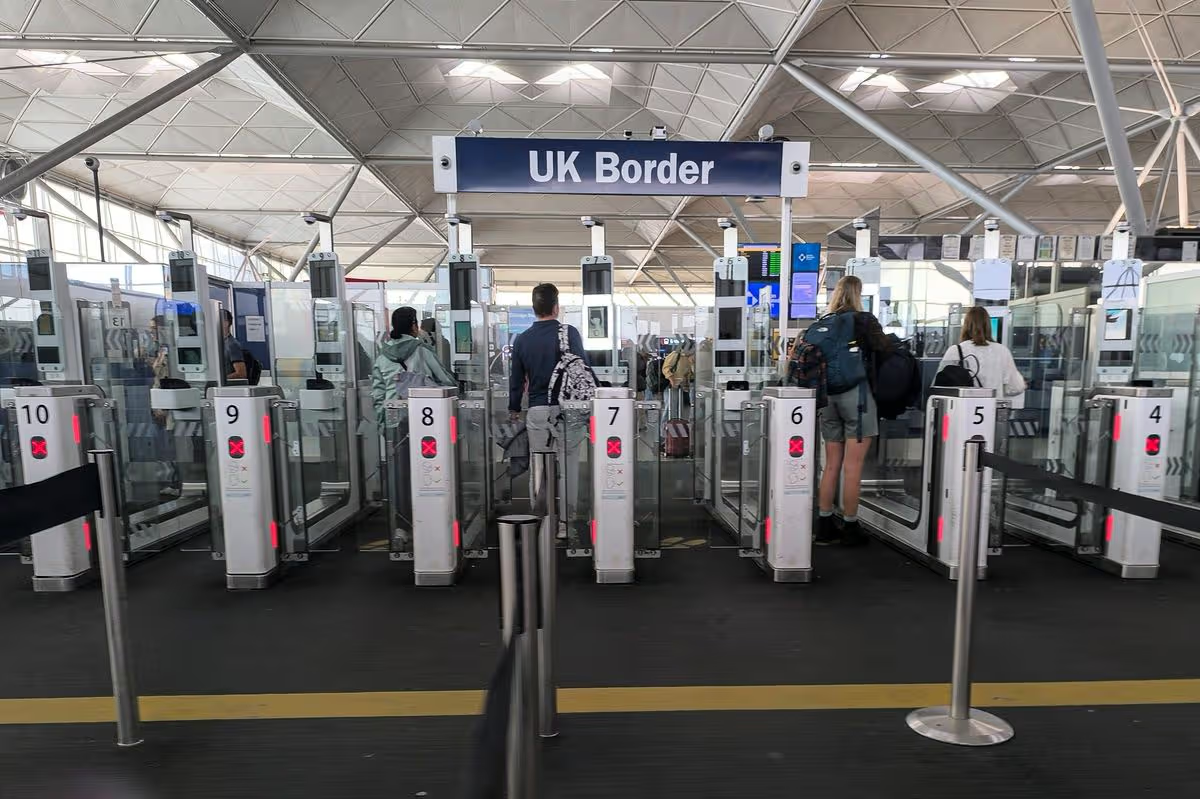
A government minister has given an update on a ban on anyone bringing food into the UK on aircraft. Since last April passengers face being stopped at the UK border and having items confiscated and could face fines of £5,000.

The ban is in place because of a food and mouth outbreak in Europe. The Department for Environment, Food & Rural Affairs (DEFRA) banned items like sandwiches, cheese, cured meats, raw meats or milk into Great Britain.

Travellers are not allowed to bring cattle, sheep, goat, and pig meat, as well as dairy products, from EU countries into Great Britain for personal use, to protect the health of British livestock, the security of farmers, and the UK’s food security.

And yesterday the government issued an alert about a new outbreak in UK holiday hotspot Cyprus, meaning more restrictions have been brought in on commercial imports.

UK Chief Veterinary Officer Dr Christine Middlemiss said: “Foot and Mouth disease has now been confirmed in Cyprus, we remain in contact with our European counterparts to understand the latest situation.

“Robust plans are already in place to minimise the risk of disease incursion to support Britain’s farming community and food security.”

Those found with these items will need to either surrender them at the border or will have them seized and destroyed. In serious cases, those found with these items run the risk of incurring fines of up to £5,000 in England.

In a new parliamentary written question Labour MP Ben Goldsborough asked if enough was being done to inform the public and asked the Secretary of State for Environment, Food and Rural Affairs Emma Reynolds “If she will make an assessment of the potential merits of funding public awareness campaigns, including advertisements at airports and ports, on (a) foot and mouth disease and (b) African swine fever.”

DEFRA minister Dame Angela Eagle said extensive efforts have been made recently to highlight the ban: “ Biosecurity is a priority for this Government. To protect UK farmers and animals from serious diseases like Foot and Mouth Disease and African Swine Fever, we used the Christmas period as an opportunity to remind the public about the personal imports ban on travellers from the EU and EEA countries bringing dairy and meat products to GB, that came into force last year.

“This included promoting awareness of the rules to the travelling public and extending our reach through partnership channels across Government and with industry. Our insights survey results indicate that over 90% of respondents are aware that they should not bring back meat and dairy products from these countries.

“Any decisions on funding paid campaigns will be made based on the current threat level, evidence of effectiveness and available resources, ensuring maximum impact in protecting UK biosecurity.”

Restrictions on meat, dairy and animal products for human consumption

You cannot bring in any of the following:

  • cheese, milk and dairy products like butter and yoghurt
  • pork
  • beef
  • lamb
  • mutton
  • goat
  • venison
  • other products made from these meats, for example sausages

You can bring the following into Great Britain from any country without any restrictions:

  • bread, but not sandwiches filled with meat or dairy products
  • cakes without fresh cream
  • biscuits
  • chocolate and confectionery, but not those made with a lot of unprocessed dairy ingredients
  • pasta and noodles, but not if mixed or filled with meat or meat products
  • packaged soup, stocks and flavourings
  • processed and packaged plant products, such as packaged salads and frozen plant material
  • food supplements containing small amounts of an animal product, such as fish oil capsules

Ensure our latest headlines always appear at the top of your Google Search by making us a Preferred Source. Click here to activate or add us as your Preferred Source in your Google search settings.
Source link

Brexit 180 rule could see your holiday to Spain or Greece ruined

UK holidaymakers travelling to popular destinations like Spain and Greece could be turned away at airports

British holidaymakers jetting off to Spain, Greece and many other countries must follow a post-Brexit rule – or be refused boarding at the airport. While the prospect of an overseas getaway is thrilling, it’s important for travellers to be aware of all requirements before setting off.

This has become especially vital following Brexit, which has introduced new regulations in recent years. Prior to Britain’s departure from the European Union (EU), UK passport holders could visit the Schengen Area without requiring passport stamps and weren’t subject to any time limits on their stays.

However, British visitors are now limited to a maximum of 90 days during any 180-day period. To assist with this, an application called Schengen Simple has been developed.

George Cremer, founder of Schengen Simple, said: “We built a travel app that handles the 90/180 calculation for exactly this reason. The tricky part most people miss is that it’s a rolling 180-day window, not a fixed calendar period.

“So someone who did a long summer trip to Spain might unknowingly be restricted on a winter break months later. The European Commission has its own calculator, but it only looks backwards.

“It tells you how many days you’ve used, not how many you have left for a future trip. That’s the gap we fill. Users enter past and upcoming travel and can see exactly how long they can stay without risking an overstay.”

The Foreign Office’s guidance for all Schengen nations warns: “If you overstay the 90-day visa-free limit, you may be banned from entering Schengen countries for up to 3 years.”

The Schengen area consists of: Austria, Belgium, Bulgaria, Czechia, Croatia, Denmark, Estonia, Finland, France, Germany, Greece, Hungary, Iceland, Italy, Latvia, Lithuania, Liechtenstein, Luxembourg, Malta, Norway, The Netherlands, Poland, Portugal, Romania, Slovakia, Slovenia, Spain, Sweden and Switzerland.

Source link

Foreign Office changes travel advice for Spain and 28 other countries

The Foreign, Commonwealth and Development Office has updated its travel advice for a number of countries across Europe

The Foreign, Commonwealth and Development Office (FCDO) has revised its travel guidance for 29 countries, including numerous destinations that are popular with British holidaymakers.

On Wednesday, February 18, the FCDO updated its advice for travel to Austria, Belgium, Bulgaria, Croatia, Czechia, Denmark, Estonia, Finland, France, Germany, Greece, Hungary, Iceland, Italy, Latvia, Liechtenstein, Lithuania, Luxembourg, Malta, Netherlands, Norway, Poland, Portugal, Romania, Slovakia, Slovenia, Spain, Sweden, and Switzerland. The changes concern the European Union’s (EU) rollout of its new Entry/Exit System (EES).

Updated FCDO guidance states: “EES checks are being introduced in a phased way across external borders, with full operation expected from April 10, 2026. This means that when you travel into the Schengen area for short stays, you may need to register your biometric details, such as fingerprints and a photo.

“You do not need to take any action before you arrive at the border, and there is no cost for EES registration. On your first visit into a Schengen country, you may be asked to register your details at a special booth before proceeding to the immigration desk.”

Travellers are urged to follow the advice of staff at their point of entry. The FCDO alert continues: “You may also need to provide either your fingerprint or photo when you leave the Schengen area. Children aged 11 or younger will not have their fingerprints scanned but can be required to have their photo taken.

“EES might add a few extra minutes to each passenger’s journey, so brace yourself for longer waits than usual at the border. Until EES is fully implemented, your passport will continue to be stamped, even if you’ve already registered for EES.

“Once EES is fully operational, it will supersede the current practice of manually stamping passports upon arrival in the Schengen area for short stays, and you’ll input biometric details every time you enter or exit. If you enter the Schengen area via the Port of Dover, Eurotunnel at Folkestone or Eurostar at St Pancras International and you’re asked to register for EES, the information will be collected at the border before you depart the UK.”

A traveller’s digital EES record remains valid for three years. If you re-enter the Schengen zone within this timeframe, you’ll only need to provide a fingerprint or photo at the border, both upon entry and exit.

Source link