Flown

First F-16 Block 72 Has Flown

The first-ever F-16 Block 72 has taken to the air, marking a major milestone for the program and for Morocco’s long-running effort to field what Lockheed Martin describes as the most advanced version of the Viper.

The first of the jets for the Royal Moroccan Air Force (RMAF), a two-seat F-16D, completed its maiden flight at Lockheed Martin’s facility in Greenville, South Carolina, the company announced today. The aircraft will now proceed through flight testing ahead of its delivery to Morocco.

Interestingly, one of the photos of the jet published by Lockheed Martin shows the pilot in the front cockpit wearing a Digital Joint Helmet Mounted Cueing Systems (D-JHMCS). This advanced helmet is not often seen worn by F-16 pilots and it is not clear if it has been ordered by Morocco.

Regardless, Morocco was the first customer to select the Block 72 configuration when the U.S. government approved its purchase in March 2019.

At that time, the Defense Security Cooperation Agency said Morocco was seeking 25 F-16C/D Block 72 aircraft in a package estimated at $3.787 billion. The proposed aircraft were to be equipped with the AN/APG-83 Scalable Agile Beam Radar (SABR), an active electronically scanned array type, new mission computers, Link 16 Multifunctional Information Distribution Systems, modernized navigation systems, helmet-mounted cueing systems, and a range of air-to-air and air-to-ground weapons.

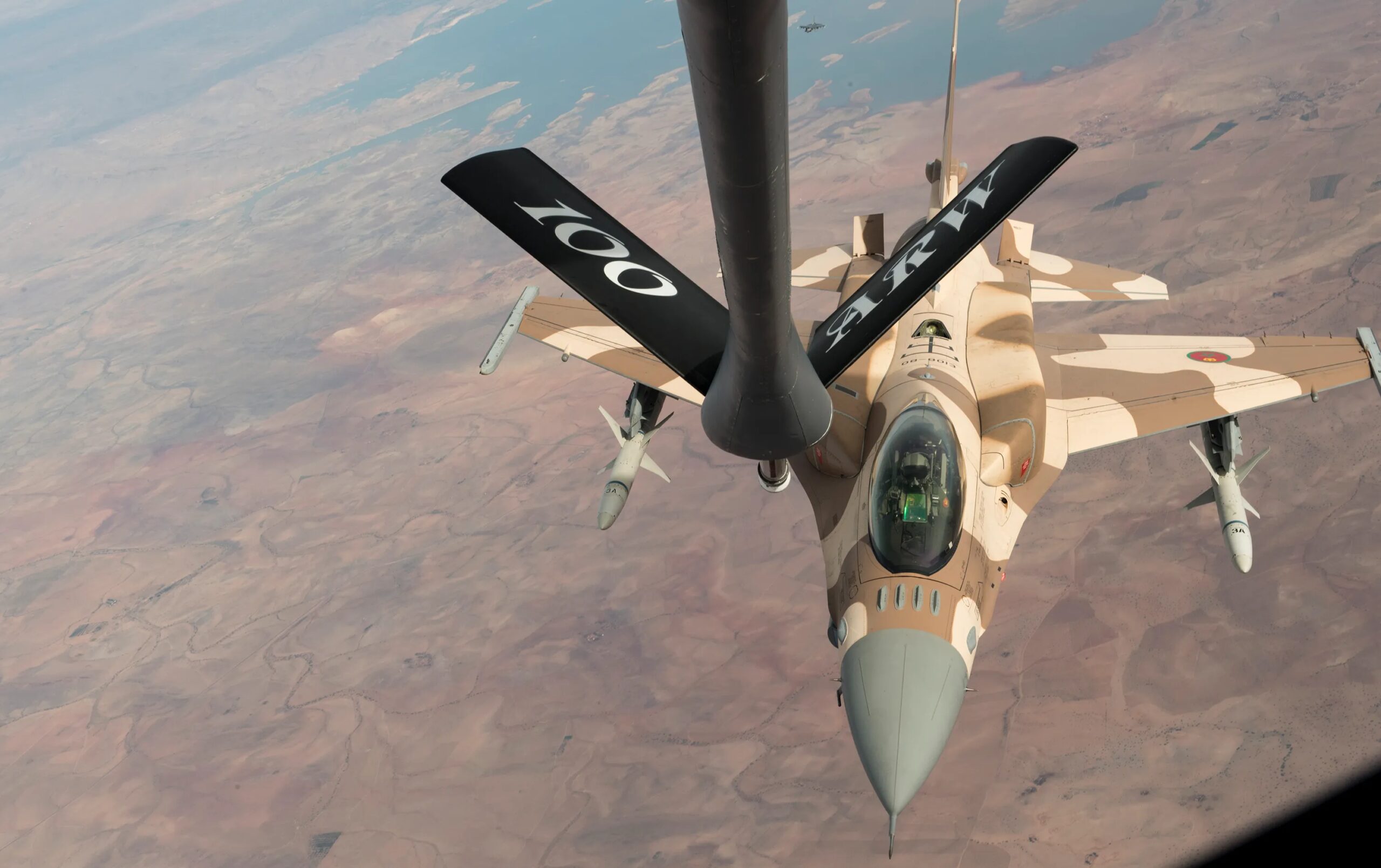
A Royal Moroccan Air Force F-16 prepares to receive fuel from a U.S. Air Force KC-135 Stratotanker from the 100th Air Refueling Wing, RAF Mildenhall, England, during exercise African Lion 2019 over the skies of Morocco, April 2, 2019. African Lion 2019 is an annual, combined multilateral exercises designed to improve interoperability and mutual understanding of each nation’s tactics, techniques and procedures while demonstrating a strong partnership between nation’s militaries. (U.S. Air Force photo by Staff Sgt. Ceaira Tinsley)
A Royal Moroccan Air Force F-16C/D Block 52+ with a pair of AGM-88 High-speed Anti-Radiation Missiles (HARM) under the wings. U.S. Air Force photo by Staff Sgt. Ceaira Tinsley

The distinction between the Block 70 and Block 72 is the engine. The Block 70 uses General Electric’s F110-GE-129, while the Block 72 uses Pratt & Whitney’s F100-PW-229, providing fractionally more power. The two configurations otherwise share the same major avionics and systems modernization package.

The F-16 began life as a Pratt & Whitney-powered fighter, with the F100 selected to power the original F-16A/B. But reliability and maintainability problems with early F100s prompted the U.S. Air Force to launch its Alternate Fighter Engine competition in the 1980s, leading General Electric to develop the F110 as an alternative. The resulting “Great Engine War” established two competing F-16 engine families, with Pratt & Whitney’s F100 and GE’s F110 ultimately becoming the principal powerplants for later F-16C/Ds. Although U.S. procurement eventually became heavily concentrated on the GE-powered F-16, Pratt & Whitney continued to supply F100-powered aircraft to international customers.

Airmen from the 49th Component Maintenance Squadron conduct a test run on a Pratt & Whitney F100 turbofan engine in the hush house at Holloman Air Force Base, New Mexico, Sept. 6, 2022. The hush house is a safe, enclosed environment designed to facilitate aircraft engine testing. (U.S. Air photo by Airman 1st Class Isaiah Pedrazzini)
Airmen conduct a test run on a Pratt & Whitney F100 turbofan engine in the hush house at Holloman Air Force Base, New Mexico. U.S. Air photo by Airman 1st Class Isaiah Pedrazzini

For Morocco, the choice of the Block 72 is based on ensuring as much fleet commonality as possible. The RMAF already operates F-16C/D Block 52+ aircraft powered by F100 engines, making the new aircraft a natural fit within its existing support infrastructure.

Morocco is also upgrading its existing F-16 fleet to the F-16V configuration, which is broadly similar to the new-build Block 70/72 standard.

That will eventually provide the RMAF with a larger fleet centered around a common, substantially modernized F-16 standard.

A separate notification in March 2019 covered the upgrade of Morocco’s existing 23 F-16C/D Block 52+ aircraft to the F-16V standard.

Morocco’s new and upgraded F-16s could also provide a significant boost to combined operations with its other international partners. In recent years, Moroccan F-16s participated in the campaign against ISIS, while the country has also deployed the aircraft on missions against Houthi rebels as part of the Saudi Arabia-led coalition in Yemen. In 2015, a Moroccan F-16 crashed in Yemen. Although the Houthis claimed they had shot down the aircraft, Moroccan authorities attributed the loss to a technical malfunction.

Outside of combat operations, the RMAF also frequently takes part in exercises with its allies, including the African Lion series, the largest annual, multinational joint military exercise led by U.S. Africa Command (USAFRICOM) and partner nations.

A Utah Air National Guard KC-135 Stratotanker refuels a Royal Moroccan Air Force F-16 aircraft over central Morocco as part of exercise African Lion 2019, March 18, 2019. This multinational air-to-air refueling training promoted interoperability and enhanced strategic cooperation. African Lion 2019 is a Chairman of the Joint Chiefs of Staff-sponsored, U.S. Africa Command-scheduled, U.S. Marine Corps Forces Europe and Africa-led, joint and combined exercise conducted in the Kingdom of Morocco with a spoke in Tunisia. (Courtesy Photo )
A Utah Air National Guard KC-135 Stratotanker refuels a Royal Moroccan Air Force F-16 over central Morocco as part of Exercise African Lion 2019. U.S. Air Force/Courtesy Photo

Meanwhile, the new-build Moroccan aircraft also arrives at an interesting point in the F-16 program.

The Block 70/72 has attracted customers across Europe, the Middle East, Asia, and elsewhere, with Bahrain, Bulgaria, Jordan, Peru, the Philippines, Slovakia, Taiwan, and Turkey also having selected the latest-generation Viper configuration. So far, only Block 70s have been ordered, although tbe Block 72 has been offered to some customers and potential customers. There is also apparent U.S. Air Force interest in a version of the Block 70 tailored for its specific needs and referred to by the manufacturer as the F-16G.

Air Force Reserve Crews over Southern California with the 370th FLTS from Edwards Air Force Base provide aerial refueling from a KC-135 to a Lockheed Martin F-16 Block 70 aircraft for the Royal Bahraini Air Force. The F-16 Block 70 is currently in developmental test with the 416th FLTS, Airpower Foundations Combined Test Force at Edwards. A sub-mission of the 416th FLTS is to provide flight test services for Foreign Military Sales customers of the F-16.
An F-16D Block 70 aircraft for the Royal Bahraini Air Force prior to delivery. U.S. Air Force

Morocco’s position as the Block 72 launch customer means the aircraft now flying is effectively the prototype-standard production aircraft for an export configuration that other countries can now buy.

The Moroccan F-16 program is also increasingly tied to a broader effort to develop the country’s military-industrial and sustainment infrastructure.

Lockheed Martin says it is working with Moroccan industry, including Maintenance Aero Maroc, on an upcoming MRO facility at Benslimane. The more than 86,000-square-foot facility is intended initially to support heavy maintenance and modernization of C-130 Hercules aircraft, with plans to expand into additional platforms, including the F-16.

A Royal Moroccan Air Force C-130 Hercules aircraft taxis down the runway during Exercise African Lion 21 at the 3rd Royal Moroccan Air Force Base in Kenitra, Morocco, June 14, 2021. U.S. C-130J Super Hercules aircraft assigned to the 37th Airlift Squadron conducted an inter-fly formation with the RMAF C-130H to maintain regional support of superior airpower capabilities. African Lion is U.S. Africa Command’s largest, premier, joint, annual exercise hosted by Morocco, Tunisia and Senegal, 7-18 June. More than 7,000 participants from nine nations and NATO train together with a focus on enhancing readiness for U.S. and partner nation forces. AL21 is a multi-domain, multi-component, and multi-national exercise, which employs a full array of mission capabilities with the goal to strengthen interoperability among participants. (U.S. Air Force photo by Tech. Sgt. Devin Nothstine)
A Royal Moroccan Air Force C-130 Hercules taxis down the runway at the 3rd Royal Moroccan Air Force Base in Kenitra, Morocco. U.S. Air Force photo by Tech. Sgt. Devin Nothstine

That could eventually give Morocco a greater role in sustaining its own expanding fleet and potentially supporting other aircraft in the region.

The F-16 program itself is part of a much broader U.S.-Moroccan defense relationship that dates back more than five decades. The Royal Moroccan Armed Forces now operate a range of U.S.-supplied systems, while Morocco is also set to receive HIMARS and has expanded its rotary-wing capabilities with AH-64E Apache attack helicopters.

For the RMAF, however, the F-16 remains central to its combat-aircraft modernization and, once it arrives, it will be the spearhead of the country’s fighter fleet.

Contact the author: thomas@thewarzone.com
Thomas Newdick is a staff writer at TWZ, where he covers military aviation, defense technology, weapons systems, and international security. Based in Berlin, Germany, he reports on conflicts, military modernization efforts, and emerging aerospace technologies around the world, with a particular interest in airpower and its role in contemporary warfare. His reporting is informed by deep expertise in modern and historical airpower, particularly in Europe, with a focus on military aviation, air campaigns, and aerospace developments across the continent and beyond.


Source link

The P-3 Orion Airborne Early Warning Aircraft Has Flown Its Last Mission

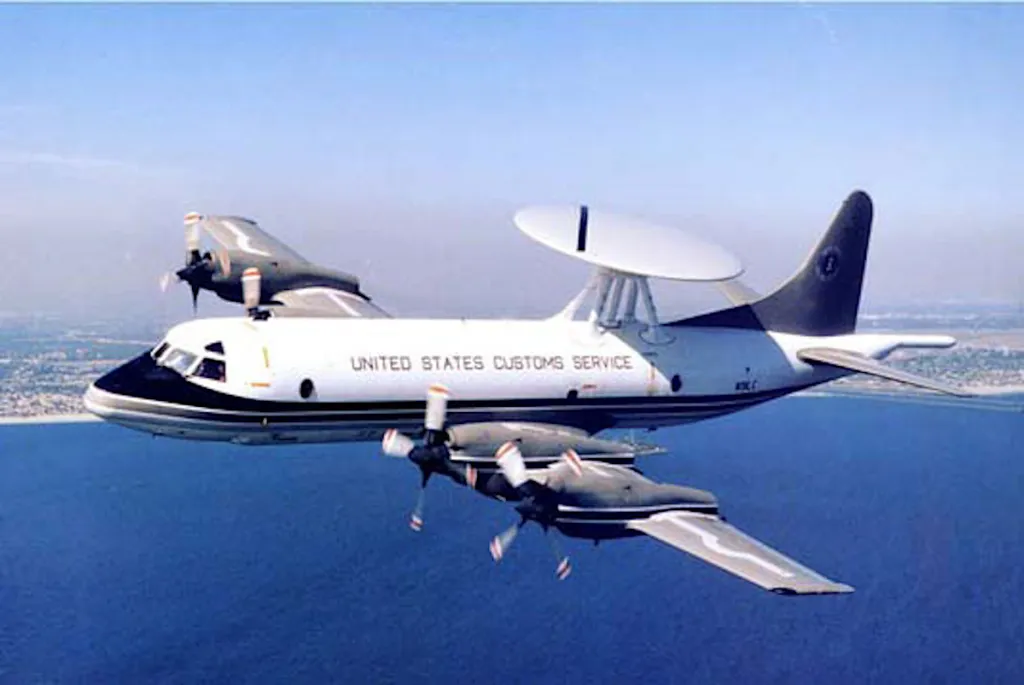
U.S. Customs and Border Protection (CBP) has retired the last of its P-3 Airborne Early Warning (AEW) aircraft. The AEW version is instantly recognizable from the saucer-like radar dome on top, as seen on other AEW types like the E-2 Hawkeye and the E-3 Sentry. CBP was the only operator of this variant of the P-3 Orion and is said to have been the only law enforcement agency to fly any kind of dedicated AEW plane. The retirement of these aircraft comes at a time when American AEW assets, in general, are under heavy strain by demands globally.

CBP officially retired its final P-3 AEW on September 30, 2026, after a final flight from National Air Security Operations Center Jacksonville (NASOC Jacksonville), in Jacksonville, Florida. CBP has also flown Long Range Tracker (LRT) variants of the P-3, configured for more traditional maritime surveillance missions. The current plans for the LRT aircraft, and whether their sunset may also be on the horizon, are not immediately clear, and TWZ has reached out for more information. Orions of all types have been steadily disappearing from service with the U.S. military and elsewhere across the U.S. government as the aging aircraft become more difficult to operate and maintain.

“Our Jacksonville-based P-3 AEW fleet has served as a cornerstone of America’s outer-layer border security,” according to a brief announcement from CBP about the retirement on social media. “Its crews flew far beyond our borders, providing wide-area surveillance across the Caribbean, Gulf of America [Gulf of Mexico], and the transit zones of Central and South America, helping detect and track threats before they could reach the United States.”

By all indications, including official CBP sources, the P-3 AEW fleet consisted of eight aircraft at its peak. There is a confusingly worded 2014 CBP press release that mentions an “11th and final Lockheed Martin P-3 Airborne Early Warning (AEW) aircraft overhaul,” but that figure looks to also include three of the six LRT versions. The same release says that CBP only had 14 P-3s of all types at that time.

What was then known as the U.S. Customs Service (USCS) first began operating the P-3 AEW version in the late 1980s. The aircraft were converted from second-hand maritime patrol variants of the Orion. The first example had started life as a P-3B for the Royal Australian Air Force (RAAF). Ex-U.S. Navy P-3s were also converted.

A picture of a P-3 AEW in USCS service circa the late 1980s. CBP

The initial three P-3 AEWs were equipped with the AN/APS-138 radar. The same radar was used on early E-2C Hawkeye airborne early warning and control aircraft operated by the U.S. Navy, as well as several other armed forces internationally.

“The Customs Service had previously borrowed U.S. Navy E-2Cs to meet its antinarcotics surveillance requirements, but required an aircraft with longer range and on-station time,” according to a 2006 report from Forecast International. “In June 1989, the U.S. General Accounting Office issued a report on the drug interdiction P-3B AEW aircraft. The findings indicated that the radar performance was as specified, but the P-3B (when compared to the E-2C) was less costly to operate per square mile of area covered because of the higher cruising speed and longer endurance. The P-3B had at least twice the in-flight endurance of the E-2C.”

Starting in the 1990s, USCS began the process of acquiring additional P-3 AEWs with newer AN/APS-145 radars, as also used on later model E-2Cs. The original AEW Orions were eventually refitted with APS-145s, as well. It’s worth noting here that the U.S. Coast Guard separately moved to acquire an AEW version of the C-130H, designated the EC-130V, in the 1990s, which used the AN/APS-125 radar, also used on older E-2s. Budget cuts led to the end of that program. The EC-130V that had been built was redesignated as an NC-130H and subsequently used for test purposes.

A US Navy E-2C Hawkeye. USN
The NC-130H test aircraft with its radar dome still on top. US Military

The P-3 AEWs were also equipped with a sensor turret containing electro-optical and infrared (EO/IR) video cameras, allowing the aircraft to more closely investigate targets spotted on radar. CBP regularly conducted P-3 operations that paired AEWs with LRT variants to provide an even broader array of sensor capabilities on missions. The LRTs have EO/IR sensor turrets, as well as AN/APG-66 and SeaVue radars. The pulse-doppler AN/APG-66 is primarily designed for spotting and tracking aerial targets, and was originally used on early variants of the F-16 fighter. SeaVue is a multi-function type with surface search and synthetic aperture radar (SAR) imagery modes. Images produced via SAR are highly detailed maps of the surface below, and can be captured day or night, and regardless of any cloud cover, smoke, or dust. 

Beyond radars and other sensors, the P-3 AEWs also had a robust communications suite consisting of VHF and UHF radios, as well as satellite communications links by the end of their career. CBP’s entire P-3 fleet, including the AEWs and LRTs, has received various updates over the years, including new ‘glass cockpits’ starting in the early 2000s.

CBP Air and Marine Operations: Extended Border Operations thumbnail

CBP Air and Marine Operations: Extended Border Operations

Though primarily employed in support of counter-narcotics interdiction operations, the airborne radar and command and control capabilities were also applied to other missions, including disaster relief and humanitarian assistance efforts at home and abroad. As an example, CBP’s P-3 AEWs helped with air traffic coordination, as well as provided other support, during relief efforts in Texas in the wake of Hurricane Harvey in 2017.

At the same time, CBP’s entire P-3 fleet, including both the AEW and LRT versions, has only been getting increasingly older and difficult to sustain. The P-3B variant first entered U.S. Navy service in the 1960s. CBP did put its P-3s through a Service Life Extension Program overhaul in the 2010s, which included “new wings and tail for each aircraft and completely strips down the aircraft to its bare metal for an inspection,” according to a 2014 press release.

A P-3 AEW seen during a test flight as part of the SLEP overhaul. The aircraft notably lacks its radar dome. CBP

As mentioned, the P-3 family has been in steadily dwindling service in the United States, overall, in recent years. The U.S. Navy has completely retired the Orion as a maritime patrol platform, and the service has also fully divested its more specialized EP-3 intelligence-gathering variants. The Navy had retained a small number of P-3s for research and development and test and evaluation activities, but growing sustainment challenges have been prompting the retirement of those planes, as well. The last NP-3C assigned to the Navy’s Scientific Development Squadron One (VXS-1), the “Warlocks,” was also retired last month. VXS-1 previously operated a ‘domed’ NP-3D, similar to, but distinct from, CBP’s P-3 AEWs, as well. The National Oceanic and Atmospheric Administration (NOAA) is also in the process of replacing its pair of P-3s, configured as civilian hurricane hunter aircraft, with new C-130J Hercules-based platforms. The shrinking U.S. Orion operator base can only have a knock-on impact on CBP P-3 operations.

A key question now is how CBP will fill any gaps left by the retirement of the final AEW version. The agency does continue to operate a mix of other crewed fixed-wing aircraft with mixtures of radars and other sensors, as well as MQ-9 drones, but none of these platforms are equipped with a sensor like the AN/APS-145. CBP also has a network of tethered aerostats with radars at fixed sites around the Caribbean. As an aside, General Atomics, together with Saab, is now working on an AEW configuration for the MQ-9B drone, but there are no known U.S. orders for that capability at the time of writing. That platform will not offer the same level of flexibility and look-down capability as modern crewed AEW aircraft, either. Look-down AEW capability is only growing in importance today amid expanding and evolving drone threats, including to the U.S. homeland.

Another look at one of CBP’s now-retired P-3 AEWs. CBP

High demand for AEW support, in general, means that the U.S. military regularly steps in to provide additional coverage with U.S. Navy E-2s and U.S. Air Force E-3s to aid in U.S. counter-drug operations around Latin America. Newer E-2D Advanced Hawkeyes notably have far more powerful radars than the E-2C or the P-3 AEW, with added surface search and track capability, too. At the same time, as mentioned at the start, those assets are in heavy demand, especially in light of the conflict with Iran. On top of that, the Air Force’s E-3 fleet is facing serious sustainment challenges itself, with replacement E-7 Wedgetail aircraft still years away from being delivered.

The Air Force, in particular, is also aiming to eventually push most, if not all, air moving-target indicator (AMTI) tasks currently performed by aircraft like the E-3 and E-7 into space. The service is heavily investing to accelerate the fielding of those capabilities, which could eventually offer revolutionary constant, persistent coverage globally. The first of those satellites are still not expected to reach an early operational state until 2028. It is possible that CBP could get access to a tailored data feed from this system when it does become operational. It still does not obviate the need to have crewed or uncrewed aircraft capable of more closely investigating tracks of interest using EO/IR cameras and other sensors.

Whatever the future might now hold, CBP’s unique time as the operator of the P-3 AEW aircraft has come to an end.

Contact the author: joe@twz.com

Joseph is TWZ’s Deputy Editor, helping to oversee the site’s highly experienced and dedicated team, while also writing informative and impactful defense and national security content. He lives right in the thick of it in the Washington, D.C. area.


Source link

Northrop Grumman’s Talon Blue Collaborative Combat Aircraft Has Flown

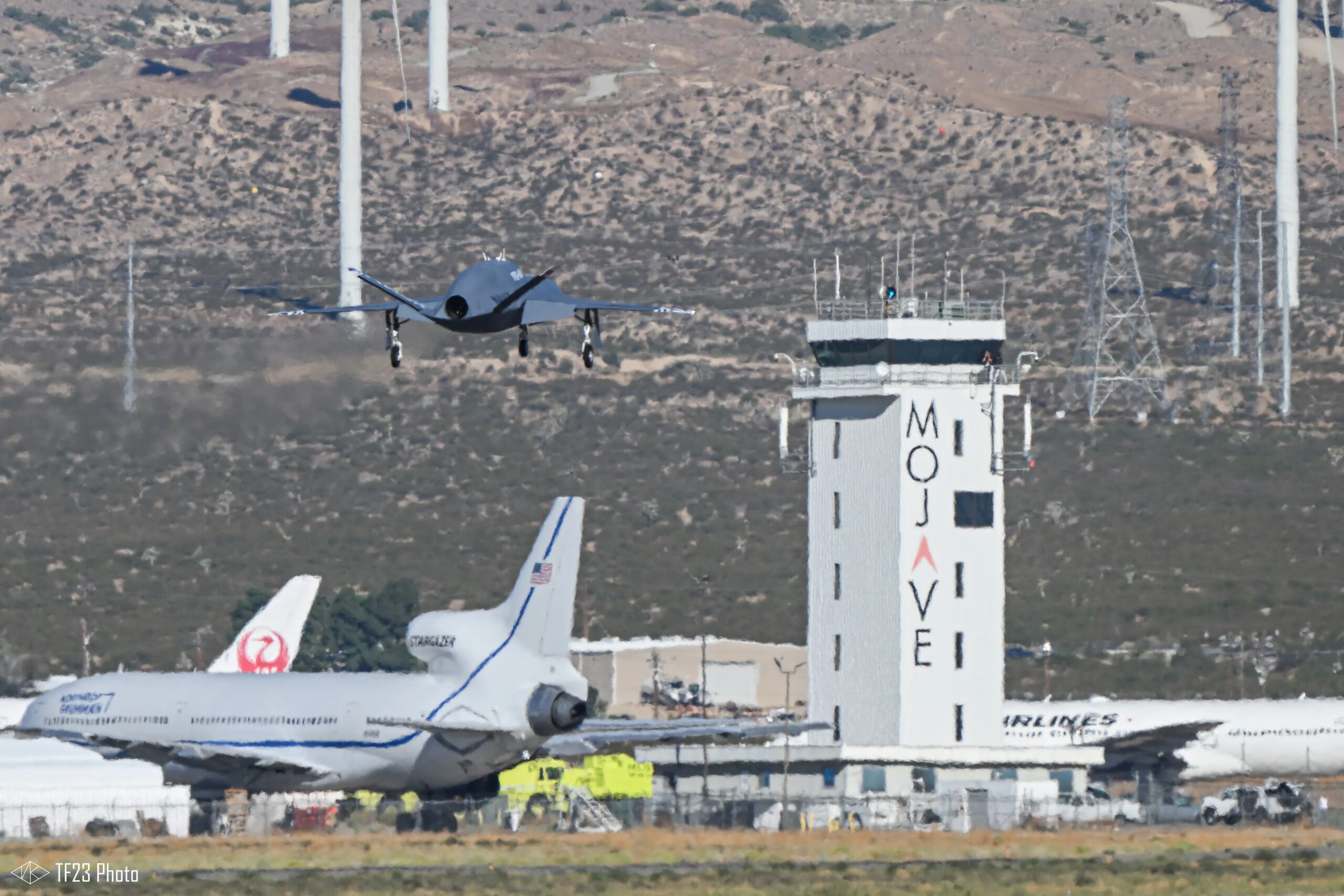
We have a significant update on the fast-moving world of Collaborative Combat Aircraft (CCA) out of Mojave, California today. Northrop Grumman’s Talon Blue, which now has the official designation YFQ-48A, has taken to the skies for the first time. The existence of Talon Blue was first officially disclosed in December of 2025 at a media event in Mojave that we attended.

Talon Blue flying out of Mojave Air and Space Port for the first time. (@Task_Force23) TASK_FORCE23

The uncrewed aircraft took to the skies over Mojave Air and Space Port, home of famed ‘bleeding0edge’ airframer and Northrop Grumman subsidiary Scaled Composites, which built the aircraft. A release from Northrop Grumman reads:

“MOJAVE, Calif. – Oct. 3, 2026 – Northrop Grumman’s (NYSE: NOC) YFQ-48A Talon Blue completed its first fully autonomous flight, including taxi, takeoff, in-flight maneuvers, and landing. Developed through company investment, Talon Blue combines modular design and advanced manufacturing to lower cost and support faster production without compromising mission capability. The flight builds on Northrop Grumman’s seven decades of autonomy experience and more than 500,000 autonomous flight hours, with lessons from Talon Blue informing future autonomous systems. 

Details on YFQ-48A Talon Blue:  

  • Talon Blue is part of Northrop Grumman’s internally-funded Project Talon portfolio focused on accelerating the development of mission-ready autonomous airpower capabilities.  
  • Manufacturing and design innovations cut part count and overall weight, lowering cost and enabling faster production to meet growing demand for autonomous systems.  
  • Designed with flexible operational concepts in mind, Talon Blue’s high air intake, wide wheelbase and integrated weapons bay support a wide variety of mission needs for U.S. and allied partners.

Craig Woolston, vice president and general manager, research and advanced design, Northrop Grumman: “Our customers made it clear they need autonomous systems that can be fielded faster and more affordably without sacrificing mission effectiveness. We listened. Talon Blue’s first flight is one step toward a new generation of autonomous capabilities. Every flight and lesson strengthens our broader autonomy work and sharpens what comes next.” 

Talon Blue flying above the Mojave Desert in California. (Northrop Grumman)

While the Talon Blue aircraft draws most of the attention, Northrop Grumman has put great emphasis on its back-end autonomy development ecosystem, which includes its purpose-built Model 437 demonstrator aircraft, now under the Talon IQ badge (formerly Beacon).

Talon Blue is entering a growing field of CCA offerings, with extremely intense competition, that are primarily aimed at equipping the USAF with its next CCA acquisition of hundreds of aircraft known as Increment 2, for which the requirements remain undefined. Currently, the USAF has moved its YFQ-44 from Anduril and its YFQ-42 from General Atomics, both of which are deep in flight testing, into production. Boeing’s MQ-28 Ghost Bat is another serious CCA contender and perhaps the most mature of all, while Lockheed Martin has its tailless Vectis, and on the lower end, Kratos’ FQ-58 Valkyrie continues to evolve and rack-up flight hours. Many more types are on the horizon, including those from new players and globally from foreign manufacturers.

(@Task_Force23) TASK_FORCE23

With the loss of the F/A-XX next-generation naval fighter program to Boeing, Northrop Grumman winning a contract from the U.S. services for Talon Blue has become more important. Doing so would get the company back into the Pentagon’s tactical air combat portfolio. As we have discussed for years, advanced uncrewed tactical systems are set to be less risky and potentially more lucrative than traditional fighter programs as air combat rotates to predominantly uncrewed capabilities and mass production of them. Beyond U.S. needs, the demand for CCAs is likely to explode internationally in the coming years, so programs like Talon Blue could find success elsewhere if the Pentagon goes another direction, but getting the U.S. armed services’ stamp of approval and the scale of production that comes with it would surely help there too.

Author’s note: A big thanks to our friend @Task_Force23 for providing us with great photos for this story.

Contact the author: Tyler@twz.com

Tyler’s passion is the study of military technology, strategy, as well as foreign policy, and he has fostered a dominant voice on those topics in the defense and national security space. Tyler was the creator of the hugely popular defense site Foxtrot Alpha before developing TWZ, which he continues to lead as the Editor-In-Chief to this day.


Source link

Anduril’s YFQ-44A Fury CCA Has Flown Alongside F-35s

Anduril’s YFQ-44A Fury Collaborative Combat Aircraft (CCA) has already flown in formation alongside F-35 fighters during U.S. Air Force testing, company executives have revealed, offering the clearest indication yet that live manned-unmanned teaming work with the fifth-generation fighter is underway.

The disclosure came during a briefing by Anduril executives Jason Levin, senior vice president for Air Dominance and Strike, and Erin Simpson, vice president for Strategy for Air Dominance and Strike, at the Air & Space Forces Air, Space and Cyber Symposium that TWZ is attending. The executives said the Fury flew alongside F-35s during a July exercise conducted with the Air Force’s Experimental Operations Unit (EOU) at Creech Air Force Base, Nevada. You can read more about that event in our past reporting here.

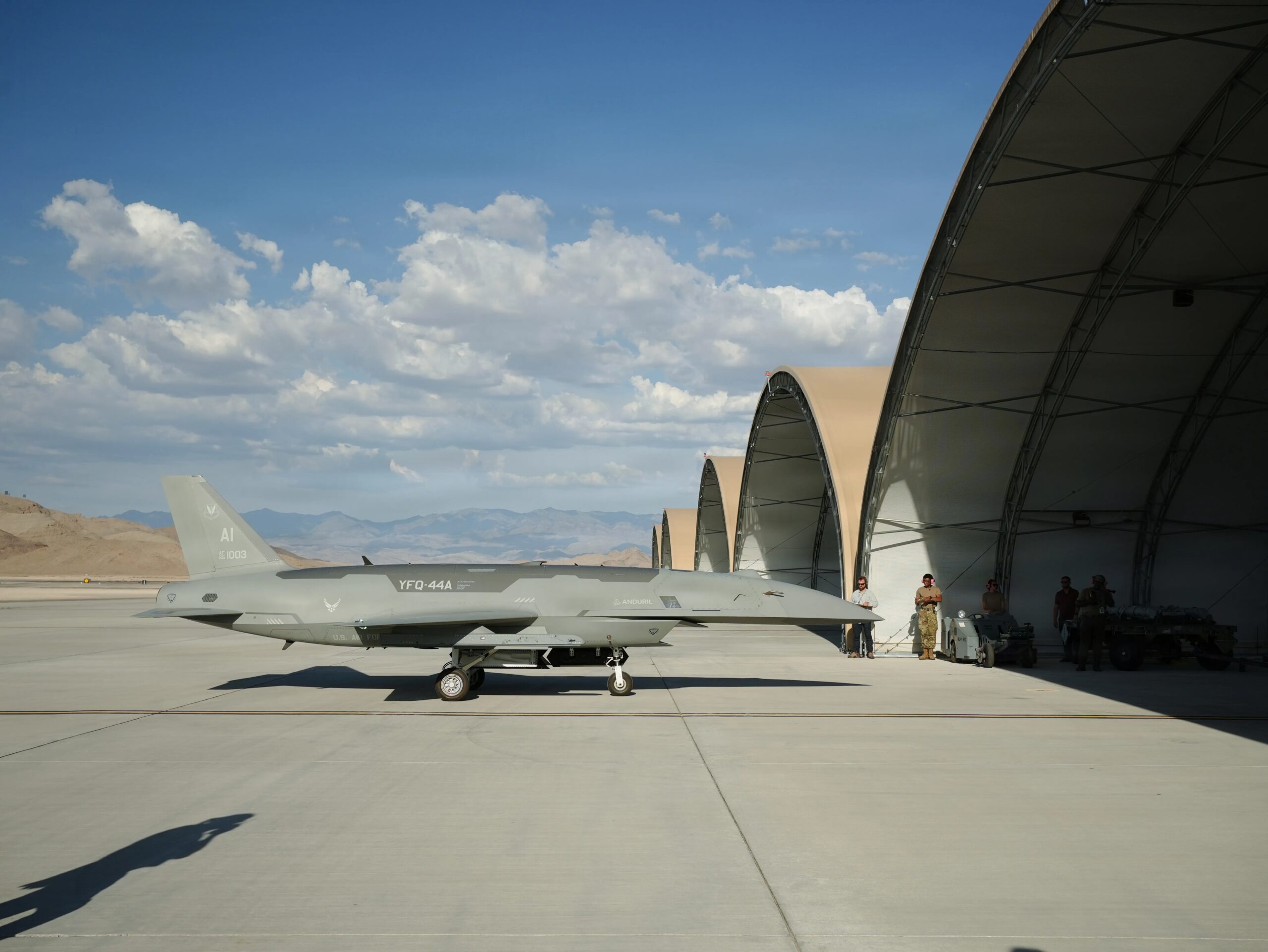
A YFQ-44A Fury aircraft assigned to the Collaborative Combat Aircraft Experimental Operations Unit taxis toward a sunshade at Creech Air Force Base, Nevada, July 20, 2026. The CCA took part in an Agile Combat Employment exercise that provided information necessary to validate the reduced logistical footprint required to operate in remote, forward-deployed locations. (U.S. Air Force photo by Senior Airman Renee Blundon)
A YFQ-44A Fury assigned to the Collaborative Combat Aircraft Experimental Operations Unit taxis toward a sunshade at Creech Air Force Base, Nevada, July 20, 2026. U.S. Air Force photo by Senior Airman Renee Blundon Senior Airman Renee Blundon

“We’ve already started flying in formation alongside crewed. I can even say fifth-gen fighters. F-35,” Levin said.

The testing is an important step toward the Air Force’s broader vision for its Collaborative Combat Aircraft program, in which relatively inexpensive autonomous aircraft are intended to operate alongside and support crewed fighters in contested airspace.

The executives stressed, however, that the F-35 was not yet controlling the Fury during those flights.

“But they’re not controlling it from the crewed fighter yet,” Levin said. “Not yet.”

Instead, the July testing involved Fury operating under its Mission Autonomy system while sharing airspace with crewed fighters, other CCAs, and other aircraft. Anduril says Air Force personnel were able to operate the autonomy system without Anduril personnel directly running the aircraft, although company personnel remained on site in a supporting role.

Lattice for Mission Autonomy: An Unfair Advantage for Unrivaled Deterrence thumbnail

Lattice for Mission Autonomy: An Unfair Advantage for Unrivaled Deterrence

The company described the progression toward direct manned-unmanned teaming as a “crawl, run, build-up” process.

Anduril says it has already begun work on what it calls “quarterback integration,” referring to the ability for a crewed aircraft to direct or task autonomous aircraft. That work has been conducted in hardware-in-the-loop and software-in-the-loop environments as well as on the Fury itself.

“Most of those events will be coming up here in a matter of weeks or months,” Levin said when asked about the timeline for the first quarterback integration with Fury.

Asked whether those events would involve live flying, the answer was unequivocal: “Yes.”

A YFQ-44A, part of the Air Force’s Collaborative Combat Aircraft (CCA) program, undergoes an undated captive carry test at a California test location. This test phase uses inert munitions to methodically validate weapons integration, structural performance and safety, ensuring the platform can safely carry external stores. The CCA program is a critical part of a larger, integrated system-of-systems designed to extend the reach and effectiveness of crewed aircraft, giving U.S. warfighters an overwhelming advantage in future conflicts. (Courtesy photo)
A YFQ-44A undergoes an undated captive carry test at a California test location. This test phase uses inert munitions to methodically validate weapons integration, structural performance and safety, ensuring the platform can safely carry external stores. Courtesy photo via U.S. Air Force Secretary of the Air Force Publi

Exactly how an F-35 would control Fury remains part of that ongoing development effort. The executives pointed to work involving integration of the appropriate human-machine interfaces, primarily including tablet-based control from the crewed fighter, at least at first.

The distinction between flying alongside an F-35 and being controlled by an F-35 is important. The former demonstrates that Fury’s aircraft and autonomy systems can operate safely in the same battlespace as a fifth-generation fighter. The latter would represent a much more significant demonstration of the operational concept behind CCAs: allowing a single crewed fighter to employ and manage additional autonomous aircraft as part of a larger force.

Anduril’s July testing went beyond simple formation flying. The company said Fury was conducting Mission Autonomy flights using live sensor data and was operating in airspace shared with crewed fighters and other CCAs. Air Force operators reportedly conducted both relatively basic route and pattern work and more representative tactical scenarios.

The Fury’s work with the Air Force’s Experimental Operations Unit has progressed through two increasingly ambitious phases. During the first exercise in April at Edwards Air Force Base, Air Force personnel were trained to operate the aircraft and were able to launch and recover it using Anduril’s compact Menace-T setup, essentially a pair of ruggedized cases and a laptop rather than a conventional ground-control station.

By the second exercise, conducted at Creech in July, the Air Force had reduced the manpower and infrastructure required further. A single EOU operator could launch and recover the aircraft after only hours of training, while Air Force personnel independently operated Fury’s Mission Autonomy. The aircraft also flew in airspace shared with other CCAs, while the exercise demonstrated disaggregated operations and a rapid “hot reload” in which two operators replaced an AIM-120 AMRAAM with the engine running, reducing the turnaround between sorties to single-digit minutes.

A U.S. Airman assigned to the Collaborative Combat Aircraft Experimental Operations Unit loads an inert missile onto a YFQ-44A Fury aircraft at Creech Air Force Base, Nevada, July 20, 2026. The data from the exercise will be used to develop and refine new tactics, techniques, and procedures for semi-autonomous air operations when deployed from main operating bases. (U.S. Air Force photo by Senior Airman Renee Blundon)
A U.S. airman assigned to the Collaborative Combat Aircraft Experimental Operations Unit loads an inert missile onto a YFQ-44A Fury aircraft at Creech Air Force Base, Nevada, July 20, 2026. U.S. Air Force photo by Senior Airman Renee Blundon Senior Airman Renee Blundon

The July exercise also included a live weapons demonstration that Anduril characterized as a complete end-to-end kill chain rather than simply a captive-carry or basic weapons-release test. The Fury launched from Edwards with a single operator and received a track generated by an external source over a beyond-line-of-sight connection. That track was ingested by Anduril’s Lattice AI-infused autonomy software system, after which the operator tasked the aircraft to engage. Fury then launched an AIM-120 AMRAAM and guided the weapon to the target. Anduril described the test as demonstrating the complete kill chain from offboard targeting information, through the aircraft’s mission systems and operator tasking, to an actual air-to-air weapons engagement.

On the weapons side, the production FQ-44 is being designed around four external hardpoints, allowing it to carry four AIM-120 AMRAAMs for the Air Force’s primary air-to-air mission set. Currently, the demonstration aircraft can carry two. Regardless, the company is also pursuing a much broader weapons portfolio for Fury. Executives said they have already begun integration and fit checks for 500-pound guided bombs, Small Diameter Bombs, low-cost cruise missiles — including Anduril’s Barracuda 500 offering — other air-to-air weapons, rocket pods and targeting pods. Those integrations are intended to give Fury options beyond air-to-air combat, including counter-drone, counter-cruise-missile and air-to-ground/air-surface strike missions. Anduril stressed that these are currently integration and engineering efforts rather than claims that all of those weapons have been flight-tested from Fury. The company also said additional sensors, such as a targeting pod, could be added for some of those missions.

The executives acknowledged that some of the more advanced tactical capabilities remain under development and are being explored extensively in simulation. Those efforts include areas such as sensor fusion, track discrimination and tactical engagements.

A U.S. Air Force YFQ-44A Fury aircraft, assigned to the Collaborative Combat Aircraft Experimental Operation Unit, takes off for a mission flight during an Agile Combat Employment exercise at Creech Air Force Base, Nevada, July 21, 2026. The flight was part of a broader ACE exercise designed to test the resilience, adaptability, and combat effectiveness of the semi-autonomous fleet. (U.S. Air Force photo by Staff Sgt. Kristal Munguia)
A U.S. Air Force YFQ-44A Fury takes off for a mission flight during an Agile Combat Employment exercise at Creech Air Force Base, Nevada, July 21, 2026. U.S. Air Force photo by Staff Sgt. Kristal Munguia Staff Sgt. Kristal Munguia

The ultimate objective is an aircraft that does not require a large ground-control infrastructure or a dedicated operator for every individual sortie. As previously noted, during the July exercise, Anduril says a single Air Force operator was able to launch and recover a Fury after only hours of training, while other Air Force personnel operated the aircraft’s Mission Autonomy functions.

That same exercise also demonstrated what Anduril described as “disaggregated operations,” with personnel at multiple locations able to operate the same aircraft. The concept is intended to support an Agile Combat Employment-style approach in which CCAs can be dispersed across multiple operating locations rather than relying on a single large ground footprint.

The company has since delivered a Fury aircraft to the Air Force’s EOU at Creech, making it the first CCA to be permanently delivered to the unit, according to Anduril. The service is now flying the aircraft multiple times a day with what the company said is a very limited Anduril presence.

A YFQ-44A production representative test vehicle is staged in a testing chamber at Costa Mesa, Calif. The Department of the Air Force’s has begun ground testing for the Collaborative Combat Aircraft program to validate performance and readiness for future flight testing. (Courtesy photo)
A YFQ-44A production-representative test vehicle is staged in a testing chamber at Costa Mesa, California. Courtesy photo via U.S. Air Force Master Sgt. Gustavo Castillo

Meanwhile, Anduril says assembly of Fury airframes has already begun at its Arsenal facility, with production aircraft expected to begin coming off the line early next year. The company says it has built the facility and supply chain around a potential production rate of 150 aircraft per year, although that figure is a planned capacity rather than an existing Air Force order. Anduril executives said the company has already advanced procurement of long-lead items and worked with its Tier 1, 2 and 3 suppliers to support that rate, while also examining additional production lines. They emphasized that the current Air Force pricing is based on a substantially lower annual buy than 150 aircraft, but said the Fury’s unit cost is well below $20 million at the quantities currently contemplated. The company also says the production line is designed for relatively rapid reconfiguration, allowing capacity to be shifted between products in weeks rather than the months or years associated with more traditional aircraft production facilities.

Earlier this year, the Air Force awarded contracts for the production of FQ-44A Fury and General Atomics FQ-42A Dark Merlin drones — the latter has now been formally named Vengeance. This sets the service up to operate a split initial fleet of CCAs. As you can read about here, the Air Force is now aiming to have at least 500 CCA in service by 2032, a substantial step up from earlier plans, with the USAF having previously talked about acquiring “over” 150 of these drones by the end of the decade. The 500 target will likely include upcoming increment two CCAs, as well, the requirements of which the Air Force is still working on.

For Anduril, the next major milestone should go far beyond simply putting a Fury and an F-35 in the same formation, demonstrating that a crewed fifth-generation fighter can actually command and employ the autonomous aircraft as part of a live mission.

If Anduril’s timeline holds, that testing could begin relatively soon.

Contact the author: thomas@thewarzone.com

Thomas Newdick is a staff writer at TWZ, where he covers military aviation, defense technology, weapons systems, and international security. Based in Berlin, Germany, he reports on conflicts, military modernization efforts, and emerging aerospace technologies around the world, with a particular interest in airpower and its role in contemporary warfare. His reporting is informed by deep expertise in modern and historical airpower, particularly in Europe, with a focus on military aviation, air campaigns, and aerospace developments across the continent and beyond.


Source link