Florida

Notre Dame’s Luderer sisters commit to Florida State for softball

When twins Keira and Kelsey Luderer of Sherman Oaks Notre Dame announced they had committed to Florida State to play college softball, their father, Brian, the new head coach for Notre Dame, was ready to cry.

“Special moment,” he said of his junior daughters.

Kelsey, an infielder who was Mission League player of they year, and Keira, a standout catcher, have been working hard for years for this moment and learned plenty from Brian, who played baseball in high school and college.

Michigan, California and Loyola Marymount were also finalists for the twins who were coached last season by Justin Siegel, a new assistant coach at Loyola Marymount.

Now dad and mom, who have been transporting them around for years in club softball, will have to begin looking for the cheapest flights to Tallahassee.

This is a daily look at the positive happenings in high school sports. To submit any news, please email eric.sondheimer@latimes.com.

Source link

‘Florida’s secret paradise’ The lesser known US city that’s the perfect Autumn break

OUR Spotlight On column gives you the lowdown on what to see and do in your favourite holiday hotspots – as well as lesser known gems.

This week we shine a light on a Florida favourite perfect for an autumn or winter break – Boca Raton.

Most Brits won’t have heard of Boca Raton Credit: Supplied
But the beautifully laid-back beaches make it a secret paradise Credit: Alamy

Close to the bright lights of Miami, it offers a more relaxed experience in a stunning coastal setting.

As the Head of Travel at the Sun, I recently visited Florida’s secret paradise, with with pristine beaches, surprisingly lush parks and Japanese gardens and a laid back vibe.

But with the new Brightline that speeds holidaymakers from Orlando to Miami on Eurostar-style trains stopping off in Boca, it’s easier than ever for us Brits to discover the delights of this upscale city that offers all the best of Miami without the crowds and frenetic city pace.

With jetlag waking me early, I took a stroll on the beachfront near Spanish River Park where the sun breaks over the water painting the sky in vibrant amber and violet tones.

KINGDOM COME

Make Disney World Florida your 2027 adventure – save 10% on bookings


FAWLT-AI TOWERS

I’m moving from Florida to Torquay — AI said it’s best place to live in UK

Settling onto the sands, I had the beach almost to myself as pelicans flew low over the gentle surf and watched as the sun rose high.

So here are some of my other tips on exploring the lesser known US city.

MUST SEE / DO

A beloved local institution, Gumbo Limbo Nature Center invites visitors to explore Boca Raton’s coastal ecosystem through nature trails, butterfly gardens and marine conservation exhibits.

It is famous for its sea turtle rehabilitation facility, where visitors can see rescued loggerhead and green sea turtles getting nursed back to health.

Visit during turtle nesting season from March through October, when the centre hosts guided night-time turtle walks and seasonal hatchling releases.

HIDDEN GEM

The Morikami Museum and Japanese Gardens offer a serene escape that feels worlds away from the buzz of the coastline.

It is easy to get to thanks to a new Eurostar-like fast train Credit: Alamy
If you want a quieter place to explore in Florida, this is the place Credit: Alamy

Spanning 16 acres, the gardens celebrate centuries of Japanese design through tranquil ponds, bonsai collections and carefully curated pathways.

BEST VIEW

Set between the Atlantic Ocean and the Intracoastal Waterway, the Blue Flag designated Spanish River Park offers spectacular sunrise views over the beach and equally beautiful sunset scenes along its shaded walking trails and waterfront areas.

RATED RESTAURANT

Mizner Park, an open-air shopping and dining complex, is all pink-stucco Mediterranean Revival architecture and towering palm trees.

Here, Tryst blends classic French bistro charm with an inventive American menu under Chef Daniel Dore, featuring dishes from steak frites to a vegan mushroom lasagna topped with oat milk béchamel.

For more relaxed, value dining, Tomasso’s Pizza and Subs is a neighbourhood institution, serving up New York-style slices and massive sandwiches for decades.

A couple of slices or hot sub is from £7.33.

BEST BAR

American Social in Mizner Park is a fun sports bar bringing Modern American cuisine with a twist.

It is the perfect place not only if you want to catch a game, but also for an intimate dinner or a night with friends.

Beer lovers should head to Biergarten Boca Raton.

Tucked into Royal Palm Place, this indoor/outdoor spot stocks more than 24 beers on taps and has dozens of craft bottles as well.

With live music and generous happy hour deals, it’s a relaxed place to kick back.

HOTEL PICK

Fresh from a £5.4million renovation, the Boca Raton Marriott at Boca Center is close to Mizner Park in the city centre and an ideal base for discovering the area.

There’s a gorgeous outdoor pool with plenty of shade from towering palms and you can pick up a cocktail or two at the outdoor Drift bar.

End the day at Sonrisa, with its bold Caribbean-American flavours.

Rooms feature floor-to-ceiling windows to make the most of the views and a calm, neutral palette with splashes of marine blue.

Rooms from £125 a night. See marriott.com.


Source link

Shahed-136 Clone Found By Florida Fisherman, Eglin AFB Admits It Lost A Drone

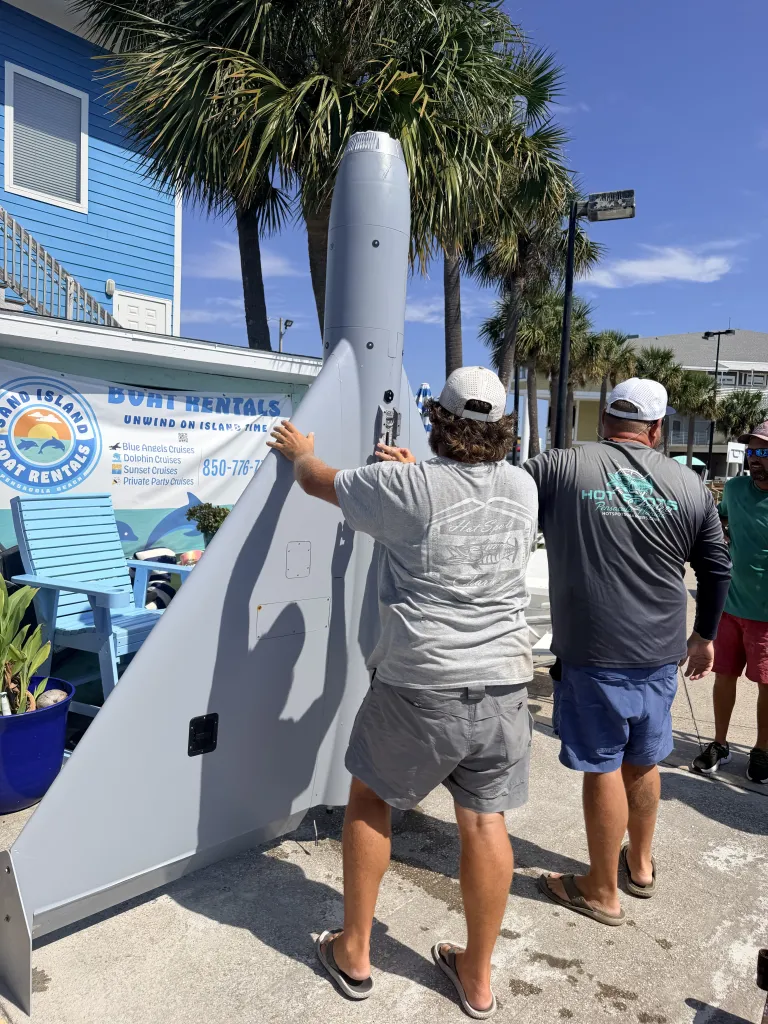
A Florida fishing charter boat made a very unusual catch Saturday while operating near Eglin Air Force Base. Located in the western end of the Florida Panhandle, Eglin is home of the U.S. Air Force weapons test wing. Hot Spots Charters pulled a delta-wing aerial drone out of the water during an excursion, according local charter captain Charlie Green. The recovered drone closely resembles a clone of the Iranian Shahed-136 one-way attack weapon, specifically the U.S. military’s Low-Cost Uncrewed Combat Attack System (LUCAS) that took center stage during its first combat use in Operation Epic Fury. The target version of that drone is built by SpecktreWorks and is designated the FLM-136. It was originally designed for mimicking one-way attack munitions, specifically the Shahed-136, which it was reverse engineered from, for testing and training before it was weaponized into LUCAS.

An Eglin AFB spokesperson told us the installation recently lost a drone, but would not confirm it was the same one found by Hot Spots Charters.

“I can confirm that we were doing a test and the test article went down,” the spokesperson told us, declining to provide further details about what kind of drone, when it was lost or the location it went down. They referred us to the Pentagon, which could not immediately provide any additional details. 

“The drone was found by local charter Capt. Daniel Arsenault with Hot Spots Charters,” said Green, who is also an aviation photographer whose work can be found at Aquatic Charlie on social media. “He saw the object at a distance and went over to check it out. When he did, he pulled a good size mahi-mahi out from underneath it, complementing his already stocked cooler full of fish from that morning charter. His passengers helped him haul it aboard.”

The drone found by Hot Spots Charters. (Charlie Green)

“Arsenault and his charter company did all the due diligence possible to notify local agencies of the recovery- and was eventually collected by one of them,” Green added. He did not know which agency.

Images taken of the drone shared with us by Green show that it did not have the engine, propeller or the nose cone/seeker intact. Losing these kind of components is common for impacts into water.

(Charlie Green)

While the Eglin spokesperson offered scant details, the host unit at the installation is the 96th Test Wing, which is the “test and evaluation center for Air Force air-delivered weapons, navigation and guidance systems, command and control systems, and Air Force Special Operations Command systems,” according to the wing’s homepage. It oversees the massive Eglin Gulf Test Range, which “provides approximately 120,000 square miles of overwater airspace, covering the eastern third of the Gulf of Mexico from the Florida panhandle to the Florida Keys. The land range covers 724 square miles and contains 70 specific test and training areas, including an approved depleted uranium test range and the only qualified air-to-ground supersonic range east of the Mississippi River.”

Eglin Test Range. (Eglin Air Force Base)

As noted in the opening of this article, the LUCAS drone was used for the first time in combat during the opening day of the Operation Epic Fury war on Iran on Feb. 28. 

“Costing approximately $35,000 per platform, LUCAS is a low-cost, scalable system that provides cutting-edge capabilities at a fraction of the cost of traditional long-range U.S. systems that can deliver similar effects,” Navy Capt. Tim Hawkins, a CENTCOM spokesperson, told TWZ when the command stood up Task Force Scorpion Strike (TFSS), the military’s first one-way attack drone unit, back in December. “The drone system has an extensive range and the ability to operate beyond line of sight, providing significant capability across CENTCOM’s vast operating area.”

“LUCAS drones deployed by CENTCOM have an extensive range and are designed to operate autonomously,” CENTCOM added in a press release. “They can be launched with different mechanisms to include catapults, rocket-assisted takeoff, and mobile ground and vehicle systems.”

TFSS falls under the auspices of U.S. Special Operations Command Central (SOCCENT), which oversees U.S. special operations activities across the Middle East.

The cost to connect each of the U.S. military's Low-Cost Uncrewed Combat Attack System (LUCAS) one-way attack drones to SpaceX's Starshield communications network is approximately $25,000 a month, according to a new report.
A LUCAS drone. (NAVCENT/C5F/U.S. Army Spc. Kayla McGuire) NAVCENT/C5F/U.S. Army Spc. Kayla Mc Guire
A LUCAS drone. (Courtesy photo/Naval Air Warfare Center Weapons Division)

While we aren’t sure if the drone found by Hot Spots Charters is the one lost by Eglin, it wouldn’t be the first time something like this has happened in Florida. For example, in 2021, beachcombers in Florida’s Palm Beach County found a U.S. Air Force BQM-167A high-performance target drone that washed ashore.

Indeed, the Air Force has a handful of 120-foot boats, the only vessels in its service, to help recover drones after they are shot down during live-fire exercises, or otherwise need to be recovered from these waters. The boats are operated by a contracted crew from Florida Offshore and retrieve around 100 of the drones each year.

The FLM-136’s origins as a target drone are highly relevant here. Counter-unmanned aerial system (C-UAS) capabilities are being hotly pursued on all fronts across the U.S. military as the threat from them has ballooned. During the war in Ukraine and multiple engagements with Iran, including Operation Epic Fury, one-way attack drones have proven to be a massive threat that is heavily influencing how wars are fought. As far as Eglin AFB goes, maybe the most high-profile C-UAS development as of late that has emerged from there has been arming USAF fighters with FALCO APKWS laser-guided rockets to shoot down exactly the same kind of threat that the FLM-136 is meant to emulate. This program began in 2019, which TWZ was first to report on, but was finally rushed into service years later as the standoff with Iran went hot. Now there are many other programs aimed at dealing with these same threats, including a more capable “fire and forget” air-to-air APKWS.

A 2019 test of air-to-air APKWS laser-guided rockets occurred off Eglin AFB. (USAF)

LUCAS development is continuing at a high-pace, with its ability to swarm cooperatively with other LUCAS drones — a feature we reported as central to the LUCAS vision when the existence of the program was disclosed — being worked on now. You can read more about this here. These systems need sanitized airspace for development activities, and the vast ranges over the gulf are some of the best in the country for it.

So, it’s not surprising to see an FLM-136 floating in the waters off Eglin AFB. Even in the war with Iran, there were multiple losses of LUCAS drones where they were found intact. These weapons are produced to be risked in large numbers, and some failing, for whatever reason, is just part of the calculus.

We will update this story with any additional details we can find about this drone. Though we don’t yet know for sure where it came from, one thing is for certain, the folks on the Hot Spots Charters boat that found it will always have a good tale about the one that didn’t get away.

Contact the author: howard@twz.com

Howard is a Senior Staff Writer for TWZ. He writes frequently about conflict, focusing heavily on the Middle East and Ukraine, and interviews with military and intelligence officials and industry leaders from around the globe. He lives near Tampa, Florida, home of U.S. Central Command, U.S. Special Operations Command.


Tyler’s passion is the study of military technology, strategy, as well as foreign policy, and he has fostered a dominant voice on those topics in the defense and national security space. Tyler was the creator of the hugely popular defense site Foxtrot Alpha before developing TWZ, which he continues to lead as the Editor-In-Chief to this day.


Source link

Many Venezuelan immigrants shun Florida and turn to smaller cities in Utah, elsewhere

Snow-covered mountains ringing a valley of wide, free-flowing roads remind Venezuelan transplants that the growing suburbs south of Salt Lake City offer what Miami can’t.

One million Venezuelans were released into the United States after crossing the Mexican border during a record immigration surge, and many shunned Miami and other longtime immigrant footholds for smaller places with less established communities — a pattern found in an exclusive Associated Press analysis of federal data from fall 2018 to summer 2025.

These cities and towns promised better jobs, cheaper homes, less traffic and higher quality of life, outweighing Florida’s allure of tropical weather and ease of getting by on Spanish alone.

Enrique Vera, 32, crossed the border in Yuma, Arizona, in 2021 and went to Miami to settle with his mother, who’d been there six years. But he found Florida untenable, he told AP — “the work, the conditions, the low pay.”

After less than two weeks there, Vera and his mother accepted a cousin’s invitation to Utah. In the southern suburbs, with massive new housing tracts and pristine shopping centers, Vera found factory work but soon quit to turn a hobby baking for co-workers into his own business. Today he employs 15 people — many, like him, asylum seekers — at a warehouse and two bakeries.

Utah — known as a relatively immigrant-friendly state despite deep Republican roots and support for President Donald Trump — became a top destination for Venezuelans crossing the border, along with parts of the Chicago, Denver, Atlanta, Dallas and Houston metro areas, AP’s data show. Venezuelans also went to smaller cities including Madison, Wisconsin; Albuquerque, New Mexico; and Savannah, Georgia.

It’s a pattern playing out across the U.S.: Some Cubans eschewed Florida and went to Louisville, Kentucky, and Odessa, Texas; Colombians chose the Boston and Denver areas; and Paterson, New Jersey, was the top pick among Peruvians.

These communities have both benefited from the influx of people and struggled to integrate their new arrivals.

Venezuelans stand out for their sheer numbers. About 8 million people, or one-fourth of the country’s population, have fled since 2014, many to the United States. About 30,000 of the 1 million released into the U.S. in AP’s data said they were going directly to Utah.

For Venezuelans in Utah, Trump’s deportation drive has instilled widespread fear

Despite the growing population here, there are few Venezuelan flags, bumper stickers or displays of patriotism on the bustling commercial strips of Midvale, an older suburb of about 40,000 people at the interchange of two highways. Signs are generally in English. The Venezuelan population has mixed in with the largely white population as new houses, malls, office parks and warehouses have gobbled up barren hillsides to meet demand for cheaper land.

President Donald Trump’s immigration crackdown instilled fear and made Venezuelans less visible since 2023, when arrivals peaked in Utah and in the United States as a whole. Everyone here seems to know someone who returned to Venezuela voluntarily because they feared being detained and deported or because they lost their work authorization.

In May 2025, Alberto Salcedo opened the parking lot of his Centro de Apoyo Familiar Church to Venezuelan food trucks. The asylum-seeking evangelical pastor dreamed of creating a vibrant gathering spot for Venezuelan immigrants. Nearly 20 vendors and 5,000 visitors came each week, he said, with trucks serving empanadas, arepas, even burgers and sushi. But that dropped down to maybe five vendors and a few hundred people. The fear of deportation is real, he said.

Restaurant owner Fidel Arrieta said it’s affected his business, too. He opened Arempa’s, his first restaurant in downtown Salt Lake City in 2019, drawing non-Latino customers and Venezuelan immigrants alike. Arempa’s — where the walls are filled with photos of Venezuelan waterfalls, an image of Mona Lisa eating an arepa and Miss Venezuela portraits — grew to five restaurants. But three closed in the last year as business slowed.

Arrieta’s wife — co-owner Sandy Arrieta — wanted to stay open. But he believes nothing will turn around while Trump’s in office.

“Until the government changes, the problems will not end,” said Fidel, 65, who immigrated in 1994.

For proof of the growing Venezuelan population, look no further than Utah’s churches

In 2001, Gregorio Rausseo immigrated to Utah, knowing no one. Fast-forward more than two decades, to 2023: Rausseo had just started as pastor at Saint Therese of the Child Jesus Church and was ready for the annual celebration of the patron saint of Zulia, an oil-rich Venezuelan state that includes Maracaibo, the country’s second-largest city. He was shocked to see more than 1,000 parishioners snake into the lobby and parking lot.

“I asked the deacon, ‘All of them are Venezuelan?’ He said … ‘They are all Maracuchos,’” a term for someone from Maracaibo.

Today, Rausseo estimates about 40% of his church’s more than 700 families are Venezuelan immigrants.

Carlos Trujillo, a 42-year-old lawyer who handles immigration cases, puts Venezuelan immigrants in three categories: those who came for the Church of Jesus Christ of Latter-day Saints; those who came to join family or friends; and those who came knowing no one. He has repeatedly heard variations of, “This is a place where I can bring my family and have a start.”

Trujillo — who immigrated in 2001, as an 18-year-old whose parents decided he would do better living with family closer to the Mormon church headquarters — said his firm has about 1,700 immigration cases, with staff fielding calls in a large room resembling a call center.

Many of the Venezuelans here came after COVID hit, flying to the Mexican border before January 2022, when Mexico tightened travel restrictions for Venezuelans. That prompted hundreds of thousands to walk through the Darien Gap, a jungle in Panama and Colombia, on a grueling journey through at least eight countries.

Ashly Estupinan, 18, walked the jungle with her grandmother. In Mexico, they used the appointment app CBP One to enter the U.S. in San Diego. Trump ended CBP One on his first day in office, two years after his predecessor, Joe Biden, started it and let more than 900,000 people come legally with two-year permits.

Estupinan, who graduated high school this spring, and her grandmother chose Utah because her uncle was there. “It’s very tranquil, very pretty, the people are very friendly,” she said.

Word of mouth and family advice brought many to Utah

Juan Gonzalez, 41, a cook at Arempa’s, walked the jungle for four days with his brother — passing corpses, he said — before eventually crossing the U.S. border in Texas. He went to Utah on the advice of a distant cousin.

“He had gone to other states, and Utah struck him as the best one,” Gonzalez said, noting he’s drawn to the state’s “strong economy.”

Many Venezuelan immigrants here work in food service — at restaurants or selling meals from their homes. Some proudly noted that a local Walmart now stocks special flour for arepas.

Others cycle through low-wage jobs: construction, nail salons, warehouse and factory work.

Gonzalo Rodriguez, 39, worked as a laborer, carpenter and office manager before rising to general manager of Fillerup Employment Services, a construction company. He said it had about 25 Venezuelans in its workforce of about 300 when he arrived in 2020. By 2022, that grew to 165.

At one point, Rodriguez said, Venezuelans camped in tents on the sidewalk at the company’s office park in suburban Sandy, waiting for work and accepting food while migrant shelters were full.

Julio Gonzalez, 33, climbed company ranks from laborer to human resources manager after crossing the border in 2021 with his wife and son, then 9, in Del Rio, Texas. A friend in Utah told him it was a good place to live. Many here agree, saying they’ve felt no pervasive racism in Utah.

It was a welcome change for Gonzalez, who said he lived in Panama for six years under anti-Venezuelan xenophobia that prompted his move to the United States.

Hector Escalona, 42, also started in construction at Fillerup, then opened a barber shop in 2022. He now has 27 barber chairs at three shops, and many employees are Venezuelan. He said he’s expanding his business even with uncertainty about his asylum case.

Others have had less financial success.

Adaya Amaya, 47, ran a catering business from her home and now operates a food truck but barely gets by. She crossed the border in 2021 with her daughter, now 9, and father, now 74. They relied at times on a food bank. She knows other Venezuelans who’ve slept in their cars.

Her father gave up his asylum claim in June to return to Maracaibo because he didn’t want to burden her.

Some wonder: Is goodwill toward immigrants cooling in Utah?

In the 2024 election, Trump — and his immigration enforcement campaign messages — won Utah by 22 points. The same year, Carlos Moreno, who won asylum after fleeing Venezuela in 2009, was elected to the Salt Lake County Council.

The state’s immigrant-friendly reputation is tied to the Utah Compact, a 2010 document signed by hundreds of local governments, businesses and civic leaders that endorses “common-sense immigration reforms that will strengthen our economy, as well as attract talent and business to our state.”

But Trujillo, the immigration attorney, said goodwill cooled during the Biden-era immigration surge and some elected leaders who were allies became more guarded in public comments.

Gov. Spencer Cox called the Venezuelan Tren de Aragua gang “a growing threat in Utah” in 2024, but few major crimes in the state have been linked to the group.

Venezuelan immigrants repeatedly told AP that a small minority of their own are their worst enemies — not just those who commit crimes but those who drink in public, play loud music and repair cars in the street. They say that while some of that behavior may be accepted in Venezuela, they must adopt local norms.

“It makes me angry,” said Joiren Rangel, who arrived in 2018 and worked at an Amazon warehouse before opening two Venezuelan restaurants, one of which closed last year. “We saw that we were in a different country and had to abide by the rules. In Venezuela, I would drive with my daughter seated on my lap. I would never do that here.”

Many here are still waiting on their asylum cases

Some asylum seekers were told to wait 10 years for an initial appointment in 2023, but the government has moved aggressively to winnow the backlog. Still, about 500,000 Venezuelans have pending cases in immigration court, more than any other nationality.

Loreana Pachano, who spent much of her childhood in Miami, has been waiting 10 years for an asylum interview. She was increasingly impatient but now wonders whether she might do better if her case remains open until after Trump leaves office.

She and her husband settled in Florida but tired of long commutes and anti-Venezuelan sentiment. They moved to Utah after a friend told her that construction wages were significantly higher. “If we had to start from scratch, how about we start from scratch somewhere else?” she remembers thinking.

Now a real estate agent, she sells houses to asylum seekers who crossed the border and has seen the impact of Trump’s policies — for example, a bank closing on a house that a Venezuelan client gave up because she lost work authorization when Trump ended Temporary Protected Status for more than 600,000 Venezuelans.

“It feels like we’re building on quicksand. We’re trying to build a future here for ourselves, for our kids,” said Pachano, who flips homes and owns trucking and construction businesses with her husband while raising their 3- and 7-year-old daughters.

“Are we going to be here by the time we reach retirement age? We don’t know. You don’t know when the rug is going to be pulled right under your feet.”

Spagat writes for the Associated Press. AP reporter Aaron Kessler contributed to this report.

Source link

Chargers rookie center Jake Slaughter wins over Justin Herbert

Jake Slaughter’s teammates could only laugh as the rookie center was swarmed by reporters asking him questions in the Chargers’ locker room.

“I don’t think he does too good with the cameras and stuff,” Isaiah World said as he recorded the spectacle with his phone. “He’s real old school.”

Whether he minds it or not, the precocious 23-year-old is living in the spotlight. Slaughter enters the Chargers’ season opener against the Arizona Cardinals as the starting center.

The second-round pick out of Florida took over the role after Tyler Biadasz, who signed a three-year deal with the Chargers last offseason, tore an anterior cruciate ligament in practice last month.

“Jake didn’t bat an eye,” offensive tackle Rashawn Slater said. “The way he’s built … he’s not going to hesitate.”

The 6-foot-4, 308-pound Slaughter, who started 33 games at center at Florida, is ready for his moment.

“You’re kind of foolish if you go into a football season not thinking you’re going to be the guy at some point,” Slaughter said. “You got to prepare like you’re going to play every snap of every series, every game … and that’s kind of been my approach since I’ve been here.”

At the time of Biadasz’s injury, Slaughter was a leading candidate in the team’s left guard competition. But the Chargers knew from the day they drafted him that he was fully capable of playing center if needed.

“Truthfully, I was like, dude, he’s going to be able to do either one,” general manager Joe Hortiz said.

Chargers defensive end Akheem Mesidor isn’t surprised by Slaughter’s seamless adjustment to center. The former edge rusher at the University of Miami remembers Slaughter’s time at Florida well.

“When we would scout him … it was always like … ‘I don’t like him,’” Mesidor said. “But then you get to meet him in person — he’s a great guy, bro. … Nothing like we portrayed him.”

Slaughter has shown the most important trait in new offensive coordinator Mike McDaniel’s system: conviction.

Grasping all of McDaniel’s concepts is no easy feat — even if they’re all Slaughter knows at the professional level. Yet the Chargers’ newest playcaller has been impressed with Slaughter’s comprehension and attention to detail.

“You can’t really compliment him. Not because he turns it down; he’s just not interested in hearing about his good play,” McDaniel said. “He wants to be corrected, and he wants to do the job right for the team. I feel like he’s wise … where he gets that regard, respect and trust of veterans — the end-all, be-all for rookies; he understands that.”

“You can tell he’s confident out there,” offensive tackle Joe Alt added. “We trust him. He trusts us.”

Chargers quarterback Justin Herbert, left, and center Jake Slaughter warm up before a preseason game.

Chargers quarterback Justin Herbert built trust with Slaughter this preseason.

(Ryan Sun / Associated Press)

Slaughter also has built trust with the franchise’s most important player: Justin Herbert.

The Chargers need to do a better job of protecting the seventh-year quarterback — and Slaughter needs to play a key role in that effort.

“He’s been awesome,” Herbert said. “He’s done such a great job of picking up the offense and playing like a veteran out there. Great to have a guy like that. He’s playing a lot earlier than I think he would have thought, but that hasn’t slowed him down.”

Slaughter credits his teammates and coaches for getting him up to speed after he was thrown into the fire.

Wide receiver Ladd McConkey said the locker room has “bought into” the Chargers’ new starting center. Offensive lineman Trey Pipkins III, meanwhile, took his praise for Slaughter a step further.

“He might be one of the smartest rookies I’ve ever seen,” Pipkins said.

Slaughter, however, earned veteran approval long before any cameras were crammed in his face. Coach Jim Harbaugh insisted he knew Slaughter was a starting-caliber player in early August.

“You know when you see it,” Harbaugh said.

But before the rookie can lose himself in any pressure or nerves on Sunday, he’s simply happy for the opportunity.

“That’s an experience I hope I’ll never forget,” Slaughter said about his upcoming NFL debut. “Something I really never thought I’d get to do growing up. It’s a really unique honor, and I’m really thankful I can be out there and play ball.”

Source link