‘Televising our revolution’: India’s Gen Z flips Modi’s social media game | Protests
New Delhi, India — She darted through a sprinting crowd, running from a cloud of tear gas just above her head. Her eyes stung so badly she could barely see, yet she filmed the chaos on her phone.
“I saw policemen brutally beating up unarmed girls and peaceful children,” said Avanshika Singh, who has been turning up for student protests that shut down the national capital, demanding the education minister’s resignation.
On her return home, the 18-year-old put together a rough cut from the chaos and captioned it on Instagram: “Today, we rang Parliament’s doorbell and ran.”
The march to the Indian parliament on July 20 against serial examination paper leaks brought the nation’s capital to a standstill as tens of thousands of protesters occupied central roads leading to the country’s corridors of power. More than 100 students were injured in a crackdown by police, operating under the direct instructions of Prime Minister Narendra Modi’s government.
But since then, Indian internet has turned into a relentless reel of police excesses: shaky smartphone footage, rapid-fire edits pulsing to hip-hop tracks, and a tidal wave of memes and expletives.
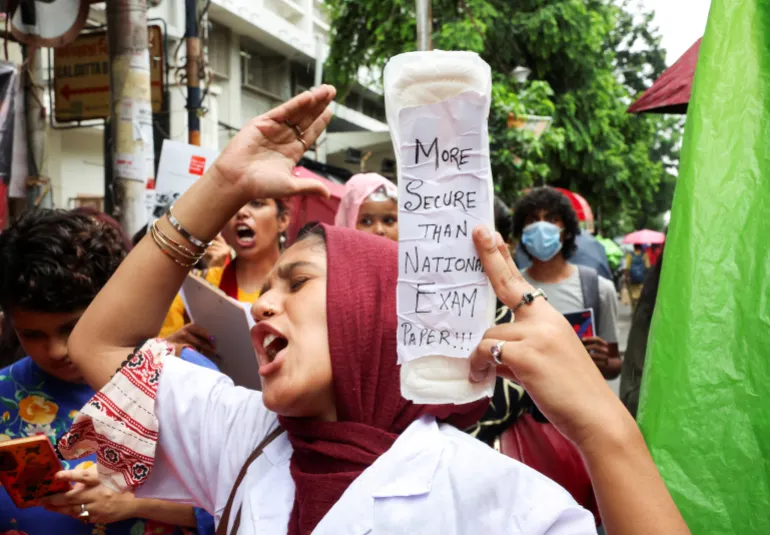
“This is the only thing anyone is talking about. If nothing, we are televising our revolution,” Singh, a teenager, told Al Jazeera, standing amid a sea of protesters choking Parliament Street on Wednesday. “The entire country today feels the sting of batons and tear gas with us.”
Twelve years ago, Modi rode to power and pioneered in many ways, leveraging social media platforms to reach the masses. Today, Gen Z is flipping his Hindu majoritarian party’s dominance on social platforms, weaponising against it the very tools the Bharatiya Janata Party has long relied on.
“Hating Modi is cool on the internet now, after years of criminalising dissent,” she said, before bursting into slogans: “Uncle Modi, go back, go back.”

Evidence of police excess
After the July 20 demonstrations against the government’s handling of paper leaks, the police denied all the protesters’ allegations and media reports of excess force in the crackdown.
But by then, social media was flooded with evidence, recorded by the protesting students.
A New Delhi police officer thrusting a baton on a female protester’s back; usage — potentially by a paramilitary force that was deployed alongside the police — of lethal pellet guns, for the first time in the national capital; a mother crying and pleading with dozens of police officials; another officer slapping and chasing unarmed students; police officers wearing Meta glasses; law enforcement agents planting a damaged car outside a protest strip; and footage where an officer casually trips the students running from tear gas.
No sight escapes the cameras at the Jantar Mantar protest strip, where thousands of protesters keep recording round the clock. The visuals from July 20 have prompted protests across India, in cities like Mumbai, Bengaluru, Patna, Lucknow and Aizawl.
The Cockroach Janta Party, a political pressure group that has been leading the students’ protest, has said the demonstrations would continue “peacefully” until three demands are met. They want Dharmendra Pradhan, the education minister, to resign; for the Modi government to assure that no criminal cases would be pursued against protesters; and for compensation of about $105,000 for families of students who died by suicide due to exam paper leaks and cancellations.
Niharika Soni, a 19-year-old, stood among the thousands-strong crowd that occupied Parliament Street on Wednesday, distributing water bottles to protesters. She did not take part in the July 20 march and did not care much about it either.
Then, the visuals appeared on her feed.
“My mother and I cried for two hours, watching the videos together at home,” she said, adding that her mother has been a staunch supporter of PM Modi.
“We hugged each other and come here every day now,” she added, now holding her mother’s hands, as part of a human chain, ready to confront government forces if attacked.

‘Leaking any responsibility’
It is also a meme fest on the Indian internet.
Protesters pose, mock and tease police personnel stationed near the protest site. Some offer flowers to them while reminding them that the officers only offered baton hits.
A stroll through the protest site and nearby roads is like scrolling an Instagram feed: posters and graffiti now line central New Delhi.
Even when they speak, protesters use language riddled with smart one-liners and mockery of the government.
“This government is leaking any responsibility towards the youth of this country,” Ipshita Gulyari, a 20-year-old, told Al Jazeera. Modi, she said, had messed with the “wrong generation”.
“There is a lot of arrogance in him — and, you know, teenagers do not tolerate that, bro.”
Another duo carried the popular Japanese manga One Piece, a symbol adopted by Gen Z protest movements worldwide. A group of friends donned fictional superhero costumes from Marvel’s Avengers: Spider-Man, Iron Man and Hulk, sitting together on police barricades, looking onto Parliament Street.
“We, the Gen Z people, are born on and for the internet. We were using Instagram before I could read a clock,” said Gulyari.
Mainstream television news channels friendly to Modi have faced accusations of not covering the protests adequately. But young people like Gulyari rely increasingly on independent small publications, and, even more, on social media.
“Gen Z is taking it lightly, being funny about it, because humour is our coping mechanism,” said 18-year-old Yashvi Kumar, a friend of Gulyari at the protest.
“In the middle of all chaos, somewhere we decided that to rebel, we need to find a way that unites us. The memes are uniting us.”
On the other hand, social media posts put up by the BJP are spammed by thousands, calling for the minister to resign.

Flipping the game
In 2014, Modi was among the first world leaders to understand and leverage social media to take his narrative to the masses. The Congress party, now in opposition, was trounced by Modi’s BJP in national elections that year, and has long struggled to keep up with the BJP’s social media dominance.
But with years in power, as India slid in multiple democratic indices, Modi’s government faced mounting accusations that it was criminalising dissent, with several critics jailed for years without a trial.
Modi’s party also mobilised extensive resources in the last decade in its so-called IT Cell, where a bunch of anonymous accounts, or creators friendly to the government, dox, troll and delegitimise social media criticism.
It is fitting, therefore, analysts say, that the biggest challenge Modi has faced on the streets stems from an online joke. After India’s chief justice casually likened the youth to “cockroaches” and “parasites”, the resulting fury led to the formation of the Cockroach Janta Party.
Before the Cockroach movement, “there was an undercurrent of memes from anonymous accounts, masked people, mocking the government,” said Anurag Minus Verma, a cultural critic and author of The Great Indian Brain Rot.
“In a post-ironical world, anything said with irony travels faster — and irony becomes a central feature of the internet during this kind of protest,” he said. “The pent-up anger found a channel at Jantar Mantar, allowing youth to do their thing, speak in their language.”
The most remarkable turnaround for Verma, he said, has been the unmasking of critics at the protest, where demonstrators ridicule and mock Modi, erasing the fear.
Verma argued that the Modi government had crushed and criminalised protests by labelling them anti-nationals and breaking them into sections. “The Gen Z protesters already identify themselves ridiculously enough: they are cockroaches,” he said. “It becomes a single identity — and that becomes easier to penetrate the virality zone.”
“Some are recreating the popular memes from Nepal, Bangladesh and Hong Kong uprisings,” he told Al Jazeera. “The criticism and hate directed at Modi in the capital is not only acceptable now, but even cool.”
Modi, in a tacit acknowledgement of the power of the social media wave that’s against his government, on Thursday morning offered his first comments on the student protests — on X.
“Nothing is more important than the welfare and future of our youth!” he wrote, before mentioning that his government had set up fast-track courts to punish those behind the paper leaks.
But the CJP’s leader Abhijeet Dipke was quick with his riposte on X.
Playing on Modi’s own words, overlaid on a photo of Education Minister Pradhan, Dipke wrote: “Hi, my name is Nothing”.