flank

Russia Building New Infrastructure For Major Troop Deployments Along NATO’s Northern Flank

In another indication of the growing military and economic importance of the Arctic, Russia and NATO are increasing their buildup of forces and facilities in the region. Recent media investigations found that Russia is constructing new bases near Finland to eventually house tens of thousands of troops while NATO on Saturday stood up a long-planned new battalion battlegroup. It is a force that will operate in Finland and Sweden as a deterrent against Russia.

TWZ has frequently reported how Russia, and to a lesser extent China, have moved aggressively to assert their presence in the High North, leaving the U.S. and its NATO allies looking to bolster their defenses.

While Russia remains totally bogged down and suffering high attrition in Ukraine with little chance of moving masses of troops to the Arctic at the moment, concern over the future has spurred NATO to bolster its presence along the Finnish border. Having moved to a wartime economy during the full-on conflict with Ukraine, Russia could leverage that in a post-Ukraine war future to threaten NATO’s borders.

A NATO official told us Friday morning that while the alliance assesses that the chances of a near-term conflict are low given the war in Ukraine, “Moscow could seek to expand westward into the Nordic and Baltic nations after a ceasefire with Ukraine.”

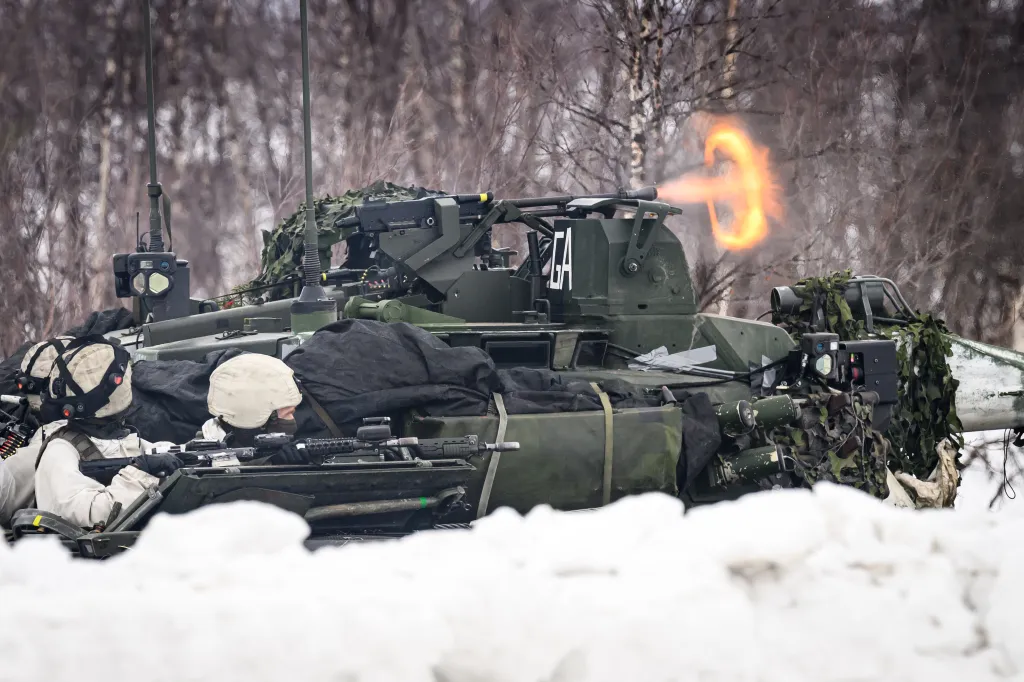
KIVILOMPOLO, FINLAND - MARCH 09: Swedish soldiers take part in an exchange of fire with "enemy troops" using blan rounds during a training exercise, visible to the media, on the Finland/Norway border during the Nordic Response military exercise on March 09, 2024 in Kivilompolo, Finland. The exercise, which primarily takes place across Scandinavia from March 3-14, features 20,000 troops from 13 allied countries. Following the recent NATO expansion, the group now includes Finland and Sweden. (Photo by Leon Neal/Getty Images)
Swedish soldiers take part in training on the Finland/Norway border during the Nordic Response military exercise on March 09, 2024 in Kivilompolo, Finland. (Photo by Leon Neal/Getty Images) LEON NEAL

Russia appears to be investing in infrastructure in preparation of such a contingency. A joint report by several Nordic and Baltic media outlets published earlier this week has found that Russia is expanding military facilities along its borders with Norway and Finland to accommodate tens of thousands of new troops.

“New satellite images show that Russia is increasing its armament in [the] vicinity,” the report stated. “SVT, together with media partners in several countries, has examined how Russia is preparing for 80,000 soldiers… It is a threat that we should take seriously, says Thomas Nilsson, head of Sweden’s military intelligence service (MUST).”

The images “show new barracks for thousands of soldiers, long lines of military vehicles and ammunition storage,” the report further noted. “All winter, Russia has been building new military structures in several places on the other side of the Finnish border.”

“We expect to have 80,000 soldiers on our border and that can be compared to the fact that we previously had 20,000,” Finnish Army Chief Pasi Välimäki told the joint investigation.

A separate report by the Finnish Yle media outlet found that the Russians are expanding a base in the town of Novaya Vilga to hold as many as 6,000 Russian troops. It is located about 100 miles east of the Finnish border.

“NATO has monitored a buildup of military infrastructure in Russia along NATO’s Eastern Flank, particularly along Finland’s border,” the NATO official told us earlier this week. “The real question is what becomes of the infrastructure? Will, for example, Russian troops now in Ukraine be relocated there after the war? It’s something we certainly need to consider, and we do.”

“That’s why NATO and nations are working to deliver real military capabilities to the alliance now, not five to ten years from now, which is so very, very important,” the official added.

KIVILOMPOLO, FINLAND - MARCH 09: A Swedish soldier takes part in an exchange of fire with "enemy troops" using blank rounds during a training exercise, visible to the media, on the Finland/Norway border during the Nordic Response military exercise on March 09, 2024 in Kivilompolo, Finland. The exercise, which primarily takes place across Scandinavia from March 3-14, features 20,000 troops from 13 allied countries. Following the recent NATO expansion, the group now includes Finland and Sweden. (Photo by Leon Neal/Getty Images)
A Swedish soldier takes part in a training exercise during the Nordic Response military exercise on March 09, 2024, in Kivilompolo, Finland. LEON NEAL

One of those efforts, as we noted earlier in this story, was stood up on Saturday, involving NATO’s two newest members.

NATO’s Forward Land Forces (FLF) Finland began operations in Finland and Sweden, according to the alliance. The FLF will include NATO’s newest multinational battlegroup, led by Sweden, “to support the defense of NATO’s northeastern flank.”

The establishment of FLF Finland places a Swedish battlegroup based in Boden, Sweden, and a Multinational Staff Element in Rovaniemi, Finland, under the command of the Supreme Allied Commander Europe (SACEUR) and NATO.

The NATO Forward Land Forces Finland has been established on June 6, 2026, in Boden, Finland. General Markus Laubenthal, SHAPE Chief of Staff, assumed Command of the Swedish Regiment in presence of the Swedish Minister of Defence Pål Jonson. The FLF Finland will be the 9th FLF in SACEURs AoR. NATO Photo by OR-7 Dennis Sattler
The NATO Forward Land Forces Finland (FLF) was established on June 6, 2026. (NATO Photo by OR-7 Dennis Sattler) MSgt OR-7 Dennis Sattler; DEU Army

“Sweden is contributing a battalion battlegroup that, together with a Multinational Staff Element in Rovaniemi, will form the core of FLF Finland,” NATO added. “The Swedish battalion battlegroup is prepositioned in Boden, with capacity to operate in the North Calotte and, where necessary, rapidly reinforce the presence in northern Finland. In 2026, Sweden’s contribution to FLF Finland will total around 600 personnel, with the option to expand to 1,200 personnel if needed.”

“This region is one of the most strategically significant and environmentally challenging areas in the world,” said U.S. Air Force Gen. and SACEUR Alexus G. Grynkewich. “FLF Finland, just like Arctic Sentry, will leverage NATO’s strength to defend our territory and ensure the Arctic and High North remains secure, especially considering Russia’s military activity and China’s growing interest there.”

Activated: NATO Multinational Battlegroup (FLF Finland) thumbnail

Activated: NATO Multinational Battlegroup (FLF Finland)


The U.S. too is working to improve its presence and operations in the region. During last month’s SOF Week symposium in Tampa, Florida, the head of U.S. Northern Command (NORTHCOM) announced the formation of Nordic Bridge to “tie together” the work of U.S. European Command, North American Aerospace Defense Command (NORAD) and SACEUR.

Air Force Gen. Gregory Guillot provided no real details about Nordic Bridge at the time, so we reached out to NORTHCOM for additional details.

“The Nordic Bridge concept seeks to enhance Arctic integration between U.S. Northern Command and U.S. European Command and enhance cooperation between NORAD and NATO in order to expand domain awareness, strengthen deterrence, and improve interoperability,” a NORTHCOM spokesperson told us last month. “It envisions increased participation in each other’s training and exercises, increased data sharing (such as air pictures), deconflicting conferences to maximize personnel availability and participation, etc.”

Last month, Guillot visited Grynkewich “to discuss opportunities under this concept,” the NORTHCOM spokesperson told us.

U.S. Marine Corps Lance Cpl. Thomas Teague, a motor vehicle operator assigned to Combat Logistics Battalion 6, Combat Logistics Regiment 2, 2nd Marine Logistics Group, provides security for a convoy during offensive and defensive operations in Syndalen, Finland during exercise Freezing Winds 23 (FW23), Nov. 30, 2023.  FW23 is a Finnish-led maritime exercise in which United States Marines assigned to Marine Rotational Force- Europe, and U.S. Navy Forces Europe take part; the exercise serves as a venue to increase Finnish Navy readiness, increase U.S., Finland, and NATO partners' interoperability in operational logistics, integrated fires, and amphibious operations within the Baltic Sea littorals. (U.S. Marine Corps photo by Lance Cpl. Christian Salazar)
U.S. Marine Corps Lance Cpl. Thomas Teague, a motor vehicle operator assigned to Combat Logistics Battalion 6, Combat Logistics Regiment 2, 2nd Marine Logistics Group, provides security for a convoy during offensive and defensive operations in Syndalen, Finland during exercise Freezing Winds 23 (FW23), Nov. 30, 2023. (U.S. Marine Corps photo by Lance Cpl. Christian Salazar) Cpl. Christian Salazar

All this is taking place, of course, against the backdrop of President Donald Trump’s frequent insistence that the U.S. subsume Greenland to provide better Arctic protection for the U.S. homeland. The issue reached a fever pitch earlier this year, causing a serious rift with NATO after the president threatened to invade the world’s largest island. You can read more about that in our story about the crisis here.

While there are no indications that the Arctic region is about to break out into open conflict, there are several indications that Russia, NATO and the U.S. are increasing preparations for such an eventuality.

Contact the author: howard@twz.com

Howard is a Senior Staff Writer for TWZ. He writes frequently about conflict, focusing heavily on the Middle East and Ukraine, and interviews with military and intelligence officials and industry leaders from around the globe. He lives near Tampa, Florida, home of U.S. Central Command, U.S. Special Operations Command.


Source link

Chris Rabb win in Pennsylvania energises Democrat’s progressive flank | Donald Trump News

The victory of Chris Rabb in a US House of Representatives primary in Pennsylvania represents a boost to Democrats’ progressive flank, a movement that has come under heavy pressure in recent years.

Running to represent a district stretching across Philadelphia, widely considered the “bluest” in the country, Rabb handily defeated his top competitors. The state lawmaker carried about 44 percent of the vote, compared with about 30 percent for State Senator Sharif Street and 24 percent for paediatric surgeon Ala Stanford.

Recommended Stories

list of 3 itemsend of list

With no Republicans on the ballot in the primary, Rabb is expected to skate to victory in the midterm.

While all candidates sought to highlight progressives’ bona fides in the race, Rabb skewed farthest left, railing against the political machinery that has long played kingmaker in local politics.

He also broke from his opponents on US policy towards Israel. He has pledged to join 12 current members of Congress in signing a resolution recognising the Nakba and has urged his competitors to describe Israel’s actions in Gaza as a “genocide” on the campaign trail.

In one exchange with voters, Stanford appeared to say that using the term “genocide” was “harmful”. Street, whose victory would have made him Philadelphia’s first Muslim member of Congress, has also been criticised for a lack of clarity on the issue.

In a statement, Kendra Brooks and Nicolas O’Rourke, cochairs of the Pennsylvania Working Families Party, said the race was a weathervane for Democrats.

“The question in this race was not whether we would elect a Democrat, but what kind of Democrat we would choose,” they said.

“The people of Philadelphia made their choice clear: bold, working-class leadership, and an end to the broken status quo.”

Indeed, the race in many ways mirrored internal strife for Democrats, kicked into overdrive following the party’s routing in the 2024 election.

Street, the former chair of the Pennsylvania Democratic Party, and Stanford, who was endorsed by outgoing Representative Dwight Evans, have largely been viewed as representing the party’s longstanding establishment.

Underscoring that perception, earlier this Month, Axios reported that Pennsylvania Governor Josh Shapiro had urged building unions supporting Street not to run attack advertisements against Stanford, over concerns it would boost Rabb’s chances.

Rabb, meanwhile, had been endorsed by a series of progressive stalwarts, including Representatives Ocasio-Cortez, Representative Ilhan Omar and Senator Chris Van Hollen and progressive groups, including Justice Democrats and the Sunrise Movement.

The Socialist Democrats of America, who endorsed Rabb early on in the race, have been largely credited with leveraging their ground operation before the primary win.

“We will be with Congressman Rabb every step of the way in the fight to abolish ICE (Immigration and Customs Enforcement), free Palestine and win Medicare for All,” the group said on Wednesday.

Progressives targeted

Rabb’s win represents a sign of hope for progressives, who have been heavily targeted in primary races, particularly for their criticism of Washington’s longstanding support for Israel.

In 2024, both Cori Bush of Missouri and Jamaal Bowman of New York, members of the so-called Progressive “squad” in Congress, lost their primary races amid a massive influx of spending by AIPAC and pro-Israel lobby groups. All told, AIPAC and affiliated groups spent about $25m to unseat the pair.

Progressives have so far seen a mixed bag this primary season. Analilia Mejia saw an early surprise victory when she defeated former Representative Tom Malinowski in February.

Malinowski, who has long portrayed himself as a centrist, was targeted by AIPAC in the 11-way race, in a strategy that has been viewed as a major backfire for the pro-Israel lobby. Instead of boosting a pro-Israel candidate, AIPAC’s targeting indirectly buoyed Mejia, a staunch critic.

In Texas, pro-Palestine pastor and civil rights leader Frederick Haynes III also won his primary race. Haynes was also endorsed by the Justice Democrats, an organisation launched in 2017 to support progressive candidates. The group has endorsed 15 candidates so far this year.

Three other progressive candidates, Junaid Ahmed and Kat Abughazaleh in Illinois, and Nida Allam in North Carolina, lost their primaries amid a massive onslaught of opposition spending from pro-Israel and artificial intelligence-aligned groups.

Still, Justice Democrats spokesperson Usamah Andrabi said Rabb’s victory was an energising sign before a slate of competitive races in June.

Also in Pennsylvania, incumbent Representative Summer Lee easily sailed to victory in her Democratic primary race in Pittsburgh.

“The sky is the limit,” Andrabi told Al Jazeera, “and it is clear that the Democratic base is desperate for a new generation of leadership that not only takes on Republican extremism but takes on the Democratic establishment and their corporate backers all at once.”

Battlelines draw

Tuesday’s primaries across six states saw the battle lines for the midterm election in November further drawn.

The vote will determine which party controls the US Senate and the US House of Representatives, which will set the pace for US President Donald Trump’s second term in office.

Most notably on the Republican side, US Representative Thomas Massie lost his primary race to Trump-backed challenger Ed Gallrein, in what was the most expensive House primary race in history.

Massie had broken with Trump on the investigation into billionaire financier Jeffrey Epstein, the war in Iran, and US support for Israel. His loss indicated Trump’s enduring hold over the party.

But it remained to be seen if that influence would extend to the general election, with Trump’s approval ranking tanking in recent months amid the war with Iran and its knock-on economic fallout. Polls have shown the president’s support has been particularly hard hit among independents, who typically do not vote in primaries.

In Georgia, two Republicans, Congressman Mike Collins and former football coach Derek Dooley, will advance to a run-off election on June 16 in the US Senate race. The winner will take on Democrat Jon Ossoff in one of the closest-watched races of the season.

Meanwhile, Democrat Keisha Lance Bottoms, the former mayor of Atlanta, won the party’s primary in the gubernatorial race. Two Republicans, Rich Jackson and Burt Jones, meanwhile, will head to a run-off.

The race is set to be consequential, with election administration – and the redrawing of congressional maps – in the state looming large in 2024 and potentially set to play a key role in the 2028 race.

Source link