Fix

Fix the Deficit and Venezuela’s Dollar Question Answers Itself

Folks confuse the medicine with the symptoms when they ask for dollarization or argue against it, as if the magic wand of switching to the dollar would cure the deep debt and the fiscal imbalances of the broken State-led model that crippled Venezuela.

Marcos Planchart wrote on this site last week that “it is certainly not the paper where the bolívar is printed the element that corrupts people or destroys the economy: it is the system behind it.” I agree with that sentence entirely. However, dollarization is not the first decision. There is a sequence that comes before it, and it is the sequence, not the currency, that determines whether any of this holds.

Antonio Ecarri and Steve Hanke want to change the unit of account. Planchart wants to keep it and repair the institutions standing behind it. Both are arguing about the currency. The currency is the second question, and it answers itself once you have answered how to fix the fiscal imbalance. 

Those imbalances have four fixes: a legitimate and credible government, a closed deficit, restored conditions for private investment, and an open and transparent market for trading bolívares and dollars. Or you can dollarize. Notice that the first four require no change in the unit of account at all.

Here is the simplified mechanism: A government running a deficit it cannot finance has the Central Bank issue bolívares to cover it. The new money goes looking for dollars and for hard assets, and the rate moves. Running an official rate alongside the market one does not stop that. It only decides who captures the difference.

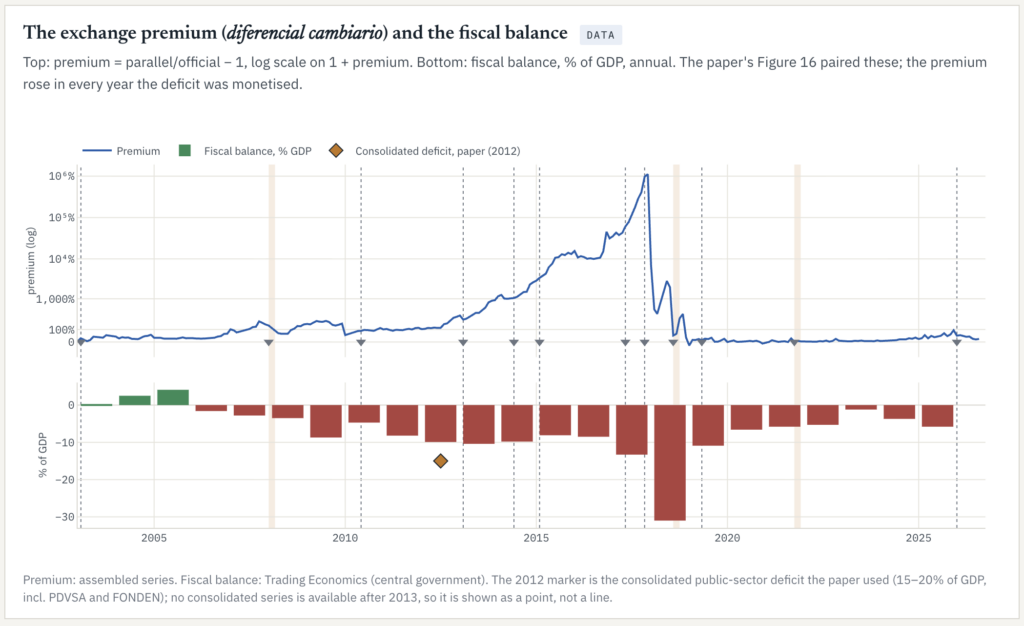
Top: Venezuela’s exchange premium, the parallel rate over the official rate, on a log scale, rising from near zero to over a million percent in 2017 and back down. Bottom: the fiscal balance as a share of GDP, in deficit every year from 2006.
The exchange premium and the fiscal balance. The premium rose every year the deficit was monetized. Premium from the assembled official and parallel series. Fiscal balance from Trading Economics, central government. The 2012 diamond is the consolidated public sector deficit used in the 2013 paper, which included PDVSA and FONDEN; no consolidated series is published after 2013.

Dollarization is a reasonable destination after the fiscal work and a ruinous substitute for it. Do the work and you may not need it, because the inflation it was sold to cure will already be gone. Skip the work and it will cost you more than the bolívar does. Redundant or ruinous. There is no third case.

The three consequences, one at a time

Planchart lists what the case for dollarization claims: eliminating inflation, forcing fiscal discipline, eradicating corruption. Take them in that order.

First: it does eliminate inflation. This is Hanke’s most popular claim, and it is true. Ecuador dollarized in January 2000. Inflation averaged 39% a year through the 1990s and 2.9% from 2003 to 2024. The policy does achieve inflation reduction, and it does so quite fast.

Top: Venezuela’s exchange premium, the parallel rate over the official rate, on a log scale, rising from near zero to over a million percent in 2017 and back down. Bottom: the fiscal balance as a share of GDP, in deficit every year from 2006.
The exchange premium and the fiscal balance. The premium rose every year the deficit was monetized. Premium from the assembled official and parallel series. Fiscal balance from Trading Economics, central government. The 2012 diamond is the consolidated public sector deficit used in the 2013 paper, which included PDVSA and FONDEN; no consolidated series is published after 2013.

Now notice what that concession costs the other side. Inflation is the entire platform. It is why the argument is popular in Caracas, and why anyone is listening to Ecarri in 2026. The harder thing to see is this: if we stabilize the fiscal accounts and jump-start private investment, inflation can be tamed and the case for dollarization goes with it. You cannot sell a cure for a disease the patient no longer has.

Second, it does not force fiscal discipline. Ecuador ran deficits in twelve of the thirteen years from 2013. The one exception was 2022, by four hundredths of a percentage point. Public debt went from 19% of GDP in 2011 to 64% in 2020, and Ecuador defaulted that year. It is 54% now. Growth averaged 6.4% a year from 2011 to 2014 and 1.4% from 2015 to 2019.

The mechanism is the one Planchart names himself. He warns that dollarization leaves a country “even more vulnerable to external shocks, such as a sudden plunge in oil prices.” That is precisely what happened to Ecuador after 2014. Oil fell, Ecuador could not devalue, and the shock had nowhere to go except the budget, and from the budget into debt and into lost growth. He states the fear and never uses the country it happened to. It is the best evidence in his own case and he leaves it on the table.

The deficit does not disappear when the currency changes. It simply has to be paid in a currency you cannot print.

Dollarization took away the printing machine, not the deficit, so the adjustment fell on debt instead of on prices. Ecuador does not show that dollarization is harmful. It shows that it is not enough. Of its two defaults, 2008 is the weaker example: it fell in a surplus year and was a choice rather than a financing crisis.

Third, regarding corruption, Planchart has already answered it, and I will not repeat a good argument badly. The exchange differential was never an oversight. It was an instrument. Change the currency and the people who built it still hold the pen.

What getting the sequence wrong costs

Planchart says a failed dollarization would force the government into more debt and severe cash shortages. He is right. Here is the size of it.

We ran the model with the same economy twice from the same starting position, $13.4 billion of reserves in 2026, changing one thing. Dollarize now on today’s deficit, alter nothing else, and the state’s dollar position will fall through zero in the third year and reach minus $24 billion by 2034. Dollarize after fiscal consolidation, with private investment recovering, and the same position accumulates to plus $127 billion. Same reserves, same model, one difference.

The deficit does not disappear when the currency changes. It simply has to be paid in a currency you cannot print.

Two lines from the same starting point of $13.4 billion in 2026. The green line, dollarization after the deficit is closed, rises steadily to about $80 billion by 2031. The red line, dollarization alone with the deficit unchanged, falls steadily and crosses zero in 2029, marked “dollars run out, 2029”.
Dollarizing without fiscal reform is a recipe for disaster. Shown to 2031; the simulation runs to 2034, by which point the red path is minus $24 billion and the green one plus $127 billion. Every assumption behind it is a control the reader can move at https://www.bolivarjesus.com/KangarooPegRevisited2026/

Why 576% inflation sits on a deficit near 6%

Planchart gives the number: inflation reached 576% year on year in July. The mechanism above explains the direction. It does not explain the size, and the size is the interesting part.

The bolívar base has collapsed; measured at the parallel rate, it was around $15 billion in 2011 and 2012. In July 2026, it was $1.7 billion. The base that can be monetised is a ninth of what it was.

In 2013, Gino Bettocchi and I wrote about a State running a consolidated deficit of 15% to 20% of GDP, including PDVSA and FONDEN. On the narrower central government measure that is still published, the deficit has roughly halved since then, from 9.9% in 2012 to 5.8% last year. A far smaller deficit now carries the inflationary force that an enormous one carried then, because there is so little left to dilute. That cuts against both camps. It is not evidence that the bolívar is cursed, and it is not evidence that only the dollar can fix it. It is arithmetic about a very small base.

Where I actually disagree

Planchart wants to keep the bolívar permanently, in part to preserve room for industrial policy. The unit of account does not carry that weight, in either direction.

What breaks or holds a monetary regime is the deficit, private investment, and the institutions behind them. Those three decide the outcome, whether prices are quoted in bolívares or in dollars.

The argument about maintaining the unit of account in bolívares is about the State’s capacity to protect and nurture strategic industries. But industrial policy is paid for by a State with fiscal room, and Venezuela has neither. It becomes possible after stabilization, not instead of it.

Without credible rules, there is no private investment. Without investment, there is no oil and no tax base. Without revenue, there is a deficit. And a deficit breaks any exchange rate regime, whether it is denominated in bolívares or in dollars.

Planchart may well be right. His is a claim about what Venezuela becomes over the medium and long term; mine is about what stops the bleeding now. Our hope is that between the two visions, readers get the order of operations.

His best line is that starting dollarization under chavista rule is like handing the reconstruction of the oil sector to a man who helped destroy the electricity grid. I would make it structural rather than personal, because it is an argument about order.

Stage one is not monetary. It is a legal framework credible enough that private capital comes back. Without credible rules, there is no private investment. Without investment, there is no oil and no tax base. Without revenue, there is a deficit. And a deficit breaks any exchange rate regime, whether it is denominated in bolívares or in dollars. Once those policies are in place, they will open the market and the premium will close on its own. Then, the decision about Venezuela adopting the dollar formally can be taken calmly, from strength, rather than desperately as a rescue.

In 2013 we wrote that the choice was reform or hyperinflation. Maduro chose hyperinflation, and it ran from 2017 to 2021. The 2026 version of that choice is not dollar or bolívar. A currency is imported. A State is built.

“The Kangaroo Peg” was written by Gino Bettocchi and Jesús Bolívar, Second Year Policy Analysis, Harvard Kennedy School, 2013, advised by Ricardo Hausmann. The thirteenth year update, with both figures, the model and its sources, is available here.

You can also track all macroeconomic metrics in the UnoPago monitoring website.
Source link

Abandoned properties, fire hazards. Are L.A. mayor candidates part of the fix, or the problem?

Labor Day is behind us, election day is less than two months away, and the question before Los Angeles voters is this:

Can anyone run this city?

Two fires at abandoned properties, one in Studio City and the other on the eastern edge of Larchmont, offer windows into City Hall dysfunction as Mayor Karen Bass defends her job against a challenge by City Councilmember Nithya Raman.

Let’s start on Babcock Avenue, just south of Moorpark Street, where, for roughly five years, neighbors of a vacant house begged City Hall for attention to what had been a dumping ground, a fire hazard and a homeless hangout.

To no avail.

When they received any response at all, they got the runaround.

Resident Jon Manzanares told me he has supported Bass and Raman in the past. But in a spring 2025 email to City Hall, he said both “should be ashamed and resign in disgrace.”

Well, they didn’t. And following an Aug. 26 fire at the Babcock property, which damaged the rear of an adjacent home, Bass and Raman went after each other for not having addressed all those pleas for help.

“Nithya Raman wants to lead the whole city,” said a Bass campaign social media post, but after six years in office “she can’t even get a single lot cleaned up in her own district.”

Raman shot back, saying she had alerted the mayor’s office about the nuisance property 10 months earlier.

“I cannot call her about the 200-plus issues that we’re dealing with that are at this level of risk,” Raman snapped.

The finger-pointing doesn’t inspire confidence, does it?

At least, said Manzanares, a retired lawyer, L.A. found out what it takes to get a response from the two mayoral candidates.

“The news crews showed up” to cover the fire, Manzanares told me, “and it finally got some attention because of the election.”

But festering eyesores are everywhere, as Bass herself indicated when she called in to KTLA-TV.

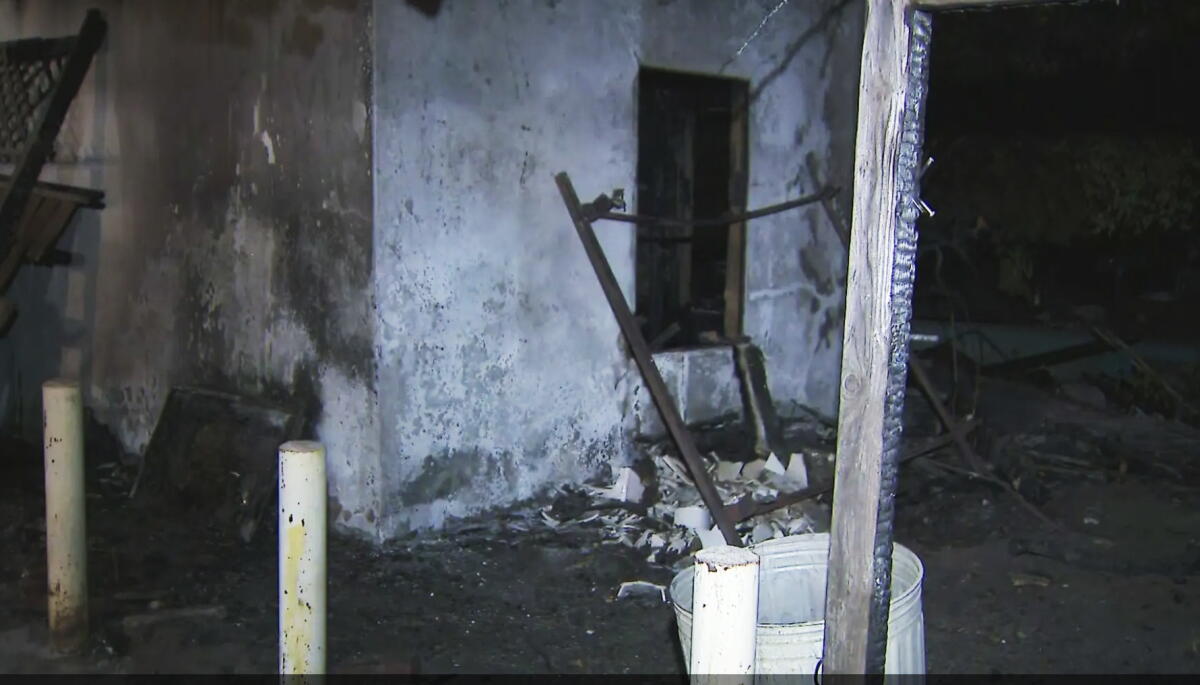
Fire damage is seen at an abandoned Studio City property following a overnight blaze

Fire damage is seen at an abandoned Studio City property following a overnight blaze on Aug. 26.

(KTLA-TV)

“You know,” she said, “this is a situation that unfortunately exists all over the city.”

A for honesty. F for failing to clean up all those messes, regardless of whether the problem is departmental failure or communications breakdowns with council members.

The fire in Studio City spread to a neighboring property and damaged a structure that Kayt Miranda uses for storage and as a home office. I spoke to Miranda on the front porch of her home, and she said she had filed multiple complaints about the nuisance property over a five-year period.

Five years.

“And we never heard back,” Miranda said, telling me she had seen people set up camp at the property, bringing in mattresses, book shelves and clothing racks. “Then we went to Raman’s office … They would send responses, but … we never saw any action.”

Manzanares showed me an email from a Raman staffer last month that said, “unfortunately, there is not a clear and expeditious path forward on this case.”

Why not? Was it going to take another five years?

Miranda said exasperated neighbors had banded together to put up more lighting and cameras to protect their properties, “but it really did feel like this is forever, because nothing was going to happen.”

When I was done in Studio City, I drove across town to meet with construction worker and pastor Juan Galicia, whose house was torched in March when fire jumped from an adjacent abandoned property.

I had first heard about Galicia in April, when I toured a nearby Hollywood neighborhood for a column about a homeowner who had hired her housekeeper to report illegal dumping, help bag up the daily mess and try to reduce the fire risk around encampments. The city wasn’t doing its job, Stefanie Keenan had told me, so she was spending her own money to protect herself and neighbors. And she still is.

Galicia didn’t get the protection he needed, despite multiple contacts with police and city offices — by him, relatives and neighbors —regarding the empty dwelling next door to his on North St. Andrews Place. Galicia said squatters were in and out of the house, with periodic fighting and drug use. Police would come, he said, but when they left, the trouble would return.

Galicia was preaching at his church in South L.A. when flames engulfed his home, where he lived with an extended family of 10.

“Eighteen years,” he said of his time in the house. “And in 10 minutes, you have nothing.”

I followed him into the house, with its charred walls, ceiling and flooring. Galicia wore a somber expression, as if still suffering from the shock, and he saw new evidence of trespassers, along with some fresh graffiti.

Galicia told me, as he told The Times’ Seamus Bozeman in July, that he intends to rebuild. But his insurance settlement won’t cover the cost of rebuilding, and he’s still paying $2,000 a month on the mortgage, plus $6,200 for temporary lodging in a rented house.

Meanwhile, as he struggles with a crushing financial problem he did not create, he’s aware that millions are being spent on homelessness without significant progress.

Aerial view of Larchmont home belonging to Pastor Juan Galicia that was destroyed by a fire.

Aerial view of Larchmont home belonging to Pastor Juan Galicia that was destroyed by a fire that began at a vacant property next door.

(Robert Gauthier/Los Angeles Times)

“I don’t understand,” Galicia said.

A spokesperson for City Councilmember Hugo Soto-Martínez told me his office became aware of Galicia’s issue in January, but because of paperwork and the complexity of legal records, could not track down the owner of the adjacent property before the fire.

In L.A., people trip and fall in droves and successfully sue the city for millions. I wondered if Galicia might have a liability case against the city, but two attorneys told me going after the next-door property owner could be more fruitful.

In a Sept. 5 press release, Bass said she was directing city crews to clean and secure nuisance properties citywide. OK, fine, but what took her so long?

Bass also said she had earlier signed legislation initiated by Councilmember Monica Rodriguez to speed the process of cracking down on negligent property owners and to hit them with stiffer penalties.

Those fines ought to go into a fund to assist Juan Galicia and others like him.

Between 2018 and 2024, according to the L.A. Fire Department, homelessness was a factor in about one-third of all fires in the city.

“I feel for these people, I really do. I’m not unsympathetic,” Jon Manzanares told me in Studio City. “But by the same token, we need to do something constructive and not have these encampments that start fires.”

With less than two months to go before the election, it’s on Bass and Raman to convince voters they can make a difference.

The finger-pointing is useless.

steve.lopez@latimes.com

Source link

Why loggers and (some) environmentalists support Fix Our Forests Act

A sweeping bipartisan bill that seeks to prevent catastrophic wildfires and restore fire-ravaged forests has revealed a schism in the nation’s environmental movement as some conservation advocates find themselves allied with a longtime foe: loggers.

The Fix Our Forests Act, which Congress is close to passing, aims to speed up forest management projects on public and tribal lands by reducing regulatory and legal hurdles.

The proposed legislation comes at a time of increasingly devastating wildfires and has garnered wide support among Republicans and the timber industry.

However, the traditional Democratic coalition of environmental groups is split over the role humanity has to play in forest management. Some argue ecosystems are best protected when humans leave them alone — a view that dominated during the timber wars of the ’80s and ’90s. Others argue that humans have a responsibility to intervene — an increasingly popular idea as climate change threatens ecosystems around the world.

Among the major environmental groups that oppose the legislation are the Sierra Club and Center for Biological Diversity. They worry that limiting environmental review and litigation will allow timber companies to heavily log these areas instead of gently thinning them. Meanwhile, some Southern California groups worry the bill would allow well-meaning land managers to approve misguided projects that ultimately harm local shrublands, which have a very different relationship with fire than the bill’s namesake, forests.

“It’s really handing the keys to the Trump administration to be able to push forward a lot of their timber agenda,” said Anna Medema, deputy legislative director for forests and public lands at the Sierra Club.

But the Nature Conservancy and other groups have voiced support for the bill, citing the constant and imminent threat that increasingly severe wildfires pose to communities and ecosystems.

“We do advocacy at a twofold level. We are doing defensive work to fight back against bad things, and we’re also trying to promote the good things that are happening on the ground,” said Morgan Cashwell, North America director of legislative affairs for the Nature Conservancy. Right now, that good work needs to “meet the moment in the current wildfire crisis.”

That sentiment appears to have motivated Western lawmakers in particular.

In the House of Representatives, roughly half of the Democrats from Western states voted for the bill, compared to about a quarter of Democrats from elsewhere in the country. Republicans voted overwhelmingly in favor. The legislation is now awaiting a final vote in the Senate. Congress has until Jan. 3, 2027, to pass it.

“Wildfires today are very different than wildfires from a generation ago,” said Sen. Alex Padilla (D-Calif.), who co-introduced the Senate version of the bill. “Oftentimes, they’re irreversibly devastating ecosystems and watersheds.”

“So,” he said, “ the status quo is clearly not working.”

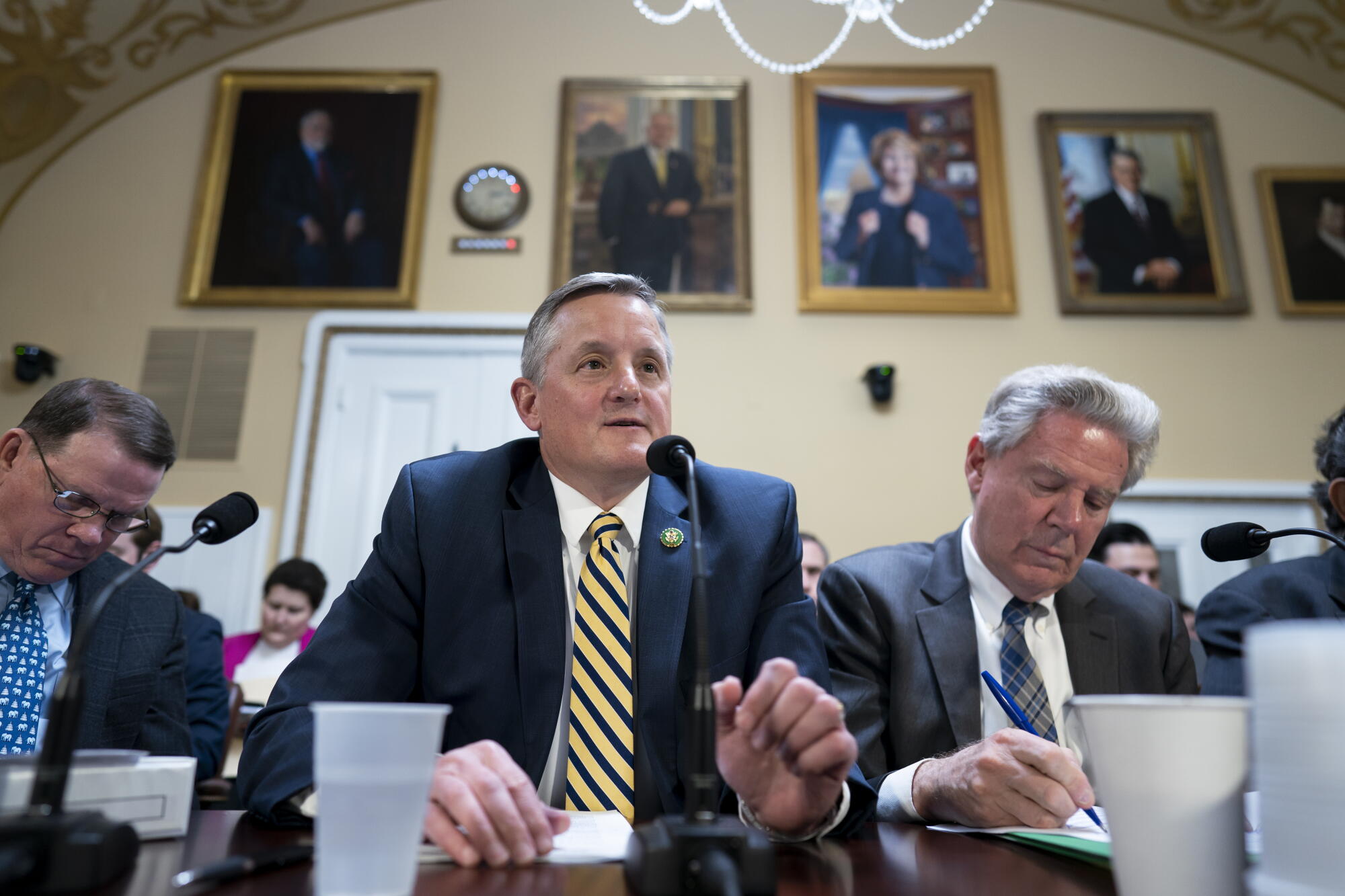
chairman of the House Committee on Natural Resources delivers remarks at the Capitol

Rep. Bruce Westerman (R-Ark.), center, chairman of the House Committee on Natural Resources, delivers remarks at the Capitol in March 2023.

(J. Scott Applewhite / Associated Press)

The act was born when Rep. Bruce Westerman (R-Ark.), a former forester, stole a seat on a plane next to Rep. Scott Peters (D-San Diego). He used the opportunity to talk Peters’ ear off about a beloved species of tree that is under threat from worsening wildfires: the giant sequoia.

The two introduced a bill to protect them, called the Save Our Sequoias Act, and quickly saw an opportunity for something bigger.

“I knew right away that this could be a gateway to talking about permit reform,” Peters said. So, “we started working on a bigger, nationwide reform of forestry practices which have been really, really clogged up.”

While California grasslands, shrublands and woodlands are adapted to different frequencies and intensities of wildfire, research has found that high-severity fires — which kill the vast majority of trees in their path — are scorching 30 times more land area than in the 1980s.

The result: California is losing, on average, more than 200,000 acres of forest every year — or roughly 2.5% of all woodlands in the state every decade. U.S. Forest Service efforts to resuscitate these ecosystems have failed to keep pace. In recent years, the agency has reforested only about 1% of woodlands that are unlikely to recover on their own.

Californian supporters of the Fix Our Forests Act argue the problem has more to do with permitting delays than finances.

Marin County firefighters train during a prescribed burn

Marin County firefighters train during a prescribed burn in June in San Rafael.

(Heather Diehl / Getty Images)

Rep. George Whitesides (D-Santa Clarita), who co-sponsored the Fix Our Forests Act, pointed to nonpartisan research that found it takes the Forest Service more than five years on average to complete a full environmental review and begin work on forest thinning projects that use mechanical equipment like bulldozers and wood chippers. For prescribed burns, it takes more than seven years on average.

“That’s insane,” he said, that it “takes as long as a kid growing up to be a first grader to be able to move on this.”

The Fix Our Forests Act would exempt projects from the full permitting process if they were in areas with the most extreme fire risk and would expand existing exemptions for projects under 3,000 acres to cover projects up to 10,000 acres. It also would limit the window during which environmental groups can sue over project approvals.

These projects tend to employ a combination of harvesting timber and thinning smaller trees and plants with heavy machinery (often the favored tools of Republicans and the timber industry) and using prescribed fire to clear out the forest floor (often favored by environmental groups).

The “environmental left” has “made it endlessly time-consuming and ultimately cost prohibitive to maintain our forests, all with the promise that this would improve the forest environment,” said Rep. Tom McClintock (R-Elk Grove), a co-sponsor who authored some of the permitting exclusions. “Well, after 50 years, I think we’re entitled to ask, how’s the forest environment doing?”

In March 2025, President Trump issued an executive order that blamed “our inability to fully exploit our domestic timber supply” as a contributor to disastrous wildfires. In response, the U.S. Forest Service set a goal to increase the amount of timber open to logging by 25% nationwide over five years.

Scott Dane, executive director of the American Loggers Council, argued the nightmare scenarios of expansive clear-cutting from the timber wars are not on the table for America’s public lands.

“It’s a boogeyman position that they love to take from 100 years ago,” he said. “It’s not, in reality, in modern forest management at all.”

Watchdogs in Southern California have a different concern: While research shows forest thinning is an effective tool in overgrown Sierra Nevada woodlands, the state’s coastal shrublands are not denser than they historically have been. Consequently, the type of projects the Fix Our Forests Act would expedite are far more controversial and contested in shrublands. Local advocates fear the act would undermine their ability to push back on proposals with questionable scientific backing.

Goats and sheep graze on top of a hill

Goats and sheep graze on top of Kite Hill in May 2025 in Los Angeles for wildfire prevention.

(Juliana Yamada / Los Angeles Times)

In contrast to projects in conifer forests that aim to decrease the density of trees and vegetation across the landscape, shrubland projects are typically centered on creating a network of corridors hundreds of feet wide with no vegetation throughout the wildlands and clearing plants away from existing buildings.

While firefighters rely on these networks of fuel breaks to access the wildlands during fires and build containment lines, research has found that when firefighters cannot reach the fuel breaks — which is often the case during extreme winds — the lines only stop fires about 13% of the time. If they are not routinely maintained, they also risk supporting the growth of flammable invasive grasses.

In Los Padres National Forest, near Santa Barbara, officials proposed in 2022 creating roughly 187,000 acres of fuel breaks and structure defense zones. After organizations like Los Padres ForestWatch pushed back on the plan through the environmental review process, the national forest ultimately scaled the proposal down to about 22,000 acres this July.

“You had community input, and you had the federal government incorporating that input into a plan that is grossly improved,” said Benjamin Pitterle, director of advocacy and field operations at Los Padres ForestWatch. “It’s arguably a perfect example of how the process should work.”

Source link

California voters can fix a flaw in the state’s recall system

Is a hissy fit worth $200 million?

That was the tab in 2021, when California held a recall election less than a year before Gov. Gavin Newsom was set to face voters.

There was angst — the COVID-19 pandemic was raging. There was anger — the lifesaving restrictions imposed by Washington and Sacramento made daily living a chore and drove many small businesses to the brink. Others went clear over the edge.

There was also no small amount of political opportunism at play.

The recall gave Newsom’s critics, mainly on the right, a chance to try to chase the Democrat from an office that Republicans, under normal circumstances, stood little chance of winning.

In the end, the recall effort amounted to scarcely more than a partisan tantrum. The result — 61.9% voting no, 38.1% voting yes — matched the outcome of the 2018 gubernatorial race down to the decimal. All that money and effort wasted on an election in which voters said pretty much, yep, we meant what we said. Not too long after, they gave Newsom a second term.

The plebiscite, and its pointlessness, underscored the many flaws inherent in California’s recall system. In November, voters will get a chance to remedy at least one of them, eliminating the chance a candidate could take office with just marginal support from voters.

You’re reading the L.A. Times Politics newsletter

Expert columnists cover the insights, legislation, players and politics you need to know.

Trigger warning: What follows is a somewhat wonky explanation of election rules and procedures.

One choice, not two

Currently, a recall election is conducted in two parts. Voters are asked whether a lawmaker should be removed and, if so, who their replacement should be. If the incumbent is ousted, whoever gets the most votes takes their place, even if they fall well shy of attaining majority support. (Which is not out of the question in a large multi-candidate field; in 2003, 135 people were on the ballot, vying to replace Gov. Gray Davis.)

Among its provisions, Proposition 5 would amend the state Constitution so that voters would be asked a simple yes-or-no question: Do you wish to recall the incumbent? If so, the lieutenant governor would serve as governor for the rest of the ousted executive’s term — unless the recall occurred during the first two years a governor was in office and before the filing deadline for the next statewide election.

In that case, a special election would be held on the same date as the next primary and a candidate receiving a majority of votes would serve out the governor’s term. If no candidate received a majority, the top-two finishers would face each other in a November runoff, with the winner taking over as governor.

Still there?

Proposition 5 has two benefits. It would save taxpayer dollars by consolidating elections and it would enhance the legitimacy and political standing of a replacement governor by ensuring he or she assumed office with at least 50% support.

But there’s still more to be done.

Ending political promiscuity

California makes it way too easy to qualify a gubernatorial recall measure.

Of the 19 states that allow their governor to be booted, California is by far the most permissive. Forcing an election requires signatures reflecting just 12% of the ballots cast in the prior gubernatorial contest. In Newsom’s case, proponents needed just under 1.5 million signatures in a state with more than 22 million voters and nearly 40 million residents.

Not exactly a thundering roar.

The threshold should be higher and the reasons for kicking a governor out of office should be more serious, such as corruption, official malfeasance or conviction for a serious crime. Not just because a governor is a member of the opposite party, or people on the losing end of an election are unhappy with the result.

“The system in its current form offers bad actors an incentive to target an elected official with whom they disagree and to have the official replaced by someone who otherwise would not enjoy the support of a majority of voters,” Josh Newman of Fullerton and Isaac Bryan of Los Angeles said in advocating change. The two Democratic lawmakers authored the constitutional amendment, which was placed on November’s ballot by the Legislature.

If you think overhauling the process is simply about protecting partisan interests, consider: Should Republican Steve Hilton pull off an epic upset and become California’s next governor, is there any doubt a recall effort would be underway before he and Mrs. Hilton even had the chance to start boxing their belongings for the move to Sacramento?

The recall is a vestige of the Progressive-era good-government movement. But the process needs to be revamped to reflect today’s bad-faith political environment.

The Little Hoover Commission, California’s independent oversight agency, has recommended several changes, including raising the signature requirement and prohibiting recalls undertaken during the first 90 days and the last six months of an officeholder’s term.

Elections, it’s said, have consequences. They also have — or should have — end dates and final results that are respected, not re-litigated until the losing side gets its way.

Proposition 5 is a step in the right direction. More should follow.

What else you should be reading

Get smart: Trump’s economic record is working against him in the midterms
The deep dive: Backlash over data centers hits California, and the midterms
The L.A. Times Special:Integrity on the ballot: Election deniers target secretary of state races in key states

Until next time,
mzb

Was this newsletter forwarded to you? Sign up here to get it in your inbox.

Source link

Why the US Dollar Won’t Fix Venezuela’s Economy

A few weeks ago, non-chavista politician Antonio Ecarri and American economist Steve Hanke managed to unearth one of Venezuela’s longstanding and unsettling debates: whether the country’s economy should be formally dollarized. After decades of economic hardship brought by repeated devaluations, hyperinflation and scarcity, the country’s monetary regime is heavily fragmented. 

De facto dollarization rules most of the transactions, while the bolívar, crypto stablecoins, euros and the currencies of neighboring countries split the rest of the monetary market share used to maneuver through Venezuela’s complex economy. With the US pushing for the country’s economic stabilization to increase trust in foreign investors, the fragmented monetary ecosystem can be detrimental to the process made so far.

Venezuela’s economic outlook has improved after Maduro’s capture and since the US took control over Delcy’s decisions. Mainly because of a sharp recovery of oil exports to the US recovered sharply; by April, these were up 192% from their 2025 average. The energy sector is spearheading the recovery while attempting to partially compensate for the devastation caused by the twin earthquakes. GDP growth projections for Venezuela are forecasted at 5.8%, almost four times the country’s 2025 growth (1.5%). Yet the threat of inflation and instability compounds investors’ worries about entering the country. After repeated announcements by the interim regime promising to close the exchange gap and tackle inflation, their actions show otherwise.

Delcy continues to erode the bolívar by stimulating the money printer needed to feed chavismo’s patronage system. Exchange rate controls, which have long incentivized corruption and inflation, are still there. On the dollar side, credit loans and transactions remain “officially” forbidden, creating an artificial tax on USD transactions and fear amongst businesses who can be punished for their use.

Eliminating inflation would require abolishing all existing exchange rates and creating a new one based on an agreed technocratic approach.

The result of this unaddressed monetary disaster has been a persistent rise in inflation, which increased by 6.1% in July, bringing year-on-year inflation to 576% and 2026 cumulative inflation to 175.5%.

This is not the first time the call for dollarization has been in the spotlight in Venezuela. Nonetheless, US control over the country’s economy may increase the possibility of it becoming a reality. While dollarizing might be an effective measure to rapidly generate trust and reduce inflation, it raises important questions about its implementation under the interim regime and the future of Venezuela’s monetary sovereignty. Similar to Trump’s oil deal or the post-earthquake reconstruction, all discussions and actions are taking place behind the scenes, sidelining the very population that will have to deal with its consequences. 

The US dollar is not the solution

Discussions regarding dollarization have primarily focused on three benefits: eliminating inflation, forcing fiscal discipline, and eradicating corruption. However, as long as those managing the dollarization process are the same ones who have guided Venezuela to the worst economic crisis in the region’s history, the result might be equally as bad but with a different set of consequences. 

Hanke asserts that no preexisting institutional, fiscal or political conditions are necessary for dollarization to be successful. However, this process requires the willingness of all three areas to move forward. Eliminating inflation would require abolishing all existing exchange rates and creating a new one based on an agreed technocratic approach. Currently, there is no incentive for anyone in the interim regime’s leadership to converge the exchange rates.

A struggling or failed dollarization plan could further erode trust while leaving the country even more vulnerable to external shocks.

The exchange rate differentials have not been an economic policy mistake overlooked by chavismo. These have been an integral part of chavismo’s strategy to undermine and replace old political elites with select, loyal ones. Long ago, they became crucial to maintain the status quo. There are no signs in favour of change in this area, as economist Juan Comella argued in May. Doing so would compromise the structure that keeps her in power.

A struggling or failed dollarization plan—which forces the government to take on further debt, experience severe cash shortages and fundamentally depend on its commodity exports—could further erode trust while leaving the country even more vulnerable to external shocks, such as a sudden plunge in oil prices. The neoliberal constraints posed by dollarization, like an extremely limited Central Bank to aid the government, will not fix decades of institutional erosion, but only try to avoid it while possibly unleashing a fresh round of obstacles that menace an already fragile economic recovery.

The bolívar is not the problem

Decades of monetary policy failures made the population skeptical of the bolívar. For long enough, the system and institutions have incentivised and even rewarded the wrong people to take advantage of its vulnerabilities at the expense of the population and evading any personal consequences.

It is certainly not the paper where the bolívar is printed the element that corrupts people or destroys the economy: it is the system behind it. It is not far-fetched to think of a plan that grants the Venezuelan Central Bank complete independence, empowering the correct people to safeguard the economy from the risks of inflation while maintaining government spending in line and preparing for external shocks.

Relinquishing our monetary sovereignty would be a mistake in a world where governments actively participate and spend to tackle modern challenges, including AI and natural disaster relief. China’s rise as a global power has been, in part, a consequence of decades of industrial policy under intense government intervention. The US and EU have started to catch up in recent years. The US has done so with the CHIPS and Inflation Reduction Act under Biden and, most recently, with the Trump administration imposing protectionist tariffs and taking equity stakes in major companies with the aim of safeguarding US interests in key sectors. The EU aims to increase competitiveness under the Clean Industrial Deal and the Industrial Accelerator Act. If Venezuelan leaders seek to move past the country’s commodity dependence, climb up in the global value chain, become competitive and diversify the economy, industrial policy will be crucial. Dollarization would compromise those goals.

Starting a dollarization process under chavista rule is similar to entrusting the reconstruction of Venezuela’s oil sector to a businessman who contributed to the destruction of the country’s electricity grid.

Foreign investment will be the driver of short- and medium-term recovery and growth for Venezuela. However, industrial policy will be crucial to guide the long-term objectives of the country. For this, Venezuela needs the bolívar, even if it’s in an open and competitive currency market where the people decide which currency earns their trust.

The Ecarri-Hanke duo surprised public opinion not only because of their proposal but also because of the odd pairing. Ecarri represents the efforts of Venezuelan politicians with limited legitimacy to enter the spheres of influence in Washington, and also chavismo’s ability to neutralize them. Hanke only views Venezuela as part of a larger plan to promote and deepen the use of the dollar internationally, in a global context that increasingly mistrusts the US currency and is hedging against it.

Ecarri is the result of a system that empowers the wrong people. Hanke represents the oversight of the reality on the ground and the impact Venezuelans will have to absorb. Both display the same shortcomings of Venezuela’s monetary institutions over the past decades. Their proposal simply tries to hide the sun with one finger instead of addressing the historical root causes of Venezuela’s monetary instability.

Starting a dollarization process under chavista rule is similar to entrusting the reconstruction of Venezuela’s oil sector to a businessman who contributed to the destruction of the country’s electricity grid. Policy should depart from both trauma-instilled calls for complete dollarization and a patriotic defense of the bolívar. Instead, it should focus on economic stability and our capacity to meet the challenges of tomorrow.

Source link