Rory McIlroy recovered sufficiently from a back injury to begin his defence of the Players Championship but he ended round one seven shots off the pace.
The world number two only arrived at TPC Sawgrass on the eve of the PGA Tour’s flagship tournament, having opted to stay at home for treatment on the injury that forced him to pull out of last week’s Arnold Palmer Invitational at Bay Hill.
He showed no obvious signs of discomfort in crushing his opening drive 329 yards down the middle of the fairway, but he took 73 more shots for a two-over par total, with birdie putts on the 16th and 17th holes grazing the edge of the cup.
McIlroy’s Ryder Cup team-mate Sepp Straka is alongside three Americans setting the clubhouse pace on five under.
Austrian Straka chipped in for an eagle three on the par-five 16th in his bogey-free 67 to join Maverick McNealy, Lee Hodges and Sahith Theegala atop the leaderboard.
“We were fortunate to play in the afternoon with hardly any wind and the greens a lot softer,” said Straka, referring to the heavy rain that doused the course earlier in the day.
England’s Tommy Fleetwood was among those playing in the worst of the weather. He briefly reached five under, after a run of eagle-birdie-birdie on Sawgrass’ notoriously difficult 16th, 17th and 18th holes. He called it a “complete bonus of a stretch” of holes.
Having started on the 10th, the world number three then birdied the second but a torrential downpour that halted play for around 25 minutes checked his momentum, and successive bogeys on the fourth and fifth holes dropped him back into the pack.
He is in good company on three under, with Sweden’s Ludvig Aberg, Norwegian Viktor Hovland and American Xander Schauffele also enjoying solid starts.
The rain delay meant four players were unable to finish their opening rounds as the sun set and darkness fell. Among them is unheralded American Austin Smotherman, who will return on Friday morning to face a 15-foot birdie putt on the ninth hole – his 18th – to take the first-round lead.
In rapidly fading light, Smotherman hit his second shot on the par-five hole into the heart of the green, but while his playing partners opted to finish the hole, he decided to mark his ball and wait for the morning light.
A FITNESS influencer has confessed to lying about getting caught in an explosion.
Influencer Malibu Fit Maxx has admitted that he lied about the ordeal while serving in the army.
Sign up for the Showbiz newsletter
Thank you!
Malibu Fit Maxx has apologised about telling his followers a lieCredit: InstagramThe influencer, whose real name is Lee Markham, took to social media in the candid videoCredit: malibufitmaxx/Instagram
The fitness influencer, whose real name is Lee Markham, shared a video this week where he revealed that he lied about sustaining an injury from an improvised explosive device while on active duty.
Speaking in his candid video, the influencer said: “I wanted to talk to you directly about the claim that I made, taking an IED blast to the face.”
He then said how he was “deeply proud” to have served in the military between 2005 and 2010.
The internet star explained how he received negative comments online about his appearance, which in turn let to him making a false claim about his time serving in the army.
“I’ve always got comments about my face and appearance.
“Some of them were harsh. And to be honest, I didn’t handle it well,” he began.
“I was new to being in the public eye and I didn’t know how to handle the criticism.”
He went on: “Instead of facing that right away, I made a bad decision and put ‘IED Survivor’ in my bio. That was not true and it was wrong.
“But truly I’m sorry from the bottom of my heart,” he said.
He added: “I have always tried to promote positivity and support for others, especially veterans.
“But I understand that my actions here contradict that. I take full responsibility for it,” he said later in the video.
Keen to regain the trust of his followers and fans, he added: “I know words alone will not fix this.
“Trust is earned. It’s not owed.
“All I can do is be honest with you guys going forward and let my actions speak over time.”
The Influencer Insider – Get all the gossip on all your favourite online stars
Want to know more about the influencer who faked cancer? Read all about Brittany Miller and her sham career here.
We have all the inside gossip about Ladbaby mum’s incredible weight loss here.
And talking of weight loss, we know all about what is going on with B&M queen Becki Jones, which you can read up on here.
If health influencers are your thing, then read this on the man behind Tonic Health and his dubious claims here.
His followers were divided in the comments section.
One person penned: “hanks for keeping it real bro. You’re one of the only accounts on here that brings true happiness to so many people.
“Don’t ever forget that and don’t ever stop going, bro.”
While another said: “This is a great example of taking accountability. You turned that from a disaster into a humble moment that other men can learn from. Respect!”
“Apologised like a man and didnt make excuses or keep lying – still a legend in my eyes,” added a third.
Meanwhile, someone else penned: “Bro only making this video because he got called out publicly. This is not accountability, this is damage control.”
And another slammed: “You ain’t sorry you’re only sorry because you got caught.”
Some fans were divided by his apology videoCredit: malibufitmaxx/Instagram
The packing technique called the “brick method” allows you to pack four weeks’ worth of clothing in a small carry-on suitcase.
Clever suitcase packing trick helps you fit 1 month’s worth of clothes in small suitcase(Image: Oscar Wong via Getty Images)
For those plotting a brief spring or summer escape this year, splashing out on a hefty suitcase for the aircraft hold often feels like overkill. This is where honing your packing prowess becomes essential, whether you’re taking a small carry-on, a rucksack, or a holdall into the cabin.
Packing cubes have become a hit amongst globe-trotters on social media for their ability to organise belongings and optimise space. Yet, you must deploy them correctly to reap their full benefits.
Kelsey captioned the video: “How to pack one month’s worth of clothes in only a carry-on suitcase.”
In this packing hack, dubbed the “brick method”, fold the trousers to a consistent size, then roll them up until they take on the appearance of a brick, thus explaining the name, reports the Express.
Content cannot be displayed without consent
When it comes to bottoms with tie strings, fold them in half to conceal the ties first before rolling them up. Then, align the bottoms in a packing cube so the straps will compress the clothes.
Kelsey recommends wearing your bulkiest layers, like denim, on travel days to preserve space. Alternatively, lay them flat over the top before zipping your packing cube shut.
For tops and shirts, follow the same method as trousers – fold everything into a uniform size. Fold button-down shirts with buttons facing you to reduce bulk.
Tuck any hoods and vest straps inwards to minimise bulk. Kelsey explains: “Your items should become similarly sized ‘bricks’, so they’ll fit uniformly in the cubes.”
For those seeking alternative packing strategies to try out this summer and who’d rather skip the packing cubes, influencer Chantel Mila offers an excellent tip.
She suggests standing your suitcase upright instead of laying it flat on the floor, and arranging your belongings vertically in columns.
This approach not only maximises space but also provides a clearer view of all your items, making the unpacking process far simpler once you reach your destination.
Weekly insights and analysis on the latest developments in military technology, strategy, and foreign policy.
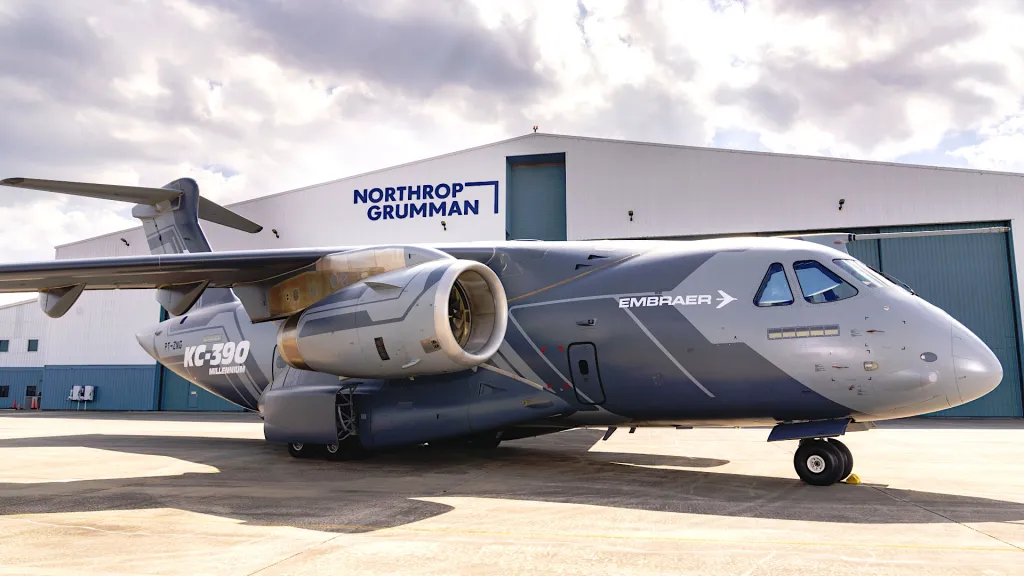
Newly teamed-up Northrop Grumman and Embraer are hoping that a boom refueling system-equipped version of the latter’s KC-390 Millennium twin jet engine tanker-transport will catch the eye of the U.S. Air Force. The two companies say the KC-390’s size and other attributes make it ideally suited to kinds of ‘agile’ distributed operations the Air Force sees as essential for success in future conflict, especially one in the Pacific against China. This is exactly the case TWZ laid out in detail when the concept for a version of this aircraft fitted with a boom first emerged four years ago.
TWZ‘s Jamie Hunter spoke with representatives from Northrop Grumman and Embraer about current plans for the boom-equipped KC-390 on the show floor at the Air & Space Forces Association’s (AFA) annual Warfare Symposium. The two firms first announced their new partnership on this aircraft last week. Embraer had originally unveiled this version of the KC-390 together with L3Harris, but the latter was no longer involved in the project, at least at a high level, by October 2024.
A KC-390 seen at Northrop Grumman’s facility in Melbourne, Florida, last week for an event. Northrop Grumman
“We are excited to announce the partnership to get started on the development of this capability, because we believe it’s a significant advantage to our U.S. Air Force, as well as our international allies,” Craig Woolston, Vice President and General Manager of Research and Advanced Design within Northrop Grumman’s Aeronautics Systems sector, said at the Warfare Symposium. “Partnering our advanced manufacturing and experience in the past in this domain with a proven design, modern capability, we think is a differentiator in this mobility space.”
“With the KC-390, the boom is adding a capability to the refueling capability that is already there with the probe-and-drogue system,” Frederico Lemos, Chief Commercial Officer for Defense and Security International Business at Embraer, also said. “So, adding that capability, and the target is to maintain the multi-mission capability, to bring the KC-390 even more … Agile Combat Employment type of capability, [and be] able to perform all of these missions in a distributed, dispersed operation type of employment.”
Lemos also said his company is committed to investing in a U.S. production facility for the KC-390, but said those plans, including the choice of location, are still to be finalized. Melbourne, Florida, has been raised as one possibility. Embraer and Northrop Grumman both have facilities already, and they held an event there last week to unveil their partnership.
Agile Combat Employment (ACE) is the term the U.S. Air Force currently uses to describe a set of concepts for distributed and disaggregated operations. ACE is focused heavily on short notice and otherwise irregular deployments, often to remote, austere, or otherwise non-traditional locales. We will come back to this later on.
Visualizing ACE
Development of the Millennium dates back to the early 2000s, originally just as a medium-sized jet-powered transport aircraft called the C-390 capable of operating from short and improvised runways. The ability to refuel receivers via the probe-and-drogue method was subsequently added to the design, resulting in its current “KC” designation. The aircraft can itself be refueled using this method via a probe that extends out from the front end of the fuselage above the cockpit. The KC-390 is loosely comparable in size and other respects to the turboprop-powered C-130 Hercules.
Further KC-390 versions configured for maritime patrol, electronic warfare, and intelligence, surveillance, and reconnaissance (ISR) missions are also now in development. Millennium variants are in service today in Brazil, Portugal, and Hungary, with a number of other countries set to begin operating the aircraft in the coming years.
Embraer | C-390 Millennium: Innovation, Performance and Reliability
The U.S. Air Force’s preferred aerial refueling method is the boom, and it is used by the vast majority of its aircraft. L3Harris had previously talked about several options for integrating a boom onto the KC-390, including ones involving remote operation, broadly akin to what is found on the KC-46, or more direct operator control, as is the case on the KC-135. On KC-390s currently configured for probe-and-drogue refueling, an operator manages those systems from a station in the cockpit.
“We’re starting that development. We’re exploring the trade space of what is the best solution,” Northrop Grumman’s Woolston said when asked for more details about the boom integration plan. “I’ll say those decisions haven’t been made. Like I said, it’s a trade space to explore.”
Woolston did highlight a particular focus on “autonomous boom” capabilities to help “rapidly integrate with whatever aircraft or system we’re refueling,” but didn’t elaborate further. This may refer to more automated boom capabilities, which Boeing and Airbus have also developed, which can help speed up the refueling process, increase safety margins, and reduce operator strain. The future development and fielding of new aerial refueling-capable air combat drones will also benefit from, if not require, these kinds of capabilities.
Boeing KC-46A Tanker Refuels Military Aircraft Using 3D
Airbus achieves world’s first fully automatic refuelling contacts
“You know the [KC-]390 is a full fly-by-wire airplane, low-workload for the crew,” Embraer’s Lemos noted. “We already have a third position in the cockpit that is there, has access to all the information that comes in and out of the airplane. Helps today with their refueling missions, monitoring the cameras … , good situational awareness of what’s happening.”
Overall, the boom integration depends “on what multi-mission capabilities we want to retain on the KC-390,” according to Woolston.
“We already have additional tanks on the [KC-]390. They are roll-on, roll-out. They are the same size as a pallet, standard 463 pallet,” Lemos added. “So you can combine additional tanks with cargo and with passengers. That’s a big advantage in terms of flexibility, in terms of employment. And you can use the fuel of [sic] those tanks to fly further or to offload the fuel for a receiver. So the moment you connect those tanks to the airplane, it’s an integral fuel system, you can use that fuel the best way you see fit.”
Lemos also stressed that retaining the KC-390’s existing capabilities in the boom-equipped version means the aircraft will still be able to operate from short and/or unimproved runways.
All of this underscores how a version of the KC-390 with a boom could fit into an ACE scenario just like TWZ previously explored in-depth. As we wrote back in 2022:
“Overall, a KC-390 would provide a significantly smaller footprint than that of a traditional boom-equipped tanker, allowing it to work out of tighter airfields. L3Harris says that the boom-equipped KC-390 itself will still be capable of receiving fuel in flight. However, the model at the Air & Space Force Association Conference shows that it will have a boom receptacle above the cockpit instead the standard type’s refueling probe. Paired with its own refueling boom and the ability to carry out ground refueling operations for other aircraft, the KC-390 will be able to provide ACE deployments with a critical fuel lifeline, not just in the air, but also on the ground, and do so at significantly extended ranges.”
“With its own aerial refueling capability, an Air Force KC-390 could fly out to refuel from a larger tanker, such as a KC-46, and then return that fuel to austere airfields to be used by combat aircraft. Currently, only the service’s special operations-configured M/HC-130s can do that and they do not have a boom of their own so they cannot also provide fuel to Air Force receptacle-equipped aircraft, which accounts for nearly all of the force’s fleet. Basically, the KC-390 could allow for true ‘hub and spoke’ tanker operations, including from austere areas, during a major conflict. This could be especially attractive for refueling tactical aircraft, like fighters and eventually drones, from forward locales. Once again, currently, the Air Force doesn’t have a solution for this problem, which could make the KC-390 very attractive.”
“There are also the multi-role capabilities this aircraft provides, being able to move cargo and personnel to far-flung locations at jet speeds. Once again, this would support a hub-and-spoke concept of operations across a vast theater like the Pacific.”
…
“As noted earlier, the ACE concept will become especially prevalent as the United States continues to keep a pulse on China and any corresponding developments in the Pacific. Considering the sheer size of the region, maintaining the flexibility to disperse aircraft and other assets in less condensed groups will not only ensure widespread U.S. presence, but also prevent adversaries like China from targeting and taking out large amounts of aircraft and other capabilities by attacking just a handful of installations. It also greatly complicates the enemy’s own defensive strategy.”
Another rendering of a boom-equipped KC-390. Embraer
As an additional point, in the scenarios described above, KC-390s could refuel fighters right after takeoff from austere airstrips. Those tactical jets could, in turn, launch with lower gross weights to help get safely airborne from shorter runways. Part of the initial fuel load could also be traded for more munitions while retaining sufficiently low weight. Topping off after takeoff, as well as being able to refuel closer to a forward operating location on the way back from a mission, would give those fighters greater overall operational reach.
The KC-390’s capabilities could be further expanded by the use of podded and/or roll-on/roll-off communications, electronic warfare, and other capabilities. The U.S. Air Force’s Air Mobility Command (AMC) is already heavily investing in new networking and self-protection systems that can be added to tankers and airlifters, as necessary.
Beyond supporting the ACE construct, KC-390s could just help provide the Air Force with valuable added tanker capacity in general, including to help meet day-to-day training and other non-combat requirements. AMC has previously raised the possibility of acquiring a business jet-based tanker, which could also act as a similar gap-filler. U.S. military officials have been sounding the alarm for years now about the strain on existing tanker fleets and raising concerns about their capacity to meet even existing demands, let alone what would be required for a major sustained conflict.
A KC-135, at right, prepares to link up with a KC-46, at left, during a test. USAF
For some time now, the Air Force has been working to refine requirements for what it is currently calling the Next-Generation Air Refueling System (NGAS). The NGAS plan could include new stealth tankers, as well as other types of aircraft and new capabilities for existing types. The service has said in the past that it hopes to see elements of NGAS begin to enter operational service by 2040, if not much sooner.
One concept for a stealth tanker that Lockheed Martin’s famed Skunk Works advanced projects division has presented in recent years. Lockheed Martin Skunk Works
“I cannot have a 90-year-old tanker refueling a B-21 [Raider stealth bomber],” Lt. Gen. Rebecca Sonkiss, head of AMC, separately told TWZ and other outlets at a roundtable yesterday on the sidelines of the AFA Warfare Symposium. “If you do math, as we reach end of programs for things, that’s reality, right? I cannot have that. I must recap[italize] the tanker force.”
“There is also an element of that, that is the NGAS portion of it, which is a more specific problem set within the theater to be able to ensure that we deliver lethality, effectively and survivably,” she continued, noting that the Air Force is also looking to acquire additional KC-46s.
“They’ve put some money in to maintain that NGAS AOA [analysis of alternatives], and they’re working through [it] right now,” Sonkiss added. “I don’t think they’ve solidified the final pathway to NGAS, and I really don’t want to comment on the half work on that space.”
An analysis of alternatives is a process that the U.S. military uses to assess available options and further refine requirements for further weapon systems and other capabilities.
Another Skunk Works stealth tanker concept. Lockheed Martin Skunk Works
“Of course, we’re open to a family [of] systems,” Lt. Gen. Sonkiss also said. “It has to fit in with the greater Air Force scheme maneuver of what do those platforms need? And then we make the NGAS platform get after that portion.”
“How far do they need to get into the threat ring?” she added, noting that there could be various avenues to providing more protection for aircraft operating in more contested environments. “And that’s what that NGAS piece is going to work through.”
It should be made clear here that there is no expectation that a boom-equipped KC-390 would be a single ‘silver bullet’ solution to the NGAS question. Aviation Week reported last week that Northrop Grumman is presenting it as just one part of a three-tiered proposal for NGAS that also includes a larger blended wing body design and a smaller tanker drone. Northrop Grumman has so far declined to confirm or deny that it is making this multi-part pitch. The company is already partnered with JetZero on a project to build a blended wing body demonstrator for the Air Force that could be configured as a tanker and/or a cargo aircraft, which you can read more about here.
A rendering of JetZero’s blended wing body design configured as an aerial refueling tanker. JetZero
“The reaction we’ve gotten here at AFA has been very positive,” Northrop Grumman’s Woolston told us when asked about current Air Force interest in the boom-equipped KC-390, specifically.
“We are now starting to have that dialog,” he also said when asked about whether there had been any formal meetings with representatives from AMC or other Air Force officials.
“I haven’t really looked at that,” Secretary of the Air Force Troy Meink had told TWZ and other outlets in response to a direct question about whether the KC-390 might have a future in his service’s tanker plans at another roundtable yesterday at the AFA Warfare Symposium.
A boom-equipped KC-390 could also be of interest to non-U.S. air arms that operate aircraft with the ability to refuel via this method. Aircraft built, at least in part, in the United States by an American firm could also open doors to acquiring them through a U.S. government foreign assistance mechanism.
Overall, it remains to be seen how the new partnership between Northrop Grumman and Embraer proceeds now, as well as how the Air Force’s vision for NGAS evolves. Still, as TWZ explored in detail four years ago, a new ‘agile tanker’ like boom-equipped KC-390 would seem to slot right into the operational scenarios the Air Force is now planning around, especially when it comes to a future conflict in the Pacific.
PHOENIX — There are expectations surrounding new Dodgers right fielder Kyle Tucker — not surprising for someone with a four-year, $240-million contract.
But first things first.
“Last year I got one hit in spring [training], so hopefully I get more than that,” Tucker said, sharing a laugh with reporters after grounding out and walking in two plate appearances in his Cactus League debut on Sunday. “So, that’s the goal. But I mean, [I’m] just feeling comfortable.”
In a clubhouse full of superstar players, the feeling seems mutual with his teammates.
“I’m glad he’s with us,” Dodgers catcher Will Smith said, adding: “Yeah, There might be other superstars on this team, but it’s not really anyone’s focus here. It’s all about getting in every day, working hard, helping us win a ballgame that day and working toward the ultimate goal of winning the World Series.”
It was a tale of two seasons for the 29-year-old Tucker in 2025.
Through the first three months of the year, Tucker had the Chicago Cubs’ offense humming, powering the club to a 53-35 start. Entering July, Tucker was batting .291 with a .395 on-base percentage, .931 OPS, 17 home runs, 52 RBIs and 20 stolen bases. Tucker found himself in the middle of the National League MVP discussion as the Cubs sat in first place in the NL Central.
But from July 1 through the end of the season, he batted just .225, posting a .690 OPS, five home runs and 21 RBI, a far cry from his first half that earned him a start in right field in the All-Star Game.
It was later revealed that Tucker sustained a hairline fracture in June, which he played through. In September, he suffered a calf strain, landing him on the injured list.
He finished the season with a .266 batting average and 22 home runs, career lows for him. That did not deter the Dodgers, and it was an easy sell for Tucker as well.
“Every organization is unique in its own sense,” Tucker said. “But this organization obviously the last couple of years has done pretty well, so I think that’s a huge part of the front office and them doing their part and trying to get a great group together. Just great people and great athletes, and then trying to just put the best product out on the field for the city of Los Angeles and the fans. I think they’ve done a pretty good job of that so far. Hopefully, we can keep winning for them.”
Despite what happened last season with Tucker, Dodgers manager Dave Roberts is confident in the newly-signed star.
“For me and the people that I talked to and how he goes about it, there’s nothing negative for me,” Roberts said last week. “I love guys that just come to work and love playing and competing. So, he just wants to win. He’s not a self-promoter; he’s not going to give [the media] a bunch of great soundbites. He wants to play to win, and I love guys like that. So, I’m excited to have him and get to know him even more.”
Tucker missed just under three weeks in the season’s final month. He would not return to the outfield in 2025, manning the designated-hitter spot for the Cubs, whose season ended at the hands of the Brewers in five games in the NL Division Series. Tucker says he felt good all offseason and is feeling even better in the early days of camp with his new team.
“It was a pretty healthy [offseason],” Tucker said. “At the beginning, I might have still been kind of nursing the calf a little bit. But it was kind of feeling pretty good right at the end. I think if we had moved onto the next series, I probably would have gone to the outfield, so I wish I could have gotten out there for that. Overall, in the offseason, I felt pretty healthy, and [feel pretty healthy] going into camp so far.”
Alex Vesia returns to the mound
Dodgers left-hander Alex Vesia made his Cactus League debut in Monday’s 3-0 win over the Seattle Mariners — the first time he’s pitched in a game of any kind since his newborn daughter died last fall.
Entering Monday’s game in the fifth inning to a loud ovation, Vesia struck out one and retired the side in order. He then received a warm greeting by his teammates in the dugout.
“Being around the guys, it’s really been comforting,” Vesia said. “These guys are my brothers, I truly love all of them. It’s meant a lot.”
Dodgers set starting pitchers for the week
Before Monday’s game, Roberts revealed starting pitchers for this week. Gavin Stone will take the mound Tuesday, Roki Sasaki will start Wednesday before Tyler Glasnow makes his first start of the Cactus League Thursday. Yoshinobu Yamamoto will start for the second time Friday, in what will likely be his final start before joining Team Japan for the World Baseball Classic.
Over the last two offseasons, the Dodgers spent a combined $141 million on relief pitchers Edwin Díaz and Tanner Scott, both of whom are expected to make their first spring training appearances later this week.
“I think Tanner and Edwin are going either Wednesday or Thursday in the Cactus League games,” Roberts said. “Those guys, we’ll start to see them this week.”