fish

Underwater memorial to wrecked slave ship draws pilgrims seeking to connect with their roots

Ruthie Browning dove into the calm, blue water off Key West, Fla., expecting to see “a big, old rock with stuff growing all over it.”

She was on a pilgrimage with other Black divers and community members, visiting sacred sites including one where a British slave ship — the Henrietta Marie — sank 326 years ago.

The vessel had delivered 200 enslaved people from West Africa to Jamaica and was heading back to Britain in 1700 — near the peak of the trans-Atlantic slave trade — when it was swallowed up in the churning waters of New Ground Reef where the Atlantic Ocean meets the Gulf of Mexico.

A concrete marker at the site memorializes the people on that ship.

As Browning and her group prepared to dive in early May, the water was calm. The marker, 20 feet below, was visible from the glassy surface. “I thought I’d look at it, pay my respects and that’ll be that,” she said.

But something unexpected happened. Tears filled her eyes. She gently told herself: If you can be quiet, maybe they will speak.

Staring at the monument, which is now a small living reef covered in corals and sponges, she felt her ancestors’ words: “My daughter, we’re so glad you’re here.”

Overwhelmed, Browning lingered by the marker bearing the words: “Henrietta Marie. In memory and recognition of the courage, pain and suffering on enslaved African people. Speak her name and gently touch the souls of our ancestors.”

She felt submerged in gratitude.

“Without their stamina, their spirit and survival, I wouldn’t be here today. None of us would be here today,” she said.

Pilgrimages aren’t meant to be easy

For the pilgrims in Key West, the gathering was an act of devotion, a quest for connection with their roots and for spiritually nourishing generations to come. They had tried to dive to the marker last summer, but the water was too choppy.

“The ancestors were not smiling down on us then,” said Jay Haigler, master diving instructor with Underwater Adventure Seekers, the world’s oldest Black scuba diving club. “This year was different.”

Such a pilgrimage was never meant to be easy, said Michael Cottman, who has written two books about the Henrietta Marie and was part of the National Association of Black Scuba Divers that installed the marker in 1992.

Cottman believes the site contains “spiritual turbulence.”

“Even if it wasn’t carrying enslaved people, it embodies the oppression of our people,” he said.

The group organized an annual pilgrimage in the 1990s, but it didn’t continue. The latest trip was spurred by an underwater interview project proposed by Stanford University anthropologist Ayana Omilade Flewellen, who serves on the board of Diving With a Purpose, a Black scuba diving nonprofit dedicated to documenting slave shipwrecks.

The submerged interviews also helped her connect as a pilgrim, Flewellen said. “I felt a kind of tenderness in my heart.”

The spiritual experience helped her process a traumatic history rooted in death and suffering.

“It’s hard to attach your life with this history,” she said. “The only way I could do that was turn toward what the divers were experiencing on this pilgrimage. That’s where it all bloomed and blossomed.”

Ancient ritual at African refugee cemetery

The pilgrims also gathered on land. At Higgs Beach on the south side of Key West, they visited a memorial and burial ground for 297 African refugees who died in 1860 after being rescued by the U.S. Navy from three slave ships — Wildfire, William and Bogota. Over 1,400 refugees were housed by the government in a compound and provided food and medical care, said Corey Malcom, the Florida Keys History Center’s lead historian.

While many were sent back to Africa, hundreds died due to the horrific conditions on the ships, he said.

Largely forgotten for decades, the grave site was discovered by historians and geologists using ground-penetrating radar. In 2010, a large pit containing 100 more bodies was located at a community dog park across the street. The area is now fenced off, Malcom said.

On Saturday, pilgrims met at the cemetery and held an emotional libation ceremony, a sacred, ancient ritual rooted in Afro-Caribbean spiritual tradition. One by one, group members tearfully thanked their ancestors and poured white rum on the beach. The clear spirit is believed to act as a messenger, inviting ancestral souls for their blessings.

“To honor your ancestors and the road they’ve traveled is very, very important because we’re all connected,” said Addeliar Guy, one of the elders and an avid diver.

Underwater monument represents a living history

Joel Johnson trained for weeks for his first open-water dive at the Henrietta Marie site. Johnson, the president and CEO of the National Marine Sanctuary Foundation, said what surprised him as he approached the monument was the vibrancy surrounding it. Fish darted among the corals that swayed with the currents; shells rested on the sandy bottom.

Conservation and protecting these habitats also preserve the history below the waves, Johnson said.

“This was not a place of death, but a place of life,” he said. “I didn’t feel like I was grieving for my ancestors. I felt like I was in the stream of history, recognizing that I’m a part of that. It made me happy.”

While underwater, Michael Philip Davenport, president of Underwater Adventure Seekers, was inspired to create art showing ancestors emerging from the monument.

“Their spirituality is still in that space,” he said. “I was feeling their lives and their tragedy.”

Dr. Melody Garrett, an anesthesiologist, started training with Diving With a Purpose in 2011 and has gone on missions to find the Guerrero, a Spanish pirate ship that wrecked in 1827 while carrying 561 enslaved Africans.

“A pilgrimage like this is so important now more than ever because there is an effort to cover up, rewrite and change history,” she said. She cited the Trump administration’s moves to remove references to slavery and Black history at National Park Service sites and federal museums, labeling it as divisive “anti-American propaganda.”

For Garrett, seeing these pieces of history gives her a strong sense of identity as an American, as the nation prepares to celebrate its 250th birthday.

“Black people have been here since before this country’s inception, longer than many other people have,” she said. “This is our country.”

Exhibit displays shackles used in slave trade

Remnants of the Henrietta Marie’s wooden hull are embedded at the site under layers of sand. The shipwreck was discovered in 1972 by treasure hunter Mel Fisher, but it wasn’t until 1983 that hundreds of intact items were recovered. Only a few slave ships were found out of the 35,000 used to transport over 12 million enslaved Africans; most vessels were intentionally destroyed to hide the illicit trade.

The artifacts, which occupy an entire floor of the Mel Fisher Maritime Museum in Key West, include over 80 sets of iron shackles, many of them child-size.

When Kory Lamberts first walked over wooden planks in the exhibit, they unexpectedly creaked.

“It was visceral,” he said. “It took me to a place. It also tells me that these were young people — children. These are baby shackles. There’s no sugarcoating it. The truth really hits you.”

While in Key West, Lamberts — who runs a nonprofit to make aquatics more equitable — said he brought back fish from the Henrietta Marie site, which he imagines would have absorbed the DNA of the ancestors. The group ate that fish for dinner the night after the dives — like a sacrament.

“I don’t practice a faith, but isn’t this what people are doing every Sunday at church?” he asked. “I wasn’t just bonded with this site through the experience of being there, but at this molecular level with a full circle moment of connection with myself and my history.”

Bharath writes for the Associated Press.

Source link

I found a very weird ‘English breakfast’ on holiday – it came with battered fish

Chris Granet visited a cafe that is a cross between a British greasy spoon and an American diner, with friendly staff, and very busy with locals and foreigners alike

Fried Bacon? Check.

Sausage? Check.

Scrambled egg? Check.

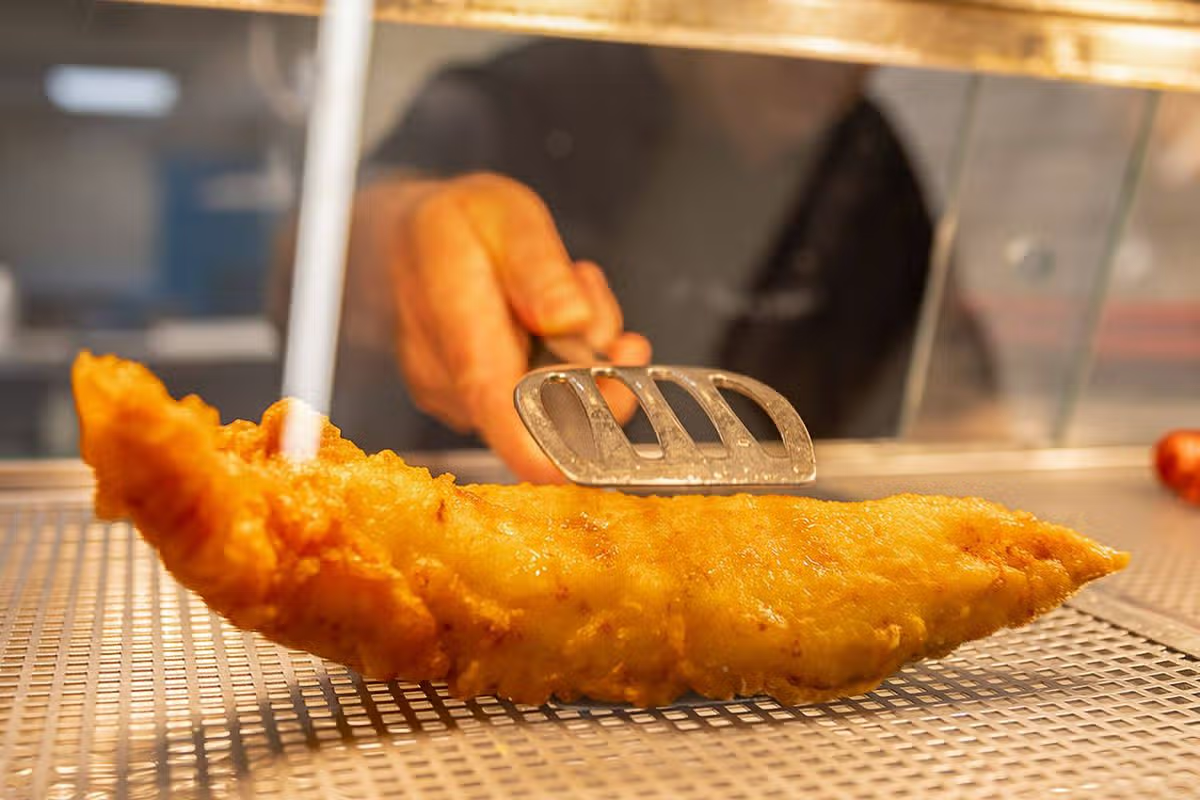
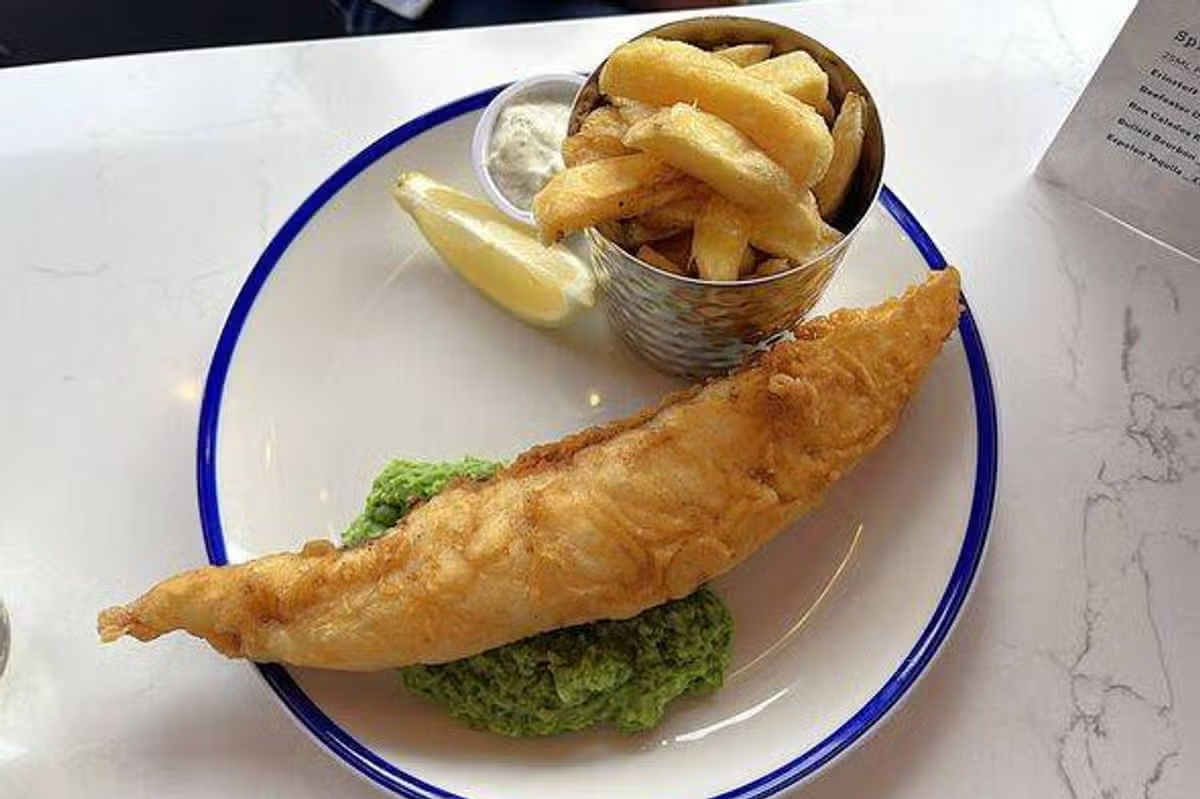
Fried fish in breadcrumbs? …Say what now??

I was in a cha chaan teng – a traditional Hong Kong cafe – in the bustling Wanchai district about to tuck into their version of the English breakfast, which had been introduced during the colonial era.

This cha chaan teng was the Victory A Cafe on the bustling Hennessy Road. It was like a cross between a British greasy spoon and an American diner, with friendly staff, and very busy with locals and foreigners alike. Always a good sign.

My plate was fully loaded and well presented when it arrived. As well as the aforementioned items, there were also baked beans, a smidge of salad and tomato, a glazed brioche bun, and garnished prettily with some nondescript diced green leaves. On the side, there was the obligatory milky tea.

READ MORE: Brit family walk through Tenerife airport at 7pm left baffled by what they find

Author avatarJulie Delahaye

In terms of taste, it was also “same, same but different”. The bacon was a bit fatty, the sausage a tad bland, but the beans were decent. The egg, on the other hand, was superior. Light and fluffy, yet rich and buttery – for in Hong Kong, they’re often made with cream and cornstarch.

And now for the fried fish. I know it sounds wrong, but it’s like when European folk are presented with an English breakfast for the first time and wince at the sight of sausage and bacon. That is, until they have a taste and are pleasantly surprised.

Well, that was me. It turned out to be my favorite thing on the plate, and was made all the better with a splash or a few of local chili sauce (far better than a bit of brown, if you ask me).

And the tea was no ordinary tea. It was made with “silk stockings”. Not real silk stockings, that’d be weird. No, these are narrow cotton bags through which potent Ceylon tea leaves are repeatedly strained, and more resemble granny tights than fancy stockings. The brew created is so strong it could strip paint, despite being half-drowned in condensed milk. Very good, though.

To cap it all off I had a “pineapple bun”. No pineapples are harmed in the making of these traditional local buns, it’s just that their mottled yellow toppings apparently resemble the tropical fruit (couldn’t see it myself).

I again was pleasantly surprised. Once biting through the crusty sugary top, the inside was soft and doughy with a much more subtle sweetness – an interesting combo of flavours and consistencies, and washed down well by the strong tea.

In total, my bill came to HK$85 (£8.50) – $62 for the breakfast, $23 for the pineapple bun. Not too bad considering it left me stuffed and not hungry again until dinner.

For all the ills of colonisation, there are some positives, and the Hong Kong breakfast is definitely one of them. Worth travelling 6,000 miles for.

BOOK IT

Cathay Pacific flies direct to Hong Kong from London, from £549 return. Book at cathaypacific.com Dorsett Wan Chai has doubles from £113 per night with breakfast. Dorsett Kai Tak has doubles from £115 per night with breakfast. Both hotels offer complimentary shuttle service to major transport hubs, shopping, and dining destinations. Find out more and book at dorsetthotels.com

Find out more at discoverhongkong.com

Source link

Can fish hook voters in India’s West Bengal elections? | Elections News

Waving a big Catla fish in his hands, Sharadwat Mukherjee went door to door canvassing for votes before Thursday’s election to the state legislature in the eastern Indian state of West Bengal.

Mukherjee is a candidate from Prime Minister Narendra Modi’s Bharatiya Janata Party (BJP), which rules nationally but has never come to power in the state, which has a greater population than Germany: more than 90 million people.

When he folds his hands to greet voters, the Catla just swings with a hook in its mouth. The big question: Can the fish also swing the election’s outcome?

Bengalis’ love for fish is legendary — on both sides of the border, in India and in Bangladesh. So much so that when a student-led uprising led to the ouster of then-Bangladesh Prime Minister Sheikh Hasina, some of the protesters who broke into her residence after she fled were seen raiding her refrigerator and walking away with fish.

But as West Bengal votes for its next government, fish has now leapt from kitchen slabs to the campaign trail, as leaders cosy up to voters in a variety of ways — and in some cases try to distance themselves from suspicions that their wins could hit the Bengali diet adversely.

Bengal election
Trinamool Congress (TMC) chairperson and chief minister of West Bengal state Mamata Banerjee, left, along with General-Secretary Abhishek Banerjee, gestures as they announce the party’s candidate list for the upcoming legislative assembly elections, in Kolkata on March 17, 2026 [Dibyangshu Sarkar/AFP]

What’s happening in the West Bengal election?

Nearly 68 million people in West Bengal are expected to vote for their candidate of choice on April 23 and 29, to elect 294 lawmakers to the state assembly.

The results will be declared on May 4 in the crucial state vote, which the Hindu majoritarian BJP has never governed.

A revision of the electoral list, which controversially swept away a total of 9.1 million names from the register before polling, and has been criticised for disenfranchising minorities, was among the major polling issues. Some 2.7 million people have challenged their expulsions.

Another is identity politics.

On the campaign trail, in rallies, and in interviews, the chief minister of Bengal, Mamata Banerjee, a firebrand, centrist regional leader — who has been sometimes touted as a contender for Modi’s job in New Delhi, if the opposition were to win — has doubled down on identity politics to corner the BJP, analysts say.

BJP-led governments in several states have imposed bans or restrictions on the sale of meat. Far-right mobs have carried out lynchings of Muslims in BJP-ruled states over accusations that they were transporting beef.

Banerjee, who is seeking a fourth consecutive term, has time and again warned that if the BJP were to come to power, they would “ban fish, meat, and even eggs” — effectively labelling them as outsiders, unaware of Bengali culture. The BJP has rejected these allegations.

Biswanath Chakraborty, a psephologist and political analyst in West Bengal who has authored several books on voting behaviour, told Al Jazeera that the whole issue surrounding fish had been “constructed by Mamata Banerjee.”

“For long, she has peddled that fish is parallel to Bengali politics,” he said. “In election campaigning, every issue is constructed, and Mamata is the champion of that.”

Chakraborty argued that by fiercely pushing back against these allegations, the BJP had ended up helping the governing party in Bengal make sure the debate over fish remained a campaign highlight with voters.

“They [the BJP] are entering, or rather trapped, into the discourse set by Mamata,” the analyst said.

Fish bengal
A fishing boat is anchored in the waters of the Bay of Bengal as fish are hung out to dry along the beach at Dublar Char in the Sundarbans, November 10, 2011 [Andrew Biraj/Reuters]

Why fish, though?

“Fish is very crucial in Bengal, very crucial,” said Utsa Ray, an assistant professor at Jadavpur University, in West Bengal’s capital Kolkata. She also authored a 2015 book on Bengal’s culinary evolution in colonial India, titled Culinary Culture in Colonial India: A Cosmopolitan Platter and the Middle-Class.

“First of all, due to Bengal’s geographical location itself – along the Bay of Bengal – [and as] a place situated near rivers and streams, fish have been the most available item,” she told Al Jazeera.

Fish has also been an integral part of many rituals in Bengal on auspicious days for both Hindus and Muslims, Ray said, adding, however, that there were sects of people in Bengal who refrain from eating fish.

A 2024 study found that nearly 65 percent of people in West Bengal consume fish weekly.

Against that backdrop, Ray told Al Jazeera that Banerjee’s party was looking to leverage “regional identity or the Bengali identity”.

Banojyotsna Lahiri, a social activist and voter in West Bengal, described the BJP’s response, with candidates like Mukherjee campaigning with fish, as a “gimmick”.

“In Bengal, [the BJP] have suddenly realised that they appear as aliens with their vegetarian posturing because both fish and meat are integral to the Bengal culinary choices, caste or religion notwithstanding,” she told Al Jazeera. ”

Fish bengal
A labourer wears a plastic sheet as it rains, while he carries Hilsa fish in a bamboo basket at a wholesale market in Diamond Harbour, in the Indian state of West Bengal, September 10, 2024 [Dibyangshu Sarkar/AFP]

What’s up with the BJP and food choices?

In the run-up to the voting on Thursday, the BJP rushed to find a senior leader who could eat a fish in front of the cameras. They finally managed to get Anurag Thakur, a member of parliament from Himachal Pradesh, to do that on Tuesday.

“Questions of what food people will eat, especially non-vegetarian [food], have been associated with the BJP’s politics to impose restrictions and dictate food options,” said Neelanjan Sircar, a senior visiting fellow at the think tank Centre for Policy Research, in Delhi.

The BJP has been dictating food choices in northern India’s Hindi-speaking belt, with its “hyper masculine, Hindutva, and vegetarianism,” said Ray. “There have been cases of lynching for eating non-vegetarian food.”

However, that falls flat in Benga.

Still, both Sircar and Ray agreed that the display of fish on the campaign trail was a novelty — even in the often-bizarre world of Indian politics.

“Creating these new images for the BJP is important,” said Sircar. “So, to create another image in voters’ minds leads to these outlandish displays.”

Source link

Gagosian’s ‘Frank Gehry’ exhibit showcases his rarely seen art

Most Angelenos know Frank Gehry as the rebel architect whose deconstructivist buildings reinvigorated L.A. amid its late-century identity crisis.

Fewer know him as the sentimental sculptor celebrated in Gagosian Beverly Hills’ upcoming “Frank Gehry” exhibition, the first to showcase Gehry’s work since his death in December. Curated by those who worked with and loved the famous architect, the show, scheduled to open May 14 and run through June 27, is equal parts tribute and art presentation. It will feature several of Gehry’s animal-themed sculptures, including a rarely seen stainless steel bear figure, on loan from the artist’s family.

The exhibition will also include the first public screening of Gehry’s entry in Gagosian Premieres, a series of videos by the gallery showcasing new art exhibitions through a mix of intimate artist interviews, studio visits and specialized musical performances.

By spotlighting Gehry’s artistic practice rather than his design ouevre — which includes Walt Disney Concert Hall, Guggenheim Museum Bilbao and Fondation Louis Vuitton — the exhibition reveals a different side of the late visionary, said Deborah McLeod, senior director at Gagosian Beverly Hills.

“I wouldn’t say it’s a retrospective, but it is a chance to stand in the room and be with him,” McLeod said, adding that she “wouldn’t have the hubris to say this is going to offer anybody closure,” but that she hopes it will help people — especially those who worked closest with Gehry — to process his loss.

“Everybody is kind of raw and missing Frank, and it’s just a chance to come together and do this again as his team,” she said.

McLeod curated the exhibition alongside Meaghan Lloyd, chief of staff and partner at Gehry Partners, whom the director said “really speaks for Frank.” Gehry‘s studio will design the show, which was realized in collaboration with the artist’s family.

Frank Gehry, Bear with Us, 2014, 316L stainless steel

“We didn’t get a chance to put one in the gallery proper. Every time we’d make one, it would get sold,” Deborah McLeod said about Frank Gehry’s bear sculptures.

(© Frank O. Gehry. Photo: Benjamin Lee Ritchie Handler / Courtesy Gogosian)

The highlight of the Gagosian exhibition is an artist proof of “Bear with Us” (2014), which the gallery lifted out of Gehry’s wife Berta Aguilera’s garden with a crane. Another edition of the bear sculpture is on view at the New Orleans Museum of Art, but at Gagosian, the work for the first time will be on view as part of an exhibition.

The stainless steel figure has a crumpled appearance that many believe is the result of Gehry balling up a piece of paper and seeing the bear in the crumple, although McLeod said Gehry told her himself that wasn’t true. The director added that the bear’s form gives the illusion of something “coming into being or dissolving.” The sculpture will likely have the Gagosian’s north gallery completely to itself.

“We’re really going to give him his due,” McLeod said. It was only right for a piece that, to her, reads as Gehry’s “self-portrait.”

A handful of other animal-themed sculptures will populate the south gallery, including a glowing black crocodile, gouache-painted papier-mâché snake lamps, and “Fish on Fire” (2023), the last of Gehry’s fish sculptures to be rendered in copper. Illuminated within the darkened gallery, the pieces will have a “magical” flair, McLeod said.

The first fish sculptures Gehry made in the ’80s were contained, even still. But when he returned to the fish form 30 years later, Mcleod said, “they started to become actually Baroque, so that’s kind of neat to see that evolution.”

Rounding out the exhibition are a series of ink, watercolor and acrylic works on paper that “express the energetic motion of fish in networks of black line and clouds of color,” a news release said.

A portion of the pieces in the exhibition will be available for purchase, with a detailed checklist to come.

Frank Gehry, Untitled (London I), 2013, Metal wire, ColorCore Formica, and silicone on wooden pedestal.

The first Frank Gehry Fish Lamps were exhibited in 1984 at Gagosian in Los Angeles.

(© Frank O. Gehry. Photo: Robert McKeever / Courtesy Gagosian)

Gehry’s designs breathed life into the city’s core, but he didn’t get to finish a number of his most exciting plans, including one to transform the 51-mile-long L.A. River.

And while his architecture was his great gift to his adoptive hometown — his art was his gift to himself.

“As one of the busiest architects in the world, imagine the math and the minutiae that you have to go through,” McLeod said, noting the enormous pressure from clients that Gehry must have felt in his daily practice.

“For him, just to make something the shape he wants to make it, plug it in … I know it was a huge relief for him,” she said. “I know how much he loved doing it, and I loved being a part of that part of his life.”

Source link