Minka Kelly and Dan Reynolds have ended their four-year relationship.
A source close to the couple confirmed the breakup, People first reported on Wednesday.
The “Friday Night Lights” actor and Imagine Dragons frontman first met in 2022 through a mutual friend — although their first month interacting was over phone calls as Kelly, 46, was in the U.K. for work and finishing her memoir, “Tell Me Everything,” which delved into her complex relationship with her mother.
Reynolds, 39, asked to read the book.
“You’ll either be terrified and run for the hills or you’ll see the beauty in all of it,” Kelly shared on “The Drew Barrymore Show” in November 2025. “He fortunately was the latter.”
The pair was first publicly spotted in November 2022 leaving Cafe Stella in Silver Lake; a month earlier, Reynolds announced his split from his wife, indie singer Aja Volkman, whom he married in 2011. His divorce from the Nico Vega vocalist was finalized in March 2024.
In July, Kelly shared an Instagram post of Reynolds featuring his four children (whom he shares with Volkman) at Disneyland, with the caption, “No place I’d rather be.”
In a 2024 interview with People, Reynolds shared that his kids had grown fond of Kelly.
“We view it as kind of bonuses to the family: more people to love, more people to help. We’ve just been really careful with that and slow with navigating how to bring Minka into that conversation,” he said. “She’s done a really incredible job of being sensitive and careful on her end as well.”
In 2025, Reynolds made a guest appearance on the first season of Netflix’s “Ransom Canyon,” which starred Kelly as Quinn O’Grady, a former concert pianist, opposite Josh Duhamel, who played rancher Staten Kirkland.
The show was canceled after two seasons this September.
ATLANTA — When Edwin Díaz envisioned his first season with the Dodgers, it looked nothing like this. He was going to stay healthy all year, pitch like an All-Star. He certainly was going to throw in more than 21 regular-season appearances.
A slew of injuries, with mechanical issues layered on top, had other plans. But everything resets in the postseason. And against the odds, the right-hander is back in the closer conversation.
“It means a lot,” Díaz said in a conversation with the Times Monday. “Because I was nowhere, basically this season. They gave me the last week and a half of the season to come and pitch. And I was ready every day.”
If he can keep pitching the way he has since returning from the IL in September, it’ll strengthen the Dodgers’ chances at a three-peat. They went into the postseason with a closer-by-committee approach. But manager Dave Roberts said before the Dodgers’ workout at Truist Park on Monday that they could get to a consistent closer by the end of the postseason.
“Certainly that last outing was as good as we’ve seen him throw, and it’s hard to imagine throwing any better,” Roberts said of Díaz’s perfect inning against the Atlanta Braves Sunday, which included three fastballs over 100 mph. “We built him up, regained the confidence in himself. So, I think that it’s certainly a viable option for [Tuesday] night. I feel very confident [with] him finishing a game.”
Though his first postseason outing for the Dodgers was in the sixth inning of Game 2 of the National League Division Series, Díaz has been mainly in high leverage in his playoff career — he owns a 2.19 ERA in nine postseason appearances. The former Mets closer even recorded a four-out save at Dodger Stadium in Game 2 of the 2024 National League Championship Series.
“I don’t try to think, ‘Oh, there’s many thousands of fans here,” he said. “Just me against the hitter, and I trust myself. And like I always tell myself, ‘You are a warrior, you are you are the best, and go and compete.’”
The Dodgers’ closer situation has been in flux all year. They had signed Díaz to a three-year, $69 million contract with that role in mind. And even when he missed three months for arthroscopic surgery to remove loose bodies from his elbow, and lefty Tanner Scott took over in the ninth inning, the spot was open for Díaz when he returned.
That was not the case after his second IL stint. And it was during that month-long road back that he finally re-found himself on the mound.
“I was like this maybe in the [World Baseball Classic] and first couple games early in the year before I got hurt,” Diaz said. “But now I feel way better than everything. So I think this is the best I ever felt this year.”
The process started with treating his neck. Díaz was feeling tightness around the front side of his right trapezius muscle, which could have contributed to Díaz dropping his arm angle. He received medication and needling therapy to address the issue, he said.
Trainers used manual manipulation to find Diaz’ ideal arm slot and build muscle memory, and he was quickly cleared to resume throwing.
“I’ve been doing that for so long, I just lost it for a little,” Díaz said of his arm angle. “And we’ve got a really good group of coaches right here, and they found it right away.”
Díaz began a rehab assignment with Triple-A Oklahoma City in early September. But it wasn’t smooth sailing. In his fourth outing, Díaz issued three walks and surrendered five runs in just two-thirds of an inning.
“I got mad at myself because I knew I was better than that,” Díaz said. “I wasn’t able to control my fastball. So after that game, I talked to the pitching coaches in Triple-A to say, ‘We need to find something because I want to be back in the big-leagues, I want to help this team to win.’”
They dug into Díaz’ biomechanics and found that his hip position was different from last year. When he’s right, Díaz explained, his leg lift starts with his hip. But he’d begun to rush the move, which caused his arm to lag behind.
He threw a bullpen with the adjustment and then took it into one final rehab appearance, a one-hit outing.
“I told the team, ‘I’m ready to go,’” Díaz said.
He sure was. Díaz posted a spotless ERA in six games down the stretch, limiting opponents to one hit combined. And that success carried into his Dodgers postseason debut.
“He’s put himself in a position to be the closer,” Roberts said. “And in October, I don’t pay too much attention to the long sample of a season in a lot of cases because in October things happen quickly, and you’ve got to be willing to read and react.”
For Díaz, the season may not have gone as planned, but his vision of the next few weeks is as clear as ever. He wants to record the final out of the World Series.
“I know how to control my emotions,” he said. “I learned that during my career, and I’m pretty good at that. I just can’t wait to be in that position, and if I’m in there, I will give my 100%.”
Dodgers right fielder Kyle Tucker has never shied away from just how bad his performance at the plate was for much of his first season in Los Angeles.
For the first five months of the season, when he’d show brief glimpses of progress before sinking back into an extended slump, Tucker’s .683 OPS was the third-worst among Dodgers hitters with at least 100 plate appearances, better than only Hyeseong Kim and Kyle Freeland, who both spent time in triple A.
In September, however, he found a sustainable adjustment. He fixed his bat path, extending through the ball more consistently instead of pulling off of it. He posted a .889 OPS in September, on par with his four straight All-Star seasons before signing with the Dodgers.
Now, all of a sudden, he looks like a potential difference-maker in the postseason.
“The last month or so is more or less what I expect out of myself,” Tucker said in a recent conversation with The Times. “The biggest thing is we have an opportunity now being in the playoffs to win another World Series. Once the playoffs start, you can forget about any stats or personal numbers. The only one that really matters is the win column. So that’s just what I’m gonna try and contribute towards.”
The Dodgers offense had a lot of success stories like Tucker’s in the final month of the regular season. He helped carry the offense, along with Teoscar Hernández and Mookie Betts, who turned around their seasons down the stretch, and Will Smith, who returned from the IL and quickly found his home run swing.
The Dodgers’ starting rotation is their biggest strength going into the postseason. But the offense’s performance against elite pitching, and the bullpen’s execution in tight games, could make or break a series.
Here’s how some other key players are trending going into the postseason:
Designated hitter Shohei Ohtani: Fortunate to have the bye
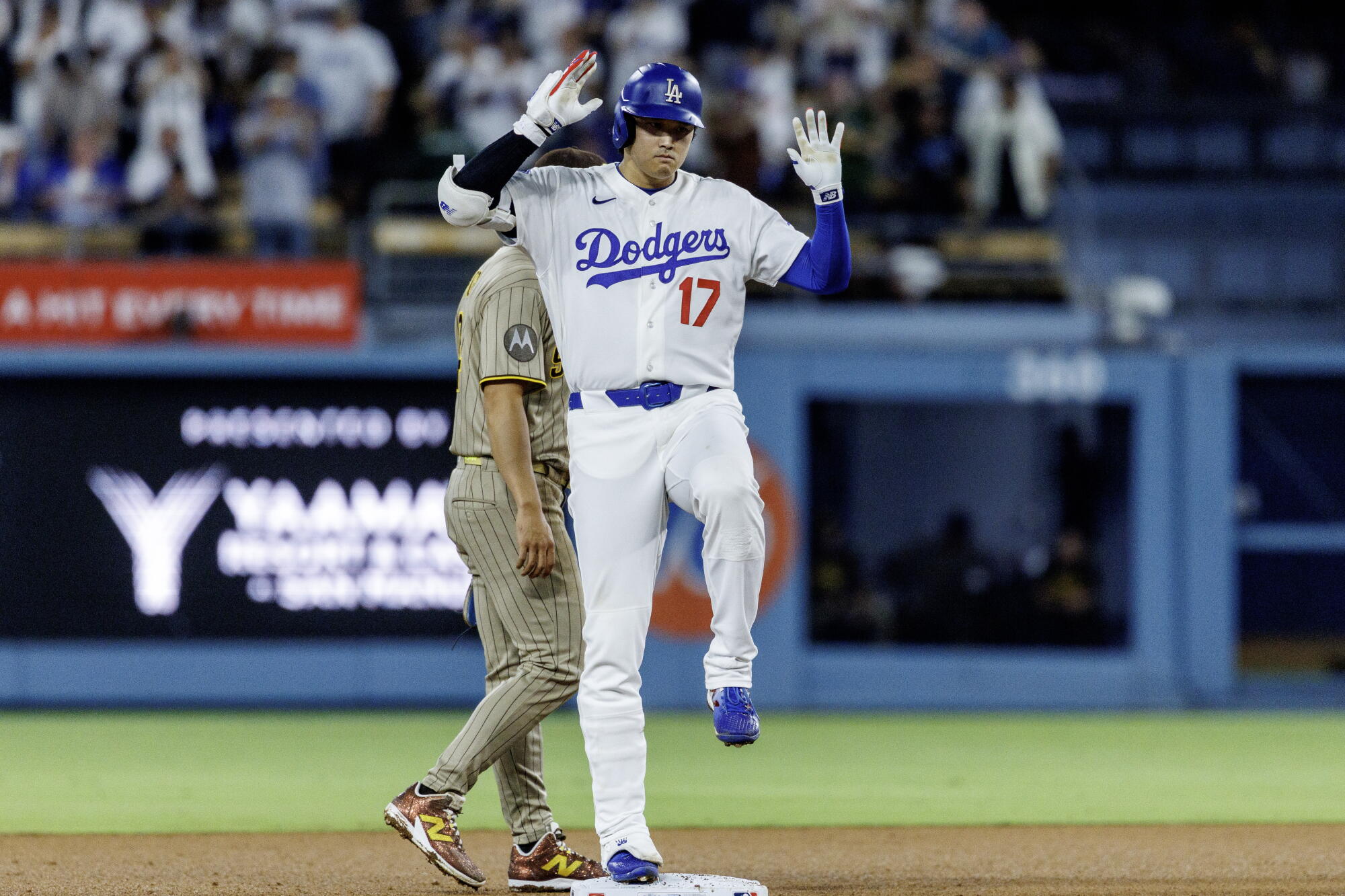
Shohei Ohtani appears on the right track for a successful postseason.
(Gina Ferazzi / Los Angeles Times)
Ohtani returned from the IL with five games left in the season, and he went five for 21 with one extra-base hit.
All indications from general manager Brandon Gomes and manager Dave Roberts in video conference calls before the Dodgers’ closed workout Tuesday were that Ohtani was feeling good physically.
“I feel confident that you’re going to see the best version of Shohei of the last two months,” Roberts said. “I know that’s sort of a low bar given his injury, but I do think that he’s as healthy as he’s been in quite some time, and every day from the training staff, it keeps getting better. So, number one, he’ll be a threat being in the lineup, but I do think that the performance piece will be what we’re hoping for.”
First baseman Freddie Freeman: Ice cold
Freddie Freeman did not hit well in September.
(Ronaldo Bolaños / Los Angeles Times)
Freeman, who pushed through a bout with tendinitis in his right knee earlier this month, hit just .184 in September and went 0-for-7 in his last two games.
On Tuesday, Freeman said he had no pain in his knee. But finally acknowledged that the injury could have affected his swing mechanics, while again emphasizing that he wouldn’t use that as an excuse.
Freeman has a plan for the bye week that he hopes will set him in the right direction for the playoffs.
“I’m going to hit on the field every day,” he said Sunday. “I already know how my Tuesday is going to go. There’s going to be a lot of blocked balls to left [field], a lot of flares into left. I’m hoping as Tuesday goes Wednesday, I’ll come back and those will be put down a little more. Thursday they’ll be moved over to shortstop and by Friday I will be feeling good. That is how my head is thinking right now.”
Center fielder Andy Pages: Out of the gate running
It was hard to predict how the center fielder would look at the plate when he returned from a fracture in his left hand. He recorded a 1.181 OPS in six games and homered twice in the final regular-season series against the San Francisco Giants.
“He went into last October really scuffling, and it sort of bled into October,” Roberts said over the weekend. “Where, I think right now he feels really confident, swinging the bat well, and the hope is that this one bleeds into October as well.”
Reliever Edgardo Henriquez: Healthy
Henriquez is “trending really well” after throwing live batting practice, Gomes said. If this week continues to go smoothly, the flame-throwing right-hander is expected to be on the NLDS roster.
“Given the body of work, what he’s done, the unique skill set,” Roberts said, “could be huge for us — will be huge for us.”
Reliever Edwin Díaz: Strong finish
Díaz made five appearances after his latest return from the IL (neck). He gave up just one hit in those games, with a 52.9% strikeout rate.
“I don’t know if we could have asked much more out of Edwin,” Gomes said. “Felt like each outing was more and more sharp and looking more like himself. So feel that he’s in a great place right now. Stuff out of hand is as good as it’s been all year. And we know that he has pitched in the hottest of hot games in the past and in any role, especially in the postseason. So he’s looked great, and glad that he’s in the position that he’s in and was able to bounce back after the IL stint.”
NLDS weather: Sweltering
Los Angeles’ weather forecast for this weekend, when the Dodgers are set to host the first two games of the NLDS, shows temperatures reaching the high 90s. The Dodgers are scheduled to play Game 2 at 5 p.m. on Sunday. But Saturday’s game time will depend on the results of the wild-card round. First pitch for Game 1 could be at 1 p.m. or 6 p.m.