firing

Russian Mi-28 Attack Helicopters Are Now Firing Cruise Missiles

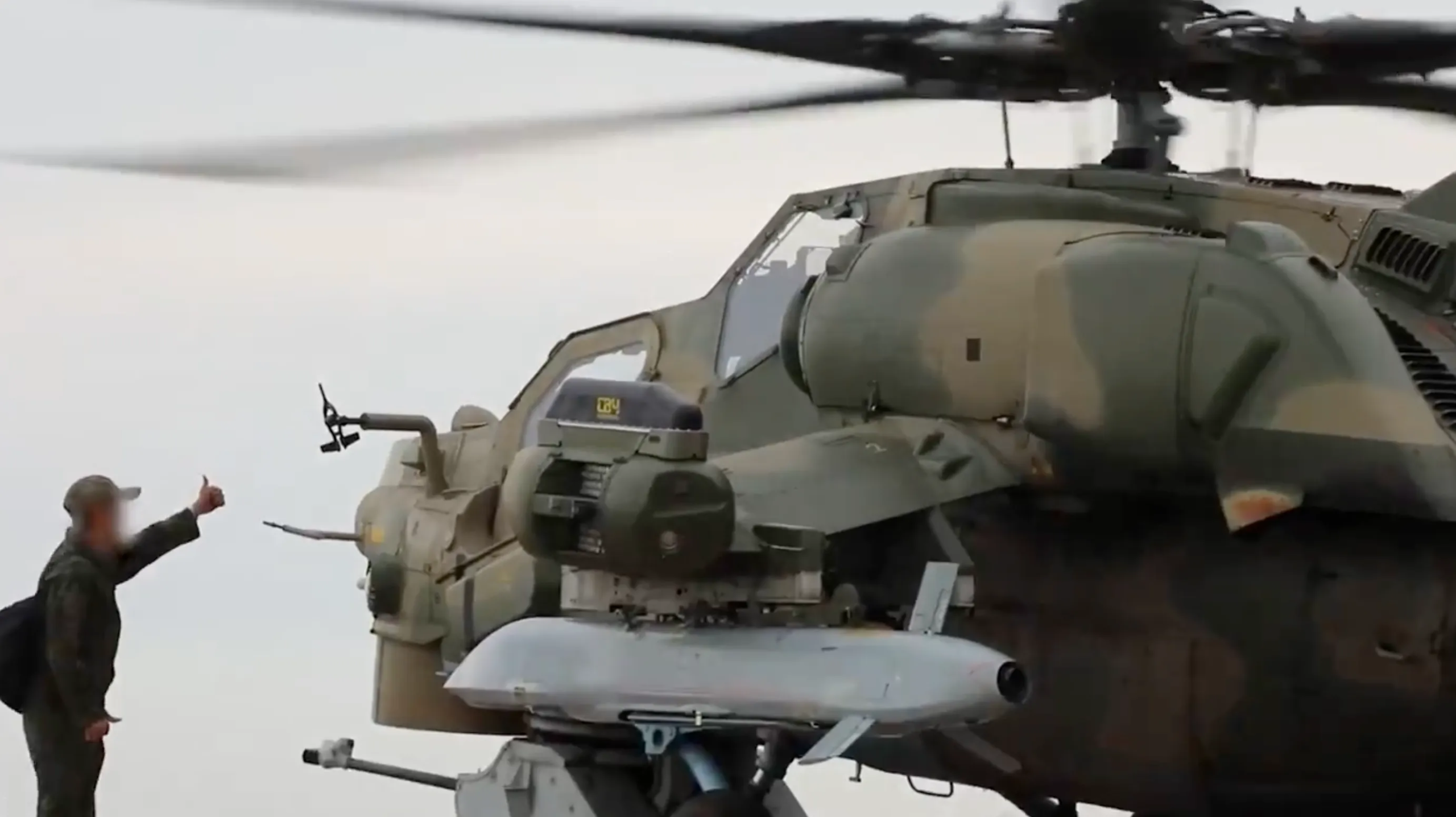
Russia’s Defense Ministry has released footage showing a Mi-28NM Havoc attack helicopter firing a small, low-cost cruise missile, supposedly during combat operations in Ukraine. The video provides the clearest official indication yet that Russia is exploring a non-traditional, new launch platform for its emerging family of relatively inexpensive standoff weapons.

One missile is seen being fired from a pylon beneath the helicopter’s left-side stub wing; the helicopter returns after the mission with an unfired missile still hanging under the right-side stub wing. The Defense Ministry has not provided a date, precise location, or details about the target. Nor has it identified the weapon, which could be either the S8000 Banderol or the Dan-T, two closely related and visually very similar Russian missile developments.

❗️🇷🇺Russians published footage of the launch of the loitering munition “Banderol” (“Dan-T”) from the attack helicopter Mi-28NM. pic.twitter.com/rDQskSRmim

— 🪖MilitaryNewsUA🇺🇦 (@front_ukrainian) November 6, 2026

A close-up of the Mi-28NM and the missile seen below the left-side stub wing. Russian Ministry of Defense/screencap

The footage is not entirely unexpected. Earlier this year, photographs began circulating showing a Mi-28NM on the ground, carrying what appeared to be the same missile. There had also been unconfirmed reports from Ukraine in August that Russia was using the helicopter as a launch platform for Banderol, including firing the weapons from over the Sea of Azov against targets around Odesa.

The Banderol, developed by Russia’s Kronstadt company, was first detailed by Ukrainian military intelligence (GUR) in the spring of 2025. According to GUR, the missile is approximately 16.4 feet long, has pop-out wings, and is powered by a small turbojet engine. It reportedly flies at around 310 miles per hour, has a range of up to 310 miles, and carries a warhead weighing approximately 110 pounds.

GUR’s analysis also provided a detailed rundown of the foreign components it identified in the weapon. Its production involves “around 30 companies” supplying “more than 20 key components,” with potentially additional parts that have yet to be identified. Among the components reportedly used are a small commercial Chinese SW800Pro turbojet and a Russian-made Kometa digital antenna for satellite navigation. The weapon also makes extensive use of components sourced from foreign manufacturers, including in the United States.

An infographic prepared by Ukraine showing the Banderol missile and some of its foreign-sourced components. GUR photo

The other possible candidate is the Dan-T, apparently derived from the Dan-M target drone, but with a roughly 300-pound warhead added. It is also reported to have a range of around 310 miles, while costing approximately 35 percent less than the Banderol.

The Banderol first emerged publicly through Ukrainian intelligence reporting, but Moscow eventually began acknowledging the weapon. Russian state television showed it beneath the wing of a Kronstadt Orion drone in July 2026, when it was first officially presented, albeit heavily obscured.

Ukrainian reporting indicates that the weapon has already seen operational use. Between mid-May and mid-July, the Ukrainian Air Force recorded 16 strikes involving Banderol. It reported five launches in a single barrage on July 16.

There are also indications that the Dan-T could ultimately become the more widely procured weapon. Reports from Ukraine suggest that Russia’s Aerospace Forces may have decided to focus procurement on the Dan-T, with plans to acquire tens of thousands of the missiles. Unlike the Banderol, the Dan-T is also reportedly intended for launch from combat aircraft and ground-based launchers. In September, Russia was already pitching the weapon for export at the El Alamein International Airshow in Egypt.

Dan-T displayed at the El Alamein International Airshow in Egypt. Rostec

The use of a helicopter to launch a weapon of this type is particularly unusual. A relatively slow- and low-flying platform like the Mi-28 would be much more vulnerable to enemy air defenses than a fixed-wing tactical aircraft. However, the reported range of the Banderol and Dan-T would allow the helicopter to launch well away from the intended target, potentially from across the border while remaining in Russian airspace. For comparison, the maximum range of the Kh-38 (or LMUR) missile — which is otherwise the farthest-reaching Mi-28 weapon — is a little over nine miles.

For many months now, Russia has been seeking to expand its arsenal of weapons capable of striking Ukrainian targets from standoff distances. Mounting losses of Russian tactical aircraft to Ukrainian ground-based air defenses have underscored the need for weapons that can hit targets precisely at and well behind the front lines without exposing expensive aircraft to excessive risk.

Most notably, Russia has fielded the UMPK, a fairly crude type of guided glide bomb that has caused considerable difficulties for Ukrainian air defenses since its introduction around early 2023. The UMPK series has since been followed by more refined winged precision-guided glide bombs.

An early UMPK glide bomb strapped on a Su-34 Fullback strike aircraft. Russian Ministry of Defense

However, these weapons are unpowered. The small turbojet engine fitted to the Banderol and Dan-T puts them in the cruise missile category, while their reported range of up to 310 miles is particularly significant, if accurate. That range comes at the expense of warhead size, especially when compared with larger Russian cruise missiles.

The weapons’ navigation and electronic warfare protection systems are also important considerations. An inertial navigation system, combined with a jamming-resistant satellite navigation system, should provide a degree of resilience against the kind of electronic warfare jamming that is increasingly being employed by Ukraine. Satellite navigation can also help correct for accumulated drift, an important consideration given the accuracy limitations of inertial navigation systems over longer distances.

Launch of the missile from the left-side stub wing. Russian Ministry of Defense/screencap

In essence, the Banderol and Dan-T offer Russia a lower-cost, potentially higher-volume complement to its more sophisticated cruise missiles.

As we noted previously:

“The Banderol is particularly relevant in the context of the economics of the Ukraine conflict. Russian forces have increasingly used combinations of relatively inexpensive one-way attack drones and more expensive cruise and ballistic missiles. The drones can be produced in large numbers and used to complicate air-defense operations, while the more capable missiles provide greater speed, range, payload, or penetration capability. A small turbojet-powered weapon such as Banderol offers another point on that spectrum.”

The ability to launch these weapons from non-traditional platforms, including drones, attack helicopters, and potentially ground-based systems, would also give Russia greater flexibility in how it employs them. Its bomber fleets and fixed-wing tactical aircraft could concentrate on their primary roles and make use of their established weapons, while other platforms take on some of the standoff strike mission.

Mi-28NM in flight with the missile seen below the right-side stub wing. Russian Ministry of Defense/screencap

For the Mi-28NM, meanwhile, the ability to employ a long-range cruise missile could provide a useful additional role, particularly after the helicopter fleet has suffered heavy losses during the war in Ukraine.

According to the Oryx open-source tracking group, Russia has lost 21 Mi-28s since launching its full-scale invasion of Ukraine four years ago. This figure could be higher because Oryx only tabulates losses it can confirm visually. Russia began the conflict with a force of around 110 Mi-28s of all versions. Other Russian battlefield helicopter types have suffered even heavier attrition, reflecting the level of danger that rotorcraft are exposed to when close to the front lines.

⚡️Video of the destruction of the Mi-28 of the 🇷🇺Russian Air Force using an 🇺🇦FPV drone. The first recorded case pic.twitter.com/LWosDeX2Ah

— 🪖MilitaryNewsUA🇺🇦 (@front_ukrainian) August 7, 2024

Russia is not alone in exploring this concept. The U.S. Marine Corps is working to give its AH-1Z Viper attack helicopters a new long-range strike capability through L3Harris’ modular Red Wolf launched-effects family. The weapon, which has already been test-fired from an AH-1Z, is being developed under the Marines’ Long Range Attack Missile (LRAM) effort, with a reported range in the low hundreds of miles. Beyond its kinetic strike role, Red Wolf can also be configured for missions such as communications relay and electronic warfare and has also been pitched for U.S. Army helicopters and tiltrotors. The effort reflects a broader push to give rotary-wing aircraft the ability to deliver precision effects well beyond the range of their traditional weapons, while raising questions about where the boundaries between cruise missiles, drones, and other launched effects are increasingly drawn.

In February 2025, NAVAIR released this image of a Red Wolf-armed AH-1Z, without identifying the weapon in question. U.S. Navy

For the Kremlin, the appeal of such weapons lies not only in their relatively low cost, but also in the ability to field them across a wider variety of platforms, further complicating Ukraine’s efforts to deal with incoming attacks.

Contact the author: thomas@thewarzone.com

Thomas Newdick is a staff writer at TWZ, where he covers military aviation, defense technology, weapons systems, and international security. Based in Berlin, Germany, he reports on conflicts, military modernization efforts, and emerging aerospace technologies around the world, with a particular interest in airpower and its role in contemporary warfare. His reporting is informed by deep expertise in modern and historical airpower, particularly in Europe, with a focus on military aviation, air campaigns, and aerospace developments across the continent and beyond.


Source link

Times of Troy: Firing a football coach midseason is usually a bad idea

Welcome back to the Times of Troy newsletter, where it’s beginning to feel like we’ve reached the point of no return for Lincoln Riley. USC’s 24-7 loss to Wisconsin on Saturday was objectively one of the worst of Riley’s tenure as a head coach.

That it came after a bye week only made it a more damning indictment of Riley and the culture he’s built at USC.

The reality is, another loss over USC’s next four games would eliminate the Trojans from College Football Playoff contention for the fifth straight season under Riley. And with three top-10 teams still on the schedule, it feels all but inevitable that USC will fall short of expectations once again this season, a half decade into Riley’s tenure as the Trojans coach.

Fight on! Are you a true Trojans fan?

Get our Times of Troy newsletter for USC insights, news and much more — exclusive to L.A. Times subscribers. Free Members receive a partial preview of each edition.

USC fans, safe to say, are fed up. Many of them, it seems, want Riley fired right now. But the Trojans are technically still in the race, even if they’re just barely limping along, and aside from the brief hit of dopamine and schadenfreude that such a swift firing might provide, cutting ties with a coach before the end of the season is almost always a dangerous idea. It makes even less sense, in this case, for USC — a school that should know by now how sideways a midseason move can go.

Each of the last three Trojan football coaches preceding Riley were fired midseason. And the ripple effects of those firings, you could argue, ended up setting USC back even further.

When USC fired Lane Kiffin in the middle of the night at LAX after a 3-2 start to the season, then-athletic director Pat Haden not only turned the Trojans into a national punchline, but also painted himself into a corner. Interim coach Ed Orgeron ended up turning the season around and earning the endorsement of USC’s entire locker room. (Which you can hear more about on this week’s new episode of House of Troy.) But Haden had no intention of hiring Orgeron, and the decision to move on ended up being a disaster, on multiple levels.

With Steve Sarkisian, Haden had no choice but to cut ties. But this time, he actually did end up hiring the interim coach, Clay Helton, after seeing how Helton had shepherded the program through a difficult season. And of course, that hire ended up being a huge failure.

I’ll never forget the chaos of USC’s 2021 season, after Helton was fired. Interim coach Donte Williams had no idea how to usher a team through a season. The locker room was in disarray. It all felt unfair to the players. The subsequent search did end up yielding Riley — a move that, at the time, looked like a major coup — but because USC was in such a desperate position, it had to offer Riley a huge deal that he couldn’t possibly refuse.

Firing Riley now would leave athletic director Jen Cohen in a similarly tough position, with months of speculation surrounding a high-pressure search. The players, as far as we know, are still behind Riley. Meanwhile, many of the coaches Cohen would probably consider in his stead will have their teams in the playoff hunt through December and even January. One need only look at what’s happened to Penn State to see how that could go awry.

There’s also the matter of Riley’s contract. If USC does fire him, it will be on the hook for his estimated $70-million buyout, plus whatever millions it would owe to the rest of his staff. But there is one way that the school could soften the blow of what would otherwise be a serious expenditure.

If Cohen makes a move, she could wait until the end of the season, when a full picture of the open coaching jobs has come into focus and Riley’s agent has had a chance to take a lay of the land. Maybe then a job would emerge that both Riley and the school agree would be a better fit.

In that case, USC could significantly offset the cost of Riley’s buyout, according to a person familiar with the situation but not authorized to speak on the matter. That would make the move much more palatable to the people already shelling out millions for a state-of-the-art facility, as well as a $40-million NIL budget.

The dots are easy to connect. The Baylor job already opened Sunday, and the school, according to On3, is looking for a coach with Texas roots. It’s possible, too, that the Texas Christian job opens up by the end of the year if Sonny Dykes, who has ties to Riley, can’t turn things around. Other jobs will surely open up that we’re not even anticipating.

Until a donor waving around a $70-million check starts making demands, it makes more sense to weather the next month with Riley, whatever it may hold. Maybe it won’t be as bad as you’re thinking.

But for the moment, it’s the rational thing to do.

LOS ANGELES, CALIFORNIA - JANUARY 15: Juju Watkins #12 of the USC Trojans looks on.

JuJu Watkins, pictured earlier this year, was back on court for USC on Sunday.

(Luke Hales / Getty Images)

—USC rushed for negative-17 yards against Wisconsin. Seriously. On the Trojans’ first carry Saturday, King Miller ran straight into a brick wall of the Badger defensive front. And it never really got better from there. Jayden Maiava lost 57 yards on five sacks, which made the rushing numbers look much worse. But it’s not like USC’s other rushers found any room. Miller had eight yards in 11 carries. Freshman Shahn Alston was the leading rusher with 28 yards. And Waymond Jordan, who had been USC’s No. 2, was conspicuously absent. We’ll find out more about that ahead of Saturday. But right now, USC’s rushing attack looks completely out of sorts.

—What was Lincoln Riley thinking on that 58-yard field goal attempt? Riley was asked about that fourth-quarter sequence, which began with a delay of game penalty that moved the Trojans out of field goal range. Riley said that USC was strangely called for the delay because it ran in a player later, then snapped the ball before the referee had given the OK, not after the clock had run out, like a usual delay. Nonetheless, after that, Riley should’ve punted on fourth and 17. Instead, he decided to send out kicker Caden Chittenden to attempt a career long … in the rain. “We knew points were at a premium at that point,” Riley explained. “We just felt like — obviously, a 58-yarder is never going to be crazy high percentages, but we needed points, and to punt it down there didn’t feel like it was the right choice at the time.” Well, they ended up making the wrong choice. Wisconsin scored on the ensuing drive and put the game away.

—USC’s offensive line might’ve been the game’s biggest disappointment. USC boasted some of the best pass protection in college football through the season’s first half, then completely collapsed against Wisconsin. Quarterback Maiava was affected throughout by the Badgers’ pressure. There was barely any room for the run game, either, as Wisconsin simply overpowered USC at the point of attack. Needless to say, not a great week to have written about how great the offensive line was looking!

—USC’s defense held Wisconsin to 58 passing yards. That’s the fewest the Trojans have given up in a game since holding Michigan to 32 in their Big Ten debut, and in an alternate timeline, it might’ve been seen as a big moment for USC’s secondary. But Badger quarterback Colton Joseph didn’t have an incompletion in the second half, completing his final 10 passes. The most critical of which came on fourth down, when Wisconsin went five wide, with four receivers bunched on one side. The subsequent screen went for a 16-yard touchdown, which was Joseph’s only pass of more than 10 yards all game. Turns out, it’s all he needed.

—Defensive tackle Jahkeem Stewart is still limited by an injured foot. The injury continues to linger, and Stewart continues to fight through it. At one point Saturday, he went to the locker room before returning to the game. There’s no questioning Stewart’s toughness, and clearly he’s capable of gutting it out through games. But it doesn’t appear that he’ll be fully healthy again this season without some serious time away from the field.

—USC’s women’s hoops gave a first glimpse of a potential title-winning team on Sunday. The Women of Troy took on Cal in an exhibition matchup that marked JuJu Watkins’ return in front of fans at Galen Center, and Watkins wasted no time making her presence felt, as she went to the hoop 14 seconds into the exhibition. The trio of Watkins, Jazzy Davidson and top freshman Saniyah Hall shot a combined 22 of 45 for 59 of USC’s 78 points. Still, USC barely snuck past Cal.

Notable quotable

“Gritty ain’t pretty. We played the harder football game, brought it to them, and they can’t really do nothing with us. It’s just two different types of football.”

—Former USC running back Bryan Jackson, who scored Saturday’s first touchdown for Wisconsin

Olympic sports spotlight

USC men’s water polo ripped off nine straight wins to start the season, then went 4-3 after that, with two losses to Stanford and one to UCLA, both of which sit just ahead of the Trojans in the national rankings.

The Trojans looked back on track in their final match of the season at home, rolling past Air Force, 21-8. And they still have road matchups against UCLA, Stanford and California that should tell us whether the Trojans are true contenders for a national title.

What I’m watching this week

Olivia Wilde, from left, Seth Rogen, Penélope Cruz and Edward Norton in "The Invite."

Olivia Wilde, from left, Seth Rogen, Penélope Cruz and Edward Norton in “The Invite.”

(A24 via Associated Press)

Some of the smartest movies are also the simplest. I kept thinking about that while watching “The Invite” recently. Directed by Olivia Wilde, the story takes place entirely in one couple’s apartment, during one evening spent with their upstairs neighbors.

It ended up being one of my favorite films of 2026 to date, with stellar performances from all the actors involved: Wilde, Seth Rogen, Ed Norton and, especially, Penélope Cruz. Maybe not the best flick to watch if you’re fighting with your significant other. But “The Invite” made me feel all sorts of feelings, which is generally what I’m looking for in a movie.

In case you missed it

Listen now: Podcast ‘House of Troy’ features inside look at highs, lows of USC Athletics

‘I’m disappointed.’ Lincoln Riley laments USC’s struggles in loss to Wisconsin

USC offensive line transforms into one of 6-1 Trojans’ biggest assets

Until next time …

That concludes today’s newsletter. If you have any feedback, ideas for improvement or things you’d like to see, email Ryan at ryan.kartje@latimes.com, and follow me on X at @Ryan_Kartje. To get this newsletter in your inbox, click here.

Source link