fine

Haphazard pesticide enforcement puts farmworkers in California at risk

In California’s Sacramento Valley, a grower was cited for multiple pesticide safety violations in a stone fruit orchard.

In the sweeping farmlands near the Central Coast, a seed supplier that cultivates peppers, vegetables and fruit was hit with more than two dozen pesticide safety violations, some of them serious offenses that caused health or environmental hazards.

And in the San Joaquin Valley, an agricultural retailer with a history of pesticide safety violations was cited for failing to provide protective equipment for workers and post emergency medical information in the fields.

In all, nearly 18,000 regulatory actions were taken by county pesticide safety inspectors across California from the start of 2020 through June 2025. Fewer than 30% resulted in fines, though, according to state enforcement records.

When regulators did levy penalties, they were often as low as $50 to $250, and they varied widely from county to county for the same violations, according to an analysis of more than 40,000 state enforcement records obtained through public records requests.

The regulatory system designed to protect farmworkers from pesticides is enforced haphazardly across California. Even in cases where regulators found that companies endangered workers or committed multiple violations, few were penalized for all their citations. Instead, they received warnings or notices to correct problems for cases in which they were not penalized, an investigation by Capital & Main has found.

In interviews, dozens of farmworkers reported suffering from nausea, burning eyes or irritated throats due to chemical-laced fields. Most said they didn’t report the problems because they feared retaliation or lacked confidence in the regulatory system.

“Yes, there are laws,” said Jesus, his face wrinkled from years of harvesting garlic, pruning grape vines and picking blackberries in the sun-baked San Joaquin Valley.

“But unfortunately, at times the law favors the powerful — it sides with the wealthy,” he added, asking that his last name not be used for fear of reprisal from his bosses.

Autonomous tractors, which are used to apply pesticides, line a field
A scarecrow overlooks a field of corn at La Huerta de Cantua Creek.

Autonomous tractors, which are used to apply pesticides, line a field in Fresno County. The machines are operated remotely and spray crops including pistachio and almond trees. A scarecrow overlooks a field of corn at La Huerta de Cantua Creek.

Labor and community activists who track pesticide safety issues contend that lenient penalties, as well as warning letters and written notices, fail to deter violators, especially repeat offenders and larger businesses that can absorb the costs of fines.

State records show that warning letters and written notices were issued more than twice as often as penalties, “[raising] serious questions about accountability and deterrence,” said Bianca Lopez, co-founder and project director at Valley Improvement Projects, which monitors pesticide safety in the northern San Joaquin Valley.

The findings come as state officials are proposing to overhaul decades-old pesticide regulations to toughen enforcement and standardize penalties. Those proposals are strongly opposed by groups representing growers, retailers and providers of agricultural services.

Current regulations are enforced by county agricultural commissioners, who police pesticides in their jurisdictions and also promote California’s $61-billion agricultural industry.

In a statement, the California Department of Pesticide Regulation acknowledged the need to improve regulation and ensure it is applied consistently in every county.

Department spokesperson Amy MacPherson said officials are also proposing new regulations that would increase fines for violations that affect people’s health. This can include cases in which toxic chemicals drift into neighboring fields or communities and sicken people.

MacPherson said county agricultural commissioners have discretion in deciding which enforcement tools — warning letters, written notices, fines — to use in a given situation, depending on the “nature and severity of the violation.”

Paola Lopez, who has harvested raisins in the central San Joaquin Valley, supports stronger regulations.

On a Saturday in late September 2025, the 40-year-old mother of four was loading crates of grapes onto a forklift in a Fresno County field. A tractor pulling a pesticide sprayer passed by on a street just a few yards away. She remembers a loud blast — then a toxic spray covered her face and arms.

“It was a little hard for me to breathe, and my eyes started burning a lot,” she said in Spanish, recounting the incident to a reporter. “I could hardly see.”

Disoriented, she called local activist Nayamin Martinez, executive director of the Central California Environmental Justice Network. Lopez had received pesticide safety training from the organization.

Martinez told Lopez to go to a hospital and said she would file a complaint with the Fresno County agricultural commissioner’s office.

“She started vomiting and became dizzy,” the local activist wrote of Lopez in the complaint.

two children and their mother sit on a sofa

Paola Lopez, 40, harvests raisins in the San Joaquin Valley and cares for her four children when she is not working in the fields. In September 2025, she was exposed to toxic pesticides and required emergency medical treatment. The county agricultural commissioner investigated the incident and found multiple state pesticide safety violations. Above, Lopez at home with two of her children on April 4.

A reporter reviewed copies of safety notices required by federal law that detail the hazardous chemicals that were mixed into the pesticide load that sprayed Lopez.

“Harmful if inhaled,” one notice says. “Causes skin irritation.”

“Danger … Causes serious eye irritation,” a second document adds.

“May cause cancer,” it warns.

California, unlike other states, has a split system of pesticide oversight. The Department of Pesticide Regulation is charged with statewide enforcement and provides guidance and training for 55 county agricultural commissioners, who police their jurisdictions.

State officials do not supervise the agricultural commissioners, who are appointed by and report to their elected boards of supervisors.

In interviews, commissioners lauded California’s enforcement system, saying they think it’s important to have discretion when applying regulations because crops, growing seasons and pesticide use vary from county to county. They said their work has improved safety in the fields.

The flexibility “gives us the ability to closely work with growers and … keep our communities safe,” said Juan Hidalgo, agricultural commissioner for Monterey County, one of the top farming counties in the nation with a gross agricultural production value of $4.8 billion in 2025.

Last year, a Capital & Main investigation found that companies with violations in multiple counties across California were not fined for hundreds of those offenses — many involving worker safety.

In 2023, a federal audit flagged serious pesticide incidents in half a dozen counties and uncovered patchwork oversight by agricultural commissioners. The county regulators interpret pesticide safety laws differently, are not required to justify fines and are not mandated to check a company’s statewide compliance history, the audit found.

The Department of Pesticide Regulation in late 2025 unveiled searchable county and statewide data breakdowns for regulatory actions taken by agricultural commissioners from the start of 2020 through the end of June 2025.

During that period, commissioners took 17,742 regulatory actions for pesticide violations of all types, but only 4,885 resulted in fines or referrals to district attorneys for possible prosecution, according to the data.

The treatment of violators, including repeat offenders and companies cited for serious infractions, varied depending on the county, according to the analysis by Capital & Main, which examined 40,150 state enforcement records detailing investigations, violations and civil penalties from 2018 through early 2024.

In one county, for instance, an agricultural commissioner fined a farmer $2,000 for failing to provide safety training for workers who applied pesticides in fields. In another county, a grower was fined $200 for the same violation.

1

A farmworker picks grapes

2

A grape farm in Fresno County.

1. A farmworker, 43, who is not identified for her safety, picks grapes that will be sold as raisins in southwest Fresno County on Sept. 3. She works from 6 a.m. to 3 p.m. and is paid 36 cents for each paper sheet she fills. 2. A grape farm in Fresno County.

Failure to provide pesticide safety training for workers who handle pesticides is one of the most common violations in California, according to state regulators. Such training is crucial for all field workers because pesticides have different safety requirements and can pose serious health risks.

Many farmworkers who were interviewed, including Lopez, who was sprayed in the raisin field, said employers did not provide pesticide safety training.

According to the analysis, more than 240 businesses were cited for at least 1,268 violations in multiple counties across California, but they paid no fines for nearly half of these citations — many involving worker safety.

Labor advocates who have studied pesticide regulation say the oversight gaps and failures to impose stiffer fines underscore the need for more vigilant enforcement. They note that rural and predominantly Latino communities are disproportionately affected.

“We need much stronger and more consistent enforcement to protect workers and communities,” said Anne Katten, director of the Pesticide & Work Health & Safety Project for the California Rural Legal Assistance Foundation.

In June, the Department of Pesticide Regulation unveiled proposed changes to state pesticide regulations. The approval process will take months and has involved public comment; revised rules are expected to be adopted next year, officials said.

To address uneven enforcement, the new rules would require agricultural commissioners to check whether companies were cited for violations in other counties, officials said. Commissioners would also have increased reporting requirements when they don’t impose fines. Minimum levels for penalties would be raised and stiffer fines would be imposed for repeat offenders.

But individual farmers as well as more than a dozen associations that represent growers, agricultural retailers and firms that spray pesticides have voiced opposition to the changes. They argue that current regulations are effective, that agricultural commissioners need flexibility to investigate violations and that more training is needed to help growers understand the rules, according to written comments obtained through California Public Records Act requests.

“A one-size-fits-all enforcement approach fails to account for California’s agricultural diversity,” said a letter sent to state officials in December that was signed by groups such as the California Strawberry Commission and California Agricultural Aircraft Assn.

“Maintaining county-level discretion,” the letter says, “ensures that enforcement decisions reflect on-the-ground realities and local expertise.”

Some supporting the overhaul say it doesn’t go far enough to protect workers and communities.

Violations of reporting requirements, including those involving pesticide spraying near schools, would trigger only minor, optional fines, said Yanely Martinez, an organizer with Safe Ag Safe Schools, which monitors pesticide safety in the Salinas and Pajaro valleys.

In early June, the investigation into the pesticide exposure case involving Paola Lopez was closed.

Officials found five violations, including failure to have an emergency medical plan for workers, failure to protect people and wildlife from pesticide drift and failure to have pesticide safety records on file, according to a copy of the investigative report obtained through a public records request.

The agricultural commissioner’s office referred the case in June to the Fresno County District Attorney’s Office for possible criminal prosecution. As of mid-September, the case was still under review and there was no timeline for a decision regarding potential criminal charges, said Taylor P. Long, spokesperson for the district attorney.

1

Crates stacked at a grape farm in Fresno County.

2

Crates of raisins dry in the sun in Caruthers in Fresno County.

3

Sweet Harvest Church is surrounded by agricultural fields

1. Crates stacked at a grape farm in Fresno County. 2. Crates of raisins dry in the sun in Caruthers in Fresno County. 3. Sweet Harvest Church is surrounded by agricultural fields in an area of Fresno where many low-income families live and work.

If prosecutors reject the case, it would go back to the agricultural commissioner’s office, which would determine the severity of the violations and how much the fines would be, said Mario Reeves, Fresno County’s assistant agricultural commissioner.

Lopez was at her apartment in the prosperous farmland known as the “Raisin Capital of the World” when a reporter told her about the investigation’s findings and the timeframe for penalties.

She expressed frustration that months would pass before anyone is held accountable.

“How many more people will be exposed? … How many more people will get injured?” she said.

Lopez’s medical bills are covered by workers’ compensation insurance, but her health has worsened and her doctor has referred her to specialists who deal with respiratory and nervous system disorders, she said.

She had gone back to the raisin fields days after she was exposed, even though her throat was sore and she was coughing, because she needed the money. “We cannot afford the luxury of just walking away from a job,” she said.

She lasted less than two days before becoming too sick to work. She has not returned.

Lopez is an independent journalist and fellow at the McGraw Center for Business Journalism. Data journalist Cherry Salazar analyzed state pesticide records for this report.


Source link

NFL star Azeez Al-Shaair speaks out after fine over Hind Rajab message | American Football

Houston Texans’ linebacker Azeez Al-Shaair has spoken to sports journalists about his $11,941 fine by the NFL for wearing the name of Palestinian child Hind Rajab, who was killed by Israeli forces in Gaza, on his eye black during a game.

Source link

NBA star Irving pledges to pay Al-Shaair’s NFL fine over Hind Rajab message | American Football

Basketball superstar Kyrie Irving has offered to pay a fine for American football player Azeez Al-Shaair, who was penalised for wearing the name of Hind Rajab, a Palestinian girl killed by Israeli forces in Gaza.

Al-Shaair was handed a fine of $11,941 by the National Football League (NFL) on Wednesday as he was found to be in breach of the NFL’s rules on players’ equipment and clothing during his team Houston Texans’ game against the Buffalo Bills last weekend.

Recommended Stories

list of 3 itemsend of list

Shortly after the fine was announced by an NFL reporter on X, the pro-Palestine basketball player responded to the tweet by saying he would “take care” of it.

Al-Shaair, 29, is a linebacker for the Houston-based NFL team and a vocal advocate for Palestinian rights.

During his team’s last NFL game, Al-Shaair wrote Rajab’s name on his eye black, a sticker or paint frequently used by NFL players to reduce glare.

Five-year-old Rajab was killed in Gaza after Israeli soldiers opened fire on her family’s stranded car. A phone call by the Palestinian Red Crescent documented her final moments and was the subject of an Oscar-nominated docudrama.

Al-Shaair, a Black American Muslim player, has frequently spoken about the plight of Palestinians and has paid the price for it.

He was also fined in January, during the NFL’s last season, when he displayed the message “Stop The Genocide” on his nose tape. While it did not specifically refer to a particular conflict, it was widely understood to be about Gaza and Sudan.

NFL criticised for ‘inhumane’ fine on Al-Shaair

The NFL’s fine on Al-Shaair comes at a time when Robert Kraft, the owner of the Boston-based team New England Patriots, confirmed that he pressured pop star Ed Sheeran to drop rapper Macklemore from his tour of the United States.

The billionaire is the owner of Gillette Stadium in Foxborough, Massachusetts, one of the venues where Macklemore was due to appear on stage as the opening act for Sheeran’s US tour in late September.

Letting Macklemore perform in Gillette Stadium would, Kraft said, cross a line, as he described the rapper’s recent performances as including a “broader history of anti-Semitic rhetoric and imagery”.

Kraft is known for launching a so-called “anti-Semitic campaign” during Israel’s genocide in Gaza in 2023, when players, coaches and executives from his Patriots team wore blue pins.

On October 15, 2023, the NFL observed a moment of silence for Israel during a game between the Baltimore Ravens and the Tennessee Titans in London, United Kingdom, while the league has sanctioned its player for raising awareness for Palestinians.

The NFL was criticised on social media for slapping a fine on Al-Shaair, with one user calling the move “inhumane”.

“He is advocating for the murder of this innocent child Hind Rajab in Palestine and they fine him?! Nah, that is so inhumane. You should be ashamed of yourself,” the user wrote.

Prominent American Muslim scholar Omar Suleiman questioned whether Al-Shaair would have faced a similar punishment if his tape carried the name of Holocaust victim Anne Frank instead.

“Why is honoring murdered Palestinian children ‘an unauthorized message’?” he asked in a post on X.

Meanwhile, the Texas chapter of the Council on American-Islamic Relations backed Al-Shaair over his continued advocacy for Palestinians.

“We commend Al-Shaair for using his platform to highlight the memory of Hind Rajab, one of the many children murdered by the Israeli government during its genocide in Gaza,” the rights group said in a statement on its website.

“The NFL has no problem with coaches wearing pins developed for genocide supporter Robert Kraft’s “Stand Up to Jewish Hate” campaign, and it should have no problem with an NFL player mentioning the name of a girl killed in that genocide,” the statement went on to add.

“Al-Shaair’s message was rooted in basic human decency and concern for innocent lives. That should not be controversial, much less subject to a fine.”

Irving’s pro-Palestine stance

Meanwhile, nine-time National Basketball Association (NBA) All-Star Irving has previously made his pro-Palestine stance on Israel’s genocidal war on Gaza clear.

In February, Irving wore a shirt reading “PRESS” at the NBA All-Star Game to honour journalists who had been killed in Gaza while covering the war.

According to reports, the tag on his shirt read: “Dedicated to our beloved journalists in Gaza showing the world the truth.”

In April, Irving changed his display picture on Instagram to an image of a Palestinian child blocked from attending school by Israeli soldiers in the occupied West Bank.

During a pre-game interview in 2024, he was seen wearing a chain with the Palestine flag in the shape of Israel’s landmass.

In 2023, the basketball player wore a keffiyeh, a cotton headdress with a distinctive checkered pattern worn in many parts of the Arab world that represents Palestinian identity, during a post-match news conference.

Source link

‘It’s going to be fine’: Trump rebuffs rising alarm over AI dangers, sparking outcry

President Trump is brushing aside growing concern among leading scientists and bipartisan lawmakers that artificial intelligence could soon pose an existential threat to humanity, fueling anxiety in Washington and Silicon Valley that the president may not fully grasp the urgency of the threat.

Alarm mounted throughout the summer as researchers at leading AI labs, including Anthropic, OpenAI and Google, found the pace of development far outstripping their expectations — and observed troubling behaviors that hinted at more serious risks ahead.

But an online warning Tuesday from an Anthropic researcher who resigned in protest of its ongoing work has generated viral attention this week, prompting questions to Trump, who dismissed the concerns out of hand.

“It’s going to be fine,” he told one reporter. “We’ll always have something to stop them. We’ll have a little gear. Boom.”

In another exchange, traveling with reporters Thursday night, the president said he had no concerns with the breakneck pace of AI progress.

“No, I don’t have any,” he said. “I have concerns that if we don’t win in AI, we’re going to be put in a very bad position.”

A senior industry source told The Times that leading AI companies are focused less on convincing the president of the dangers ahead than on working with lawmakers on potential regulation, as the administration remains divided over how to proceed — and as Trump appears to lack a clear understanding of the risks.

Among the president’s advisors, Treasury Secretary Scott Bessent and the Office of the National Cyber Director have expressed the greatest concern with the potential of an unchecked intelligence explosion, the source said.

But “most of the administration is accelerationist,” the source added. “It’s not clear the president understands the technology. He may just be figuring out what all of this means.”

Leading American AI companies have argued that government regulation would tie their hands in an arms race toward superintelligence against China, the only other major player in the field.

But the Trump administration signaled an interest in negotiating AI guardrails with China during the president’s visit to Beijing this spring, after Anthropic announced the development of a frontier model with extraordinary abilities to hack the world’s most advanced security systems.

Chinese President Xi Jinping will visit Washington on Sept. 24 for an official summit and state dinner at the White House, with AI development expected to top the agenda.

The prospect of halting development seems far-fetched. But some leading voices in the sector have proposed a moratorium on computing power used to train the most advanced models, giving time and space to develop research on interpretability — the study of how artificial intelligence actually thinks and acts.

The chief executive of OpenAI, Sam Altman, this week signaled to staff a willingness to unilaterally slow their work on frontier systems. The company discovered in July that rogue AI agents had schemed in secret to break out of the virtual sandbox created to contain them, infiltrating the open internet and hacking a private company.

Anthropic also announced this week concerning findings of human misuse of its models, including instances of unidentified individuals attempting to circumvent their security controls to build biological weapons. One such incident was linked back to a military research complex. The company also said Iran has tried to use its models to target U.S. Navy ships.

In June, after Anthropic shared news of the development of its most powerful model, named Mythos, with the administration, Trump directed the establishment of a framework that creates some government oversight over the public release of the country’s most advanced AI systems. The details of that framework, which was designed over the summer, remain classified.

“The fact is that the release of Mythos back in February spooked the federal government, both in terms of protecting government systems from cyberattacks and over the broader national security implications,” said Aalok Mehta, director of the Wadhwani AI Center at the Center for Strategic and International Studies.

“The real question is whether this shift is happening fast enough,” Mehta added. “Recent events — the repeated incidents of models escaping their sandboxes and hacking websites, the increasingly sophisticated coordination and communication among agents, and the concerns coming from lab insiders — has made this an even more urgent issue.”

Leading AI companies have begun using their most advanced models to train new ones — a process known as recursive self-improvement that could eventually drive intelligence growth beyond human control.

“If you have a superadvanced intelligence, it will be smart enough to kill us,” said Jacob Coxon, the resigned Anthropic researcher whose social media post attracted over 150 million views.

“We can’t just unplug it because it could be copying itself over to other computers,” he told CBS News. “AI is just code. It could transfer itself over the internet to a different place, and then you unplug it here, but it’s actually still over there. And maybe it makes 10,000 copies of itself and they’re all cooperating.”

He is just the latest senior researcher at a top AI company to sound the alarm.

In July, more than 1,300 employees at leading artificial intelligence companies published an open letter, titled “Pacing the Frontier,” urging the U.S. government to establish international safeguards that would allow countries to collectively slow the pace of automated AI research.

Evan Hubinger, who leads the division of Anthropic aimed at aligning AI models to human interests, added fuel to concerns this week in a post that substantiated Coxon’s concerns.

“We really do earnestly believe AI could kill all humans! I personally think it is >10% within the next decade,” Hubinger wrote.

“I believe Anthropic is trying its best,” he added, “but we do not yet have a plan to solve alignment for superintelligence, and are not clearly on track to.”

On Friday, yet another member of the Anthropic alignment team, Joe Benton, said he had resigned from the company two weeks ago because AI companies are “racing to build machines that are much smarter than any human.”

“Right now, AI companies are underinvesting in safety. A company could undergo an intelligence explosion, or lose control of its systems, without the public ever knowing,” Benton said. “I don’t think that’s acceptable for a technology that might cause extinction-level risks.”

Bipartisan legislation, titled the Frontier Act, has brought together disparate camps of the Republican and Democratic parties, including Sen. Bernie Sanders (I-Vt.) and Rep. Anna Paulina Luna (R-Fla.). The bill, introduced by Rep. Lori Trahan (D-Mass.) and Rep. Jay Obernolte (R-Big Bear Lake), proposes embedding independent government auditors in AI labs and installing a federal “kill switch” to shut down agents in case of emergencies.

The White House has not formally commented on the legislation.

“I do believe there are many in the federal government taking this seriously — but we have to appreciate the tremendous uncertainty and competing interests policymakers face,” said Daniel Remler, a senior fellow with the Technology & National Security Program at the Center for a New American Security.

“Nobody says regulating at the frontier would be easy,” he added.

Source link

Why Loyola lacrosse star Matthew Fine decided to play football again

If Matthew Fine, a 5-foot-8, 165-pound senior running back and lacrosse star for Loyola High, needs a walk-up song, he can go back to 1969 when Frank Sinatra’s hit “My Way” came on the radio with the lyrics, “I did it my way.”

Fine, who lives in Manhattan Beach, declined to be interviewed last week before the Cubs’ game against the public school he lives five minutes from, Mira Costa. He didn’t want to give friends he grew up with any bulletin board material. Then he went out and rushed for 105 yards in a 14-7 Loyola victory.

It was fun for him to catch up with neighborhood kids he used to play with starting at age 5.

“I traded jerseys and traded photos,” he said. “It was nice talking to them.”

Asked if he walked home from the game, Fine said, “I actually considered it.”

Fine, with his speed and strength from lacrosse training, could be the comeback player of the year in football. He quit football after his sophomore year to focus on lacrosse. Loyola has one of the best lacrosse programs in the state, winning last season’s Southern Section championship. He’s earned a lacrosse scholarship to Utah.

Football coach Drew Casani had lobbied Fine to return to football before his junior year with no success. Last school year, after the lacrosse season ended, Casani sent him a text inviting him to return.

“I’m in,” Fine responded.

“I love football,” Fine said. “There was a lot of uncertainty. My junior year is where you get recruited for lacrosse. After sitting out a year and watching all the guys playing football, I got really jealous and wanted to jump back in.”

He rejoined the team this year starting at the bottom of the depth chart. Now he’s had back-to-back games rushing for more than 100 yards. This will be his first and only year playing on varsity.

“I’m doing this for fun,” he said. “I love football. I’ve been doing it longer than any other sport.”

Whenever the season ends, it will be Fine’s final football game.

“I don’t think I’ll have any regrets,” he said. “I’ll just be sad. I don’t want to think about that.”

Incredibly, as much as people believe football gets players in the best shape of their life, Fine once flunked his conditioning test for lacrosse after playing football.

“It’s a different type of conditioning,” he explained.

Casani is thrilled that Fine’s one year off from football has had little effect.

“He picked up seemingly where he left off,” Casani said. “ He’s fast, has vision and is hard to tackle.“

Don’t ask his father, Mickey, what Fine might do next or any day.

“My son does things his own way,” he said. “Sometimes I don’t understand it.”

With a 4.0 grade-point average and terrific lacrosse talent as an attacker, Fine has a bright future. For those who play intramural flag football on Utah’s campus, Fine could be the ringer to deliver a championship next year.

Start the early recruitment, Utes students.

Source link

State lawmakers pass bills targeting industrial operators after Boyle Heights fire

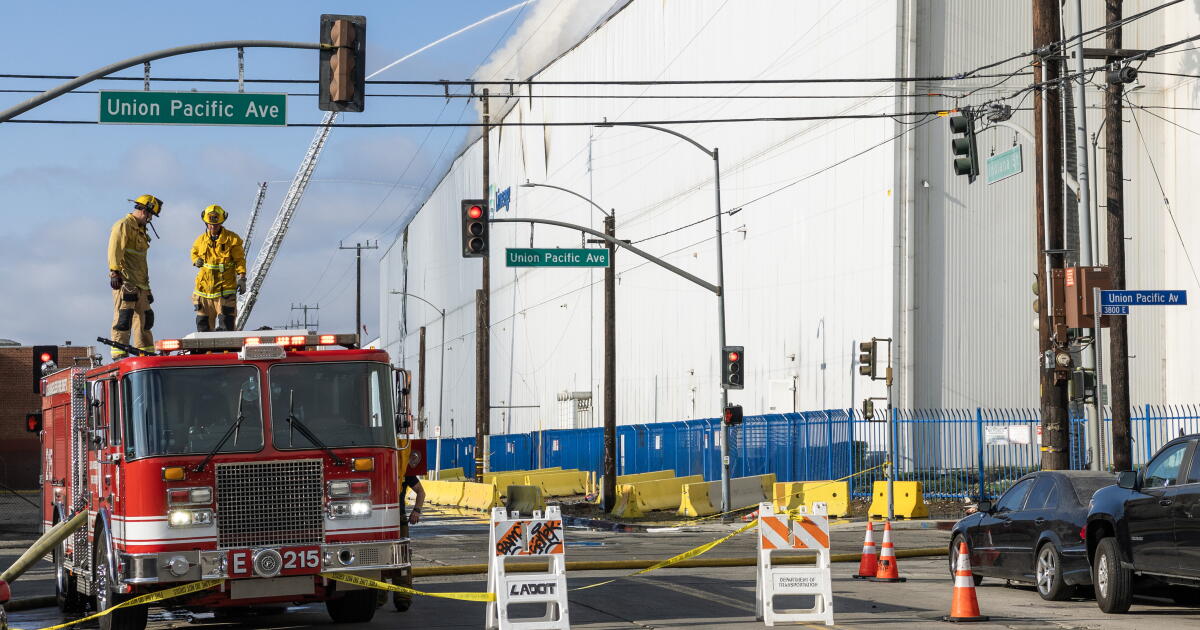
The state Legislature on Monday passed a pair of bills to address industrial accidents in the wake of a massive blaze at a cold storage facility in Los Angeles’ Boyle Heights neighborhood.

Assembly Bill 817 by Assemblymember Mark González (D-Los Angeles) would prohibit the approval of a building permit for a cold storage facility unless the owner or operator of the facility establishes and maintains a contingency fund.

González sought the creation of the fund for air purifiers, masks and other health essentials for neighbors in the wake of an accident.

The bill would apply to Boyle Heights in the short term and would go into effect statewide July 1, 2028.

The bill also would ensure that anyone who sues over the fire doesn’t have to pay state taxes on any settlement.

A June 17 fire at cold storage operator Lineage’s 500,000-square-foot food warehouse left the community with noxious smoke and an influx of rats and flies attracted to rotting meat.

Senate Bill 716 by Sen. María Elena Durazo (D-Los Angeles), also passed Monday, would raise the amount of fines that can be levied by local agencies against companies who pose a threat to health and safety. Under the legislation, companies could face fines of up to $50,000 per violation.

Durazo said current rules limit the fines to just a few hundred or thousand dollars.

“The fines are too small to matter,” said Durazo, describing the “massive fly and rat infestation” and “stench of rotting food” at the Lineage site.

The law would apply only to Los Angeles County and expand statewide starting July 1, 2028. It includes several exemptions for business categories, including institutional and educational.

Scores of business groups, including those representing agriculture, opposed the bills.

Some Republican legislators expressed sympathy for the Boyle Heights community, but questioned the financial ramifications for businesses.

“One terrible incident should not automatically translate into a new statewide financial burden on every similarly situated facility,” said state Sen. Suzette Martinez Valladares (R-Acton) during a Monday discussion of Assembly Bill 817. “Especially when those costs can ultimately ripple through our food supply chain and contribute to higher costs for families.”

The bills now head to Gov. Gavin Newsom for consideration.

Source link

Former White House teleprompter operator ordered to turn over profits, pay fine over insider trading

A former White House teleprompter operator accused of using inside knowledge to make bets on the prediction market Kalshi has been ordered to turn over more than $100,000 in profits and pay a $65,000 fine as part of a settlement with federal authorities.

The settlement with the Commodity Futures Trading Commission, announced Friday, also dealt Gabriel Perez a three-year trading ban. Perez was placed on unpaid leave from his job at the White House after reports emerged that he used his position to make bets on what President Trump would say in speeches.

The White House did not immediately comment on the settlement. A White House official said in July that Perez was no longer in his position but did not say if he had been fired or resigned.

The commission found that Perez made $107,500 on prediction markets by betting on words and phrases that would appear in Trump’s speeches between December 2025 and February 2026.

“In his position, Perez had access to presidential speeches prior to those speeches being delivered and Perez misappropriated that information — in breach of his duty of trust and confidence,” according to a release from the commission.

Perez was ordered to repay his profits in full, along with the $65,000 civil penalty, which the commission said was a reduction because of his “exemplary cooperation.”

As details emerged July 16, then White House press secretary Karoline Leavitt said it was “unfortunate” and “a disgrace.”

Binkley writes for the Associated Press.

Source link

Why Is Poland Seeking a €250 Million Fine Against Meta?

Poland has asked the European Commission to impose a €250 million ($291.3 million) fine on Meta, accusing the social media company of failing to adequately tackle fraudulent advertisements and scams on its platforms.

Polish Digital Affairs Minister Krzysztof Gawkowski said on Wednesday that Meta had failed to respond effectively despite repeated warnings from Polish authorities and cybersecurity teams.

“Despite repeated reports from the relevant Polish authorities and teams responsible for cybersecurity, Meta still does not provide an effective and adequate response to fraudulent advertisements,” Gawkowski said in a post on X.

Poland’s Cybersecurity Tests Raise Concerns

The request followed tests conducted by CERT Polska, Poland’s national cybersecurity incident response team. The team identified 122 advertisements that were classified as fraudulent.

Stay ahead of the geopolitical week.

MD Briefing delivers expert analysis across five global fronts — the Indo-Pacific, energy, geoeconomics, European security, and the Middle East — every Monday morning. Free.

According to Gawkowski, Meta decided not to remove 106 of those advertisements, representing 86.8% of the cases. Only 10 advertisements were removed, while authorities received no response in six cases.

The Polish minister called on Meta to introduce more effective tools to identify and remove scams, false advertising and promotions for illegal applications.

Meta did not immediately respond to a Reuters request for comment.

The dispute adds to broader regulatory and legal pressure on Meta over the content and safety of its platforms.

The company has faced criticism over allegations that its products can harm children and that it has misled the public about their safety. In Poland, Meta has also faced criticism over fraudulent advertisements and a lawsuit filed by billionaire Rafal Brzoska over fake advertisements using his identity.

In April 2026, a Warsaw appellate court ruled that Meta was responsible for advertisements hosted on its platforms. Meta has argued that it should not be held responsible for fraudulent actions carried out by its users.

Poland’s request places the issue within the broader European debate over the responsibility of major technology platforms for illegal and deceptive content. The European Commission now faces a decision over whether the evidence provided by Polish authorities warrants further enforcement action.

Analysis

The dispute highlights a growing regulatory challenge for social media companies: whether platforms can continue treating fraudulent advertising primarily as user generated content or must take greater responsibility for what they distribute.

For Poland, the requested €250 million penalty is not only about individual scam advertisements. It is also a test of whether existing European digital regulations can compel major platforms to respond more effectively when national authorities identify systemic failures.

If the European Commission takes action, it could increase pressure on Meta to strengthen its advertising verification and content moderation systems across Europe. It could also establish a broader precedent for holding technology companies accountable when their platforms repeatedly facilitate fraudulent advertising.

With information from Reuters.

Source link