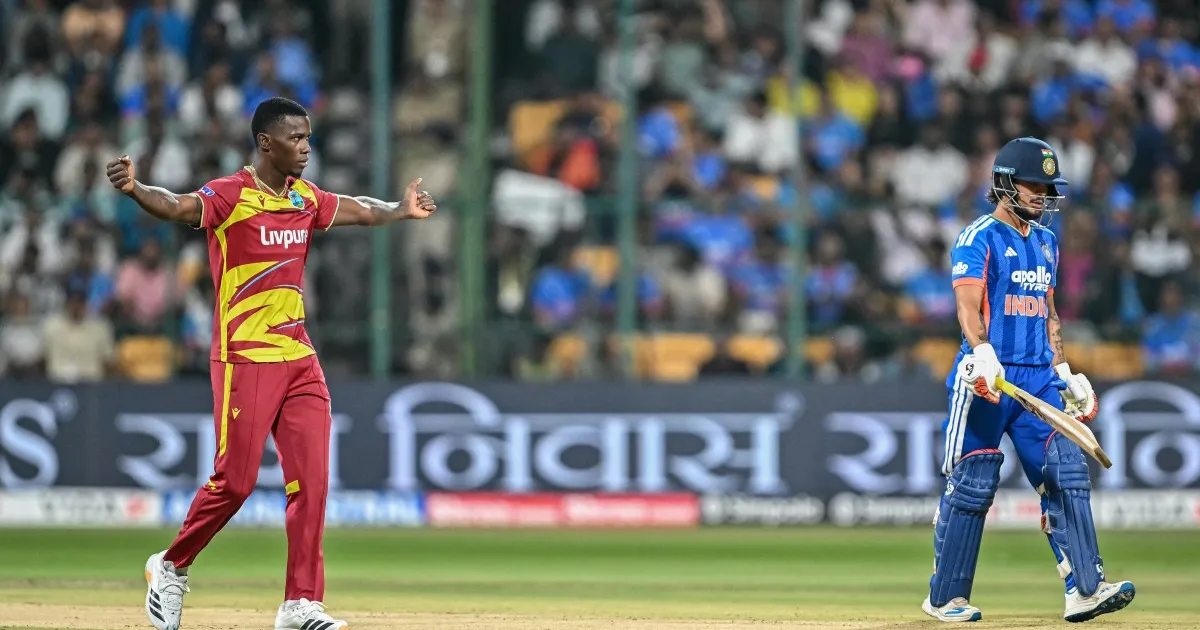
India reached 118-5 after seven overs with Naman Dhir hitting 24 off six balls before rain forced an end to the game.
Published On 17 Oct 202617 Oct 2026
India and the West Indies were forced to settle for a 2-2 stalemate in their five-match Twenty20 International series after Saturday’s deciding match lasted just 48 minutes before it met a watery end.
At Bengaluru’s M Chinnaswamy Stadium, where play began an hour and 45 minutes behind schedule and the match was reduced to nine overs a side, India had reached 118-5 in 7.4 overs when the rain returned, forcing the umpires to call off play with not even a five-overs-a-side shootout possible.
Recommended Stories
list of 4 itemsend of list
The stadium was hosting its first international fixture since the October 2024 Test match between India and New Zealand and more than 20,000 expectant fans braved the inclement weather.
Their patience was rewarded when India’s batters went on the rampage after being put in by West Indies captain Shai Hope, with Ishan Kishan, Sanju Samson and the impressive Naman Dhir – with an unbeaten 24 off six balls – leading the way.
India lashed eight fours and seven sixes in their limited batting stint, with Kishan bringing up the 100th six of the series by swinging Romario Shepherd over long leg and out of the stadium.
But then, the skies opened up again, emphatically washing away any prospect of a decisive outcome.
This story contains spoilers for Episode 8 of HBO Max’s “Lanterns.”
From the very first time Tom King and DC Studios’ James Gunn ever talked about a Green Lantern show, they envisioned John Stewart as the kind of hero who could generate excitement and change the tide of any battle upon his arrival.
“The idea was to build a character as compelling and impactful as, say, Thor in the Marvel universe,” says King, the “Lanterns” co-creator, during a recent video call. “Someone who arrives in a movie with a thunderclap, and … the audience [just] screams when they arrive because you’re in love with that character … not just [for] the power set they have, but the integrity of that character.”
That hero officially takes flight in Sunday’s “Lanterns” finale.
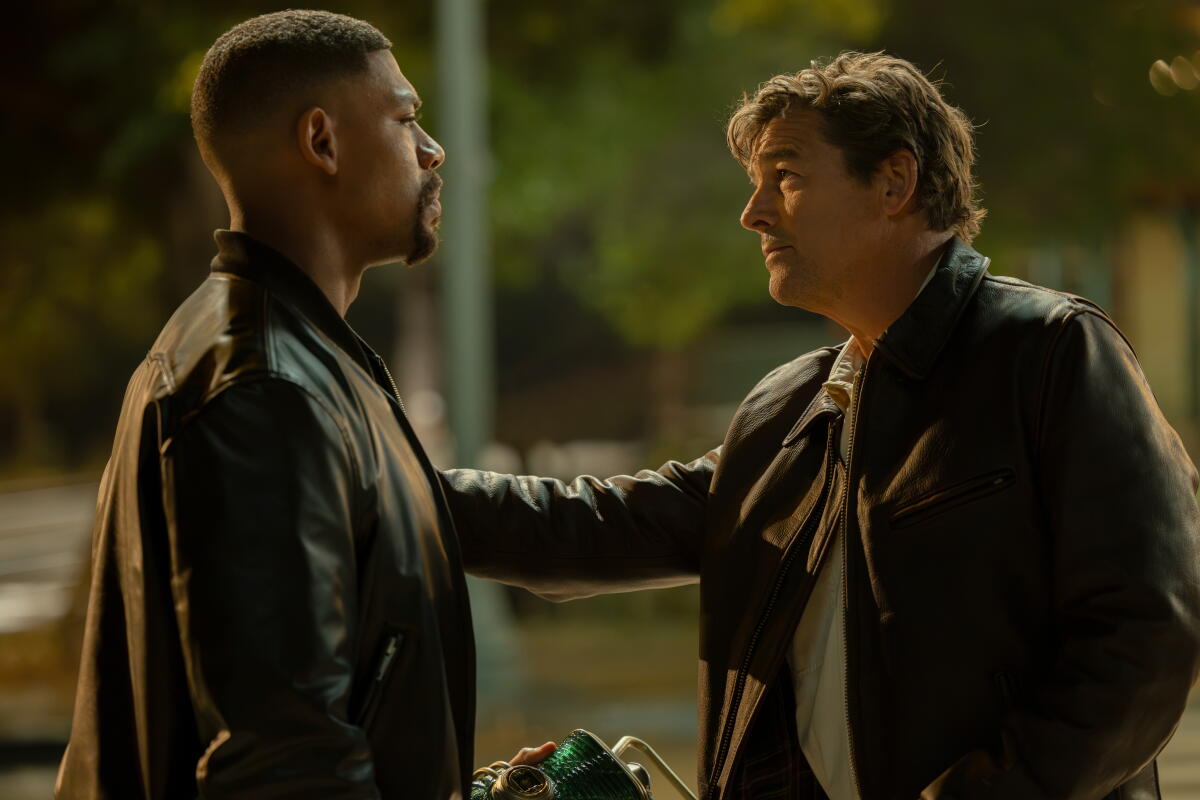
Episode 8 of the HBO Max superhero crime drama, titled “Dirt and Stars,” sees John Stewart (Aaron Pierre) take up the mantle as Earth’s newest Green Lantern. After solving the mystery of his predecessor Hal Jordan’s (Kyle Chandler) death, Stewart claims Jordan’s power ring as his own, recites his oath and jets off toward his next adventure. (A second season of “Lanterns” has not been announced, but the character will appear in Gunn’s upcoming “Superman” sequel, “Man of Tomorrow.”)
Co-created by King, Damon Lindelof and Chris Mundy, “Lanterns” introduces Jordan as a grizzled, veteran member of the Green Lantern Corps, intergalactic space cops who are armed with a special ring that allows them to manifest objects and manipulate energy.
In the finale, John Stewart, left, claims Hal Jordan’s (Kyle Chandler) ring as his own.
(John Johnson / HBO Max)
Stewart is a new Green Lantern recruit, but when an investigation into the whereabouts of a killer alien robot on the run goes awry, they go their separate ways.
“One of the cool things about the canonical Green Lanterns is that, technically speaking, there’s only one ring delegated to this particular sector in which Earth fell,” says Lindelof of one of the show’s central conflicts.
The creative team knew from the jump that Stewart would be the one to bear that ring at the end of the season, but the idea that Stewart would be a child prodigy whose parents preordained his path to become the next Green Lantern developed over time.
“We [decided] the first part of John’s life is going to be [about] coming to terms with the fact that he doesn’t really want the ring — or he doesn’t want the ring on those terms,” Lindelof says. “Then there would have to be some period of time where he was living his dream. … Then and only then would he be able to wipe the slate clean, as it were, and gravitate back toward a healthy way to want the ring.”
In the comics, Green Lanterns are known for their oaths, which they recite when recharging their rings or to reaffirm their commitment to the group. In “Lanterns,” Stewart creates his own version that acknowledges his journey and perspective on becoming a Green Lantern.
“We talked a lot about it in the room, but the feeling was that he was changing the relationship with the Guardians in that moment,” Mundy says, referring to the immortal aliens that created the Green Lantern Corps.
In the end, Hal, left, is able to impart lessons that nobody else would have been able to teach John.
(John Johnson / HBO Max)
The Guardians had once considered Stewart an ideal replacement for Jordan because he was willing to blindly follow orders, but by the time he claimed Jordan’s ring, it’s clear Stewart has no plans to be affiliated with the Guardians or the Green Lantern Corps in that way, and the writers wanted his oath to reflect that.
“We wanted John to take [the role] on his terms,” Mundy says. “Even though Hal didn’t train him as well as he should have trained him, he taught him lessons that nobody else would have taught him. … [Including] how you need to be your own person even as you’re working for this organization.”
Besides his unconventional path to becoming a Green Lantern, Stewart is in possession of a unique lantern for recharging his ring that was forged by Sinestro, Jordan’s disgraced mentor.
The “Lanterns” showrunner remained coy when asked whether this lantern’s more ominous origins could lead to any unintended consequences for Stewart.
“It’s rife with possibility, is what I will say,” Mundy says.
In separate interviews, Mundy, Lindelof and King discussed the “Lanterns” finale, Stewart and Jordan’s bittersweet reconciliation and the show’s fiercely protective mothers. Their comments have been edited for clarity and length.
Because the “real” Hal is killed in 2026, his relationship with John is left unresolved. John shares a moment with the Halogram, the backup version of 2006 Hal’s consciousness, after working with him and the mystery is solved, but can you address that lack of proper closure for them?
Mundy: We talked about this thing as a love story between these guys in a certain way, but one of them has to die in order for them to truly come together. Even over the course of the Halogram being in the show, he never called John “Junior” ever. He always called him “trainee.” Until the last moment when he says … “I love you, too, Junior.” There’s something very bittersweet about the fact that the two people we spent all that time with don’t fully have their moment together.
King: What I think is hinted at between the Halogram and the final Hal we get is this Sinestro subplot. This is right from the comics, but Hal’s best friend, his mentor, the person who trained him, betrayed everything he trusted and Hal had to put him away. I think the trauma of that moment closed Hal up. It damaged him … so he was unable to see John for what he is and unable to listen to John the way he should. [With the Halogram] John finally encounters a Hal who hasn’t gone through that and they can have conversations they couldn’t have before. John can start to feel the empathy that Hal denied him, and he can see Hal for who Hal really is.
Lindelof: I love the idea that that version of Hal and John are unresolved. There is no apology. There is no forgiveness. The only closure that John can get is from this earlier version of Hal who has a lot of sympathy and empathy, not just for John, but for himself. Obviously, this is a crazy sci-fi superhero show, but that feels more authentic to life. Sort of like when someone that you love is gone, and you find a note that they wrote or an old birthday card and you extrapolate new meaning from it even though it’s from an earlier version of them.
Viewers get some backstory on the romance between Kerry Kane (Kelly Macdonald) and Hal.
(John Johnson / HBO Max)
Why was it important to show more of 2026 Hal Jordan’s life before his death in the finale?
Lindelof: The only flavoring that we get of him directly [before this] is in the diner scene, when John comes for his apology and doesn’t get one. Only toward the very end of that scene after John has hit Hal, and Hal says, “Don’t let anybody know that you were here,” is there a flash that something has changed in this guy. It’s one thing for Kerry to tell us that they were in love, or to hear Hal’s “buttercup” voicemail, but I think that the audience needed to see it and experience it. Hal is not a changed man in 2026, but he’s an evolved man. And there’s real tragedy inherent in all of the decisions that he’s making because we know that all of those decisions basically lead him to be a corpse in the stands at a football game. The subtle differences by which Kyle plays older Hal versus Halogram Hal is really on sharp display in the finale.
With Noah being a Manhunter, it turned out that he and John were dealing with similar questions around lineageand legacy and nature versus nurture. How did the exploration into these themes evolve during the show’s development? Much of it is unpacked in their truck ride together.
King: The basic idea [was] that John had been one of these kids who had been told, “You’re going to be this when you grow up.” Like a Tiger Woods or Michael Jackson-esque child. We started talking about what that’s like — to be a prodigy, to be forced into [something]. The idea that you’re kind of programmed by your parents. And then we were talking about Manhunters. The problem with Manhunters is they’ve been programmed to do this one thing, and they can’t defy their programming [to eradicate mankind]. That’s why they had to eventually be erased. Then we started talking about the parallel of programming and overcoming programming, and what makes you human, what doesn’t, that parallel came first. Those were the very nascent ideas, and we took that to our brilliant writers room, and [Breannah Gibson], Justin [Britt-Gibson] and Vanessa [Baden Kelly] added their own personal experience to that and made it a much richer … and personal story.
Mundy: John still doesn’t know if he’s about to die in this car. Noah is trying to learn about himself and figure out if he wants to kill John or die himself. The important thing was to hold that tension and then kind of step that conversation through chapters. There’s anger about what happened to Zoe. After he understands that a little bit better, he says “these are the different ways my life could go.” And then John can actually bring a piece of himself. We talked all the time about the way John was raised and the programming of the Manhunters and what’s “programming” and what’s “being raised.” Then there’s a confession that ends up being false, but also this request to be killed. There were three distinct sections of that conversation, and we wanted them all to be meaningful and personal.
In the final scenes of the episode, John and Kerry have a conversation about what parents are willing to do for their children.
(John Johnson / HBO Max)
With both Hal and John, so much of their intergenerational trauma is tied to their fathers. But with Noah and John, you also see just how big of a role their mothers have played in shaping them. How did that aspect come about?
Mundy: Once we knew that Noah was a Manhunter, it felt too cheap and too easy for that to be the answer [to the mystery of Hal’s death]. But it felt key to the answer of it, and we were talking so much about parenthood and what you would do for your child and what it means. What’s protecting people and what’s not? It just became a given pretty early on that Kerry would be the answer at the end. It just fit into the same story Bernadette was going through. And [John’s] conversation with Kerry explains so much of that.
Lindelof: I think this all came from Vanessa Baden Kelly. We had written the pilot, where John’s father is shooting the apple off of his head, and then when Vanessa came on shortly thereafter, she’s like, “Where’s mom?” It is one of those moments where you realize it, particularly because we were three men, but also inside of the canon of these superheroes, it’s always a dad. So the idea was having Bernadette really be the mastermind of John’s upbringing as a way to provide a simultaneous salve for her husband’s shame about being afraid about losing out on the opportunity.
I think that Kerry is an equally fierce mother. Obviously, she loves Hal. But when you watch it a second time after you’ve seen the finale, you realize that there’s guilt there as well because of what she did to him, all in the name of her son.
John starts to reframe what Bernadette did as something for him, as opposed to something for her — in a lot of ways, it was a selfless act. She’s doing it knowing that her child will hate her, but that he’ll be the Earth’s Green Lantern, and there’s going to be an aspirational quality to that for generations to follow.
Deadliest Catch’s Todd Meadows fell overboard to his death in a tragic fishing accident in February 2025Credit: Facebook/Todd MeadowsThe 25-year-old had an eerie last FaceTime call with his children just moments before he fellCredit: Facebook/Todd Meadows
The rookie deckhand fell off the Aleutian Lady in a fishing accident on The Bering Sea and died from downing with possible hypothermia on February 25, 2026.
In the final episode of Season 22, a touching segment showed before and after his death, and captured his final conversation with his children just moments before the accident.
Sign up for the Showbiz newsletter
Thank you!
In a FaceTime call, he told his three children, all under five, that he was “being safe” and promised a fishing trip when he saw them again.
“I hope you’re being safe,” his daughter said on the call.
He promised his son a salmon fishing trip when he returned, telling producers on-camera that it was a “heart-wrencher” to leave his children at home for long stretches.
“It’s been one of my dreams and goals to make it up here,” he said, speaking of joining the crew for the season.
Most read in Entertainment
“That’s why I’m up here to make it and to try to support my family.”
Another part of the season finale captured the chaos surrounding the moment he fell overboard, without the actual fall or subsequent actions being shown on camera.
Captain Rick, who announced Meadows’ death, is filmed manning the vessel and asking “Everybody OK?” before the crew say that a man has gone overboard.
As he turns the boat and instructs them to ready the ring and crane, he tells the crew: “I got my eye on him.”
They successfully got Meadows out of the frigid sea and the Captain instructed them to perform CPR.
“Come on, man, come on, someone go get the AUD right now,” he says off camera with him tearfully telling the crew to “keep pumping” before a producer says, “He’s gone, Rick.”
In his last conversation with his three children, Meadows told them he was being safe and promised to take his son on a fishing trip when he was backCredit: DiscoveryThe impact of Meadows’ death on the crew was depicted in the season finale of Season 22Credit: Facebook/Todd Meadows
A statement on screen read: “On February 25th, 2026, deckhand Todd Meadows went overboard.
“After six minutes and twenty-six seconds in the water, he was recovered unresponsive.”
The episode then showed the aftermath of his death and its impact on the crew.
It ends with a cut back to Meadows as he prepares food in the kitchen and answers a producer’s question about what he would want to say to his children.
“Work towards your dreams and goals, don’t let anything slow you down. If you put your mind to it, you can do anything.
“Just want my kids to know I want them to work hard and be successful in life.”
Weeks before his fall, Meadows suffered a serious head injury onboard and was sent home on medical leave before being cleared again for work on September 18.
His week of medical leave saw him go back to his family while nursing his concussion which would tragically be the last time he saw them.
“The last photo I got of him was when he was building a fire. He was listening to music in the moment and was so happy,” his mom Angela said at the time.