final rule

Appeals court hands Trump a loss on mail voting as Supreme Court considers his executive order

Nicholas Riccardi and Lindsay Whitehurst

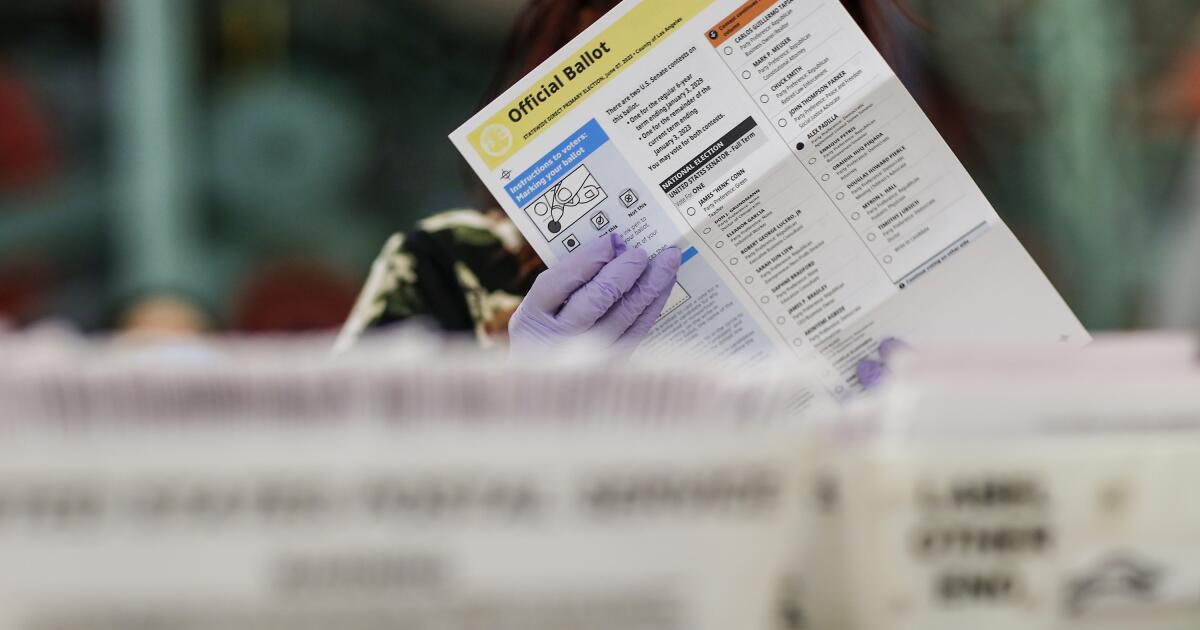
An appeals court on Thursday upheld a block on President Trump’s executive order limiting mail voting, a decision that comes as the Supreme Court considers the same case and states have already started sending out ballots for the high-stakes midterm elections.

The three-judge panel refused to lift a preliminary injunction against the order issued last week by U.S. District Judge Indira Talwani. It prohibits the U.S. Postal Service from implementing Trump’s directive. The Postal Service has said it would not deliver ballots from states that did not pre-clear their envelope design with the federal government and submit a list of voters to an online portal, which has yet to be activated.

Election officials warn that it’s impossible to comply with those terms, especially with the first mail ballots already being sent out in Alabama, North Carolina and Wisconsin.

The panel of three judges nominated by former President Biden agreed with the plaintiffs that the president does not have the power to regulate states’ election policy.

“Appellants have not made a strong showing that the district court erred in determining that the Final Rule is likely unlawful,” they wrote, a reference to a rule published by the Postal Service to implement Trump’s order.

The panel wrote that the Trump administration had done little to dispel arguments by many election officials that the changes would bring “chaos and widespread disenfranchisement.”

“Indeed, appellants have not even seriously challenged this aspect of the district court’s ruling, much less demonstrated why it is clearly erroneous,” the order states.

The government also hasn’t shown evidence of past fraud to justify the restrictions, the judges said.

A request for comment from the White House was not immediately returned.

The panel’s decision comes even as the Supreme Court is already considering the same case, which is part of a frenzied legal rush as states are beginning to send out mail ballots for this fall’s midterm elections. Democrats and civil rights groups in a separate lawsuit in Washington, D.C., also are trying to halt the executive order.

The 1st Circuit also had upheld a previous hold Talwani placed on the executive order. But that ruling was lifted by the Supreme Court in a procedural decision that did not determine whether the plan was constitutional.

The plaintiffs swiftly filed new lawsuits after the Postal Service finalized its rule governing mail ballots.

Riccardi and Whitehurst write for the Associated Press.

Source link

Postal Service work to comply with Trump’s executive order is rushed, sloppy, whistleblower contends

The U.S. Postal Service is poised to launch a hastily built, error-riddled computer system that could jeopardize the process of mail voting relied upon by one-third of all voters, according to a whistleblower statement released Tuesday by Democratic Sen. Richard Blumenthal.

The effort is part of the implementation of President Trump’s executive order limiting mail voting and has been temporarily halted by a federal judge. The ruling is being appealed by the administration and the directive may ultimately end up back before the U.S. Supreme Court.

The disclosure from the unidentified whistleblower contends that the Postal Service has been scrambling to try to build a complex system that would normally take a year or more in only three months, sometimes in defiance of the judge’s orders halting work. The goal is to have it ready for use in the midterm elections.

The disclosure contends that, due to the new procedures, a single scanning error in a batch of tens of thousands of ballot envelopes could prevent any from reaching voters. It details a system that election officials have already warned could not be implemented before the first mail ballots begin going out Friday in North Carolina.

“The Postal Service has designed a system to disenfranchise millions of Americans,” Blumenthal told reporters in advance of releasing the whistleblower information. “This administration seems hell-bent on changing the framework on casting ballots in this country clearly for political reasons.”

Executive order is subject to furious court action with midterms nearing

Trump’s executive order, signed in March, directed U.S. Citizenship and Immigration Services and the commissioner of the Social Security Administration to develop state citizenship lists and then required the Postal Service to send mail ballots only to voters who are on such a list. Ballot envelopes would have to comply with new Postal Service rules and include bar codes.

The online portal that is the subject of the whistleblower complaint is intended for states to deliver their lists of verified voters to the Postal Service.

The Postal Service did not comment on Monday night. The White House did not immediately respond to a request for comment Tuesday. The White House has called the mail voting provisions “commonsense measures” necessary to combat fraud.

Trump has long opposed voting by mail, even though he has repeatedly used the method to cast his own ballot. He falsely blamed mail voting for his 2020 election loss and has spent years spreading conspiracy theories about it. A report by the Brookings Institution published in 2025 found that mail voting fraud occurred in only about four cases out of every 10 million mail ballots cast.

Since returning to office, Trump has said Republicans should be “taking over” vote counting in Democratic areas and launched a sweeping attempt to reinvestigate the 2020 election, despite a mountain of evidence that he lost fairly to Democrat Joe Biden.

Until Trump came out against mail voting in 2020, the system was used equally by both parties. Since then, it has become more common among Democratic voters. More than 29% of all voters in 2024 cast their ballots through the mail.

After Trump issued his executive order, Democrats and civil rights groups sued and eventually won a ruling from U.S. District Court Judge Indira Talwani in Boston barring implementation of the system before the November midterms. But without ruling on the legality of Trump’s order, the Supreme Court’s conservative majority last week found that was premature and overruled Talwani, momentarily clearing the way for its implementation.

On the night of Aug. 21, the Postal Service released a final rule outlining how it would implement the order.

It said it would only send mail ballots for states that got approval for the design of their envelopes and submitted a list of voters receiving them through the still-not-active online portal. That rule gave plaintiffs a chance to sue again, and Talwani on Thursday night issued a 14-day restraining order against implementation of the measure.

Whistleblower complaint says portal development is rushed and sloppy

The letter from Blumenthal and an accompanying summary of the whistleblower’s statements says the Postal Service began work on the portal on June 15 and stopped on June 25 after Talwani’s initial order. Then on July 29, the Postal Service restarted the work. That was when the administration appealed the judge’s order to the Supreme Court. The high court did not strike Talwani’s injunction down until Aug. 24.

Talwani last week found the Postal Service violated her order by continuing to work on the final rule, but she imposed no sanctions on the government. On Monday, she issued a ruling refusing to lift the restraining order that also said the Postal Service could continue work on its portal, as long as it wasn’t forcing states to use it.

In its summary of the whistleblower’s statement, the group Whistleblower Aid says the hurried construction of the portal, with a goal of being active on Tuesday, meant it did not undergo full testing.

“The apparently sloppy and rushed manner in which the Federal Ballot Mail Portal and supporting IT systems are being built poses significant risk,” the group wrote. “Potentially millions of American voters may not receive their mail-in ballot this election cycle in a timely manner, or at all.”

The statement also says the Postal Service is implementing a “zero percent” rule in which any errors in any mail ballots sent out by an election office could lead to all of them being discarded — even if it’s simply one problem amid tens of thousands of legitimate ballots.

The rule requires ballots to be handled in a physical post office by an election official. Those will then be scanned to ensure they match the voter database. During three layers of checks, a single apparent error could cause the whole batch to be rejected, the statement says.

Blumenthal said he has “a very strong hope and some faith that our system of justice will strike down this unconstitutional and unconscionable rule.” But, he added, if it somehow goes into effect for the midterms, he would not advise voting by mail.

Riccardi writes for the Associated Press. AP writer Lindsay Whitehurst contributed to this story.

Source link

California, other states sue again to block new U.S. Postal Service rules for mail ballots

California and a coalition of other Democratic-led states sued again Wednesday to block the U.S. Postal Service from implementing new nationwide rules for mail ballots, arguing they usurp state authority over elections at President Trump’s behest, expose voter information unnecessarily and threaten chaos in the rapidly approaching November election.

The Postal Service formally issued a 95-page “final rule” on Friday asserting that it was amending its mailing standards for mail ballots in federal elections to comply with Trump’s March executive order.

Trump demanded the rule changes as part of a broader plan to combat what he alleges — without evidence — is widespread voter fraud in the U.S., including by noncitizens voting through the mail. Election experts say there is zero evidence of such problems existing at scale.

“This mail-in voting rule is an unlawful overreach that shows just how far President Trump will go to control elections, but as I’ve said before, this fight is far from over and we are confident that the facts and the law are on our side,” California Atty. Gen. Rob Bonta said in a statement.

“Donald Trump does not run elections. States do. And his latest attack on democracy is proof of how weak he has become,” said Gov. Gavin Newsom. “California will continue to lead the way in defending democracy — using every tool at our disposal and every minute in our day. This perilous moment in history demands no less from us.”

The new postal rules require states to submit lists of eligible voters — including their names and addresses — to the Postal Service, and to use new ballot envelopes with digital barcodes that would allow the Postal Service to identify and reject ballots that don’t match those lists.

The rules do not give the Postal Service authority to dictate which voters may appear on state lists. However, the rules do acknowledge that the lists would provide state voter data to federal law enforcement for the first time, and would put those authorities in “a better position to identify any potential issues regarding compliance with federal law that may merit further investigation.”

Trump’s March executive order also required the Department of Homeland Security to use available federal data to compile its own state lists of eligible citizen voters, ostensibly to compare them with the mail voter lists provided by the states to the Postal Service, and identify and pursue any ineligible voters.

Wednesday’s lawsuit follows a Monday decision by the U.S. Supreme Court that found an earlier challenge from the states was premature, in part because it sought court relief to a rule-making process that required nothing of the states and before the Postal Service had moved to implement any changes.

“On Monday, the U.S. Supreme Court declined to fully close the door on the President’s attempt to interfere in our election administration. Today, we’re taking legal action to stop this unlawful rule in its tracks and ensure that voters can exercise their constitutional right to vote,” Bonta said.

The White House did not immediately respond Wednesday to a request for comment on the latest lawsuit.

However, it has defended Trump’s executive order as overdue and badly needed to secure U.S. elections, and hailed the Supreme Court’s ruling allowing the rule-making to proceed as “a major win for the security of American elections.”

“These are commonsense measures that protect the security of mail-in ballots and ensure only Americans are electing American leaders,” White House spokeswoman Lauren Bis said.

The high court allowed the Postal Service to move forward with its work to comply with Trump’s order, but explicitly noted that it had reached no conclusions as to the legality of the pending rules.

Trump administration officials have said they are pursuing fraudulent voters, and have warned state election officials that they could face legal consequences personally if they don’t do everything in their power to prevent voter fraud, including by noncitizens.

Critics contend Trump’s executive order was devised as an end run around laws and a slew of recent court rulings blocking the Trump administration’s demands for state voter rolls — which states, including California, have refused to provide.

States have argued the administration’s demands are in bad faith, intended to bolster Trump’s baseless claims that U.S. elections are compromised rather than enhance election security.

In issuing its new rules, the Postal Service rejected a slate of concerns from critics who submitted comments on the proposed rules, including that the changes are being proposed far too close to the November election and will cost states and localities a huge amount of money to comply with.

It also rejected concerns that creating a single nationwide voter database — which has never existed before — will provide a massive new target for foreign adversaries and other bad actors interested in disrupting U.S. elections.

The Postal Service concluded that the cost to the states is outweighed by the benefits of the changes. It said it has sufficient staffing to implement the changes, and is ready to safeguard the database it builds using “multi-layered security controls.”

The lawsuit, brought by 24 state attorneys general and the governor of Pennsylvania, asks for immediate court intervention to halt the Postal Service changes from being implemented while the litigation continues.

“Let’s be clear: the U.S. Constitution gives states the power to regulate elections — not the President and not USPS,” Bonta said. “Ballots are an extension of our voices and we’re asking the court to ensure that every person has the right to make theirs heard.”

Independent voting rights groups have also sued to block the Postal Service rules from being implemented.

Source link