The Iranian military shot down a U.S. F-15E similar to the one pictured on Friday. File Photo by Senior Airman Mitch Fuqua/U.S. Air Force.
April 3 (UPI) — The U.S. forces rescued at least one crew member after Iran shot down a U.S. F-15E fighter jet Friday, unnamed U.S. military sources told multiple media outlets.
Officials confirmed the rescue to CBS News but said search-and-rescue operations were still taking place. CNN reported they were looking for one other pilot before Iranian forces could reach them. The F-15E has a standard crew of two pilots, The New York Times reported.
Iran’s state-run Tasnim news agency reported that Iranian officials’ efforts to locate the two U.S. pilot had “so far been unsuccessful.” Another Iranian news outlet, Fars News, said the government was offering a reward to anyone who captured an “enemy pilot or pilots.”
The New York Times reported that amid the search-and-rescue efforts, Iranian ground fire also hit a U.S. Air Force UH-60 Black Hawk helicopter. Officials told the news outlet that the crew was able to fly the aircraft back to safety in Iraq.
The Times also reported that another aircraft, an A-10 Thunderbolt, or Warthog, crashed near the Strait of Hormuz around the same time as the F-15E fighter jet. Two U.S. officials told the outlet that the only pilot on board the aircraft was rescued.
Iranian media outlets published photos of what appears to be a shot-down F-15 fighter jet.
White House press secretary Karoline Leavitt told CNN that President Donald Trump had been briefed on the incident.
This is the first U.S. aircraft to be shot down by Iran since the start of U.S. and Israeli bombing on Feb. 28. Three other F-15 jets were shot down by mistake in Kuwait.
President Donald Trump delivers a prime-time address to the nation from the Cross Hall in the White House on Wednesday. President Trump used the address to update the public on the month-long war in Iran. Pool photo by Alex Brandon/UPI | License Photo
WASHINGTON — A crew member was rescued after an American aircraft went down Friday in Iran, the Associated Press reported, citing U.S. and Israeli officials.
U.S. forces launched a rescue mission in southwestern Iran after at least one American crew member ejected from a fighter jet downed by Iranian defenses, according to a U.S. official and news outlets.
The downing of the jet, an F-15E, was confirmed to The Times by a U.S. official who was not authorized to speak publicly. That type of jet reportedly carries a standard crew of two, but it was not clear if more than one crew member ejected.
Defense Secretary Pete Hegseth has maintained for weeks that the U.S. has “complete, uncontested control of Iranian airspace” after destroying the country’s air defenses.
“Iran has no air defenses, Iran has no air force,” he said at a March 13 Pentagon news conference. “Today, as we speak, we fly over the top of Iran and Tehran, fighters and bombers all day, picking targets as they choose, as our intelligence gets better and better and more refined.”
But the Islamic Revolutionary Guard Corps claimed that a new type of Iranian air defense system deployed for the first time in recent days had shot down a warplane on Friday.
The statements stirred a flurry of conflicting instructions from Iranian state-affiliated broadcasters. One local television channel initially encouraged viewers to search for the downed pilot and “shoot them as soon as you see them.”
It then changed the instructions, according to the Associated Press, after local police issued a statement asking the public to capture and turn in American pilots alive to security agencies to “receive a precious prize.”
On social media, Iranian accounts posted videos purporting to show helicopters searching for downed pilots in Iran’s western and southern provinces, according to a report from Fars News.
Fars also reported officials in Iran’s southwest were offering a “valuable reward” to anyone “who captures the American pilot alive.”
Images of a tail section posted on social media had markings indicating it was from the 48th Fighter Wing, which is based at RAF Lakenheath in the United Kingdom, according to Peter Layton, a visiting fellow at the Griffith Asia Institute in Australia, in an interview with NBC News.
U.S. and Israel escalate attacks on infrastructure
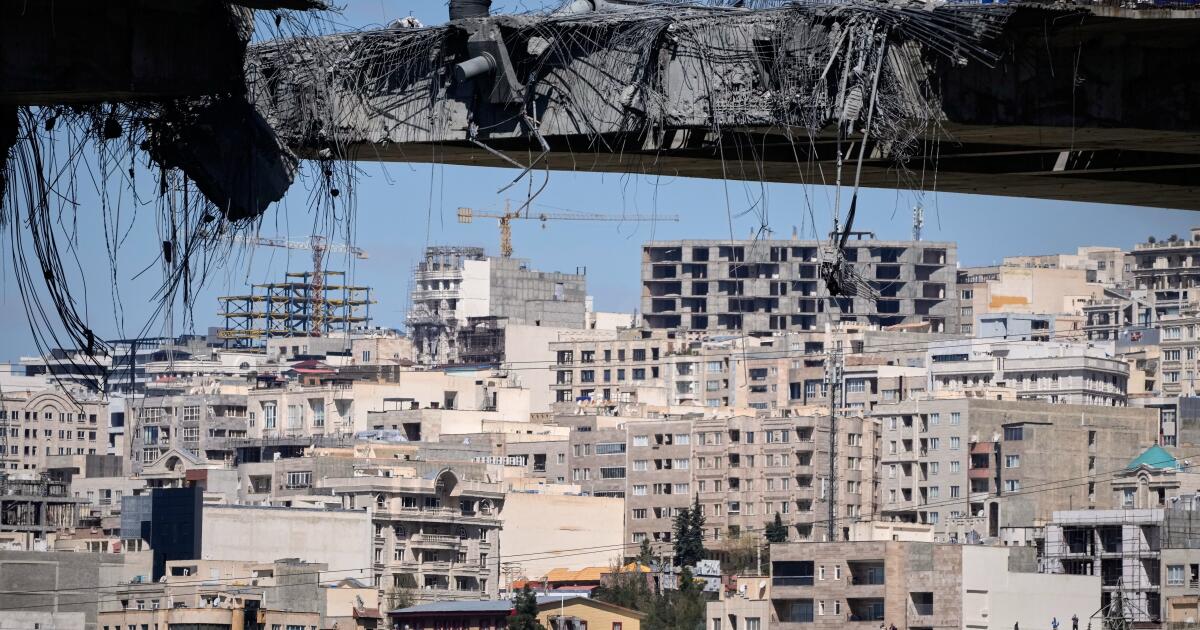
The development came as U.S. and Israeli forces escalated attacks on civilian sites and key infrastructure across Iran Friday, including strikes on residential buildings, health centers and Iran’s largest bridge, with President Trump warning that the U.S. “hasn’t even started destroying what’s left in Iran.”
On his social media, the president posted dramatic images of the smoldering B1 bridge, a towering cable-suspended viaduct that was severed in U.S.-Israel strikes late Thursday.
“The biggest bridge in Iran comes tumbling down, never to be used again — Much more to follow!” Trump wrote.
Connecting Tehran to the city of Karaj, the $400-million bridge was Iran’s largest, and was often regarded as one of the most prominent, expensive and complex engineering endeavors in the Middle East.
Iranian Foreign Ministry spokesperson Esmail Baghaei labeled the attack a “war crime in the style of ISIS terrorism.” Foreign Minister Seyed Abbas Araghchi called the act a sign of moral collapse by “an enemy in disarray,” stating that such actions will not compel Iranians to surrender.
“Every bridge and building will be built back stronger. What will never recover: damage to America’s standing.”
The attacks come after Trump announced what he described as a two- to three-day “off-ramp” from hostilities, while simultaneously warning he would bring Iran “back to the Stone Ages” if it didn’t cede to U.S. demands.
Reports from Iranian state media and international monitoring groups indicate strikes have also hit homes, religious centers, universities and municipal infrastructure across multiple provinces, raising concerns among humanitarian organizations about the widening scope of targets.
World Health Organization Director-General Tedros Adhanom Ghebreyesus said Friday that the U.S. and Israel have carried out routine attacks on Iranian healthcare facilities since March 1.
“WHO has verified over 20 attacks on health care in Iran, resulting in at least nine deaths, including that of an infectious diseases health worker and a member of the Iranian Red Crescent Society,” Tedros wrote on X.
Iran’s health ministry estimated about 2,076 people have been killed and 26,500 wounded by U.S.-Israeli attacks since fighting broke out Feb. 28. An estimated 1,300 have been killed in Lebanon, according to its health ministry, while more than two dozen people have died in Gulf states and the occupied West Bank.
Thirteen U.S. service members have been killed, and 19 Israeli service members have been reported dead in a five-week-old war that has triggered growing unease stateside.
A recent Pew Research Center survey conducted in late March found that most Americans opposed direct U.S. military involvement in a war with Iran. A separate Gallup poll reported declining approval for the administration’s handling of foreign policy.
Lawmakers in both parties have raised concerns about Israel’s influence in the Trump administration’s decision to enter a lengthy conflict, stoking debates over military aid and executive war powers.
Rep. Alexandria Ocasio-Cortez (D-N.Y.) said Wednesday that she plans to oppose future military aid to Israel, including for its Iron Dome defense systems. She argued that the Israeli government recently funded a $45-billion defense budget and is “well able” to bankroll its war without U.S. help.
“I will not support Congress sending more taxpayer dollars and military aid to a government that consistently ignores international law and U.S. law,” she said on X.
Iran hit desalination plant and oil refinery
Iran returned fire, again aiming at infrastructure targets operated by its Gulf neighbors. A series of airstrikes set Kuwait’s Mina al-Ahmadi oil refinery on fire, the Associated Press reported, as Kuwaiti firefighters were working to knock down several blazes there.
Kuwait also reported that an Iranian attack significantly damaged a desalination plant, which supplies drinking water to the region.
Bahrain, Saudi Arabia and Israel all scrambled to intercept incoming Iranian missiles Friday, according to reports, despite the Pentagon’s assurances that Iran’s military facilities and missile capacity have been largely wiped out.
Meanwhile, the United Arab Emirates shut down a gas field after a missile interception reportedly rained debris on it and started a fire, the Associated Press reported.
The war has pushed Iran to tighten its grip over the Strait of Hormuz, sending oil prices soaring 50%, upending stock markets, and stirring supply chain disruptions that threaten to destabilize global food markets.
Americans felt the oil rally again this week, after Trump’s Wednesday address dashed investors’ hopes of a swift end to the conflict, sending U.S. crude prices up 11% Thursday and another half point on Friday.
Weekly insights and analysis on the latest developments in military technology, strategy, and foreign policy.
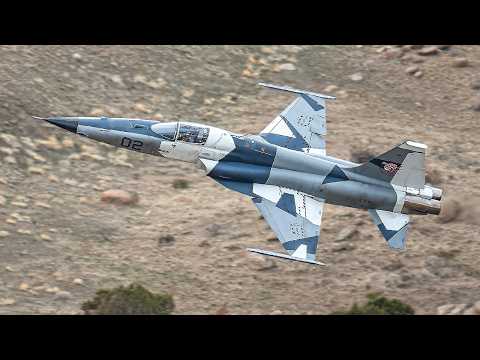
On this episode of TWZ: Special Access, Jamie Hunter visited TacAir to learn about their heavily upgraded F-5AT fighters and how they replicate enemy aircraft to keep U.S. fighter aircrews sharp.
Tactical Air Support, better known as TacAir, is a Reno, Nevada-based private ‘red air’ commercial adversary support contractor that aims to efficiently simulate enemy capabilities to better prepare U.S. and allied aircrews for future conflicts. They support all branches in various training and testing events, but they’re most known for the contract they fulfill out of NAS Fallon in Nevada, where Topgun is based and where air wings spin-up for deployments.
TacAir’s fleet is made up of ex-Jordanian and Saudi F-5E/Fs airframes that have been equipped with tailored upgrades to create a “4th generation adversary platform with 3rd generation economy,” as described by the company. The latest configuration includes an AESA radar, datalink, Garmin wide-area display open architecture avionics, Scorpion helmet mounted display, and internal IRST. You can read more about TacAir and their F-5ATs here: https://www.twz.com/category/tac-air
Watch the full video here:
Private F-5 Adversary Jets Taking The Fight To Navy Fighter Pilots
Weekly insights and analysis on the latest developments in military technology, strategy, and foreign policy.
South Korea today rolled out the first series-produced example of its homegrown KF-21 fighter. This major milestone in the program also underscores just how quickly it has progressed, with the rollout coming a little over five years since the first prototype of the fighter was unveiled. The development schedule is especially impressive when compared with other new-generation fighter programs, although Seoul has taken some notable shortcuts to meet this aggressive timeline.
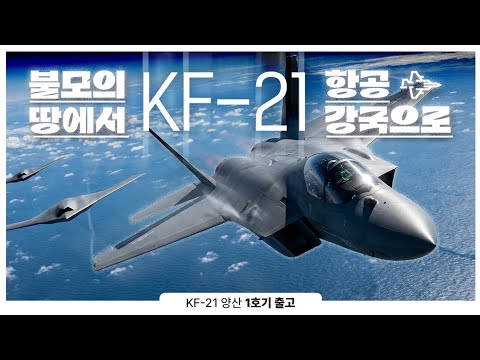
An official Republic of Korea Air Force video commemorates the rollout of the first series-produced KF-21:
KF-21 양산 1호기 출고 | 불모의 땅에서 항공 강국으로
The first series-production KF-21 — also known as the Boramae, meaning hawk in Korean — is a two-seater, unveiled in a ceremony today at the Korea Aerospace Industries (KAI) headquarters in Sacheon, southeast of Seoul.
President Lee Jae Myung told guests that the fighter symbolized South Korea’s “aspirations for self-reliant defense,” and said he was committed to establishing the country as one of the world’s top four defense powers.
“South Korea has finally secured weapons to protect peace with its own technology, not only on land and sea but also in the air,” Lee added.
Rollout of the first series-production KF-21 at the Korea Aerospace Industries (KAI) headquarters in Sacheon, southeast of Seoul, today. Office of the President of South Korea
There is no doubt that South Korea is fast emerging as a major player when it comes to defense manufacturing, and, increasingly, this is reflected in high-profile exports, too.
As well as the KF-21, Lee also took time to mention the country’s K9 self-propelled howitzer and Cheongung surface-to-air missile system, both of which have secured lucrative foreign sales. In the military aircraft sector, KAI’s T-50/FA-50 advanced jet trainer/light combat aircraft has also proven a force to be reckoned with in terms of global sales.
President Lee Jae Myung speaks at the rollout of the first series-production KF-21 today. Office of the President of South Korea
Returning to the KF-21, the jet was developed to replace South Korea’s now-retired F-4E Phantom II and still-active F-5E/F Tiger II fighters.
The program was formally launched in 2016, followed by the roll-out of the first prototype in April 2021, and the first flight of a prototype in July 2022. In May 2023, the KF-21 was provisionally judged “fit for combat.”
A pilot disembarks the first prototype KF-21 at the rollout ceremony in Sacheon in April 2021. MBC News Screencap
A total of six prototypes have been built and flown, two of these being completed in the two-seat version of the jet.
Previously announced plans call for the Republic of Korea Air Force (ROKAF) to receive 40 KF-21s by 2028 and have a full fleet of 120 aircraft deployed by 2032.
As to how South Korea got to this stage so fast, it has adopted a notably different approach from other next-generation fighter programs.
The KF-21 has never been billed as a fifth-generation fighter with all of the advanced features and capabilities that this entails. Instead, Seoul refers to it as a “4.5-generation fighter jet,” using nomenclature that’s more commonly used to define the new or significantly modernized fighters that appeared from the 1990s onward.
Unlike a ‘true’ fifth-generation fighter, the airframe design of the KF-21 is not primarily driven by stealth, and its level of sensor fusion is at a notably less advanced level than found in the F-35, for example.
For the ROKAF, a more austere fighter is less of an issue, since it is already receiving the U.S.-supplied F-35A.
A Republic of Korea Air Force F-35A fighter. U.S. Air Force
At the same time, the KF-21 will bring a host of advanced features that wouldn’t be out of place on a more ambitious design.
Concept artwork of a KF-21 armed with four semi-recessed Meteor air-to-air missiles, IRIS-T self-defense missiles, and a pair of JDAMs. MBDA
There is also scope for further improvements, which would bring the KF-21 up to a standard much closer to a fifth-generation jet.
In its initial form, the KF-21 carries its weapons externally or semi-conformally, although the future Block 3 version of the jet is planned to feature internal weapons bays.
Other advanced versions of the jet are also being considered, including an escort jamming platform, a concept for which was revealed at the rollout ceremony today.
🇰🇷KF-21EJ (Escort Jammer) / KF-21EX (true 5th-generation variant with internal weapons bay) Concept.These concepts were introduced in the rollout ceremony video of the first mass-produced KF-21, showcasing potential future evolutions of the platform—ranging from dedicated… https://t.co/j7BvtoZQ39pic.twitter.com/PRaAJHZWbW
South Korea is also embracing the concept of crewed/uncrewed teaming to further enhance the capabilities of the KF-21.
Seoul expects to have its KF-21s working closely with homegrown stealth drones, as a means of boosting the potential of the crewed fighter as well as maximizing “combat mass.” In this regard, the existence of a two-seat version should have particular benefits, with the rear cockpit accommodating a dedicated drone controller. You can read more about the concept here.
An official video shows a heavily armed KF-21 (complete with an external targeting pod) flying a mission with three stealthy drones. DAPA screencap
In terms of raw performance, the KF-21 is no slouch, either, with claims of better kinematic performance than an F-16C.
By avoiding some of the aspects of fighter development that traditionally consume exorbitant time and funds, KAI has managed to leapfrog many other potential rivals. At the same time, a gap of five years between the rollout of the prototype and the first series-produced example compares to roughly 11 years between the first flight of the prototype X-35 Joint Strike Fighter and the first flight of the first full-production airframe, F-35A AF-6.
On this day in 2011, AF-6 took off. 🚀 #DYK: AF-6, the first production F-35, completed its first flight on Feb. 25, 2011.
Today, this fifth-generation fighter continues to evolve, ensuring allied forces stay ahead of any threat. pic.twitter.com/3Dj2mz1ss7
For Russia, too, there was a full 10 years between the first flight of the prototype T-50 in 2010 and the first flight of the first full-production Su-57 Felon airframe in 2020.
That’s not to say that the KF-21 hasn’t faced any problems. In particular, there has been a tricky relationship with Indonesia, which joined the program as a junior partner before becoming locked in disputes over costs and workshares.
According to the latest reports, Seoul plans to sign a deal to export 16 KF-21s to Indonesia. Today, President Lee also said that South Korea would seek other partner nations to further strengthen the competitiveness of its defense industry, perhaps also including the KF-21.
A KF-21 prototype conducts a test flight during the Seoul International Aerospace and Defense Exhibition (ADEX 2025) at Seoul Air Base in Seongnam, Gyeonggi Province, South Korea, on October 17, 2025. Photo by Chris Jung/NurPhoto Chris Jung
Increasingly, South Korea is developing a wide range of locally made air-launched weapons, avoiding reliance on arms imports and, at the same time, allowing Seoul to offer these for export itself without facing potential restrictions like the U.S. government’s International Traffic in Arms Regulations (ITAR).
With South Korea’s growing pedigree as a supplier of higher-end arms, the KF-21 could well become a very attractive export prospect. In the meantime, however, the rollout of the series-produced jet brings the first delivery to the ROKAF a step closer and, with it, underscores the continued modernization of the air arm.
Some of the most impressive performances at UFC London came on the undercard.
Nathaniel Wood overcame the odds yet again to beat Losene Keita, while Mason Jones overwhelmed Axel Sola in a bruising back and forth fight of the year encounter.
Jones and Sola were covered in blood and breathing heavily by the end of their contest, with both fighters swinging until the final bell, using every last drop of energy.
Fighters on the prelims like Wood and Jones don’t get as much media attention or promotion from the UFC – and strikingly less money than their headlining peers.
But in a sport that demands so much from the flesh and mind, there are arguments the athletes should be better looked after amid a changing landscape in combat sports.
Zuffa Boxing is owned by UFC president Dana White, so critics have asked why the 56-year-old isn’t paying similar amounts to his MMA fighters under contract.
The UFC gives about 20% of revenue to fighter pay, compared with boxers who get about 60% of revenue from their events.
London’s Wood, who has won 11 of 14 fights in the UFC, says he hopes the Benn deal will spark a change because he was “heartbroken” when he saw how much he would be earning.
“When you think I’ve been in the UFC for eight years, but I’m not on that, I”m not even on 1% of that,” Wood told BBC Sport before UFC London.
“Especially when I believe MMA is the tougher sport as well, but again I just try and control what’s in my hands and it’s got nothing to do with me.
“It was definitely heartbreaking to see someone is getting paid that much.”
Weekly insights and analysis on the latest developments in military technology, strategy, and foreign policy.
As part of its seemingly never-ending search for new fighters, the Indian Ministry of Defense says it wants to team up with one of the two rival European next-generation combat aircraft programs. Faced by the twin challenges of China and Pakistan’s modernizing air arms, Indian defense officials are now looking at sixth-generation fighters, although buying into either of these programs would be fraught with difficulties.
The development was revealed in a report on 2026 defense budget plans tabled in India’s parliament yesterday. Such a move would provide an alternative to India’s domestically developed next-generation fighter, the Advanced Medium Combat Aircraft (AMCA), which looks entirely unlikely to meet its timeline.
BREAKING ⚠️
India will join either the Tempest or FCAS 6th generation fighter programs, Indian MoD tells Parliamentary Standing Committee on Defence pic.twitter.com/EC9N4d8zSS
The two European efforts identified by the IAF are the British-led Global Combat Air Program (GCAP), the centerpiece of which is the Tempest next-generation stealth fighter, and the pan-European Future Combat Air System (FCAS) program, at the heart of which will be the crewed New Generation Fighter (NGF). Both are expected to be in service by 2035, although that target is questionable in both cases.
As well as the United Kingdom, Italy, and Japan have joined the GCAP program, and other potential partners have been mentioned. Meanwhile, the pan-European FCAS program is led by France and Germany, with Belgium and Spain on board as junior partners. This may well change, however, with the program riddled by infighting.
The budget report states that the Indian Ministry of Defense has told the parliament’s Standing Committee on Defense that the Indian Air Force (IAF) wants to join one of these programs “right away.”
The result of such a partnership, the defense ministry contends, would help the IAF “ensure that they do not lag behind in achieving the target for advanced aircraft.”
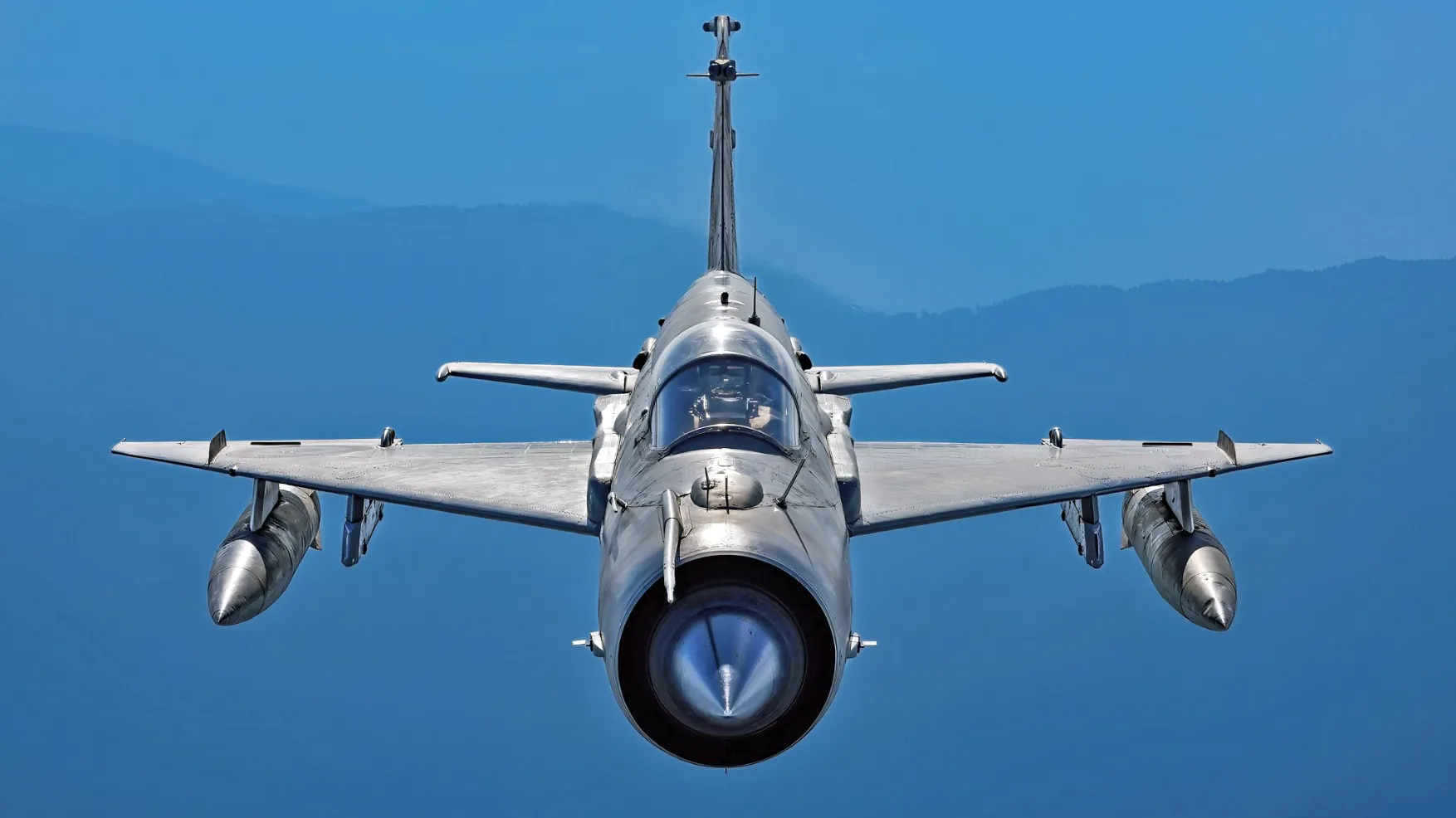
As we described at the end of last year, the Indian government has said that the IAF needs at least 42 squadrons of combat aircraft. Currently, it has just 29, meaning the service is operating its smallest combat force since it went to war with China in 1962. This problem has been exacerbated by the retirement of the veteran MiG-21 Fishbed.
The upgraded MiG-21 Bison was the last version of the iconic Fishbed in Indian Air Force service. Indian Air Force
Meanwhile, the Tejas Light Combat Aircraft program, which should have provided a successor to the MiG-21, has been mired by delays.
An initial-production version of the Tejas Mk 1 during air combat maneuvers. Indian Ministry of Defense
In the background, India faces the dual threats of China and Pakistan.
Shenyang Aircraft Corporation’s (SAC) J-XDS, also referred to unofficially as the J-50. via X
The question of how the IAF shapes up against the Pakistan Air Force (PAF) has long underpinned its status and planning. After the brief conflict last year, both services claimed success with contradictory reports from official channels and rampant speculation across social media.
Pakistan Air Force personnel in front of 14 dual-seat JF-17B fighters rolled out at a ceremony which coincided with the launch of JF-17 Block III aircraft at the Pakistan Aeronautical Complex in Kamra, in December 2020. Photo by AAMIR QURESHI/AFP via Getty Images AAMIR QURESHI
All of this piles on the pressure to modernize the IAF’s aging combat fleet.
At one point, the IAF appeared set on a fifth-generation fighter.
The twin-engine AMCA is planned to feature low-observable characteristics and — in later versions — a supercruise capability, among other advanced features. Bearing in mind that construction is yet to begin, the possibility of putting this aircraft production by 2035, as has been suggested, seems entirely far-fetched. The saga of the Tejas program, in particular, must cast doubt on the future of the AMCA, at least in terms of meeting schedules.
A full-scale model of the Advanced Medium Combat Aircraft (AMCA) is displayed during the 15th edition of Aero India 2025 at Yelahanka Air Force Station in Bengaluru in February 2025. Photo by Idrees MOHAMMED / AFP IDREES MOHAMMED
In the meantime, both the United States and Russia have pitched alternative fifth-generation fighters to India.
Last year, in something of a surprise announcement, U.S. President Donald Trump offered the F-35 to India, while Russia has long sought India as a customer for its Su-57 Felon. As long ago as 2003, the Prospective Multirole Fighter (PMF) was planned as an India-specific version of the Su-57, before New Delhi exited the program, as you can read about here.
A Russian Su-57 (left) and a U.S. Air Force F-35A during Aero India 2025, a military aviation exhibition at the Yelahanka Air Force Station in Bengaluru. Photo by Arun SANKAR / AFP ARUN SANKAR
The budget report indicates that the Indian Ministry of Defense would like to at least have the option of leapfrogging fifth-generation fighters like the AMCA, F-35, and Su-57, and move directly to the sixth generation.
In terms of keeping pace with China and Pakistan, that is an understandable aspiration.
On the other hand, joining either GCAP or the FCAS program would bring challenges of its own.
At this point, GCAP — involving the United Kingdom, Italy, and Japan — might look more promising. Compared to FCAS, the relationship between the three partners is relatively peaceful. There has been talk of Saudi Arabia possibly joining in some capacity, and, more recently, Poland has been reported as being interested in buying the aircraft, too.
But the possibility of India participating more directly in GCAP/Tempest is somewhat remote, since workshare arrangements have already been agreed between the three partners. The IAF would likely be forced to buy the aircraft off the shelf.
The latest concept configuration for the Tempest reveals a design tailored for long-range performance combined with a significant payload capacity. Leonardo
And that is if the British-led program survives the considerable challenges, both technical and political, that lie ahead.
After all, the process of creating an all-new fighter, especially one incorporating stealth technologies, brings very lengthy development times and high costs. The prospect of the Tempest entering service long after 2035 is likely, and the IAF needs new fighters sooner rather than later.
The same goes for the FCAS program, of course.
With FCAS, however, the chances of the program actually making it as far as operational hardware currently seem much slimmer.
For months now, there have been reports of significant rifts between France and Germany on the course that FCAS should take, especially when it comes to workshare, which has yet to be resolved.
French and German officials have repeatedly tried to get the program back on track, in the face of a bitter standoff between the two primes, France’s Dassault Aviation and Germany’s Airbus Defense and Space.
Concept artwork of the NGF fighter that is the centerpiece of the pan-European FCAS. Dassault Aviation
Most recently, it has been reported that France and Germany will have one more go at finding common ground on the program in April.
In the meantime, Germany has raised the possibility of taking its own path to developing a future combat aircraft, something it hasn’t done for decades, and which France has campaigned against.
Whatever happens next month, India’s joining FCAS would be a big risk. Some Indian media reports have suggested that, as a Dassault customer (for the Rafale multirole fighter), India might be able to take Germany’s place in the FCAS program, although it’s equally unclear whether it would be able to negotiate the kind of workshare deal it might want.
An Indian Air Force Rafale. Dassault Aviation
In the best-case scenario, it might be able to buy a much-delayed aircraft that is not necessarily tailored to its own requirements. In the worst case, the program may fall apart entirely and force the various partners to start again from scratch or look for alternatives.
If there is a way for India to enter GCAP or FCAS, that could bring a huge financial windfall for either program. This is what each program needs more than anything else, while increased production rates would mean lower unit costs, preventing the program from entering a death spiral should it mature.
Then there is the future of the AMCA to consider. If India genuinely wants to push ahead with a fifth-generation fighter, which can be developed according to its own particular needs, and over which it retains sovereignty, this program will need to be urgently kick-started. It seems unlikely that it would be possible if India had one foot in either the GCAP or FCAS camps.
Finally, it needs to be acknowledged that it is the Indian Ministry of Defense — acting upon the IAF’s wishes — that wants to join GCAP or FCAS, not necessarily a reflection of what the government wants. As one long-standing Indian defense observer told TWZ, “the standing committee has no teeth.” Until the government signs off on it, the Indian Air Force joining an existing sixth-generation fighter program remains just an aspiration.