The fight had initially been discussed for November but, with negotiations over the venue dragging on, it now looks set for December.
Staging an open-air stadium fight in the UK at that time carries immense risk.
While Wembley offers unmatched prestige, exposing tens of thousands of fans and a massive international broadcast operation to potentially freezing temperatures, wind and rain was deemed unacceptable.
Moving the event indoors to an arena like London’s O2 would eliminate weather risks, but at the cost of sacrificing tens of thousands of ticket sales.
The Principality Stadium’s retractable roof allows organisers to capture the immense scale, atmosphere and gate revenue of a stadium show while offering full protection from the elements.
The venue’s official seated capacity is just under 74,000, but boxing configurations allow for even larger crowds.
Joshua has already proven he can sell out the venue, having defended his WBA and IBF titles there against Carlos Takam in front of nearly 80,000 fans in 2017 before adding the WBO belt against Joseph Parker five months later.
Lisandro Brusco is an Argentine political scientist and Palestine solidarity activist with a track record in geopolitical analysis and journalism focused on Global South struggles. He has contributed as a columnist to international media outlets such as Hispan TV, El Salto, Alma Plus TV, and Huellas del Sur, and is a prominent organizer at Masar Badil. In this exclusive interview, Brusco shares his perspective on the genocide in Palestine, analyzes the expansion of Zionism in Latin America, and outlines the challenges facing anti-imperialist internationalism.
Venezuela recently announced the establishment of consular relations and “technical cooperation” with Israel. The rapprochement began with the arrival of a military-humanitarian contingent days after the June 24 earthquake. How can we explain that an army that destroys hospitals and schools and murders people in Gaza would travel to other countries to portray itself as a lifesaver?
What we saw in Venezuela after the double earthquakes, and in Colombia as well, is part of the Israeli colonial regime’s “humanitarian washing” policy. This involves sending humanitarian contingents to aid the civilian population following a natural disaster. The genocidal state of Israel seeks to restore the image it has lost, especially since October 7. On a global scale, its mask has slipped. People began to see, especially in the West, what the State of Israel was doing to the Palestinian people, even before October 7. After October 7, what we call a “televised genocide” became even more evident. Much credit goes to the press and grassroots journalists, many of whom have been killed, especially in the Gaza Strip.
Israel has lost the legitimacy it once enjoyed in global Western opinion as a democratic state, as a state constantly under attack by neighboring nations, by Arab countries. All those myths are crumbling.
“Humanitarian washing” is an attempt to say, “Here are the good guys coming to show solidarity with this population.”
How is it possible that a regime – which has destroyed more than 70% of the infrastructure in the Gaza Strip, which blows up hospitals, schools, and mosques, which has destroyed the agricultural production capacity, the very little the Gaza Strip had, which blocks the entry of humanitarian aid, could turn around and send so-called humanitarian contingents to other regions?
Some of these contingents include soldiers who have even been accused of genocide and are wanted for arrest.
How can this happen? Because governments complicit in this genocide allow these troops to enter their territories. Unfortunately, this is happening in Latin America.
This entire whitewashing mechanism is also applied on social media. In 2025, Israel invested $1 billion in PR firms, influencers, digital diplomacy, artificial intelligence, and so on. The settler-colonial regime needs to control search engines to steer information in its favor and create a permanent stranglehold on social media, so that the public consumes fake news it produces.
Venezuelan Acting President Delcy Rodríguez held multiple meetings with the Israeli military-diplomatic mission. (Presidential Press)
Israel’s influence in Latin America has been linked to the sale of surveillance technology and “combat-tested” weaponry used against the Palestinian people and on other fronts. As Venezuela normalizes its relationship with Israel, what are the main risks you see?
The Zionist lobby in Latin America operates in tandem with imperialist interests in the region. It is very important to highlight this premise in order to analyze the situation correctly and implement sound political strategies.
This is not a recent development: that organic link already existed between the Israeli colonial entity and the ecclesiastical-civil-military dictatorships that were imposed by blood and fire across Latin America in the 1960s and 1970s.
They were not individual Zionist links with each dictatorship, but with the imperial project being imposed on the region: Operation Condor, the US policy toward Latin America and the Caribbean aimed at quelling the revolutionary movements that were taking shape. Israel sold weapons and provided military training to those dictatorships.
The process continued with the so-called democratic transitions of the 1980s and gained new momentum following the US “War on Terror” offensive beginning in 2001. Today we also see this expressed in a clear strengthening of the ties between the Zionist movement, the State of Israel, and US imperialism.
This is not about particular interests, nor is there any intention to create a situation in Latin America similar to that in Palestine. Israel has no plan to build settlements in the region. Here, Zionism continues to support the capitalist imperialist interests of the United States.
We see this in the trade agreements that various governments have signed with Israeli surveillance, arms, and extractive companies.
For example, the Israeli state-owned water company Mekorot advises various provincial governments in Argentina on water management. Similarly, the Israeli company XtraLit is involved in the extraction of lithium, a strategic mineral for contemporary capitalism. Another example is Navitas Petroleum, an oil company that also extracts resources in Argentina.
The focus of these Israeli companies is the same as that of global capitalism: resources. And to ensure the extraction of resources, they need repression; that is why they have military companies, surveillance software, and so on.
Because what Israel has historically sold to the world is repressive technology tested on the ground. Who can better vouch for military tools than the genocidal regime par excellence?
Obviously, there is a political landscape in the region that facilitates all of this: governments like we have in Argentina, Colombia, Chile, and Ecuador. These are governments subservient to imperialist interests, which even create regional and global political structures such as the Isaac Agreements – signed by the Milei administration – that are set to expand to other nations. All of this goes hand in hand with military initiatives such as the Shield of the Americas.
The presence of Zionism in Latin America is a political concern for anti-imperialist activists: there is a hegemonic bloc that is coming for our resources, our territories, to plunder, pollute, and destroy our land. We must fight this bloc.
Having been on the ground in the West Bank, you describe how the machinery of home demolitions, checkpoints, and the violent expansion of settlements operates on a daily basis. How is the settler-colonial project sustained economically and militarily, and what role does the complicity of the international community play?
Israel is sustained, to a great extent, by the United States, international banks, and European powers such as Germany. Without US support, Israel would not have lasted a week in the recent war against Iran. The US Congress, driven by the Zionist lobby, had to approve emergency funds to support Israel’s military defense.
On the other hand, the settlements in the West Bank are sustained economically by state support from the Israeli regime, through subsidies – largely contributions from multinational corporations, ranging from investment funds to Zionist foundations such as the Jewish National Fund.
And the international community, such as the United Nations, has historically legitimized and normalized this occupation, not only through the resolution that allowed for the establishment of the State of Israel, but also by failing to take action against Jewish settlements in the West Bank, despite declaring them illegal.
It is worth noting that when the Oslo Accords were signed in 1993, there were just over 150,000 settlers in the West Bank. Today there are approximately 700,000. There are entire cities that are illegal settlements, with industries, schools, police stations, and so on.
The UN member states are also doing nothing. They could sever trade and diplomatic ties with this genocidal entity, but even the powers that proclaim themselves anti-hegemonic fail to do so.
The only sovereign state that has no ties to the Israeli regime and whose political goal is the destruction of this colonial entity is the Islamic Republic of Iran. It is the only country that has advocated for the destruction of the Israeli occupation of Palestine since 1948.
In short, there is no political initiative by the international community to at least halt the advance of illegal settlements in Palestine. Recently, although the systematic aggression against Gaza continues, the Zionist entity is making much greater inroads in the West Bank through its settlers.
Settler civilians – the vast majority of whom are armed – set fire to Palestinian homes and fields, kill grazing animals, and prevent Palestinian children from going to school. All of this takes place under the protection of the Israeli occupation army. The situation is desperate, and often – with a few honorable exceptions – Palestinians feel that they are on their own.
Brusco has witnessed the brutality of the Israeli occupation first-hand. (Archive)
In the West Bank, you spent time alongside local families. In the face of Israeli violence, how do the Palestinian people sustain their daily lives, their culture, and their resistance in the face of this ongoing occupation?
It is a question as important as it is difficult to answer, because from our perspective it is hard to understand how the Palestinian people sustain their daily lives, their culture, and their resistance in the face of such genocide and ongoing occupation.
As with all anti-colonial struggles, there is a fundamental factor that the colonizers fail to consider as a variable: the Palestinian people’s deep connection with their land. This goes far beyond a purely utilitarian view; it is an ancestral, cultural, social, and historical bond. That is why, despite the brutal attacks of the Zionist occupation, the Palestinian people have no intention of leaving their territory.
Getting them to leave is the primary objective of the Zionist movement: a project of ethnic cleansing that has failed to do so for over 100 years, despite Western support. As time goes on, the Israeli regime faces increasingly severe crises, while the Palestinian population remains steadfast on its land.
We must bear in mind that there is also a deliberate effort to destroy written historical records, civil registries, libraries, and universities. All of this is part of a very clear mission to erase the written history of the Palestinian people. In the face of this, memory is preserved and expressed through oral history – the stories that refugees pass down to new generations.
Therein lies the idea of return and liberation, symbolized by the key. This goes far beyond the material property that families once owned in what is now the State of Israel. The key embodies the history of a people, of a family, their tradition of struggle, their connection to the land, and their origins. It is not conceived in terms of private property, but rather from a social and historical perspective.
That is why, in every refugee camp – whether in the West Bank, Gaza, Lebanon, Jordan, or Syria – each family preserves not only the key but also its customs and identity. If we ask a third- or fourth-generation Palestinian refugee, born in Beirut, where they are from, they will immediately name the Palestinian village razed in 1948 from which their family hails. That identity remains extremely strong even several generations later. That is why there is such brutal repression against the refugee camps, because that is where the revolutionary spirit is preserved.
This tradition is sustained in large part by the daily efforts of families and, in a very special way, by the educational role of women. They are the ones who pass down oral history to children and take charge of their education, especially in contexts where children are prevented from attending school due to Israeli checkpoints or settler attacks.
Alongside this collective memory, Palestinian society draws on solidarity and community resilience. Facing daily policies of apartheid, displacement, torture, home demolitions, and mass incarceration, the community responds collectively. Committees of prisoners’ family members are organized, and when a home is slated for demolition, the community mobilizes to ensure that the family is not left homeless.
In the face of apartheid and ethnic cleansing, resistance is practiced in daily life.
In your writings, you address the essence of the Zionist colonial project and the imposition of permanent control structures in Gaza. What plans does the Israeli government have in store, together with Trump’s Board of Peace, for Gaza?
The Board of Peace is yet another of the many tools of the Israeli colonial regime. In this case, it was proposed by the United States, just as others came from the British Empire, just as the UN hatched a plan to create the State of Israel on Palestinian territory.
These are proposals imposed by the West to ensure the expansion of the State of Israel – as a Zionist project – across all Palestinian territory and beyond.
Thus, the Board of Peace is a strategic policy of the Zionist movement, a tool for administering this occupation, denying the genocide, and imposing a supposed stability built upon the total massacre of the Palestinian people.
We’ve seen this story before, even in Oslo in 1993. At that time, there was talk of building a Palestinian state, of economic growth, of foreign investment, of an economy integrated into the region, and of the creation of a so-called Palestinian Authority.
Far from that, the result was a territory that became even more controlled, more occupied, more fragmented, and more bombed. The Palestinian Authority, it is now undeniable, serves the occupation, collaborating in the repression of those who oppose normalization and the recognition of the State of Israel.
So, I’ll say it again: Trump’s Board of Peace has nothing to do with peace. It serves to uphold the policy of exterminating the Palestinian population and destroying homes, farmland, water supply systems, roads, hospitals, schools, markets, refugee camps, and so on. All the infrastructure that supported daily Palestinian life in the Gaza Strip has now been destroyed.
And this Board of Peace proposes the reconstruction of this territory. Reconstruction for what purpose and for whose benefit? Who will manage this reconstruction? Who will control food supplies and productive land? This Board of Peace goes hand in hand with a plan for the total colonization of the Gaza Strip and total control over its territory, with the possible establishment of a Palestinian governing body in the future.
But in reality, just like the Palestinian Authority in the West Bank, what it will guarantee is the occupying power’s control over that territory, along with a supply of cheap labor.
“Yankees and Zionists out of Venezuela” banner in a recent protest. (Leo Fernandes)
For years, progressive governments in Latin America firmly condemned Israel, and in some cases even severed ties. In the current climate, where realpolitik prevails and the normalization of the Zionist regime is advancing, what challenges do solidarity movements face in sustaining support for the Palestinian cause?
From a communications perspective, the role of grassroots solidarity movements with Palestine is central. We saw this beginning on October 7, 2023, when Palestinian journalists and media workers in Gaza and Lebanon became military targets of the Israeli colonial regime, in response to the threat that was beginning to emerge in the battle of ideas, in the battle for the hearts and minds of the people.
Communication work is strategic when it comes to fostering critical thinking and a revolutionary, solidarity-based practice that breaks with the commodified conception of news to uphold the basic principles of informing the public.
On the other hand, the role of international movements – both in the West and in West Asia, as well as in the countries of the Global South – is fundamental. What the Al-Aqsa Flood operation did was precisely to mobilize and awaken many peoples who were dormant and to show that the enemy is not invincible.
We can launch our own political initiatives, including military ones, to create crises in these genocidal, criminal, and occupation projects that exist today in West Asia and throughout the world.
One key question to address from a solidarity perspective is: How do we bring these national liberation resistance movements together? We must approach this from an internationalist perspective. For example, any victory for the movements organized around the Axis of Resistance that directly confront imperialism – the United States and Israel – is a victory for the peoples of Latin America who face the same enemy. This is the Guevarist conception that any defeat of imperialism anywhere in the world is a victory for the peoples.
It seems to me that this solidarity bond must be organic and strategic when considering the building of international fronts that break the capitalist domination that prevails in much of the world.
If revolutionary governments came to power in Latin America and truly severed ties with the Israeli entity, that would weaken all those fronts involved in the sale of arms, technology, etc,. and set a precedent for other peoples around the world.
And that is the way to support the Palestinian cause, which is the cause of liberation and return. We, too, must instill in public opinion and in our discussions with all organizations the conviction that Palestine will be free from the river to the sea. Today, we cannot reconcile the liberation of the Palestinian people and their return with the existence of the State of Israel.
We need to build political, organic, and genuine solidarity that focuses on projects of national liberation and collective emancipation. And it seems to me that the Al-Aqsa Flood has, in a way, established precisely that: that the best way to change the status quo is by dealing real and tangible blows to colonialism and imperialism.
Brusco interviewing Georges Abdallah, a Lebanese militant who was released in 2025 after more than four decades as a political prisoner in France. (Resumen Latinoamericano)
WASHINGTON — The unprecedented spate of mid-decade redistricting for the U.S. House has changed the congressional districts for one-tenth of Americans and significantly altered the makeup of at least one-fifth of districts, according to a new study.
A report by Protect Democracy found that 34.8 million people — about one in 10 Americans — now live in a different district than they did during the 2024 election cycle. And about one-fifth of all Americans now live in a district where more than a quarter of voters are new to the district compared with the last election cycle.
The findings display the stark overhaul that partisan redistricting fights kicked off by President Trump last year have caused for Americans across the country. The new congressional maps are increasingly drawn in ways that favor partisan politics over factors like geography and shared communities. That raises concerns among scholars about how the country’s hyperpolarized politics are affecting American democracy.
“If this trend continues, it really brings into question whether or not elected officials are really representing their constituents anymore, or if the voters are being randomly picked by mapmakers to squeeze out partisan advantage,” said Ben Raderstorf, a policy advocate at Protect Democracy and one of the paper’s co-authors.
The bare-knuckled partisan redistricting battle for the House began when Trump urged the Republican-controlled legislature in Texas, the second most populous state, to redraw its congressional map to help the party. The highly unusual plan prompted an immediate response from California, the most populous state, which held a successful referendum to tilt its map toward Democrats.
Other states followed, and Republicans are positioned to potentially gain nine seats because of redistricting.
The Protect Democracy report warns that such partisan tactics reduce faith in American elections generally and insulate incumbent lawmakers from public opinion. That can make political organizing more difficult, the report cautioned, potentially worsening the country’s already highly polarized politics. Both parties may also enter a “doom loop” where they embrace more aggressive and frequent redistricting efforts to avoid ceding any ground to their rivals.
In some states such as Missouri, the mid-decade redistricting has created confusion for voters about which district they live in and which candidates will appear on their November ballot. After conflicting lower court rulings, the U.S. Supreme Court last week blocked new Missouri districts backed by Trump that had been used in the primary, leaving the state to revert to its previous districts for the general election.
The report concludes with a call for new electoral structures the authors believe would eliminate the potential downsides of partisan redistricting, like proportional representation or a formal truce between the parties to implement nonpartisan districting plans.
Nine states already use nonpartisan commissions to draw congressional district lines but those provisions have limits. California, for instance, suspended its nonpartisan maps with a referendum last year in response to Texas’ redistricting measures.
Such remedies would face long odds in Congress and statehouses, but scholars believe there are few other avenues to turn down the temperature in the partisan redistricting fights.
“This is only going to get worse until somebody stops it,” Raderstorf said. “The logic of gerrymandering points inevitably towards maximalist partisan advantage on both sides. There is no off-ramp other than reform. It is the only way to break the cycle.”
José Rivera’s “Marisol” came out around the same time as Tony Kushner’s “Angels in America,” and both plays, vibrating with millennial anxieties, carry the earthly battle for human survival up to the heavens.
There’s a dramatically prominent Angel (Taylor Scott) as well in Rivera’s drama, now in an Open Fist Theater Company revival at Atwater Village Theatre. This celestial warrior has been protecting Marisol (Jade Santana) without her knowing it throughout her life. Marisol, referred to by a publishing colleague as “Miss Puerto Rican Yuppy Princess of the Universe,” still lives in the Bronx and is assailed by dangers just getting to and from work every day.
After an incident on the subway with a deranged man threatening her with a golf club, Marisol returns to her cramped, noisy apartment to learn that her guardian angel is abandoning her to enlist in the battle to replace a senile God, who (to judge by the ailing state of the universe) has grown too old for the job.
Jack Sharpe and Jade Santana in ‘Marisol’ at Open Fist.
(John Dlugolecki)
Marisol will have to fend for herself in New York, a dystopian landscape where crime is rampant, poverty is pervasive and the unhoused are threatened by roving gangs of Nazi skinheads who set them on fire for kicks.
What follows is a modern picaresque journey, in which a clever underdog has to rely on her wit and wiles to survive a corrupt and perilous world. Rivera’s play, which won an Obie Award, caught fire in its 1993 New York premiere at the Public Theater with its theatrical street sense, savage imagery and Puerto Rican-inflected magical realism.
The apocalyptic fears boiling up in the play are perhaps even more acutely felt today, with the ravages of climate change compounding each year and the threat of AI hanging an existential cloud over our heads.
But what’s most satisfying about this reencounter with “Marisol” is seeing a new generation embrace the play’s kinetic freedom. Rivera, who received an Oscar nomination for his adapted screenplay for the 2004 film “The Motorcycle Diaries,” solidified his reputation with this play after his breakthrough work “The House of Ramón Iglesia.”
Director Amanda Weier and her company approach “Marisol” as though it were a new play. The quicksilver changes of scene in this urban hellscape are handled with crisp dispatch. Subway cars and burned-out streets don’t require much in the way of elaborate illustration for the overhang of menace to be felt.
Occasionally, particularly in the early going, the blocking and Christopher Moscatiello’s sound design seemed to be working at cross-purposes. The production’s adventurousness, traversing every corner of Brad Bentz’s scenic design, can have a diffuse effect.
But the clever props design (Bruce Dickinson and Anna Krause) fills in any shoestring gaps. And Mylette Nora’s costumes artfully conjure both the underworld and the spiritual realm.
Jade Santana and Hutchins Foster in ‘Marisol’ at Open Fist.
(John Dlugolecki)
Santana’s Marisol, likable yet spiky, anchors the revival. Her interactions with the golf club maniac (Matthew Goodrich) and the scarred homeless man (Hutchins Foster) are fearfully intense, as they should be.
Grace Soens, who plays June, Marisol’s confederate at work, and Jack Sharpe, who takes on the role of Lenny, June’s mentally disturbed brother, expand this unstable world, where it’s hard to know who to trust.
“Marisol” is rife with ambiguity. One of the biggest questions is whether Marisol is dead or alive. But the surreal reality extends to the map of New York. Marisol can no longer tell if she is heading north or south. And the number of characters wielding golf clubs as deadly weapons raises the concern that the villains are interchangeable — and that the good guys have all fled.
One thing that’s certain is that Marisol will have to take up the fight for her own future. With no one left to protect her, she’s learning to look after herself and those she cares about. To become, in other words, the hero that’s needed to turn this momentous struggle around.
‘Marisol’
Where: Atwater Village Theatre, 3269 Casitas Ave, L.A.
When: 8 p.m. Fridays-Saturdays, 4 p.m. Sundays. (Check for exceptions and additions.) Ends Oct. 24
LAS VEGAS — After taking 10 years to win his first world championship, Ryan Garcia needed only 4 minutes and 25 seconds to finish off Conor Benn on Saturday night in the first defense of his WBC welterweight title.
“I kind of figured he would just come at me crazy,” Garcia said. “Second round, I said I’m tired of him coming forward; I’m gonna stand my ground a little bit … and then he got caught with a hellacious one.”
Garcia’s sharp right hand to the jaw put Benn on the canvas early in the second round. Moments later, with the Englishman on the ropes, Garcia (26-2, 21 KOs) served a flurry of punches that prompted referee Thomas Taylor to step in and end the contest at the 1:25 mark and send the announced sold-out crowd of 18,855 into a frenzy.
”He’s exactly what I thought he was; he went in and tried to fight me. I think he needs to be a little bit more patient,” Garcia said. “I don’t think he has enough experience. I think he will be back. I have a new level of respect for him.”
Garcia closed -300 at BetMGM, meaning bettors would have had to put down $300 to win $100.
WBC welterweight champion Ryan Garcia celebrates after defeating Conor Benn in the second round Saturday.
(Steve Marcus / Getty Images)
The bout was more than another high-profile main event, as it marked a career-defining crossroads for both fighters.
For Garcia, he solidified himself in the 147-pound weight class as a durable, legitimate titleholder rather than a gifted attraction whose career has often been defined by controversy, inconsistency and unrealized potential.
The convincing victory positioned Garcia for a lucrative welterweight fight against the division’s other leading names, including Teofimo Lopez, who was ringside, or another major showdown with Devin Haney, who was also in attendance.
For the 29-year-old Benn (25-2), it’s likely back to the middleweight division after failing in his first world-title opportunity and a chance to escape the considerable shadow of his father, former two-division champion Nigel Benn.
Benn was transported to a hospital after the fight for observation.
In the co-main event, Jai Opetaia (31-0, 24 KOs) patiently weathered several cagey rounds before stopping Noel Mikaelian in the ninth round of their scheduled 12-round lineal cruiserweight championship fight.
Opetaia stunned Mikaelian (28-4) with a multi-punch combination and two crushing hooks, then sent him backward into the ropes with a powerful right hand. Referee Harvey Dock administered a standing eight-count before determining Mikaelian could not continue, ending the competitive fight by TKO at 1:30.
Da’Mazion Vanhouter (13-0, 10 KOs) wasted no time in his scheduled eight-round heavyweight bout, delivering a crushing right hand at the 1:58 mark of the first round for a knockout of Raphael Akpejiori (19-4).
In the 10-round lightweight bout that opened the main card, Andres Cortes (26-0) retained his belt with a unanimous decision over Mark Magsayo (29-3), with all three judges scoring the fight 97-93.
WASHINGTON: President Donald Trump vowed Friday that the United States would never forget the September 11, 2001 attacks and suggested the country was continuing the “war on terror” 25 years later by fighting Iran.
Speaking at the Pentagon after skipping the main 9/11 commemorations in New York, Republican Trump also hit out at domestic “fanatics” in an apparent swipe at Democrats.
“Today we renew the sacred oath that we first swore in their names a quarter of a century ago. We will never, ever forget. That’s why we fight today,” Trump said in a speech.
“We don’t have a choice. There can only be victory. We fight hard. We fight to win,” added the president, who was accompanied by First Lady Melania Trump.
One of the jets hijacked on 9/11 hit the Pentagon in Washington, killing 184 people who were remembered by a single bell tolling as their names were read out.
But presidents have previously marked major anniversaries by attending several sites including New York, where the majority of the 2,977 victims were killed in the attacks on the World Trade Center.
Trump went on to link the fight against Al-Qaeda launched by his Republican predecessor George W. Bush to the US-Israeli war on Iran which is now in its seventh month.
“Today we salute every member of the United States military who served in the ‘War on Terror.’ It is a war on sick, horrible terror,” Trump said.
“And we salute the service members working right now to ensure the world’s number one sponsor of terror, the Islamic Republic of Iran, will never ever have a nuclear weapon.”
US Defense Secretary Pete Hegseth also lashed out at Iran in his remarks to the Pentagon ceremony.
“Over the past six months, we have laid waste to the world’s most prolific state sponsor of terrorism. Our warriors have fought an Islamic theocracy that has wished us death for nearly half a century,” Hegseth said.
The Iran war has slid into a stalemate with Iran largely maintaining its grip on the Strait of Hormuz, and keeping oil prices high, despite sporadic exchanges of fire with the United States.
Trump also turned to the domestic front, a day after a Republican convention for the US midterm elections in which Trump and Vice President JD Vance accused Democrats of sympathizing with the 9/11 attackers.
“A generation after 9/11, we also know that the final response to those atrocities and the ultimate victory over the perpetrators will not be found on a foreign battlefield,” Trump said.
Telling the story of a firefighter killed in the attacks whose son went on to become a US Navy veteran, Trump said it showed that “we can be a nation whose heroes are not fanatics for an abstract cause.”
In his speech to the Republican convention on Wednesday, Trump had used the same term: “With your vote in this election, you can tell these far-left lunatics and fanatics that America is not for sale to them or to anybody else.”
Republicans at the convention repeatedly trained their fire on left-wing Democratic senate hopeful Abdul El-Sayed over his previous social media posts about 9/11.
THE Office star Lucy Davis has tackled a terrifying zip-wire challenge amid her terminal cancer fight.
The 53-year-old announced last month that she’s been diagnosed with incurable stage four breast cancer.
The Office star Lucy Davis has bravely taken on a gruelling hike and terrifying zip wireCredit: reallucydavis/ InstagramShe took to Instagram to share her zip line challengeCredit: reallucydavis/ Instagram
She admitted “I don’t know how long I have left” as she revealed the tragic news with her followers in a video on social media.
However, Lucy said she was determined to have as much fun as she can during the time she has left and she’s doing exactly that.
Sign up for the Showbiz newsletter
Thank you!
The daredevil shared her pride on Wednesday after completing a gruelling hike followed by a scary zip line through a California canyon.
She took to Instagram to share pictures of herself on the hike as well as video of the moment she bravely took on the zip line.
Lucy took the zip line in her strideCredit: reallucydavis/ InstagramShe hiked across the California canyonCredit: reallucydavis/ Instagram
Lucy penned: “I loved this #zipline and I was a bit proud of myself for doing it because they said to be prepared for a 25 minute walk, so I took my pain meds an hour before in preparation.
“In previous zip lines, I’ve always been driven up to the first line, and the walking is in between the lines.
“But no. This was a legit hike up to the first zip. It took me one hour and 15 minutes.
“I was so grateful for the support of the guides and my friend @jharris1231 who helped me up, and the other people on the hike that never judged me or made me feel stupid. Thank you.”
Her fans flocked to the comments section as one expressed: “Still living to the fullest and experiencing life. Good on you!”
Another person commented: “Oh wow, you’re fabulous Lucy. Still chokes me up though.”
Somebody else gushed: “You are such an inspiration. Also, whenever I see you I remember Aunt Hilda, she was so comforting as a character.
“You really played her so well, you’re truly amazing. So talented and inspiring.”
She revealed last month that she’s got incurable cancerCredit: instagram/reallucydavisShe’s best known for her role in The OfficeCredit: BBC
Yet another added: “My gosh Lucy, so much courage! You are such an inspiration.”
Lucy took to Instagram last month to share her heartbreaking news.
She wrote: “Hi friends:) I wanted to share something with you all that I’ve kept to myself for a while but for various reasons would like to share now.
“A year and a half ago I was diagnosed with Stage 4 Breast Cancer, which has metastasized to my bones. Specifically to my spine, right hip, and my ribs. The cancer is incurable, and too late for chemo.
“The initial lump that I felt, wasn’t a ‘lump’ as such; rather a kind of hard spot. Really tiny.
“I almost didn’t bother getting it checked. So I guess I’m saying don’t ignore anything – get everything checked out.”
Lucy told her fans that she’s at peace with “whatever comes next,” as she shared the clip of her ringing the cancer treatment bell.
While she rang the bell, Lucy confessed she has been told by doctors it’s “too late” for her to receive Chemotherapy.
WASHINGTON — Republicans appeared to have a firm grip on the Senate heading into the final two years of President Trump’s term. But with less than two months until Election Day, control of the chamber is now up for grabs.
Democrats have found themselves competing in states that once seemed beyond their reach as Trump’s slipping approval ratings and voters’ dissatisfaction with the economy create a difficult political environment for Republicans. But races Democrats once counted on winning have also become more complicated.
It’s a battle that’s expected to exceed $3.4 billion in spending across all races during the midterm campaign. The implications are huge for Trump’s agenda and his ability to fill administration jobs and open court seats for the remainder of his term, as the Senate is empowered to confirm or block presidential nominees.
Republicans say it’s unlikely for everything to break in Democrats’ favor, but they acknowledge they’re facing a difficult landscape. Senate Majority Leader John Thune told South Dakota’s KELOLAND News last week that he does “worry” about losing the chamber.
“I’m a realist,” Thune said. “I don’t ever try and sugarcoat things. I think it’s a competitive environment right now.”
Democrats face a scrambled path to the majority
Democrats need to net four seats to win the majority. The original path had been to hold Michigan, Georgia and New Hampshire while winning back Republican-held seats in Alaska, Maine, North Carolina and Ohio. But things have changed.
“We now have multiple paths for the majority,” Senate Democratic Leader Chuck Schumer said last month. “We found new states — Iowa, Texas — which people a year ago weren’t even paying attention to.”
Some of the states where Democrats were feeling most optimistic at the start of the election cycle, such as Michigan and Maine, have grown murkier.
In Michigan, where there’s an open seat this fall, no GOP candidate has won a Senate race since 1994. But Democrats are struggling to unite behind nominee Abdul El-Sayed. The favorite of progressives narrowly defeated moderate U.S. Rep. Haley Stevens in the August primary, and feelings remain raw from a bruising contest that saw nearly $70 million spent against El-Sayed.
Republicans believe Mike Rogers, who lost the 2024 Senate race by fewer than 20,000 votes, has an improved shot against El-Sayed. The Senate Leadership Fund — Senate Republicans’ spending PAC — added $6 million to its Michigan advertising investment after El-Sayed won, bringing their total spending to $51 million, the third-highest total.
Democrats also saw a prime opportunity to finally defeat five-term Republican Sen. Susan Collins in Maine, where Democratic Vice President Kamala Harris won more votes than Trump in 2024.
Progressive Graham Platner easily won the nomination in June, but he left the race the next month over a sexual assault allegation that he denies. Democratic delegates in late July chose Troy Jackson, a lesser-known former state legislative leader, to replace him.
Jackson has been forced to play catch-up. Collins and aligned super PACs have spent almost $80 million so far, according to the ad-tracking firm AdImpact, while Jackson and Democratic-aligned groups have spent and reserved close to $45 million since he became the nominee.
As one path narrowed for Democrats, others widened
Democrats increasingly see a real possibility in Texas, a state that has been an elusive goal for decades, and other GOP-led states including Iowa, Alaska and Ohio.
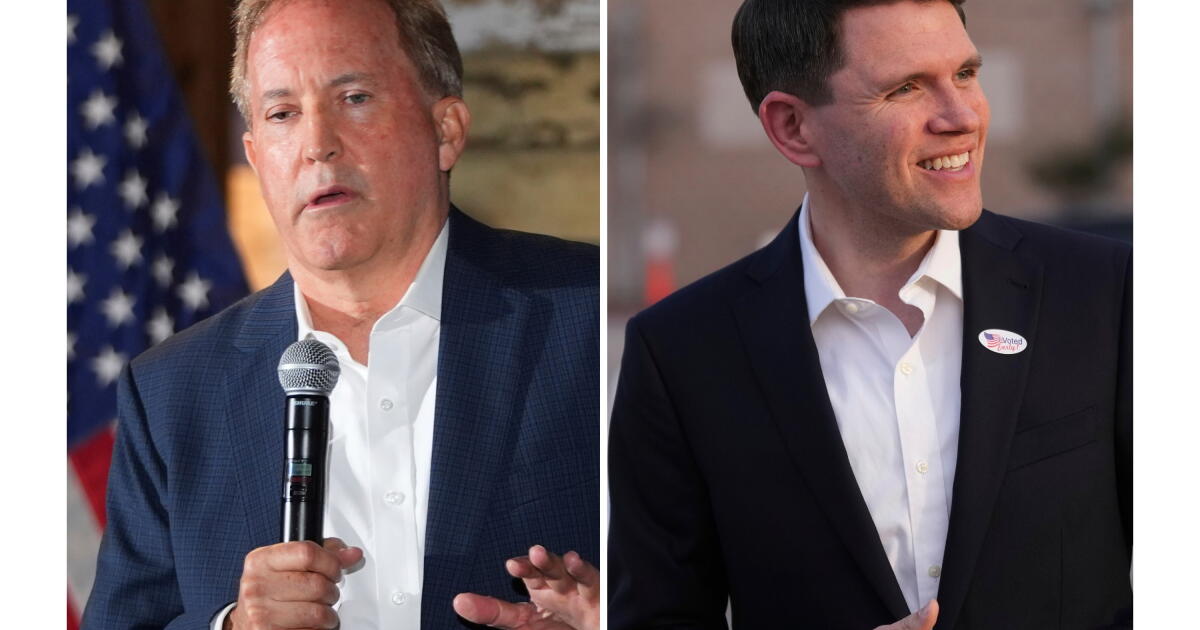
In Texas, Democrat James Talarico faces state Attorney General Ken Paxton, who ousted four-term incumbent Republican Sen. John Cornyn to win the GOP nomination. Senate GOP leadership backed Cornyn, seeing him as the stronger general election candidate.
Paxton has been shadowed for decades by legal and ethical questions, including indictments for securities fraud, though he was not convicted.
Talarico and allied groups have spent nearly $30 million on advertising since the May runoff, compared to less than $3 million by pro-Paxton groups. The political fund associated with Trump last week spent $10 million on TV and digital ads to help Paxton — the first major general election investment by MAGA Inc. for the midterms. Senate GOP leaders had petitioned Trump’s political team to spend some of the more than $400 million it had last month to help Paxton.
Democrats have also upped their spending in Alaska, Iowa, Ohio and North Carolina, all states currently held by Republicans. The GOP, meanwhile, is feeling more optimistic about New Hampshire as well as Michigan, while spending more to defend seats in Iowa and Alaska.
The expanded map has upped the anticipated total spending this cycle. AdImpact in June projected $3.4 billion in advertising spending on Senate races, a significant increase from the $2.8 billion the ad spending firm projected in the fall of 2025.
Why more states are in play than expected
Democrats’ path has widened in part because of Trump’s slumping job approval, notably on handling the economy, which was at 32% according to an AP-NORC poll in July — down from 40% in March 2025, shortly after he took office.
Trump’s trade policies and the war in Iran, with its corresponding inflated fuel costs, have added to the economic uncertainty for voters less than two months before Election Day.
“Things still cost too much. And so we’ve got to work on that issue,” Republican Rep. Jim Jordan of Ohio told The Associated Press. “We understand that and we know that’s real.”
Ohio Sen. Jon Husted heard the concern firsthand at a roundtable last month. Husted is looking to fend off a comeback from former Sen. Sherrod Brown in another key matchup for both parties.
During the discussion on housing, one attendee told Husted that costs were “skyrocketing” in part because of uncertainty around tariffs.
“Uncertainty is the killer to this economy,” said Dean Windham, a real estate developer who previously ran for office as a Republican.
Some Republican Senate candidates have defended Trump’s policies while confronting concerns about their economic impact.
In Michigan, where Trump’s tariffs on Canada have become a central issue, Rogers has backed the president’s approach while leaving room for disagreement.
“President Trump is right to put America First — and tariffs are necessary, but are not a one-size-fits-all solution,” Rogers said in a recent statement.
Republicans believe the math still favors them
Even if Democrats hold every seat they currently control, they would need to flip at least two seats in states Trump carried by double digits in 2024 to win the majority.
Republicans are betting that those underlying advantages will matter more as Election Day approaches — particularly as Trump and the party turn their attention toward mobilizing voters who helped return him to the White House.
Trump told reporters last week that he will “be making a lot of stops” in the last 30 days before the election.
This week, Republicans will hold a midterm convention in Texas, where Trump is set to speak and top Senate candidates including Rogers and Husted are expected to attend.
But Republicans acknowledge they have work to do.
“Politics is local,” Republican Sen. Mike Rounds of South Dakota said. He pointed to Trump’s decision to import beef, which he said made farmers and ranchers “feel just like the administration pulled the rug right off from underneath” them.
“They’re hurt,” Rounds said. “They feel like they’ve been let down.”
Cappelletti, Beaumont and Jalonick write for the Associated Press. Beaumont reported from Des Moines, Iowa.
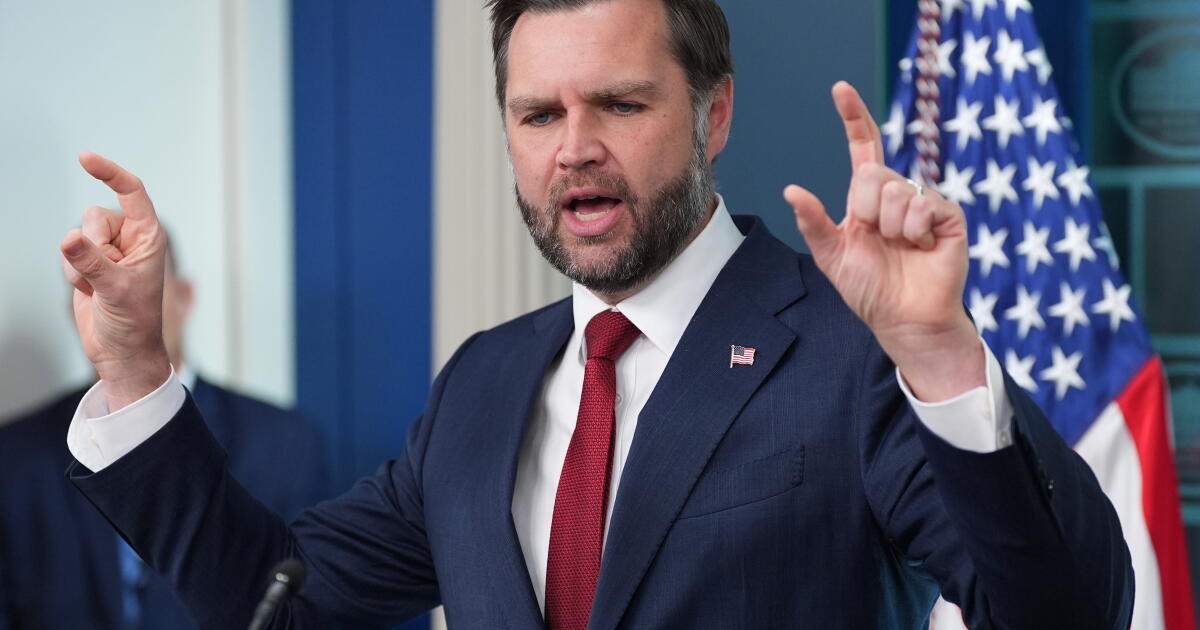
WASHINGTON — Vice President JD Vance rejected the use of the word “war” to describe the U.S. fighting with Iran as he steered clear of predicting that the six-month-old conflict would be over by November’s midterm elections, in which Republicans are trying to hang on to their narrow majorities in Congress.
“I wouldn’t call it a war,” Vance said Thursday after being asked during a White House press briefing about whether the fighting could end before voters cast their ballots in the Nov. 3 congressional elections. “Right now, there is no active shooting.”
Vance’s assertion came even as Iran fired at U.S. Gulf ally Kuwait on Thursday as it continued to retaliate for rounds of U.S. strikes on Iran earlier in the week.
The vice president said the U.S. had a “responsibility” to carry out this week’s strikes because Iran continued to target commercial vessels passing through the Strait of Hormuz.
Vance’s attempt to minimize the intensity of the fighting illuminates the difficult task at hand for Trump and his administration as he tries to persuade American voters to keep Republicans in control of Congress, even as the unpopular conflict — one the White House said at its outset would last a matter of weeks — has driven up gas prices and left consumers grappling with higher inflation.
Vance said he didn’t want to set “artificial timelines.”
“But when you ask, ‘When will this end?’ You’re asking me a question like, ‘When will the Iranians stop shooting at ships?’” Vance said. “I think the reality is, I don’t know the answer to that question. You would have to ask the Iranians.”
The administration in July faced scrutiny after it reclassified four fallen soldiers as well as dozens of wounded troops in its Defense Casualty Analysis System, which Pentagon officials have repeatedly pointed to as the definitive source on the numbers of dead and wounded from the conflict. Those killed or wounded in fighting after a brief ceasefire between the U.S. and Iran fell apart were classified in a new category called “Overseas Operations” after initially being tallied in the totals from the war.
White House insists more oil is getting out of Gulf, but prices remain high
Brent crude prices hovered above $95 per barrel Thursday. The international benchmark was around $72 per barrel the day before the conflict began.
Still, Trump and his aides have sought to push that the U.S. Navy is in control of the Strait of Hormuz, where about 20% of the world’s traded oil passed before the war. They insist a near prewar level of Gulf oil is now making its way out of the critical waterway.
Vance at Thursday’s press briefing said the U.S. escorted about 15 million barrels of oil on Wednesday. This was after Energy Secretary Chris Wright told CNBC on Wednesday that 17 million barrels were carried through the strait on Monday with assistance from the U.S. Navy. About 20 million barrels of Gulf oil flowed through the strait prior to the start of the war.
But ship traffic through the strait remains well below prewar levels, according to independent firms that track marine traffic.
There were 102 transits last week and 126 the week before, according to shipping data company Lloyd’s List Intelligence, compared with 130 or more per day before the war.
Over the past 28 days, 5 million barrels a day have exited the strait on average, according to TankerTrackers.com. Other recent estimates have varied from 2 million barrels per day to 6 million barrels per day.
Trump has tried to soothe volatile markets
Over the course of the war, Trump has repeatedly reported progress in negotiations or called off threats of military action at the last moment when global markets have become jittery. And markets have reacted swiftly to his public signals of peace or hints of progress.
“The administration is still jawboning oil markets,” said Rosemary Kelanic, Middle East director at Defense Priorities, of the administration’s claims of dramatically increased flows of oil. “And they appear to be doing it again to keep prices from going too high, so that they can extend the timeline before there’s a worse price spike.”
With Iran’s refusal to back down in the face of the U.S. military campaign, Trump has settled on a dual-prong approach that combines economic pressure with threats of an escalation in force, if necessary.
Trump has consistently emphasized that the campaign launched by the U.S. and Israel has been devastating for Iran’s navy and air force. Iranian officials have said the country has suffered $270 billion in direct and indirect damage. Israeli military strikes in the first weeks of the war wiped out much of the theocratic government’s leadership structure, including its Supreme Leader Ayatollah Ali Khamenei.
Still, Iran has found leverage through its own strikes on the strait and Gulf allies of the United States. But the administration has sought to make the case that the waterway will become less important by the day, even as it asserts that more oil is getting through.
Treasury Secretary Scott Bessent said in a Fox Business interview this week that the Strait of Hormuz will become a “worthless piece of water” within two years as new land pipelines planned for the region bypass the energy chokepoint. Trump himself took to social media on Thursday to highlight a news report about Syria’s effort to transform the port of Baniyas on the Mediterranean coast into a westward route to international markets for Gulf exporters.
Meanwhile, Iran and Oman have recently discussed a phased approach to jointly managing ship traffic through the Strait of Hormuz.
Trump settles into holding pattern before midterms, analysts say
The administration maintains it’s making progress economically choking off Iranian hard-liners, including the powerful Islamic Revolutionary Guard Corps. At the moment, it would be a leap for Trump to agree to any plan that puts Iran in position to claim control of the strait, analysts say.
“I find it hard to believe the president would agree to anything that hands back any modicum of IRGC control over the strait that has been wrested away,” said Richard Goldberg, who served as a senior adviser on Iran policy in Trump’s first administration.
Aaron David Miller, a senior fellow at the Carnegie Endowment for International Peace, said Iran does not appear ready to “let Trump out of the box” despite the massive pain being inflicted on its economy.
At the same time, Miller said, Trump seems to have settled into a holding pattern ahead of the midterms — one in which he avoids both a return to the full-throttle bombardment of Iran and making any accommodations to Tehran on the Strait of Hormuz.
“The White House doesn’t want a massive war, and they don’t want to be seen as offering massive concessions,” Miller said. “The tack they are taking avoids both of those things.”
Madhani writes for the Associated Press. AP writers Jonathan J. Cooper and Josh Boak in Washington and David McHugh in Frankfurt, Germany, contributed to this report.
Former USC and NFL quarterback Mark Sanchez plans to enter a guilty plea in connection with his physical altercation with a 69-year-old truck driver in Indianapolis last October, according to online court records.
Attorneys for both sides entered a joint motion Thursday requesting that the judge “set this matter for a guilty plea and sentencing hearing,” according to WTHR-TV in Indianapolis, which has viewed the filing.
A jury trial had been scheduled to start Tuesday. The filing asks instead for a sentencing trial to be scheduled for November.
“The parties have reached a resolution that will obviate the need for the jury trial,” the document reads.
Sanchez was in town during the first weekend of October to cover a Colts game for Fox Sports. According to a police affidavit, Sanchez accosted Perry Tole after the Indiana resident had backed his truck into the loading docks of a downtown Indianapolis hotel.
Sanchez was charged with a level five felony of battery involving serious bodily injury, as well as the misdemeanors of battery resulting in injury, unauthorized entry of a motor vehicle and public intoxication. It is not clear the charges to which Sanchez will be pleading guilty.
In a civil suit against Sanchez, Tole alleged that he suffered “severe permanent disfigurement, loss of function, other physical injuries, emotional distress, and other damages.” Sanchez was hospitalized with stab wounds to his upper right torso following the incident.
“This is a positive development. We are finalizing an agreement with the prosecutor’s office that provides a path toward resolving the state’s case,” Nick Sanchez Jr., the former quarterback’s brother and legal advisor, said Thursday in a statement obtained by multiple media outlets. “We’re also encouraged by the constructive conversations taking place regarding the related civil matter. There is real momentum toward bringing this entire chapter to a close.”
Tole’s attorney, Matt Golitko, said Thursday in a statement: “We are pleased with the constructive and professional conversations we’ve had with Mr. Sanchez’s team. Our discussions have been productive and we’re on a positive path toward an agreement that will allow the parties to move forward. Mr. Tole appreciates the progress we have achieved and looks forward to an amicable resolution.”
Sanchez played for the New York Jets, Philadelphia, Dallas and Washington during his eight-year NFL career. Fox Sports confirmed in November that Sanchez is no longer employed by the network.
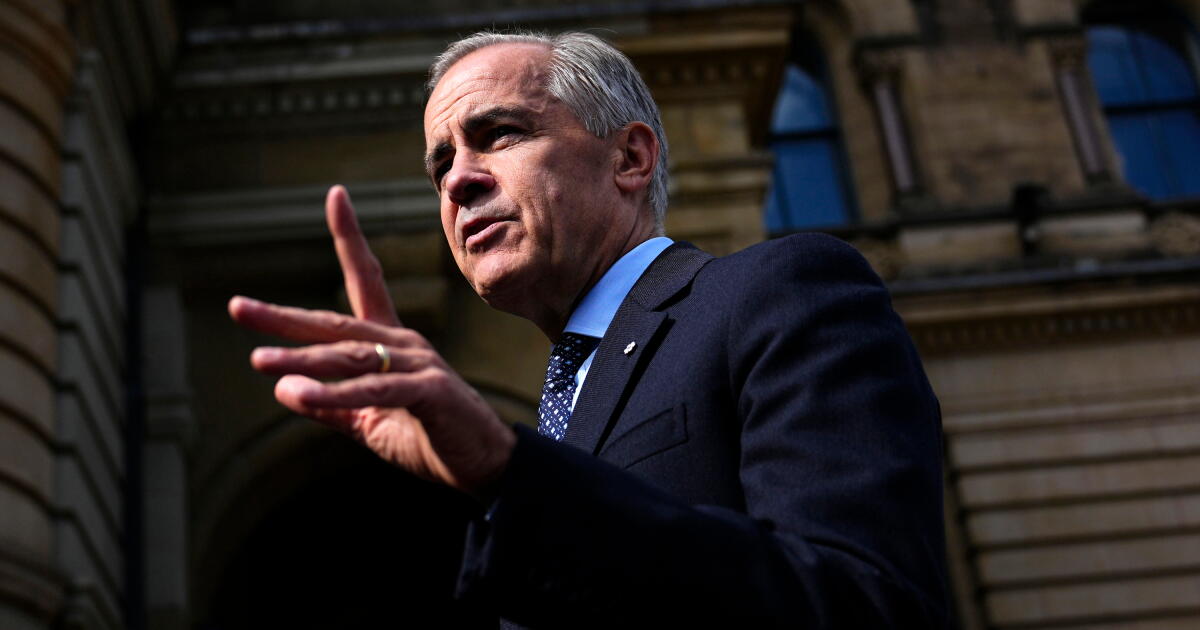
TORONTO — Canadian Prime Minister Mark Carney told the Trump administration Tuesday to “stop doing memes, stop throwing shade and stop trying to be tough,” as he pushed back against a fresh wave of attacks from Washington.
Carney said U.S.-Canada trade talks could resume if Washington became serious about negotiations, but he also accused the United States of pursuing terms that he said could leave Canadian industries “gradually wound down in Canada and wiped out.”
“When the Americans stop doing memes, stop throwing shade and stop trying to be tough, and start being serious about having those discussions, we can have those discussions,” Carney said. “It’s not constructive, but that’s their democracy.”
His comments came after a new barrage from Washington since trade talks collapsed Aug. 21, including Trump’s move to rename Lake Ontario “Lake America” and social media posts taunting Canada. U.S. Treasury Secretary Scott Bessent also said Canada could not go “tit for tat” with a U.S. economy 13 times larger, while U.S. Secretary of Defense Pete Hegseth mocked female Canadian cadets online.
Hegseth on Monday posted an image from a cadet training center in British Columbia showing two young women in uniform, adding “this is real” alongside a Canadian flag. Carney called the post “beneath their office.”
The Pentagon stood by it Tuesday, with deputy press secretary Jacob Bliss saying, “The X post speaks for itself.”
Carney said the U.S. approach in the talks would have left Canadian industries effectively as subsidiaries of American companies or imposed terms under which they would be “gradually wound down in Canada and wiped out.”
“We’re not going to — of course, we’re not going to accept those terms,” Carney said.
Carney said Washington sought an “uncompetitive” deal for key industries, including autos, while pushing changes affecting French-language and cultural protections. He said any of those issues was enough to block an agreement.
Carney said Washington also sought limits on Canada’s future trade deals. “Canada is a sovereign state. We will strike free trade deals with the countries we wish to strike free trade deals,” he said.
Carney was also buoyed by Monday’s Liberal sweep of three special elections, including a decisive win in Chicoutimi-Le Fjord, Quebec, where the Conservatives fell to third place.
The victories brought the Liberals to 173 seats in the 343-seat House of Commons and reinforced Carney’s position as he confronts Trump over trade and Canadian sovereignty.
Nelson Wiseman, a professor emeritus of political science at the University of Toronto, said Trump’s annexation threats carry particular weight in Quebec. “Quebecers have the most to lose in an apocalyptic scenario where the U.S. absorbs Canada, and the status of the French language disappears,” he said.
U.S.-Canada trade talks collapsed after the two sides failed to reach a deal, and Trump imposed 50% tariffs on roughly $20 billion in Canadian goods. Canada responded with plans for tariffs on U.S. products.
Trump has repeatedly talked about making Canada the 51st state.
SACRAMENTO — California could have some zany theater this fall: county prosecutors charging federal postmasters with felonies for obeying President Trump’s order to withhold delivery of mail ballots to voters.
Does Trump then federalize the California National Guard to protect his postmasters from local sheriffs bent on hauling them off to the jailhouse?
Just wondering after reading legislation whipping through the state Capitol.
George Skelton and other analysts cover the insights, legislation, players and politics you need to know. In your inbox Monday and Thursday mornings.
By continuing, you agree to our Terms of Service, which include arbitration and a class action waiver. You agree that we and our third-party vendors may collect and use your information, including through cookies, pixels and similar technologies, for the purposes set forth in our Privacy Policy such as personalizing your experience and ads.
“Mail-in voting means mail-in cheating,” Trump asserted in March, while escalating his crusade against popular “absentee” voting. “Cheating on mail-in voting is legendary. It’s horrible what’s going on.”
It’s a big lie. There has never been any hard evidence produced by anyone, anywhere of significant mail-ballot cheating.
It’s also hypocritical because Trump routinely votes by mail himself in Florida elections.
Why is mail-voting OK for him but not for other Americans? “Because I’m president of the United States,” he told reporters. “I had a lot of different things” to do. As if the rest of us don’t. Voting apparently only needs to be convenient for him.
But Trump obsessively keeps trying to justify his false claim that Joe Biden’s 2020 election victory over him was rigged. It’s sick.
It may please his MAGA base, but Democrats and independents across America — especially in California — frown on Trump’s attack against their voting rights. They favor mail voting.
Overall, 58% of Americans support allowing ballots to be cast by mail, according to a recent survey by the Pew Research Center. But there’s a huge difference between the parties — 83% of Democrats and left-leaning independents favor mail voting while 68% of Republicans oppose it.
In California, 72% of all voters approve of balloting by mail, according to a recent poll by the UC Berkeley Institute of Governmental Studies. But there’s a big split ideologically: 93% of Democrats and 72% of independents approve, but 62% of Republicans disapprove.
Regardless of what GOP voters tell pollsters, they must be overwhelmingly voting by mail. That’s because 81% of all California ballots were cast by mail in the 2024 presidential election. In this year’s gubernatorial primary, it was up to 89%.
In March, Trump issued an executive order directing the Homeland Security Department to compile a list of eligible citizen voters in each state and commanding the U.S. Postal Service to handle only the ballots of people on the list.
Gosh? What could possibly go wrong with Trump’s Homeland Security agency — the overseer of divisive ICE — deciding who is entitled to vote in the pivotal midterm elections?
The nation’s Founders decreed in the Constitution that states could decide on “the times, places and manner” of federal elections — unless Congress wanted to alter the rules. Trump persuaded the House of Representatives to pass legislation restricting mail voting, but the bill died in the Senate, blocked by Democrats.
Trump’s executive order was an effort to bypass Congress and essentially enact a law by himself.
The Supreme Court decreed on a 6-3 vote last week that Trump could proceed with his planning. But since no precise regulations had yet been announced by the administration when the opposition lawsuit was filed, it was premature to rule on their constitutionality.
But now Trump’s draconian rules have been revealed. And California has joined other states in filing a new lawsuit.
“Donald Trump does not run elections. States do,” Gov. Gavin Newsom declared. “California will continue to lead the way in defending democracy.”
In the Legislature, a bill was introduced to make it a felony punishable by up to four years in prison for a person in authority to order the withholding of a ballot’s delivery to a voter or its return to a local election official.
A person like a postmaster? Who else could order mail carriers not to deliver ballots to some registered voters?
“That’s for law enforcement to decide,” says the bill’s author, Sen. Aisha Wahab (D-Hayward), who was just elected to finish the current term of resigned U.S. Rep. Eric Swalwell.
“My bill is trying to protect all voters. They may be on vacation, they may be ill. They may want to vote early or late. Whatever. They remain entitled to vote by mail.”
Her bill breezed through three Assembly committees in 24 hours — Democrats voting yes and Republicans no.
The measure is unlikely, however, to ever result in a postmaster being jailed for obeying the president.
For starters, it’s hard to envision the president’s executive order ever being ruled constitutional — even by this lackey court.
“Trump is trying to exercise control over elections when he has absolutely no authority to do so,” UC Berkeley Law School Dean Erwin Chemerinsky wrote in a Times opinion piece last week.
If the Supreme Court shockingly did rule that Trump has the authority, then could his postmasters be arrested under the new state law? Under the Constitution’s Supremacy Clause, the answer would seem to be “no.” Federal law generally supersedes conflicting state law.
“An executive order cannot supersede state law,” says UCLA law professor Rick Hasen, who specializes in election law. “But there are all kinds of immunity doctrines and other reasons why a state would have a hard time prosecuting a federal official for violating state law in the conduct of official duties.”
The real answer is for Trump to stop trying to concoct a solution to an election problem that only exists in his warped imagination.
SACRAMENTO — After weeks of intense negotiation, state lawmakers on Friday reached a compromise on legislation to regulate energy use by California’s growing data center industry, action triggered by community anger over the facilities and fears of high utility bills in some communities.
The goal, according to legislators and advocates, is to protect consumers from growing electricity costs driven upward by the sprawling facilities and to track the centers’ immense energy and water consumption.
Business groups representing tech companies argued that some of the proposed restrictions and requirements, along with California’s high energy costs and lack of available land, would make it difficult for data centers to open in the state.
Municipalities risk missing out on tax revenues and jobs from the centers if the industry goes elsewhere, they said.
Two bills to regulate the controversial industry consumed the state Legislature in the final weeks of the 2026 session, drawing in Gov. Gavin Newsom and industry organizations and lobbyists representing some of the world’s most influential companies, including Google, Meta, Amazon and artificial intelligence firms such as Anthropic and OpenAI.
Proposed legislation by Sen. Steve Padilla (D-Chula Vista) and Assemblymember Rick Chavez Zbur (D-Los Angeles), finalized Friday, would establish special rules for data centers’ electrical use. The legislation requires the California Public Utilities Commission to create special rates and updated rules for data centers’ use of electricity, including the costs for new power for infrastructure upgrades.
The debate in Sacramento around the data centers centered on how much they should pay for power and infrastructure, and whether that should be mandated by the state Legislature or the California Public Utilities Commission, which regulates investor-owned utilities and is controlled by a board appointed by the governor.
An aerial view of a 49.5-megawatt data center under construction in Vernon last month.
(Myung J. Chun / Los Angeles Times)
Nevertheless, advocates focused on reforming the state’s utilities sought this year to seize the moment to enact tough regulations, including forcing data centers to pay for transmission upgrades and wildfire mitigation efforts.
Utility reform advocates and environmental leaders offered mixed reaction on Saturday.
Matthew Freedman, a senior staff attorney for The Utility Reform Network (TURN), praised the final language in the two bills, saying the legislation would prevent data center costs from “being foisted on other customers” while helping California meet its clean energy goals.
Monica Embrey, the founder of Affordable Energy Campaign, called the last-minute amendments “concerning.”
In particular, she pointed to a lack of clean energy requirements for data centers who use their own energy, and a provision that allows a utility to enter into its own agreement with a data center for energy in the interim period before the state finalizes its regulations.
A representative for the Data Center Coalition, whose members include Google and Microsoft, didn’t immediately respond to a request for comment.
Data centers have existed for decades but are rapidly expanding because of the rise of artificial intelligence, or AI. The centers help power everything from streaming services to videoconferencing calls.
Data centers in California are typically smaller than the mammoth, 500+-megawatt AI facilities making headlines in other parts of the country. Electricity costs and state regulations on gas-powered generators limit the vast majority of them to under 100 megawatts.
But as proposals increase in number, opposition has been fierce and growing.
A Public Policy Institute of California poll from July showed that 73% of residents oppose the construction of data centers in their communities.
Opposition centers on water use, air and noise pollution, and the potential for data centers to raise utility bills as they add strain to the grid requiring costly upgrades and new electricity supply.
The California Energy Commission expects data center electricity use, currently 2% of the state’s demand, to double in the next 10 years.
Monterey Park became the first city in the country in June to permanently ban data centers by a popular vote, and at least four other San Gabriel Valley cities have enacted moratoriums.
Southeast of L.A., Imperial County, Desert Hot Springs, and Palm Springs also voted on moratoriums, while Coachella permanently banned the facilities. In the Central Valley, Tulare County adopted a moratorium this month as residents voiced opposition to proposals to develop tiny data centers on local fairgrounds in the region.
And in San José, the state’s hot spot of data center development, residents flooded a recent public hearing to call for a moratorium while the city updates its data center standards.
Newsom last year vetoed legislation by Assemblymember Diane Papan (D-San Mateo) that would have required data centers to disclose and certify their water consumption. The governor said he was reluctant to impose “rigid” reporting requirements on the development of “this critically important digital infrastructure.”
Separate bills that would require the centers to disclose their energy and water use were recently approved by state lawmakers.
Like other state legislators, Papan said she wants to work with the centers, not ban them.
“I constantly say, ‘Help us help you.’ We will all get this right if we can just be transparent and methodical,” said Papan, whose district includes Silicon Valley.
Padilla’s district includes Imperial Valley, where a developer’s plans for a data center on 75 acres is sparking fierce backlash.
Advocates and lawmakers fought over two approaches on the issue of regulating data centers’ energy use.
A wider coalition of environmental groups supported the bill from Padilla, SB 886, sponsored by TURN, that would have required data centers to pay up front for broader power grid updates required to meet their demand. That approach made it into the final package.
TURN pointed to a recent transmission plan from California’s grid operator projecting that increased power demands from data centers in PG&E‘s service territory, where the majority of current and proposed data centers are concentrated, would create up to $1.8 billion in upgrade costs for the power grid, including transmission lines.
PG&E favored a less stringent approach. In an email earlier this week, a PG&E spokesperson argued SB 886 would “risk higher costs for customers and delay critical infrastructure needed to serve the state’s growing energy demand.”
The Data Center Coalition had opposed both bills for “singling out” one type of power user.
The high cost of land and power, as well as lack of available land, are just some of the reasons that California hasn’t seen a flood of data centers, said Khara Boender, a director of government affairs at the Data Center Coalition. She said dozens of states offer some type of exemption for data centers, but California does not.
Additional regulation in the Golden State, she said earlier this week, “would be another signal that the state is a more challenging place for data center development.”
Weekly insights and analysis on the latest developments in military technology, strategy, and foreign policy.
Faced with having to fight as technology rapidly transforms the nature of warfare, the U.S. Marine Corps on Wednesday unveiled its vision for the future of ground combat. Dubbed Ground Combat Element (GCE) 2040, the document lays out how Marines will fight and what kinds of equipment and training they will need to succeed, down to the squad level. Though the document doesn’t mention a specific adversary, it focuses heavily on the kind of littoral, anti-access battle a future Pacific fight would entail.
“I think that you would agree that the global security landscape today demonstrates an intensity for that kind of modernization,”Lt. Gen. Jay M. Bargeron, Deputy Commandant, Plans, Policies, and Operations, said today during a media roundtable to introduce GCE 2040 that TWZ attended virtually. “It’s a landscape that’s defined by rapid technological change and the reemergence, importantly, of peer-level adversaries like China and Russia.”
In a future fight against enemies with ubiquitous sensors, advanced artificial intelligence and machine learning (AI/ML) capabilities, waves of expendable drones, offensive and defensive electronic warfare systems and long-range precision weapons, smaller Marine units like rifle squads will have to act more independently to defend themselves and execute successful attacks.
The new plan recognizes that “widespread use of drones underscores the need for effective organic protective measures across the GCE, down to the squad level. The evolving drone threat presents the most significant risk to ground maneuver, requiring layered active and passive counter-UAS capabilities to retain the initiative. Survivability must be addressed by comprehensively encompassing improved training, updated doctrine, and technological advancements.”
You can see an example of how small drones are being used against Ukrainian forces in the following video.
Video showing a Russian 🇷🇺 fiber-optic FPV drone hitting one of the 4 🇺🇦 IFVs returning from this attack today
The ubiquity of drones on the battlefield has devastated both Russian and Ukrainian forces, which are each using these weapons to create an ever-growing no-go zone. Bargeron acknowledged that providing protection from drones for smaller Marine units presents a major challenge.
“The ability for our lowest echelon units – squad, platoon, company – to defend themselves against one-way attack systems is really maybe one of the biggest holes in our swing, and so we’re working hard on that,” the general admitted.
The Marine Air Defense Integrated System (MADIS). (USMC) US Marine Corps Marine Air Defense Integrated System (MADIS) vehicles. USMC
In addition, Bargeron said the Marines will also rely on a system called “Home Alone,” which a spokesman for the service told us “is a Counter-small Unmanned Aircraft System (CsUAS) that is a semi-fixed site GBAD solution that supports our layered defense structure.” The Marines declined to provide any details about how that system works, citing its classified nature.
For protection at the squad level, “the GCE 2040 integrates both active and passive measures to ensure organic protection,” a Marine official told us. “A key component of this is the Organic Counter-small UAS, or O-CsUAS, initiative. This program has fielded dismounted kits directly to the squads. These kits provide Marines with the ability to actively and passively detect drone threats and to defeat them using both kinetic and non-kinetic means.”
Those kits are “complemented by the use of frangible 5.56 ammunition for standard-issue rifles, which is more effective against aerial targets, and the continued employment of passive countermeasures like multi-spectral camouflage, dispersion, and displacement to degrade enemy targeting,” the official added.
Bargeron noted that the Marines have already purchased 400,000 of the frangible counter-drone rounds and that they are undergoing training on how to use them.
You can read more about the Marines’ emerging doctrine for devolving air defense down to the individual Marine in our story here.
Drone Round: The Next Evolution of Counter-UAS
As noted earlier in this story, GCE 2040 also calls for providing squads with longer-range offensive weapons.
“What we’re trying to do is to bring precision strike capabilities down to the lowest level,” the general noted. “That’s a great example of using advanced technology to enhance the lethality of Marines that are already doing that job. The OPF [Organic Precision Fires] increases the individual Marine’s or Marine rifle squads’ ability to strike targets, at ranges that you had previously needed fixed-wing air or aviation fire support or indirect fire.”
The goal is for squads to be able to strike targets at a range of about 20 kilometers, Bargeron stated.
“So in the hands of the individual Marines to be able to strike targets like that…will be dramatic,” he exclaimed.
They are also being sent to Ukraine, where the use of these systems by small units is a daily fact of life, not a vision for the future.
A Neros Archer first-person view drone sits on a case during a demonstration range at Weapons Training Battalion on Marine Corps Base Quantico, Virginia, March 7, 2025. (U.S. Marine Corps photo by Cpl. Joshua Barker) Cpl. Joshua Barker
Bargeron offered no other details on specific offensive squad-level longer-range weapons options that will be developed and fielded over the coming years.
The plan itself is vague in terms of overall timelines, noting that there will be a “phased approach to modernization” occurring across “three overlapping time periods.”
Near-Term (2026-2030): This period focuses on refining and accelerating ongoing Force Design modernization efforts, addressing the immediate threat of drones, and setting conditions for future investments.
Mid-Term (2031-2035): Investments in AI and autonomous systems will mature, enhancing headquarters functions, streamlining logistics, and improving operational tempo. Drone/unmanned formations and layered counter-UAS capabilities become critical.
Long-Range (2036-2040): The GCE is transformed by AI-enabled command and control, widespread Human-Machine Teaming, and resilient, dispersed formations. It operates with increased combat power and survivability, providing the Joint Force with a decisive advantage on key littoral terrain.
Ukraine has shown American troops up close and personal how difficult it is to defend against drones. In a recent training exercise in Germany, U.S. Army soldiers were trounced by Ukrainian drone operators, only improving their performance after the lessons learned from initial engagements. While there are still many unknowns about the goals and rules put in place for that exercise, which accomplished its mission of learning, it underlines long-standing questions about why the U.S. military has taken so long to adapt to a glaringly different battlefield. Whether the new Marine Corps plan will do so fast enough, especially as major foes, especially China, are moving aggressively in employing new weapons and tactics based on lessons learned in global conflicts, is still up for debate.
That being said, the Marines acknowledge that GCE 2040 is a work-in-progress, but the changes it is trying to address are critical to operating against threats the U.S. military has yet to face at the scale it would against China or Russia.
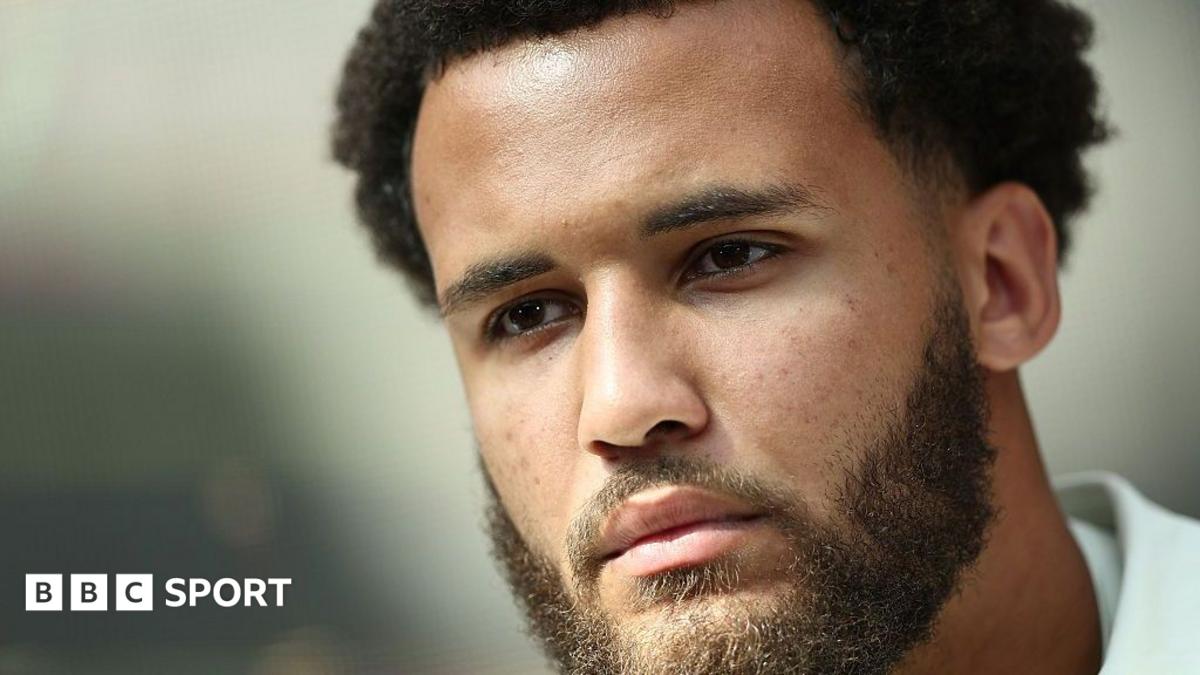
Moses Itauma says Filip Hrgovic’s comments are starting to “wind him up” before their IBF heavyweight world title fight on Saturday.
A victory at the O2 Arena would mean 21-year-old Itauma becomes the second youngest heavyweight world champion in history, behind only Mike Tyson.
The British fighter is the favouite going into the contest, but Hrgovic has been trying to taunt his rival by calling him a “kid” and “inexperienced”.
“I tell myself there’s nothing that this Hrgovic guy can do to get in my head but he’s starting to wind me up,” Itauma said.
“In an interview earlier, apparently he said I wake up and I just hug trees. He’s really starting to annoy me.
“In my mind if somebody’s trying to get one up on you, or trying to get in your head, it’s because they’re not confident in themselves. Obviously Hrgovic is a talker.”
Croatia’s Hrgovic, 13 years Itauma’s senior, has suggested that victory for his opponent could have a negative affect on Itauma’s future and that losing the fight would “save his soul”.
Kinshasa, DR Congo – President Felix Tshisekedi is due to leave office in 2028 under the current Constitution of the Democratic Republic of the Congo. Yet with more than two years to go, a battle over the rules governing what happens when his mandate ends is already reshaping Congolese politics.
In May, Tshisekedi said he had not sought a third term but would accept one if the Congolese people wanted him to continue. The remarks revived opposition fears that constitutional reform could eventually open a path beyond the existing two-term limit.
Under the current constitution, the president is elected for five years, renewable once, while the number and length of presidential terms are protected from constitutional revision.
Tshisekedi’s camp says the country needs institutional reform. Opponents of the reform fear the process could ultimately be used to change the rules governing presidential succession.
The dispute is unfolding as the DRC fights a rebellion in the east led by M23, an armed group that operates within the broader Alliance Fleuve Congo (AFC), a political-military coalition that controls Goma and Bukavu, the capitals of North Kivu and South Kivu.
With an opposition mobilisation planned for September and Tshisekedi preparing to outline an inclusive national dialogue, the confrontation is entering a critical phase.
The referendum battle
The confrontation accelerated in June when the Parliament of the Democratic Republic of the Congo passed legislation setting out conditions for organising a referendum.
The Constitutional Court ruled in July that the law complied with the constitution, while raising concerns about some of its provisions. On August 10, Tshisekedi formally asked the presidents of the National Assembly and Senate to reconsider the legislation in light of the court’s observations. The National Assembly said the fresh deliberation would be placed on the agenda for its September session.
The legislation provides for a constituent assembly followed by a referendum in the event of what it describes as a “major dysfunction” of state institutions.
Critics of the process say the mechanism could eventually be used to alter provisions that currently prevent Tshisekedi from seeking a third term. The government, meanwhile, has presented constitutional reform as a broader institutional issue rather than an explicit bid to extend the president’s tenure.
The main opposition group campaigning against the process is known as C64, or the Article 64 coalition. Its name refers to Article 64 of the DRC’s constitution, which calls on citizens to oppose anyone who takes power in violation of the constitutional order.
C64 says it will resist any attempt to use constitutional reform to extend Tshisekedi’s mandate beyond 2028. The coalition announced a nationwide mobilisation for September 15, with demonstrations in Kinshasa expected to converge on the Palais du Peuple, the seat of parliament.
Taking the fight to parliament
The dispute has already spilled onto the streets.
Thousands demonstrated in Goma and Bukavu on July 28 against proposed constitutional changes and any attempt to extend Tshisekedi’s time in office.
In Kinshasa, protesters are expected to converge on the Palais du Peuple.
People protest against constitutional reforms in Kinshasa, DRC on June 12, 2026 [Fiston Issemwami/Al Jazeera]
For C64, the destination is deliberate: the coalition wants to take its protest to the institution at the centre of the constitutional process.
Jean-Marc Kabund, a Congolese opposition politician, told Al Jazeera that no constitutional revision, referendum or legal manoeuvre should be allowed to circumvent the current constitution.
He warned that this happening while the country is at war could deepen divisions and threaten national cohesion.
A constitutional fight during a war
The constitutional dispute is unfolding alongside a conflict that has transformed eastern Congo.
M23 and the AFC have seized large areas of territory, including Goma and Bukavu. The Congolese government accuses Rwanda of supporting M23, a charge that Kigali denies.
The war is also raising questions about the 2028 elections.
Tshisekedi has warned that elections may not be possible if the fighting continues, arguing that it would be difficult to organise a credible vote while parts of the country remain outside government control.
Emmanuel Bugama, a Congolese political analyst based in Bunia, told Al Jazeera that national interests should come before political disputes.
“The nation’s best interests should take precedence over these political squabbles,” he said.
The view from Goma
In Goma, the argument is being watched from a city no longer under Kinshasa’s control.
Gentil Mulume, a civil society activist in Goma, told Al Jazeera that any constitutional change extending Tshisekedi’s mandate would not be recognised in territory controlled by M23 and the AFC.
“If Tshisekedi dares to amend this constitution to extend his term of office, it will not be recognised here,” he said.
Mulume said the dispute was part of a deeper divide between Kinshasa and the east. He argued that continued Tshisekedi rule could be viewed there as a form of domination and that self-determination should be part of the political debate.
His comments illustrate how a constitutional confrontation in Kinshasa is being interpreted in territory already beyond the government’s effective control.
What do ordinary Congolese know?
There is also a more basic question: how much do ordinary citizens understand about the proposed changes?
Kevin Kalala, a 30-year-old mobile-credit retailer in Kinshasa, told Al Jazeera that he does not know enough about the constitution to take a position.
“We do not know what our constitution entails,” he said. “The Congolese state should start by teaching us about our constitution.”
Kalala said citizens should first be shown which provisions need changing, why they need changing, and what the benefits would be.
“I am neither for nor against amending the constitution,” he said.
An offer of dialogue
As tensions rise, Tshisekedi has proposed an inclusive national dialogue involving political parties, civil society and religious groups.
While in Libreville, Gabon, on August 16, he said he would soon address the nation to set out his vision and the contours of the talks. The date and format of the dialogue have yet to be announced.
Tshisekedi has ruled out sitting with people he accuses of siding with Rwanda or the armed rebellion.
Martin Fayulu, who challenged Tshisekedi in the 2018 presidential election, has called for former President Joseph Kabila and Corneille Nangaa, the political leader of the AFC, to participate.
For now, the constitutional dispute is running alongside the war in the east and the uncertainty over the 2028 elections.
The question is no longer only whether the constitution will change. It is whether Congo’s political forces can agree on the rules for what happens when Tshisekedi’s current mandate ends.
“We are certainly heading towards one of the most decisive periods in our recent history,” Bugama told Al Jazeera. “The country is under the control of an armed group, whilst the government in Kinshasa is posturing over constitutional reform instead of tackling what matters most.”