field

Joey Browner death: He was a star defensive back for USC and Vikings

Joey Browner, a star defensive back at USC and a six-time NFL Pro Bowl selection, has died. He was 65.

“The Vikings are mourning the loss of Ring of Honor member Joey Browner,” the team said Sunday in a statement. “Browner will be deeply missed by former coaches and teammates, as well as many others he impacted throughout his life.”

The Vikings added in a separate post: “He helped define what it is to be an NFL safety.”

No cause of death was given. In August, former Minnesota quarterback Tommy Kramer organized a fundraiser for Browner, who Kramer said was “battling through some serious health issues.”

On Sunday, Kramer wrote about Browning on Facebook: “Not only a great player, a great person. Rest in peace my friend.”

Browner was one of six brothers, all of whom played college football and four of whom went on to play in the NFL. Younger brother Keith Browner, who also played at USC and spent five seasons in the NFL, died in November at age 63 after a sudden illness.

Oldest brother Ross Browner, who played 10 NFL seasons for the Cincinnati Bengals and Green Bay Packers, died in 2022. Another older brother, Jim Browner, who played two seasons for the Bengals, died in 2024.

A high school standout in football, basketball and track and field, Browner played at USC from 1979-1982. He was named team MVP his senior year and finished his college career with nine interceptions and 40 pass deflections, as well as one punt return for a touchdown.

In the 1983 draft, Browner became the first defensive back to be selected by the Vikings in the first round (19th overall). He went on to play nine seasons in Minnesota, making the Pro Bowl six times (1985-1990), and spent his final NFL season with the Tampa Bay Buccaneers.

Browner finished his career with 37 interceptions, 17 forced fumbles and 17 fumble recoveries. He was named to the NFL 1980s all-decade team, as selected by the Pro Football Hall of Fame, and inducted into the Vikings’ Ring of Honor in 2013.

Sean Salisbury, a former quarterback whose career intersected with Browner’s in college and the NFL, was one of many in the football community paying their respects to the four-time All-Pro player.

“This is a major gut punch,” Salisbury wrote on X. “I was blessed to be his teammate at USC and with the Vikings! Phenomenal player and loved by so many. One of the best players I’ve ever played with in both college and the NFL. Very grateful to have called him a good friend. God Bless him and his family.”

Former tight end Steve Jordan, who played nine seasons with Browner in Minnesota, recently visited his former teammate in the Twin Cities, according to a Vikings news release.

“We’ve lost a great friend and one of the best Vikings teammates,” Jordan said in a statement released by the team. “God blessed Joey with phenomenal talent and a big heart to love people and be a beacon of positivity. Truly, he will be missed.”

Former quarterback Rich Gannon, who played five seasons with Browner in Minnesota, wrote on X: “Sad to hear about the passing of my former teammate Joey Browner. On the football field he was one bad dude, off he was a kind soul!”

Retired punter Greg Coleman wrote on X that “one of the happiest moments of my time with the Vikings” was learning that Browner was going to be added to the punt team.

“One of the best teammates you could have and a man I called Friend!” Coleman wrote. “Prayers up for his family. RIP JB!”

Current Vikings cornerback Dwight McGlothern wrote on X: “Dang, I had a chance to meet him my rookie year & I was wearing #47 at the time during camp & hearing about his accomplishments, I’m grateful to [have] had the chance to meet him & [represent] the # he wore with the Vikings !! Everytime I walk in the DB room I always see greatness on the wall !!”
Source link

The two Taylor Lautners are expecting a baby Lautner soon

The two Taylor Lautners are expecting a baby.

“What’s better than two Taylor Lautners?”

That’s what the couple — call him Taylor and her Tay — wrote Thursday in a social media post announcing that a newborn was in their future.

The couple included four photos: The first showed the “Twilight” franchise star, 34, kissing the belly of his 29-year-old wife as she stands in a field holding sonogram images. The others showed them having fun in that same field as they celebrated the news.

That last one was in black and white and a little blurry, but it showed her sitting in a low chair, hands on her belly, cracking up as he sat low by her side with a big smile on his face. The sonogram made its way through all of the baby-on-board photos.

The couple offered no further details about the baby, including the due date.

Taylor Lautner met the former Taylor Dome in December 2017, and the two went public with their couplehood the next October and got married in November 2022 after a yearlong engagement. She was a registered nurse when they met; he was a few years off playing werewolf Jacob Black in the blockbuster franchise that brought a sparkly vampire-human love story to life.

While co-stars Kristen Stewart and Robert Pattinson, who played Bella Swan and Edward Cullen, have charted distinctive acting careers since 2012, when “The Twilight Saga: Breaking Dawn — Part 2” debuted, Taylor has hung back a bit. He met Tay after his sister set them up with invites to the same game night.

Tay, by the way, was Team Edward, crushing on Pattinson more than Lautner when she experienced the “Twilight” franchise. “I was too young for Jacob’s abs,” Tay told Cosmopolitan in a 2025 profile of the Lautners.

“Yeah, when I was walking around in my little booty jean shorts and ripping my shirt off and my abs were on big screens, she’s 11 years old, throwing a ‘Twilight’ birthday party,” he told the magazine. Tay was “a breath of fresh air” for him after years of dating women who worked in the spotlight.

That list famously included Taylor Swift, his co-star in “Valentine’s Day,” with whom he coupled up for several months before that 2010 movie came out.

“Now I have my priorities straight,” Taylor Lautner told Cosmo. “If I do a project and it doesn’t go as planned, I’ll still be coming home to my family that’s always going to be there.”

And soon that family will be more than two.


Source link

Alex Freeland shows why he made Dodgers’ roster in win over Arizona

The Dodger Stadium crowd roared at the sound of contact, cheers growing louder as Kyle Tucker’s single made it through the right side of the field and Alex Freeland trotted home to finally break a persistent tie.

In the Dodgers’ 5-4 win on Friday night, Freeland scored the go-ahead run in the eighth inning, jump-started the Dodgers’ offense in the third inning, and showed off his arm strength in a pair of momentum-changing plays.

“I’m just happy that we’re starting off on a good note, and everybody feels like we’re one,” Freeland said. “It’s just exciting to play for this team and in front of all these fans. I’m just enjoying it.”

The Dodgers fell behind 1-0 in the second inning, but the damage could have been worse. With two runners on and two outs, the Diamondbacks’ Alek Thomas lined a double off Dodgers starting pitcher Emmet Sheehan, into the right-field corner.

One run was guaranteed Tucker chased down the ball. Then he turned and fired to second, starting a smooth relay through Freeland to throw out Pavin Smith at home to end the inning.

The next inning, after Sheehan surrendered a solo homer to Ketel Marte, Freeland showed off his bat.

Coming off a middling spring training from a surface-level results perspective, Freeland immediately fell into a two-strike count in his first at-bat of the season.

Then he displayed the plate discipline that helped him make the opening day roster.

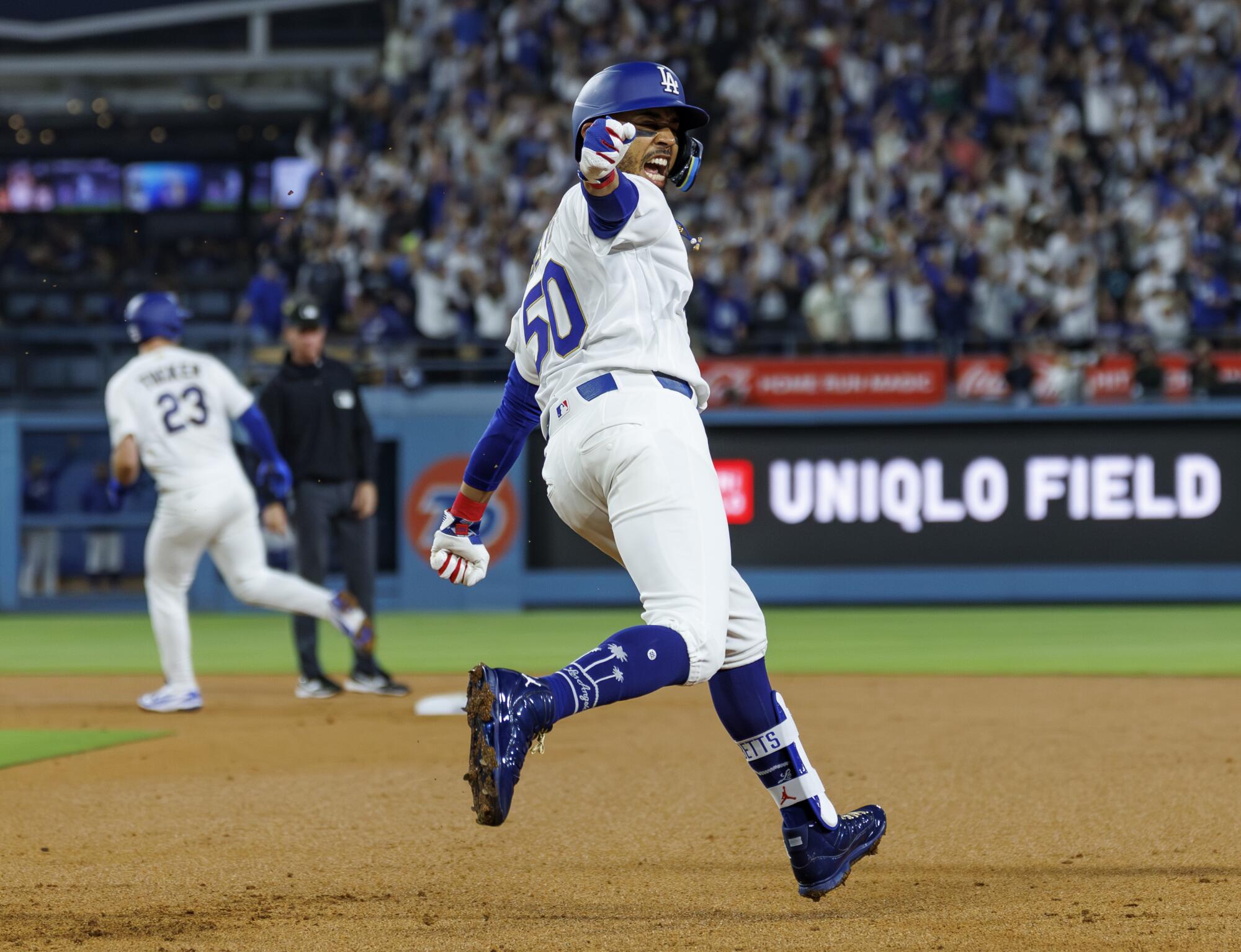
Dodgers shortstop Mookie Betts celebrates after hitting a three-run homer against Arizona Diamondbacks in the third inning.

Dodgers shortstop Mookie Betts celebrates after hitting a three-run homer against Arizona Diamondbacks in the third inning Friday.

(Gina Ferazzi / Los Angeles Times)

Freeland worked the count back even and then crushed an inside fastball over the right-field fence to end the Dodgers’ scoreless stretch.

“I just tried to have a long at-bat, get some more pitches for that inning,” Freeland said. “And it led to that.”

Two batters later, Mookie Betts followed with a three-run homer to put the Dodgers up 4-2.

In the fourth, the Diamondbacks tacked on two more runs, but again fell prey to a Tucker-to-Freeland relay.

The Diamondbacks again had two runners on for Thomas, and the Dodgers made a pitching change. It didn’t make a difference. Against left-hander Jack Dreyer, Thomas again hit a line drive into the right-field corner.

This time, two runs scored easily, tying the score. But Tucker and Freeland relayed the ball to third baseman Max Muncy to get Thomas as he tried to stretch his hit into a triple. Dreyer then got out of the inning with a strikeout.

With those fourth-inning runs charged to Sheehan, he wrapped up his season debut with four earned runs and five hits in 3⅓ innings. His average fastball velocity was down 1.6 mph compared to last season, according to Statcast.

“I felt pretty good early, and then I think [my stuff] ticked down a little towards the end,” Sheehan said. “But still working to try to get the delivery in the right place.”

In the eighth inning, Freeland lined a double into center field to give the top of the Dodgers’ batting order a runner in scoring position with the score still tied 4-4.

Shohei Ohtani grounded out to second base to move Freeland to third. Then Tucker sent him home to give the Dodgers the lead.

That set up closer Edwin Díaz to make his Dodgers debut. His infamous walk-in music, Timmy Trumpet’s “Narco,” was accompanied by a light show and a live trumpet performance. He recorded the save.

“I was surprised a little bit,” Díaz said after recording the save. “I heard a trumpet sounding before I was coming out. I said, ‘No way, they got a live trumpet.’ It was pretty fun. I enjoyed it, and I know fans enjoyed it, too.”

Vesia makes his season debut

Dodgers relief pitcher Alex Vesia reacts after striking out Arizona's Geraldo Perdomo to retire the side.

Dodgers relief pitcher Alex Vesia reacts after striking out Arizona’s Geraldo Perdomo to retire the side in the seventh inning Friday.

(Gina Ferazzi / Los Angeles Times)

Left-hander Alex Vesia received a loud ovation as he ran to the mound from the bullpen in the seventh inning. He pitched for the first time in the regular season since his newborn daughter died in October.

Dodgers relievers honored Vesia and his family during the World Series by writing his number on their caps.

On Friday, Vesia threw a scoreless inning. And as he walked off the field, he appeared to acknowledge the crowd and put his hand over his heart.

“The fans have been waiting a long time to show their love for him and [his wife] Kayla, and it meant a lot to him,” Roberts said. “He’s an emotional guy. I know fans get it.”

Stewart throws in batting practice

Right-hander Brock Stewart (shoulder surgery recovery) threw the first live batting practice session of his rehabilitation Friday. He estimated he threw 18 pitches.

“Command hasn’t been perfect with the bullpens, but it’s coming around,” Stewart said. “And today it was another step in the right direction with the command. Velocity was fine, and execution was pretty good. Really I just wanted to feel good, and I did feel good. So, main objective cleared.”

He said he has another live batting practice scheduled for Tuesday in Phoenix and then could begin a rehab assignment, which he expects to be at least two to three weeks long.

Source link

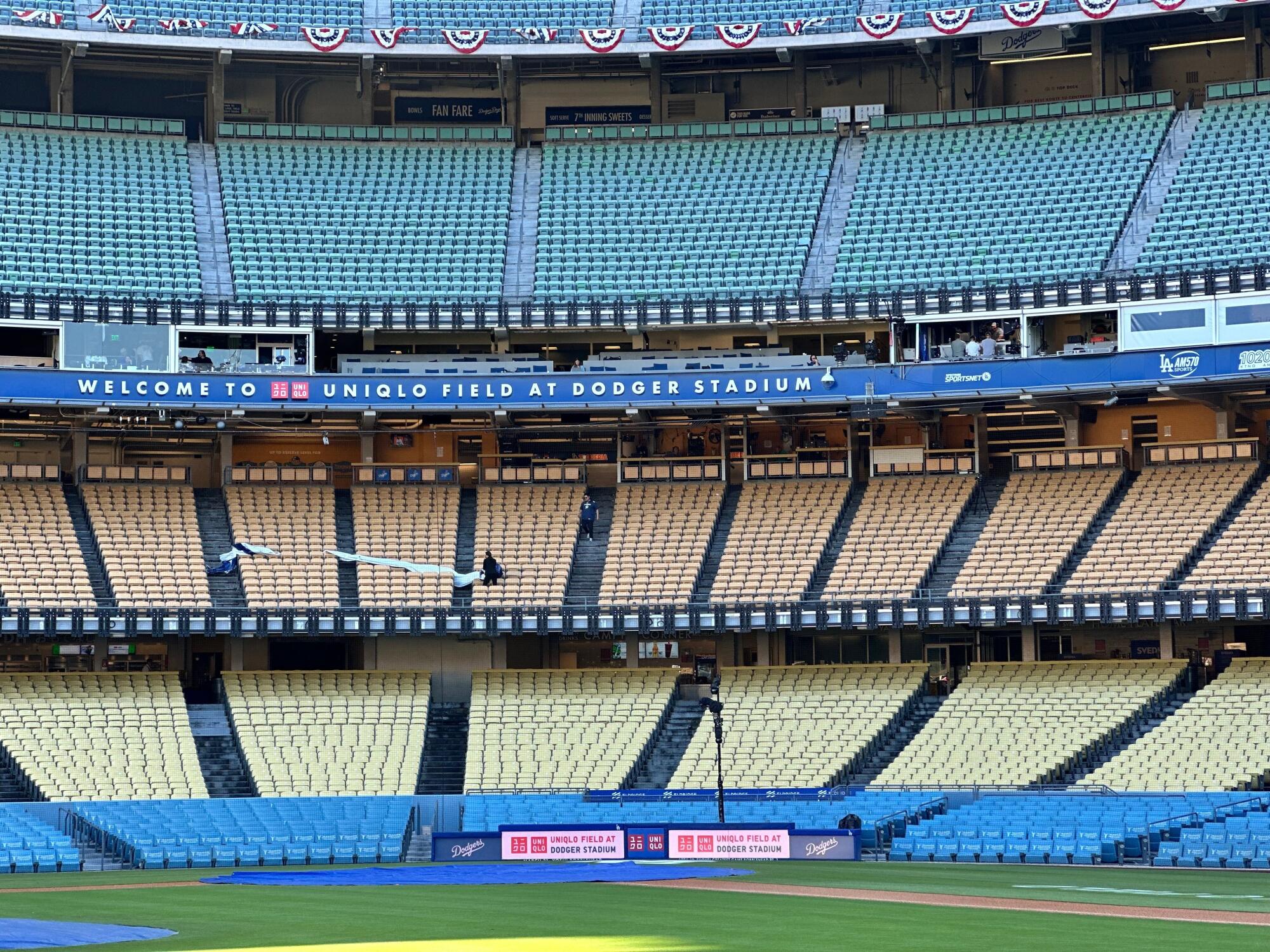
The signs say Uniqlo Field. You will continue to say Dodger Stadium

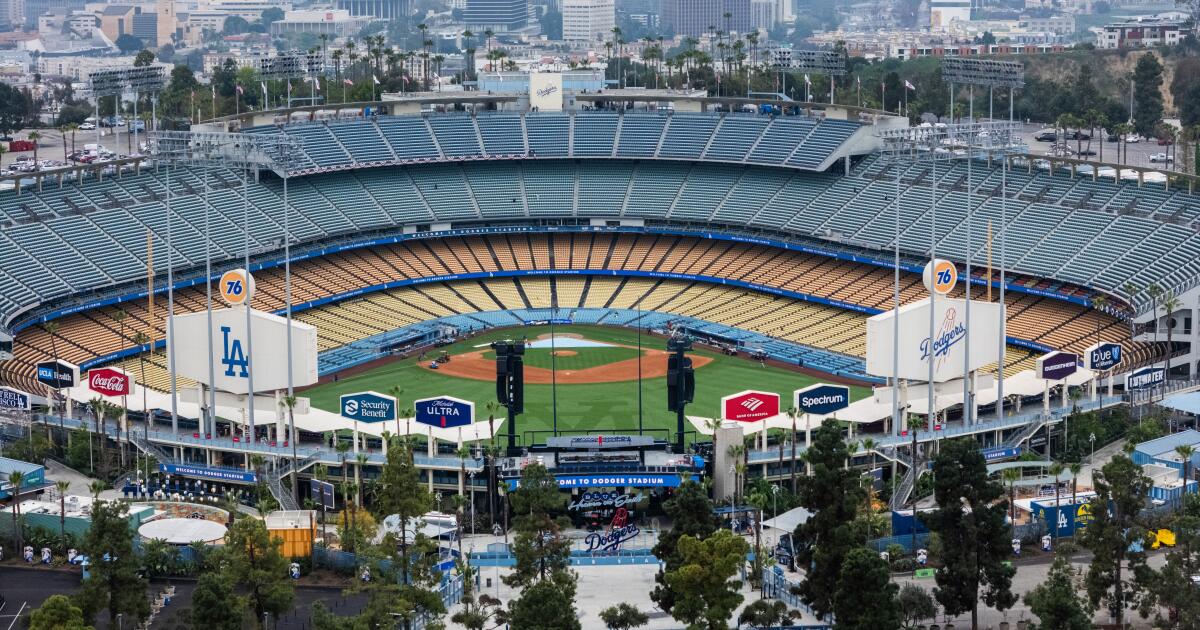
It was Dodger Stadium on Wednesday, when the grass outside the baseline and the bright red sign high above center field read “UNIQLO FIELD.” It will be Dodger Stadium on Thursday, when the defending World Series champions open their new season, and forevermore.

The official name of our summer home is now Uniqlo Field at Dodger Stadium. The team announcers will say that, and so will some of the signs. The fans won’t, and the founder of the company that just spent nine figures on the name you won’t use said he completely understands.

“That’s a very natural reaction,” Uniqlo founder Tadashi Yanai told me through an interpreter. “We respect that.”

Yanai said his company’s deal with the Dodgers covers five years. He would say only that the total value was “more” than $125 million. That provides the Dodgers with an annual naming rights payment in line with the ones at Crypto.com Arena, Intuit Dome and Sofi Stadium, without the Dodgers having to sell naming rights to the actual venue.

Are the Dodgers baseball’s version of a gold mine? Yes. Do they spend big and win big? Also yes. Do you mind if Uniqlo essentially covers Freddie Freeman’s salary this season?

“We need a lot of revenue to put out the product that we do,” Dodgers president Stan Kasten said. “That’s not a secret. And we’re proud of everyone who helps us do it: all of our fans, all of our media partners, and all of our sponsor partners. They are all important. It is how this all comes together.”

While Uniqlo would be delighted if you used its name, whatever local fans choose to call the stadium is not critical to the success of the partnership.

For a Japanese company in pursuit of brand awareness and expansion in the United States and elsewhere, there might be nothing better than getting your name in front of millions of fans around the world watching Shohei Ohtani play on television.

Ohtani made an estimated $125 million in endorsements and sponsorships last year, Sportico reported, a larger annual haul “than any other athlete in the history of sports.”

“The Dodgers are such a popular team,” Yanai said. “I usually ask my wife, after I come back from the office, whether Shohei hit a home run. I think all the Japanese people do that.”

Uniqlo Field signs were unveiled Wednesday at Dodger Stadium in the wake of the team's naming rights deal.

Uniqlo Field signs were unveiled Wednesday at Dodger Stadium in the wake of the team’s naming rights deal.

(Beth Harris / Associated Press)

According to Forbes, Yanai is the richest man in Japan, where baseball teams carry corporate names. Why not buy a team and call it, say, the Uniqlo Bears?

“I always keep saying that could be very interesting,” he said, “but my wife turned it down. She keeps telling me, ‘Tadashi, you are not cut out to manage sports teams.’”

Instead, he is managing Uniqlo, an apparel company that pitches itself as blending comfort with quality. “We do not make disposable clothing,” Yanai said in the company’s last annual report.

Uniqlo has 794 stores in Japan but only 77 in the United States, including 14 in the Southland. Koji Yanai, a senior executive officer and Tadashi’s son, said the company aspires to grow annual U.S. revenues from $6 billion to $30 billion.

He shared what might be a more challenging aspiration.

“The Uniqlo Field at Dodger Stadium name may be very new for everyone,” he said, “but I hope in the near future the fans will like it and will love it.”

United Airlines Field at the Coliseum? Yeah, no.

Jeff Marks, the chief executive of Los Angeles-based Innovative Partnerships Group, once brokered a naming rights deal in which the Cal football team would play on Kabam Field at California Memorial Stadium. He tried to find a receptive audience for the name.

“We educated a lot of freshmen, sophomores, and newcomers,” Marks said. “Are you going to go after alumni who have been calling it Memorial Stadium? No. So you didn’t focus on that. You focused on people that could be more impressionable, and it worked.”

With Dodger Stadium, we’ll see. For the 2026 season, it is now time for Dodgers baseball, but not before one reporter at a press conference Wednesday asked company officials whether Uniqlo would provide the Dodgers players with free clothing.

Kasten could not pass up the chance to interject.

“We pay them enough,” he said with a grin, “to shop at Uniqlo stores.”

Source link

Contributor: Kamala Harris is polling well, which signifies nothing

When I read all the hype being heaped on Kamala Harris’ lead in early polls for the 2028 Democratic nomination, I have to chuckle to myself.

The release of a Rasmussen Reports poll in February was titled, “Kamala Harris Still Leads 2028 Field for Democrats.” One headline in the Hill predicted, “Kamala Harris may yet be the Democratic nominee in 2028.” A Washington Examiner piece about polling warned, “Democrats won’t get rid of Kamala Harris that easily for 2028.”

I chuckle not because I don’t believe the numbers, but because I don’t believe any poll this far out in an open contest is meaningful, let alone determinative. I’ve seen this movie before, and it didn’t end well.

In 2003, after managing the successful 2002 reelection campaign of California Gov. Gray Davis, I signed on as an advisor to the presidential campaign of Connecticut Sen. Joseph Lieberman — who, I needn’t remind anyone, had been the Democratic nominee for vice president in the 2000 election, which he and Al Gore lost in a nail-biter to George W. Bush.

Based simply on his high name identification from that hellzapoppin’ race, and the fact his name had been on the ballot in all 50 states just two years before, Lieberman initially led the Democratic field quite handily in almost every national poll.

An ABC News/Washington Post survey in January 2003 found Lieberman leading the Democratic field with 27%. A Gallup poll from that same month also placed him first, ahead of both John Kerry and Richard Gephardt.

A Pew poll in the summer of 2003 also found Lieberman atop the field, as the best-known candidate at 85% name recognition, and 58% support, ahead of Kerry, Gephardt and Howard Dean.

Boy, did we brag about Lieberman’s lead at every stop and in every press release. But in the end, the promising early numbers meant nothing. When actual votes were cast, Lieberman totally flamed out, receiving a measly 8.9% of the vote in the critical first primary in New Hampshire, finishing dead last, and dropping out of the race in February 2004, having lost every primary and caucus up to that point.

Why? A lot of reasons, including mistakes made by the candidate and campaign. But fundamentally because, when Democrats started to take a close look at and assess the full field, they relegated Lieberman to the status of a loser, and they wanted to move on. We heard a lot of, “He had his chance and lost.” Does Harris come to mind?

The fact is, we Democrats tend to put defeated presidential nominees in the rear-view mirror pretty quickly. Think of Michael Dukakis, Gore and Kerry. And let’s not forget, Harris obtaining the nomination in 2024 was a fluke; she didn’t compete in one primary or receive one primary vote. The first time she ran for president, in the 2020 cycle, she also didn’t win one primary or receive a single primary vote, because she ran a bad campaign and hightailed it out of the race before a single vote was cast. Two strikes and you’re out?

We Democrats just don’t renominate losers. The last time we did it was exactly 70 — yes, 70 — years ago, with Adlai Stevenson in 1956 after he had lost the 1952 presidential race to Dwight Eisenhower. Stevenson rewarded Democrats for this recycling effort by losing to Eisenhower a second time — by an even worse margin. Democrats learned their lesson: Reheating doesn’t work with failed candidates.

And, come on, Harris not only lost to Trump, not only lost all seven swing states, but was the first Democratic presidential nominee in 20 years to lose the popular vote. And her weak showing also helped Republicans wrest control of the Senate from Democrats. We’re supposed to imagine that’s a credible record on which to run again for the nomination?

All of these breathless stories about Harris leading the field nationally also never mention her perilous standing in her own home state of California. A Berkeley IGS survey in August revealed that by a margin of 18 percentage points, even her fellow Democrats in California did not want her to run again. A Politico poll this month showed Gov. Gavin Newsom with a 2-to-1 lead in California among voters leaning toward voting in the 2028 Democratic primary.

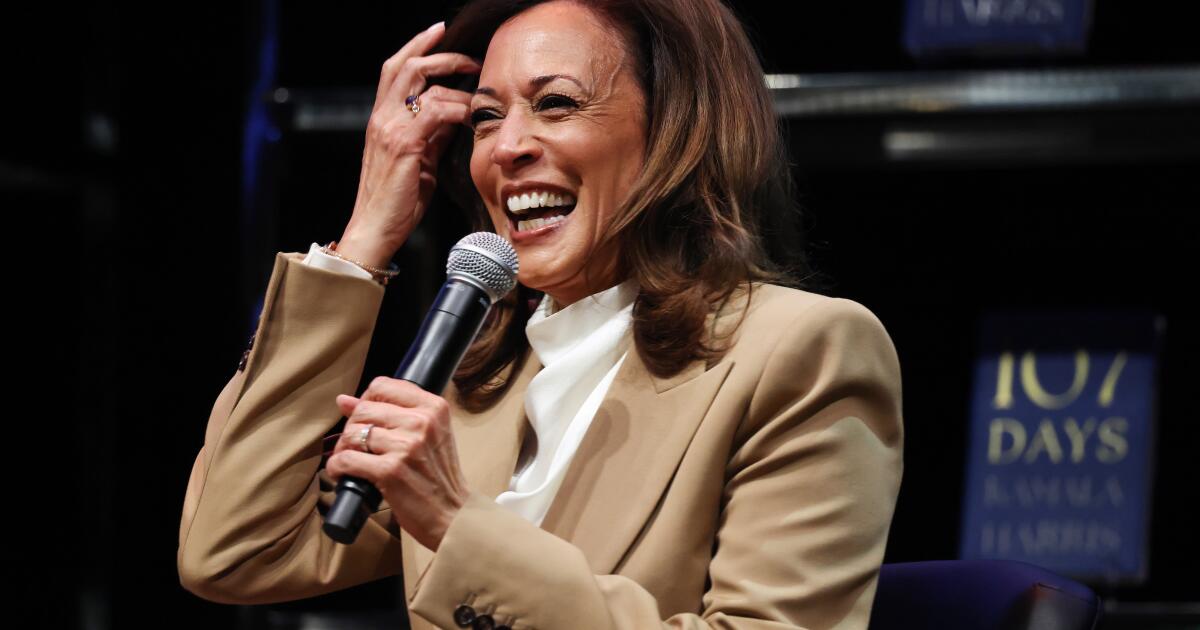
So have fun, Kamala Harris, enjoying your name-ID high while it lasts (although maybe a mite longer than your 107-day presidential effort).

Garry South is a Democratic strategist who has managed four campaigns for governor of California and played significant roles in three presidential campaigns, including that of Al Gore.

Source link

March Madness: Lauren Betts and UCLA advance to the Sweet 16

On a day when No. 1 seeds dominated, UCLA wasn’t the exception.

The top-seeded Bruins led wire-to-wire, beating No. 8-seed Oklahoma State 87-68 in the second round of the NCAA tournament on Monday night at Pauley Pavilion to advance to the Sweet 16.

They will face No. 4-seed Minnesota on Friday in Sacramento.

While UCLA started much better than it did in its opening-round game, there were still elements to nitpick. The Bruins were outscored 21-18 in the third quarter, Oklahoma State won the offensive rebounding battle and outside of Lauren Betts — who scored a career-high 35 points while shooting 15 of 19 — the offense fell flat at times in the second half.

But with arguably the best post player in the country, the Bruins overcame all of that.

UCLA (33-1) jumped out to an 11-2 lead while the Cowgirls (24-10) went the final 4:26 without scoring and shot 0 for 8 from the field during that span. The Bruins turned that into a 25-point lead and were up 46-26 at halftime.

Unlike the first-round victory over California Baptist on Saturday, UCLA came out cold to start the third quarter. The Bruins missed six shots in a row while Oklahoma State went on a 9-0 run to narrow the deficit to 13.

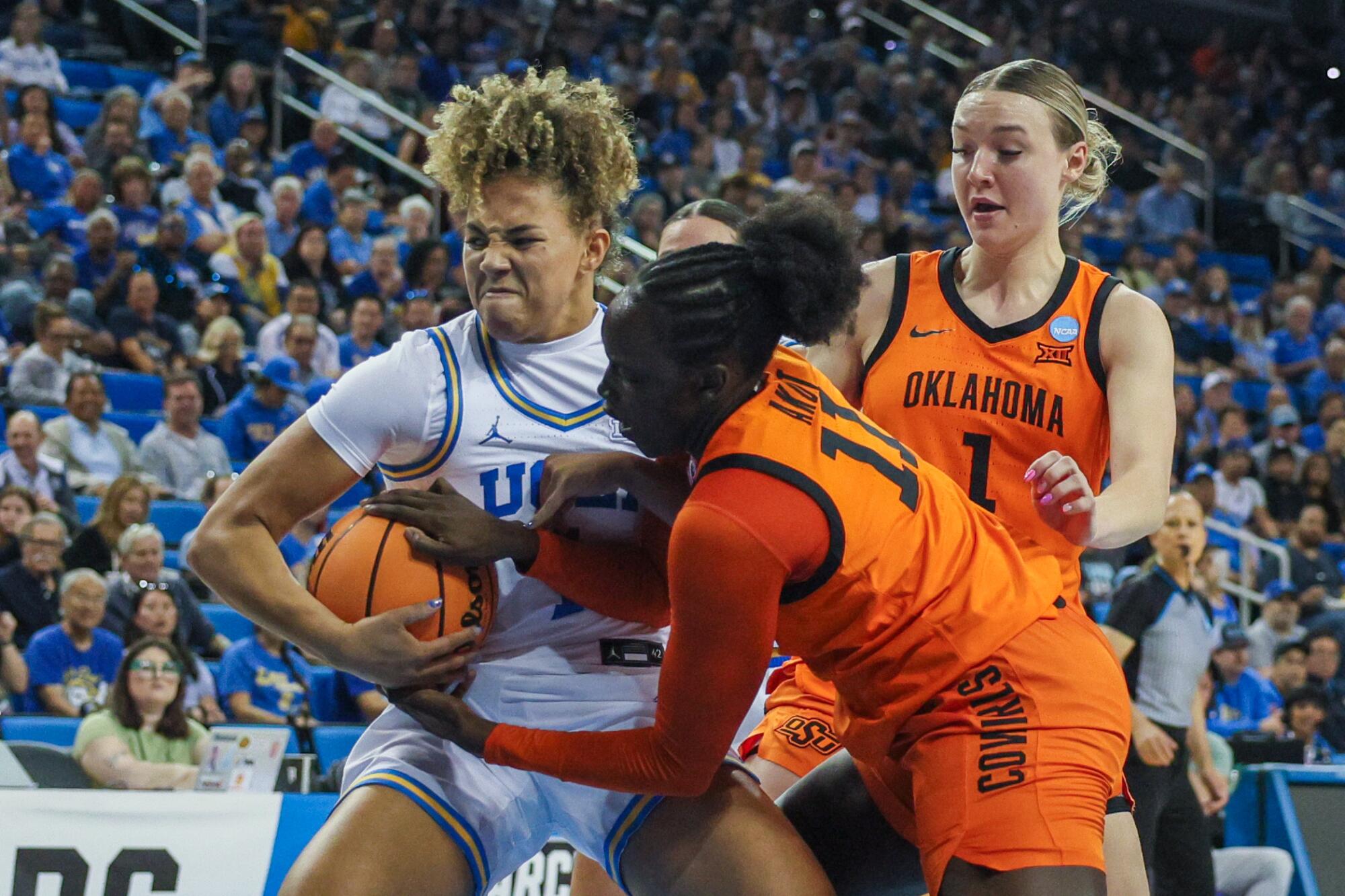
UCLA guard Kiki Rice, left, fights for the ball with Oklahoma State forward Achol Akot during the Bruins' win Monday.

UCLA guard Kiki Rice, left, fights for the ball with Oklahoma State forward Achol Akot during the Bruins’ win Monday.

(Ronaldo Bolanos / Los Angeles Times)

The Cowgirls shot 51.4% from the field in the second half to stay within striking distance while UCLA’s offense went mostly cold. But Oklahoma State’s leading scorer, Achol Akot (23 points), had four fouls by the start of the fourth quarter and had to spend much of the quarter on the bench.

Betts scored 11 consecutive UCLA points in the final four minutes of the third to put the Bruins ahead by 19. In addition, she finished the game with nine rebounds and five assists.

Gianna Kneepkens (15 points) made a couple of key shots in the fourth quarter to help jolt the Bruins’ shooting, but it was still Betts’ dominant showing that kept UCLA well ahead. Of UCLA’s 87 points, 50 came in the paint.

UCLA’s next opponent, the Golden Gophers (24-8), advanced on a buzzer-beater against No. 5-seed Mississippi on Sunday. The Bruins beat Minnesota 76-58 on the road during conference play earlier this season.

Source link

Bass leads the field for L.A. mayor, but many voters view her unfavorably, poll finds

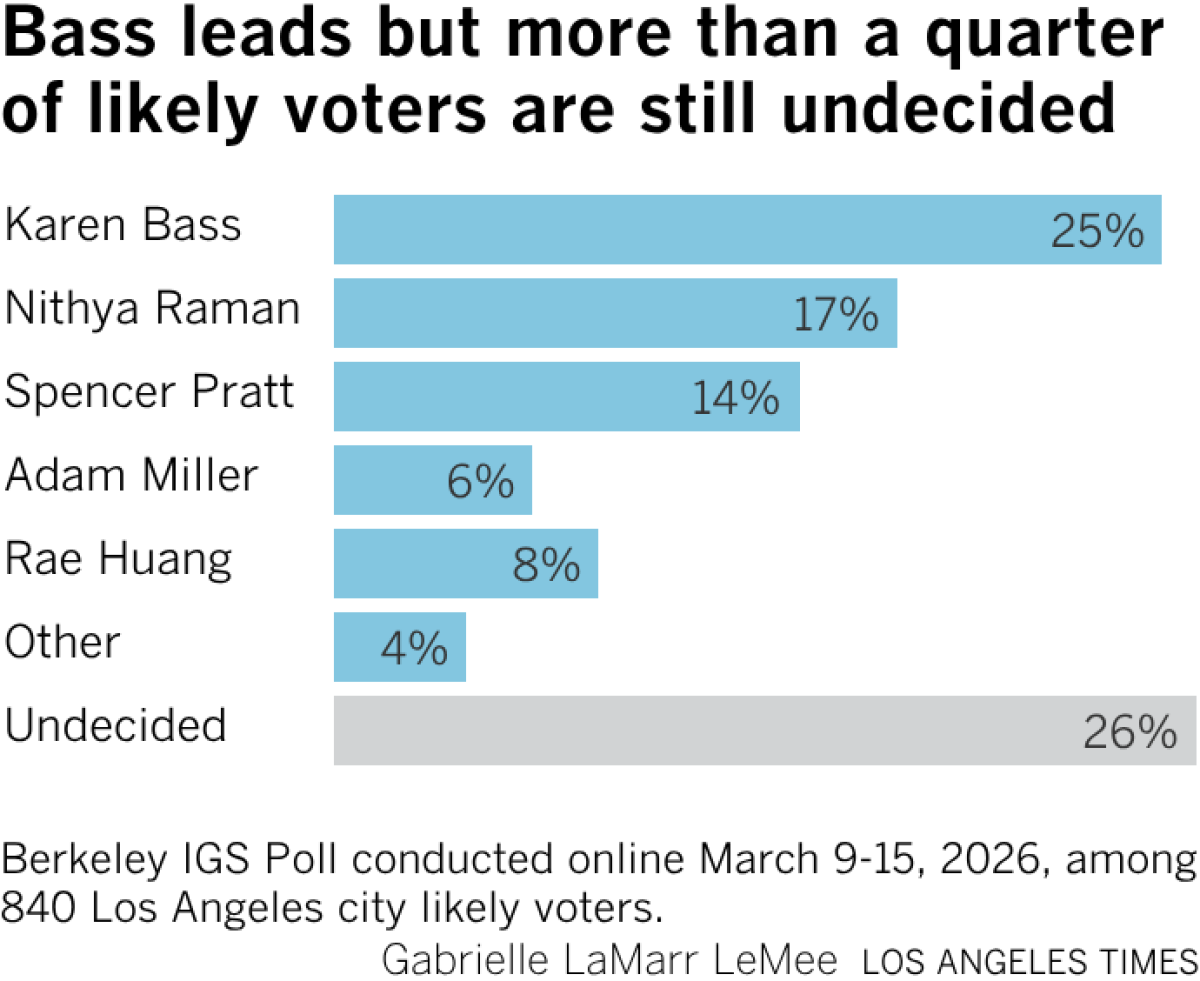
Los Angeles Mayor Karen Bass has a lead over her challengers in her bid for reelection, but more than half of voters view her unfavorably, according to a poll released Sunday.

Bass was supported by 25% of voters, while City Councilmember Nithya Raman drew 17% and conservative reality TV star Spencer Pratt came in third at 14% in the poll by the UC Berkeley Institute of Governmental Studies, co-sponsored by The Times.

About a quarter of voters were undecided, the poll found.

Bass has come under heavy criticism for her handling of the devastating Palisades fire. More than a year later, 56% of those polled said they had an unfavorable view of her, while 31% viewed her favorably.

The survey of 840 likely voters between March 9 and 15 provides one of the first snapshots of the mayoral race, less than three months before the June 2 primary.

Beyond the top three, leftist Rae Huang notched support from 8% of those polled, while tech entrepreneur Adam Miller drew 6%.

Despite Bass’ lead, the poll is “borderline catastrophic” for her, because the field of candidates is so weak, said Dan Schnur, a politics professor at USC, UC Berkeley and Pepperdine.

“That she’s having this much trouble against this field, against such a little-known field of opponents, bodes very, very poorly for her,” Schnur said. “The only thing saving her at this point is that the top tier of potential candidates who were considering running against her decided to stay out of this race.”

The mayoral race solidified in early February, when Raman shocked the political establishment by jumping in against her ally Bass, hours before the filing deadline.

By that time, other well-known politicians, including billionaire developer Rick Caruso and L.A. County Supervisor Lindsey Horvath, had opted to stay out of the race. Former Los Angeles schools Supt. Austin Beutner dropped out following the death of his 22-year-old daughter.

Those decisions have left Angelenos with a field of candidates they hardly know. While they have strong views about Bass, slightly more than half of those polled said they didn’t know enough about Raman to have an opinion. Even more voters were unfamiliar with the other candidates.

Bass was on a diplomatic trip to Ghana when the Palisades fire ignited on Jan. 7, 2025, killing 12 people and destroying thousands of homes. She was unsteady in her initial public appearances and has since come under attack by Pratt, Caruso and others over the LAFD’s management of the fire and the pace of the recovery as well as allegations that she ordered an after-action report on the fire to be watered down.

Bass’ campaign has pointed to declining homelessness and crime as among the successes of her first term as mayor.

“It’s clear Angelenos are frustrated by decades of inaction on major issues,” Douglas Herman, a spokesperson for the Bass campaign, said in a statement. “This campaign will show that it’s Karen Bass who changed the direction on these issues and that others running responded with reports while Karen Bass took action.”

Raman, who represents Los Feliz and parts of Silver Lake and the San Fernando Valley, was viewed favorably by 26% of those polled and unfavorably by 23%. The 51% who said they didn’t have an opinion of her could be an indication that she has yet to expand her name recognition citywide.

She has said that her decision to run was driven in part by her frustration with city leaders’ inability to get the basics right, such as fixing streetlights and paving streets.

“I am very grateful that our campaign to make our city more affordable is resonating with so many Angelenos,” she said in a statement.

Former City Councilmember Mike Bonin, who runs the Pat Brown Institute for Public Affairs at Cal State L.A., said that after the shock of Raman’s entry into the race, the mayoral campaign has taken on a sleepier pace.

“Candidates are raising money and doing their due diligence … but it’s felt like a staid, quiet race,” he said. “This poll reflects that.”

Bonin said the most important number is the gap between Raman and Pratt.

If no candidate gets more than 50% of the vote in the primary, the top two finishers will proceed to a November run off. According to Bonin, Raman and Pratt will likely be jockeying to face off against Bass.

“While voters are clearly looking for an alternative [to Bass], they haven’t chosen one,” Bonin said.

The poll showed Bass — the city’s first female mayor and first Black female mayor — with strong support from Black voters, at 43%, while Raman has 6%.

Raman, who if elected would be the city’s first South Asian mayor, leads with Asian and Pacific Islander voters at 34%, with Bass at 10%.

Bass performs better with older voters, while Raman and Huang are appealing to younger voters, the poll found. Huang led the pack at 19% with voters between 18 and 29 years old.

In the poll, Angelenos ranked their top priorities for the next mayor to address. Building more affordable housing came in first, followed by fixing streets, sidewalks and streetlights and then moving homeless Angelenos indoors.

One potential bright spot for Bass was policing.

The poll found that 39% of Angelenos think the LAPD needs to increase in size, with 29% saying the department should stay the same size and 19% saying it should shrink.

Bass has called on the City Council to hire more police officers.

Raman, meanwhile, has said that she believes the police force is the right size at around 8,700 officers, down from a peak of 10,000 in 2020.

“Bass is going to make Raman look like AOC’s liberal sister,” said Schnur, referring to progressive U.S. Rep. Alexandria Ocasio-Cortez (D-N.Y.). “If she ends up in a runoff against Raman, she can run as a tough-on-crime centrist.”

Source link

Netanyahu: Israel ‘acted alone’ against Iran’s South Pars gas field

March 20 (UPI) — Prime Minister Benjamin Netanyahu said Thursday that Israel “acted alone” in striking Iran’s South Pars gas field, an attack that escalated the war in the Middle East and prompted President Donald Trump to declare that the U.S. ally would not target the site again.

Israel attacked the South Pars field on Wednesday. In retaliation, Iran targeted major Persian Gulf energy facilities of U.S. allies, causing damage to Qatar’s Ras Laffan Industrial City and the United Arab Emirates’ Bab gas field.

The tit-for-tat strikes have edged the region closer to all-out war while soaring the price of oil, leading Trump to state the United States had known nothing of Israel’s plans before it struck the South Pars gas field and to threaten Iran if it attacked Qatar again. He also said Israel would not attack Iranian energy infrastructure unless Iran attacked Qatar again.

Trump’s comments and his administration’s rationale for entering the war have come under scrutiny after reporting challenged his claim that Washington had no prior knowledge of the South Pars attack, while critics accused the United States of being lured into the war by Israel.

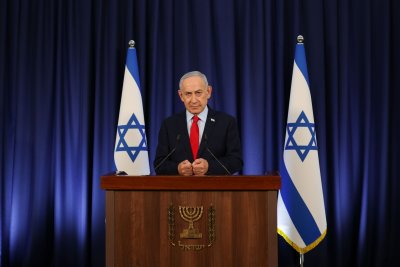
Speaking to reporters in English on Thursday, Netanyahu mostly backed Trump’s account, saying “Israel acted alone against the Asaluyeh gas compound,” using the name of the nearby Iranian port and industrial complex that is often used as a shorthand for the gas field.

He did not directly address whether Trump or the United States knew of the attack beforehand, but pivoted to state that further attacks would not occur, as the American president had ordered.

“President Trump asked us to hold off on future attacks, and we’re holding off,” he said.

The press conference was held following reporting, including by CNN, citing U.S. and Israeli officials who said the attack had been conducted in coordination with the United States.

It was also held as accusations mount that the United States was dragged into the war by Israel. After the United States launched initial attacks with Israel on Feb. 28, Secretary of State Marco Rubio told reporters that it was a preemptive strike to reduce U.S. casualties and deaths because they knew Israel was going to strike Iran and believed Tehran would retaliate against American forces.

The Trump administration has attempted to thwart the notion that Israel forced the United States into war, with officials repeatedly stating that Trump’s decision to attack was not influenced by others.

Netanyahu echoed this sentiment.

“Does anyone really think that someone can tell President Trump what to do? Come on,” he said. “President Trump always makes his decision on what he thinks is good for America, and may I add, I think what is also good for future generations.”

Source link

Commentary: And just like that, the Cesar Chavez myth is punctured. What’s next?

An eerie silence had settled.

As word evidently reached activists in the last few weeks that disturbing allegations of sexual abuse against Chicano civil rights icon Cesar Chavez were forthcoming, things started to happen without much explanation.

Groups began to cancel long-planned parades, dinners, lectures and fundraisers scheduled for Chavez’s birthday on March 31. People who I’ve known for years suddenly weren’t returning calls or texts about what was going on. Longtime defenders of Chavez — who stood by their hero even as revelations in this paper and in biographies over the past generation showed there was a dark side to the man — suddenly became hard to reach.

When the United Farm Workers and the Cesar Chavez Foundation put out statements Tuesday morning that “troubling allegations” against their patriarch were considered credible enough for them to offer help to his victims, the silence transformed into dread. There was a discomfort similar to waiting for a tsunami — that whatever was coming would change lives, shake institutions and make people question values and principles that they had long held dear.

And like a natural disaster, what emerged about Chavez was far worse than anyone could’ve expected.

Wednesday morning, the New York Times published a story where two women whose families marched alongside Chavez in the fields of California during the 1960s and 1970s disclosed that he sexually abused them for years when they were girls. Just as shocking was the revelation by Dolores Huerta, Chavez’s longtime compatriot and a civil rights legend, that he had once raped her at a time when their leadership in the fight to bring dignity to grape pickers earned national acclaim and amounted to a modern-day Via Dolorosa.

The silence has transformed into screams. Politicians and organizations that long commemorated Chavez and urged others to follow his ways are releasing statements by the minute. My social media feed is now a torrent of friends and strangers expressing empathy for Chavez’s victims and outrage, disgust and — above all — disappointment that someone considered a secular saint by many for decades turned out to be a human more terrible than anyone could’ve imagined.

There will be questions and soul-searching about these horrifying disclosures in the weeks, months and years to come. We will see a push for the renaming of the dozens of schools, parks and streets that bear Chavez’s name across the country and even the rebranding of Cesar Chavez Day, a California state holiday since 2000 devoted to urging people to give back to their communities and the least among us.

The reckoning is only right. Much of the Latino civil rights, political and educational ecosystem will have to grapple with why they held up Chavez as a paragon of virtue for too long above others just as deserving and, as it turns out, nowhere near as compromised.

In any event, the myth has been punctured.

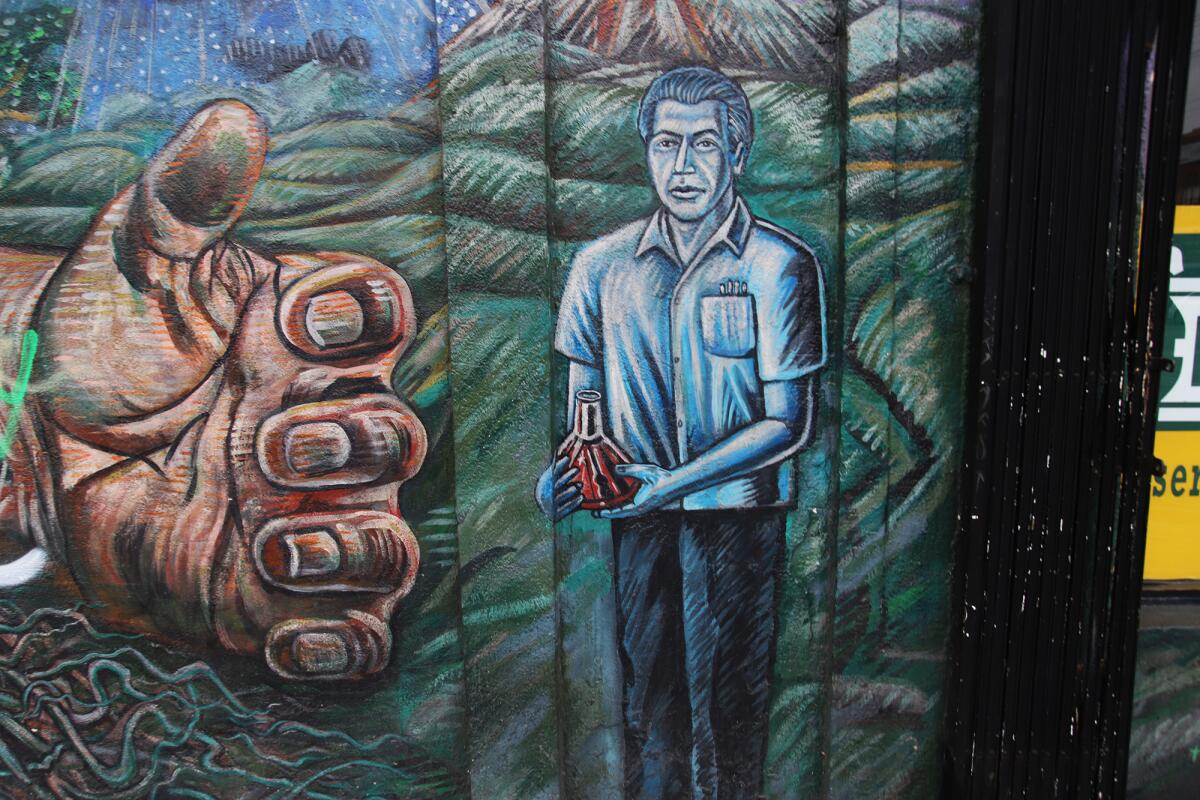
A portrait of Cesar E Chavez

A portrait of Cesar Chavez on a mural on Farmacia Ramirez, 2403 Cesar E Chavez Ave. in East Los Angeles.

(James Carbone / Los Angeles Times)

Chavez’s biography always reads like an entry in the “Lives of the Saints” genre of books that Catholics used to read about the holy men of their faith. The son of farmworkers who became a Mexican American Moses trying to lead his people to the promised land of equity and political power. An internationally famous leader who lived a mendicant’s life. Who devoted decades to some of the most exploited people in the American economy. Honored with awards, plays, posters. Murals, movies and monuments. President Biden even kept a bust of Chavez at his Oval Office desk.

It was a beatific reputation that largely persisted even as the union he helped to create lost its influence in the fields of California and a new generation of activists looked down on Chavez for his long-standing opposition to immigrants who came to this country to work without legal status. Admirers kept him on a pedestal even as former UFW members alleged over the last two decades that the boss they once idolized purged too many good people in the name of absolute control. The hagiography continued even as a new generation of Latinos came of age not knowing anything about him other than an occasional school lesson or television segment.

I was one of those neophytes. I first heard his name at Anaheim High School in the mid-1990s and thought my teacher was talking about Julio Cesar Chavez, the famous Mexican boxer. I was thrilled to discover that someone had bravely fought for the rights of campesinos like my mom and her sisters, who toiled in the garlic fields of Gilroy and strawberry patches of Orange County as teenage girls in the 1960s, the same time that Chavez and the UFW were enjoying their historic wins.

“Who’s Cesar Chavez?” my Mami responded when I asked if his efforts ever made her work easier.

My admiration for Chavez continued even as I learned about some of his faults. I was able to separate Chavez the man from the movement for which he was a figurehead. Long-maligned communities seek heroes to emulate, to draw hope from, to hang on their walls and share their quotes on social media. We create them even as we ignore that they’re flesh and blood just like us.

Chavez seemed like the right man at the right moment as Mexican Americans rose up like never before to battle discrimination and segregation. Now, Latinos and others who admired Chavez have to grapple with his moral failings of the worst possible magnitude at the worst possible time: when there’s an administration doing everything possible to crush Latinos and we’re looking for people to look up to like never before.

He remains one of the few Latino civil rights leaders known nationwide — and Chavez is nowhere near as known as acolytes make him out to be. Some people will argue that it’s unfair he will likely get wiped away from the public sphere while other predatory men from the past and present largely maintain their riches and reputations.

But that’s looking at the abuse revelations the wrong way. For now, I will follow what those most directly affected by Chavez’s actions are telling us to do.

The UFW and Cesar Chavez Foundation were wise to not try to defend the indefensible in their statements and instead consider any victims first before deciding how to decide what’s next for them.

The Chavez family put out a news release that states “we honor the voices of those who feel unheard and who report sexual abuse.”

Huerta wrote in an online essay: “Cesar’s actions do not reflect the values of our community and our movement. The farmworker movement has always been bigger and far more important than any one individual.”

Another of his victims told the New York Times of Chavez’s legacy: “It makes you rethink in history all those heroes. The movement — that’s the hero.”

The fountain in the Memorial Garden surrounds the gravesite of Cesar Chavez and his wife Helen Chavez

The fountain in the Memorial Garden surrounds the gravesite of Cesar Chavez and his wife Helen Chavez at Cesar E. Chavez National Monument in Keene, Calif.

(Francine Orr)

The face of that movimiento brought inspiration to millions and improved the lives of hundreds of thousands. That’s why we shouldn’t cancel the good that Chavez fought for alongside so many; we should direct the adulation he once attracted and the anger he’ll now rightfully receive toward the work that still needs to be done.

To quote an old UFW slogan that Chavez transformed into a mantra, la lucha sigue — the fight continues. It’s a statement that’s more pertinent than ever, damn its imperfect messenger.

Source link

Dodgers reportedly agree to deal with Uniqlo for field naming rights

The Dodgers agreed to a deal granting Uniqlo naming rights to the field at Dodger Stadium, according to the Athletic — marking the first time in the 64-year history of the stadium that a corporate sponsorship has been attached to it.

Dodger Stadium’s name remains unchanged. The organization made it a priority to keep the name of the ballpark, which has been in place since its opening in 1962.

“[The stadium’s name] will never be for sale,” Dodgers president Stan Kasten told The Times in 2017.

Though not officially announced by the Dodgers, the name likely will be Uniqlo Field at Dodger Stadium.

With more than 1,000 stores worldwide, the Japanese-based clothing brand will hold exclusive marketing and promotional opportunities as the Dodgers’ main sponsor. The new deal will also include a new sign in center field.

Since signing Japanese two-way star Shohei Ohtani, the team has partnered with several different Japanese companies, earning $70 million in sponsorship revenue in 2024 alone, according to Forbes.

Bob Lynch, chief executive of research firm SponsorUnited, estimated that teams hosting the Dodgers generated roughly $15 million in cumulative revenue from the brands that have attached themselves to the team.

“ … A slew of brands essentially following him around across the country that are paying dollars either directly to the team or to Van Wagner, who’s selling the backstop signage,” Lynch told Forbes in 2025.

In 2022, the Dodgers partnered with global sports marketing agency Sportfive to secure premier sponsorships. Two years later, the organization announced a self-sponsorship with its ownership group, Guggenheim Baseball Management, which placed a patch on the team’s jerseys.

Source link

California Dems launch polling effort to winnow gubernatorial field

As anxiety mounts among California Democrats about the potential of a Republican being elected governor, the state party will spend hundreds of thousands of dollars on polling to assess the viability of the sprawling field of candidates hoping to replace termed-out Gov. Gavin Newsom, according to plans released Tuesday.

The move comes after nearly every Democratic candidate refused party leaders’ call last week to withdraw from the race to avoid splitting the vote in the June primary — an outcome that could lead to a Republican being elected to statewide office for the first time in two decades.

“Candidates have filed, and now they’ve got the opportunity to showcase their viability, their path to win. I want to simply ensure that everybody has information to fully understand the current state of the race,” said Rusty Hicks, the leader of the California Democratic Party.

As campaign season ramps up, the series of six polls will allow “candidates, supporters, the media, voters, anyone and everyone to have a clear understanding of what is or is not happening in this particular race,” he said.

The filing deadline to appear on the June 2 ballot was Friday. Three days earlier, Hicks released an open letter urging candidates who did not have a path to victory to withdraw from the race. Of the nine prominent Democrats who had announced runs for governor, only one heeded his call: former state Assembly Majority Leader Ian Calderon.

That means the eight other candidates’ names will appear on the ballot, regardless of whether they decide to later drop out. And that creates the possibility of a Republican winning the race because of how California elections are decided.

The state has a voter-approved top-two primary system, under which the two candidates who receive the most votes in the June primary advance to the November general election, regardless of party.

Two prominent Republicans will appear on the ballot: former conservative commentator Steve Hilton and Riverside County Sheriff Chad Bianco. Even though Democratic voters outnumber Republicans nearly 2 to 1, and the state’s electorate last elevated Republicans to statewide office in 2006, it is mathematically possible for Democrats to splinter the vote, allowing the two GOP candidates to advance.

Under such a scenario, not only would Republicans be guaranteed the leadership of the nation’s most-populous state, but Democratic voter turnout also would probably be depressed in November, potentially affecting down-ballot races such as those that could determine control of Congress.

Hicks’ call last week prompted concerns among candidates of color, including former U.S. Health and Human Services Secretary Xavier Becerra and state Supt. of Public Instruction Tony Thurmond, that the effort was aimed at every nonwhite candidate in the race.

The state party chairman responded that his letter was not aimed at any specific candidate.

“It’s not something I lose sleep over,” Hicks said when asked about the racial claims. But he added that the voter surveys will be conducted by Los Angeles-based Evitarus, the state’s only Black- and Latino-led full-service polling firm, and will oversample historically underrepresented communities: Latino, Black and Asian American voters.

Hicks said the polling will cost “multiple six figures” but did not specify the exact amount.

The first poll will be released on March 24, and then five additional surveys will come out every seven to 10 days until voters start receiving mail ballots in early May.

“We’re putting this forward to ensure everyone is armed with the information they need to clearly have an eyes-wide-open assessment of where the state of the race currently is between now and when ballots land in the mailboxes of voters,” Hicks said.

Source link

UCLA basketball pummels Iowa, wins Big Ten tournament title

As it turns out, the UCLA women’s basketball team was more than ready for the moment.

After competitive games in their first two Big Ten tournament contests, the Bruins dismantled No. 2 seed Iowa from start to finish during a 96-45 victory from Gainbridge Fieldhouse to seal an NCAA tournament berth and win the Big Ten.

The 51-point win was the largest margin of victory in Big Ten championship history, eclipsing the 33-point mark Iowa set in its 2023 win over Ohio State. UCLA’s 34 team assists were also a Big Ten championship record, and a season-high for the Bruins.

In front of a Iowa-heavy crowd, the Bruins put up one of their best shooting games of the season, firing 63% from the field. Gianna Kneepkens tallied 19 points and all five starters reached double digits.

It was UCLA’s 25th consecutive win dating back to November.

Kiki Rice finished with 15 points and eight assists, earning Big Ten tournament most outstanding player honors.

After Iowa (26-6, 15-3) held down Michigan in the semifinal, the Bruins (30-1, 18-0) returned the favor. The Hawkeyes tallied just five first-quarter points, their season-low in any period.

Iowa missed nine consecutive shots and committed four turnovers during a five-minute run during which UCLA mounted an 11-0 run. By the second quarter, the Bruins built a 25-point lead.

UCLA scored netted back-to-back three-pointers in 25 seconds early in the third quarter to take a 32-point advantage — 55-23.

As the Bruins did Saturday against Ohio State, UCLA relied on its defense to extend its lead. The Bruins forced 19 Iowa turnovers that led to 22 points in transition. They also held Iowa to 28% from the field.

The Hawkeyes likely earned themselves a No. 2 seed in the NCAA tournament with their conference performance.

UCLA will learn its seeding and bracket placement during Selection Sunday next week before hosting first and second round contests.

Source link